On today's episode of Cool Cars with Chris, we are talking all about electric vehicles.
EVs, as they were, lots of companies have them.
I think every single car company now today has got either a bunch of EVs or a few, but they all have some kind of electric vehicle in their lineup.
But the real question is, are these actually cool cars to have?
Would you be considered cool if you owned an electric vehicle?
Well, we are going to find out what it's like to have an electric vehicle.
Plus, today, courage is coming back to the show better than ever.
And we're going to discuss the top 10 best-selling EV cars in the United States as of right now, 2025.
Let's go.
All right. Welcome back with Courage himself. Hey, Courage, before I get started, I got to ask you, man, how did you get your name?
Good question. So my dad's from Nigeria.
And if you meet anybody, honestly, from Nigeria or any, honestly, any African country, really, they tend to want to instill something in their kids.
Really, I'm named after my late uncle, but it just really came from that.
I got a lot of cousins named Hope and Faith and things like that.
So Courage was just what they landed on.
And I didn't appreciate it when I was younger, but I appreciated a lot these days.
What do you mean you didn't appreciate it when you were younger?
Did kids say stuff or was it kind of brought up in conversation?
Yeah, kids can be cruel.
And mine wasn't as bad, but it was only conveniently because I had a show that was...
If you know about that show, Courage the Cowardly Dog, that show was big.
It was a cartoon back in the day that was big right around the time I was in elementary school and everything.
So that was it.
I was just Courage the Cowardly Dog this, and they just would make fun of me just because of that.
And so when I was younger, I just was like, oh, goodness, why couldn't I just be Chris or something else?
Yeah, I mean, kids can be cruel.
Name or no name really tell you the truth.
Really? Yeah, that is true.
They can be mean.
And I was kind of worried about Courage because I don't think I've ever really heard the name Courage before as a person.
Maybe it's like a boat name.
A boat.
Yeah, I tell people all the time, if they ever meet another Courage, we either have to be family or I want to know the person
so that we can see what was your family's determination on naming you Courage.
But I've never met another Courage outside, like I said, my uncle.
But yeah, I think that's really funny that you really don't ever see that as an actual person's name.
Yeah, when he told me and I was like, that can't be his name.
That must be a nickname for something.
That must be his show name or his radio name or something.
Yeah, I could lean into it that way though.
I just could build a whole persona, but unfortunately, everything else about me is tied to the name.
Okay, well, there you go.
And speaking tied to things, you and your cool cars, man.
So today you want to bring up a topic about EV cars, which I know everything right now.
Well, it's kind of paused a little bit and I think about it.
But for a hot minute, it seems like everything was going EV all day.
Every company was leaning heavily into EVs, especially when gas prices, at least around here, hit like seven or eight bucks a gallon.
Yeah.
What are your thoughts on EVs?
I mean, it's really interesting to me because I think that EVs are interesting in and of themselves.
I mean, you know, I share with you, I go to the drag strip, you know, the small drag strip nearby me.
And, you know, I see guys that come out and like they'll bring just like their Model Y just straight looks like they drove it, you know, off of the Tesla or from Tesla.
And they'll come out and just like max the thing down the dragway and beat pretty much everything there, unless it's like some hyper focused drag car.
And the concept of it makes a lot of sense, too.
I mean, you know, as much as I love cars, like, you know, I am conscious of, you know, kind of the environmental side of things.
And, you know, just what that would it contributes to with, you know, all of, you know, greenhouse gases and things.
And I know that, you know, we're moving in that direction, but there's just something that has always kind of been missing with EVs for me.
And, you know, even having spent a decent amount of time behind the wheel, you know, I've found my enjoyable parts of them.
But I've also found things that just really just kind of really annoy me.
Okay.
Let's start with a good before going to the bad. Yeah. So yeah, good side of an EV.
You said you're very environmentally conscious, but did you know that they do run off electricity, which probably is not here.
But I think back east, I think they run off coal plants or probably like burning fossil fuels or some kind degenerate electricity out here.
We got a lot of electricity. We get through like solar and wind.
You've got the Palm Springs. You've been out there. I'm sure you've seen all the windmills and all that.
Well, and as you know, I work for Renewable Energy Company.
That's right. You sure do, man. That's right. It's right your wheelhouse, literally.
Yeah. Yeah. I mean, that's a big thing, too, is that I personally work with a lot of battery storage installations.
And I personally know that really to make these lithium-ion battery packaging, you know, situations, it takes a lot of energy.
And it's actually not the cleanest way of going about, you know, refining materials, which is the majority of what these batteries and cars are made of.
It's like, you know, these lithium components, cobalt, different things like that.
Mining for those is not very, you know, environmentally friendly.
Didn't they just find like a big reserve in California somewhere, Salt Lake, Salt Lake City somewhere out that way?
I hadn't heard about that yet. No, but I wouldn't be surprised, but I hadn't heard about that.
Okay. Okay. So these batteries in these cars, they're made out of these chemicals or these minerals, like you said, and make the battery.
And the battery is probably the most important part, probably the biggest part, heaviest part of the EV vehicle in itself, right?
Yeah. Mm-hmm. Yeah.
Now, I mean, weight's a big thing with the EVs as well.
Well, think of a regular battery. If you hold a battery for, you know, just a double A battery or whatever, or a C battery, D battery, they're pretty heavy.
That'll wait. You put a bunch of those in the sock, you can just bring those things around and do some damage. You know what I'm saying?
Yeah.
So these batteries, are they really hard to make these batteries?
I heard they're probably making like really quick processes to make these things pretty quickly.
I would think just because they keep pulling out so many EVs at all the time.
Yeah. They have streamlined it a lot. You know, Tesla actually just, I think now with their newer cars are actually in house making their own battery cells and packaging them and then using them in their cars.
So the actual process, once they have the materials to my knowledge is actually pretty streamlined. It's just really the availability of the materials.
And honestly, you know, looking down the road is the recyclability and the reusability is a big issue around them too.
Because yeah, they can make them pretty easily and package them and get them into these cars, but being able to reuse them.
There's just so much that we have to be cognizant of, you know, whether like battery packs have been an impact or just all in all if there's been any issues with the sales over their lifespan.
You know, they can cause really big issues if they haven't been maintained properly. And yeah, again, recycling is an issue as well.
So there's the benefit of they've really kind of, you know, they've refined their way of making them, but their lifespan and then also what they do after is a big question mark, I feel like.
So I wonder how long is a battery good for? Because I don't have my MacBook Pro computer in my iPhone. You can look in the battery settings on your device.
It'll tell you like how many charge cycles you have left and you also can tell like how much like juice you have left.
Like I think my my MacBook Pro, it's older. It's a 2020 model. And I think it says on the battery level, it says something like it can only go to like 87% of its max capacity because it keeps.
I guess the battery depletes itself every time you charge it.
If you want to find out this correctly, I'm not a scientist. I don't know. I only play one on TV, but you know, yeah, TV and radio.
But is that how it works with the with the battery? They kind of like each time you use it, it kind of depletes itself a cycle.
Yeah. No, I mean, you're spot on with that. You know, batteries really are kind of rated almost in like, you know, cycles kind of situation.
Like, you know, EVs, EV cars particularly are rated to kind of go through a heavy amount of cycles because obviously you're going to be using the car over and over again.
And you're going to get to points where you got to recharge and in the renewable space, like the utility scale space, you know, that's a little different.
Like, you know, the batteries that we install to go along these solar fields might only have, you know, you can only cycle through those in a day.
Like if you were better places every day.
No, like in terms of like what is rated to basically keep its capacity for a certain amount of time, you can only you can only kind of go through a full cycle of the battery in one day.
So like if you if you had a situation where the battery system got depleted more than, you know, if it got depleted twice in the day by then charging the batteries up back to full capacity twice in the day,
you're technically halving the battery lifespan of the battery.
It's not to get too nerdy, but it's like it's it's an inherent issue that like if you overcycle a battery, it's going to it's going to lose its capacity to now kind of produce the same power over a long period of time.
And yeah, with the with the EVs, it's like that as well of, you know, you I think they've started to work around this a little bit more.
But like there's recommendations from like say the older Teslas where you you aren't supposed to actually like fully charge the battery to 100% quote unquote.
You're actually supposed to keep the battery in a range of 20% to 80% to to now basically maximize the longevity of the battery.
You know, by fully charging the battery, which is the weirdest thing to think about like you think like I want to use the maximum capacity of this battery.
But a lot of cars have limits on there to preserve their their longevity to say like don't overcharge your batteries.
You know, you're charging the 80 or 85% let them degrade try not to let them get down to like the 10s or like the 5% because that's also really bad for batteries and keep them in that range.
But you have some people that just ignore that and they charge it fully.
They, you know, they'll be the ones that like same as if you're in your car and you're like, you know, you're on E but you're like, I got 50 miles of range left.
I know what my reserve tanks going to do.
Like there's people that'll do that with their EVs and that that's killing the range overall.
Like that's killing the longevity of the battery.
How long is an EV?
I mean, are they all I'm assuming they're all different, of course.
I'm sure different cars, different EV cars have different sized batteries, right?
So like the one on say the F 150 lightning is way bigger than I'm assuming the one on the out of them.
Maybe the model that was a model three, maybe.
One of those. Yeah.
Or yeah, the most massive one, probably the record is probably the Hummer EV or something.
It's probably one of the largest like battery packs out there.
But yeah, I think you're you're pretty spot on with that like different side.
For example, it brags that you can actually reverse the charge flow so you can actually take it and plug it to your house.
And you can plug your house and run your house off your truck, which is kind of funny because say you're in a in a town with a blackout.
Tornado comes in, blacks at your town, you got no power, no, whatever.
Oh, that's cool.
I'll just plug in my lightning into my house and I can play the internet or whatever you want to do.
Right.
And then all of a sudden, wait, hey, honey, we need to go get supplies.
We're out of stuff.
Oh, maybe fire my truck.
Oh, wait a second.
You remember the three days you were playing playing Fortnite?
Yeah, was it worth it?
Right.
So that's kind of a drawback.
It's kind of a cool concept.
But like with anything, whether even with the gas or whatever, too, because even if you have a gas vehicle and you somehow can run a generator off your gas vehicle, because my truck has got those plugs in it.
I have two of the three prong plugs, one on the front and one on the back seat.
So I can plug in.
I think it's 120 volt maybe.
I'm not sure.
Listen, I'm not an electrician.
Yeah.
If you can run like standard electrical like, you know, powers and yet most likely it's probably 120, I would think.
I think it says right on the little thing.
I forget what it says on there, but I've never I've only used it for like a computer charger really.
It's only ever used it for.
But I don't think we're like a refrigerator like that.
But I do have an option.
I guess I could probably run because this has a converter under the back of the back seat.
There's a little power inverter.
And it says right there.
Power inverter on the thing.
So this converts power into the proper electricity.
So you can run bigger, bigger gadgets and gear.
I know the lighting for lightning can do that.
It's kind of designed for that kind of stuff.
But I guess in theory, like I could run out of gas, running electricity, which would be the same difference as having a lightning, running electricity, powering the house.
Now you can't go anywhere because you ran on your juice up, you know, powering your, you know, TVs and stuff.
So it's kind of the same.
Sorry to cut you off.
Yeah, not to change the subject.
But I think like range comes into play too.
With just like, just range in general of like when you're like this, this point you're bringing up is you ever heard the term range anxiety?
Yeah, I would probably have that if I bought an EV, tell you the truth.
That'd be the first thing I would do.
Second, I left the dealership a lot.
The range anxiety would just kick in.
Well, that's this is maybe a good story for you is I rented a I rented a Tesla to go out to Reno, Nevada from here in Temecula.
And so and we actually took the we took we drove.
No, actually we rented it from Sacramento area.
And so we drove up through Tahoe where you can kind of bypass Tahoe going to Reno but we like to go up because it's just a beautiful drive going up and we like to spend a little time in Lake Tahoe.
And so we rented a Tesla to go up there.
And I was super excited.
I mean, and this is where I can kind of slide in the pros of EVs is that what you got?
I mean, they're they're just quick.
Oh, they almost it's almost kind of like a joke.
When you see a Tesla on the drag strip going up against anything else.
Yeah, or any EV really doesn't have to be a Tesla.
I mean, they give me the little Nissan thing or whatever they got.
Those things are fast, too.
As at the auto show and they were giving us test drives in those.
And they first say the torque is just that it's just right there.
It's right there.
It's instant.
It's ridiculous.
So I don't think it's a fair battle at all, but they are very, very, very quick.
And I think everybody who owns one, that's like the first thing you got to show off first.
You got to show off is you got to punch it because I've been in one and the guy did the same thing.
He punched it and threw me back in the sea and the whole thing.
I mean, like a, I think I had a Tesla three.
So, but yeah, that's the party trick.
Yeah.
And I, you know, I had so much fun with that.
And in the short amount of time I had it, like it didn't get old to me.
Like a lot of people say once you've owned it for a while, like you get over that.
But, you know, in the two or three days we had it, I was having fun with that all the time.
But, you know, super fast, you know, super quiet for the most part.
You know, some EVs kind of struggled, newer ones don't really struggle as much,
but some of them struggle with a little bit of sound deadening because you don't really have,
you know, you don't really have anything, any noise from the engine or anything.
So they really have to be well isolated from like the road when you're on like long highway drives.
But all in all, like it was comfortable.
It was fast.
Even when it came to back road driving when we were going up to Lake Tahoe,
it was actually pretty fun too because they, a lot of them have this like one pedal drive feature
where when you let off of the accelerator, it'll basically engage like the electric motors to work in reverse.
And so you're basically the car is breaking on its own power.
That threw me off when I drove the Tesla.
Yeah, it's a little weird.
The guy warned me about it.
And I was like, okay, well, I've driven a bunch of different cars.
How different is this?
But it kind of reminded me of maybe I'm trying to think of something I've driven like that before.
And maybe some forklift I drove or some kind of equipment I drove that did something similar to that.
Could it feel very similar to that?
I can see that.
Yeah, we'll go to the throttle.
It like, it started breaking immediately.
And like, that just seems weird.
It's really weird for me to do.
I only drove like a block.
And you can take you in the EVs, like you can a lot of times you can turn it off.
Like you, you can set some of them.
You can, yeah, you can actually set sometimes you can set how much it engages versus like,
or maybe going completely off or like going to a certain middle level.
But it is a weird feeling.
But I tell you, like on a, honestly, on a back road, it's like, it's super fun because you can like, you know,
a lot of times when I'm driving like a fun car on the back road, like, you know,
you're maybe needing to know exactly what gear you're in or downshifting so that you don't either go into low.
And the car is kind of lobbing its way through the corner.
Or if you go into high, like you're, you're basically slowing yourself down too much going around the corner.
And so it's just kind of a weird feel overall with, with that one foot breaking, like you go into a corner and you,
you let off, you let the car kind of slow down and then you find like where the,
where the moment is where you want to start accelerating again and then you just shoot out of the corner.
So I wonder how connected those EVs are with the battery pack sitting like all the weight sitting there on the floorboard,
like sitting there, like all the weights probably spread across.
It's not like a car or the engine is heavier or whatever kind of thing.
Yeah. That's actually a huge benefit.
And that because of it being like all of that weight being so low down because that,
I think that's probably one of the biggest design challenges of EVs overall, in my opinion,
at least is, is how do you bring all of that weight to a certain like kind of centralized location,
but also, you know, lower down in the car.
So I actually felt like it really was like at least the Model 3 that I was in was actually really planted.
Like there was, I mean, it is heavy so you can get into a situation where you get a good amount of understeer
if you were going to go into a corner kind of wrong angle, but it still feels planet.
Like it's because it's a heavy car.
I think that sort of works in its favor a little bit because you're,
because yeah, you're going in corners with a little bit more confidence
knowing like this thing is grounded.
Like I feel like I'm, you know, it's going to be on rails per se.
And then you got the benefit of shooting out the corner afterwards with all of that torque that it's like,
you know, it's somewhat of a perfect experience in that sense.
But you just, and I'll save this portion of it for the cons,
but what I was really wanting to bring up with that was that I had a lot of fun driving up there
with, you know, some of these back rows and everything,
but the range anxiety really kicked in at a certain point when we were,
there's a certain point between like Sacramento area and Lake Tahoe where there's no EV charging stations.
No way.
So on the screen, it tells you where your next charging point is, right?
Yeah.
So, you know, so we were paying attention to that.
And basically there's a gap of probably like 30 to 40 ish miles or so where there's nothing.
Like a gap.
Like a gap.
Like, yeah.
And like stations.
So like places where you could stop and charge the car essentially.
I think there's a gap in like actual like range.
Cause I know in your regular car, it'll tell you like you have 500 miles up in the tank,
but it's really close to be 400 or whatever, depending how you drive.
Does it, does it fluctuate like that when you drive?
It's pretty, yeah.
It's pretty accurate to that too.
Like, yeah, if you were like really grandma driving it, no offense to grandma's,
but if you were grandma driving it, you could extend that,
extend the range there, you know, more so than if you were really kind of trying to
have fun with it.
Yeah.
But, but yeah, it was more so of just like, you know, it's really cool in the Tesla,
at least how it maps out where you're going and then lets you know if you,
if you need to stop in order to get to your destination, then it'll tell you
like you have to charge at this point.
You have to charge at this point to get there.
And then, you know, then charge there and then you have enough range to get to
where you're going at the end of the day.
Yeah.
That's the thing what screwed me up too is the whole charging thing,
figuring out mapping.
Like you really have to map out your, your trips, especially a far one,
like to run around town, like you charge at your house,
you go to work back and forth, whatever, you know, no big deal.
But, but I think you have to know like, I guess same thing for a long road
trip or like a long drive, you got to, it's less to like,
I mean, you know, like I said, the app does a lot for you to like plan out
where you would need to stop to get, to like get the range you need.
But it's, it's a timing thing too.
Like if you were really trying, if you needed to get somewhere
in a certain amount of time, but you didn't account for the fact
that you might have to stop for 30 or 40 minutes to charge the car.
That's true.
Yeah.
You're, you know, you're going to be late.
Like there's just nothing you can do about it.
You got a plan.
I'm a horrible plan.
I'm a horrible plan dude.
I just like go.
I, yeah, I'm a little bit like that too.
And I say really like, you know, it's, it's an issue that could be fixed
when we really have the charging network to really support the EV cars
like we have gas stations.
Like when they're just, when they're somewhat as abundant as that.
Yeah.
Well, I make them quicker too.
Like make them figure way and quicker.
Yeah.
A hundred percent.
Consider for 30 minutes or whatever.
You know, one thing that I would love to invent,
but I'm not a scientist, I know you're in the,
you're in the solar business and the renewable energy business.
Is that they can design a really cool looking like hood,
hood panel or roof panel that's completely clean,
but solar, you know, panels of some sort.
And it can just charge and go.
Charge and go.
That would be my dream.
Like, like charge to full.
Like not like a little trickle.
I'm like full charge.
We need, yeah.
And then that way you can imagine driving cross country in your
new, whatever car we call it, the Chris car,
just because I patent it.
And it's got solar panels that look like the hood.
You can't tell the difference.
And it charges while you go,
just like any solar panel would for your house.
Yeah.
That would be the dream.
Yeah.
I mean, and there's, there's partial,
those cars that have kind of partial integration of that,
but yes, nowhere near the fact,
like it made it, it may extend the range,
but it's not charging you up to, you know,
extending the ranges on a EV.
What about those range extenders?
Some cars have it.
I don't know a lot about those.
The way I understand it is the way it works like this is that
you have your standard, you know, battery pack,
the charger, whatever, there is a gas tank.
It's super small.
It can't be very big.
It's very small because all it does power is it
powers a generator and then gas generator,
which, you know,
theoretically charges the battery.
So runs it.
Yeah.
It just extends it a little bit.
There's a new EV coming out that I really like by Scout.
It's the off-road company.
They're coming back with EV models and they have a range
extender on their models.
Now the EV for Scout has not been released yet.
They have like concept cars, things like that.
I think it's coming out maybe next year,
the year after that.
And they had a range extender.
I think Mercedes or one of the luxury brand for their
EV has a range extender also.
And it's kind of a nice little way to kind of blend both
together.
So you can, that range anxiety,
you can really kind of cure that with like topping off your
10 gallon tank or whatever, you know,
you can go the extra, maybe 30, 40, 50,
maybe it's 100 miles.
I don't really know.
But you can go further, you know,
using that extender, which was,
I would probably want to get if I was getting an EV,
especially if I traveled far,
if I didn't travel far, if I wouldn't care.
But if I was traveling,
you're saying like to Vegas or wherever,
that's the one thing about my truck,
even my older truck,
I could go to Vegas in one full tank,
you know, and get gas and head back.
Well, and that's to be honest that,
and now when you explain it,
it made me kind of go back to realizing it.
Like, I mean, that's,
that's how essentially like the Prius
and some of these like kind of hybrid systems
for cars work now,
where you do have like the other side of hybrids
where the engine is still engaged to the drive wheels
and they work in tandem with an electric motor.
But like the Prius has always been more on the camp of
you have sort of a gas motor
that is never really actually driving the car.
It's basically just kicking in
to give the electric motor and the batteries
more juice when it's needed.
And I think there are some more cars now that do that as well,
but to your point is now like we've gotten to that point
where we've refined that technology so much more
and not to completely derail the topic,
but I personally think hybrids are just where it's at.
Like I'm as a car enthusiast as well.
Like, I mean, it's just the perfect way to keep the,
you know, keep what we love about cars,
which is, you know, to sound as primitive as possible.
We love the motor.
We love the engine.
We love like the characteristic that that gives cars
and pairing that with EVs
and having them work alongside each other
to now kind of boost the performance of the gas motors
is where I think, you know, again,
I think that companies really can lean more into that overall.
Well, what do you think of the,
is it the Dodge Challenger EV
that had like a motor sound produced out of the EV
here by that one?
Yeah.
Yeah.
I don't know, Matt.
I heard, I don't know if this is true or not,
but I heard somebody actually got a sound ticket
for being too exhaust too loud for an electric vehicle.
He boosted those speakers up.
Yeah.
I mean, you know what's funny?
I always thought about this a while ago.
I thought about if you could have say a Tesla or whatever
and figure out a way to like have like a real,
like raw V8 sound playing through the system
and like be it ever like next to somebody
and just like have that V8 rumble.
He looks over and it's a Tesla.
He's like whatever.
This is something, yeah.
But one thing I wouldn't be surprised.
Yeah.
Well, one thing that really pissed me off about Teslas
is that I guess EVs too is that
what about the gas station?
This always pissed me off.
It's when a Tesla parks at a pump
just to go in and get whatever they want to get
but you're not getting gas.
Get out of here.
Get out of here with that thing.
Yeah.
You know, like go to go to,
you don't see us parking at your little Tesla spots
with my car.
Yeah.
So.
Let's have mutual respect.
It's basically what you're saying.
Yeah.
Like we won't, we won't park at your charging station.
It's the same as parking at a hand gas spot.
Yeah.
You know, that's why I feel,
I see it happen all the time at the stations
all the time.
I see it all the time and some people are like,
I don't care, whatever, you know,
but if it's a busy station where people are like
waiting in line.
You need to get gas or whatever.
And they're parked there.
It happens a lot.
I see it a lot.
And you can't get away with it.
Some cars might look like,
cause some cars have like their gas comparative,
you know, versions or whatever.
The Teslas are all electric.
You can't say there's a gas version of that, you know.
So if it's a Tesla parked in the gas pump,
you know, it's not getting gas.
It's not there.
Yeah.
But I, so I do have an overall theory with this question
that I feel like is the reason
why car enthusiasts don't like EVs.
But I want to get,
I want to see if there's anything else that you want to share
on either pros and cons
about just your thoughts on EVs
before I kind of get into that.
On EVs here, listen,
I know Hayfarm.
I think they're great.
They're fantastic.
Some of them look pretty cool.
Some of them are very basic plane chain.
They're very, they're cars, you know what I mean?
They're just basic cars with the R.
And they are very quick.
They're very fast.
I get that.
They got that cool factor for being quick and fast
from the electric motor.
All the torque right there.
Hit it.
Punch it.
You're good.
You're gone.
I get all that.
The things I don't like about the EVs is the flexibility
to be able to like go anywhere,
travel anywhere, get gas anywhere,
do whatever you want to do anywhere.
It's like there's some kind of like,
there's some freedoms that you don't really think about.
You give up when you have an EV.
Yeah.
And I think,
I think having people don't seem to realize that it's nothing
to do with political enough, nothing like that.
It just has a fact that like,
you have to go find the different charging points.
You have to sit there and wait to charge it,
probably wait in line to charge it.
You have, you can't just get it,
get gas anywhere like you can with a,
with a regular, you know, gas-powered car.
And so for those reasons,
the range anxiety, I guess,
is kind of like, I don't know,
but if they can then somehow invent that
super cool solar panel like,
charge as you go system,
I'm all down.
I'll buy one today.
Yeah.
Yeah.
No, I mean, that's, I think you're spot on.
Like, you know, it's, you're,
you're, you are compromising in a way that's different
from how we've had to compromise in the,
in the past to, you know,
kind of go full EV life, you know,
and I guess really if you're in like,
you know, a densely populated town
and you're not driving very far,
you know, you're just doing like a,
you know, quick, you know, 20 minute commute,
you know, 10, 15 mile commute,
like you can, you know,
an EV probably is, is a good solution for you
at that point.
But like for really like committing to
like a longer commute or,
or longer just travel in general,
it's, it's a bit of a,
it's a bit of a change that I think a lot of us
just aren't ready for.
And you know, the infrastructure isn't quite
there as well.
Like, I mean, we talked about the grid
and things like that.
I mean, the demands on,
you know, say if everybody were to have EVs,
I hate using that argument because
it kind of puts you,
puts us in that bucket where like,
oh, well, you know, it's never going to change.
Like we, and we know it is like we're finding
ways to increase the capacity of our grid
all the time.
But right now it's a huge demand on the grid
to charge these EV cars.
During the summer,
if everybody's run their AC,
it's hot at your place.
And charge an EV at the same time.
Like.
Right.
Right.
So, but hey, Courage,
I have the 10 best selling EVs of 2025
so far this year in the United States.
Yeah.
Would you like to run down this list for you?
Yeah, that'd be cool.
Okay.
So the number,
starting number 10,
it is the Chevrolet Blazer EV.
Now, I know there's a Chevrolet Blazer
does make a regular Blazer.
And so this must be like your EV version of it,
which I think it's kind of a,
I wonder from like a factory component wise,
if it's just super easy to just like
make an EV version of the same car you already have,
or is it like a whole new like
assembly line?
I don't know.
I don't work there.
I don't know how this stuff works,
but I'm guessing with some of these,
they seem like just to make an EV version,
super easy to do.
That'd be a good question for Jim Farley
when he comes on the podcast.
Yeah.
Yeah.
I'll work on getting them booked right now,
going through his agent,
his people,
calling people,
kind of a thing.
Okay.
Moving on to number nine,
hate it or love it,
but it's everyone's like
ugliest truck on the road today.
Oh.
Tesla Cybertruck.
Yeah.
Yeah.
I'll say one thing about the Cybertruck,
it no matter,
I mean,
whether you think it looks good or bad,
it is one of the most just like,
you know,
instantly when a Cybertruck's coming up,
either day or night.
The lights,
yeah.
I mean,
the headlights,
the front lights,
back lights,
whatever.
Yeah.
Like that.
And I think that's a really cool thing to do
in this day and age where you can have a car
that's like instantly recognizable
by non-car people
and car people alike.
So that,
I mean,
that's the biggest thing I think the Cybertruck has going
for it is just so unique.
Right.
It looks like,
I mean,
I always thought it looked kind of cool,
but I guess I was kind of in the minority with that.
But I think it looked kind of cool from like,
unique perspective,
like you're saying it's different.
It's not like anything else out there.
It's not trying to copy any other kind of style
or brand.
Yeah.
And I heard it drives fairly well.
Like it,
it's got these,
what is it,
like rear wheel steering or steering by wire.
Some of the,
some of the what with the steering to where it turns
really take,
it turns like a little car,
like even though it's big,
it turns like a little car or whatever.
So moving on to number eight,
and that is Volkswagen.
It's a Volkswagen ID four.
Now,
not too familiar with the ID four,
but it looks like a typical like little cute little
Volkswagen thing.
I mean,
it looks like what you expect.
It's like a little small compact car.
It's like a mini hatchback.
It looks like a mini hatchback.
It's got the four doors,
maybe a little like hatchback.
And the thing that pops up gives you a mini trunk area.
You know, it's cute,
whatever, you know,
I get it.
It's probably fine.
You know,
I mean,
you know,
so moving on to number seven,
which is the only EV I actually considered buying when I
first heard it was launched.
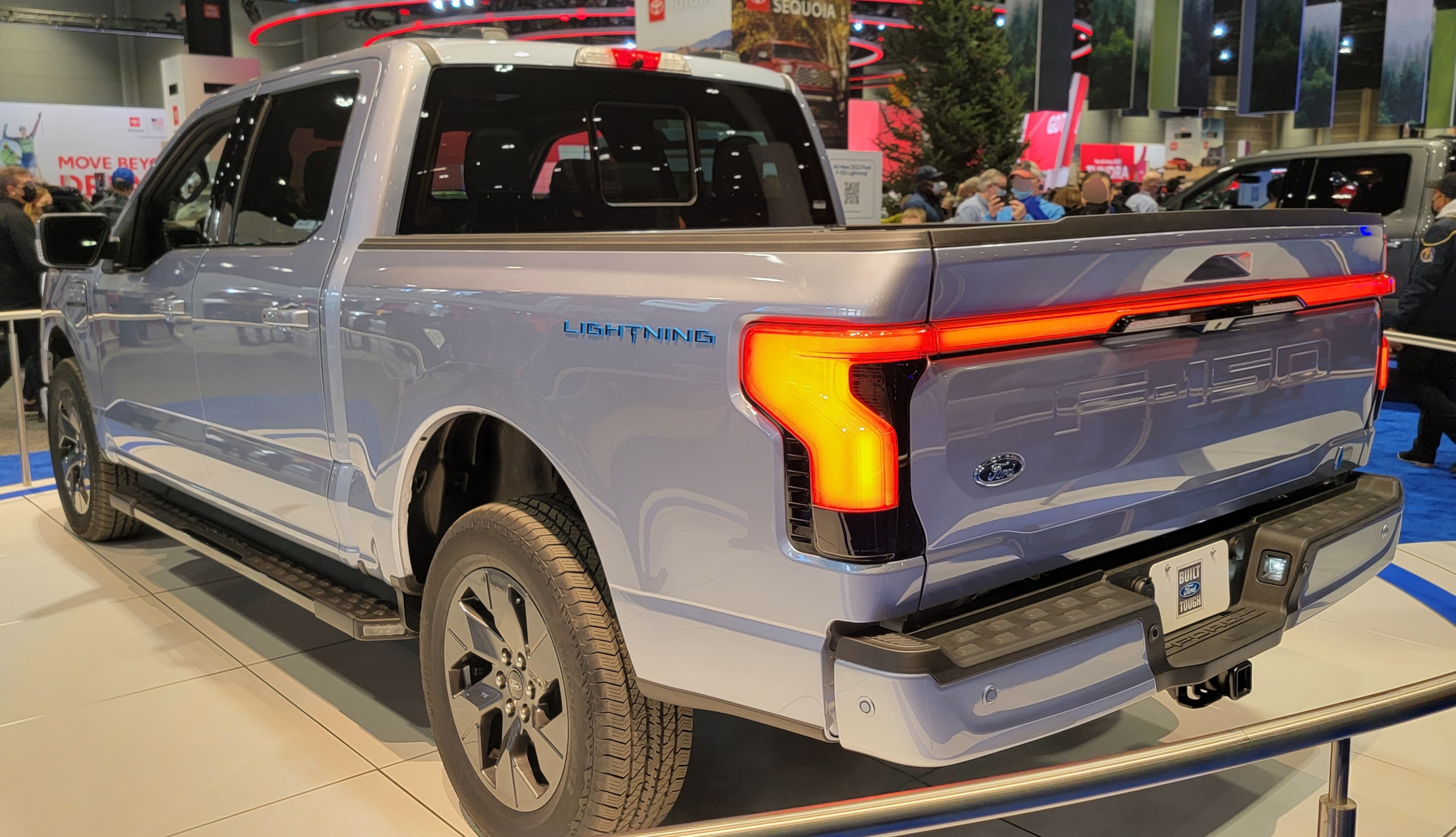
And that is the Ford F-150 Lightning.
Yeah.
Uh-huh.
Because I can see that because it's exactly what I
already have.
So it's like,
it's like here,
I already went from another F-150,
which is exactly like the new F-150 I have.
And this would be another F-150.
It'd be very,
very comfortable like size and like dimensions and kind of,
I'll be already kind of used to it, I guess,
so to speak.
You wouldn't have to like learn the dimensions and the size
and learn all the different knickknacks and stuff on the car.
Yeah.
Which kind of be a natural transition.
So that's number seven.
So moving on number six,
we got Honda Prelude,
probably the Pre-Log,
sorry, Pre-Log.
Oh yeah.
Well,
that's a hybrid.
I don't think it's,
I don't think it's,
I think this is just an EV list.
So this is just probably straight EV only,
like battery powered.
And that's it.
So that is number six.
It looks very similar to the,
to the Volkswagen,
like in the size,
like it's a four door car,
this little back section for like your groceries or whatever
pops up,
a standard car.
It kind of reminds me of like,
there was a time when Eve,
when SUVs kind of became like more like miniature SUVs.
Where they weren't like big and tall.
They were like smaller and like kind of like extended cars,
a little bit.
And this kind of reminds me of that, that model.
Yeah.
So,
so I hate it says here that it's a luxurious brother is the
accurate ZDX,
which would discontinued.
So,
so Honda and Acura,
of course the same company,
that kind of thing,
share a lot of parts,
that kind of deal.
So moving on to number five,
we're in your zone.
We're in the Hyundai.
Is it Iconox?
Iconox?
Oh, the Ioniq.
Ioniq.
Okay.
Yeah.
Which, which one did they choose?
Was it the Ioniq five?
Five.
Yes.
Five.
Yeah.
Now this is,
this is based on units sold so far this year.
So,
a fifth place is that,
it looks like the other one,
but this has a little more of a chisel design.
It's kind of like,
kind of like defenders and the sidelines live a little more
squared and chiseled off versus,
like some of the other ones.
So,
yeah.
It kind of reminds me like if,
if they want like more of a mellower version
of the Tesla truck in an SUV,
kind of the way they chiseled it.
Because it still does have a little bit of that retro-ish
kind of look,
like with the lights and things.
Yeah, I'm looking at it right now.
Like the square lights.
Uh-huh.
And they actually have an inversion to that car too,
if you know.
Oh,
that was not an inversion of the,
of the EV version, is it?
No.
So it's,
it's like the in-car,
the iron in-car.
So it probably just has like the brakes and the package
and the spoiler and the splitter and all that kind of stuff.
It doesn't have like any motor then.
It's just the EV.
So no motor.
Yeah.
Suspension upgrades for sure.
Breakup grades.
It has,
and not to derail this,
but it has like,
it has simulated gear shifting and,
and like engine sounds and things.
We could probably do a whole,
a whole podcast on just the quirks of that car.
But,
but yeah,
they,
EV or Hyundai kind of has like their electric EV line.
And then they have really the only car that's left from their
regular EV or their regular inline is the Elantra in,
but,
but yeah,
they,
they have two sided camps that they're playing with this like
performance EV side.
And then their gas powered,
like in cars.
But yeah,
that,
that car is pretty interesting.
I've never driven one and I really,
really want to,
but I've never driven one before.
Imagine they probably run like a bunch of the smaller
compact,
well,
not talking the inversion,
I'm talking like the regular electric version,
but they probably run very similar to a lot of the other
smaller compact electric cars.
So moving on to number four,
we have the Ford Mustang Mach-E,
which is kind of funny because
it's,
it's,
it's a Mustang.
It says it's a Mustang,
but it's a really Mustang.
Is it really?
You know,
it says it was,
and I remember when they were bringing this car out and,
and people were losing their minds,
they were losing their freaking minds thinking that the Mustang
itself was going to be gone.
And it's going to be turning to this like abomination,
like hybrid,
like this electric thing.
Just like it did with the stupid,
Mitsubishi Eclipse.
It became an SUV.
They got rid of the Eclipse.
So they thought the same thing.
That's like,
I think that's like the perfect,
like who did it better type scenario between like how
Mitsubishi did that with the Eclipse
and how Ford did that with the Mustang Mach-E.
Cause I feel like people love the Mach-E
and people that I did not think would love the Mach-E,
love the Mach-E.
And they,
and they're,
I guess to your point though,
I'm happy that we still have like a real Mustang.
Yeah.
Imagine,
they got rid of that thing.
Oh my gosh, you'd be late.
It would be a different story.
And I think that's maybe part of it is that,
yes, they used the Mustang name,
but they still gave,
they still kept us with like what we know as a Mustang.
You know,
Mitsubishi on the other hand was like,
yeah,
we could just like do this and change this all up.
And now it's an EV and like,
nobody was really about that at the end of the day.
Right.
So it's,
it's selling pretty good cause it's a fourth best seller
of all the EVs in the United States this year so far.
So top three,
here we go.
Number three,
back to Chevrolet,
the Chevrolet Equinox EV,
which looks like another like blazer.
It looks like to me.
Yeah.
Yeah.
I mean,
it looks like a blazer,
maybe it's bigger,
maybe it's smaller.
I can't tell nothing to compare it to,
but it looks like your typical like,
like SUV kind of,
but it looks more like a road SUV.
Cause there's like off-road SUVs,
like the Bronco or whatever.
And they got this thing,
which looks a little more like your standard,
like,
I don't want to get a midi van,
so I'll get this kind of EV.
Yeah.
That's what it is.
That's the one thing with it,
with Chevy's EVs early and just to correct,
I threw that Jim Farley plug in there
when we were talking about a Chevy EV
and just for folks to know,
I know that Jim Farley is forward
and Chevy's got something else going on.
But,
but yeah,
that's,
I think that's been Chevy's issue
that a lot of people have said is that they've,
they,
like the Blazer could have easily been a great competitor
to like a Bronco
or like some of that,
that more off-roady type.
Yeah, but they went more that like urban,
like street,
like soccer mom,
urban,
I guess kind of,
kind of flavor with,
with their,
with their SUVs.
And I think,
same thing with Hyundai too.
I don't think Hyundai,
Hyundai has a really like room will drive SUV,
do they?
No,
I'm waiting on that body on frame thing
we talked about last time around though.
Maybe, maybe someday, maybe,
maybe we'll get an engine in that thing,
another electric motor.
Yeah,
let's cross fingers on that.
Something big, something bigger.
I'll take a hybrid.
What's bigger than four cylinders?
All right, come on now.
Hey, don't brag on the four cylinders.
No, they're fine.
They're fine.
They're fine.
No, I know.
Her Explorer had the 2.3 liter eco-boost
in her Explorer.
Trust me.
I'm,
I'm literally on the same camp.
Like as much as I love four cylinders,
like I don't,
like even,
or what is it called,
SUVs need something bigger.
Like I'm on that camp.
Cause the Santa Fe has,
they have a hybrid version of that.
And it has a four cylinder and then it has a,
you know,
it has this EV component as well.
And,
and it has a DCT on top of that,
which is even pretty interesting.
But when you're driving it,
you just feel like this just doesn't vibe well.
Like you,
you want like at least a V six,
like you get kind of a,
you know,
characteristic SUV grown when you get like a six cylinder.
Obviously a V eight is like where it's at,
but I'm,
I'm, I'm with you on the sense where like I respect four cylinder
engines and what we've been able to do with them,
but there's just certain cars that they just don't fit well in
and SUVs to me.
And that's,
that's one of them where they just don't fit very well.
So on EVs here,
would you like to guess the top two?
What,
what company have you not mentioned so far?
Yeah.
Well,
I think there's an obvious,
an obvious elephant in the room.
Well,
I guess we did,
we did mention Tesla already.
Yes.
Tesla, they own number one and number two.
And number two.
Yeah.
Would you like to guess which one is in which spot?
I would actually.
So I'm guessing just with our economy and with who,
with, you know,
with people being so much into crossovers SUVs that the model
Y would be top and the three would be second.
That is correct.
Did you see this list?
I think you saw this list.
I didn't know.
I didn't try to cheat a little bit, but I'd like,
I'd got distracted.
But no, I, that was a pure guess.
That's what it is right there.
Model Y number one and model three number two.
And according to their numbers, the model Y
estimated has sold so far 232,000 units.
As of like, as this model year, essentially,
as they're saying, but I don't,
it seems like a lot though,
because I know the F 150 made a big deal when they,
they cracked out like 700,000
or a million or whatever units for a first single year.
So 232,000 units of a single car that's electric
by a single company that only makes electric.
Yeah.
Sounds impressive.
Yeah.
No, they're, you know, people,
those things fly like hotcakes like,
and I do actually like the look of the model wise
and the model, the model three as well.
Like I've seen a couple of people that done like
slight little changes.
You know, kept the stock wheels.
Like I do say that like the upper like trim wheels
are like the best option.
Like, you know, the base model wheels look really funny to me.
But I've seen them with like certain wraps and like,
you know, maybe like certain like little displays.
I've seen it with wheels and I've seen them with wings
and I've seen them with like splitters on the bottom.
I think that's going a little too far sometimes, but.
Fake exhaust tips on the back.
Oh no.
Just kidding.
But that was too much.
I think, I think we see the fake exhaust tips on the back
of a Tesla.
I think you're, I think it's a little,
I think you've got a little too far.
I draw the line somewhere, you know?
Yeah.
Yeah.
This has been so much fun, man.
I really appreciate you stopping by today
and talking all about EVs and go charge it up, man.
Speaking of the chargers lost today, but it's okay.
It's all good.
We're supposed to leave on a high note.
We left on a low note.
Well, until next time,
we will see you guys later.
About this episode
Chris and Courage dive into the world of electric vehicles, discussing their pros and cons from environmental impact to driving experience. They explore battery technology, range anxiety, and the challenges of charging infrastructure. The conversation highlights the fun of instant torque and quiet rides, but also the limitations on long trips. They review the top 10 best-selling EVs in the US for 2025, including Tesla’s dominance with the Model Y and Model 3, and notable entries like the Ford F-150 Lightning and Chevy Blazer EV. The episode blends personal stories, technical insights, and a candid take on EV culture.
Are EVs actually cool… or just overhyped appliances with torque?
In this episode of Cool Cars with Chris, I sit down with my good friend Courage (yes, that’s his real name — we get into it) to talk all things EV in 2025. From Tesla drag strip dominance to battery drama, we unpack the truth behind electric vehicles today.
We cover the real pros and cons of EV ownership, including:
🔋 Battery life and charging cycles
🏁 The insane speed of even the “boring” EVs
📉 Range anxiety and road trip nightmares
☀️ My dream for solar-powered hoods (Tesla, call me)
And yes — we count down the Top 10 Best-Selling EVs in the U.S. for 2025. Some will surprise you. Some will offend your car guy soul. Some… are Teslas (duh).
🚗 Topics We Hit:
EV vs gas car convenience in real life
What makes an EV fun (or not)
The F-150 Lightning's party trick that might backfire
Courage’s EV rental experience (spoiler: range anxiety is real)
The EV we’d actually buy (if we had to)
Whether you're team gas, team electric, or just here for the jokes — this episode has something for every kind of car fan. 👂Hit play and let’s get into it.