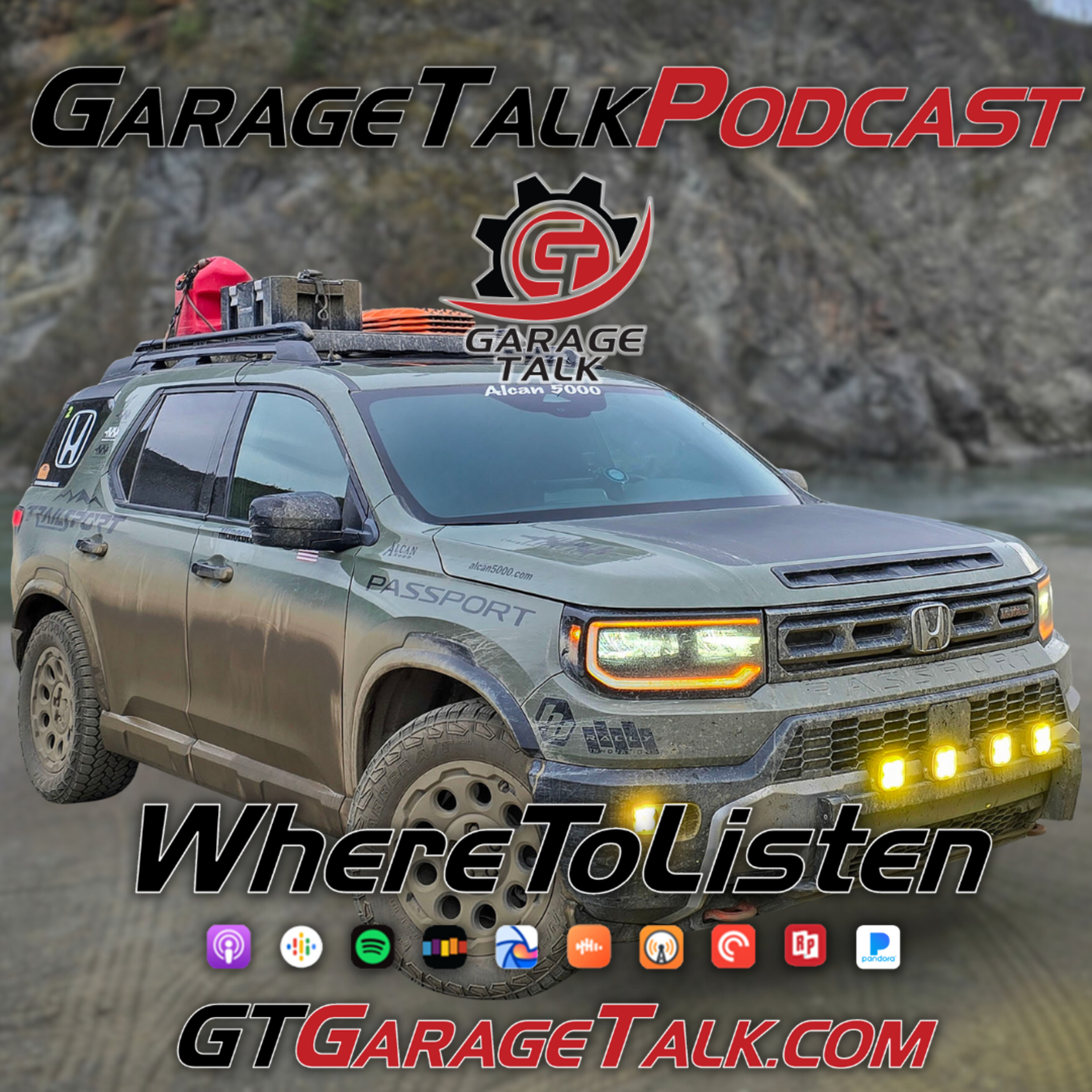
Andy and Mercedes-Lillienthal share their thrilling experiences from the Alcan 5000 Summer Rally, discussing the challenges and adventures of navigating 5,502 miles of rugged terrain in a 2026 Honda Passport Trail Sport. They delve into the unique aspects of Time Speed Distance (TSD) rallies, including the importance of vehicle performance, comfort, and strategy. With tales of unexpected obstacles like cattle and flooded roads, they reflect on the camaraderie among participants and the joy of rallying. The couple also hints at future rallies, including the upcoming Colorado Adventure Rally.
If you liked that episode and would like to hear more, head over to Patreon.com/GTGarageTalk and sign up on our 1LT Camaro tier and you will be granted access to TheAftermarket, extra content recorded after each new episode. You’ll get to hear just a little more about what Cory and guests are like when making an episode of GT: Garage Talk. If that’s not enough, browse through our many other tiers and see what perks come with each level.
"...today we are talking TSD, or Time Speed Distance Rally, the Alcan 5000 Rally to be specific..."
TSD is a type of car rally where drivers have to follow a route and keep a certain speed. It's like a timed race, but instead of just going fast, you have to be very accurate with your timing and distance.
TSD stands for Time Speed Distance rally, a type of motorsport where participants navigate a course based on time, speed, and distance calculations. Competitors must maintain a specific average speed over a set distance, making it a test of both driving skill and precision.
"...we are talking TSD, or Time Speed Distance Rally, the Alcan 5000 Rally to be specific..."
The Alcan 5000 Rally is a big car race that happens in Canada and Alaska. It's a long event where drivers face different types of roads and weather, making it a tough challenge for everyone involved.
The Alcan 5000 Rally is a long-distance rally that typically takes place in Canada and Alaska, featuring various terrains and challenging conditions. It is known for attracting both amateur and professional rally teams who compete over several days.
"...they were basically running bone stock, but I won't give it all..."
'Bone stock' means that a car is completely original and hasn't been changed or upgraded in any way. It's just like how it came from the factory.
'Bone stock' refers to a vehicle that is completely unmodified and retains all of its original factory specifications. This term is often used in motorsports to indicate that a car is being used in its original form without any aftermarket parts or enhancements.
"So I just had the Toyota Tacoma Trail Sport and my son and I took it off road."
The Toyota Tacoma Trail Sport is a special version of the Tacoma pickup truck that is built for off-road driving. It has features that help it handle rough terrain better than regular trucks.
The Toyota Tacoma Trail Sport is a variant of the Tacoma, designed for off-road performance with enhanced features like improved suspension and all-terrain tires.
"...my son and I took it off road. We have an hour to drive to get there and spend an hour off road."
Off-road means driving on surfaces that aren't paved, like dirt or gravel. Vehicles designed for off-road can handle these rough conditions better than regular cars.
Off-road refers to driving on unpaved surfaces, such as dirt, gravel, or rugged terrain, which requires vehicles to have specific features for better traction and stability.
"...I had met a few people who did this thing called road rally. And I didn't really know what road rally meant, but it sounded like it could be fun..."
A road rally is a fun driving event where people follow a set route and try to reach checkpoints at specific times. It's like a race, but with more focus on navigation and timing than just speed.
A road rally is a motorsport event where participants drive a specified route, often with checkpoints, and compete based on time, speed, and distance. It combines navigation skills with driving performance, making it a unique challenge for car enthusiasts.
"...he's like, Oh, there's a, there's a cascade sports car club, uh, which is here in Portland, and they have a time speed distance club..."
The Cascade Sports Car Club is a group in Portland, Oregon, that organizes fun car events like races and rallies. It's a place for car lovers to come together and enjoy driving.
The Cascade Sports Car Club is an automotive organization based in Portland, Oregon, that organizes various motorsport events, including road rallies and autocross competitions. They provide a platform for car enthusiasts to engage in motorsport activities.
"...So a road rally is, or a time speed distance rally is held on public roads..."
A time speed distance rally is a type of event where you have to figure out how fast to go and when to arrive at certain points. It's more about being accurate than being the fastest.
A time speed distance (TSD) rally is a specific format of road rally where participants must calculate their speed and timing to meet average speed requirements over a set distance. It emphasizes precision and navigation rather than outright speed.
"And somebody had a booth and they had a Subaru Forester with this big Alcan 5000 graphic on the side."
The Subaru Forester is a type of SUV that can drive well on different kinds of roads. It's great for people who like to go on adventures and road trips.
The Subaru Forester is a compact SUV known for its all-wheel drive capabilities and versatility, making it a popular choice for outdoor enthusiasts and those who enjoy road trips.
"...we took an outfit at our 1991 Mitsubishi Pajero. It's a turbo diesel, a little Japanese right hand drive SUV. Because why not?"
The Mitsubishi Pajero is a type of SUV known for being tough and good for off-road driving. The 1991 version has a diesel engine, which is efficient and powerful, especially in snowy or rough conditions.
The Mitsubishi Pajero is a mid-size SUV that was popular for its off-road capabilities and rugged design. The 1991 model features a turbo diesel engine, making it suitable for various terrains, including challenging winter conditions.
"...we were driving a 2026 Honda Passport Trail Sport. I love that vehicle. I have not gotten to spend as much time in it as I would like..."
The Honda Passport Trail Sport is a version of the Honda Passport that is built for off-road driving. It has special features that help it handle rough roads better.
The Honda Passport Trail Sport is a variant of the Honda Passport designed for off-road capability, featuring enhancements for rugged terrain and adventure driving.
"...mostly bone stock, there were some different OEM upgrades that we did to it, like the rock sliders,..."
OEM upgrades are parts made by the same company that built your car. They are meant to replace or improve the original parts without changing the car's design.
OEM upgrades refer to modifications or enhancements made to a vehicle using parts that are made by the original equipment manufacturer. These parts are designed to fit and function just like the original components that came with the vehicle.
"...there were some different OEM upgrades that we did to it, like the rock sliders,..."
Rock sliders are strong bars that you put on the sides of off-road vehicles to keep them safe from bumps and scrapes when driving on rocky paths.
Rock sliders are protective bars installed on the sides of off-road vehicles. They help protect the vehicle's body from damage when driving over rocks or rough terrain.
"...interior spare tire setup in the cargo area, LED cargo liftgate light, which is awesome,..."
An LED cargo liftgate light is a bright light that turns on when you open the back of your car, helping you see inside better, especially at night.
An LED cargo liftgate light is a lighting fixture installed in the cargo area of a vehicle, designed to illuminate the space when the liftgate is opened. LEDs are energy-efficient and provide bright light.
"...and a roof rack. So, but what we also did,..."
A roof rack is a frame on top of your car that lets you carry extra stuff, like bikes or luggage, that wouldn't fit inside the car.
A roof rack is a set of bars mounted on the roof of a vehicle, used to carry extra cargo such as luggage, bicycles, or sports equipment. It helps maximize storage space.
"...the only aftermarket parts is we partnered with rally innovations,..."
Rally Innovations is a company that makes special parts for cars, especially for those that go off-road or race. They help make cars better for tough driving conditions.
Rally Innovations is a company based in California that specializes in aftermarket parts and accessories for vehicles, particularly those used in off-road and rally racing. They provide enhancements that improve performance and functionality.
"...we also did another California-based company and manufacturer, Baja Designs Front Lights. So we drove a car, or no, we flew down,..."
Baja Designs makes special lights for cars that drive off-road, like in the desert or mountains. Their lights help you see better in dark or rough conditions.
Baja Designs is a company known for manufacturing high-quality off-road lighting products, such as LED light bars and auxiliary lights. They cater to off-road enthusiasts and motorsport applications.
"...you want in an LKN, 5,000 vehicles, summer or winter? And we came to three fundamental things you want, ground clearance, power and comfort."
Ground clearance is how high a car sits off the ground. Higher ground clearance helps a car drive over bumps and rough terrain without getting damaged.
Ground clearance refers to the distance between the ground and the lowest point of a vehicle's chassis. It is important for off-road capability and helps prevent damage to the vehicle when driving over obstacles.
"...but we only had about 90 horsepower because it was a diesel. So it was not fast. We didn't generally go fast on 65 miles an hour."
Horsepower is a way to measure how powerful an engine is. More horsepower usually means the car can go faster and accelerate better.
Horsepower is a unit of measurement for power, commonly used to describe the power output of engines. More horsepower generally means a vehicle can accelerate faster and reach higher speeds.
"...because it was a diesel. So it was not fast. We didn't generally go fast on 65 miles an hour."
Diesel is a type of fuel used in some cars and trucks. Diesel engines are usually more efficient and can provide more power for heavy vehicles compared to regular gasoline engines.
Diesel refers to a type of fuel used in diesel engines, which are known for their fuel efficiency and torque. Diesel engines typically provide better fuel economy than gasoline engines, especially for larger vehicles.
"...you want in an LKN, 5,000 vehicles, summer or winter? And we came to three fundamental things you want, ground clearance, power and comfort."
Comfort in a car means how nice it is to sit in and drive. This includes things like soft seats, a smooth ride, and good air conditioning.
Comfort in a vehicle refers to how pleasant and enjoyable it is to ride in, which includes factors like seating, ride quality, noise levels, and climate control. A comfortable vehicle enhances the driving experience, especially on long trips.
"And our friends, Jesse and Debbie Hires, and they had a Jeep Wrangler."
The Jeep Wrangler is a tough vehicle made for off-road driving. It's known for its ability to handle rough terrains and is a favorite for people who love outdoor activities.
The Jeep Wrangler is a compact and mid-size four-wheel-drive off-road vehicle known for its rugged design and off-road capabilities. It's popular among outdoor enthusiasts and is often used for off-roading adventures.
The Jeep Grand Cherokee is a larger SUV that's good for both off-road adventures and everyday driving. It has more space and features compared to the Wrangler.
The Jeep Grand Cherokee is a mid-size SUV that combines off-road capability with on-road comfort. It offers a range of powerful engines and advanced technology features, making it suitable for both adventure and daily driving.
"I mean, I can't speak highly enough of those tires. Those are actually the first time that I ran a General Grabbers."
General Grabbers are special tires made for driving on rough surfaces like dirt and mud. They help vehicles grip the ground better when off-roading.
General Grabbers are a line of tires designed for off-road and all-terrain use. They provide enhanced traction and durability, making them suitable for vehicles that frequently encounter rugged conditions.
"I mean, I can't speak highly enough of those tires. Those are actually the first time that I ran a General Grabbers, or General Tires of any kind."
General Tires is a company that makes tires for cars and trucks. They are known for making good quality tires that last a long time.
General Tires is a tire manufacturing company known for producing a wide range of tires for various vehicles, including passenger cars, trucks, and SUVs. They focus on performance and durability in their tire designs.
"...there were at least three or four people that had flat tires. So it was, it was pretty rough going."
A flat tire is when a tire doesn't have enough air in it, making it hard for the car to drive properly. It can happen if something sharp punctures the tire.
A flat tire occurs when a tire loses air pressure, often due to punctures, leaks, or damage. This can lead to poor handling and safety issues while driving.
"...if I had to be critical of anything I'd say, it could be, it could have used a little bit different shock tuning."
Shock tuning is about adjusting the parts of a car that help it absorb bumps and keep the ride smooth. It can make a car handle better on rough roads.
Shock tuning refers to the adjustment of the shock absorbers in a vehicle to optimize ride quality and handling characteristics. Proper tuning can enhance performance on different terrains, improving stability and comfort.
"We did just get out of a forerunner trail hunter for a test vehicle. And there was a small contemplation of us taking that with my parents down to San Antonio for a trip and back."
The Toyota 4Runner is a tough SUV that can handle rough roads and off-road adventures. It's a favorite for people who like to explore nature.
The Toyota 4Runner is a rugged SUV known for its off-road capabilities and durability. It's popular among outdoor enthusiasts for its reliability and performance in challenging terrains.
"...it's really neat to see Honda's evolution with the Trailsport vehicles, whether it's a Pilot 3-row or the Passport 2-row."
The Honda Pilot is a large SUV that can fit many passengers and has a lot of room for luggage. It's designed for families and people who need extra space.
The Honda Pilot is a midsize SUV known for its spacious interior and family-friendly features. It typically offers three rows of seating, making it a popular choice for larger families or those needing extra cargo space.
"...we're in a big truck, Ram 1500, for example, we're in a big truck,..."
The Ram 1500 is a large truck that many people use for work or towing things. It's known for being powerful and comfortable to drive.
The Ram 1500 is a full-size pickup truck known for its strong performance, towing capacity, and comfortable ride. It's popular among both work and leisure users.
Car
Honda That Honda
"...bladder wasn't, but I was. That's another problem that Honda can't really fix entirely. But I mean, you know, ..."
The Honda That's is a small car that was mainly sold in Japan and is known for being very practical and easy to drive around the city. It has a unique look and is designed to make the most out of its small size, which is great for people who need a car that can fit in tight spaces.
The Honda That's is a compact, versatile vehicle that was primarily sold in Japan, known for its unique design and practical features. It stands out for its space-efficient interior and is often discussed for its quirky styling and functionality, appealing to urban drivers and those needing a small car with ample storage. Although not widely available outside Japan, it represents Honda's innovative approach to city cars.
"...this new team out of Texas in a Maverick, Ford Maverick hybrid front-wheel drive on highway tires..."
The Ford Maverick hybrid is a small truck that uses both gas and electric power to save fuel. It's made for city driving but can also handle light truck tasks.
The Ford Maverick hybrid is a compact pickup truck that combines a gasoline engine with an electric motor for improved fuel efficiency. It is designed for urban use while still offering the versatility of a truck.
"...Europe and do the Baltic Sea Circle Rally with an ID buzz before they even came out in North America"
The Volkswagen ID. Buzz is a new electric van that looks a lot like the old VW buses from the 1960s. It's special because it's designed to be good for the environment and can carry a lot of people or stuff, making it a fun option for families or road trips.
The Volkswagen ID. Buzz is an all-electric van that pays homage to the classic VW Microbus while incorporating modern technology and sustainability. It represents Volkswagen's commitment to electric mobility and is significant for its retro design combined with contemporary electric vehicle performance. The ID. Buzz is often discussed for its potential to revolutionize family transport and its appeal to both nostalgic fans and eco-conscious consumers.
Select text to request an explanation
Hey, Gear Heads and welcome to GT Garage Talk, a discussion about all things automotive.
I am your host, Corey, and today we are talking TSD, or Time Speed Distance Rally, the Alcan
5000 Rally to be specific with longtime friends of the podcast, Andy and Mercedes-Lillienthal.
These especially, we've talked lots of rallies, her and I together, Andy and Mercedes together,
we've talked Alcan 5000, they've done a summer, they've done winter, and here again we will
be speaking about their summer 2025, even though it was in September, summer 2025 Alcan
5000 Rally in a very new, very fun, very capable vehicle that they worked with the
manufacturer to secure. They were basically running bone stock, but I won't give it all
away. We'll go ahead and jump into the conversation with Andy and Mercedes.
Well, great to have both of y'all back on the show. Andy, you and I have driven all
over Kentucky and southern Indiana since last we spoke virtually. How are y'all today?
Now, I'm doing great.
We're doing great. Well, I'm speaking for you now. I'm doing great as well.
Yeah, so lots to catch up on. I know we really want to focus specifically here on the Alcan
5000 Summer Rally that y'all wrapped up. We're creeping a little ways and we're already into
fall here, but I do want to touch base with y'all on that because you'll partnered with a new
manufacturer. And as I mentioned, it was summer versus the last time y'all ran it in the
winter. Correct?
Yeah, you got it. Yeah, this one. So the Alcan goes typically every two years, summer, then winter,
then summer, then winter. And then every several years, they do sort of a makeup one.
They throw another summer in there. So we had winter 2024. Now we had this makeup
summer 2025, even though it happened last month in September. And then they're going to do
another summer in 2026. And then they'll be back to winter in 28.
Oh, wow. So they're glinting for management doing back to back to back to back years right
one after one another. Not quite like the Olympics.
Yeah, not quite, but I mean, you know, it's a different rally. I mean, this year was 11 days.
We thought it was a standard 10 days, but it's 11 days. And we clocked, we did all of the
optional extreme control routes for fringe lunatics, as Andy likes to call us, to do everything.
Because of course, that's the perfect way to test the Honda that will get into what vehicle that
was in just a second. But that was 11 days. We clocked 5,502 miles. Oh my goodness.
Okay. And you think about a thousand of it was dirt and gravel.
Yeah. So very interesting. So I just had the Toyota Tacoma Trail Sport and my son and I
took it off road. We have an hour to drive to get there and spend an hour off road.
And as we're driving back, he's like, wouldn't it be cool if we drove home all off road?
And I was like, yes, some, but it would probably take it longer than an hour.
And then I had to do all the explanation to a seven year old of why driving off road takes
much longer than driving on the highways and such as that. But at what point?
Yale said, Yale did not know it was 11 days. At what point did you all find that out?
Showing up and surprise. Actually, it was writing one of our pre-rally articles.
And I looked on the website and I'm like, okay, this, this and looking at the mileage
and double checking things. And I went, oh crap, Andy, it's another day.
And I was like, wait, what? It's 11 days. And yeah.
And next year is going to be 11 days too. They already have the itinerary up and the
tentative route planned. Next year is going to be 11 days. And I think it'll be over
6,000 miles. And about 1,300 miles of that is dirt and gravel for next year.
We're going to be hitting above two Arctic circles and the Arctic Ocean in the summer.
So that'll be a mother of all rallies there. We'll be going up the Dempster
highway all the way to, uh, in New Vic in Northwest Territories. And then there'll be
an optional jaunt up to the Pacific Ocean. Talk to you. I'm sorry, the Arctic Ocean
thank you at the talk to talk. But then there's also, they have what they call extreme controls.
And the extreme controls are optional routes. You can get extra points for it to go for the
go farther award. And there will be an optional jaunt up the Dalton highway from Fairbanks up to
Coldfoot. Coldfoot is pretty much only exists because it's a fuel. And so you'll get extra
points if you go up there. That's also about the Arctic Circle, but that's next year. So
all right. So, uh, we just jumped right in feet first in this. I covered some in the intro,
but, uh, this is not your first rally. This is not your first Alcan 5000. This is not the first
time we've talked about the Alcan 5000, uh, between all of us, but just real quick,
if this is someone's first episode, getting to know y'all, getting to know the rally first,
quick introduction, husband and wife team, Mercedes and Andy Lillianthol.
How, where, why, why do we do this? Yeah, that's a valid question. Why do we do this? So,
I guess if you jump back to 2018, actually, if you go farther back than that, further back than
that, I had met a few people who did this thing called road rally. And I didn't really know
what road rally meant, but it sounded like it could be fun. And so, um, I met a, uh, another
automotive writer, the automotive journalist by the name of Jess, Jeff Zerschmead, who lives here in
Oregon. And, uh, I got on the, we got on the topic of it. And he's like, Oh yeah. He's like,
I do road rally, you should do one. And I'm like, well, how do I even go about that? And
he's like, Oh, there's a, there's a cascade sports car club, uh, which is here in Portland,
and they have a time speed distance club. And we're like, okay. So I looked into it. And in 2018,
Mercedes and I entered a, a road rally, a time speed distance road rally, and we had a really
good time. And we actually took like third place in the novice class. I, they were probably
only three people, but anyway, um, we might want to preface what a road rally is compared to a
race, like a go. Yeah. Yeah. Yeah. Yeah. Great. You might not know the difference.
Yeah. Great point. So a road rally is, or a time speed distance rally is held on public roads,
at or below speed limits. It usually includes a route book and that route book has things like
the directions and what you're supposed to do an average speed. And so as an average speed, so,
uh, you may go, it may say take a left on at 0.5 miles onto Smith street, change your average speed
to or cast CAST, change your average speed to 30 miles an hour. And then there'll be another one in,
you know, 1.2 miles turn left on Elm street and change average speed to 22 miles an hour
and so on and so forth. And so, um, we did this in 2018 and we had a really good time.
And then we did a couple more. And then I had heard of this thing called the Alcan 5000.
I was at Portland international raceway in like 2007 or eight or something like that.
And somebody had a booth and they had a Subaru Forester with this big Alcan 5000 graphic on the side
and they had a big map to like, I think it was laid on my hood. And I remember looking at this
going just my road trip, my love of road trip and driving. I'm like, wait a minute, this is a
group rally up to Alaska. I'm like, wow, I know what that's all about. And I, I didn't know all
that much about it. It just sound, well, I'd love to drive to Alaska someday. And again, like,
I was talking to Jeff about this and he's like, I've done it. He's like, it's incredible. You
should do it. And I was like, someday maybe. And anyway, Mercedes and I are our big fans of
not doing the maybe on someday. And so, um, so we like to actually try to make this stuff
happen. And we looked into it for 2020 and it was a winter rally and we took an outfit at our 1991
Mitsubishi Pajero. It's a turbo diesel, a little Japanese right hand drive SUV. Because why not?
And the Arctic in the winter. I can tell you many reasons why not? Yeah, exactly. There's probably
more reasons not than to do it. But we did it. And we did it well. It was an unbelievable
adventure. First of all, you're with a whole bunch of people. So the safety factor is higher than if
you were just do it by yourself. So there's that travel aspect. And then I don't, unless you've been
out there before, I'm not sure you can really prepare yourself for what, what it's like up there
in the wintertime in, in February in, you know, as far north as you can drive in North America.
In a blizzard. In a blizzard, 43 below zero without the wind chill, you know, snow piled up real high.
And it's, it's alien. I mean, the sky is different. The landscape looks like, like it looks like it's
like that perfect fondant frosting on a wedding cake. It's, it's perfect. And you see we saw
bison and wolves and caribou. And I mean, it's like, and then you're doing it with a bunch
of other fringe lunatic car, car people who, you know, all paid good money like we did to
drive horrible roads and try not to die of exposure. And, you know, when we were done,
they passed around a sheet and we didn't even contemplate it. We're like ever
signing up for 22. It's a summer one. And we got hooked. Yeah. Well, I mean, summer makes more
sense to this Texas boy who like, no, to all the cold. No. But yeah, the summer would be where I
would dip my toe in if I were to venture that way. So your first one was in the crazy year of our
Lord 2020. And then you've been hooked ever since you've done a couple summer rallies now,
this being your second. Correct. Yeah, we did 2022 with Subaru as well. And that really gave us
that opportunity to see what the difference was between what a summer one and a winter one is like.
I mean, I don't know, what do you think? What was your, what was your summer versus winter Alcan?
Pretty much the same as what you were saying. So, you know, you've got a lot more obviously
dirt and gravel in the summer. You've got a lot of mosquitoes. You know, they're not out
during the winter, thankfully. They exist that far north. Just by the boatload, I can say that much.
But yeah, you know, and I mean, the roads are rougher because there isn't grooved ice and snow
that is, you know, showcased during the winter. I mean, a lot of the roads that we're on are all
haul roads, so they have to keep them groomed for the ultimate traction for all the long
haul truckers. The potholes are filled in by the snow and the ice. Right. So there's a lot
more tires that get slashed in the summer. We've not, thankfully, knock on wood have had that
ever happen, as much as it did to you with Honda and their, their general bravers that they had
that they co-designed with, with General and Honda. But no, there have been many teams that
have slashed tires in the summer. Wow. So y'all have done this a couple years now,
a couple different situations, more than a couple years now, and in two different situations,
this time going back second summer rally, new vehicle, what were y'all driving?
Well, yeah, but we were driving a 2026 Honda Passport Trail Sport.
I love that vehicle. I have not gotten to spend as much time in it as I would like,
but we road tripped it down to Austin, very much kept it on the roads. I'm very curious,
your perspective now after practically probably the same amount of on-road miles for us as off-road
miles for y'all in this 5,000 mile rally, how did, what was your experience?
I think for me we had, I think we had a total of over 7,000 miles, about 7,600 miles or
something in total with this vehicle. So what we did, it was mostly bone stock,
there was some different OEM upgrades that we did to it, like the rock sliders,
interior spare tire cargo, or interior spare tire setup in the cargo area,
LED cargo liftgate light, which is awesome, and some other things.
Roof rack.
And in the roof rack, right, yes, that was a big essential piece too.
So, but what we also did, the only aftermarket parts is we partnered with rally innovations,
which is a California-based and California manufacturer outfitter of a really,
really cool prototype of front light bar mount. And then we also did another California-based
company and manufacturer, Baja Designs Front Lights. So we drove a car, or no, we flew down,
and then we finished up and we did social engineering.
This was in Anaheim, California.
In Anaheim, California, and then basically pick up the rally car when the install was
done, and then basically drove it all the way back up here, started, we live in Portland,
then started the rally in Seattle, and then took off.
And I saw a shakedown run.
Yeah, I was going to say, we basically drove all the way from LA to where?
All the way up to White Dorsen, Alaska, and I mean, we did like a huge amount of the United
States and huge amount of Canada, when you think about that trip, and that was
before we didn't start a rally.
Yeah. The three things I should, if you rewind back to 2020,
so this 91 mid-speech for JR, we were in, had lots of ground clearance.
We had great heated shill man seats from Germany, but we only had about 90 horsepower because it
was a diesel. So it was not fast. We didn't generally go fast on 65 miles an hour.
And as we're going, putting up these hills at like 50, 50 is probably an exaggeration.
It was probably like 30. And we kept thinking like, everyone would go past us.
And we kept thinking like, what are the traits you want in an LKN, 5,000 vehicles, summer or winter?
And we came to three fundamental things you want, ground clearance, power and comfort.
And that little pajaro had two of the three, but we've made sure that every time we've done
it since then, we have those three as minimum.
So the cross up, excuse me, the trail sport, the passport trail sport has had 8.3 inches of
ground clearance, had 285 horsepower and lots of space. In fact, I'd say this is,
it was probably the roomiest car we've taken on the LKN.
And I would have, I could probably used another inch of ground clearance,
but everything else and it was fine. But, but everything else was,
was spot on for what you'd want to do for the LKN.
Well, and there's some of the highways up there, especially in the summertime,
the frost heaves are really bad. And if people aren't are familiar with what
frost heaves are on a highway, up in Alaska and in Northern Canada,
they're big, huge rollers that, you know, because it, it thaws and it freezes,
thaws and it freezes, then it really creates these, these crazy rollers on highways.
So when you're doing highway speeds, I mean, we literally wasn't a boater.
I think we saw that. Oh my gosh, I forgot about that.
There were a couple of us rallies that were, you know, in tandem,
you always kind of drive with a buddy car during a, you know,
several hundred mile long transits. And then all of a sudden our guy came on.
He's like, that boat just, we saw that axle just break right now.
It was a break right now. So the road was, they had a sign that said
that there was broken pavement ahead because of one of these rollers.
And there was a guy, I don't remember what he was towing with,
but it was a pickup truck and he had a boat, like a, like a,
like a speed boat on the back.
We thought we were going to wear the boat as a huddle.
And so he passed us and he went in front of us and he did not slow down for this broken pavement.
And he hit it and the boat trailer left the ground.
Like we saw a sky underneath it and it came back down real hard.
And we were like, oh my goodness, like we all, we, we both audibly gasped.
And then they pulled over at the next pullout and we all went past,
there was about four of us in our little caravan.
And our friends, Jesse and Debbie Hires, and they had a Jeep Wrangler.
And I'm sorry, they had a Jeep Grand Cherokee.
And he got on the road, he's like, did you see his trailer?
I'm like, oh my gosh, like we audibly gasped. We couldn't believe it.
And so those kind of road conditions can be just really hard on a car.
But the Honda did pretty well. I mean, considering, you know,
I mean, I can't speak highly enough of those tires.
Those are actually the first time that I ran a General Grabbers,
or General Tires of any kind.
And they co-designed Honda and General together.
And so Honda was pretty particular, they were particularly interested
in how this vehicle would do over, you know, almost 6,000 miles and 11 days.
You know, that's a pretty good quick shake down.
So when we did the, when we ran up the, the Demster Highway,
we ran, I mean, there were at least three or four people that had flat tires.
So it was, it was pretty, pretty rough going.
So for them to, for, we had, we had zero flat tires the whole way.
So yeah, the tires were, were pretty good.
I will say, if I had to be critical of anything I'd say, it could be,
it could have used a little bit different shock tuning.
We'd go over some of these rollers and we'd hit the bump stops coming down.
You know, we're going, we're trying to go, you know,
where I think the speed limit was 20 kilometers an hour or 80 kilometers an hour.
So like, you know, between 60 and 50, something like that.
And, and so over the biggest bumps, you, you touch the bump stops,
but we are doing some pretty extreme stuff.
But overall, the, the Passport Trail Sport was a great vehicle
because it was big and comfortable and powerful.
Well, and I'm, you know, to add to Andy's sentiment about the roads,
what we did up there and what those roads are like up there are like,
none other compared to what we have typically down here.
So, you know, make no mistake, those roads up there will not just about anybody,
you know, off if you're, if you're not careful and those frosty especially.
So it doesn't matter if it's a Honda, if it's a Subaru,
if it's an Inyo's Grenadier or whatever it is,
you have to be really careful up there because those roads are no joke compared
to how bad they can be compared to the mainland here.
And actually the pavement can be worse than the dirt
because the potholes are sharp around the corner.
Yeah.
And so the section, right as you cross back into.
And the Denali.
Right as you cross back into Canada from Alaska, that road, which is the Alaska Highway,
there are sections that are bad and you cannot go highway.
You got to slow and go around these, you know, moon craters potholes.
Well, same with the Denali way.
Denali was the same way.
We did the Denali Highway up in Alaska and there were parts of that that were really bad.
Unbelievable scenery.
Absolutely one of the most beautiful places I've ever been in the world.
And the road, not so much, but the scenery definitely.
So you said there are three main criteria you'll have for rally vehicles,
ground clearance, power and comfort.
I had to ask you know, Honda did something very interesting this year
with the Passport and offering a trail sport elite.
So did you all have trail sport or trail sport elite for the comfort side of things up there?
We had, we had the elite.
So we had, we had everything but the full blackout package.
So ours was a ash green metallic, I believe it was an ash green.
And and we had the black HPD wheels on it.
And it was a good looking rig.
We had some stickers.
They sent us some Passport and Honda decals for the side and trail sport.
That's right.
So it was in full regalia.
It looked good.
Like I said, I'm in love with that vehicle.
I've been on built in price longer than I care to admit after they announced that one.
We did just get out of a forerunner trail hunter for a test vehicle.
And there was a small contemplation of us taking that with my parents down to
San Antonio for a trip and back.
But it is just so tight on the inside because well, it's body on frame.
It's a true rugged off-roader.
But Honda has done leaves and bounds for this new crossover unibody
Passport trail sport that again, I referenced.
We took it down to Alaska to Alaska.
We took it down to Austin with my mother-in-law with no problem for space.
Sounds like y'all had no problem for space either, even with the spare tire in the way back.
Yeah.
And you know, what was really cool about that spare tire setup is they have a false floor
and they have like a cubby area and that's where the tire sits in.
So it sits down and it straps in super tight.
It didn't come loose at all, which is amazing.
And the visibility was pretty good out of it even with having the car,
but out of the vehicle and the tire back there too.
So and as far as space, I kept on thinking, my gosh, what are we not bringing?
Because we had so much room.
I thought I was missing some cargo, but we had everything.
And I wanted to say is it's really neat to see Honda's evolution with the
Trailsport vehicles, whether it's a Pilot 3-row or the Passport 2-row.
I was fortunate to myself, Andy wasn't there obviously because he's a man,
but in 2023, I drove the 2020, well that iteration of the Passport Trailsport.
And that was for the Ramel rally.
Pilot.
I'm sorry, the Pilot.
Yes, exactly.
Sorry, too many P's, Passport and Pilot.
But in 2023, I drove the Pilot Trailsport, which is a 3-row.
We did take out that last row in that middle section because we had other gear and things like that.
But boy, that was so much fun to drive off-road.
And when I mean off-road, I'm not saying dirt highways or gravel highways
or roads that we did in the Alcama, completely different.
We were doing cliffside rocky areas.
We were doing silt.
We were doing sand dunes.
We were doing high speed desert whoops.
I mean, all sorts of stuff that you could think that the Ramel rally could throw at you.
And that vehicle was great.
And it was so much fun to left foot brake too.
And just, you know, dampen the suspension before some of those big areas.
And it just, it worked.
And it was so much fun to drive.
If you don't need low range, and a lot of people don't need low range, you know.
Honda, the Passport Trailsport, and like she was saying, the Pilot Trailsport too,
it has a lot going for it.
And the camera system is amazing.
Oh, yeah, trail.
That trail watch camera system is very good.
During Ramel, for instance, and I know that they have later iterations now,
especially with the 26 that we drove.
But in 2023, I mean, the hoods are tall.
And for me as a 5-4 woman, I just have a shorter torso.
And so even with the seat all the way up and driving,
it's hard for me to see over that hood.
But that camera system is just that good.
I never felt like, oh God, what's on the other side of that trail?
Can I go?
Can I not go?
And then the bird's eye with the 360 and see the fenders.
I mean, it was great.
It's good to park too, what Andy says.
Yeah, helped parking.
Yeah, I mean, we have a 13-degree incline driveway.
Whenever we don't have 360 cameras coming up that we're like,
is there a cat just waiting for us at the top of the hill?
Like what is up there that we don't know that is not paying attention to the fact that,
I mean, we're in a hybrid right now, so it could creep up there silently.
And we're like, what's waiting for us at the top of the hill?
Wow, 13 degrees.
It's almost like you could just perfectly test all the hill holds.
You don't even have to leave your driveway.
There have been some thoughts of doing some true off-road testing on that hill,
but I also don't really love filming in my neighborhood,
showing the whole world exactly where I live.
But the one thing that we always bring up is rear automatic braking.
You wouldn't believe how many systems get tripped up trying to back down our driveway
to the point where we're in a big truck, Ram 1500, for example, we're in a big truck,
but if you don't take it just right, it's going to slam on the brakes on you
when you least expect it.
It's like they do it two seconds too late.
Like you're already down on the road and then bam, the brakes.
Wow.
Luckily, most of those systems, we figured out how to easily turn them off.
The Ram's got a very easy button.
But yeah, for the Honda, like I said, we did not have the trail sport elite.
We had the passport trail sport, cloth seats, still very comfortable, very spacious.
We loved that thing.
To the point, again, I was on building price longer than I care to admit,
thinking, you know what, this very well could be our next vehicle.
It's plenty roomy, spacious, has all the features and amenities.
And even bumping up to that trail sport elite.
Again, I've been on building price was not as big of a price jump as I thought it would be,
especially when comparing it to its main rival.
And I've gotten a lot of flack online from the purists,
comparing it to the forerunner because they're like, oh no, that's a crossover
versus body on frame.
That's not the same.
I'm like 90% of consumers out there buying something that size
I feel are going to be way happier in the very spacious Honda with a V6, might I add,
versus a turbo hybrid four cylinder with a cramped interior.
Let's just call it a spade, spade.
So yeah, it's interesting.
You know, and I just think that, you know, it brings up a whole other topic of, you know,
how many people are actually using low range.
I know people like us who actually like to go out off-roading and all that stuff.
Yeah, we want low range in a four by four.
But like if I'm, you know, if I'm using this as a cross country vehicle,
if I'm using it to tow my boat, if I'm doing it, that kind of stuff,
and I don't need the low range, then why wouldn't I?
And, you know, the other thing too, like she and I talked a lot about was the useful space,
like she could get her big Nalgene water bottle in the door.
This Nalgene, the 32 ounce puppy that I'm holding right now,
I didn't get it in the doors, the center console everywhere.
And I have to drink a lot of water every day.
So I was so happy.
My bladder wasn't, but I was.
That's another problem that Honda can't really fix entirely.
But I mean, you know, and it also goes to the fact that some of the consumers
where they think they need low range and then they just never use it.
Right.
So.
And the four-wheel drive or all-wheel drive,
IVT 4M, whatever they call it there on the Honda is a very good system.
I have not been able to truly push it beyond what I feel 90 plus percent of consumers are
going to put it through.
And I had a lot of fun when we took ours on our road trip down to Austin.
We went to the Hot Wheels Legends tour that was in a Walmart parking lot,
but that poor Walmart parking lot was overrun and had a lot of like
mulch raised flowerbed sections that I'll go ahead and say a lot of people were parking in.
I was like, I've got a four-wheel drive vehicle.
And you wouldn't believe how many people were commenting.
Yeah, that's that's how you do it.
And there are a bunch of jeeps up there too.
So I was like, you know what, it is what it is.
And again, for what 90 plus percent of consumers are looking for,
you get all the benefit of all-wheel drive traction with added room from it being a
crossover unibody design vehicle that y'all said it multiple times.
It was an embarrassment of how much space y'all had where you were looking for things.
It sounds like to fill the space.
Yeah, I just, you know, as a navigator, I've got all the navigation supplies, right?
And then I typically we have, we've been fine-tuning every single year of what we need
and what we don't need.
And obviously the summer rally, you don't need, you know, Arctic boots, Arctic hats,
Arctic, you know, jackets.
So there is less cargo that way, but, you know, it was, it definitely was spacious enough.
And one thing that I can say across the board for all manufacturers,
actually except for Inyos, Inyos did a really great job of offering opportunities
is to ratchet down your gear, you know.
The Inyos, for instance, has an L-track system in the back.
They even, in the passenger and the driver's rear doors, they even have like a D-ring
that is rated enough that you can, and it's in the door, you know, that-
Strapped right down.
Biggest strapped stuff down.
And for us, especially if it's a Rebella rally or if it's Alcan or something like that,
we always strap our stuff down because, God forbid, if something happens,
then you don't have a fridge flying at you or your big, you know,
whatever tote bag or something.
They have tack inspection.
They check to make sure your stuff's ratchet.
Yeah.
And so in Honda's defense, they had areas where we were able to, because it was spacious enough,
we were able to use some of, like the kid's latch down points.
So we did that in the rear section.
And then in the rear cargo area, we used, you know, where the seats fold back,
we used hooks that we were able to put in there and the seats still held back
or still popped back and latcheted.
And the Moly panels, yeah.
And the Moly panels too were great.
We had the optional Moly panels in the sides as well.
Right.
And that held all of our emergency equipment.
So we had our first aid kit, that fire extinguisher,
and we had the triangle and stuff like that in there.
We even had a perfect space to carry a gallon jug of wiper fluid,
which we would have to top off because there's a lot of bugs.
So.
Yeah.
But I mean, I think from an OEM perspective, I think that Honda had a good opportunity
of us being able to ratchet things down, which I know is niche for us,
but, you know, other people will need it too.
Right.
And just all the little cubbies and compartments that they do have,
you mentioned the spare tire place, you mentioned having a gallon jug in the back,
just very thoughtful.
So space, non-issue, comfort, non-issue.
What about power?
How did the naturally aspirated V6 hold up for y'all?
Yeah, it was great.
There's two things that I always say you have to worry about getting around on the Alkan 5000.
One is slow RVs on the Alaska Highway.
And the other one is like log trucks and slow implements on side roads and dirt roads and stuff.
So I found that the car had a lot of good mid-range and it really screamed,
and not in a bad way, in the upper echelon.
It almost sounded like, I'm going to kind of geek out here,
it sounded like a Star Wars TIE fighter at full throttle.
It was just wow.
And I thought it had a great sound, especially under load.
And it was, yeah, it never was without enough power for us.
I thought it was great.
It is an interesting entry into the segment, both the pilot that you referenced earlier
and the passport and the ridgeline that rides on the old platform with it,
all still employ a naturally aspirated V6 when it seems like everybody else is going turbo four
or some variation thereof.
And for people, especially like my parents,
they will not even shop something with four cylinders.
They say it's got to have at least six.
And there are some trade-offs.
When you get forced induction, you don't have to worry about altitude as much,
causing an anemic power problem.
But it sounds like that V6 was more than enough for your gear, your stuff, and all the obstacles.
Yeah, we had zero problems.
I really don't think there was a single time where I was like, you know,
you step on it and you're like, come on, go, you know, it really did great.
Especially with the paddle shifters.
Yeah, so that's another thing.
During the competition aspect of the Alkan 5000,
we have to hold gear because you have to average a speed, right?
So if it says average 30 miles an hour, we might have to hold 30 miles an hour for many miles.
And in some vehicles that don't allow you to manually hold,
say, second or third gear, it's really difficult to maintain an average speed.
Because it's either wanting to upshift or downshift.
In 2022, we used the outback wilderness.
And a couple of times I forgot to put it in manual mode.
And it would do, you know, it would want to go faster, slower.
I'm like, oh, I had to put it in manual mode.
So the ability to do that is very helpful.
And I prefer the having the paddle shifter where I can just quickly, you know,
move my finger and change gear.
Because you have to go from like, sometimes you have to go from like 36 miles an hour
to 45 miles an hour.
Or you have to drop speed too.
And I can just downshift and stop the brake real quick and get down to 22 miles an hour.
I was just going to say 22 seems to be every vehicle's worst nemesis.
Because no vehicle wants to do 22 or 21.
Every once in a while, the rally will say you have to do 22 miles an hour,
but it's for like 3.92 miles.
And you're like, oh my God.
I could get out and run faster.
Yeah.
Yeah, yeah.
Well, and I mean, you always want to go faster at that slow speed too.
So it's hard to drive slower.
But the Honda did pretty good.
I mean, heck, we did pretty good with coming in our place that we did.
Yeah, we won our class, which was great.
And then we actually took second place overall in the rally, which was amazing.
Nice perfect segue too, because that was next up on my list.
Yeah.
With all that power, comfort, convenience, et cetera.
What are the results?
What came of it for y'all?
Yeah.
Yeah, we took second in the 2S class.
Cars or vehicles in the 2 class are going to be trucks and SUVs.
S stands for the seat of pants class, which is the non-calculator class,
non-computer class.
2S is generally the largest class too.
Right.
And so when Andy means calculator, he means like a rally app or rally computer.
Those are unlimited.
I can use like a simple calculator, like a kid's calculator in the SOP class.
And basically do long form math to figure out what are called incremental time differences.
So let's say if we've got one direction that says, you do 30 miles an hour,
and then at 0.29 turn left at whatever intersection.
I can figure out the long form math to get me to that exact next intersection
at whatever time it would be.
So I should just real quickly.
In the route books, they give you the mileage and they give you the directions
and you have to figure out the time.
Yep.
So, but SOP equals basically, you know, you can use a simple GPS odometer.
I think everybody in the Alcan class or like any of the classes can use that,
but a simple calculator, long form math.
And I use the kitchen timer.
I don't even use the stopwatch.
I use kitchen timer to keep me on track.
So big buttons.
You can hit quick and big easy buttons.
I try to stopwatch, but no matter if I hung it on my neck or I had it somewhere else,
I just could never grab it quick enough.
I'm like kitchen timer Velcro to my little math board and there I go.
And then when I need to clear it, I'm done.
So for what it's worth, the unlimited classes like we were referring to,
they can use calculators where you upload a spreadsheet.
Sorry.
It was my kid.
Oh, no worries.
So basically the unlimited classes, you can run a computer or an app that you upload a
spreadsheet of the segment length and speed.
And it'll be able to tell you if you should speed up or slow down while you're driving.
So our friends were running an app called Rabbit.
And it has a little gauge and the gauge has green on one side and red on the other side
and yellow in the middle.
And you're supposed to, or maybe it's yellow, it doesn't matter.
You're supposed to keep the needle in the middle.
And it'll tell you if you're running slower or fast.
So those are unlimited because it's telling you you're going too slow, dummy.
And it's during real time.
We're way beyond nor jacked this whole conversation.
But so basically unlimited teams have apps or computers or things like that.
So as you're driving in the competitive segments of it,
it will constantly say, okay, you're a little bit fast, a little bit slow,
a little bit fast, you're dead nuts on.
Whereas us in the SOP, either you need to figure that out manually, which I don't,
I can't do it that quickly to try to change something.
Or you hit the next direction that's in the root book at a specific time.
And then I start seeing one more close.
Okay, we're a little late, speed up or slow down.
You're forgetting one thing, Spidey sense.
There is a little bit of that where we'll have done these calculations
and something will have happened and we get off the calculation.
She and she'll just go, all right, this is all you.
She's like, just blind see the pants.
And so I'm, I'm trying to, you know, feel really feel it out.
Like, okay, I think I'm going too fast.
I'm going to slow down or I went down this hill and I noticed that the average speed is supposed to be 45.
And I'm pretty sure I was going 50.
So I got to slow down.
And so to average that 45, I've got to go down at 40, you know, whatever.
Well, and I think we might have missed one main part.
How do we get scored?
So there are invisible checkpoints that used to be manned at checkpoints,
where people were actually there with like stopwatches being like, okay, here's this car.
Here's this car.
Now it's all via a rick to app or another rally app that literally goes
7.2 seconds late or something.
And then you, then you can, yeah, yes.
Then you can kind of recalibrate and go, okay, you know, the Alcan rally,
if you're that amount late, if you go through a checkpoint and if it tells you
you're that amount late, for instance, you're still that amount late.
So either you take a time allowance to catch back up and reset yourself or you need to make it up.
But the thing is, is don't speed.
Don't be reckless.
Don't any of that type of stuff.
Again, this is a precision rally that's based, you know, on public roads with other traffic,
with cows, with sheep, with flooding roads, with everything in stereo,
because it all happened with us.
No, sheep didn't happen this year.
Cows, cows and flooding all at the same time,
which took us all for a loop because it was really deep mud too.
But that being said is, you know, there's a lot going with it.
And then figuring out, so it's all that game of chess.
One thing I want to also add to this is we probably made it sound really complicated
and it doesn't have to be complicated.
We're passionate about it and we're trying to win classes and all that stuff.
If you want to try a TSD rally, show up and just try to stay on the route.
Yeah.
Like don't worry about, you know, using incremental time calculations
and taking time allowances and all these things.
Just make sure you stay on the route and have a good time.
And you might find that this is actually a blast.
That's what happened to us.
Well, and there I want to give a huge shout out to all of the rookie teams
that were during the Alcan every year, but especially this year.
A lot of rookie teams this year.
Summer has vehicles and also like DualSpar adventure motos and stuff
like their motorcycles.
So there were so many new people and a lot of them are so passionate.
Whether they ask, you know, a couple of the other veteran people,
the teams that were there or us, for instance, I still call myself a veteran,
but, you know, we tried to say, hey, this is what you don't do
because we've learned just about failure through everything.
And so, you know, we try to help them or they help each other.
And it was so cool to see so many new passionate people give it a try and go,
oh, I'm starting to get the hang of it by a couple of days in there,
like, oh, what are we doing here?
This keeps happening. Oh, and then they learn.
And then it was so cool to see their energy was awesome.
Every now and then you run into these novice teams who've never done this before
and they just get it.
They get the math.
They get how to do it.
And here's us who run four Alcans and done a bunch of TSD rally.
And here's this new team out of Texas in a Maverick, Ford Maverick hybrid
front-wheel drive on highway tires.
And we're like, how are they so close to us?
They must have done this before.
And we're talking to them like, yeah, it was our first time.
I'm like, how are you so close the first time?
In their defense, I think that I can't remember if they were engineers or something.
The one guy was like a mathematician or something.
He's like, oh, well, I love math.
And I built up this whole grid, this whole everything.
And I'm just like, dude, I got a kitchen timer.
Yeah.
But I mean, so they were a perfect example.
Never underestimate a Texan.
Those guys were awesome, too, by the way.
They had, they took highway tires on this Maverick.
They ended up getting three flats.
And like, yeah, next time we're doing an all-terrain tires, but.
Well, I think they had two spares, two pairs by spares.
So, you know, but everybody learns.
So that's their learning point, right?
I mean, I learned the first, we went through two,
with the two Alcan 5000 rallies where we realized the way that we were running
through the checkpoints.
So our local awesome rally club that we have here in the Portland area
is called Cascades Sports Car Club.
And they're great, great.
Monty and Victoria do an awesome job and everybody that helps.
They run their rallies differently where is if you go through a checkpoint
an unmanaged checkpoint, it'll ding and say 2.9 seconds off, like late.
Okay.
So there's all their checkpoints reset to a perfect zero.
So basically what that means is let's say, oh my gosh,
you're off 22 seconds or something like that.
And then he goes through a checkpoint.
Boop, you're perfectly on time again.
You're back on time.
Yeah.
We thought all TSD rallies ran that way.
So we ran two Alcan 5000 rallies.
We ran one or two Norwester rallies, which is another local Pacific Northwest
rally that we have done a couple of years not knowing until we finally
talked to another veteran, Paul and Julia.
They're just awesome.
They overheard us and we started talking to them.
They're like, oh no, no, not everybody does it that way.
Most people don't reset to a perfect zero score.
And we were, I mean, I remember sitting there all of a sudden for the first time,
after two years of asking about this and people looking at us like we had two heads,
it all of a sudden was like, oh my gosh, that's the reason it's because it does.
That's because we're not getting better.
So basically these rallies that we do here, if you have one leg that has 10 checkpoints,
you're almost running 10 individual rally.
And in Alcan and most of the other ones, if you show up 10 seconds late to the first checkpoint,
you're now 10 seconds late to the second checkpoint, you have to make that up.
Or use what they call a time allowance, which we didn't get into.
But you have the ability to actually take time.
If you show up 10 seconds to a checkpoint late,
you can hit a button that says TA, time allowance, positive or negative,
and actually make up that time without having to go faster or slower.
Right. I mean, the biggest thing is safety first, right?
And this is not a race.
It's not the fastest.
It's not go fast to see how fast your vehicle can go.
You know, this is at or below public decision driving, right?
Yeah. And I mean, listening to all of your adventures combined because Mercedes,
I don't know how many rebel rallies you and I have talked about and gone over over the years
is that is like the most interesting point to me is one, you're on public roads with everybody else
and two, like you're obeying the speed limit.
And I mean, you're not a nuisance other than there may be more of y'all in any given section
of road than would typically be on a Tuesday afternoon, whatever the case may be.
But yeah, it just seems very interesting to me to where I'm like, what if I did one?
What if I create one?
So my mind is all over the place on that one.
But it does seem like a very interesting concept.
Yeah, definitely.
I mean, so, you know, you hit it on the head.
You should try one.
Everybody should try one because if you're a gear head, if you have an on-road vehicle,
an off-road centric vehicle or things like that, any vehicle just about
and any price range just about can do this.
And that's what's so cool.
And there's new ones that and they're not very expensive.
It's like the Cascade Sports Club.
Let's say if you do a half-day rally, 30 bucks.
I think it's 30 if you're not a member and then it's 20 bucks if you remember.
And it's like a half day of fun and then you get to have lunch together,
you know, all together at the end.
It's a great day and you spend, you know,
where else can you spend for a day of entertainment for 30 bucks?
And the rally masters generally like to find fun roads.
So they generally choose fantastic driving roads in super cool scenery.
And and certainly with Alkan, Alkan, there's not that many roads up there.
I mean, I mean, you're sort of limited to when you've got to get to,
you know, hotels each night.
There's only so many roads you can do, but the hotels have gotten a lot better.
But so if you like to drive, if you like to hang out with other motorsports people,
timespeed distance rally is fantastic.
Like, you know, I like to think that we're leading a road rally revival here.
And I think that, you know, it's something we're passionate about and just love to do.
Well, and speaking of revival, there are new rallies and new rally master or
seasoned rally masters that come in to play.
So for instance, Jim Crittiden, he's a long, long time rallyer,
part of SCCA, all that type of stuff, hugely notable in the TSD world.
He just created a new, it's called CAR.
It's the Colorado Adventure Rally.
And it's right now, it's a one time event, but it's in Colorado on beautiful paved,
high elevation paved roads and some off road dirt roads.
They're not same trails.
They're not braiding.
I was going to get to that.
Yep. Yep.
So but 100 miles of the 600 total miles are off pavement on more dirt and gravel.
But it's in July.
And so it's his first time doing this rally.
But how cool is that?
You know, you've got a beautiful, you know, in July and in Colorado.
It should be a great time.
Well, I just asked chat GPT and it gave me a 10 step guide as to how I could
create my own rally.
So stay tuned for the first inaugural GT garage talk rally through Texas.
I don't know where yet.
Oh boy.
And I think we're going to have to be a part of that.
With my handy chat, GPT guide telling me everything to do along the way.
What could go wrong?
Oh boy.
Oh boy.
So what is next for the Lillianthals?
It already sounds like y'all are signed up for the next Alcan.
But what's in between here and there?
Is that the next big thing?
Yeah, we've got the Colorado Adventure Rally in July that we're planning for.
And you just never know what else is going to come.
We did.
Yes, we did sign up for the 2026 Alcan rally.
We don't know what vehicle we're going to take yet.
We're in some preliminary talks with people about what we're doing.
But definitely the next big rally we have on tap is this Colorado Adventure Rally,
which we're really looking forward to.
And I'm sure we'll get in all sorts of trouble before then.
Yeah, I was going to say, I'm like, first things first, sleep.
I think after that, you never know.
I mean, we had a couple of really big long things this year,
the Alcan 5000 being one of them, Transamerica Trail being another
that took up a good chunk of our year.
And so we purposely just kept Q1, Q2-ish open of 2026,
just because we needed to reset, kind of revitalize and sleep a bit.
But you never know what'll happen.
I don't think a lot of people understand the amount of planning
that needs to go into some of these things.
If you're building up a car, that can take a while.
You know, we work with the manufacturers and aftermarket support,
that takes a while.
And then by the way, we are also writing and photographing all these things.
While competing, so there were a couple of things that, you know,
we had kind of wanted to take a big trip
in October for Mercedes birthday.
And we had come back from Transamerica Trail,
then we had a month and then we had the Alcan.
And it was like, we have too much to do.
And we're like, just maybe hang around Oregon for a while.
But it's all good though.
I mean, you know, we live life for the now.
And we don't want to put it off
because we want to do it while we physically mentally are able.
And not to be a Debbie Downer here, but it just,
it's so hugely important.
And for us, we love to travel.
We love to spend time with each other.
And what better way than to marry it all together with road rally
or off-road rally?
It's the travel.
Yeah, our travel is just get out there and do it.
Take the time.
And if you don't have the time,
try to make sure you have the time soon is all we can say.
And we, we're kind of an extreme example
where we both left our professional white collar careers.
And we did it at different times.
But now we're able to say, okay, if we want to plan
and take, you know, five weeks off for Europe
and do the Baltic Sea Circle Rally with an ID buzz
before they even came out in North America
several months earlier, let's go ahead and do it.
But we took a lot of planning to make that happen, but we did.
Yeah. And it's not just a vacation.
Like this isn't just a vacation.
It's not a vacation for us.
Like every, every now and then, maybe you run into this too
where you'll be taking photos at an event and someone's like,
Hey, can you send me those photos of my truck?
And they're like, well, these are actually for publications.
And he's like, I, I, I actually can't do that.
I, we're not going to sell you the most people understand
occasion to get people who are just like, whatever.
I'm like, well, like sorry, but we're photographers.
And, you know, we start giving this stuff away.
This is our job.
Well, yeah, I mean, we crammed a lot into these things.
You know, we're competing.
We're taking notes for articles.
We're taking photos for this stuff.
We're gathering content for our social media social.
It's a lot.
And, you know, one of the questions we get asked
by a lot of people is like, how do you do this
about killing each other over 10 days?
And, you know, especially the time to distance rallies.
I mean, yeah, we have some pressure cooker moments,
but, you know, we're generally, you know, riled up
about the situation.
And I, I'm not mad at her.
Because you accidentally got me stuck or accidentally
got you lost or something or were behind
or something happened.
Like, you know, cows butt jumps out and you're like,
ah, you know, if you have to like slow me down,
but then it throws your timing off for two checkpoints.
I mean, yeah.
There's, there's times too where like we,
we come into this section.
It was a very, very long stage at 65 miles.
And we come into this, come around the corner
and there's, I heard a cattle like spaced out in the road.
And then the road is partially flooded.
And I was, I had put the car in a manual mode
and we went in through some of these water holes that were.
It was really deep.
Foot and foot half deep.
And I got my foot to the floor thinking, come on,
come on.
And I realized I was in manual mode
and it was stuck in like third gear.
And, and, and she's going, go, go, go.
I'm like, I'm going.
He's trying, he's trying.
And so, so you get these little moments like that.
And then, but we've gotten really good about getting back
to where like focus, focus, focus, focus.
Like don't dwell on the cow in the, in the,
don't dwell on the cow standing in the water
that we went around.
You didn't realize there were multiple cattle
and they were grazing right in that whole flooded area
and my window was half down.
Oh no, yeah.
So I had Betsy's, you know what, on me
and my mat board and everything else.
And I went, whoosh, Shani, he was able to like,
you know, yeah, anyway.
And by the way, fun fact, cows did not care about the horn
on the call.
I know.
I'm like honk and I'm like yelling, go,
move out of the way.
They don't care.
They're just like staring at you.
Mind you, we're doing like 10 miles an hour or something.
Yeah.
I mean, we weren't like calling, calling through that area.
No, no.
But it's all, I mean, that's part of the narrative,
right?
And that's, that's part of the experience
that we just look back at.
And it might have been stressful at that point,
but it's like, yeah, remember that timeline.
Well, you hit on it a little bit.
This is not the end of the story for us talking here.
We've got a rare back-to-back couple of episodes
where we will be talking about the Transmarica Trail
See something that's not quite right? Our annotations are AI-generated and can sometimes miss the mark.
Click the flag icon on any annotation to suggest a correction.