If you're an HVAC technician and a call comes in, Granger knows that you need a partner that
helps you find the right product, fast and hassle-free.
And you know that when the first problem of the day is a clanking blower motor, there's
no need to break a sweat.
With Granger's easy-to-use website and product details, you're confident you'll soon have
everything humming right along.
Call 1-800-GRANGER, click Granger.com or just stop by.
Granger, for the ones who get it done.
Episode 1.
I'm Alex, and this is Chrome and Gasoline.
Where we celebrate the kind of machines that don't just move you around, they move into your
brain rent-free.
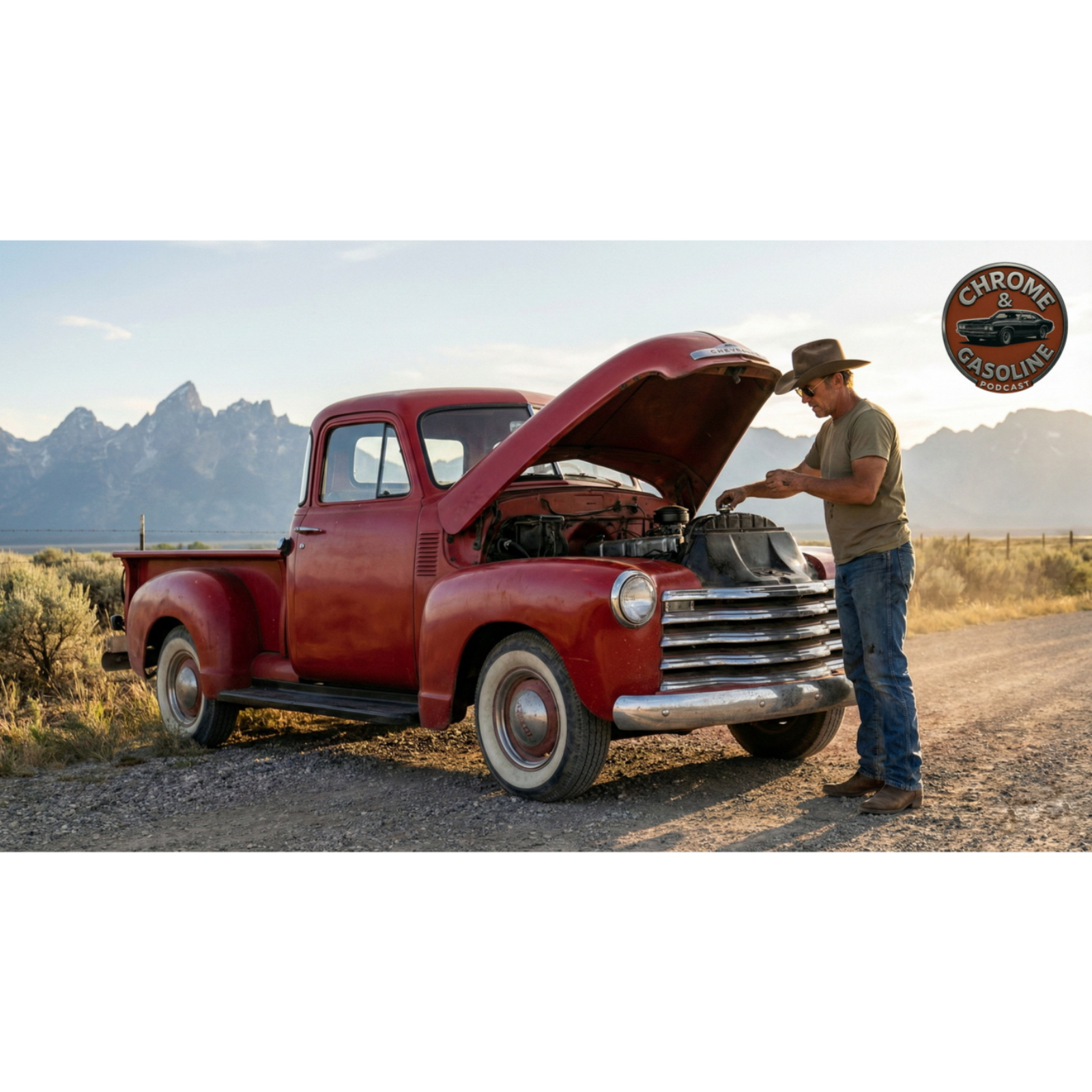
And if you've ever seen a 1948 to 1953 Chevrolet 3,100 pickup, you already know the problem.
You start by admiring a nice old truck, and five minutes later, you're fantasizing
about wearing work boots you don't own and hauling lumber you don't need.
The 3,100 lives in that sweet post-war moment when America was busy building everything,
homes, highways, businesses, and the myth that you can fix anything with optimism and a screwdriver.
Chevy's trucks from this era were designed to work for a living, not pose for social
media, which makes it even funnier that they became some of the most photogenic vehicles
on the planet.
You can park one behind a rusty garden shed, and it still looks like it's starring
in a feel-good movie about second chances.
Now Basoul, 3,100 isn't a secret code for make strangers wave at you.
It's basically Chevy's way of identifying the light-duty, half-ton-ish member of the
family.
Not the big bruiser that's hauling boulders, and not a car trying to cosplay as a truck.
This is the everyday workhorse, farm runs, hardware store life, small business deliveries,
and all the we're-just-gonna-move-one-couch promises that become three trips and a bruised
ego.
Underneath the charm, it's wonderfully straightforward, front engine, rear-wheel drive, and body-on-frame
construction.
That's the classic recipe for it'll survive your questionable decisions.
A separate frame means the structure takes abuse, and the body can be repaired, swapped,
or patched with the kind of creativity that makes professional restorers stare into the
distance.
The suspension is old-school truck logic, built to carry weight and shrug-off punishment.
With ride quality that politely reminds you, you're driving a truck, not floating on a
cloud.
Here's where the recurring argument begins.
Truck math versus car math.
Car math says, if it leaks anything, it's totaled.
Truck math says, if it leaks, it has fluid.
That means it's healthy.
Car math says, my paint must be perfect.
Truck math says, my paint has character, also it's mostly holding the rust in place, which
is teamwork.
And that's the 3,100s magic.
You can talk specs all day, but this truck's real superpower is vibe, honest, friendly,
and just rugged enough to make you feel capable while you're doing something deeply unskilled.
Like trying to remember which way a screwdriver goes when you're upside down under a dash.
So keep that image.
A simple, stout pickup from 1948 to 1953 that started life as a tool and ended up as a symbol.
Because once you understand why the 3,100 caught on, you start seeing it everywhere.
On back roads, at shows, in garages, and in the corner of your mind whispering, you
could totally restore one.
It's just bolts.
Road 2.
I'm Alex on chrome and gasoline, and I need to say something out loud.
The 1948 to 1953 Chevrolet 3,100 has no business being this charming.
It's a work truck.
It was born in an era when aerodynamics meant the wind will figure it out.
But look at one and tell me it doesn't have a friendly face.
Like it would help you move and then refuse to accept payment, because that's what
neighbors do.
A lot of that charm is the shape.
The hood and fenders have that rounded, confident simplicity.
No angry angles, no influencer jawline.
The cab sits upright, like it's ready for duty, and the bed looks like it actually
expects to carry something heavier than a yoga mat.
It's proportions with purpose, which is why photos of these trucks always feel
honest.
Even when the paint is sunburned and the chrome is tired, the design still
reads as sturdy and approachable.
Inside, the experience is equally straightforward.
Big steering wheel, big glass, simple controls.
It was built for boots, not for fancy shoes.
The cabin is more durable handshake than luxury hug.
And I love that, because it tells you exactly what the deal is.
You're here to drive, work, and maybe sit on a bench seat that has
approximately two settings, firm and firmer.
And usability matters, because the 3,100 hits a practical sweet spot.
It's not a modern, full-size land yacht that needs its own zip code.
It's manageable, approachable, and still genuinely useful.
You can load stuff, you can reach the bed, you can use the tailgate
without needing a three-step ladder and a quarterly gym membership.
It makes you feel productive, even if what you're actually doing
is transporting one sad box from the garage to the shed.
Truck math versus car math returns.
Car math says, I will not put a scratch in the bed.
Truck math says, the bed is a scratch collector.
That's its full-time job.
Car math says, I'm worried about my resale value.
Truck math says, my resale value is measured in how many bags
of mulch it can handle before I stop complaining.
Car math sees sun-faded paint and panics.
Truck math sees sun-faded paint and calls it natural two-tone.
The funniest part is how the 3,100 ended up becoming a cultural mascot.
It shows up at meets with muscle cars and somehow isn't intimidated.
It's not trying to be fast.
It's trying to be useful and lovable, and it nails both.
You'll see them restored to perfection,
and you'll see them wearing patina like a badge of honor
and both versions feel right because the core idea is the same.
Simple, functional truck design that still looks good doing its job.
And when you drive one, even slowly, people react.
A modern car gets ignored unless it's shouting.
A classic 3,100 gets smiles without even trying.
It doesn't demand attention.
It earns it.
That's the kind of charisma you can't order from a catalog.
So if you've ever wondered why these trucks became icons,
it's not just nostalgia.
It's design that communicates purpose and a vibe that says, yeah,
I've worked.
Yeah, I've lived.
And yes, I can still haul your questionable weekend projects.
Episode 3.
I'm Alex, and Chromen Gasoline is
about the romance of machines, but also the reality of them.
Like the reality that a 1948 to 1953 Chevrolet 3,100
will teach you patience in ways modern cars have forgotten.
Modern vehicles are like smartphones.
Push button.
It works.
You never think about it.
The 3,100 is more like a cast iron skillet.
It rewards you, but it expects you to participate.
Most of these trucks lived their lives
with Chevy's trusty inline six up front.
The old stove bolt family that earned a reputation
for being simple, durable, and more
interested in torque and reliability than bragging rights.
Nobody in 1950 was standing around a 3,100 saying, bro,
what's your top speed?
They were saying, can it start on a cold morning
and pull a load without complaining?
And in that world, a willing low-revving six
was the hero.
The vibe is mechanical in the best way.
Carburetion, for example, isn't magic.
It's a polite negotiation.
You're basically giving the engine the right mix of air and fuel
and hoping it agrees with your plan.
In cold weather, there's often a little extra ritual involved,
and the truck will let you know if your ritual is sloppy.
If you grew up with modern fuel injection,
the first time you deal with an older setup,
you'll feel like you've been promoted to assistant engine
whisperer with no training.
Behind the engine, you're generally
dealing with a straightforward manual transmission,
often a three-speed that feels like it
was designed by someone who really wanted you
to commit to each gear change.
The shifter might live on the column in many of these trucks,
which is a whole vibe.
You're driving a pickup and simultaneously performing
a small piece of mid-century choreography.
And the gearing is geared toward work,
getting moving with a load, not sprinting
to impress a sports car.
Truck math loves that.
The truck feels happiest when it's being used, not chased.
Steering, suspension, and brakes
are the part that makes new drivers do a double take.
The suspension is leaf spring truck stuff,
and it communicates the road to you
like it's reading you a list of grievances.
The steering can feel heavier and slower
than what people expect, especially at low speeds.
Brakes are typically old-school drums,
which means you drive with a little more planning,
not fear, planning.
You leave space, you think ahead,
and honestly, that's not a bad life lesson.
There's also the electrical personality.
Many of these trucks were built
when six-volt systems were common,
and even if yours has been updated,
the whole truck still carries that simple electricity vibe.
Lights, wiring, switches, less complicated,
but also less forgiven of crusty connections.
The truck doesn't hide problems
behind a dashboard message.
It just gives you symptoms and dares you to become handy.
Truck math versus car math, round three.
Car math says, I want zero vibration.
Truck math says, if it doesn't vibrate at least a little,
how do I know it's alive?
Car math says, I need a cup holder.
Truck math says, your cup holder is the bench seat.
Grip strength is part of the ownership experience.
And here's the punchline.
The 3,100 isn't slow in spirit.
It's unhurried on purpose.
It feels like it's doing what it was built to do,
and it invites you to slow down and drive it with respect.
You're not just operating transportation.
You're collaborating with a piece of history
that still wants to earn its keep.
Episode four.
I'm Alex, and Chrome and gasoline
is where we admit the truth,
owning a 1948 to 1953 Chevrolet.
3,100 pickup is less like buying a vehicle
and more like adopting a very charming,
occasionally stubborn friend
who communicates mainly through leaks and squeaks.
If you're looking at one of these trucks,
restoration reality starts with the basics,
metal, wiring, and everything time touches.
Many survivors have lived real lives,
farm duty, winter roads, decades of sitting,
decades of being almost fixed.
Rust is common in the places you'd expect
on an old working vehicle
and worn weather stripping and tired seals
can make the truck feel like it has
a drafty old house personality.
The wiring can be simple, but simple doesn't mean healthy.
Simple also means one bad connection
can make the whole truck act like it's haunted.
Then you get to the philosophical debate,
stock versus upgraded.
Some folks want the truck
as close to original spirit as possible,
period correct vibe, mechanical authenticity,
and a driving experience that feels like a handshake
from 1950.
Others want the 3,100 to behave more like a modern daily,
better stopping confidence, brighter lights,
maybe a more predictable electrical system.
Both camps have a point.
The only real rule is to do it thoughtfully
with respect for what the truck is.
Truck math versus car math thrives here.
Car math says patina is neglect.
Truck math says patina is history.
Car math says that dent ruins the line.
Truck math says that dent is a receipt
from the truck's working career.
Car math wants flawless.
Truck math wants honest, and I'll admit,
I'm guilty of liking honest,
especially on a truck that was never supposed
to be a jewelry box.
Here's a practical note without getting preachy.
Older trucks drive differently,
and the best upgrade isn't always a shiny part.
It's maintenance and setup, fresh tires,
healthy brakes, tight steering components,
good lights and confidence in the fuel system
can make the truck feel like a partner
instead of a project.
The goal is not to erase the old truck character.
It's to make the character less likely
to ruin your afternoon,
and the community is a huge part
of why these trucks are still around.
The 3,100 has a big fan base,
owners who trade knowledge, share solutions,
and celebrate the small victories,
like getting the door to close without a shoulder check.
These are the people who will calmly explain a fix
that sounds impossible,
and then cheer when you report back
that the turn signals
finally quit doing interpretive dance,
which brings us to project timeline comedy.
Because the 3,100 is the undefeated champion of the phrase,
it'll be a quick weekend job.
You'll start with,
I'm just going to clean the fuel system,
then you find something,
then you find something hiding behind that thing,
then you're ordering parts at 2 a.m.
while telling yourself you're being responsible,
but here's why it's worth it.
When a 3,100 is dialed in, even modestly,
it gives you something modern cars rarely do.
Connection, you can feel it, hear it, understand it.
And when you fix something,
you don't feel like you updated software.
You feel like you brought an old tool back to work.
Episode five, I'm Alex.
And on Chrome and gasoline,
I talk about cars like their characters,
but every once in a while,
one actually behaves like a character.
My favorite memory involving a 1948 to 1953,
Chevrolet 3,100 pickup
starts the way most questionable adventures start
with someone saying it ran when we parked it,
which is the mechanical equivalent of
I was healthy right before I got sick.
I was visiting a small local shop,
one of those places where the floor
has seen more stories than a library.
In the back lot, tucked near a stack of old wheels
and a couple of innocent weeds living their best life
was a 3,100, faded paint, a little surface rust,
and a stance that said,
I used to work for a living
and I'm not interested in your excuses.
The door handle was cool to the touch,
the kind of cold metal that instantly time travels your hand.
Inside, the cab smelled like old vinyl, dust,
and a faint hint of old gasoline
that somehow smelled like a memory.
The owner tossed me the keys like this was no big deal.
Truck math.
In truck math, keys are not sacred objects.
They are suggestions.
Car math would have put the keys in a velvet pouch,
apologize to them, and offered them bottled water.
We popped the hood and there it was.
Simple, honest machinery, no plastic covers, no mystery,
just an engine that looked like it believed in hard work
and didn't care if you felt seen.
We checked the basics the way you do with old equipment,
fuel, spark, and the overall vibe.
Yes, I said vibe, don't laugh.
Every old truck has a mood
and this one's mood was prove you deserve me.
The first attempt was educational.
The starter gave a reluctant churn
like it was waking up from a nap it didn't agree to.
We tried again after a quick tweak and a little more patience.
The engine caught, stumbled, then settled into an idle
that sounded like a steady conversation, not loud,
not flashy, just confident.
The kind of sound that makes you smile
because it feels like you didn't just start something,
you negotiated with it, then I drove it,
not fast, not far, just enough to understand it.
The steering had heft, the brakes wanted planning
and the whole truck moved with the calm certainty
of a tool designed to do a job, not when in argument.
Over bumps, the suspension reminded me
that comfort is a modern luxury
and my spine was clearly not consulted in 1950.
I remember rolling through the lot
and catching my reflection in the windshield glass
and there I was looking like a guy
who suddenly had opinions about fence posts
and driveway gravel, that's the 3,100 effect.
You don't drive it, you become a version of yourself
that owns a pair of gloves and says things like
we can probably save that.
On the way back, the owner asked, so what do you think?
Car math would have brought up paint, perfection,
and resale, truck math took over my mouth
and I said, it feels honest,
which is a ridiculous thing to say about a machine
right up until you know exactly what it means
and I'll be honest, for a week afterward
I kept replaying it in my head,
doing project timeline comedy math
telling myself I could quickly get one running
as if I didn't just watch a simple truck
turn a five minute task into a full afternoon
of charming negotiations.
That moment stuck with me
because it wasn't about show trophies
or flawless restoration, it was about connection,
about a truck built for work
that still feels ready to contribute
as long as you meet it halfway.
And every time I see a 3,100 now,
I don't just see a classic pickup.
I see a reminder that simple things cared for
can outlast the noise
and still do what they were made to do.
If you're the purchasing manager at a manufacturing plant
you know having a trusted partner
makes all the difference.
That's why hands down you count on Granger
for auto reordering.
With on time restocks your team
will have the cut resistant gloves
they need at the start of their shift.
And you can end your day knowing
they've got safety well in hand.
Call 1-800-GRANGER, click Granger.com
or just stop by Granger for the ones who get it done.
About this episode
Exploring the charm and practicality of the 1948-1953 Chevrolet 3100 pickup, this episode delves into its design, functionality, and cultural significance. The host discusses the truck's straightforward mechanics, emphasizing the contrast between 'truck math' and 'car math.' Listeners will appreciate anecdotes about the truck's character, its role as a workhorse, and the community surrounding its restoration. The episode highlights the 3100's ability to evoke nostalgia and connection, making it a beloved icon in the automotive world.