If you're the purchasing manager at a manufacturing plant, you know having a trusted partner makes
all the difference.
That's why hands down you count on Granger for auto-reordering.
With on-time restocks, your team will have the cut-resistant gloves they need at the
start of their shift.
And you can end your day knowing they've got safety well in hand.
Call 1-800-GRANGER, click Granger.com or just stop by.
Granger for the ones who get it done.
Episode 1, The Hornet Lands.
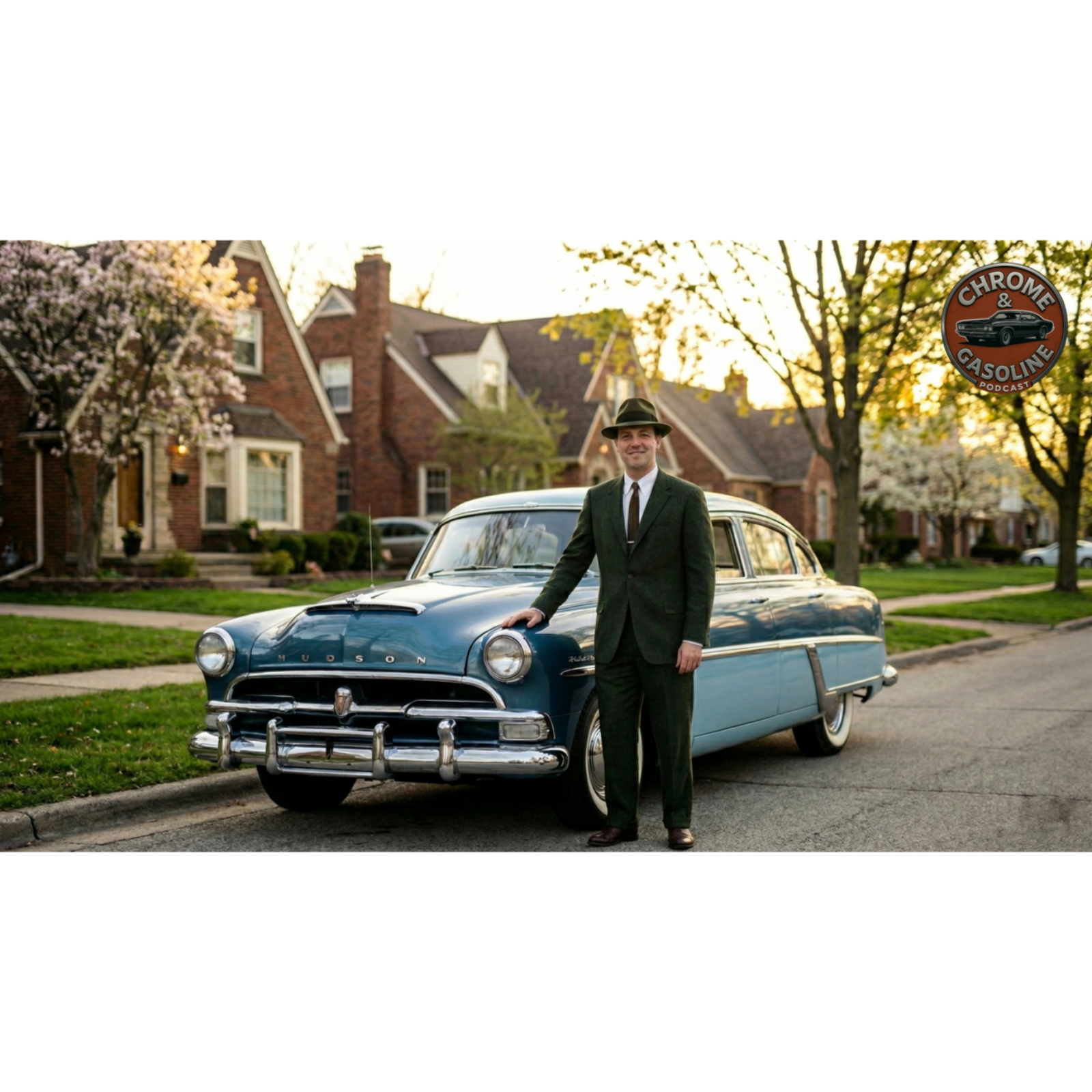
If cars had a posture, the 1951 Hudson Hornet would be standing in the corner with its shoulders
back, refusing to make small talk.
Not flashy bad, not loud bad.
More like, I don't need your approval, I brought my own.
The Hornet appears in the early 50s, when America is obsessed with size, shine, and
the idea that bigger chrome equals a better personality.
And Hudson decides to build a car that doesn't just look confident, it's shaped like confidence.
Here's the thing, the Hornet's whole vibe starts with something Hudson called step-down
design.
That name sounds like a polite way to end an argument.
Sir, please step down from the podium.
But what it really means is the floor pan sat lower between the frame rails, so when
you got in, you didn't climb up, you stepped down into the car, and the result was a lower
stance and a lower center of gravity, translation, it sat like it meant business, and it handled
like it had read tomorrow's newspaper.
Imagine a 1951 salesperson trying to sell you on this.
Madam, observe, you step down into luxury, and you're like, do I step down into
luxury, or am I stepping down into a complicated relationship?
Because once you step down into a Hornet, you're not escaping casually.
You're married to a machine that feels like it has opinions about road manners.
Hudson wasn't the biggest automaker in the room.
They didn't have the biggest everything, so they got clever.
The Hornet looks long and low, and it has that almost smug planted stance.
Some cars sit high like they're afraid of potholes.
The Hornet sits low, as if it knows potholes or fear itself made physical, and fear is for
other people.
And if your picture in the early 50s, this is the era when driving felt like an event.
People dressed to go places, gas stations had attendance, maps were paper, and if you
wanted to feel like the main character, you didn't need a soundtrack, you required
a hood that looked like it could host a picnic.
Hudson's Hornet came in with a reputation.
This was a premium-ish car, a serious adult car, but the kind of adult who can unexpectedly
win an arm wrestling contest.
It wasn't trying to be a hot rod, it just happened to have the bones of one, like
a librarian who happens to bench press.
And the name?
Hornet.
Perfect.
Not a lion.
Not an eagle.
A Hornet.
Small, angry physics.
You don't negotiate with a Hornet.
You don't reason with a Hornet.
You just suddenly respect its personal space.
The other part of this story is that the Hudson people were proud.
They were the type to say, we don't need the biggest engine to go fast.
Which is the automotive equivalent of, I don't need to shout to win this argument.
The Hornet's secret sauce wasn't just power, it was how it sat, how it moved,
and how it made other cars feel a little top-heavy and insecure, and if you've
never been around a Hornet in person, it has a presence.
It's not delicate.
It's not fussy.
It's not begging you to like it.
It's the kind of car that looks like it would pull into a diner parking lot and immediately
start a rumor.
So that's the setup.
Early 50s America, chrome everywhere, and Hudson rolls in with this low-slung heavyweight
casually inventing a new kind of confidence.
Step down, they said, like it's a suggestion, like it's optional.
You step down, and suddenly you're in a car that feels like it's already halfway through
a victory lap.
To speak.
Episode two, straight six, serious attitude.
Let's talk about the Hudson-Hornet's engine situation, because it's one of the funniest
flexes in car history.
While the rest of the neighborhood is bragging about V8s like they're handing out business
cards at a party, the Hornet shows up with a big straight six and the calm expression
of a guy who knows exactly how this ends.
A straight six doesn't have the flashy reputation.
It's not the engine that screams, it's the engine that clears its throat, and suddenly
the room gets quiet, smooth, strong, and more about real-world shove than dramatic noise.
And in the Hornet, that straight six was paired with a car that sat low and steady, so the
whole package felt like it could put its weight down and go.
Now, you'll hear people talk about performance options, like dual-carb setups that HUD
stands in marketed with a kind of proud raccoon energy.
Look, two carburetors.
In the early 50s, that was basically saying, this car has two espresso machines.
It is not here to nap.
The exact numbers are less important than the effect.
Hornet owners would tell you it pulled hard, it felt quick, and it didn't act like
it was trying.
It wasn't the fast that needed to announce itself.
It was the kind of fast that's already gone while you're still finishing the sentence.
Is that thing?
And that's the Hornet's personality in a nutshell.
Not frantic, not peaky.
Just confident torque and momentum that feels like being pushed by a friendly bouncer.
If a modern, buzzy engine is a caffeinated squirrel, the Hornet's straight six is a
well-dressed bulldozer.
It's not sprinting, it's rearranging the universe.
Picture a stoplight.
A guy in the next lane is revving like he's auditioning for a movie that doesn't need him.
The Hornet sits there, low, Cham is stewing.
And when the light changes, it doesn't leap.
It glides forward with that, oh, we're doing this now?
Attitude, as if speed is something it's slightly embarrassed about.
The fun part is how this matches the car's design, because a low car with steady
power feels planted and planted feels fast, even when you're not trying to impress anyone.
Your brain interprets stability as capability.
The Hornet makes you feel like you could take a corner at speed and still have enough
composure left to complain about the coffee.
And Hudson leaned into that image.
Not childish speed, but grown-up speed.
The kind where you arrive early and still have your hat on straight.
The kind where you don't spill your milkshake.
The kind where you pass someone.
And it feels less like a race and more like a polite correction.
There's also something weirdly modern about the Hornet's approach.
In a time when many cars drove like sofas on roller skates, Hudson built something with
a low stance and a power delivery that played well with it.
It's not that every 50s car was bad, plenty were charming.
But many were charming like a huge dog that thinks it's a lap dog.
The Hornet?
The Hornet is charming like a heavyweight boxer who also knows how to waltz.
Oh yes, straight six, not exotic, not flashy, but in the Hornet it becomes a statement.
I don't need more cylinders, I need more respect.
And that, my friends, is the most Hudson sentence imaginable.
Episode 3.
Oval track royalty.
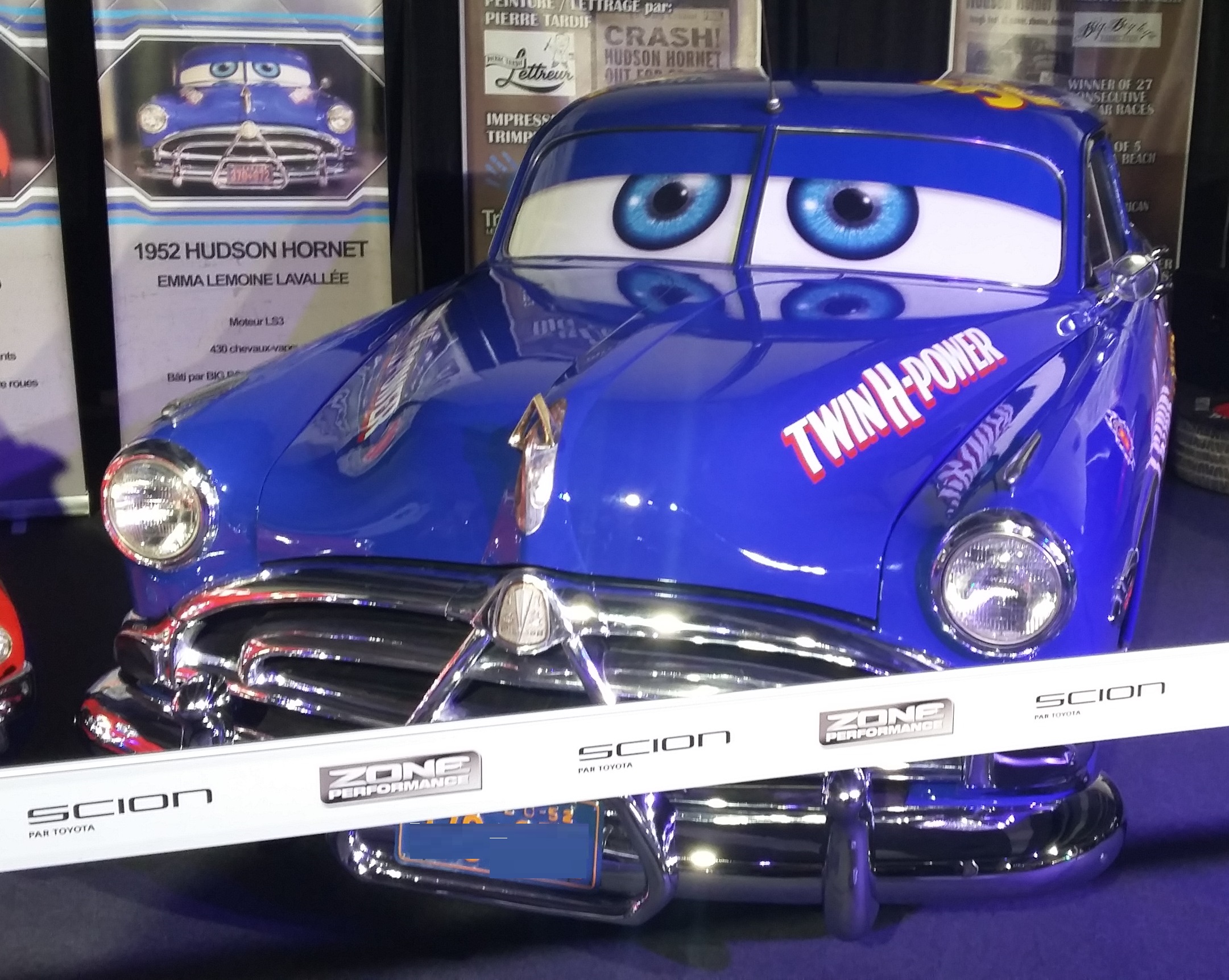
Now we get to the part where the Hudson Hornet stops being just a cool car and starts
becoming a folk hero.
Because in the early days of American stock car racing, when stock was a concept you
could still say with a straight face, the Hornet did something magical.
It showed up and started winning.
This is the era when racing felt like a traveling circus got into a bar fight with physics.
Oval's, dust, danger, and the kind of bravery that makes you question everyone's judgment.
And Hudson shows up with this low slung sedan that looks like it should be parked outside
a nice restaurant.
And then it goes out and embarrasses everybody.
Why?
Because all the stuff that makes the Hornet feel composed on a normal road becomes a super
power on a track.
That low center of gravity, thank you, step down design, meant it could corner flatter
than some rivals.
Less leaning, more grip, more confidence.
If other cars were tiptoeing through turns like they were carrying soup, the Hornet
was carrying a tray of confidence and not spilling a drop.
And you can imagine the racing gossip.
One team is standing around squinting at it like it's a magic trick.
How's that thing doing that?
Another guy shrugs and says, it's low, it's stable, it's annoying.
And that's when you know you built the right car.
When your opponents describe your success as personally inconvenient, Hudson's racing
reputation became part of the Hornet legend.
People didn't just see a sedan, they saw a machine with a resume.
And what's funny is how unglamorous stock car racing was compared to the myth it became.
This wasn't polished corporate motorsport.
This was gritty, practical, and loud.
This was a place where aerodynamics meant we took the hubcaps off.
And yet the Hornet thrived because its advantage wasn't decorative.
It was structural.
It was the kind of advantage you can't paint on.
It had the stance, the balance, and the real world power to play the long game.
The Hornet didn't need to be twitchy.
It needed to be relentless.
If you want the mood, imagine a small town heavyweight champion who doesn't talk much.
He just keeps winning until everyone starts telling stories about him that grow larger
than life.
I heard that Hornet took turn three so flat it ironed the track.
I heard it pass three cars while the driver was also thinking about lunch.
Racing stories always get wild, but they get wild for a reason.
Something real happened first.
And the Hornet name?
Again, perfect.
A Hornet doesn't win by being large.
It wins by being persistent and unimpressed.
It doesn't chase glory.
It chases you.
So the Hornet becomes more than transportation.
It becomes proof that clever engineering and good balance can beat brute force.
It's the underdog story, but also not quite the underdog because the Hornet shows up with
swagger.
It's like the quiet kid who turns out to be a chess shark and also, somehow, captain
of the wrestling team.
When you hear people talk about Hudson's today, you can feel that lingering pride.
Like the car didn't just win races.
It won an argument.
It's a reminder that different can be an advantage, not a compromise.
That a smaller company can build something that punches above its weight, and that
sometimes the best way to win is to sit lower, stay stable, and let everyone else wobble themselves
into defeat.
Episode 4.
The Grown-Up Hot Rod
The Hudson Hornet sits in a beautiful middle ground.
It's not a stripped-down rebel, and it's not a delicate showpiece.
It's a grown-up hot rod in a suit.
Like if your accountant secretly had a leather jacket and surprisingly good reflexes.
Visually, the Hornet has that long, low-confident profile.
It looks settled.
Many cars of the early 50s look like they're perched on their suspension like a cat on a countertop.
The Hornet looks like it's already planted, already ready, already judging your lane discipline.
And because you step down into it, the cabin experience is instantly different.
It feels like you're in the car rather than on it.
That's a small thing that becomes a big thing when you're driving.
The walls feel higher around you.
The road feels closer, and suddenly you feel, how do I put this politely?
It's like a tourist and more like the pilot.
Inside, these cars were built for people who liked comfort, but also liked a sense of purpose.
This is the era of broad bench seats, big steering wheels, and dashboards that look
like they could host a radio show.
And usually, that adds up to cozy.
In the Hornet, it adds up to cozy, but watch what I can do.
It's also the kind of car where the details can vary by year and trim.
And if you're not careful, that's where people start fighting in the comments.
So I'm going to speak generally.
The Hornet's styling evolves in that early 50s way.
Subtle changes, different grill treatments, more chrome here, different bright work there,
like it's slowly refining how to look expensive while also looking ready to throw hands.
And then there's Hudson's broader story, which is part of why Hornets feel a little
bittersweet.
Hudson was doing smart, distinctive engineering, but the industry was consolidating, competition
was fierce, and being clever isn't always enough when the other guys can build in bigger
volumes and throw money at every problem.
The Hornet feels like a highlight reel from a company that punched above its weight,
but here's why it matters today.
The Hornet isn't just a pretty classic.
It's a classic that had a point of view.
It had a personality.
It's not merely nostalgic.
It's interesting.
And in a world where plenty of old cars are lovable mainly because they're old, the Hornet
is lovable because it was genuinely doing something different.
And different is hard.
Different is risky.
Different is how you watch Send Up with a fan club that speaks about your car like
it's a family member.
The Hornet?
Oh, that's not a car.
That's my uncle.
He's a little heavy, but he shows up when it counts.
That's the Hornet in modern terms.
It's an old school machine with a distinct engineering trick, a real performance reputation,
and the rare ability to make you smile without trying too hard.
So if you ever see one at a show, don't just glance and move on.
Stand next to it and absorb the stance.
It sits low like it's keeping a secret.
And the secret is, it's still proud of what it did.
Not loud proud, quiet proud, Hudson proud.
The kind of pride that doesn't need a trophy on the hood because the whole car is the
trophy.
Episode 5, Anecdote Special, The Diner Parking Lot, Hornet.
I once had one of those evenings where nothing big was supposed to happen.
Just a normal drive, a normal hunger, a typical, let's stop at a diner because my body has
decided pancakes are a medical necessity.
The parking lot was half whole.
The neon sign was doing that tired flicker and the air smelled like fries in old stories.
And then I see it.
A Hudson Hornet, 51 to 54 era somewhere in that range, sitting under a streetlight like
it paid rent, low, long and calm, not shiny in a desperate way, shiny in a I've earned
this way.
It looked like the kind of car that doesn't get parked, it gets stationed.
I did the classic move, the slow walk, the aum, I'm not staring, I'm just strolling
in a direction that happens to be directly at your car walk.
And I'm doing what car people do.
Being in the stance, the shape, the whole vibe.
When a man appears out of nowhere like a summoned character, he's holding a coffee
cup the size of a small aquarium.
He nods at me the way Hornet owners nod, not hello, but yes it is.
I say something intelligent like, wow.
He doesn't smile, he just looks at the Hornet and says, step down.
That's it.
One word.
Like he's revealing an ancient secret.
Like I'm being inducted into a society.
I'm half expecting him to press a button and open a hidden garage door to a bunker
full of Hudson brochures.
I'm like, step down, yeah, you sit lower, right?
He finally cracks a smile, the way a teacher smiles when a student gets the answer but
still spells it wrong.
You don't sit lower, he says.
You step down, it changes you.
That's a dangerous sentence to hear in a diner parking lot.
We circle the car like it's a campfire.
He points out details with the care of someone describing a family portrait and the Hornet
is just sitting there, low and steady, looking like it could take a corner while holding a
conversation.
Then he hits me with the line every classic car owner has ready like a loaded spring.
Want to hear it?
Now this is where your survival instincts should speak up because want to hear it is
how you end up agreeing to help move an engine at midnight but I'm already emotionally
invested.
So I say, absolutely.
He turns the key and the straight six catches with a sound that isn't loud, it's authoritative.
Not a scream.
More like a confident clearing of the throat, the kind that makes you instinctively stand
up straighter.
You can tell it's not here for theatrics, it's here for work.
He blips the throttle gently like he's not trying to show off, remind the universe
that this machine exists and there's this smoothness to it, like the engine
is rolling its eyes at modern drama.
No fuss, no panic, just a steady grounded presence that feels like it could pull a building off
its foundation if you ask politely.
I'm standing there pretending I'm calm, but internally I'm about to start writing love
letters to 1952.
He leans in and says, people think you need a V8 to feel fast.
I nod like I'm in a courtroom.
Right.
He points at the car again like the Hornet is going to testify.
You need balance, you need low, you need Hornet.
And I swear the car looked slightly smug.
We shut it off and the diner's neon buzz feels louder now, like it's been humbled.
He takes a sip of coffee and says, this one's not a trailer queen.
Of course it isn't.
A trailer queen is polite.
The Hornet looks like it would be offended by a trailer.
Like it would say, I drove here in 1953, I will drive home in 2053.
I ask him if he ever races it.
He gives me the kind of look you give a child who asks if you're friends with the president.
Race, he says.
This car already won.
And he's not wrong.
That's the Hornet's magic.
Whether it's actually on a track or just sitting in a diner parking lot, it carries
this quiet reputation, like it has stories in its sheet metal.
Like it remembers the days when stock cars were closer to actual cars and winning
was about grit, stability, and a refusal to wobble.
Before he heads inside, he pats the roof lightly, like you'd pat a dog that just did something
impressive.
I'm still standing there grinning like an idiot, realizing I've been out in the
cold long enough to qualify as a hood ornament legally.
He turns back once and says, step down, changes you.
Then he walks into the diner, leaving me alone with the Hornet and the faint
suspicion that I've just been recruited into something.
Not a club, a condition.
Because after you've stood next to a Hornet, after you've heard that calm, confident
straight six, your brain starts doing it.
You start looking at other cars and thinking, nice, but do you step down?
About this episode
Exploring the 1951-1954 Hudson Hornet reveals a car that exudes confidence with its unique step-down design and powerful straight-six engine. The Hornet's low stance and handling made it a standout in the early 50s, both on the road and in stock car racing, where it became a folk hero. This episode dives into its engineering, racing legacy, and the personal anecdotes that highlight the Hornet's charm and character, showcasing how it remains a symbol of clever design and understated performance.