it's something that honestly deserves a little attention.
I'm talking about estate planning.
And before you tune out thinking it's complicated or expensive,
that's actually why I want to mention trust and will.
Trust and will makes estate planning feel
way less intimidating than it sounds.
They offer modern, attorney-designed wills and trusts
that you can create online.
And the process is surprisingly straightforward.
In fact, you can create a will in as little as 30 minutes.
That includes things like guardianship for your kids or pets,
how your assets are distributed,
and even healthcare directives.
Don't wait until it's too late.
Protect your loved ones with trust and will,
the most trusted name in online estate planning.
Go to trustandwill.com slash future to get 20% off.
That's trustandwill.com slash future for 20% off.
Trustandwill.com slash F-U-T-U-R-E.
Episode one, I'm Tom, and this is Chrome and Gasoline,
where we talk about cars the way people talk about exes,
lovingly, a little irrationally,
and always with at least one story that ends with,
and that's why I don't trust optimism.
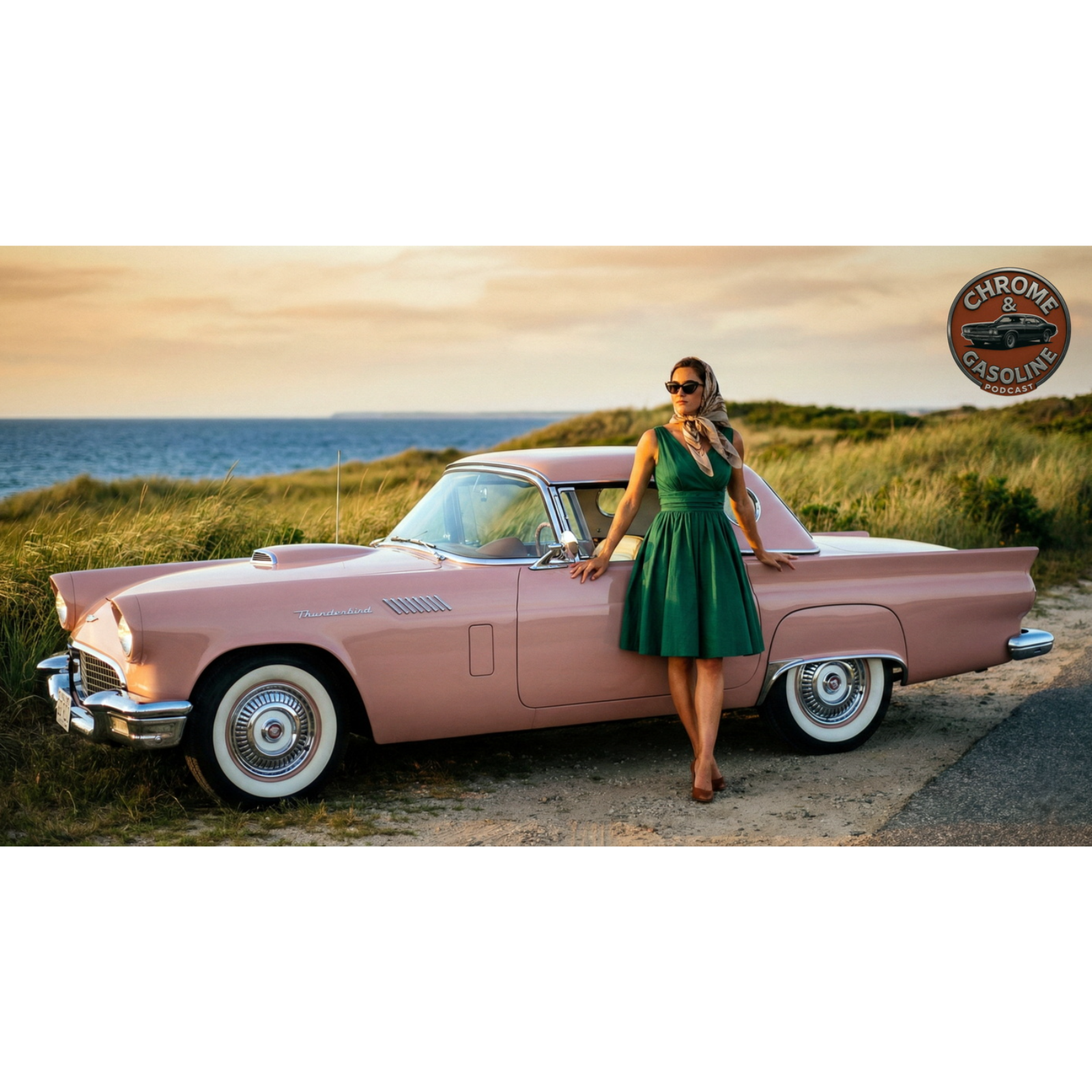
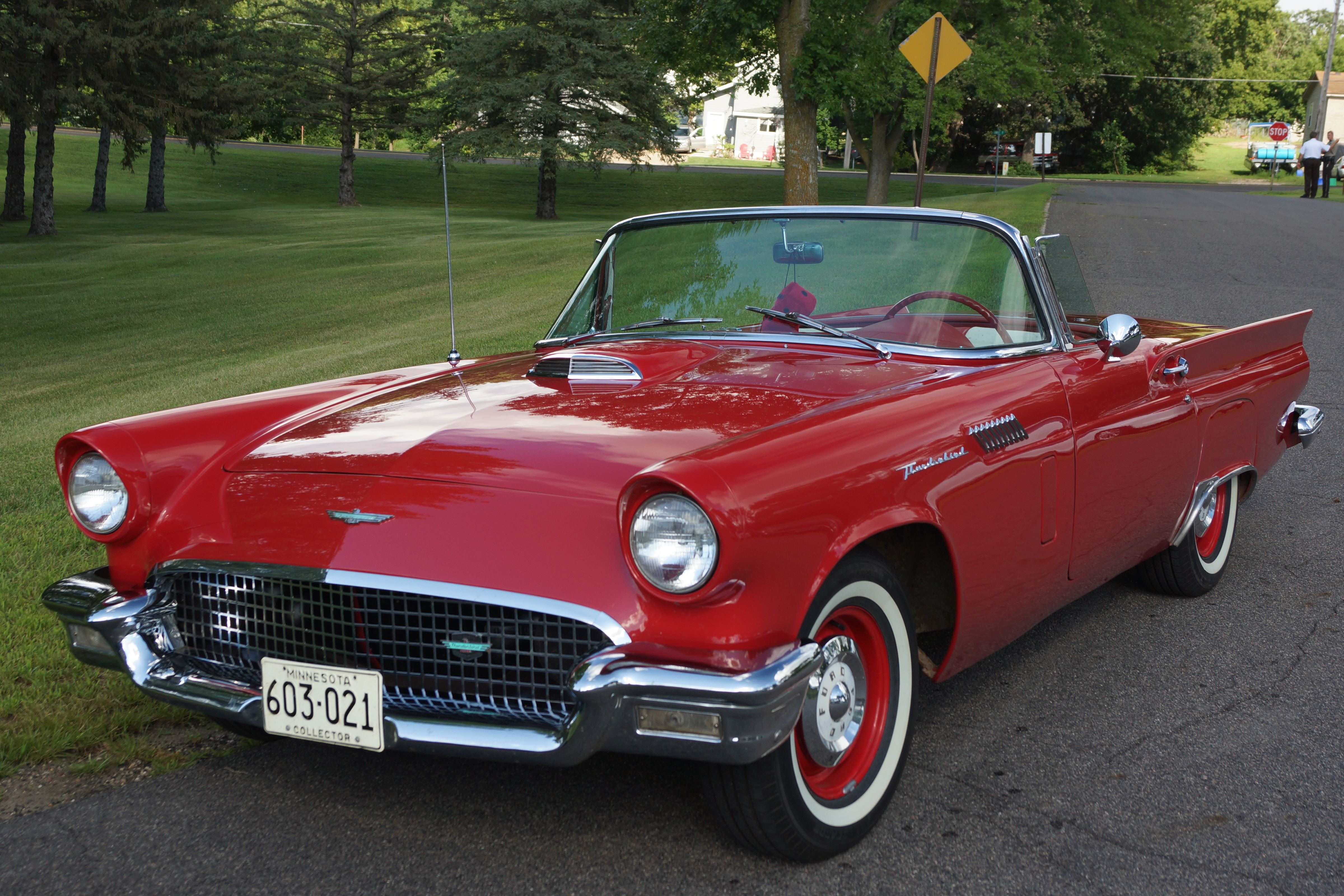
Today, we're hanging out with the 1955, 1957 Ford Thunderbird,
which is basically Ford saying, yes, we can do sporty,
and also no, we are not giving you a back seat,
so choose your friends wisely.
Let's get one thing straight right out of the gate.
The early Thunderbird isn't trying to be a race car.
It's not kicking down your door yelling, track day.
It's strolling into the room in a crisp jacket,
smiling like it knows your secrets,
and casually implying it has better plans
than whatever you're doing.
This is a personal luxury two-seater,
emphasis on personal, as in personal space,
personal choices, personal consequences, and I mean it,
two seats, that's not a layout, that's a lifestyle,
that's a firm boundary, that's the automotive equivalent
of putting no drama in your dating profile,
because the Thunderbird is basically a rolling filter.
If someone's upset they can't come along, congratulations,
you just found out something important about them.
So why did this car hit so hard in the mid-1950s?
Because the whole era was a victory lap.
Post-war America was feeling optimistic,
the highways were opening up,
and Chrome was basically a religion.
People wanted style and confidence,
and something that made them feel like life
was finally fun again.
The Thunderbird shows up and says yes,
and also I'm gonna look incredible next to a diner.
That's the mission.
The early Thunderbird is front engine, rear wheel drive,
and it comes in with V8 power as a core theme,
because this is the 1950s, and subtlety was not the vibe.
The point wasn't hyper-efficient, it was effortless.
You wanted that smooth pull from a stop light,
that relaxed surge when you roll into the throttle,
and the feeling that the car is doing the heavy lifting
while you focus on the important stuff,
like posing at a stop sign.
And let's talk about the convertible,
but also not convertible situation,
because this is where the Thunderbird
makes you feel like you're in a spy movie,
and also in a mild storage problem.
You've typically got a soft top for true open air freedom,
and a removable hard top for the,
I wanna look like I live in Palm Springs,
even if it's actually a Midwest parking lot vibe.
Either way, you're driving around
in something that feels special, just sitting still.
If you've never seen one in person,
it's got that low, tidy two seat proportion
that makes it look athletic without being aggressive.
It's confident, but not angry.
It's more, let's go cruising
than I drink octane for breakfast.
It's a car with manners,
just enough manners to get away with being gorgeous.
Now, speaking of the fact it's gorgeous,
there's always this moment where someone says,
isn't that Ford's Corvette?
And I get it, two seats, flashy, mid-50s, a statement.
But the early Thunderbird really carved its own lane,
not a bare-knuckle brawler,
more like a stylish heavyweight with a silk tie,
the kind of car that doesn't need to prove anything
because it already knows it looks good from every angle.
And throughout this whole series,
we're gonna revisit my favorite recurring crisis,
two seat problems, like where do you put your stuff?
Answer, wherever it fits,
which is also how you decide what belongs in your life.
Coat, yes.
Extra passenger, no.
Your friend's emotional support cooler?
Absolutely not, get your own Thunderbird, Steve.
So that's the setup.
The 1955, 1957.
Thunderbird is Ford's mid-50s statement.
A personal luxury two-seater with V8 confidence
and enough charm to make you forgive the fact
that practicality is not invited to this party.
It's a car that makes you feel like you're doing
better than you are.
Even if you just left the grocery store with one bag
and a lot of self-respect.
Stick with me because next we'll get into
why these things photograph like movie stars,
why the design still hits people right in the nostalgia
and how a simple V8 and cruise mission
became a whole attitude.
I'm Tom, this is Chrome and gasoline.
And yes, two seats is plenty.
For me.
Episode two, I'm Tom
and you're listening to Chrome and gasoline.
Still deep in the spell of the 1955, 1957 Ford Thunderbird,
AKA the car that makes you want to wear sunglasses
even at night just to match the attitude.
This episode we're talking looks, vibe
and why this thing has the photographic charisma
of a movie star who never pays for parking.
The design is the reason most people fall in love
before they've heard it run.
The proportions are the whole trick.
Short cabin, long-ish hood presence
and that tidy two-seat silhouette
that says I'm going somewhere
even if you're just going to a drive-through.
It's not massive, it's not trying to be a battleship
yet it has that 1950s confidence
where every line feels deliberate,
every curve feels polished
and every piece of Chrome looks like it's flexing.
And then there's the removable hardtop mystique.
Some folks remember these
with those distinctive side windows in the hardtop
like a little design wink.
However you describe it, the vibe is the same.
The hardtop turns a sunny convertible
into a stylish coupe-like look in about five seconds
and suddenly you feel like you should be pulling up
to a fancy hotel to ask the valet
if he knows how to treat a classic.
Now, let's pair that look
with what it feels like on the road
because the Thunderbird is not a scream it
to red line experience.
It's a lean back
and let the torque do the talking experience.
Mid-50 SV8S in general
are about smooth usable pull.
They're designed to move a car with ease
not to win a modern spec sheet argument.
You roll into the throttle
and it responds with that confident grown-up shove
like the car is saying, relax, I've got it.
And because we're in the land of carburetion culture,
yes, the era where fuel delivery
was part science and part mood,
you also get that old school personality.
The engine can feel lively, mechanical, honest.
It's not trying to hide what it's doing.
You can almost hear it thinking.
Sometimes it's thinking, this is great.
Sometimes it's thinking,
did you seriously buy gas from that place?
You get to be part of the conversation.
Suspension-wise, the whole mission is boulevard comfort
with enough control to feel composed and normal driving.
You're not carving apexes like you're chasing a trophy.
You're cruising.
The Thunderbird is more of a long hood,
smooth road, evening air kind of thing.
It's built for that classic American joyride.
Windows down, cool breeze,
and your brain deciding you're the main character
for no reason other than the car looks
that good reflected in a storefront window.
Let's bring back our recurring problem,
two seat problems.
Because as soon as you own a two-seater,
everyone becomes deeply interested in your schedule.
Suddenly you have friends.
Suddenly people wanna just ride along.
No, this is not a bus.
This is a vow of minimalism on wheels.
Two seats means you can bring one passenger
or one questionable decision.
Choose wisely.
And the trunk situation?
Let's just say you learn to pack
like you're going on a glamorous weekend trip,
even if you're going to an afternoon car show.
You become the kind of person
who can fit three things into a space built for two
and you'll feel proud about it.
Look at me.
I brought a jacket, a microfiber towel, and my dignity.
We're good.
So the Thunderbird's magic is the blend.
It looks like it was designed by someone
who understood drama and it drives like it was built
for enjoying the world rather than conquering it.
It's effortless style
with real mechanical presence underneath.
Next up, we get real about living with one.
The charming quirks, the maintenance themes,
and how classic car ownership is sometimes 60% joy,
30% learning, and 10% standing in a driveway whispering,
please just start.
I'm Tom.
This is Chrome and gasoline.
And yes, the Thunderbird still makes you look cooler.
That's the whole point.
Episode three, I'm Tom and this is Chrome and gasoline
where we celebrate the 1955-1957 Ford Thunderbird
and also gently warn you that classic cars are like pets,
adorable, lovable, and occasionally they will embarrass you
in public for no reason.
This episode is ownership reality,
the part nobody puts on the brochure.
Because the Thunderbird is gorgeous, yes,
but it's also a mid-1950s machine
and that means it comes with personality,
not quirky, fun friend personality,
more like charming uncle who sometimes disappears
at family gatherings.
Let's start with the greatest classic car ritual,
starting it after it's been sitting.
Modern cars, you press a button, it starts,
it apologizes for nothing.
A mid-50s V8 with carburation,
it has a small interview process.
It wants to know if you're serious.
It wants to know if you're emotionally stable.
It wants to know if you touched anything
since last time.
Some days it fires right up
and you feel like a hero.
Other days it cranks like it's composing a memoir
and that's why a big part of classic ownership
is respecting the basics,
fuel, spark, air, and cooling.
You learn casually,
like you didn't just become an unpaid mechanic.
Carb tuning is part of the era's charm
but it can also be part of the era's comedy.
Sometimes the car runs perfectly and you do nothing.
Sometimes you do everything and it runs the same.
That's when you realize you're not just maintaining a car,
you're negotiating with it.
Ignition-wise, again broadly speaking,
these cars rely on older school approaches
compared to modern computerized timing
and fuel injection.
The upside is they're understandable.
The downside is they're understandable,
meaning you are now responsible for understanding them.
Congratulations, you've been promoted.
Cooling systems matter.
Old cars like attention.
A good cooling system, good hoses, good belts.
Those are the quiet heroes
because nothing ruins your cool two-seat cruiser image
faster than pulling over with steam escaping
while you pretend you meant to stop and admire the scenery.
Two seats is a flex
but roadside repairs are a humbling experience
for everyone involved.
Now let's talk about driving feel.
Steering effort in a 1950s car
often feels different than modern,
less filtered, more connected.
Not hard, just honest.
Brakes?
Compared to today, you drive with more planning.
You leave room, you think ahead.
You don't tailgate.
The Thunderbird isn't asking you to be scared.
It's asking you to be present,
which frankly is a good life lesson.
And here comes our other recurring bit,
the 1950s marketing translator.
If a brochure says something like spirited performance,
what it often means is V8 torque
makes it feel confident in normal driving
and you'll smile when you roll into it.
If it says luxurious appointments,
it means you will absolutely touch the chrome
and not like you understand fine art.
If it says road hugging, it means
please don't drive it like a modern sports car
we're begging you.
Then there's the little stuff,
weather stripping, seals, old rubber parts,
things you don't notice until you do.
A Thunderbird can be perfectly happy
and then one small rubber piece
decides it's had enough of 1957 and chooses retirement.
That's classic ownership, a thousand small victories
and sometimes small puddles.
But here's the payoff.
When it's running right, it's a vibe you can't fake.
The engine note has that warm mechanical rhythm.
The cabin feels like time travel.
People look.
You feel connected to the road
in a way modern cars don't deliver
because modern cars are too busy being perfect.
And yes, two seat problems return again.
When you own a two-seater, you become selective.
You pick one passenger.
Maybe it's your best friend.
Maybe it's your spouse.
Maybe it's nobody because peace is underrated.
The Thunderbird teaches you boundaries
and it looks incredible doing it.
Next episode, we'll talk about how the 55-Chim,
57 years evolved in spirit,
how refinements and tweaks shaped the experience
and we'll keep it careful, fun and centered
on what enthusiasts actually feel
when they're around these cars.
I'm Tom.
This is Chrome and gasoline.
And if your classic starts on the first try today,
just accept the blessing and don't ask questions.
Episode four, I'm Tom and this is Chrome and gasoline,
still cruising with the 1955-1957 Ford Thunderbird.
And yes, the two-seat lifestyle
is still working out great for me.
Episode four is about how those three model years
feel like a little mini era of refinement.
Same core vibe, but with changes and tweaks
that enthusiasts notice even if they can't resist
arguing about them at car shows.
Here's the careful truth.
Most classic car lines evolve year to year
with styling details, feature updates
and general improvements, some subtle, some obvious.
The early Thunderbird story across 55, 56 and 57
can be thought of like a band's first three albums,
same sound, but a growing confidence.
The melodies are familiar,
but the production gets cleaner, the hook's sharper
and suddenly everyone has opinions
about which one is the real one.
From a 10,000 foot view,
the Thunderbird stays true to its mission.
Personal luxury, two-seat focus, stylish design
and V8 cruising, that's the backbone.
Within that, you'll see differences in trim,
interior cues and features,
things that can change the atmosphere
without changing the soul.
People notice the way certain details look,
the way the cabin presents itself
and how finished the car feels as the series matures.
And because it's the 1950s,
the feature set is part comfort, part showmanship.
Everything feels like it was designed not just to function,
but to make you feel taken care of.
You don't climb into a Thunderbird,
you get welcomed into it.
Moderate tech time, drive train personality
can vary depending on options and setup,
including transmission type.
In that era, you're generally dealing
with manual or automatic choices
and whichever you have shapes the vibe.
A manual can make the car feel more involved,
more of that I'm driving it energy.
An automatic leans into the Thunderbird smooth cruise identity,
more I'm arriving than I'm working.
Neither is wrong, they're just different flavors of cool.
Also, gearing and power delivery
can make a car feel relaxed or eager
without changing the fundamental engine design.
You might hear owners describe one setup
as more effortless on the highway
or snappier around town.
That's the kind of real world difference
people actually feel, not numbers, feel.
Now, I promise comedy,
so let's bring back two seat problems.
This is where you discover that a two seat Thunderbird
doesn't just limit passengers, it limits expectations.
People stop asking you to help them move.
Do you understand what a gift that is?
That's not a disadvantage, that's a feature.
The car is basically a rolling excuse
to avoid carrying furniture.
Sorry I can't, the Thunderbird, it's a two seater.
And then you drive away looking like a movie star
while they wrestle a couch.
And our 1950s marketing translator returns too.
When someone says, this year has more refinement,
translation, it feels like Ford kept polishing
the idea until it gleamed.
When someone says this year has the best look,
translation, I saw one when I was 12
and my brain permanently imprinted on it.
So what's the big takeaway across 1955, 1957?
The Thunderbird stays consistent.
It's about style and personal enjoyment,
not practicality or track dominance.
The yearly changes are like tailoring,
a better fit, a sharper look,
more confidence in the same suit.
And that sets us up for the finale
because the Thunderbird isn't just a spec list.
It's a memory machine.
It's the kind of car people remember seeing,
hearing, dreaming about.
Next episode, I'll tell you a personal story,
one that involves a Thunderbird in a moment where,
for a few minutes, the world felt like it was made
of warm sunlight and chrome reflections.
I'm Tom, this is Chrome and gasoline.
And yes, I still think two seats is enough,
especially when the seats are this cool.
Episode five, I'm Tom and this is Chrome and gasoline.
And I promised you a personal Thunderbird story,
so here it is.
No heroic claims, no mythical barn fine drama,
just one of those moments where a car shows up
and your brain goes quiet for a second,
like it's making room for a memory.
It was a warm day, one of those late afternoon days
where the sunlight turns everything
into a soft gold filter
and makes you feel like your life
has better cinematography than it deserves.
I was at a small local car gathering,
the kind with folding chairs, coolers
and guys standing around with arms crossed
like they're judging the moral character
of each paint job.
And then I saw it, a mid-50s Thunderbird, clean and proud,
sitting there like it didn't know
it was stealing the whole show.
The paint looked deep enough to fall into,
and the chrome, man, the chrome was doing
what 1950s chrome does,
reflecting the world back at you
like a perfectly polished lie.
You could see the sky, the trees
and half the crowd in those bumpers.
It was like the car had its own highlight reel.
The owner was leaning nearby, relaxed,
like he was used to people orbiting his car.
He wasn't showing off, he didn't have to.
The Thunderbird did that for him.
I walked over slowly, trying not to look like the guy
who's about to ask too many questions.
But the smell hit me first when I got close.
Old interior, a mix of warm vinyl, faint fuel
and that unmistakable, this is a machine
from another era scent.
It's not perfume, but it's honest.
He opened the door and I heard that gentle, solid click
like the hardware was built to last longer
than some marriages.
I leaned in and looked at the dashboard,
the bright work, the simple layout
that somehow feels classy without trying.
And I made a joke because I always do
something like two seats, huh?
This car really believed in boundaries.
He stared at me for half a second,
then laughed and said, best feature it's got.
Immediate friendship, that's how you know
you're with a Thunderbird person.
Then he offered me the passenger seat.
And here's where the story gets dangerous,
because the moment you sit in a Thunderbird,
you immediately start rewriting your budget in your head.
I sat down, the seat warmed from the sun
and the cabin wrapped around you
like it's inviting you to be cooler than you are.
The steering wheel looked like something
you'd see in a vintage photo
where everyone somehow has perfect hair.
He turned the key and the V8 came to life
with that soft, low rumble.
Like it wasn't angry, it was confident.
Not loud for attention, just present.
You could feel it through the seat.
A gentle vibration like the car was reminding you,
it's real, not a poster.
We rolled out slowly and the breeze came in
and the sunlight bounced off the hood
like it was showing off.
And for a moment, I got it.
Not the specs, not the arguments,
not the collectability chatter.
I got the feeling.
The Thunderbird isn't trying to prove
it's the fastest thing on the road.
It's trying to make the road feel like it belongs to you.
And that's where my 1950s marketing translator kicked in.
If the brochure said luxurious personal motoring,
what it meant was you will feel like life is going fine
even if your phone is full of overdue reminders.
And if it said sporty, what it meant was
you will smile every time you see your reflection
in a storefront window.
We didn't go far, just a short loop,
but when we got back, I stepped out and realized something.
I'd been quieter.
Not because I had nothing to say,
but because the car had said it already without words.
It reminded me that joy can be simple.
Warm air, an old V8,
and a design that makes your brain light up.
And the lesson I took from it is this.
Classic cars don't just require maintenance.
They require presence.
They reward you when you slow down and pay attention.
They don't fit modern life perfectly,
and that's the point.
They make you choose what matters.
Also, two seat problems?
That day it hit me.
The Thunderbird doesn't have a back seat
because it refuses to carry your nonsense.
And honestly, I respect that.
I'm Tom.
This is Chrome and gasoline.
And if a 55, 57 Thunderbird ever offers you a ride,
take it.
Your schedule can wait.
Your memory can't.
If you're an HVAC technician and a call comes in,
Granger knows that you need a partner
that helps you find the right product, fast and hassle-free.
And you know that when the first problem of the day
is a clanking blower motor,
there's no need to break a sweat.
With Granger's easy to use website and product details,
you're confident you'll soon have
everything humming right along.
Call 1-800-GRANGER, click Granger.com, or just stop by.
Granger, for the ones who get it done.
About this episode
Exploring the 1955-1957 Ford Thunderbird, this episode dives into its unique charm as a personal luxury two-seater. With a focus on style over practicality, the Thunderbird embodies post-war optimism and effortless cruising. The discussion highlights its V8 power, convertible options, and the allure of its design, which has a cinematic quality. Ownership realities are also addressed, including the quirks of classic car maintenance and the joy of driving a vehicle that demands presence and attention. Personal anecdotes add warmth, illustrating the Thunderbird's impact on memories and experiences.