As the purchasing manager at a manufacturing plant,
she knows the only thing more important
than having the right safety gear
is having it there when you need it.
That's why she partners with Granger for auto-reordering.
So her team members can count on her
to have cut-resistant gloves on hand
and each shift can run safely and efficiently.
Call 1-800-GRANGER, click Granger.com, or just stop by.
Granger for the ones who get it done.
Episode one, hey, Alex here
and you're listening to Chrome and gasoline.
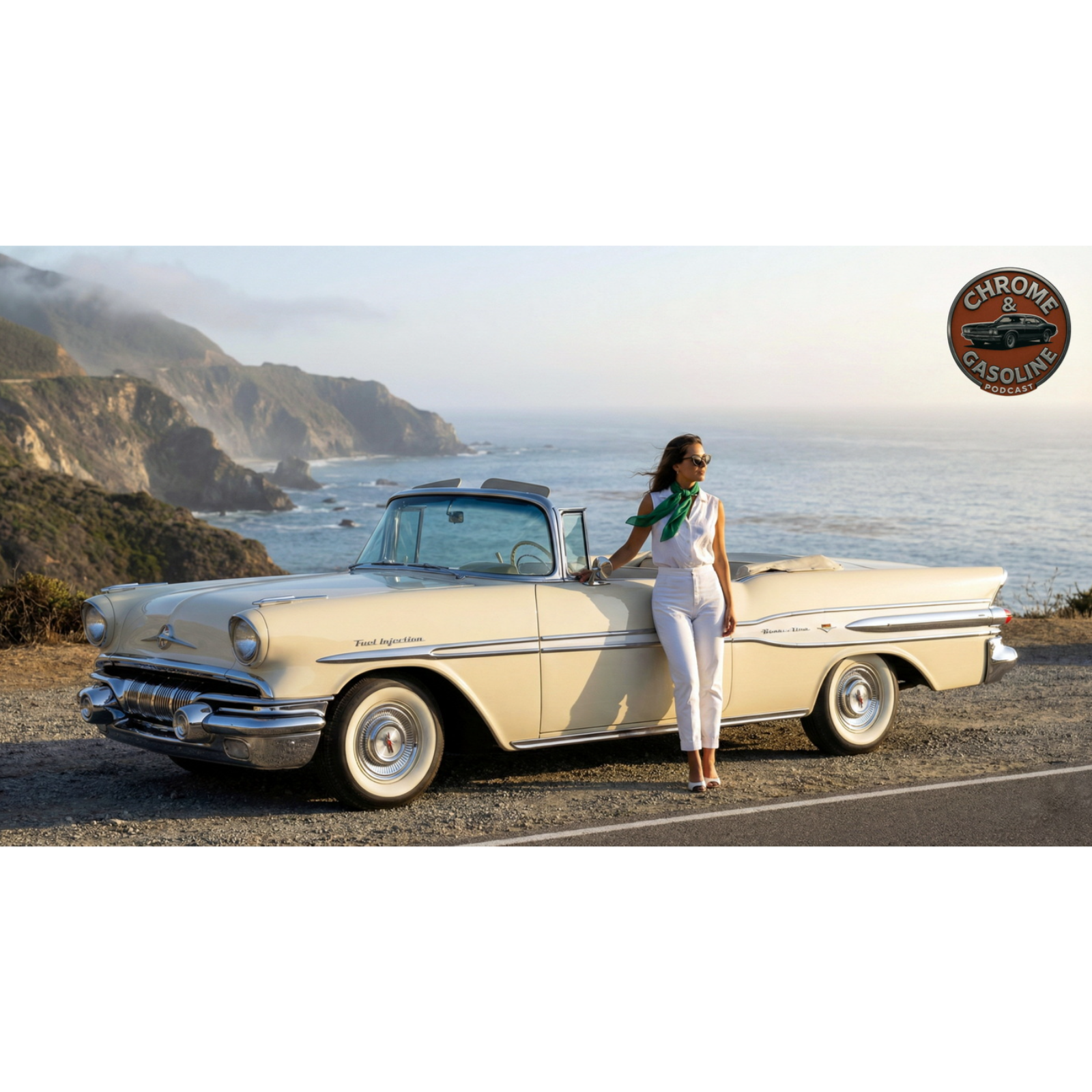
Today we're talking about the 1957 Pontiac Bonneville convertible
which is basically what happens when Detroit
looks at a normal car and says, nice.
Now add optimism and Chrome
and a little bit of I probably shouldn't but I will.
Picture late 1950s America, highways getting longer,
sunglasses getting cooler
and every design studio acting like the space program
was handing out styling notes.
Everything wanted to be longer, lower, wider,
like the car was trying to lie down
while still moving forward.
And Pontiac, Pontiac was busy trying to prove
it could be more than sensible transportation.
The Bonneville shows up like a well-dressed troublemaker
at a country club buffet.
Why does the 57 Bonneville convertible matter?
Because it's a luxury car
that keeps side-eye in the performance aisle.
It's polite, but it's also the kind of polite
that knows where the back door is.
It's the nice suit loud laugh of the Pontiac lineup
in that era and it helped push the brand toward
that whole wide track confidence
that would become a real identity later on.
Now let's begin our first scientific measurement
of the evening, Chrome math.
If you've never done Chrome math,
it's where you calculate something totally unreasonable
then treat it like a peer reviewed study.
So, rough estimate.
Take the amount of Chrome on a 57 Bonneville,
bumpers, trim, the shiny bits that exist purely
to reflect the sun into your retinas,
multiply by one convertible windshield frame,
divide by the number of people
who turn their heads at a stoplight
and you get approximately, yes.
And that's the Bonneville vibe.
It's not subtle.
It's not trying to be subtle.
It's a rolling announcement.
I have arrived and I brought extra sparkle.
Under all that jewelry though, there's real muscle.
By 1957 standards anyway,
Pontiac V8s in that period were getting more serious
and the Bonneville name was associated
with higher performance setups for the day.
Think strong, torquey, American five eight character,
the kind of engine that doesn't so much rev as it,
it expresses itself.
We'll dig into that next episode
including the era's whole carburetion culture
and the fact that late fifties automakers
were also flirting with early fuel injection
in a way that could be brilliant or occasionally dramatic
because here's the contradiction that makes this car fun.
It's a big, fancy convertible,
comfort, presence, boulevard manners,
yet it's also wearing a grin that says,
but what if we pass everybody
on the way to the fancy restaurant?
So in episode two, we'll talk engine personality.
What fast for 1957 really means
without doing modern number gymnastics
and how different induction setups of the era
could change the way the car feels.
Smooth, moody, eager,
or occasionally like it woke up
on the wrong side of the choke.
For now, just lock in the mental image,
top down, chrome everywhere
and a car that's basically a handshake,
a wink, and a bold claim all at once.
I'm Alex, this is Chrome and gasoline
and the 57 Bonneville convertible
is about to teach us that luxury and mischief
can share the same bench seat.
Episode two, Alex back with you on chrome and gasoline
and it's time to talk about
what gives the 1957 Pontiac Bonneville convertible
its heartbeat because underneath the chrome confidence
and the I'm definitely parked
at an angle on purpose stance.
This thing lives and dies by its V8 personality.
Pontiac in 1957 is in that sweet spot
where the brand is clearly aiming higher,
more power, more polish, more,
we're not just here to be your responsible choice.
The Bonneville name especially
was associated with the spicier end
of the menu for that era.
Not modern sports car fast,
but 1957 fast, which translates to
it can pull with authority, cruise with ease
and make passing traffic feel like it agreed
to be part of your demonstration.
Here's what that kind of V8 feels like in real life.
You don't chase red line, you summon momentum.
You roll into the throttle
and the car leans into it
like a heavyweight boxer getting warmed up.
Slow smile, then a firm shove.
Torque is the star of the show.
It's not a screaming high strong thing.
It's more like the engine is saying,
relax, I've got it,
while the whole car gently lifts its eyebrows.
Now, induction.
Carburetion versus the fuel injection buzzword
of the late fifties.
Most cars of the period lived in carburetor land.
Simple, familiar and very much dependent
on good tuning, temperature
and the mood of the choke.
In that era, some manufacturers also offered
or experimented with early mechanical fuel injection
on certain performance leaning models and trims.
When it worked, it could feel sharper and more consistent
like the engine was a little more awake.
When it didn't, let's just say the car
might ask you to be emotionally available
before it fully commits.
And this is where we deploy our recurring public service,
the sales bro translator.
Because if you read a 1950s brochure,
you'd think every car was powered
by patriotism and rocket science.
Sales bro translator, line one.
Jet smooth acceleration, translation.
It won't shake your dental work loose
and it pulls nicely once it's rolling.
Line two, instant response at your command, translation.
If everything's adjusted, it reacts quicker
than your neighbor's lawnmower on the first warm day.
Line three, effortless power for the open road,
translation, highway cruising is the whole point
and the engine is happiest doing that all day.
So what does fast for 1957 mean
without doing modern benchmarks?
It means the Bonneville can feel genuinely confident
in real traffic, especially in that rolling mid-speed world
where torque matters more than hero numbers.
It's the kind of car that makes you feel
like you planned your route just so you'd have
a long on ramp.
And the best part is the way it matches
the car's personality.
Luxury outside, strength underneath.
It's wearing cologne and carrying a gym bag.
Next episode, we'll talk about how that power
gets delivered, automatic versus manual vibes
and what the Bonneville feels like on the road
when you're asking a big late 50s convertible
to do modern things like turn and stop.
I'm Alex, this is Chrome and gasoline
and the 57 Bonneville convertible is proof
that even in 1957, Pontiac knew the recipe.
Dress it up, tune it up
and let the boulevard be your runway.
Episode three.
All right, Alex here on Chrome and gasoline
and now we get to the part where the 1957
Pontiac Bonneville convertible stops being a poster
and starts being a moving object with opinions
because power is fun, but how it delivers that power
and how the whole car behaves,
this is where the late 50s personality really shows up.
Let's talk transmissions,
the way polite society talked about scandals in 1957.
Quietly, but with intense interest.
Big American convertibles of the era
were often ordered with a smooth automatic
because the whole vibe was effortless cruising.
You glide, you steer with a couple fingers,
you pretend you're not checking your hair in the Chrome.
Automatics then were generally tuned
for smoothness and comfort, not snappy modern shifts
which means the experience can feel relaxed,
sometimes a little marshmallow in the best possible way.
Manuals existed too, depending on how a car was equipped
and what the buyer wanted,
usually fewer gears than you'd expect today
and more involvement than the car's
I'm luxurious facial expression suggests.
A manual and a big convertible
can feel like wearing dress shoes to a hiking trail.
You can do it.
You might even enjoy it,
but you'll also wonder why you chose the option
that makes you work harder
while the car is dressed like it hired a chauffeur.
Driving feel in modern terms,
the automatic experience is smooth and relaxed,
sometimes a little slushy,
like the car is translating your foot movements
into a polite suggestion.
You press the pedal, there's a half beat of,
yes, sir, then it gathers itself and goes.
That's not a flaw.
It's the era's definition of refinement.
It's luxury momentum,
steering generally lighter
and less direct than modern cars.
You don't aim so much as you guide.
It's like steering a confident couch,
one that's wearing a belt,
brakes, typically drum based in that period,
which means your stopping plan
should include forethought, mild prayer,
and a respectful following distance.
Not scary, just different.
You learn to drive it with your brain,
not just your toes.
And because it's a convertible,
the chassis feel is its own character.
Big convertibles carry weight
and they can flex more than a hard top.
Over bumps, you might feel a little shimmy,
like the car is briefly reminding you
it's basically a living room with no roof.
The upside is ride comfort.
These cars were built to float over imperfect pavement
like it's apologizing for being there.
Time for our recurring truth serum, convertible problems.
Convertible problems are the funny little realities
nobody mentions when they're posing for photos.
Problem one, wind.
Wind has plans for your hair, your hat,
and any paperwork you thought you'd keep in the cabin.
Problem two, the top mechanism.
When it's behaving, it's charming.
When it's not,
it turns into a slow motion trust exercise.
Problem three, weather.
A convertible is basically a relationship with the sky
and the sky is emotionally inconsistent.
You'll leave the house under perfect sun
and suddenly a cloud shows up like,
oh, we're doing this today.
Now, put it all together in a 57 Bonneville convertible.
You're not hustling it like a track car.
You're letting it do what it was born to do.
Crews glide make you feel slightly important
and occasionally surprise you with how eager it can be
when you ask for more throttle.
It's luxury with a mischievous streak.
Next episode, we're going full fashion show.
Colors, trim, interiors, two-tone drama,
and the kind of Chrome that could signal aircraft
in an emergency.
I'm Alex.
This is Chrome and gasoline.
And if you can drive a late 50s convertible smoothly,
congratulations.
You have the patience of a sane,
is one and the forethought of a chess grandmaster.
Episode four, Alex here, still on Chrome and gasoline.
And today, the 1957 Pontiac Bonneville convertible
gets to do what it was built to do best,
look outrageous in the most lovable way possible.
This is the episode where we talk colors,
trim, interiors, and that late 50s belief
that if a little Chrome is good,
then a lot of Chrome is basically a moral virtue.
The design cues are pure 1950s optimism,
long, low, wide, and confident.
The car has that rocket theme running through it,
styling that feels like it wants to be photographed
next to a jet, even if it's just going to the drive-in.
The stance says, I'm parked,
but the lines say, I'm posing.
Now, paint culture in that era was theater.
Two-tone combinations were a whole language.
Your car didn't just have a color, it had a personality.
You might see period style names like Kenya Ivory,
Bonneville Red, Fontaine Blue,
or some kind of silver or charcoal tone
that exists mainly to make the Chrome pop even harder.
Not claiming any one shade was the color,
just saying Pontiac people in that time were not shy.
Interior vibe, think bright work, textures,
and details that feel like mid-century living room design
got promoted to the dashboard.
Upholstery might be vinyl or cloth blends
depending on how it was equipped
with patterns that say cocktail lounge,
more than minimalist Scandinavian.
Buttons and knobs feel substantial.
The dashboard doesn't whisper, it announces.
And because we're here for science,
it's time to revive Chrome math.
Let's calculate the Chrome to drama ratio.
Step one, measure the bumper sparkle.
Step two, add the side trim
that seems to run for three zip codes.
Step three, multiply by the number of onlookers
who suddenly remember they have feelings.
Result, a ratio scientifically classified
as potentially blinding, definitely awesome.
Now for the fun part, personality archetypes
based on color and trim choices.
If you pick a bright ivory with a bold red accent,
you're the country club rebel,
polite smile, spicy playlist.
If you go deep blue with lots of Chrome contrast,
you're the night cruise poet,
the kind of person who thinks street lights are mood lighting.
If you choose a silver gray vibe,
you're the stealth glamour type, still flashy,
just with better negotiation skills.
And if you pick something boldly warm,
yellowish or coralish, congratulations,
you're the main character.
And the car is your supporting actor
that refuses to stay in the background.
All of this styling ties back to what makes
the 57 Bonneville convertible special.
It's not just transportation, it's a statement.
It's Pontiac trying to outdress the room
while still keeping a punch in its pocket.
Next episode, we wrap it up.
The ownership fantasy versus reality.
And I'll tell you a very human story
about a memorable encounter with a 57 era convertible.
Sensory details, minor embarrassment,
and a lesson delivered by wind.
I'm Alex and this is Chrome and gasoline.
Episode five, all right.
Alex here on Chrome and gasoline
and it's time to land the plane,
or more accurately, to park the Chrome spaceship.
The 1957 Pontiac Bonneville convertible
is the kind of car that makes your imagination do overtime.
You picture top-down sunsets,
effortless cruising, strangers smiling at stoplights,
and your hair somehow staying perfect in the wind,
which is adorable because wind
has never signed that agreement.
The ownership fantasy is real.
This car has presence.
It doesn't just arrive, it makes an entrance.
It turns a simple drive into an event.
You don't go get milk, you go on a milk tour.
And it has that late 50s luxury performance contradiction
we've been living with all series.
It's comfortable and classy,
but it also carries that Pontiac Vive 8 attitude.
Strong, torquey, I can move when I feel like it.
Now the reality, lovingly, it's still a big 50s convertible.
Things are mechanical, they have moods.
The car likes maintenance the way a house
likes a toolbox, regularly and forever.
Brakes and steering demand respect.
The top is either your best friend or an elaborate prank
and modern traffic can feel like everyone else
is playing a different sport.
But if you meet it on its terms, cruise, glide,
plan your stops, enjoy the ritual,
it pays you back with charm you can't download.
Convertible problems, check in
because we can't leave without it.
The wind is still your stylist
and it is not a professional.
Also, sudden weather is like a pop quiz
and the top mechanism, it's basically a small committee.
Sometimes it votes yes.
Sometimes it requests a recess.
Okay, personal story time.
Years ago I was at a little weekend cruise.
In, nothing fancy, just a parking lot full of people
pretending they just happened to be in the area
while polishing things with the seriousness
of brain surgery.
A 57-era Pontiac convertible rolled in.
Could have been a Bonneville or a close cousin.
I'm not going to swear on a carburetor manual
but it had that unmistakable late 50s stance
and enough chrome to reflect my whole questionable life choices.
The owner was an older guy with that calm confidence
you only get from years of dealing with machines
that can't be bullied.
He's chatting with people
and I'm doing what I always do,
hovering respectfully while my brain shouts,
ask him to start it, ask him to start it.
I finally say something intelligent which is,
oh man, look at all that chrome.
Real genius level contribution, Alex.
He laughs and he offers to let me sit in it for a second.
Just sit, not drive.
Sit.
So I climb in and immediately I learn lesson one.
Summer sun plus vinyl seat equals
you're doing the world's hottest slip and slide.
I try to lower myself gracefully
and my shoes decide, nope.
I kind of half sit, half scoot
and for one perfect moment I'm doing
an awkward little dance move
that looks like I'm trying to start a lawnmower
with my hips.
Everybody sees it, of course they do.
The chrome probably recorded it.
Then the owner, absolute gentleman,
reaches over and shows me a control for the top
and right as he's explaining it,
a gust of wind comes through the cabin
like it paid admission.
My hair which had been behaving
becomes a whole separate project car.
I'm blinking, laughing, trying to look cool
and he says, dead calm.
That's convertibles for ya.
And I swear the car itself felt like it was smiling.
I stepped out smelling faintly of warm vinyl
and old car perfume, gasoline, sun baked materials
and a hint of history.
And my takeaway wasn't I need to own one tomorrow.
It was respect the era, respect the machine
and never assume the wind is on your side.
That's the magic of a 57 Bonneville convertible.
It's not perfect, it's charismatic.
It's the kind of car that gives you stories
sometimes even before you turn the key.
I'm Alex, this is Chrome and gasoline
and I'll see you next time
when we chase another legend
with a little humor and a lot of respect.
About this episode
The 1957 Pontiac Bonneville Convertible embodies the exuberance of late 50s America, blending luxury with a mischievous spirit. This episode dives into its striking design, characterized by chrome accents and vibrant color options, reflecting the era's optimism. The Bonneville's V8 engine delivers a unique driving experience, balancing comfort with surprising performance. Listeners will appreciate the anecdotes about ownership realities, convertible quirks, and the charm of cruising in such an iconic vehicle. The episode wraps up with a personal story that highlights the connection between the car and its driver.