If you're the purchasing manager at a manufacturing plant, you know having a trusted partner makes
all the difference.
That's why hands down you count on Granger for auto-reordering.
With on-time restocks, your team will have the cut-resistant gloves they need at the start
of their shift.
And you can end your day knowing they've got safety well in hand.
Call 1-800-GRANGER, click Granger.com or just stop by.
Granger for the ones who get it done.
Episode 1, hey, it's Alex and this is Chrome and Gasoline, where we talk about cars that
look like they should be parked outside a country club but sound like they're late for a fistfight
with physics.
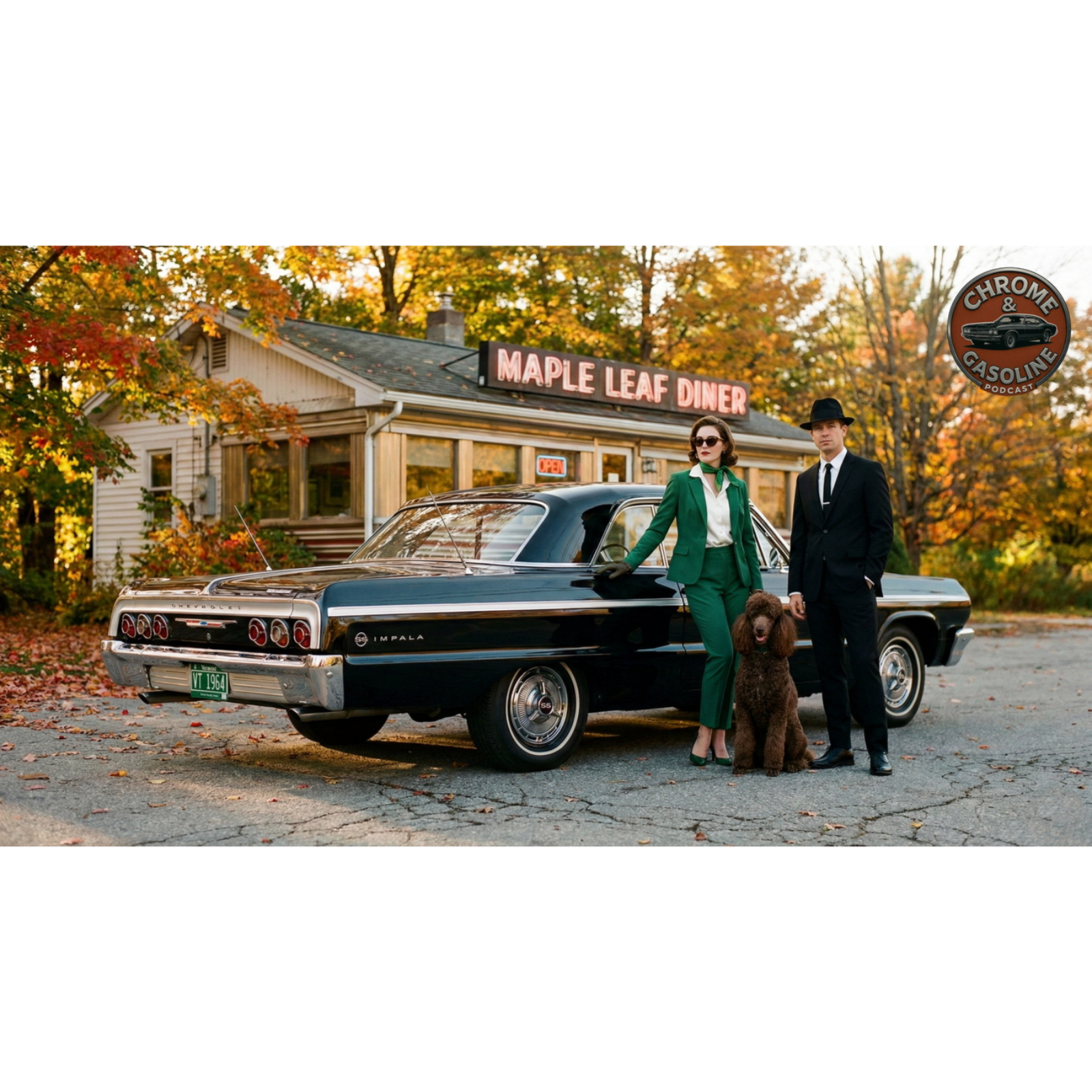
Today's star is the 1961-1964 Chevrolet Impala SS, which is basically Chevy saying, what
if a full-size living room could also do a respectable impression of a rocket?
First, let's set the scene.
Early 1960s America is wearing a crisp shirt, slicking its hair back, and believe in the
future will be made of chrome and confidence.
And the Impala SS shows up like a tuxedo with a mischievous grin.
It's big, it's low, it's shiny enough to charge you a chrome tax just for standing
near it.
You don't merely walk up to one, you approach it like you're greeting an important relative
at a wedding.
With respect, and maybe a little fear.
Now, one of the most Impala SS things about this era isn't just the engine talk, it's
the structure underneath.
These cars ride on what enthusiasts call the X-frame.
Picture a ladder frame that got bored and decided to do yoga.
It helped keep the floor lower and the body sleek and it can feel solid cruising straight
down the road.
We'll debate the trade-offs compared to perimeter frames, but the main point for us is this.
It's an early 60s full-size Chevy foundation designed for smooth, stable highway life.
Then the SS shows up and says, cool, now add spice.
And that spice often meant V8 power, because this is the era where cubic inches was basically
a love language.
Depending on how the car was optioned, you could see small block setups that feel
eager and lighter on their feet, or big block muscle that brings more torque and more nose
weight.
And looming over this whole period is the legend, the 409.
If you've ever heard someone mention 409 with the reverence usually reserved for barbecue
recipes and family heirlooms, that's the vibe.
The 409's reputation is torque, attitude, and a soundtrack that makes your neighbors
suddenly become early morning people.
I'm being careful here because options varied and the exact combos depended on year and ordering,
but as a cultural force, oh yeah.
The 409 is a headline.
The Impala SS is also a masterclass in what I call parking lot physics.
You know the rule.
The longer the hood, the more your brain starts using aviation metaphors.
Turning radius becomes a suggestion.
Parallel parking becomes a negotiation process.
And that's fine.
Because the Impala SS wasn't built to slice apexes, it was built to own the boulevard.
Underneath, you've generally got a coil spring setup that's tuned for comfort, with suspension
geometry that prioritizes a stable ride over razor handling.
Steering is typically recirculating ball, which means you don't so much aim the car
as you politely request a direction, and the car responds when it's good and ready.
It's not a flaw, that's a personality.
It's like driving a confident uncle who refuses to be rushed.
Brakes?
We'll get deeper later, but let's just say the era is mostly drum brakes, and drums
demand respect.
The Impala SS can move, but it also teaches you a life lesson.
Speed is easy, stopping is a plan.
We'll revisit that with what I like to call the drum brake prayer.
Dear road, please remain predictable.
So that's our intro, a big, stylish, early 60s icon with an SS badge that can mean business,
especially when properly optioned.
Next episode, we're going to dig into engines, carburetion culture, and why the phrase
just needs a tune-up is sometimes the funniest lie a human can tell.
And yes, this is Alex, and this is Chrome and gasoline, hang on.
Good to, Alex here, welcome back to Chrome and gasoline.
Today we're talking engines, which is perfect, because nothing reveals a person's character
like how they react to the phrase big block.
Some people smile, some people panic, some people immediately start explaining torque
like they're defending a dissertation in a bar.
So 1961 to 1964 Impala.
SS, the performance aura stems from the fact that Chevy offered serious V8 power during
this period.
You'll generally hear the conversation split into small block and big block behavior.
And that difference is not just more power, it's weight, feel, heat, and attitude.
A small block and a big car can feel surprisingly lively, the front end doesn't feel quite
as burdened, the engine can rev a bit more freely and the car feels like it's cooperating
with you.
Big block, especially the famous 409 Aerovibe, tends to feel like you've hooked your right
foot to a winch.
You don't always need to rev it, you lean on the throttle and the car starts pulling
like it's offended by the existence of hills.
That's torque.
That's also how you accidentally discover your low on fuel.
Now let's talk carburetion, because early 60s performance is basically how many carburetors
can we reasonably justify before our spouse notices.
Many were equipped with a four barrel setup when performance was the goal.
Even in the broader era, multi-carb setups were part of the culture, whether factory on
specific performance packages or owner installed dreams bolted on over a weekend.
If you've never watched someone adjust a carb, it's like watching someone tune an instrument
they also want to fight.
Mixed your screws, idle speed, choke behavior, there's art, there's science, and there's
a tiny bit of superstition.
Here's your bench racing translator moment for the day.
When someone says, oh, it's got a spicy carb setup, what they sometimes mean is, it runs
great for two minutes, then idles like a washing machine full of bricks until it warms up.
Carburetion is glorious, but it's also a relationship.
You don't just have a carb, you negotiate with it.
And let's not forget, this era lives in the world of point ignition for many cars.
Points and condenser mean tune ups involve real tactile adjustments, dwell, timing,
and that magical moment when the engine goes from angry lawn mower to smooth V8 lullaby.
If the points are worn, the dwell drifts, timing gets sloppy, and suddenly your Impala SS feels
like it's trying to clear its throat at every stoplight.
Compression and fuel expectations matter too.
Many performance engines of the day were happier on higher octane fuel.
Back when premium had a different cultural meaning and leaded gas was a thing.
Today, owners often have to be thoughtful, tune, fuel choice, maybe timing adjustments,
things that aren't scary, but they're part of the ownership reality.
The engine isn't high maintenance, it's just from an era where machines expected you
to be part of the conversation.
Cooling is another big one, especially with bigger engines.
More heat means the cooling system is not a background character.
It's a lead actor, radiator condition, fan, shroud, thermostat, hoses, and the general
cleanliness of the system matter.
A big, torquey Impala SS on a hot day in traffic will test whether your cooling system is a
professional or an optimist.
And because this is an SS conversation, we should acknowledge the SS meaning without
turning into a brochure.
In this era, SS generally signals a performance-leaning personality, often tied to appearance cues
and available powertrain options, depending on year and how it was ordered.
The critical part is the vibe.
It's the Impala that showed up wearing nicer shoes and carrying a bigger lunch.
So if you're dreaming about a 1961 to 64 Impala SS, you're not just picking an engine.
You're picking a temperament, revvy and willing, or torquey and dramatic.
Either way, you pay the chrome tax and smiles per mile.
Next episode, we're going to talk transmissions, rear gears, and why a full-sized Chevy can
feel either like a smooth cruise ship or a freight train with ambition.
Alex, Chrome and gasoline, let's shift.
Episode 3.
Alright, it's Alex, back on Chrome and gasoline.
And today, we're getting into transmissions and gearing, also known as the stuff that
decides whether your Impala SS feels like a calm Sunday stroll or like it's trying to
relocate your spine.
Let's start simple.
Early 60s full-size Chevys could be ordered with different transmission types depending
on year and configuration.
But the broad categories are manual and automatic, and the personalities are wildly different.
A manual in a big car is hilarious in the best way.
You've got a clutch, linkages, and that mechanical connection that makes you feel like you're operating
heavy equipment, but stylish heavy equipment.
The shift feel can be anything from crisp to stirring a pot of soup, depending on wear,
adjustment, and how much of the linkage is original versus fixed by three different
owners with three different philosophies.
But when it's right, it's satisfying.
You're choosing the moment.
You're deciding how the engine delivers its mood.
An automatic in this era is the king of smooth cruising.
It's the transmission equivalent of saying, I don't want drama, I want vibes.
It can be wonderfully relaxed, especially in a big car designed for comfort.
But automatics also bring their own reality.
Heat management, fluid condition, and the simple truth that decades of use can make
shifting either buttery or interpretive.
If an automatic is slipping, that's not character.
That's a cry for help.
Now, here's the part most people forget.
The transmission is only half the story.
The other half is the rear axle gearing, and gearing is basically how your car thinks.
Tall gears make the car calmer at highway speeds, lower RPMs, and more comfortable to cruise.
Shorter gears can make the vehicle feel punchier off the line, more responsive, more go, but
you pay for it with higher RPM at speed and sometimes a little more noise and thirst.
This is where the Bench Racing Translator returns.
When someone says, oh, it's geared right, that can mean it launches hard, or it cruises
quietly, or it matches their personal definition of right, which is usually based on one magical
night in 1987 they will not stop talking about.
And then there's the driveline, driveshaft, U-joints, mounts, the parts that live between
the engine's enthusiasm and the tire's ability to cope.
Big torque plus old rubber mounts can create the kind of clunk that makes you look around
like someone bumped your bumper.
U-joints wear, pinion seals seep, and if the car's been enjoyed the way an SS begs
to be enjoyed, some of those components have stories.
Let's bring in parking lot physics for a second.
In a big Impala, the drivetrain choices show up even at low speeds.
A tall geared automatic car will creep like a polite yacht.
A more aggressively geared car can feel eager, almost impatient, like it's whispering,
we could leave, we could leave right now.
And since we're talking about how it feels, we've got to mention traction and tires.
Many of these cars live their early lives on bias ply tires, which behave differently
from modern radials.
Bias plies can feel more floaty, more sensitive to road grooves, and they communicate in
a language best described as vintage.
Modern radials often make the car feel more stable and predictable, but they can also
reveal other worn components because the tires no longer mask the chaos.
Suddenly, you notice steering play and bushing softness like you just got new glasses.
So the transmission and gears are not trivia, they're the personality settings.
They decide whether your Impala SS is a smooth boulevard cruiser, a torque forward bruiser,
or something in between.
Next episode, we go under the hood and talk ride, steering, brakes, and the truth about
stopping a big early 60s car that really wants to keep going, Alex, Chrome, and gasoline.
And yes, we are absolutely doing the drum brake prayer next.
Episode 4, Alex here.
This is Chrome and gasoline, and today we're talking about the stuff that separates
dreamers from drivers, suspension, steering, brakes, and what an early 60s Impala SS actually
feels like when the road stops being a postcard.
Let's start with ride quality.
Because these cars were built in an era when comfort wasn't a feature.
It was a mission statement.
The suspension in this family generally leans on coil springs and geometry that prioritizes
smoothness.
Up front, you're dealing with control arms and bushings that, when fresh, make
the car feel confident and settled.
When worn, they make the car feel like it's gently negotiating with the pavement.
In the rear, full-size Chevy's of this era often use a coil spring setup with locating
arms.
The takeaway isn't the exact architecture.
It's the result, that classic full-size float that becomes surprisingly composed
when everything is tight and aligned.
But the moment bushings are tired or shocks are weak, the car can start doing that boat
after a wave motion, charming for 10 seconds.
Then you remember you are not, in fact, a boat.
Steering is typically recirculating ball, and I say that with love.
It's not sharp like modern rack and pinion.
It's more like you suggest direction and the car accepts the suggestion after thinking
about it.
That's why parking lot physics exists.
You don't whip an Impala SS into a spot.
You schedule a meeting.
You turn the wheel, and the car arrives.
Now, brakes.
This is where we respect the era.
Most of these cars are living that drum brake life.
Drums can work well when properly adjusted and in good condition, but they have limits,
especially with repeated hard stops, heat buildup, and modern traffic expectations.
Brake fade is real, pedal feel can change as things warm up, and drum brakes reward
drivers who think ahead.
This is not fear mongering.
This is just vintage reality.
Which brings us to the drum brake prayer, a respectful little mantra.
Dear momentum, please cooperate.
The Impala SS can cruise at speed all day, but stopping a heavy car with drums means
you drive with foresight.
You leave space.
You don't tailgate like you're late to your own wedding.
Tires matter a lot here.
Bias ply tires, if you're running period style rubber, will feel different.
Less lateral grip, more wander, and a general sense that the car is communicating via interpretive
dance.
Radials often improve stability and braking confidence, but they can also highlight steering
play and alignment issues.
Either way, you want the whole system, tires, brakes, suspension, to be on the
same page.
Cooling and charging systems also deserve a quick nod.
On a warm day, a big old V8 can turn an engine bay into a slow cooker.
A healthy radiator, fan setup, and clean coolant passages matter.
And charging systems in this era can vary by year and configuration, so I'll speak
generally.
You want good wiring, solid grounds, and a system that can keep up with lights, accessories,
and the reality that nighttime cruising with extra electrical load is part of the lifestyle.
And speaking of lifestyle, the Impala SS is a rolling statement.
The chrome, the stance, the size, this thing doesn't whisper.
It announces itself, and every time sunlight hits the trim just right, you pay the chrome
tax in squintedon.
Next episode is our finale, and it's personal.
I'm going to tell you a true-to-life story from my own world, because every classic
car person has that one moment where a car taught them something.
Usually about respect, sometimes about brakes, sometimes about not trusting a quick fix.
Alex, Chrome, and Gasoline, final episode coming in hot, but you know, responsibly.
Episode 5.
Hey, Alex here, and this is Chrome and Gasoline, and I owe you a story.
Because for all the specs and legends around the 1961-64 Impala SS, the real magic is
the moment it stops being a car and starts being a memory you can smell.
You know what I mean, warm vinyl, a hint of fuel, a little exhaust, and the sun bouncing
off enough chrome to illuminate low-flying aircraft.
Chrome tax paid in full.
Years ago, I got a chance to ride in a friend of a friend's early 60s Impala SS.
I'm being a little vague on the exact year because I don't want to claim something
wrong, but it sat right in that 1961-64 sweet spot.
Big body, SS vibe, and an engine bay that made you instinctively lower your voice
like you were standing in a cathedral.
It wasn't a museum trailer queen, it was a driver.
The kind with a few tiny imperfections that actually make you trust it more, like laugh
lines on a face.
We met up at dusk, which is the best time for a car like this, because the lighting
makes every body line look like it was drawn with confidence.
I walk up and immediately parking lot physics kicks in.
The hood looked long enough to host a family reunion.
The grill looked like it could inhale small animals.
And the owner, cool as a freezer full of steaks, says, hop in.
Inside the cabin felt like a stylish time capsule.
Big steering wheel, simple gauges.
That early 60s sense that comfort was the point.
And then he starts it.
You know that moment when a V8 catches and settles into an idle that sounds like
it's clearing its throat before telling you a secret?
That.
The whole car had this subtle vibration.
Nothing harsh.
It's the gentle reminder that there's combustion happening and it's proud of it.
We roll out and at first it's pure cruise ship, smooth throttle, easy pace, automatic
style glide.
Again, I'm not going to swear what transmission was in it, but the vibe was effortless.
And then he gives it a little more pedal.
Not a show off stab, just enough to feel the torque come alive.
The nose lifts that fraction of an inch.
And suddenly the big Chevy stops being a couch and starts being a confident animal.
This is where the bench racing translator shows up.
When someone says it pulls, what they mean is your internal organs file a brief complaint
and then accept the new leadership.
We get onto a longer stretch of road and I'm thinking about everything we've talked
about.
Gearing feel, engine character, how these cars make speed feel casual.
And then we come up on a traffic change.
Cars slowing ahead, nothing dramatic.
Just a normal everybody squeeze in situation.
He eases onto the brakes and right there, in that moment, I learned why vintage driving
is a mindset.
The pedal feel was fine, but it wasn't modern car instant.
It was progressive, honest.
You could feel the system do and work and my brain quietly started reciting the
drum brake prayer without asking permission.
He handled it perfectly, left space, smooth inputs, no panic.
And as we slowed, he just says calmly, that's the whole game with these.
You drive it like you respect it.
That sentence stuck with me because the Impala SS isn't scary.
It's just real, real weight, real momentum, real mechanical personality.
And when everything is sorted, brakes adjusted, suspension tight, cooling healthy,
moon clean, it's not stressful, it's satisfying.
It's like dancing with a partner who's larger than you, but surprisingly graceful.
As long as you don't try to lead like a maniac.
We finished the ride back where we started, and when I stepped out, I caught the last
light glinting off the trim and thought, this car is a rolling lesson in confidence
and consequences.
Big style.
Big presence.
And yes, big responsibility.
That's the 1961 to 64 Impala SS vibe in a nutshell.
This is Alex and this is Chrome and gasoline.
And if you ever get the chance to ride in one, pay the Chrome tax, respect the parking
lot physics and never forget the drum brake prayer.
About this episode
Exploring the 1961-1964 Chevrolet Impala SS, this episode dives into its unique blend of style and power. The Impala SS is portrayed as a full-size car with a sporty edge, featuring the iconic X-frame and a range of V8 options, including the legendary 409. Discussions cover the nuances of engine types, carburetion culture, and the importance of understanding the car's personality through its transmission and gearing. The episode also highlights the driving experience, emphasizing the need for respect and foresight when handling vintage drum brakes and the overall charm of this classic American icon.