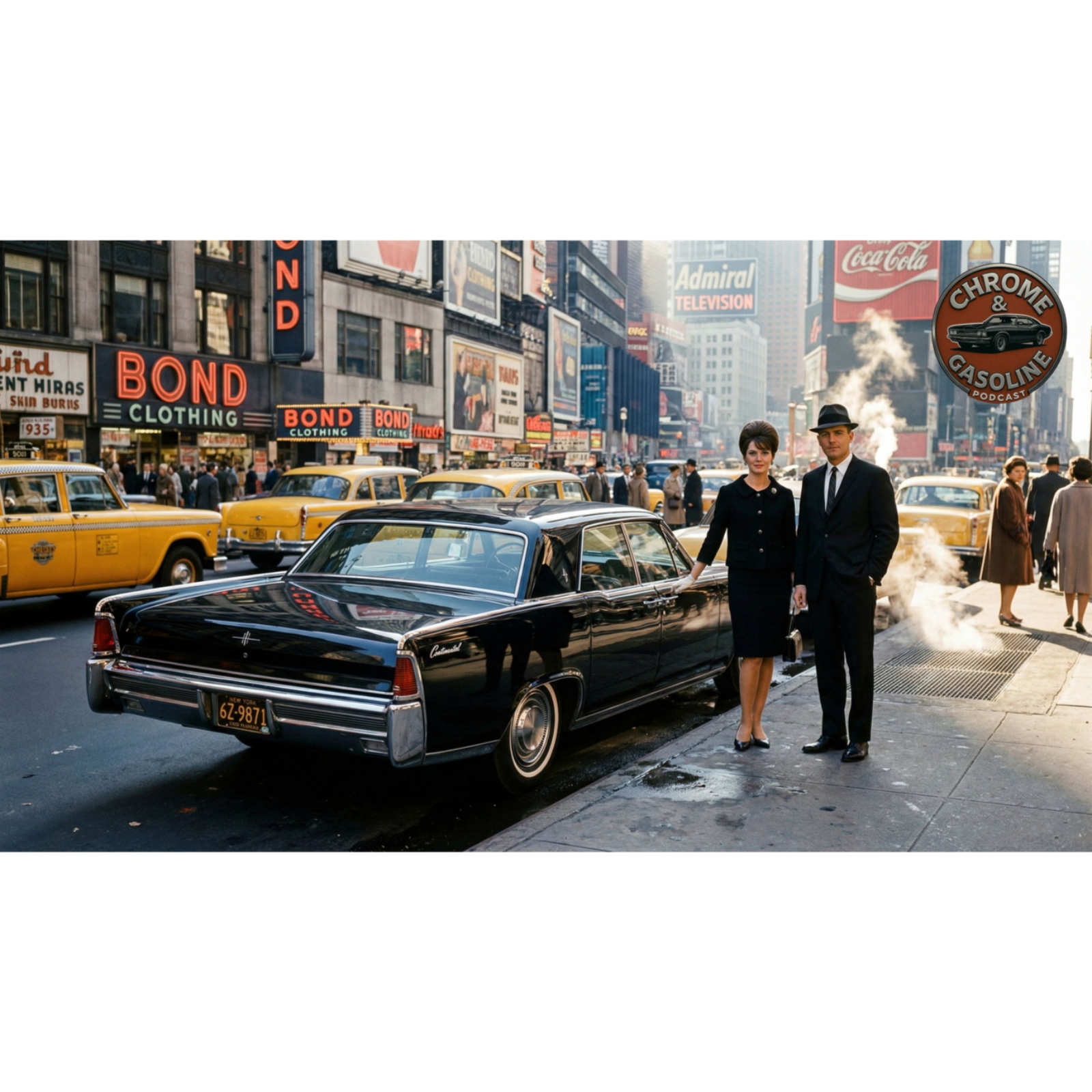
The body looks like it was carved from a single block.
Then carefully scored with just enough lines to keep it interesting.
Every crease has a purpose.
It's long, but not messy.
It's big, but not loud.
It doesn't scream.
It just calmly takes up half the block and assumes you'll notice.
That slab-sided look is the whole mood.
No wild curves, no fins, no flashy gimmicks.
Just a long, straight shoulder line running from headlight to taillight.
And sheet metal that appears laser straight decades before lasers were part
of the design process.
Parked at the curb, a 1961 to 1965 Continental looks like
modern architecture that escaped the drawing board.
It fits right in front of a glass office tower, a mid-century house,
or a fancy hotel awning.
And then there are the doors.
The rear-hinged rear doors are the Continental's party trick.
Open all four at once, and the car becomes a moving stage.
The rear doors swing toward the back,
earning that slightly dramatic nickname everyone knows.
They look theatrical, a little dangerous, and incredibly cool.
Step out of the back seat, and you don't exit the car.
You make an entrance.
Of course, from the driver's seat,
those doors feel a little bit like a trust exercise.
You're hoping everyone latches things properly,
because that's a lot of door swinging into the wind.
But for passengers, especially in the back,
they're genuinely practical.
The opening is wide, the sill is low,
and climbing in feels more like walking into a private lounge
than getting into a sedan.
Said all of this against the backdrop of the early 1960s,
the so-called Camelot era, polished suits,
sleek modern furniture, and big American optimism,
Lincoln needed to reinvent itself
to go toe-to-toe with Cadillac, not by out-chroming them,
but by out-classing them.
The Continental became Lincoln's statement piece.
We're still big, we're still luxurious,
but we're grown up now.
On the street, a 60s Continental
has a kind of calm authority.
In its day, it was a serious luxury machine.
Today, Park 1 next to a modern crossover,
and it absolutely dwarfs it in presence,
even if the dimensions aren't wildly different on paper.
Parallel parking, one feels less like a driving maneuver
and more like planning a small construction project.
You don't just park it,
you negotiate a treaty with the curb.
Yet despite all that size, it never looks cartoonish.
The proportions are too well judged.
The hood is long, but not absurd.
The roofline is low, but formal.
The rear deck is neatly trimmed.
Every angle gives you another taste
of that quiet confidence.
It's the rare luxury car
that looks both imposing and calm at the same time.
So in this first stop on our little Lincoln journey,
the big takeaway is simple.
The 1961 to 1965 Continental was a design reset.
Where everyone else had been chasing fins and flash,
Lincoln built a clean, confident brick on the boulevard
and turned it into art.
Next time, we'll talk about
what's hiding under all that sheet metal
because a car this heavy doesn't move itself.
I'm Alex, this is Chrome.
Mo, and gasoline, and we're just getting warmed up.
Episode two, under the slab sides.
Welcome back.
It's Alex with Chrome and gasoline.
Last time we talked about the 1961 to 1965
Lincoln Continental as the cleanest brick on the boulevard.
Today, we're lifting the metaphorical hood
and talking about what actually
drags that monument down the road
because hopes and mid-century furniture catalogs
do not power this car.
Under that long, flat hood lived big V8s
from Lincoln's MEL family.
I think large displacement, lots of torque,
and an attitude that says, I will move this house,
just don't rush me.
In the early 60s, you'd find engines
around the 430 cubic inch neighborhood
powering these Continentals.
As the decade went on,
similar big MEL V8s grew even larger
with displacements like the 462
appearing in the mid-60s Lincoln lineup.
The themes stayed the same.
Smooth, quiet force instead of high-rev fireworks.
These engines weren't interested
in screaming their way to redline.
They were more about a deep, effortless push.
Press the throttle and the car doesn't lunge.
It glides harder.
The whole experience feels like an elevator
that's very sure of itself.
You don't really floor it in a Continental.
You make a polite request for more momentum
and the big V8 grants it without losing its composure.
Bolted to that torque is a big automatic transmission
with three forward gears tuned with one mission.
Keep everything calm.
Shifts are smooth, almost invisible when the car's healthy.
No neck-snapping drama, no performance theatrics,
just quiet steps from one ratio to the next.
It's the sort of transmission
that seems personally offended by the idea of a harsh shift.
The layout is classic luxury American,
rear-wheel drive with that big engine up front
and a long drive shaft heading to the rear axle.
What's not so typical for the era
is the unibody construction.
Instead of a separate frame,
the body and structure are integrated,
which helped give the Continental
its solid, almost carved feeling.
Combined with a long wheelbase,
everything works together
to create that famous Lincoln float.
You don't so much drive a 60s Continental as pilot it.
The suspension is tuned for comfort, not autocross glory.
The car smooths out bad pavement,
expansion joints and minor road sends,
as if it's been instructed not to bother the passengers
with anything as uncivilized as reality.
Power steering and power brakes play their part too,
making it surprisingly easy
to guide this big rectangle around,
at least once you get used to the size.
Inside, all that mechanical effort is wrapped in luxury.
Imagine a deep, dark exterior color
like a rich black or metallic blue
with pale leather seats and thick carpets
that absorb the world's problems.
You sit behind the wheel, look down that long hood
and the drivetrain is busy turning gasoline into serenity.
The engine and transmission are working,
the unibody and suspension are cooperating,
and you sit there enjoying the illusion
that traffic is something happening to other people.
Of course, there's a price for moving a heavy,
unaerodynamic mansion with a big V8.
Fuel economy is character building.
If you're the kind of person
who checks gas prices daily
and collects fuel points like trophies,
this is not your spirit animal.
The continental is more of a fill it up, don't ask,
and let's go kind of.
Companion, you measure the smiles per mile,
not the miles per gallon,
but that's the magic of this setup.
Big V8 torque, a gentle three-speed automatic,
rear-wheel drive, unibody solidity,
and a long wheelbase all work together
to create one feeling, effortlessness.
You don't buy a 60s Lincoln Continental
to save anything except your own stress levels.
Next time, we'll step out from under the hood
and into the cabin to talk about what it's like
inside this rolling living room,
especially if the roof happens to fold away.
I'm Alex, this is Chrome and Gasoline,
and the brick on the Boulevard
has a very soft couch and inside.
Episode three, living in room on wheels.
Hey, it's Alex again with Chrome and Gasoline,
and today we're opening the door of the 1961
to 1965 Lincoln Continental
and stepping into what is basically
a mid-century living room on wheels.
If you've ever looked at one and thought,
that seems like a nice place to sit still,
you're absolutely right.
The only twist is that it also moves.
The first thing you notice
inside a Continental of this era is space,
big broad seats that feel less like car chairs
and more like sofas that were tailored up for a road trip.
Wide armrests invite your elbows to relax.
The dash stretches out in front of you
like a control panel from a stylish 60s lounge,
clean horizontal lines, tasteful chrome,
and gauges laid out with a kind of quiet confidence.
Materials matter here.
Leather that's rich without being gaudy,
bits of wood and chrome applied like accents
instead of decorations thrown from a moving truck.
You get the sense somebody thought about
where every switch and dial went.
The cabin feels curated rather than crowded
even though there is no shortage of things to touch.
And there are a lot of things to touch.
Power windows, power seats, power door locks, power antenna,
and on the convertible, a power top system
that is legendary for both its complexity and its drama.
Sit in the driver's seat of a well-optioned Continental
and you're basically the captain of a very polite ship.
The first time you slide behind the wheel,
you spend a good minute just looking around,
thinking, I wonder what that switch does.
Colors seal the mood.
Picture a car in deep presidential style black
with a light ivory leather interior.
The contrast making the cabin feel even more spacious
or a soft metallic blue exterior
over matching blue leather
like someone turned a calm ocean into upholstery.
You also saw whites, silvers, and elegant greens
often paired with interiors
that echoed or complimented the paint.
The whole car feels color coordinated
in a way that makes modern black over black
seem a little lazy.
Now, about that convertible.
A four-door convertible luxury car is already unusual.
To then give it those dramatic rear-hinged rear doors
and a power top that disappears
in a carefully choreographed sequence.
That's not just engineering.
That's a flex.
The mechanism is intricate with panels and framework
moving in a sequence that feels like a slow magic trick.
From the outside, the finished look is astonishing.
A long, open four-door luxury car
gliding by with no visible roof
like a parade float that grew a V8.
From the owner's perspective,
that same complexity means you treat
the top switch with respect.
It's a fantastic party piece,
but it's the sort of thing you want adjusted
by someone who knows which relay does what.
Still, when it works correctly, the payoff is enormous.
Top down, windows dropped, four big doors,
and a full complement of passengers
all surrounded by leather and chrome
while the world gets a free show.
Driving from inside this cabin
is its own exceptional experience.
You're surrounded by soft surfaces,
powered everything, and have enough switches
to confuse a new driver.
It's very easy to picture someone sitting
in the driver's seat for the first time
and asking, does this button raise the antenna
or launch the garage door into orbit?
It feels more like piloting a small yacht
through traffic than driving a sedan.
The continental's interior is where the design,
engineering, and luxury all meet.
It's not just about being transported from A to B.
It's about doing it in a space
that feels intentional, comfortable,
and just a little bit theatrical,
especially if the roof folds away.
Next time, we'll step out of the cabin
and look at how these cars live in the wider world.
Presidents, pop culture,
and what it's really like to own one today.
I'm Alex, this is Chrome and gasoline,
and we're just getting cozy in this rolling living room.
Episode four, presidents, pop culture,
and owning one today.
Welcome back, this is Alex with Chrome and gasoline,
and today we're talking about the 1961 to 1965
Lincoln Continental, out in the wild.
This car didn't just live in driveways
and dealer showrooms.
It ended up on some very serious streets
and some very famous screens.
When people think of early 60s continental's,
a lot of minds go straight to Washington.
These cars were closely associated with US presidents
and high level officials,
especially in limousine and parade form.
Images of long dark Lincoln convertibles
rolling slowly through city streets,
flags on the fenders,
and suited passengers in the back seat
are burned into the historical record.
It's a connection that gives the continental
a certain weight, a sense that it's not just a car,
but a witness to essential chapters.
You also see these Lincolns pop up in movies,
TV shows and photo shoots whenever someone wants
to capture that specific mid-century cool.
Clean lines, serious presence, and those dramatic doors.
Directors and photographers love a car
that looks stately, just sitting still.
The continental is basically instant production design.
Park one in the background
and the scene suddenly feels more expensive.
So what is it like to own or drive one of these today?
First, you have to accept that this is a big car
from a different era.
The size and weight are real.
On a modern highway, it actually settles in pretty nicely.
Long wheelbase, smooth suspension,
and that big V8 make it a fantastic cruiser
at reasonable speeds.
It's when you exit the highway
and start threading your way into tight parking lots
that you remember you brought a rectangle
to a world built for rounded crossovers.
Parking is an adventure.
You spot a space, you aim carefully,
and then you gently guide several thousand pounds
of mid-60s Lincoln into a spot
that was probably measured
using a compact hatchback as a reference.
You learn to check your mirrors, your surroundings,
and possibly your horoscope before committing
to a parallel parking attempt on a busy street.
Mechanically, ownership is a mix of luxury
and responsibility.
The big V8, the automatic transmission,
the power steering and power brakes
can all be reliable if maintained,
but you're dealing with components
that have been around for decades.
Parts are generally available if you know where to look,
but this is not a car you fix
with whatever you find at the corner store.
Having a good mechanic who understands
older American luxury cars
is practically part of the ownership checklist.
Then there are the power features
and on convertibles, the top.
Power windows, seats, locks, and antennas are wonderful
until age catches up and something moves slower
than it should or not at all.
The convertible top with its elaborate mechanisms
needs respect, careful adjustment,
and sometimes patient diagnosis.
It's not a reason to avoid the car,
but it is a reminder that you're caring
for a complicated piece of history,
not just transportation.
As for driving one daily,
most people treat a 60s continental
as a special occasion car.
You can drive it regularly if you're committed,
but it's not the same experience
as hopping into a small modern car
with great fuel economy and tiny turning radius.
You wouldn't use a grand piano as your coffee table.
You could, but that's not really the point.
In terms of collectability and desirability,
these cars sit in a sweet spot.
They're respected, visually iconic,
and tied to an era that still fascinates people.
Values vary with condition, originality, and body style,
but the underlying appeal is stable,
presence, elegance, and that unique combination
of design, purity, and historical connection.
At the end of the day,
people are still drawn to the 1961 to 1965 Lincoln Continental
because it makes every trip feel like an event.
A grocery run becomes a slow parade.
A Sunday drive turns into a small chapter
in your own personal history.
In our final episode,
I'm going to tell you my own Lincoln story
because of course I have one.
I'm Alex, this is Chrome and Gasoline,
and I'll see you in a moment for a little personal confession
involving a very long car and a very small parking lot.
Episode five, Alex's Lincoln Story.
Hey, it's Alex with Chrome and Gasoline,
and for this last episode
of our Lincoln Continental mini series,
I'm going to do something dangerous.
I'm going to tell you the truth
about the first time I tried to park one.
A friend of mine had a mid-60s Continental sedan
in a dark, almost inky color with a pale leather interior,
one of those cars that looks like it should come
with a security detail.
He called me up and said, I need a favor.
The Lincoln has to go from my storage unit
to a downtown hotel for a wedding.
You love old cars.
You want to drive it?
This is the kind of question you don't answer with words.
Your soul hits the throttle.
So I show up at the storage unit.
The metal door rolls up and there it is.
A long, low slab of 60s Lincoln
sitting under a dusty car cover.
We pull the cover off and the car looks like
it's been waiting for a motorcade
that got delayed by a few decades.
I open the front door and you get that smell.
You only find in older luxury cars,
old leather, a hint of fuel, a little bit of time.
The door closes with a heavy, precise sound
that makes modern doors seem a bit thin.
I slide into the driver's seat and suddenly I'm small.
The dash stretches out in front.
The hood stretches even farther
and the rear deck feels like it's somewhere
in a neighboring county.
We fire up the big V8.
It doesn't bark.
It clears its throat, settles into a deep, quiet idle
and the whole car just hums.
Drop the automatic into drive, let off the brake
and the continental starts to roll
like it was never supposed to stop moving
in the first place.
The power steering is light.
The brakes are firm but friendly
and in a few minutes, I'm thinking, I could get used to this.
On the highway, it's glorious.
The car settles down.
The big V8 just whispers along
and the world moves by in wide screen slow motion.
You sit back in that big leather seat,
one hand on the wheel
and suddenly every other car looks nervous around you.
People stare, phones come out, thumbs point.
You are not blending in
and the Lincoln is fine with that.
The real plot twist comes when we get off the highway
and arrive at the hotel.
The entrance is busy, the valet area is crowded
and the only place to park this thing is a row of spots
that look like they were laid out
using compact rental cars as a template.
I pull up, look down the endless hood,
glance at the mirrors
and realize this is about to be a geometry exam.
I start the turn, trying to swing the nose wide enough
without taking out any decorative planters.
The rear hinged rear doors
mean there's a lot of doorline to think about
even when they're shut.
People are watching.
The wedding party is outside.
There are cameras.
Somewhere in the universe,
the spirit of a Lincoln engineer
is watching and judging my turning radius.
After a couple of careful corrections,
some creative steering input
and one moment where I was positive
we were longer than the parking space itself,
the continental settles into place.
I open the door, step out
and the car just sits there.
Calm and perfect
as if it didn't just make me sweat
like an overworked valet.
Later that night, driving it back out of the city,
we took the long way home.
The streets were quieter.
The big V8 was still smooth.
The automatic was doing its seamless gear changes
and the car floated over beat up pavement
like it was erasing the road as it went.
The dash lights glowed softly.
The leather creaked just a little
and for a few miles,
it felt less like I was driving a car
and more like I was borrowing a piece of history.
That's what the 1961 to 1965.
Lincoln Continental means to me.
It's beautiful, a little intimidating,
occasionally inconvenient
and completely worth the trouble.
It turns simple drives into stories.
It carries the weight of its era
without feeling trapped in it.
And every time you close one of those doors,
you're reminded that someone once decided
luxury should think like this.
So that's my Lincoln story.
I'm Alex and this has been our Continental Tour
on Chrome and Gasoline.
Thanks for riding along with this clean,
elegant brick on the boulevard.
Until next time, keep the tank at least half full
and the stories even fuller.
I'm here on a job site with Tim,
who owns his own electrical contracting business.
Three employees and two work trucks.
Tim traded up to Geico commercial auto insurance.
We're positively here where he needs us most.
They sure are.
With step-by-step help on all his insurance needs,
all for shockingly low rates.
Shockingly low, huh?
Just a little bit of electrician humor.
Did you get it?
I got it.
You know, it feels like we have a real connection.
All right, I'll stop.
Get a commercial auto insurance quote today
at geico.com and see how much you could save.
It feels good to Geico.
About this episode
Exploring the 1961-1965 Lincoln Continental reveals a stunning blend of luxury and understated design, moving away from the flashy styles of the 1950s. The episode highlights its clean lines, spacious interior, and unique rear-hinged doors that create a dramatic entrance. The discussion also delves into the powerful yet smooth V8 engines, unibody construction, and the car's cultural significance, including its association with U.S. presidents. Alex shares personal anecdotes about driving and parking this iconic vehicle, emphasizing its presence and the experience it offers.