Hello, I'm here during the lunch rush with Janice, who owns her own food truck.
Best cheese sticks in town?
Janice traded up to Geico Commercial Auto Insurance for her food truck business.
We're here where she needs us most.
There sure are.
We make it so easy for her to save, with customized coverage that grows with her business.
Sorry, I just get so emotional talking about saving folks' money.
Not this onion I'm chopping.
It's just so beautiful.
Oh yeah, nice the onion.
Get a commercial auto insurance quote today at Geico.com and see how much you could save.
It feels good to Geico.
Hey, everyone.
Welcome to Chrome and gasoline, the show where we live for the smell of hot oil and the sound
of eight cylinders breathing deep.
I'm your host, Alex, and this is our brand new miniseries on one car and one car only.
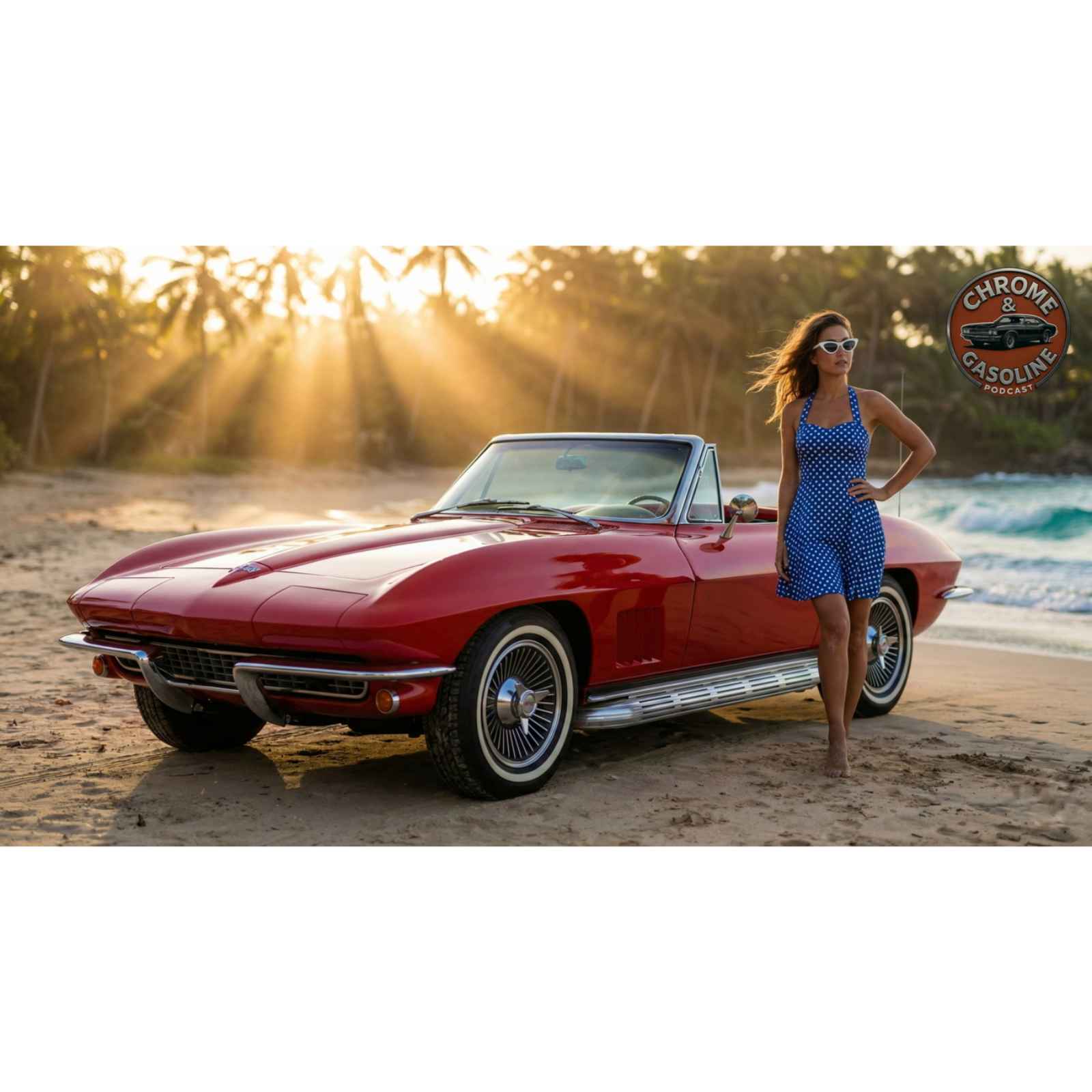
The 1963 to 1967 Chevrolet Corvette Stingray.
Today, episode one, birth of a legend.
The day everything changed.
Picture late, 1950s Detroit.
The first generation Corvette, the C1, is cute.
It's fun, but honestly, it's getting embarrassed by Jaguars and even Porsche.
356 on the racetrack.
GM vice president of styling.
Bill Mitchell is not happy.
Legend says he went marlin fishing in Florida, watched a stingray glide past the boat
and the light bulb went off.
Sharp nose, tapered tail, pure predator.
He comes back, funds a secret project out of his own pocket called the Stingray Racer.
A wild silver open top with side pipes that smokes everything at SCCA events in 59 and
60, Mitchell tells designer Larry Shinoda, I want the production car to look like that
racer just grew a roof.
Fast forward to September 1962, Chevrolet drops the bomb.
The all new 1963 Corvette.
No more solid rear axle.
For the first time ever on an American production car, independent rear suspension, a new ladder
frame, a stiffer chassis, a shorter wheelbase, and that jaw dropping body.
The coupe has the famous split rear window, one year only, that turns the back of the
car into a dramatic fastback.
Convertible still looks killer, but the coupe?
People literally stop on the street.
Under the hood, you can get anything from a 250 horse 327 up to the brand new fuel injected
version pumping out 360 horsepower four wheel drum brakes, discs come later, four speed manual
standard, and you can even order knock off aluminum wheels that look straight off a race car.
The press loses its mind.
Car and driver calls it the most beautiful car in the world.
Sales double overnight.
The Corvette stops being a weekend toy and becomes America's legitimate answer to Ferrari.
And that split window?
Half the buyers loved the drama.
The other half complained it wrecked rear visibility.
Guess who won that argument next year?
So that's how the stingray was born.
One man's fishing trip, one designer's pen, and Chevrolet finally deciding to
build a real sports car.
Next episode we're diving deep into the curves, the hidden headlights, and why
driving a 63 to 67 still feels like strapping into a rocket with chrome bumpers.
And now a little anecdote.
First time in a split window.
I'll never forget the first time I drove a real 63 split window coupe, riverside red,
black interior, fuel-y.
The owner hands me the keys as if he's passing along the nuclear codes.
I fold myself in.
The door shuts with that solid fiberglass thunk, and the cockpit is so tight my left
knee is flirting with the dash.
Fire it up, brap, brap, brap it.
The fuel-injected 327 settles into that loppy idle that sounds like it's daring you.
Pull out onto Pacific Coast Highway at dusk.
Top down, even though it's a coupe.
Yeah, I took the roof off first.
I roll into second gear, floor it, and the nose lifts just enough to remind
you 3,200 pounds is nothing when 360 horses wake up.
The split window turns the rear view into two letterboxes of pure 1963.
California sliding away behind me.
And the smell, hot fiberglass, amicobremium, and salt air hits like a time machine.
60 comes up so fast that the hidden headlights haven't even finished popping up yet.
That's the moment I understood why people sell houses for these things.
Thanks for riding with me on chrome and gasoline.
If you're enjoying the series, hit that subscribe button and tell a friend who
still believes in carburetors.
See you next time.
Welcome back to Chrome and Gasoline.
I'm Alex, and we're knee-deep in the greatest Corvette generation ever built.
The 1963 to 1967, C2, Stingray, last episode.
We watched it burst onto the scene in 63.
Today, episode two.
Sexiest shape on wheels.
You drop into the driver's seat.
And I mean drop because ground clearance is basically a rumor.
Twin cowls on the dash stare back at you like a fighter cockpit.
Deep dish steering wheel, big tack, and speedo right in your face.
And every switch feels like it was placed by someone who actually drives fast.
Outside, pure drama.
That long hood stretches forever.
Fender peaks rise like a cobra ready to strike.
And starting in 1964, the split window disappears,
replaced by a single piece of glass that actually lets you see the car chasing you.
Hidden headlights flip up with a satisfying whir, electric motors in 63.
Vacuum in later years when they were trying to save weight.
Side pipes were optional every year and still sound like God clearing his throat.
Colors?
Riverside red, Daytona blue, Milano maroon.
Names that make grown men weak.
And the chrome rocker panels on early cars?
Gorgeous until you realize stones chip them to death.
Underneath, the magic is that new independent rear suspension with a transverse leaf spring.
It transforms the car.
Suddenly Corvette's corner like they mean it instead of just going straight really loud.
Brakes go from drums to four wheel discs in 65.
Best brakes in America overnight.
Engines?
The small block 327 grows legs every year.
300, 340, 350, 365 horsepower with Holly carbs or that insane Rochester fuel injection.
The 1965 drops the bomb.
The 396 big block, 425 horsepower in a 3,200 pound fiberglass body.
Zero to 60 in about five seconds when Mustang GTs were still bragging about nine.
In 1966, the 427 replaced the 396 and in 67 you can order it with tri-power.
Three two barrels making a factory claimed 435 horsepower that everyone knows is closer to 500.
Driving one feels alive.
The steering is quick, the ride is firm, but never harsh.
And when you nail second gear, the whole car crouches and lunges like the stingray it's named after.
So whether you love the pure 63 split window coupe or the flared fender 67 big block roadster,
every single year has its own personality and every single one is drop dead gorgeous.
Next time we're hitting the track, Route 66 and even the silver screen,
the racing triumphs and pop culture moments that turn the stingray into an American icon
and now a little anecdote, big block 67 on a back road.
Last summer I got seat time in a numbers matching 67 L71 roadster, Marlboro Maroon,
427 tri-power, side pipes, no power steering, no power brakes, no excuses.
We're on this forgotten two lane north of Malibu, sun low, eucalyptus everywhere.
I bang second gear at about 4500 rpm and the three two barrels open like church doors on Sunday.
The whole car squats, the stinger hood ripples and those side pipes turn into flamethrowers.
Wah boom boom boom, every explosion bouncing off the canyon walls.
The tach needle swings past 6000 so fast I almost miss the shift.
The back end steps out just enough for me to catch it with opposite lock,
tires howling like banshees on bias plies.
My passenger, a grown man who races modern GT3s,
is white knuckle grip in the dash screaming, this thing is possessed.
I just laughed because the steering is talking to me through that thin wood wheel telling me
exactly where the grip is. That's not horsepower, that's witchcraft with chrome valve covers.
Thanks for riding with me on chrome and gasoline. If you're enjoying the series,
hit that subscribe button and tell a friend who still believes in carburetors. See you next
time. Rev those engines and welcome back to chrome and gasoline. I'm Alex, still living in 1963 to
1967 Corvette heaven. We've covered the birth and the beauty and now Episode 3 Kings of the Road
and Track. You mash the loud pedal on a 67 L71 for 27, try power and the world disappears.
The hood lifts a little, both back tires light up and you're doing 70 before you
finish shifting to third quarter mile, times in the low 13 seconds, stock with point ignition
and bias ply tires. That's how you humble a hemi on a Saturday night in 1966, but the stingray
wasn't just a drag strip terror. Privateers like Roger Penske, Dick Goldstrand and the
Grady Davis Gulf oil team took grand sports and production cars to Le Mans, Daytona, Sebring,
and they scared Ferrari silly. The lightweight Z06 package in 63 with its monster 36.5 gallon tank
centered metallic brakes and thicker sway bars turned street cars into barely legal race cars.
Then there's the five factory grand sport lightweights in 63 aluminum blocks, fender flares,
550 horsepower. They were so fast that Chevrolet had to withdraw official support to keep the
piece with the AMA over the racing ban. Only 100 L88s in 67 to 69, but the spirit started right here
in the C2. Off the track, the stingray became the car of the 1960s fantasy. Route 66 television
show, Todd and Buzz cruising in a new Corvette. Every season, Apollo astronauts got 67s as lease
cars for a dollar a year. Elvis had one, so did John Glenn. In movies, it's everywhere.
Austin Powers didn't invent the swinging vibe, the stingray lived it. It represented everything
America wanted to be in the mid 60s. Fast, loud, beautiful, a little dangerous, and completely
unattainable unless you were willing to skip a few mortgage payments. Bottom line, the C2 didn't
just perform. It redefined what an American car could be and it looked cool doing it.
And now a little anecdote. 65, fuely rain run, taste the storm, top down in the rain.
65, fuely, Mulholland at midnight. The cockpit smells like wet dog and race gas.
Then I floor it and the Rochester injection screams, sucking in raindrops that explode into mist.
Every breath is a mouthful of cold water, hot exhaust, and that metallic tang of mechanical
fuel injection. The leather wheel is swollen and slippery from the rain. My palms leave perfect
prints that refill the instant I shift. The headers are cherry red. And every raindrop that hits them
flashes to steam, hot vapor blasting up through the hood scoops and into my face like a sauna full
of 100 octane. I'm chewing on the air. It tastes electric, like licking a spark plug mixed
with summer rain and scorched good year rubber. The seat is soaked. Cold water pools under my thighs,
then instantly warms from the transmission tunnel heat. When the tires finally bite after
a hydroplane heartbeat, the g-force slams me sideways and the door panel kisses my shoulder
with wet vinyl that tastes faintly of mildew and pure freedom. When I lick my lips, next episode
we bring it home. What these cars are worth today, which ones to hunt for and why the Stingray's legacy
still echoes in every Corvette that rolls off the line in bowling green. Thanks for riding Shotgun
on chrome and gasoline. See you for the finale. Welcome to the final ride of our chrome and
gasoline mini series on the 1963 to 1967 Corvette Stingray. I'm Alex and if you've been
listening all week, your garage probably feels empty right now. Episode four still turning heads
after 60 years. You walk into a concor field today and the C2 row still stops traffic.
A real 63 split window fueling in the right color can bring 200 grand easy A documented L8867
roadster. Try north of 2 million. Even solid small block convertibles are six figures now.
Prices have climbed every year for two decades and they're not done. So which one should you chase?
63 split window coops are the poster children but 67 big block roadsters with side pipes and
stinger hoods are pure sex on wheels. The sweet spot for most of us? A 65 to 66 small block
coop with factory air and four speed. Stunning to look at. Still a blast to drive and you
might find a nice one south of 100 grand watch out for. Rust never eats the fiberglass but the birds
cage around the windshield pillars and the frame underneath absolutely can check for crash damage.
Fiberglass hides sins badly and numbers matching matters more on C2's than almost any other
classic. Restoring one budget double what you think chrome shops and CRS judging guides and
correct date coated plug wires will humble you fast. But when it's done and you fire that 327
for the first time man there's no sound like it. The stingrays real legacy it saved the Corvette
name. Without the C2 there might never have been a C3, S4 or the mid-engine S8 we're driving today.
Every modern Corvette still carries that sharp nose those hidden headlights and that attitude that
says I dare you to keep up. And now a little anecdote 1966 427 slash 425 dawn on Ortega the full
breakfast of senses cold start on a 66 big block at 5 a.m. the 427 coughs blue smoke that tastes
like frozen race gas and despair until the secondary is open then it's suddenly sweet and rich
like maple syrup poured over burning tires the fiberglass fender is ice under my fingertips
numbingly cold then the headers tick and pop and the heat radiates through the hood so fast
I can feel the paint temperature climb under my palm slide in the seat leather is stiff and
cracked biting into the backs of my legs like stale toast still carrying that ghost flavor
of 1960s brill cream and cigar ash when I breathe deep the wood wheel is frigid at first then warm
so fast it feels alive I roll onto Ortega highway and the big 427 finally clears its throat exhaust
notes so fat and rich it coats my tongue like barbecue smoke downshift into a hairpin and the
G's pin me into the bolster the vinyl is tacky from overnight dew and tastes salty when I bite
my lip on the exit sun crest the ridge chrome explodes with light and the cow vent scoops sage
brush air so thick with wildflowers and hot oil I'm chewing on California itself every shift the
hearse knob is molten aluminum in my palm every throttle blip sends a hot pulse out up my right
foot and for 10 perfect miles I'm tasting touching and breathing the greatest sports car
America ever built so that's our series four episodes 20 minutes of pure American dream
machine I hope somewhere out there you've caught the bug and you're already scanning
classifieds for a stingray of your own thanks for spending your week with me on chrome and
gasoline if you love the show leave a review tell your car club buddies and keep the revs high
and the rubber side down until the next tank of premium and open road this is alex signing off
if you're an h-fact technician and a call comes in granger knows that you need a partner
that helps you find the right product fast and hassle free and you know that when the
first problem of the day is a clanking blower motor there's no need to break a sweat with granger is
easy to use website and product details you're confident you'll soon have everything humming
right along call 1 800 granger click ranger.com or just stop by granger for the ones who get it done
About this episode
Exploring the iconic 1963-1967 Chevrolet Corvette Sting Ray, this episode dives into its revolutionary design and engineering that transformed it into America's answer to European sports cars. From the inspiration behind its creation to the introduction of independent rear suspension and the split rear window, listeners learn how the Sting Ray captured hearts and minds. Anecdotes from driving experiences highlight the raw power and beauty of these cars, making it clear why they remain coveted collectibles today.