Refresh your home for the new year with Dania Furniture.
From elevated living and dining pieces to cozy guest rooms,
create spaces that feel fresh and ready for everything the new year brings.
Explore modern dining sets, stylish storage solutions,
and contemporary pieces that make the most of every moment.
Dania Furniture. We make it simple. You make it home.
Visit your local showroom or shop online at daniafurniture.com.
Episode 1, 1964, How Pontiac Invented Trouble on Purpose.
Hey, I'm Alex, and this is Chrome and Gasoline,
the show where we celebrate the kind of engineering decisions that begin with,
technically, the rule didn't say we couldn't.
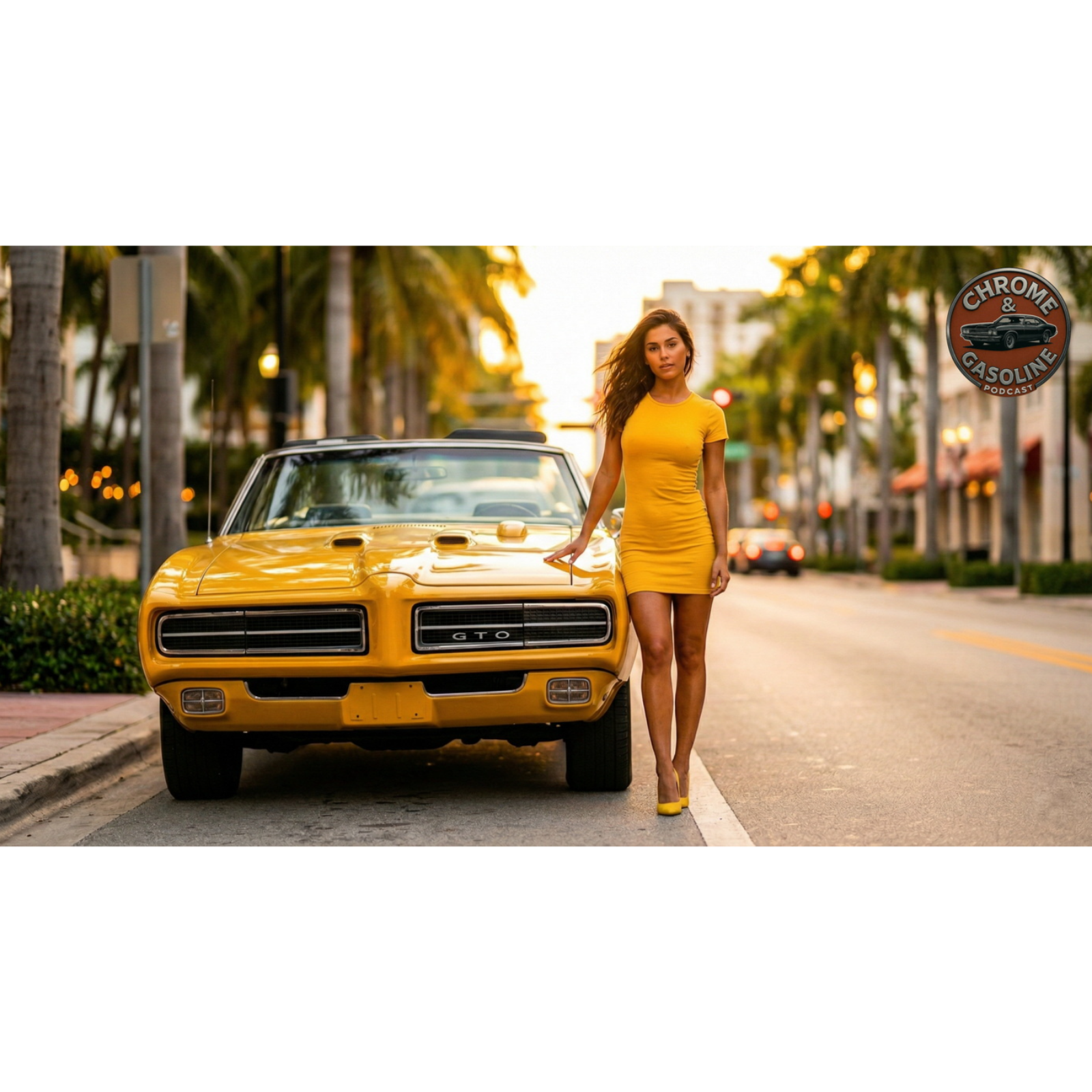
Let's talk about the 1964 Pontiac GTO,
not a standalone model at first,
more like an option package that Pontiac slipped into an intermediate-sized car,
the Le Mans, like hiding a firecracker in a lunchbox.
The idea was simple. Take a normal-ish, mid-size Pontiac
and stuff a big V8 in it.
And by big, I mean the kind of engine that makes your neighbors
suddenly get very interested in local noise ordinances.
Now, in the early 60s, General Motors had a corporate policy that basically said,
let's all calm down, especially with big engines and smaller cars.
Pontiac heard that and responded the way a teenager responds to a curfew.
Sure, totally. Anyway, the GTO was a beautiful workaround,
an option package, not a separate model,
which is the automotive version of saying,
I didn't break the rules, I just aggressively interpreted them.
Under the hood, the early GTOs centered around Pontiac's 389 cubic inch V8,
and depending on how spicy your order form got, you could get serious power.
The legends love to argue exact numbers like their reading sacred texts,
so I'll keep it sane. It was fast for its day, it was torquey,
and it made ordinary commutes feel like you were late to a bank heist,
and then there's the name, GTO,
borrowed from European racing tradition, most famously Ferrari's 250 GTO,
because nothing says American practicality like naming your mid-size Pontiac
after an Italian thoroughbred. It's like buying a lawnmower and calling it
Monaco Grand Prix, but it worked. It sounded exotic.
It sounded important. It sounded like you should wear driving gloves
even if you're just going to get milk. This is also where our running gag begins.
The GTO is the goat. And yes, the G-O-A-T before G-O-A-T was a thing.
Greatest of all time? Sure. Also, an actual goat.
Meaning, stubborn, loud, and fully willing to climb onto your roof for no reason.
That is the GTO energy. Time for my 1960s marketing translator.
Here's the brochure voice. A spirited new performance option for the discerning driver.
Translation. Congratulations. You have purchased a reason to talk to strangers at gas stations.
Because that's what the 1964 GTO really created. The modern muscle car mood.
A car that wasn't pretending to be refined. A car that wasn't apologizing.
It was the moment American performance started saying,
What if we made the fun the whole point? And the wild part is how quickly it all happened.
Pontiac didn't ease into it. There was no let's try a mild one and see how it goes.
No. They lit the match, smiled politely, and watched the whole segment catch fire.
In a good way. Sort of. So that's 1964. The origin story.
An option package that became a legend. A big V8 in a mid-sized body.
And a name audacious enough to make everyone else look like they packed a sensible lunch.
Next episode, we hit 1965 and 1966. When Pontiac turns the dial from rowdy to are we sure this is legal?
And the goat starts headbutting the muscle car world into shape.
Episode 2. 1965 to 1966. The goat finds its face.
Welcome back to Chrome and Gasoline. I'm Alex and today we're talking 1965 and 1966.
When the Pontiac GTO stops being a clever idea and starts being a full-blown identity.
Like it got its driver's license and immediately tried to do a burnout in cursive.
By 1965, the secret was out. The whole, it's just an option package thing?
Yeah, nobody believed that anymore. The GTO had become a vibe. A statement.
A rolling announcement that you weren't interested in arriving quietly.
Stylistically, this is where many people fall in love. The mid-60s GTO look is pure confidence.
Aggressive front end. Strong lines. The kind of design that says, I lift weights.
Without ever specifying which weights or whether the form is good.
And it wasn't just looks. This was the era when ordering a GTO could feel like building a custom sandwich.
Except the toppings were things like bigger carbs, better breathing, and parts that make your insurance agent develop a stress twitch.
Let's keep the facts clean and the arguments off the porch. Yes, the 389V8 is still the core of the story here.
And yes, Pontiac gave buyers ways to crank up performance. If you wanted an automatic, you could do that.
If you wanted a manual and a more connected snappy feel, you could do that too.
The GTO didn't judge unless you tried to act like it was just a nice cruiser.
The Goat knows what it is. Goat logic rule number one. If the gas pedal exists, it must be tested.
Goat logic rule number two. The rear tires are a renewable resource.
And now the 1960s marketing translator returns, brochure voice, a responsive driving experience with commanding acceleration.
Translation, it moves as it owes you money. Then we get to 1966 and the GTO's design keeps sharpening its personality.
Pontiac leaned into the idea that this car should look fast even when it's parked,
which is important because half the muscle car lifestyle is sitting still while other people orbit your car like curious moons.
And culturally, this is where the GTO starts to represent more than horsepower.
It's the car that tells you something about America in that moment. Optimism.
Excess. A little rebellion and a willingness to accept consequences later.
Like ordering dessert first because life is short, and then immediately ordering a second dessert because so is restraint.
What's also happening during 1965 to 66 is the rest of the industry waking up.
Competitors see the GTO's popularity and start showing up with their own big engine midsize bruisers.
The muscle car era goes from Pontiac's fun experiment to everybody grab a helmet.
The goat didn't just join the party. It basically brought the speakers and told everyone else they were boring.
And yet, even with all that, the mid-60s GTO still feels relatively simple.
No screens. No driving modes named after emotions. Just engine, car, driver, and a clear message. It's your problem now.
Next episode, we hit 1967. The pivot year. New energy, new attitude, and the goat starts wearing a slightly nicer shirt while still trying to eat your lawn furniture.
Episode 3. 1967. Growing up but not calming down.
I'm Alex, and this is Chrome and Gasoline. Today's episode is 1967. The year the Pontiac GTO feels like it matures.
But in the way a mischievous friend matures when they start using a planner to schedule chaos.
By 1967, the world is changing. Safety expectations are climbing. Competition is everywhere.
And performance buyers are getting pickier. Pontiac responds by keeping the GTO's spirit intact while updating what matters.
The headline change, enthusiasts love. The engine story evolves. This is the period when Pontiac moves into the 400 cubic inch era for the GTO.
The car keeps doing what it does best. Making normal traffic feel personally insulted.
I'm not going to throw exact horsepower numbers at you like we're in a trivia cage match.
The honest truth is, a 67 GTO, properly optioned, is absolutely a real muscle car.
Strong torque, strong presence, and that classic V8 feel where the car doesn't rev, it announces.
Now it's time for our new segment, goat court. Today's case, did the GTO becoming more refined make it better or did it dilute the madness?
The court finds better. Because refinement doesn't mean boring.
It means the goat learned where the fence is. So it can jump it more efficiently.
Part of the 1967 appeal is balance. It's still got that mid-60s toughness, but it's starting to feel more cohesive.
Like Pontiac was learning which parts of the experience buyers wanted most and doubling down.
You get a car that feels slightly more buttoned up without losing the point.
If anything, it becomes more confident, less trying to prove itself. More like, yes, I am a GTO. Next question.
And let's be real, muscle cars are comedy. They are a punchline with a V8.
The GTO is still the kind of car where you can be sitting at a stoplight,
minding your business, and suddenly you're thinking, what if I accidentally become a legend for three seconds?
That's the goat whispering. Also, keep in mind, 1967 is a transition point in the industry.
Regulations and standards are moving. Manufacturers are adapting.
The GTO is adapting too, without turning into a polite appliance. That's the trick.
It stays a muscle car without becoming a parody of itself.
So if 1964 is the invention and 1965 to 66 is the swagger, 1967 is the GTO getting sharper,
still rowdy, just a little more deliberate, like it's learned to aim.
Next episode is 1968 and that's a big one.
Styling takes a bold step. The late 60s attitude shows up in the sheet metal
and the goat gets a whole new outfit. Tailored, dramatic, and absolutely not subtle.
Episode 4, 1968. The Glow Up Year.
Welcome back to Chrome and Gasoline. I'm Alex and we've reached 1968.
The year the Pontiac GTO shows up looking like it just got a makeover
and then immediately picked a fight with the concept of moderation.
1968 is a major styling reset. If earlier GTOs feel like crisp mid-60s muscle
with a clean classic look, the 68 leans into the late 60s vibe, more curves, more drama,
more this car definitely listens to the loudest song first.
And one of the signature talking points for 68 is the front-end treatment,
Pontiac's Endura concept, that body-colored, flexible front bumper idea
that helped create a cleaner, integrated face.
The effect is simple. It looks modern for its time and means the best.
And if you got specific options, the front could look even sleeker
because Pontiac understood that half of performance is psychological warfare at the stoplight.
Now, the GTO is still proudly old school where it counts, considerable V8 energy,
strong torque feel, and an ordering process that encourages questionable decisions.
You could still speck a GTO to be a grown-up, comfortable cruiser, but let's not kid ourselves.
This is still a car that makes you pronounce the word merge like it's an action verb.
Modern Comparison Time
In 2025, a performance car might ask you what mode you want.
Comfort, Sport, Sport Plus, Track. I'm feeling dramatic.
Tax Auditor, whatever. The 1968 GTO has one mode.
Yes, the touchscreen is your right foot. The driver assist system is your common sense.
Please update it regularly. Goat Court Returns. Case.
Is the 1968 redesign a glow-up or a betrayal?
Verdict, glow-up. The goat didn't change species.
It just started wearing a sharper jacket and learned how to pose for photos.
And culturally, 1968 is right in that sweet spot where muscle cars become rolling identity.
This isn't just transportation. This is a statement about who you are
or who you want strangers to think you are.
The GTO is basically a business card that says,
I make fun choices and I accept the consequences later.
So 1968 gives us a GTO that looks like the future of the era,
but still feels like the pure muscle car formula underneath.
It's bold without being goofy, aggressive without trying too hard.
Okay, it tries a little hard, but that's part of the charm.
Next episode is 1969, and that's where we hit peak personality.
The judge arrives, the graphics get louder, and the goat earns a crown,
possibly made of tire smoke.
Episode 5, 1969. The judge, the legend, and peak goat.
I'm Alex, and this is Chrome and Gasoline.
Today, we're finishing our 1964 to 1969 Pontiac GTO run with 1969.
The year the goat shows up wearing a cape and refuses to explain itself,
because 1969 brings us one of the most famous GTO packages ever, the judge.
And yes, it sounds like a stern authority figure,
but in practice, it's more like the cool cousin who convinces you to do something dumb
and then high fives you when it works.
The judge wasn't just about performance, though you could absolutely get serious hardware
depending on how you ordered it.
It was also about image, bold stripes, loud colors,
and a styling attitude that basically dared you to look away.
If earlier GTOs were confident, the judge was confident
and also brought glitter to the argument.
Let's do the 1960s marketing translator one last time.
Brochure Voice, a new youthful expression of Pontiac excitement.
Translation.
We made it louder so your friends will believe your stories.
And that's the magic of 1969.
It's peak late 60s muscle car culture, performance options, visual swagger,
and a sense that the entire industry briefly agreed subtlety was overrated.
The GTO in 69 feels like it's fully in on the joke,
but also fully capable of backing it up.
Goat Court Final Session.
Case.
Is the judge said too much?
Verdict.
That's the point.
The entire muscle car era is too much and that's why we love it.
These cars weren't designed to whisper.
They were designed to make memories, burn fuel,
and turn ordinary parking lots into tiny car shows.
So what did 1964 to 1969 give us?
A story arc.
1964.
Pontiac figures out how to sneak a big engine party into a mid-sized car.
1965 to 66.
The GTO becomes the blueprint.
Clean, aggressive, instantly recognizable.
1967.
It sharpens up and proves it can evolve without losing its soul.
1968.
It gets the glow up and looks like the late 60s in motion.
1969.
It goes full legend, especially with the judge,
because subtlety is for people who don't own stripe kits.
And beyond the specs, beyond the options, beyond the debates,
the GTO endures because it's honest.
It's a car that says driving should feel like something.
It should have character.
It should have a little danger, a little joy,
and a whole lot of sound.
The goat isn't just a car.
It's an attitude with a license plate.
That's our series on the 1964 to 1969 Pontiac GTO.
I'm Alex, and this has been Chrome and Gasoline,
where we celebrate the classics, respect the legends,
and gently remind ourselves that rear tires are not
technically forever.
If you're the purchasing manager at a manufacturing plant,
you know having a trusted partner makes all the difference.
That's why, hands down, you count on Granger for auto reordering.
With on-time restocks, your team will have the cut-resistant gloves
they need at the start of their shift.
And you can end your day knowing they've got safety
well in hand.
Call 1-800-GRANGER, click Granger.com or just stop by.
Granger for the ones who get it done.
About this episode
Exploring the evolution of the Pontiac GTO from 1964 to 1969, this episode dives into how Pontiac cleverly introduced the GTO as an option package, igniting the muscle car movement. The discussion highlights the GTO's transformation from a rebellious mid-size car with a powerful V8 to a cultural icon, showcasing its bold design changes and performance enhancements over the years. With humor and insight, the host reflects on the GTO's impact on American automotive culture, culminating in the iconic 'Judge' model of 1969, which epitomized the era's excess and personality.