It's that wave of torque you don't have to negotiate with.
The engine doesn't ask permission, it just starts pulling.
The car feels alive in a very analog way,
like it's communicating through vibration,
noise and the subtle panic in your passengers.
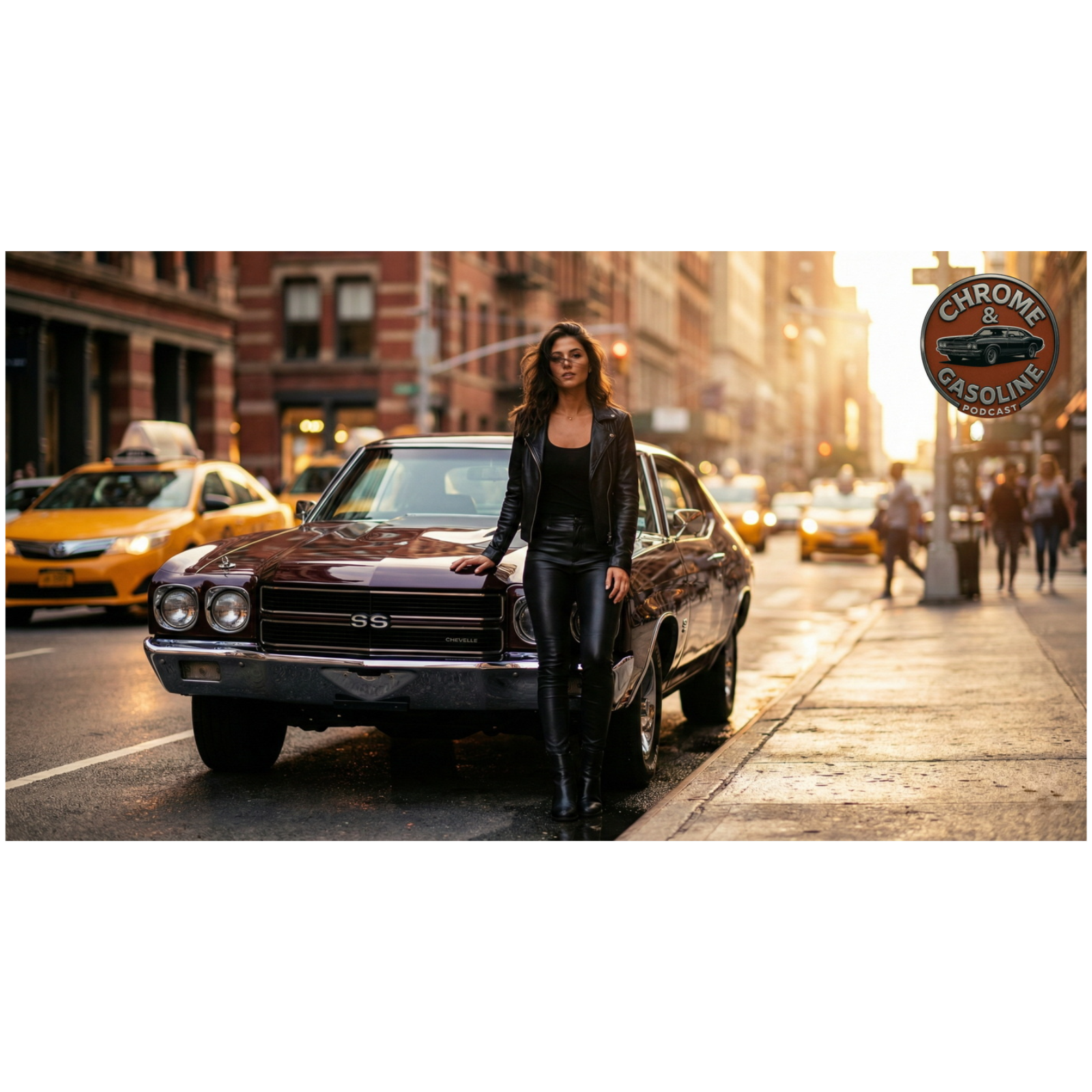
Practical takeaway, when you see a 67 Chevelle SS,
look for the details that tell you it was cared for,
not just polished.
How does it sit?
Does it look right?
Or does it look like it's wearing someone else's shoes?
Ask about suspension, brakes, and cooling upgrades
if it's driven regularly,
because enjoying a classic is better
than worshiping it under a cover like a museum statue.
Next episode, 1968 shows up with a full glow-up,
new shape, new swagger, and the kind of redesign
that makes people argue in parking lots
until somebody's burger gets cold.
Chrome and gasoline.
Episode three, the glow-up.
1968, redesign and street presence.
Welcome back to Chrome and gasoline.
I'm Alex, and today we hit 1968
when the Chevelle got redesigned
and suddenly looked like it started going to the gym
and listening to louder music.
1968 is a big deal
because the Chevelle's styling
shifts into a more aggressive, more modern look.
The body gets that Coke bottle shape
people love to say out loud
because it makes them sound like they own a clipboard,
translator, the sides pinch in around the middle
and flare out over the wheels,
its curves with purpose,
it's the automotive equivalent of a power stance.
Chevelle Group Therapy, session three.
I swear I bought it for the craftsmanship.
Uh-huh, and I bought a leather jacket for warmth.
We love these cars
because they look like they want to race,
even if they're parked at a diner next to a minivan
with a baby on board sticker.
Option code, decoder, ring.
When people argue SS,
they're usually arguing three things,
appearance, equipment and the engine.
The SS identity in the late 60s
is closely tied to that big block era,
especially the famous SS 396 naming.
But the real story is that Chevelle
offered different combinations
and over decades,
owners have mixed and matched parts
like a Lego set with a V8 addiction.
Let's talk about street presence.
A car like a 1968 Chevelle SS feels bigger than it is
because the design is muscular.
The hood looks like it's containing a small thunderstorm.
The stance is wider
and the whole package says,
yes, I'm mid-size,
but I also bench press your entire personality.
Parking lot mythbusters, episode three.
Looks are everything.
No, but they're a lot.
Here's the truth.
What makes these cars magic
is the balance between look, sound and feel.
The steering is not a video game controller.
The brakes are a suggestion by modern standards.
The suspension is trying,
but the experience is so physical and dramatic
that it sticks in your brain.
And 1968 era muscle is about more than stopwatch numbers.
It's about the sensation of speed.
The engine note is rising.
The body lifts slightly under the throttle.
The way the car communicates traction limits
by making noises that sound
like it's chewing gum angrily.
If you've never driven something like this,
imagine this, modern performance cars
are like a laparoscopic surgery robot.
Precise, controlled, almost too competent.
A Chevelle SS is like a bar fight you win with charisma.
It's messy, loud and unforgettable, practical takeaway.
When you're admiring or shopping, ask yourself,
are you chasing the perfect factory correct time capsule
or do you want the best driving version of the idea?
Both are valid, but don't pretend you want originality
if you secretly crave modern brakes
in a drivetrain that doesn't treat traffic
like emotional abuse.
Be honest with your dream.
Next episode is 1969, peak poster car cool,
peak arguments about what's best
and peak chances of whispering nice
at the sight of a well done SS in the wild.
Chrome and gasoline.
Episode four, 1969, peak sticker poster, cool.
Welcome back.
I'm Alex and today we're in 1969.
Arguably the year the Chevelle SS became
a full time celebrity.
If 1968 was the glow up, 1969 is the moment
the glow up shows up at prom
and everybody forgets how to speak.
The 1969 Chevelle SS has that look,
aggressive front end, confident lines
and a stance that suggests it's already idling
at judgmental levels.
This is the car a lot of people picture
when you say Chevelle, even if they swear
they're more into sleepers.
Sure you are and I'm more into salads.
Chevelle group therapy, session four.
The I had one in high school story.
It's always the same.
I sold it for $900 to pay rent
and everyone listening has the same reaction.
A silent scream that lasts 45 seconds.
If you're telling the story right now,
it's okay, breathe.
You are among friends, slightly traumatized friends.
Option code decoder ring, real SS.
You'll hear this phrase said with the seriousness
of a courtroom oath.
What people mean is did it leave the factory
as an SS configured car
or is it a tribute built from a standard Chevelle?
Here's my take.
A tribute done well can be fantastic.
A fake done poorly is just cosplay with rust.
The critical part is honesty and documentation
because the market is full of cars
wearing badges like Halloween costumes,
parking lot mythbusters, episode four.
Horsepower tells you everything.
It doesn't, weight, gearing, traction,
and plot twist, driver skill matter.
Also, the way a car makes power matters.
Two cars can have similar peak numbers
but one feels eager and alive
and the other feels like it's waiting for permission.
This is also where muscle car culture gets fun.
The Chevelle SS is a platform people personalize.
Wheels, tires, exhaust, ride height, and interior touches.
And yes, some purists want everything
exactly like it rolled off the line.
Bless them.
They are the librarians of horsepower.
Necessary, vigilant, and slightly terrifying
when you touch the wrong thing.
But for drivers, 1969 is a sweet spot.
It's classic but not too delicate.
It's muscular but still relatively straightforward.
It's the kind of car you can enjoy
without needing a PhD in why is it leaking today?
Practical takeaway.
If you're looking at a 1969,
focus on the body and structure first.
Classic cars can hide sins beneath their shiny paint
like a villain in a tuxedo.
Look for straight panel gaps,
honest metalwork, and signs of thoughtful restoration.
The drivetrain can be rebuilt.
Rust is a lifestyle.
Next episode, we hit 1970.
The year that gets spoken about like a legend,
a prophecy, and occasionally a tax bracket.
Chrome and gasoline.
Episode five, 1970.
The legend, the hype, and the reality check.
Welcome back to Chrome and gasoline.
I'm Alex, and we've arrived at 1970.
Chevelle SS territory so famous
it practically has its own theme park.
Let's address the big headline.
1970 is beloved because it represents
peak muscle car energy in a factory package.
This is where the Chevelle SS 454 enters the chat.
Among those, the LS6 is often treated
like the era's final boss.
High performance, highly collectible,
and capable of starting arguments
at any car show within a five mile radius.
Chevelle Group Therapy final session.
I want one, but the price is, yep,
the market has looked at 1970 Chevelle's
and said, what if we made nostalgia extremely expensive?
But don't worry, your admiration is still free.
For now, option code decoder ring LS6.
Without turning this into a phone book of specs,
here's the general idea.
It's a top tier performance big block package
that became legendary for its factory rated output
and real world punch.
People chase it because it represents
the peak expression of what Detroit muscle
was trying to do.
Put an absurd amount of engine into a mid-sized car
and call it a Tuesday.
Parking lot mythbusters, episode five.
A 1970 Chevelle SS is automatically the best.
Best depends on what you want.
If you want the most iconic, the most talked about,
the most likely to make strangers ask you questions
while you're just trying to buy milk.
Sure, but 1966 to 1969 can be just as satisfying,
sometimes more approachable
and often less stressful to own.
The best Chevelle is the one you can actually enjoy,
not fearfully dust in it like an ancient artifact.
Also, let's talk reality.
Factory muscle cars weren't perfect.
They were fast for their time,
dramatic for their time
and a little wild by design.
Modern cars will out corner them,
out break them, out everything them.
But modern cars don't give you
the same theatrical experience.
A big block Chevelle feels like
you're driving a mechanical event.
It's loud, it's physical,
it's slightly ridiculous in the best way.
And why does it feel fast beyond horsepower?
Because the sensations are unfiltered.
You hear the engine, you think the drivetrain,
you sense the chassis load up.
You're part of the process.
It's not press button, receive speed.
It's negotiate with physics and grin about it.
Practical takeaway.
If 1970 is your dream,
decide what you're really chasing,
rarity, originality or the experience.
If the experience is the goal,
you may be happier with a well-sorted car
that's built to drive
even if it isn't the rarest code combination.
Ask for documentation,
be wary of two perfect stories
and remember, the most valuable classic
is the one that makes you want to take the long way home.
That's our Chevelle.
SS Journey from 1966 to 1970.
Five years of mid-size mischief,
big block theater and enough legend
to keep parking lots talking for another 50.
If you're an HVAC technician and a call comes in,
Granger knows that you need a partner
that helps you find the right product,
fast and hassle free.
And you know that when the first problem of the day
is a clanking blower motor,
there's no need to break a sweat.
With Granger's easy to use website and product details,
you're confident you'll soon have
everything humming right along.
Call 1-800-GRANGER, click Granger.com or just stop by.
Granger, for the ones who get it done.
About this episode
Exploring the iconic Chevrolet Chevelle SS from 1966 to 1970, this episode dives into the evolution of this beloved muscle car. From its midsize charm and big block engines to its cultural significance, Alex shares insights on the Chevelle's design, performance, and the emotional connections enthusiasts have with these vehicles. Each year brings unique characteristics, from the clean lines of the '66 to the aggressive stance of the '69 and the legendary LS6 of '70. Listeners will appreciate the blend of history, technical details, and personal anecdotes that make the Chevelle a lasting symbol of American muscle.