If you're the purchasing manager at a manufacturing plant, you know having a trusted partner makes
all the difference.
That's why hands down you count on Granger for auto-reordering.
With on-time restocks, your team will have the cut-resistant gloves they need at the
start of their shift.
And you can end your day knowing they've got safety well in hand.
Call 1-800-GRANGER, click Granger.com or just stop by.
Granger for the ones who get it done.
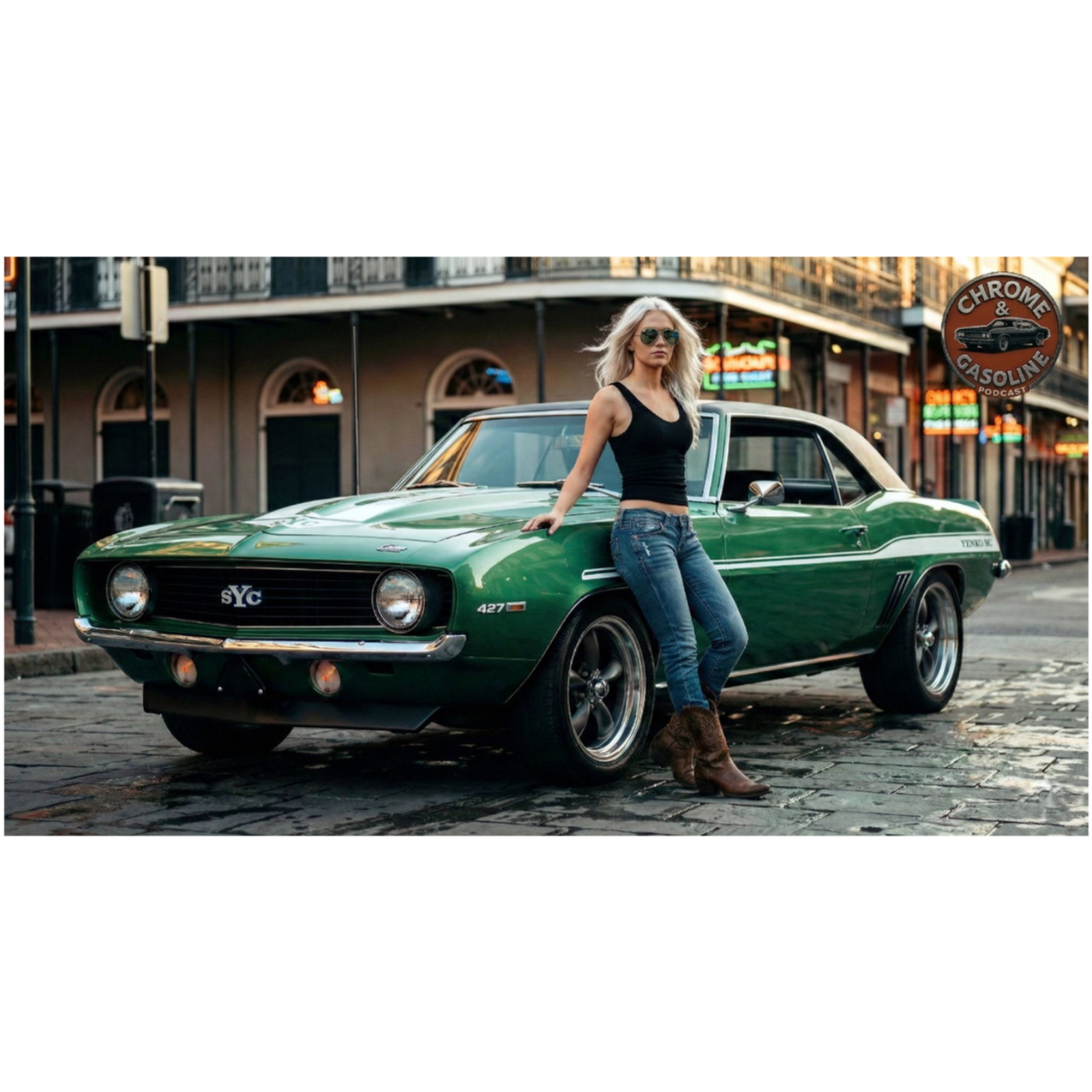
Episode 1, Birth of the Yenco Super Camaro, 1967.
Hey everyone, Alex here and welcome to Chrome and Gasoline, the show where we fire up the
legends of the automotive world and take them out for a proper spin through history.
Today, we're kicking off a special MINI series on one of the most fearsome Camaros
ever to roll off and then way beyond a Chevrolet dealership lot, the 1967 to 1969
Chevrolet Yenco Camaro.
So, picture this, it's the late 1960s.
American streets are buzzing with V8s.
The Mustang has kicked off the pony car craze, Mopars swinging back with big block monsters
and Chevrolet has just thrown the Camaro into the ring to join the fight muscle car wars
are heating up and every brand wants to be king of the quarter mile.
But there's a catch, inside General Motors there's a corporate rule that keeps the
really big engines the wild 427 cubic inch big blocks out of smaller cars like the early Camaro.
On paper you simply couldn't walk into a Chevy dealer and order a Camaro with the nastiest
big block Chevy had and that's where one man decided the rulebook was more of a
suggestion and Erdan Yenco, he wasn't just some dealer in Pennsylvania.
He was a road racer, a hot shoe and a performance true believer.
He looked at the new Camaro and saw the perfect canvas for something much more serious.
If the factory wouldn't build the ultimate Camaro, he would.
In 1967, Yenco took brand new Camaro SS 396, pulled out their perfectly respectable big
block engines and swapped in the heavy hitting 427, the kind of motor you'd normally
expect to see in a Corvette or a full size Chevy Bruiser.
These weren't backyard swaps.
These were dealer built, professionally tuned machines that you could finance and drive home
like any other car.
Except nothing about them was ordinary.
Those first 1967 Yenco Super Camaros were almost like a secret menu item.
A handful of customers in the know walked into Yenco Chevrolet and came out with weapons,
cars that looked like Camaros, sounded like thunder and pulled like a freight train.
They weren't just about straight line speed either.
Yenco understood that if you were going to stuff that much power into a smaller body, you
needed to back it up so he focused on gearing, handling and making sure these cars could live
on the street and at the strip.
Even so, they were raw, loud, demanding.
The kind of car that made your palms sweat and your heart race long before you turned
the key.
And here's what made them special in a bigger sense.
The Yenco Camaro was one of the earliest, clearest examples of the idea that a dealership
could become a performance brand in its own right.
Not just a place to buy cars, but a place to buy legends.
Those early 1967 conversions laid the groundwork for what would come in 1968 and especially
1969 when the Yenco name would become synonymous with some of the wildest Camaros ever built.
In this series we're going to dig into how these cars were engineered, what they
were like to drive, how they tore up tracks and streets, and why today they're treated
like holy relics in the muscle car world.
That's it for this first warm up lap.
In our next episode, we'll pop the hood and crawl underneath.
We'll talk about the engineering, the design cues, and the details that turned a regular
Camaro into a Yenco Super Camaro.
I'm Alex, this is Chrome and Gasoline, and I'll see you in episode 2.
Under the Skin, Engineering and Design Hey folks, Alex here.
You're listening to Chrome and Gasoline, and this is episode 2 of our deep dive into the
1967 to 1969 Yenco Camaro.
Last time, we talked about how Don Yenco decided the rules didn't apply to him.
Today we're going to look at what made these cars such serious hardware.
Under the Skin and to the Eye Let's start with the Heart of the Beast,
the 427 Big Block V8.
If you've never stood next to one at idle, imagine a deep, uneven thump that you can
feel in your chest more than you hear in your ears.
This wasn't some mild cruiser engine.
We're talking serious horsepower for the era, with torquey that came on like a sledgehammer,
the moment you breathed on the throttle.
On the early 1967 cars, that 427 was swapped in at the dealership, replacing
the already strong 396.
To make it all work, Yenco paid attention to the supporting cast.
Heavy-duty suspensions, beefier driveline components, and performance-minded gear ratios that let
the car leap off the line and pull hard through the gears.
Move into 1968, and the formula becomes more refined.
Yenco had more experience, more feedback from customers, and a clearer picture of
what people wanted.
A car that could dominate the strip, but still live on the street.
You see a more systematic approach to options, gearing, and tuning.
These weren't one-off science experiments anymore.
They were repeatable performance packages.
By 1969, the first-generation Camaro's styling had sharpened into the aggressive, iconic
shape so many of us love, and the Yenco treatment sat perfectly on top of it.
Underneath, the 427-powered package had matured into something truly fearsome.
A car that could stand toe-to-toe with just about anything you might roll up next to.
Whether it wore a blue oval, a bow tie, or a pair of Mopar stripes.
But the Yenco story isn't just mechanical.
It's visual.
A Yenco Camaro didn't look like every other Camaro in the high school parking lot,
bold side stripes, hood stripes, and the famous Yenco and SYC markings announced that this
car was something special.
The stance was purposeful.
Muscular, nose down, ready to pounce special hoods, spoilers, and wheels made it look less
like a commuter and more like a race car that accidentally wore license plates.
Inside, it was still very much a Camaro.
Familiar gauges, seats, and layout, but with subtle cues that hinted at its mission.
The real difference was what happened when you turned the key.
Heavy clutch, solid shifter, a rumbling idle that shook the mirrors just a little bit, steering
that felt direct and honest, brakes that demanded respect, and an engine that always seemed
to be asking, is that all you've got?
Driving a Yenco back in the day wasn't about comfort, it was about experience.
It was raw, mechanical, and a little bit intimidating in the best possible way.
So when you combine that brutal big block power, the strengthened hardware, and the unmistakable
striping and stance, you get something more than just a modified Camaro.
You get a car with identity.
In our next episode, we're gonna take all of this to its natural arena, the drag strip
in the street.
We'll talk about how the Yenco earned its reputation in actual competition, and in
late night races that never showed up on any official timing slip, I'm Alex.
This is Chrome and gasoline, and we'll light up the tires in episode three.
Episode three, on the strip and the street, racing and performance.
Legacy, welcome back to Chrome and gasoline.
I'm Alex, and this is episode three of our series on the 1967 to 1969 Yenco Camaro.
Last time, we looked at what made these cars such serious machines, now it's time to
put them where they belong, on the track, and on the street.
If you were serious about going fast in the late 60s, the drag strip was your proving
ground.
Quarter-mile times were like bragging rights on a scoreboard for everyone to see.
A Yenco Camaro, with its 427 big block and aggressive gearing, was built to shine in
that exact environment.
Imagine a Saturday at a local strip, the staging lanes are full of Chevelles,
Novas, GTOs, Roadrunners, Mustangs, all idling, all loud.
When a Yenco Camaro rolls up, the big block is rumbling, the stripe package leaves no doubt
about what you're looking at.
And everyone within earshot knows this isn't just another Camaro.
When that tree drops, the Yenco's advantage becomes obvious.
That tidal wave of torque shoves the car forward, tires scrambling for grip.
It's violent, it's noisy, and when it hooks up, it's devastatingly quick for
its time.
These cars earned reputations as quarter-mile weapons, perfectly at home laying down passes
and bringing home trophies.
But for a lot of people, the legend of the Yenco Camaro wasn't built under track
lights.
It was built under streetlights.
Picture a warm Friday night on the edge of town gas station meet-ups, neon buzzing,
people leaning on fenders and talking trash.
Someone mentions that a certain Yenco just pulled in.
That's the car everyone's heard about.
The one that supposedly walked away from big block mopars and 428 Mustangs a race gets
lined up on some half-forgotten stretch of road.
Two cars roll up, engines' reverend headlights stretch down a dark two-lane.
Someone's arm drops, and for a few priceless seconds, the world shrinks down to roaring
V8s and the blur of white lines, win or lose, those moments are the stuff of
local legend, and the Yenco name kept showing up in those stories.
Of course, all that performance came with trade-offs.
Oh, Yenco, Camaro could be a handful on the street.
Traction was more of a suggestion than a guarantee.
Fuel economy?
Let's just say you got to know your gas attendant really well, and daily comfort
took a back seat, sometimes literally, to the goal of going fast.
But that was the deal.
If you were willing to live with the quirks, a Yenco rewarded you with the kind of
performance that most cars simply couldn't match.
That's how it carved out a legacy, not as a gentle cruiser, but as a serious
driver's car for serious enthusiasts.
Over time, those drag-strip time slips and late-night races turned into stories.
Stories turned into myths, and myths turned the Yenco, Camaro, into one of
the most respected names in the muscle car world.
In our next episode, we're going to step away from smoky burnouts and look at the
cultural side of all this.
How the Yenco, Camaro went from a rare dealer special to a full-on pop culture
and enthusiast icon.
I'm Alex, and you're listening to Chrome and Gasoline.
Stick around for episode four.
Episode four.
From dealer lot to pop culture icon.
Hey everyone, Alex here.
This is Chrome and Gasoline, and you're tuned in to episode four of our series on the 1967
to 1969 Yenco, Camaro.
We've talked about how these cars were built and how they battled on track and street.
Now, let's talk about how they became larger than life.
Back when these cars were new, the easiest way to turn a fast car into a star was
through car magazines and enthusiast circles.
In a performance magazine in the late sixties or early seventies, and you'd see coverage
of wild dealer specials, big block bruisers, and quarter mile heroes, the Yenco, Camaro
fit perfectly into that world.
Because they were built in relatively small numbers, Yencos were never as common as
regular Camaros.
You didn't see them on every street corner.
That rarity made them feel almost like an inside secret, something you heard about
through word of mouth, a friend of a friend who'd seen one run, or knew a guy who had
a cousin who drove one.
That mix of real world performance, distinctive looks, and scarcity gave the Yenco, Camaro
a mythic quality.
You didn't even have to see one in person to be obsessed with it.
Maybe you saw a photo in a magazine, a grainy picture in a classified section, or a black
and white shot of a car on a drag strip with Yenco on the quarter panel.
For a lot of enthusiasts, that was enough to spark a lifelong fascination.
As the years rolled on, the broader image of the big block Camaro, stripes, spoilers, cow
hoods, fat tires, became a kind of shorthand for American muscle in movies, TV, and eventually
video games.
Even if a car on screen wasn't a real Yenco, it often carried that same attitude, bold
graphics menacing stance, and the sense that this was the fastest thing in the
frame.
Meanwhile, in the real world, the Yenco name started to take on holy grail status.
As muscle car values rose and nostalgia kicked in, people began hunting for authentic Yenco
stories surfaced about cars tucked in barns, forgotten in storage, or sitting in garages
waiting to be rediscovered.
Each one found was like uncovering buried treasure.
Because originals were so rare and expensive, a whole culture of clones and tribute cars
sprang up.
Others would take a standard Camaro and give it the Yenco look, the stripes, the badges,
maybe even big block power, as a way to capture the spirit without the six or seven figure price
tag.
Some purists only want the real thing, but there's no question that tributes helped
spread the Yenco image even further.
By the time modern enthusiasts came along, the Yenco Camaro wasn't just an old
dealer special.
It was a symbol of an era when rules could be bent, when a dealership could become
a performance brand, and when raw horsepower was the ultimate calling card.
In our final episode, we're going to look at where that leaves us today.
How are these cars treated in the collector market?
What's the difference between a survivor, a clone, and a restamod?
And what does the Yenco legacy mean for modern performance cars?
I'm Alex.
This is Chrome and Gasoline, and we'll wrap up the series in episode 5.
The collector's holy grail, values, survivors, and legacy.
Welcome back to Chrome and Gasoline.
I'm Alex, and this is the final episode of our special series on the 1967 to 1969 Yenco
Camaro.
We've taken these cars from their birth in a Pennsylvania dealership all the way
through track battles and cultural legend.
Now, let's talk about what they mean today.
First, let's talk survivors.
Only a relatively small number of genuine Yenco Camaros were built, and even fewer have survived
the decades intact.
Some were raced hard and wrecked.
Others were modified, repainted, or simply used up like any other old car in the years
before they were collectible.
That makes authentic, documented Yencos incredibly valuable.
If you're looking at one today, you're not just checking paint in Chrome.
You're looking for paperwork.
Other records, build sheets, documentation that ties the car back to its Yenco origins,
experts study casting numbers, trim tags, and tiny details to separate the real legends
from the look-alikes.
When one of these cars shows up at a major auction, it's a big deal.
Prices can climb into the very high six figures, even seven figures, depending on
condition, originality, year, and specific options.
A well-preserved or properly restored Yenco isn't just a car anymore.
It's part of muscle car history, and collectors treat it that way.
But not everyone can, or wants to, chase that level of rarity.
That's where clones, tributes, and restimads come in.
A tribute car might start life as a regular Camaro and be transformed with Yenco-style
stripes, badges, and performance upgrades.
The goal isn't to fake out experts.
It's to capture the look and feel of a Yenco in a way that real people can enjoy on the
street without worrying about putting priceless metal at risk.
Then there are restimads, cars that blend classic body lines with modern technology.
Think, disc brakes that actually stop on a dime, modern suspension, fuel-injected
big blocks or crate engines, overdrive transmissions.
A restimad that takes inspiration from the Yenco idea is like a love letter to
the past, written with today's tools.
All of this yam, this.
The survivors, the tributes, the restimads, feeds into the legacy of the Yenco name.
It helped prove that a dealership could be more than a place to sign paperwork.
It could be a performance brand.
That idea lives on today in factory-backed special editions, tuner collaborations, and
limited-run monsters that you can technically still drive off a showroom floor.
Modern Camaros and other performance cars that carry special badges, big power, and limited
production owe a little something to that moment in the late 60s when Don Yenco said,
let's build what the factory won't.
So as we close out this series, think about what the 1967 to 1969 Yenco Camaro really
represents.
It's not just stripes in a big engine.
It's a story about passion, ingenuity, and the refusal to accept limits.
It's about a time when the muscle car wars were in full swing and one dealer decided to
tilt the battlefield his way.
Thanks for riding along with me on this journey through one of Chevrolet's wildest chapters
I'm Alex, and this has been Chrome and Gasoline.
If you enjoyed this deep dive into the Yenco Camaro, stick around.
We've got plenty more legends to fire up, one classic at a time.
Hey everyone!
Welcome to Chrome and Gasoline, the show where we dive deep into the stories behind the machines
that make our hearts race.
I'm your host Alex and this is an extra episode on 1967 to 1969 Yenco Camaro called Dick Harrell,
the real Mr. Chevrolet behind the Yenco 427's bite.
If Don Yenco was the visionary dealer who dreamed up the Super Camaro, Dick
Harrell was the guy with the wrenches who actually made those dreams terrifyingly fast,
nicknamed Mr. Chevrolet for good reason.
He stuck with bowties when everyone else bailed after GM's 1957 racing ban.
Harrell was a drag racing champion turned mad scientist.
By the time the Camaro hit the streets in 1967, he was already the go-to guy for stuff in
427's where GM said they couldn't go, how the partnership started.
Harrell cut his teeth doing the very first dealer 427 Camaro swap for Nicky Chevrolet in Chicago,
widely believed to be the first one ever sold new to the public.
Don Yenco heard about it, tracked him down and basically said,
come to Pennsylvania, I've got 54 396 Camaros that need to grow up.
Harrell set up shop in East St. Louis and personally handled most,
if not all, of the 1967 Yenco conversions, plus a handful of 1968's before the big
copo flood in 69 what Harrell actually did to the engines factory.
L72427 IS were rated at a laughable 425 horsepower insurance reasons.
Harrell looked at that number the way the rest of us look at decaf,
his typical recipe on Yenco cars, blue printed the bottom end for perfect tolerances,
handpicked the best cranks, rods and pistons, portmatched the double hump heads,
added his signature tuned headers that snaked through the frame rails,
these alone were worth 30 to 40 horsepower, advanced the timing, jetted the Holly Richer
and dialed in the solid lifter cam until the engine made a reliable 450 to 475
honest horsepower. Some owners swear closer to 500 on a good day, added traction bars,
heavier clutches, scatter shields and hood pins so the car didn't eat itself, the first time you
floored it. A select few 1967 Yencos got the full YS450 package that officially advertised 450
horsepower at 6000 rpm. Those are the holy grail cars today. Famous stories and anecdotes
from the Harrell era, the Herb Fox got lost story. In summer 1967, Herb Fox, Fred Gibbs
Driver, literally got lost in St. Louis, stopped at Harrell's shop for directions and spotted
two fresh Yenco 427 Camaros sitting there. He called Gibb, you gotta see these. Gibb bought
both on the spot and hired Harrell on the spot, timing was perfect because Harrell and
Yenco were apparently having a, let's call it a business disagreement that ended in court Gibb.
Became Harrell's new pipeline, Bruce Larson's 10 second 67 drag racer, Bruce Larson bought one of
the early Harrell tuned 67 Yencos. In 1968 on bias ply tires, he started clicking off consistent
10 second quarter miles. Think about that, a street car running 10s when most factory hot
rods were still in the 13 seconds. NHRA basically panicked and rewrote the rule book
because of cars wearing Yenco slash Harrell badges were cleaning house. We don't need no
stinking warranty. Harrell's headers were so good that customers would come back complaining
the car was too loud. His fix, he'd hand them earplugs and say, problem solved.
The pinning out by late 67 slash early 68 Harrell's daughter Valerie says her dad was
making more money selling the go fast parts than Yenco was making on the whole car.
Things got tense, lawsuits flew and Harrell packed up for Kansas City to start the
Dick Harrell performance center. From there, he kept building 427 Camaros,
Chevelle's and Nova's for anyone with a checkbook. Still under his own badge or for Gibb,
the tragic end, Harrell kept racing nitro funny cars on the side. In September 1971,
he was match racing in Toronto when a front tire blew. The car hit the guard rail and he didn't
make it. He was only 39. The drag racing world basically stopped for a minute. Guy was that
respected. Bottom line. Every time someone tells you a 1967 to 68 Yenco only made 425 horsepower,
you can smile and say, yeah, unless Dick Harrell got his hands on it first. Those early cars are
faster, meaner and rarer because of him. And when you hear solid lifters clattering and chambered
sidepipes barking on an old Yenco clip, that's not just a Camaro. That's Dick Harrell's signature
still echoing 50 plus years later. If you ever get the chance to stand next to a real Harrell-tuned
427 Yenco at idle, just don't stand too close. Those headers get hot and the attitude hasn't
cooled off one bit. If you're the purchasing manager at a manufacturing plant, you know
having a trusted partner makes all the difference. That's why hands down you count on Granger for
auto-reordering. With on-time restocks, your team will have the cut resistant gloves they need at
the start of their shift. And you can end your day knowing they've got safety well in hand.
Call 1-800-GRANGER, click Granger.com or just stop by. Granger for the ones who get it done.
About this episode
Exploring the legendary 1967-1969 Chevrolet Yenko Camaro, this episode dives into the origins of the Yenco Super Camaro, highlighting Don Yenko's defiance of GM's corporate rules to create a high-performance muscle car. The discussion covers the engineering behind the 427 big block engine, the car's unique handling, and its reputation on the drag strip and street racing scenes. With anecdotes from the era and insights into the car's cultural impact, listeners gain a deeper appreciation for why the Yenko Camaro remains a revered icon in automotive history.