If you're the purchasing manager at a manufacturing plant, you know having a trusted partner makes
all the difference.
That's why hands down you count on Granger for auto-reordering.
With on-time restocks, your team will have the cut-resistant gloves they need at the
start of their shift.
And you can end your day knowing they've got safety well in hand.
Call 1-800-GRANGER, click Granger.com or just stop by.
Granger for the ones who get it done.
Episode 1, The Birth of a Legend.
Hey everyone, and welcome to Chrome and gasoline.
I'm your host, Alex, and today we're firing up the stories of one of the most mythical
muscle machines ever to hit American roads.
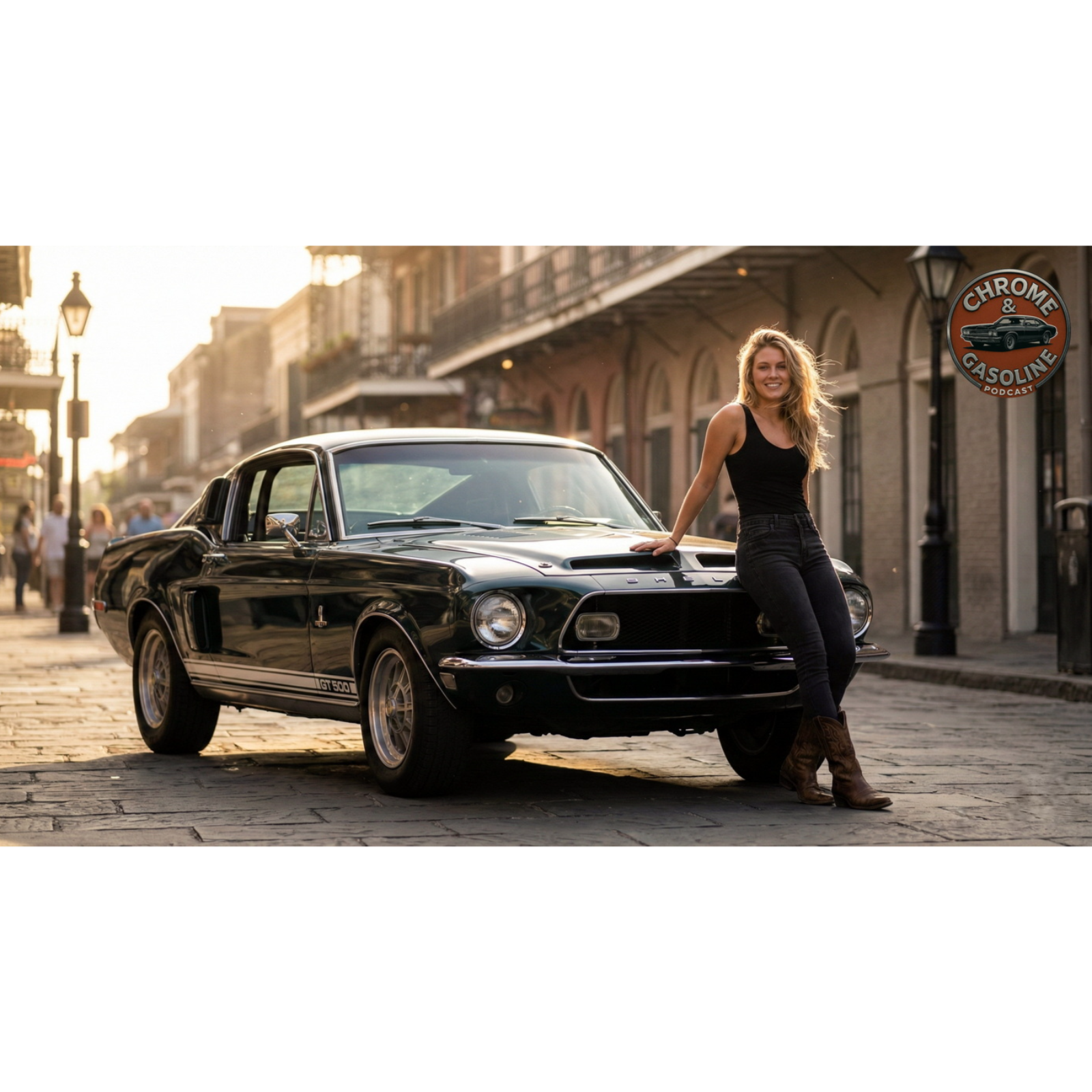
The 1967 to 1970 Shelby Mustang.
In this first episode, we're rolling back the clock to see how this legend was born,
how it evolved, and why those few short years left such a big mark to really understand
the 1967 to 1970 cars.
We have to start with the man whose name is on the fender, Carol Shelby.
Shelby was a Texas-born race car driver turned builder, famous for helping Ford beat Ferrari
at Le Mans and for creating the Cobra.
When Ford launched the Mustang in 1964, it was stylish and sporty, but not yet a true
thoroughbred.
Ford asked Shelby to change that, and the Shelby GT350 and GT500 were the result.
Those early Shelby's were built in relatively small numbers at Shelby American, where the
atmosphere felt more like a race shop than a corporate assembly line.
Mechanics and fabricators were constantly experimenting, tweaking suspensions, trying new parts, and
pushing the limits of what the Mustang could be.
That hot rod hands-on spirit shaped the personality of every Shelby Mustang that followed.
By 1967, the Mustang itself had grown up.
The body was larger, the styling more muscular, and there was room under the hood for serious
power.
This was the perfect canvas for Shelby to create a more refined, more powerful version
of the earlier cars.
The 1967 Shelby Mustang arrived as a kind of street-legal race car with manners, big
engines, upgraded suspension, and a look that shouted performance from a block away.
The story doesn't stop there.
In 1968, the Shelby Mustang lineup continued to evolve.
The GT500KR, king of the road, showed up with a brutal big-block V8 in an attitude to match.
Production numbers stayed relatively low, which already started to give these cars an
air of exclusivity.
These weren't just Mustangs, they were something more special, more focused.
By 1969, Shelby's influence at Ford was changing.
The cars took on an even more radical look, with long, sloping front ends, big scoops, and
a unique rear treatment that set them apart from regular Mustangs.
They were still fast, still desirable, but you could also sense that the muscle car
era was nearing its peak.
Insurance costs, emissions rules, and changing tastes were all gathering on the horizon.
The 1970 Shelby Mustangs were really the last of the line.
They were actually left over 1969 cars, given new numbers and sold as 1970 models.
After that, the original Shelby Mustang program shut down.
It had been a short run, just a handful of model years, but what a run it was.
In that brief window, the Shelby Mustang carved out a reputation that would last
for decades.
Contemporary road tests raved about the sheer power and presence of these cars.
Customers loved that they could buy something from a dealer that felt like it belonged on
a racetrack at the same time.
There were stories of dealers struggling to move such expensive, high performance machines,
when a regular Mustang cost much less.
Little did they know how collectible these cars would become.
Today, when collectors talk about real Shelby's, the 1967 to 1970 cars sit right at the
center of the conversation.
They represent the moment when muscle, style, and racing pedigree all collided in one package.
In just a few years, the Shelby Mustang went from an idea on Carol Shelby's drawing board
to an American icon.
In our next episode, we're going to pop the hood on these machines and talk about
what made them so special.
The design, the engineering, and the performance that set them apart.
Thanks for riding along with me on Chrome and gasoline.
I'm Alex and I'll see you in episode two where we get into the nuts and bolts and the
roar of the 1967 to 1970 Shelby Mustang.
Episode two, design and performance.
Hey everyone, Alex here and welcome back to Chrome and gasoline.
In episode one, we traced how the 1967 to 1970 Shelby Mustang came to life.
Today, we're getting closer to the metal itself.
We're going to walk around the car, slide into the driver's seat, and talk about what
these Shelby's looked like, how they were built, and how they performed.
When you put your foot down picture A, 1967 or 1968 Shelby Mustang rolling up to the curb.
The first thing you notice is that it doesn't look like a regular Mustang with a few stickers.
The front end is stretched and more aggressive with a unique fiberglass nose, extra lights,
and a hood that practically announces what's hiding underneath side scoops, rear scoops,
stripes, and Shelby badging give it a purpose built, almost racing homologation feel.
By 1969 and 1970, the styling got even bolder with a long sloping front, big functional
scoops, and a distinct rear end that made sure you knew this wasn't just any pony
car.
Open the door and the differences continue.
While the basic layout is still Mustang, Shelby models often came with special touches, extra
gauges to keep an eye on oil pressure and amps, wood grain trim, and unique steering wheels.
It felt like a car designed for someone who actually cared about what the engine was doing.
Not just how the car looked in the driveway, even small details like the way the tachometer
is placed or how the seats hold you in place remind you that this is a driver's car first.
Under the hood is where things get serious.
Early Shelby's built their reputation on high-revving small block V8 engines and then
on brutal big block power.
The GT350 focused more on balanced performance, while the GT500 and later, the GT500KR leaned
into sheer torque and straight-line punch big block V8s, upgraded intake and exhaust systems,
and performance-tuned components meant that when you turned the key, you weren't just
starting a car.
You were waking up a very loud, very alive machine.
Of course, power alone isn't the whole story.
Shelby Mustangs typically featured suspension and brake upgrades over a standard Mustang,
stiffer springs, better shocks and beefier components helped the car handle the extra speed.
It was still a product of its time, more of a powerful grand touring bruiser than a delicate
sports car.
But compared with many of its muscle car rivals, the Shelby felt more composed, more engineered.
Drivers of the day often talked about the confidence these cars inspired on a fast back
road or a long highway run.
The steering had weight and feedback, the body stayed relatively flat in corners, and the
car felt secure at the kind of speeds that would get you into serious trouble today.
It wasn't perfect, the tires and brakes of the era could only do so much, but for its
time, the Shelby Mustang delivered a blend of speed and control that really stood out.
So what was it like to drive one?
Imagine sliding into the seat, twisting the key and hearing that V8 bark to life.
The idle is lumpy and impatient, like the car is annoyed you're not already on the gas.
As you pull onto the road, the steering is weighty, the nose rises slightly under acceleration
and the exhaust note hardens into a deep roar, it's not subtle.
Neighbors hear you coming home and people turn their heads at gas stations, the car
demands that you pay attention and in return it gives you that old school mechanical connection
that modern cars often hide.
Period road tests talked about strong acceleration, serious passing power, and the feeling that
the car always had more to give.
They also mentioned that if you weren't respectful with the throttle, the rear
tires were more than happy to remind you who was in charge.
This was a car that rewarded skill and confidence and punished carelessness.
By the end of the 1960s, the Shelby Mustang had established itself as more than just a
dress-up package.
It was a carefully tuned, visually striking performance machine that delivered on its
promise.
In our final episode, we'll step away from the spec sheets and dyno charts and talk
about what the 1967 to 1970 Shelby Mustang has meant to car culture, collectors, and dreamers
ever since.
Thanks for riding shotgun with me on Chrome and gasoline.
I'm Alex and I'll see you in episode 3 where we explore the cultural impact and
lasting legacy of the Shelby Mustang.
Episode 3.
Cultural Impact and Legacy.
Welcome back to Chrome and gasoline.
I'm your host, Alex.
And in this final episode of our 1967 to 1970 Shelby Mustang series, we're stepping back
from the garage and looking at the bigger picture.
We've talked about how these cars were born and how they were built.
Now it's time to talk about what they meant, and still mean to car culture and to the
people who fell in love with them.
The late 1960s in America were loud, fast, and full of change, and the Shelby
Mustang fit right into that mood.
It wasn't just transportation.
It was attitude on four wheels.
The long hood, the scoops, the stripes, and that famous Cobra snake badge turned the
car into a rolling statement about power and independence.
Owning a Shelby Mustang said you wanted more than the ordinary, even in a world
where V8s and muscle cars were everywhere.
Over the years, the Shelby Mustang became a kind of shorthand for serious performance
When people pictured an ultimate Mustang, the Shelby versions were what came to mind.
They showed up at drag strips, road courses, and car shows, and they inspired countless
posters on bedroom walls.
Even if someone never saw one in person, they knew the look, the aggressive stance
and the promise that this car was built to go fast.
Hollywood and pop culture helped cement that image.
High performance Mustangs, including Shelby variants and Shelby inspired cars, made
appearances in films, TV shows, and later video games.
Whenever a director wanted to signal this character is serious about cars, a hot
Mustang was a pretty good way to do it.
That visibility kept the Shelby legend alive even when the original production
run was long over.
Meanwhile, collectors quietly began to realize how special these machines were.
Limited production, a direct connection to Carroll Shelby, and a key role in the
golden age of American performance cars all combined to make the 1967 to 1970
Shelby's highly desirable.
Over time, well preserved and correctly restored examples became stars at
auctions and concor events.
For many enthusiasts, owning one is the ultimate Mustang dream.
There's also a whole community built around these cars.
Owners, clubs, online forums, and meetups bring together people from all over
the world who share a common obsession.
They trade restoration tips, track down rare parts, and tell stories about the
first time they heard a Shelby fire up.
For some, the car is a family heirloom, passed from one generation to the next
along with the memories attached to it.
The legacy doesn't stop in the past though.
Ford and Shelby would reconnect years later, bringing the Shelby name back
to modern Mustangs.
Those newer cars owe a lot of their image to the 1960s originals.
The idea is the same.
Take a Mustang, turn up the power, sharpen the handling, and give it a look that
makes it instantly recognizable.
Every time a modern Shelby roars to life, it echoes what was started back in 1967.
So why does the 1967 to 1970 Shelby Mustang still matter today?
Maybe it's because it represents a moment when American performance cars
were at their boldest.
Maybe it's the story of Carol Shelby himself, the racer turned builder who left
his imprint on everything from Cobras to GT40s to Mustangs.
Or maybe it's the simple, unshakable appeal of a big V8, a manual gearbox,
and a car that makes your heart beat faster just by sitting in the driveway.
Whatever the reason, the Shelby Mustang has moved from new car showrooms
into the realm of legend.
It's a piece of rolling history that still feels alive every time someone
turns the key.
That's going to wrap up this mini series on the 1967 to 1970 Shelby
Mustang here on Chrome and gasoline.
I'm Alex, your host, and I want to thank you for riding along
through the history, the hardware, and the lasting impact
of this incredible car.
Until next time, keep your revs up, drive safe,
and I'll catch you on the next episode.
About this episode
Explore the legendary 1967 to 1970 Shelby Mustang, a symbol of American muscle and performance. Host Alex dives into the car's origins, detailing Carroll Shelby's pivotal role in transforming the Mustang into a high-performance machine. The episode highlights the evolution of the Shelby models, their unique features, and the cultural impact they had during the late 1960s. From their racing pedigree to their status as collectibles, the Shelby Mustang represents a blend of power, style, and history that continues to resonate with car enthusiasts today.