Episode 1, Chrome and Gasoline, Chrome and Gasoline, if you don't feel like hunting for the ampersand.
Alex here, and I want you to picture a corporate meeting in the late 1960s where somebody says,
we should build a muscle car that's fast, but also cheap enough that regular humans can buy it.
And everyone gasps, like they just suggested putting ketchup on a steak.
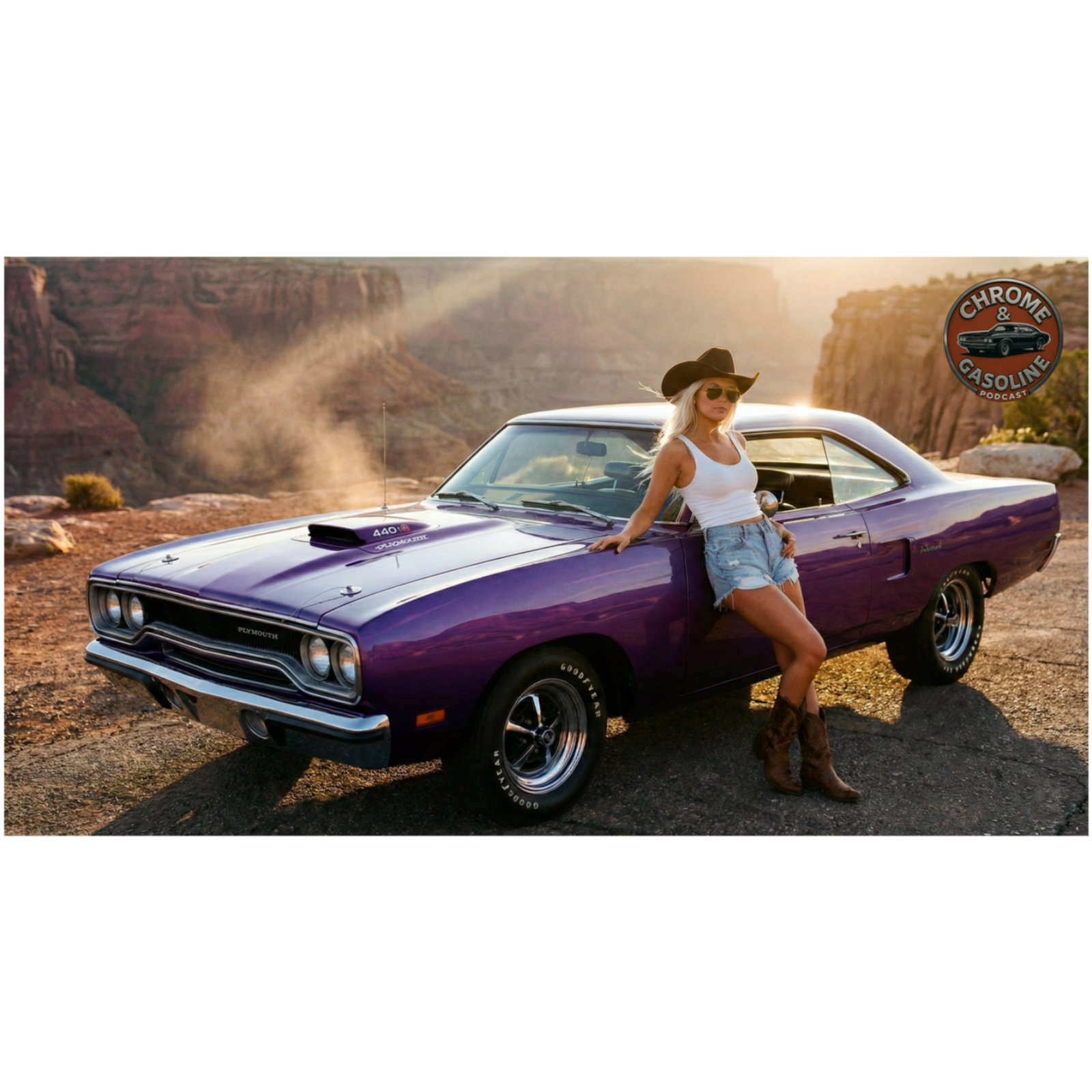
That's the Plymouth Roadrunner vibe in 1968, a no-nonsense, intermediate-sized B-body that looked
at fancy trim and said, I'm here for the stoplight, not the opera. The trick wasn't only horsepower,
it was a focus. Keep the interior straight forward, keep the options list from turning
into a novel, and spend the budget where it matters. Engine, drivetrain,
and the kind of stance that makes the neighbors quietly update their opinions about you.
The default Roadrunner recipe was a big-torque V8 with a carburetor,
and zero interest in being misunderstood. Many cars came with a 383 cubic-inch V8 that's already
plenty for the street, and if you checked enough boxes and emptied enough pockets,
there were bigger choices like a 440, and in rarer, more extreme cases, the 426 Hemi.
I'm saying rarer, because not everybody needs an engine that turns gasoline into heat,
noise, and a sudden desire to buy rear tires in bulk. The layout is classic American muscle.
Front engine, rear wheel drive, and a chassis that can handle cruising comfortably right up until
you remember why you bought it. Up front, torsion bars do the springing. Outback,
leaf springs keep things simple and tough. Steering is old school and mechanical. It
gives feedback and also occasionally asks you to participate. Brakes in this era often
started life as drums, and some cars were ordered with front disc brakes. Either way,
you learn to plan ahead compared to a modern ABS-equipped car.
Personality-wise, the Roadrunner wasn't trying to be a gentleman's express. It's more like your
loud buddy who shows up to help you move, then immediately asks if your sofa is
rated for 383 torque. The cabin is functional. The ride can be busy on rough pavement.
The steering can feel a little interpretive, but when you lean into the throttle, everything
snaps into focus. Torque arrives early, the nose lifts a bit, and the car starts speaking fluent
bad ideas. What makes 1968 to 1970 such a sweet zone is how pure it feels. Performance is still
the main event. Stuff is mechanical. The car doesn't try to flatter you with computers.
If the Roadrunner is happy, you feel it. If it's unhappy, you also feel it.
Usually through the steering wheel and your wallet. So if you've ever wanted a muscle car that's
basically a punchline with a license plate in the best possible way, the Roadrunner shows up like
fast, simple, and allergic to subtle. That's chrome and gasoline. And that's Alex saying
the Roadrunner didn't need fancy. It needed forward. Episode two. Chrome and gasoline.
Chrome and gasoline. And yes, I'm saying it both ways so there's no confusion.
Alex here, and we need to talk about the Roadrunner's real party trick. Torque. Not the kind of torque
you quoted a car show while holding a plastic trophy. I mean the kind that changes the
expression on your face before your brain has time to file a complaint. For 1968 through 1970,
the Roadrunner's lineup generally lived in that sweet spot of big V8s that are simple,
durable, and very honest about their intentions. Carburetors were the norm. Fuel injection was
still a distant dream for most street cars. And engine management meant a screwdriver,
a timing light, and a friend who swears he can hear two degrees of ignition timing.
A lot of Roadrunners use the 383 as the mainstream muscle choice. Big enough to feel
serious, common enough that knowledge and part support are widespread. Step up the menu and
you get into bigger displacement territory like the 440 and in rarer, more extreme cases,
the famous 426 Hemi. Think of it as a spectrum. 383 is, I want to drive it. 440 is, I want to
intimidate it. The wild stuff is, I want to pick up groceries and accidentally start a legend.
Exact configurations vary by how the car was ordered, but the big picture stays the same.
Lots of torque, strong mid-range, and a power band that feels like it's tugging the whole
car forward by the collar. Here's the thing about these engines. Peak numbers matter less
than how they deliver. A big V8 in this era tends to pull hard in the low and mid-range,
which is exactly where street driving happens. You roll into the throttle at 30 miles per hour,
and suddenly the horizon gets closer on a schedule you didn't approve. That's why people
remember these cars as fast, even when they can't recite a spec sheet. They feel strong,
now. Transmissions. You typically see manuals and automatics that were rugged, relatively simple,
and not shy about being mechanical. A manual makes the car feel like it's plotting with you.
You pick the gear, you feel the driveline load up, and the car responds like a well-trained
bouncer. An automatic, usually a three-speed design for many cars of the day, can make
the roadrunner feel like a big lazy hammer. You lean on it and it swings. Either version
can be fun. One just makes you feel more responsible for your own chaos.
Then there's rear gearing. One of the most underrated, why does this car feel different,
factors. Shorter gears make the car punch off the line and feel eager, but the engine will
spin higher on the highway. Taller gears calm it down for cruising, but you give up some of
that instant shove. Roadrunner people talk about gearing the way chefs talk about salt. A little
change and suddenly the whole dish tastes different, and traction. Or, as the roadrunner sometimes calls
it, a suggestion. Period tires were often narrower than what we're used to today, and the combination
of weight transfer and torque makes wheel spin easy. Especially from a rolling start or a stoplight
moment, you swear was just testing something. Modern, sticky radials can make these cars
feel like they gained a superpower. But even on vintage-style rubber, the roadrunner has
this hilarious, slightly irresponsible charm. It's always ready to remind you that physics is
undefeated, so if you're shopping or just daydreaming, the 383 tends to be the sweet spot for use it often,
the bigger engines are for use it loudly, and the truly exotic stuff is for use it and then
become insufferable at parties. That's chrome and gasoline. And that's Alex telling you,
the roadrunner's powertrain isn't complicated. It's just confident.
Episode 3. Chrome and Gasoline. Chrome and Gasoline. Alex here, and now we get to the part every
roadrunner owner eventually learns. Straight line speed is easy. Making 1968 to 1970,
muscle behave politely is the real art project. Start with the basics. The roadrunner sits
on a classic late 1960s American intermediate chassis. Up front, you've got torsion bars,
which is a very mopar way of saying, springs but sideways. Out back, leaf springs hold it
together like a hard-working department that never gets the credit. It's simple and it's tough.
The geometry is not trying to win modern autocross trophies. It's trying to survive potholes,
drag strip launches, and the kind of driving decisions you make when your friend says,
I dare you. Steering is the old school recirculating ball flavor in many cars of this era.
Translation. It's sturdy and it tells you what the front tires are doing,
but it's not razor sharp, and it hates being rushed. You don't flick a roadrunner into a
corner. You negotiate. You file paperwork. You schedule the turn two business days in
advance. Brakes take a little respect too. Many cars started with drum brakes,
and some were ordered with front discs. Either way, compared to modern cars,
pedal feel and fade resistance can be a surprise the first time you drive spiritedly for more than
10 minutes. The car may be fast, but it does not magically turn into a modern performance sedan
when you ask it to stop repeatedly. The wise roadrunner driver plans ahead,
keeps the system in top shape, and remembers that vintage is not a synonym for invincible.
Now, let's talk tires, because tires are the translator between your dreams and the pavement.
Period correct tires were often narrower, with different construction than modern radials.
That affects everything. Steering response, grip, and how the car behaves when it breaks traction.
If the rear lets go, it does it with enthusiasm. With modern radials, these cars can feel more
planted and predictable, which is great if your goal is arrive with the car facing forward.
Suspension-wise, the roadrunner can be made nicer without betraying its soul. Fresh bushings,
good shocks, and a properly aligned front end can transform how it feels. You're not turning it
into a track weapon, you're turning it into the best version of itself. Think of it like
giving a grumpy old bulldog a comfortable bed. Still a bulldog just less likely to bite
the mailman. A few drivability upgrades show up in real life for a reason. Improved cooling
for hot days and traffic, updated ignition components for better starting and smoother running,
and brake improvements if you actually drive the car the way it begs to be driven. None of that is
sacrilege. These cars were built to run, not to hibernate under a cover like a museum display
with a title. The punchline is that the roadrunner's charm lives in that mix of brute force and
old-school manners. It talks to you through the chassis. It rewards smooth inputs. It
punishes panic. And when you get it right, you feel like you're driving, not commuting.
That's chrome and gasoline, and that's Alex saying the 1968 to 1970 roadrunner doesn't
need to handle like a modern car. It needs to handle like a great old muscle car that's
been cared for by an adult who plans to keep it. Episode four. Chrome and gasoline. Alex
here. And now we do the fun part. Spotting 1968, 1969, and 1970 roadrunners. Like you're a bird
watcher, except your bird is loud, thirsty, and allergic to understatement. 1968 is the opening
statement. It's the year the roadrunner lands with that whole budget muscle attitude,
and it wears it proudly. The styling fits the late 1960s B-body vibe. Clean, purposeful,
and more about presence than decoration. Inside, it's not trying to soothe you. It's trying to
leave more money in the budget for cubic inches. If you want luxury, there were other cars in
the showroom. The roadrunner is for the person who thinks interior ambiance is what happens
when the dome light works. 1969 tends to feel like the year the idea gets sharpened.
Companies in that era were constantly tweaking, refining trim, adjusting option mixes,
and chasing performance headlines. In general terms, you'll see roadrunners in this window
with more variety and performance flavor, depending on how they were ordered. Some
are fairly straightforward street cars. Some are dressed to fight for bragging rights,
with bigger engines, more aggressive induction setups, and driveline pieces chosen with
one goal, acceleration, and quarter mile credibility. Then, 1970 shows up, and the roadrunner story
starts to split into two lanes, the regular street bruiser, and the we are absolutely not
being subtle about racing lane. Styling evolves again, as it always did. The muscle car market
was moving fast, and every year had to look a little newer, a little tougher, a little more
like it could win a parking lot staring contest. In 1970 is also the year you get the famous aerodynamic
offshoot that takes the roadrunner concept and cranks it into a NASCAR homologation direction,
with the winged Superbird variant that's become its own legend. Underneath these year-to-year
shifts, the fundamentals stay consistent, rear-wheel drive, straightforward suspension design,
and the kind of big V8 options that make the car feel strong in real life. The differences you'll
notice most as an owner are often condition, setup, and how the car was ordered. Gearing, brakes,
cooling, tires, more than any single styling detail. So which year is best? That's like asking
which slice of pizza is best. It depends what you want. 1968 is the pure first swing,
1969 is the sharpened middle act, 1970 is where things start getting dramatic in the best way.
That's chrome and gasoline, and that's Alex telling you, pick the year that matches your
personality, because the roadrunner will absolutely reflect it back at you. Episode five,
chrome and gasoline. Alex here, and I'm going to tell you a roadrunner story that still
makes me smile, mostly because it ended with the car running and my ego only slightly ruined.
A buddy called me about a 1969 roadrunner he'd recently bought.
It runs, he said, which in classic car language means, if you treat it gently and never ask
questions, it will move under its own power. He wanted me to come over and help dial it in,
which is also classic car language for bring tools, patience, and whatever emotional stability
you have left. We pop the hood and it's the usual scene. Big V8, a carburetor sitting up top like
it owns the real estate, plug wires that have seen some things, and a coolant smell that says,
I'm not leaking, I'm just expressing myself. The car would start cold, but hot restarts
were a little dramatic. You'd shut it off, run inside for two minutes, come back out,
and suddenly it acted like you'd personally offended it. So we did the boring stuff first,
because boring stuff solves most problems. We checked for obvious vacuum leaks,
looked at loose clamps, made sure the throttle linkage wasn't hanging up, and verified the basics.
Good spark, decent fuel supply, cleanish filters. The choke behavior got a quick glance,
because carburetors love to make you think you're losing your mind when you're really
just dealing with a sticky mechanism, and last year's quick fix. Then we got into timing,
not timing like your friend who's always late, timing like ignition advance,
the thing that makes an old V8 feel crisp instead of cranky. A little adjustment can change a road
runner from rough idle and bad attitude into steady lope and confident grin. We didn't chase
perfection, we chased smooth, reliable, and happy. I've learned that with these cars,
perfect is often where you find the next issue. Once it would hot start without the drama,
my buddy immediately wanted a test drive. Of course he did. That's the thing about a road runner.
The second it behaves for five minutes, it convinces you it deserves a victory lap.
We eased it out, warmed it up, and then he gave it just enough throttle to remind both of us
why this car has such a reputation. The torque comes in like someone opened a door,
and the whole room leaned forward. The rear tires didn't spin wildly, we weren't trying to be clowns,
but you could feel the car getting light in the front, like it was thinking about its
high school track days. And then, because the universe likes comedy, we hit the brakes for a
normal stop, and the pedal feel reminded us. This is a late 1960s machine, not a modern
performance car. It stopped fine, but it stopped with that old school plan ahead personality.
It was like the car was saying, I'll do it, but I want you to respect the process.
We pulled back into the driveway, shut it down, and it hot started again, without arguing.
My buddy looked at me like I'd performed wizardry. I told him the truth, it was mostly
basic checks and small adjustments, plus the willingness to admit that sometimes the
problem is just years of tiny neglect stacked into a trench coat. That's what I love about the 1968 to
1970 Road Runner. It's blunt, mechanical, and weirdly honest. Take care of the simple things,
and it rewards you with the kind of driving that feels alive. Ignore the simple things,
and it rewards you with a lesson. That's chrome and gasoline, and that's alex,
still chasing that perfect mix of loud, fast, and dependable, usually in that order.
About this episode
Exploring the 1968-1970 Plymouth Road Runner, this episode dives into the essence of American muscle cars that prioritize performance over luxury. Alex highlights the Road Runner's straightforward design, big-torque V8 engines, and mechanical simplicity, showcasing its raw driving experience. The discussion covers the evolution of the model across the years, emphasizing the balance between power and handling. With anecdotes about tuning and personal experiences, the episode captures the charm of a car that embodies the spirit of muscle without the frills.