There I was scrolling my phone, then someone cracked open a Mountain Dew Baja Cabo Citrus.
I grabbed my own and took a sip.
Next thing I know, I heard a rip. My friend tried the splits and skinny jeans.
The crew couldn't stop laughing. But hey, not a drop of Baja Cabo Citrus was spilled.
Have a blast with Mountain Dew Baja Cabo Citrus. A punch of tropical citrus flavor.
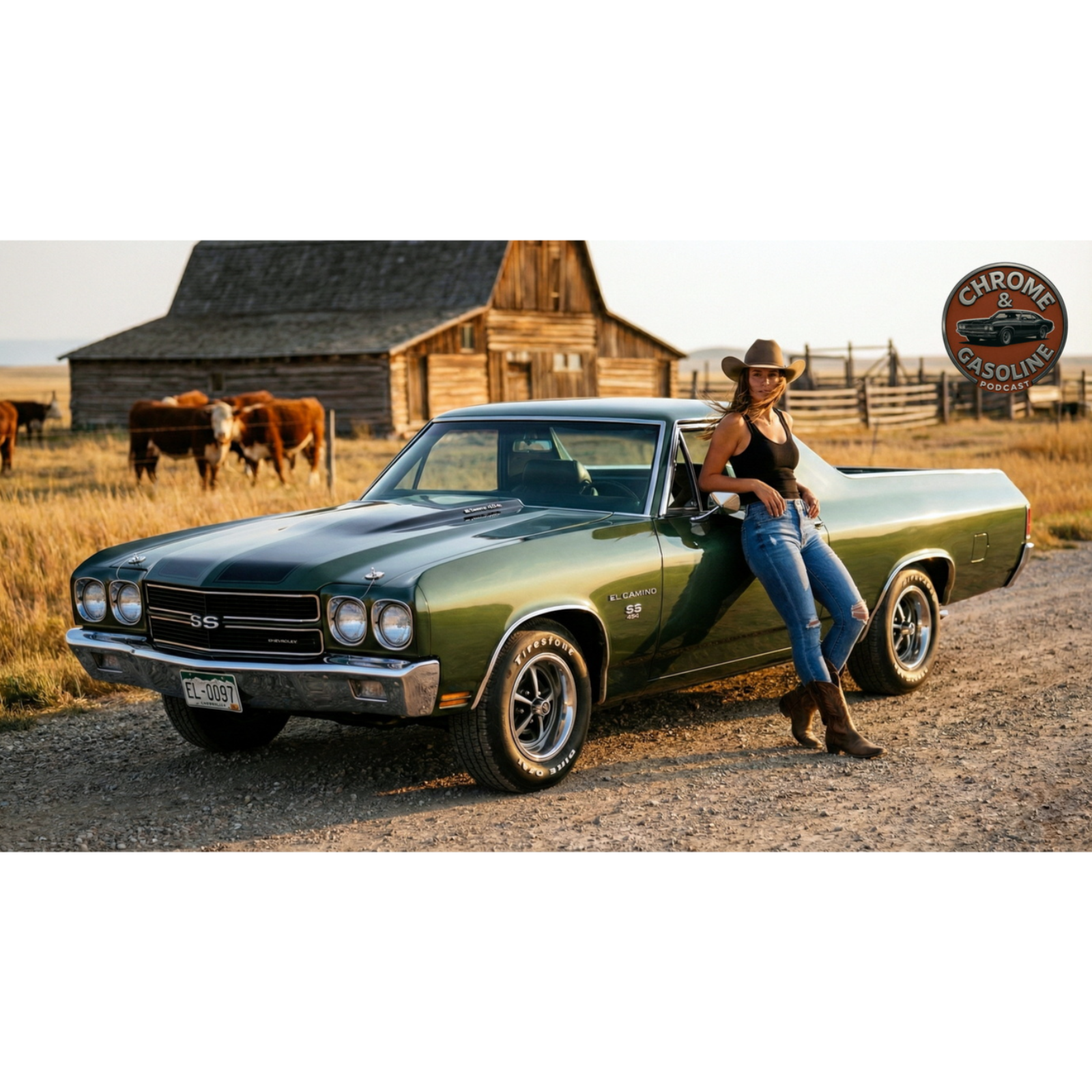
Today's star is the 1968 to 1972 Chevrolet El Camino SS.
A vehicle that wakes up every morning, looks in the mirror and asks,
Am I a truck or am I a muscle car? And honestly, same.
The El Camino is the classic identity crisis on four wheels, except it's not sad about it.
It's proud. It's like, yeah, I've got a bed.
Yeah, I've got performance badges. I can haul plywood and also haul feelings.
The whole idea is beautifully American.
Why choose between practicality and fun, when you can combine them into one long hood,
one short bed, and one set of rear tires that are always just one bad decision away from becoming smoke?
Now, put yourself in the late 60s into the early 70s.
This is the peak performance-era energy. Gas is cheap, engines are generous,
and everyone's advertising sounds like they're narrating a boxing match.
The streets are full of big attitudes and bigger carburetors.
And right in there, Chevrolet drops the El Camino SS like,
What if we gave you muscle car vibes, but you could also pick up a refrigerator?
If you squint and believe in yourself? And SS back then?
It's basically Chevrolet's way of saying, this one's got the spice.
It's not a single magical spell that turns any car into a drag strip legend.
But it usually signals a performance-flavored package, more aggressive look,
upgraded bits depending on year and options, and the general promise
that you did not buy the slow one on purpose.
It's the automotive equivalent of ordering your sandwich loaded.
Does it guarantee greatness? Not always.
But it tells the world you showed up hungry. Underneath all the swagger,
the El Camino SS is rooted in Chevrolet's mid-size car bones from the era.
Think car first, not farm equipment first.
It rides and drives more like a car than a traditional pickup,
because it basically is one, just with the back half chopped into a bed
and a whole new personality installed.
That means it feels lower, more plentiful,
and more like something you'd take to a cruise night instead of a cattle auction.
And that's where our first recurring argument begins.
Truck logic versus muscle car logic.
Truck logic says, a bed. You can use it. You can work.
You can carry lumber. You can be responsible.
Muscle car logic says, yeah, also you can leave two black stripes
behind the Home Depot and pretend that counts as cardio.
This is the El Camino SS in a nutshell.
A car that can technically do chores, but mostly wants to do crime.
Legal, tire-based crime.
In this series, we're going to walk through what made the 1968 to 1972 El Camino SS,
such a lovable oddball, the powertrain vibe,
the way it drives when the bed is empty,
the way it changes the room when it rolls in,
and the legends people swear are true about El Camino SS.
Because the El Camino SS isn't just a car truck,
it's a sliding scale of responsibility.
One end is, I bought mulch.
The other end is, I bought a big block,
and now my neighbors hate me.
And every El Camino owner lives somewhere in the middle,
constantly negotiating with their own common sense.
Episode two, I'm Alex.
This is Chrome and Gasoline,
and we are now talking about El Camino SS.
Episode two, I'm Alex.
This is Chrome and Gasoline,
and we are now entering the sacred temple of bench racing,
engines, torque, and the kind of math that only makes sense
if your evidence is,
trust me bro.
Let's talk powertrains in the 1968 to 1972 El Camino SS era,
but in a responsible way.
Not the I memorized every casting number way.
More like the,
a thunderstorm under the hood way.
Across those years,
the El Camino SS world generally lives in the land of V8s.
Small block vibes and,
depending on year and how the car was optioned,
big block energy too.
And the difference in daily life is basically this.
Small block logic says,
I'm lively, I rev, I'm a good time,
and I might still let you afford tires.
Big block logic says,
hello, I am torque, I move the earth,
your wallet will never forgive you,
but your soul will be at peace.
And torque is the secret sauce here.
Horse power is the headline.
Torque is the part where the car shoves you like it's offended.
Torque is what makes the El Camino feel like it could tow the moon,
until truck logic reminds you,
please do not tow the moon.
The brakes are having emotions.
Now these cars grew up in carburetor culture.
And if you've never lived with a carbureted V8,
imagine starting your morning with a little ritual.
Modern cars, push button, go.
Carb cars, negotiate.
Two pumps, maybe three.
A prayer, a weird half throttle.
Listen to it cough like it's clearing it's throat.
Okay, now it's awake.
And the smell, oh, the smell.
Gasoline isn't just fuel in these cars,
it's a perfume.
It's the El Camino SS saying,
I'm alive and I'm not particularly interested in your indoor air quality.
This is where we bring in our marketing translator bit,
because the brochures back then were basically written
like a Carnival Barker with a necktie.
They'd say things like exciting performance
and sports-minded driving,
and what they meant was,
this car will encourage you to make decisions
you'll explain later with hand gestures.
And the experience of speed in an El Camino SS
isn't just the engine.
It's everything around it.
The gearing, the weight, the traction,
the fact you're sitting in something that looks like
it should be delivering appliances,
but is instead trying to leap forward
like a dog spotting a squirrel.
Also, bench racing math must be addressed.
Bench racing math is where horsepower numbers
inflate over time like a fish story.
It had 350 horsepower.
Two years later, it had 400.
Five years later, it was basically a race car.
Ten years later, NASA called me about it.
The truth is, the El Camino SS's performance
depends on how it was equipped
and how it's been maintained, tuned,
and occasionally lied about.
But the vibe remains consistent.
V8 torque, carburetor attitude,
and the feeling that the rear tires
are always voting yes on your worst ideas.
Truck logic says,
use the power responsibly.
Muscle car logic says,
power is responsibility to have fun.
Episode 3, I'm Alex,
and you're listening to Chrome and Gasoline,
where we keep one hand on the steering wheel
and the other hand waving away bad ideas
like their mosquitoes.
Today, we're talking about how the 1968
to 1972 El Camino SS actually behaves
because owning one is like living with a charming friend
who occasionally rearranges your furniture
when nobody's looking.
The El Camino SS comes from car-based routes
so the ride and feel are different
from the old-school truck-truck pickups of the era.
It sits lower.
It feels more like a mid-size car
that got a job at a hardware store.
That's the whole appeal.
You get a more car-like driving experience
with a bed attached like a bonus level,
but the bed changes everything
and this is where truck logic versus muscle car logic
turns into a full courtroom drama.
Truck logic says,
a bed means utility.
It's practical.
Muscle car logic says,
a bed means less weight over the rear wheels,
which means you can accidentally invent drifting
because when the bed is empty,
the rear can feel light,
especially if you treat the throttle like an on-off switch.
The El Camino SS can be perfectly well-mannered
until you remember you own a V8 and you have ankles.
Then it becomes a physics lesson
taught by your rear tires.
Now, let's keep the tech moderate,
but real.
Suspension and brakes in that era
can vary by exact setup,
but the general theme is
you've got classic American muscle-era hardware.
Steering can feel big and relaxed
compared to modern cars.
Braking performance depends a lot
on condition and equipment.
Power assist can feel like a gift from heaven,
and front disc brakes, if equipped,
feel like someone upgraded your reality.
But regardless, you still need to drive it
like an old car.
It's not a modern performance machine
with computers babysitting your impulses.
It's more like,
here are tools, please be an adult.
And then it watches you fail.
Also, a practical note,
the bed is useful,
but it comes with consequences.
Weather is a factor,
security is a factor,
and anything in the bed
becomes a potential projectile.
If you drive like muscle car logic
is in charge of your life,
you don't want your toolbox discovering flight.
There's also the way the El Camino SS
feels on the road,
longer than you think,
hoods stretching out like a runway
with a front end that feels confident
and a rear end that feels like it's ready to party.
When you're cruising, it's smooth and easy
like it could do this all day.
When you stab the throttle,
it suddenly remembers it has an SS badge
and starts acting like you owe it money.
This is the sweet spot.
It's a cruiser, a hauler,
and a troublemaker depending on your mood.
And that's why people fall for it.
Truck logic says,
load it up with lumber
and drive carefully.
Muscle car logic says,
load it up with a single lawn chair
and still do a burnout.
And deep down,
the El Camino SS just smiles
because it knows both of you are right.
Episode 4, I'm Alex
and this is Chrome and Gasoline
where we talk about classic cars.
The way people talk about old friends
with affection, mild concern,
and a lot of stories that start with
so here's what happened.
By the time you get into the 1968
to 1972 El Camino SS,
you're not just buying transportation,
you're buying a vibe.
The El Camino doesn't silently arrive anywhere.
It rolls in like it's late to a meeting
but somehow still the most interesting person in the room.
Styling wise,
it's got that late 60s to early 70s
Chevrolet confidence,
long hood, purposeful stance,
and just enough bright work or badging
to let you know it wants attention.
SS trim cues,
depending on year and options,
signal that this isn't the I bought it on sale package.
This is the I made a choice package
and culturally,
the El Camino SS is a genius move.
It appeals to two crowds that normally
argue at the same barbecue.
The truck crowd looks at it and goes,
hey, a bed makes sense.
The muscle car crowd looks at it and goes,
hey, V8 makes sense.
Meanwhile,
the El Camino owner is standing
in the middle going, exactly.
I am unstoppable.
This is where our marketing translator returns.
Period advertising would imply
the El Camino is the perfect blend
of sport and utility.
Translation,
you can justify horsepower to your family
by mentioning groceries.
Then there are the ownership myths.
Every El Camino SS
seems to come with a legend attached.
Somebody's uncle used it as a work truck
all week and then ran 12 seconds
on the weekend.
Somebody's neighbor pulled a boat
uphill in reverse.
Somebody's friend swears it was factory
everything except the cam,
the carb, the exhaust, the gears,
the ignition and reality.
And that leads us back to
bench racing math.
In El Camino land,
horsepower is never just horsepower.
It's an evolving narrative.
The car becomes a personality.
People talk about it like it's a teammate.
She's got a little attitude.
He likes premium.
It doesn't like cold mornings.
All true by the way.
Maintenance and longevity?
Here's the general truth.
These are simple mechanical cars
that reward basic care.
They're not delicate flowers,
but they don't like neglect either.
A well-sorted one can feel solid
and honest.
A neglected one can feel like it's trying
to communicate exclusively through vibrations.
And that's the thing.
The El Camino SS is beloved because
it lives at the intersection of usefulness
and mischief.
It's the kind of car that makes
you invent excuses to drive it.
You find yourself saying things like
I should pick up some plywood
even though you don't own a saw.
That's not practicality.
That's a symptom.
Truck logic says it's a tool.
Muscle car logic says it's a toy.
The El Camino SS says
why not both?
Also, please rev me at stoplights.
And next,
I'll tell you about a moment
where I personally fell into the El Camino trap
because nobody is immune,
especially not me.
Episode 5.
I'm Alex
and you're listening to Chrome and Gasoline
and I owe you a personal confession.
I have been personally attacked
by a 1968 to 1972 El Camino SS,
not physically, emotionally,
spiritually,
like it reached into my brain
and rearranged my priorities.
Here's what happened.
A few years back,
I'm at a local cruise in.
You know the scene.
Lawn chairs,
the smell of fuel and sunscreen.
A guy explaining his rear end ratio
to someone who didn't ask
and the constant soundtrack of engines
clearing their throats
like they're practicing a pickup line.
And then I see it.
An El Camino SS.
Sitting there like it owns the parking lot.
Perfect stance.
The kind of paint that looks deep enough
to drown your bad financial decisions.
The nose says muscle car.
The bed says I'm here to help.
The whole thing says
get in.
We're making mistakes.
I walk up and do the normal car person thing
where you pretend you're just casually looking
but really you're circling like a hawk.
And the owner,
because El Camino owners are always like this,
hits me with the line.
It's the best of both worlds.
Truck logic in my head
immediately stands up with a clipboard.
A bed means utility.
Think of the errands.
Think of the airport runs.
Think of the mulch.
Muscle car logic kicks the clipboard into traffic.
SS badge.
V8.
Car based.
It wants to party.
The owner pops the hood
and I'm not going to pretend I decoded every detail
like a factory inspector.
But the vibe was clear.
Big American V8 energy.
Tidy enough to be proud of
and loud enough to be honest.
It wasn't whispering.
It was speaking in uppercase.
Then he says,
you want to hear it?
And I know what you're thinking.
Alex, you're an adult.
You can say no.
No.
No.
You cannot.
Not at a cruise in.
Not when an El Camino SS
is offering you an audition.
That's like turning down a handshake
from a cartoon villain.
You're curious.
You're doomed.
He fires it up
and the whole car
does that old school V8 thing
where it doesn't just start.
It announces itself.
The idol had that gentle lope
like it was breathing through confidence
and the smell.
Pure carburetor culture.
It's like the 1970s reached out
and said,
remember when engines had personalities
and your eyes watered a little?
Good times.
Marketing translator voice
in my head goes,
this is exciting performance.
Translation.
This thing will convince you to accelerate
for no reason.
And I'm standing there thinking practical thoughts
because I'm trying to be responsible.
I'm thinking,
you could haul stuff in that bed
and at the exact same time I'm thinking,
you could do a burnout so long
it becomes a weather event.
That's the El Camino SS spell.
It makes you believe you're buying a tool
when really you're adopting a lifestyle.
The owner tells me,
drives like a car.
Truck logic nods.
See?
Comfort.
Sensible.
Muscle car logic leans in
and whispers,
until you hit it.
Because that's the thing.
An El Camino SS can cruise politely
and then the moment you give it throttle
it remembers it has an SS badge
and an ego.
The rear end gets light when the bed is empty,
the nose rises a little
and suddenly your brain starts doing
bench racing math.
This feels fast.
Five minutes later,
this is the fastest thing ever made.
Ten minutes later,
I could beat a modern sports car.
Twenty minutes later,
I am basically a professional driver.
And right there,
at that cruise in,
I realized why the El Camino SS
still hits people in the chest.
It's not just the engine.
It's the ridiculous logic of it.
It's the confidence.
It's the way it makes you smile
even while you're trying to act mature.
I didn't buy that El Camino.
I went home
and pretended I was responsible.
But I'll tell you the truth.
Every time I see one now,
my brain starts negotiating again.
Truck logic says,
you don't need it.
Muscle car logic says,
need is a weak word.
And the El Camino SS says,
softly,
like a devil on your shoulder.
Come on.
You can carry groceries and your pride
at the same time.
That's the magic of the 1968 to 1972
Chevrolet El Camino SS.
It's a beautiful contradiction
that somehow works.
It's a classic car with a split personality
and both personalities are hilarious.
If you're an HVAC technician
and a call comes in,
Granger knows that you need a partner
that helps you find the right product,
fast and hassle-free.
And you know that when the first problem of the day
is a clanking blower motor,
there's no need to break a sweat.
With Granger's easy-to-use website
and product details,
you're confident you'll soon have everything
humming right along.
Call 1-800-GRANGER, click Granger.com
or just stop by.
Call 1-800-GRANGER for the ones who get it done.
About this episode
Exploring the unique charm of the 1968-1972 Chevrolet El Camino SS, this episode dives into its dual identity as both a muscle car and a practical truck. The hosts discuss its performance roots, V8 powertrains, and the cultural significance of this classic vehicle. With a blend of humor and nostalgia, they highlight the El Camino's ability to deliver thrills while still being functional, making it a beloved oddball in automotive history. Listeners will enjoy anecdotes about ownership myths and the irresistible allure of this versatile ride.