You know, this is one of those topics that no one really wants to think about, but if you're
a parent, a homeowner, married, or helping take care of aging parents, it's something
that honestly deserves a little attention.
I'm talking about estate planning.
And before you tune out thinking it's complicated or expensive, that's actually why I want
to mention trust and will.
Trust and will makes estate planning feel way less intimidating than it sounds.
They offer modern, attorney-designed wills and trusts that you can create online.
The process is surprisingly straightforward.
In fact, you can create a will in as little as 30 minutes.
That includes things like guardianship for your kids or pets, how your assets are distributed,
and even healthcare directives.
Don't wait until it's too late.
Protect your loved ones with trust and will, the most trusted name in online estate
planning.
Get trustandwill.com slash future to get 20% off.
That's trustandwill.com slash future for 20% off.
Trustandwill.com slash F-U-T-U-R-E.
Episode one, welcome to Chrome and gasoline.
I'm Alex and today we are stepping back into the glory days of the late 60s.
Specifically, we are looking at Ford in 1969 and 1970.
This was a time when safety regulations were basically just suggestions written on a napkin
and the answer to every engineering question was add more carburetor.
We need to talk about the boss, not the guy who signs your paycheck and denies your
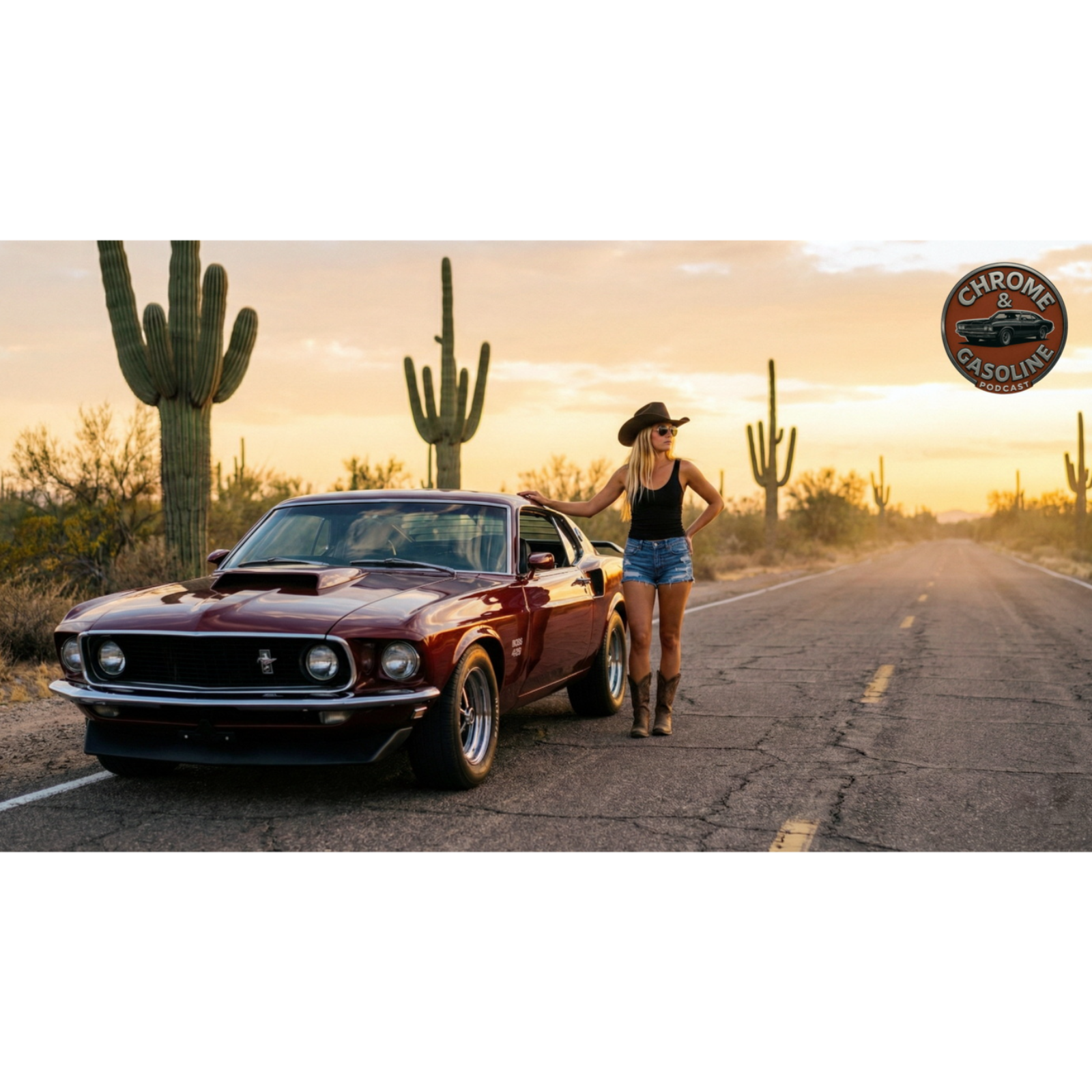
vacation requests, but the Ford Mustang Boss, the Boss 302 and the Boss 429.
These cars were born out of a very specific kind of corporate panic.
See, back then, when on Sunday, sell on Monday, wasn't just a catchy slogan.
It was a business model.
If your car didn't cross a finish line first, people assumed it would explode in their
driveway.
Ford needed to homologate engines for racing.
That brings us to our first segment, marketing translator.
Whenever you hear the word homologation, that is just fancy automotive speak for.
The rule book says we have to build 500 of these ridiculous things and sell them to the
public or we can't go racing.
That's it.
It means the manufacturer is essentially annoyed that they have to sell you a race car with
a license plate, so Ford had a two front war.
On one side, you had the Trans Am series.
This was road racing, left turns, right turns, breaking, actual driver skill.
It was a gentleman's brawl.
Ford needed a small block engine that could scream at high RPMs without sending a piston
into orbit.
That became the Boss 302.
On the other side, you had NASCAR, the big ovals, the land of giants.
Ford had this massive, hemi-headed 429 engine they wanted to use to crush Chrysler.
NASCAR rules said, fine, but you have to put that engine in a car you actually
sell.
Ford looked around the shop, saw the Mustang and said, it won't fit.
Get the torch.
That became the Boss 429.
The vibe of these two cars is totally different, even though they share a name.
The Boss 302 is the street fighter.
It's got stripes, it's got attitude, it looks like it's ready to punch you in
the throat for looking at it wrong.
The Boss 429 is the quiet heavy lifter.
It usually didn't have the wild graphics.
It just had a hood scoop the size of a mailbox and a stance that suggested the
suspension was crying for help.
We are going to dive deep into both of these legends over the next few episodes.
We will talk about why the 302 is the one you want to drive and why the 429 is the
one you want to park in your living room and stare at while eating cereal.
We will debunk some myths, roast some auction prices and try to figure out why we are
still obsessed with 50-year-old technology that gets 8 miles to the gallon downhill.
Buckle up.
Episode 2.
We are back with Chrome and gasoline.
I'm Alex and right now we are focusing on the scalpel of the pair.
The Boss 302.
If you grew up in the muscle car era or if you just absorbed the culture through
osmosis and aggressive YouTube algorithms, you know that American muscle cars generally
had one trick.
They went straight very fast and if you tried to turn the tires would file a formal grievance.
The Boss 302 was different.
This was the car designed to turn.
The engine was a masterpiece of, what if we just let it breathe?
It was a 302 cubic inch V8 but it had these massive cylinder heads that allowed
for ridiculous air flow.
It was a high revving engine.
You had to ring its neck to get the power.
Driving a standard big block Mustang is like riding a bull.
Driving a Boss 302 is like wrestling a very angry cheetah.
It's precise, it's loud, and it requires your full attention.
Let's go to the marketing translator.
In 1969 the brochures talked about road-hugging weight and European inspired handling.
Translation.
We put stiffer springs on it and if you hit a pothole your spine will shatter
but you'll look cool doing it.
The visual package on the Boss 302 is iconic.
The reflective sea stripes on the side of the 1969 model or the hockey stick stripes on
the 70, the rear window slats, the spoilers.
It was loud visually.
It screamed, I am a race car.
Which is ironic because most of them spent their lives doing burnouts in high school
parking lots.
I have a buddy, let's call him Steve.
Steve is not a mechanic but he owns a terrifying amount of tools.
Steve swears he once drove a Boss 302 that was so dialed in he could take an off-ramp
at 80 miles an hour.
Now this brings us to a segment I like to call Garage Court.
In the case of Steve versus Physics I am ruling in favor of exaggeration.
While the Boss 302 was the best handling Mustang of its time we have to remember
that good handling in 1970 meant the car didn't immediately flip over.
It still had leaf springs and tires that were essentially made of hard plastic by
modern standards.
But the feeling?
That's real.
The solid lifter ticking sound.
The vibration of the shaker hood.
It's a sensory overload.
The Boss 302 isn't about zero to sixty times.
If you care about drag racing numbers go buy a Cobra Jet.
The Boss 302 is about the noise it makes at 7000 RPM.
It's about the fact that it hates idling in traffic.
It loads up.
It gets hot.
It grumbles.
It wants to run.
It's a car with a caffeine addiction and that's why we love it.
It has a personality and that personality is aggressive.
Welcome back to Chrome and Gasoline.
I'm Alex.
Today we are talking about the big boy.
The legend.
The packaging nightmare.
The Boss 429.
If the Boss 302 was a scalpel the Boss 429 was a sledgehammer duct taped to a roller
skate.
This car exists solely because Ford wanted to race this engine in NASCAR and the
rules said they had to sell it to the public.
But here's the punchline.
They didn't race the Mustang in NASCAR.
They raced the Torino.
They just used the Mustang to meet the production numbers because the engine bay in the Torino
wasn't ready or the marketing guys thought it would be funny.
The engine was massive.
It was so wide they couldn't fit it between the shock towers of a standard Mustang.
They had to ship the cars to a subcontractor called CarCraft.
These poor guys basically had to take a perfectly good Mustang, chop the shock towers, move the
suspension geometry and shoehorn this behemoth into the hole.
It was like trying to park a bus in a closet.
Let's convene the garage court.
The case at hand.
People who claim the Boss 429 was the fastest streetcar ever made.
The ruling, guilty of nostalgia.
Here is the truth.
The Boss 429, as it came from the factory, was actually kind of… polite.
It had a mild cam.
It had a restrictive intake.
It had an exhaust system that strangled it.
On the street, a 428 Cobra Jet would often beat its stoplight to stoplight.
The 429 was a race engine that was handcuffed and gagged for street use.
But that doesn't matter.
The appeal of the Boss 429 isn't the quarter-mile time, it's the flex.
It's popping the hood and revealing an engine that looks like it was stolen from
a B-52 bomber.
The valve covers are the size of carry-on luggage.
The hood scoop is functional and massive.
It's an engineering absurdity.
We also have to address the battery.
They had to move the battery to the trunk because there was literally no room left under
the hood.
In 1969, that was exotic stuff.
It messed up the weight distribution, sure.
The car was nose-heavy.
If you hit the brakes too hard, the rear bumper would try to overtake the front bumper.
There is a myth that every Boss 429 owner was a street racing king.
In reality, most of these cars probably overheated if they sat in traffic for 10
minutes.
But when you own a Boss 429, you don't need to race.
You have already won.
You own the unicorn.
You own the car that Ford lost money on every time they built one.
It is a monument to excess.
And for that, we have to respect it.
It is terrible at being a car, but excellent at being a legend.
Episode 4.
I'm Alex.
This is Chrome and gasoline.
And today, we are settling the score.
Boss 302 versus Boss 429.
The eternal argument.
If you go to a high-end car auction, one of those places where people pay six figures
for a car, they will drive exactly zero miles.
You will see the difference.
The Boss 429 is the crown jewel.
It's the investment-grade asset.
It sits behind a velvet rope.
People whisper when they look at it.
The Boss 302?
The Boss 302 is usually parked in the paddock with stone chips on the nose and bugs on
the windshield.
It's the working man's hero, relatively speaking.
This brings us to our recurring segment.
Bench racing inflation.
This is the phenomenon where horsepower numbers increase by 10% for every year that passes
since the car was built.
If you listen to guys at a car show, they will tell you the Boss 429 made 600 horsepower
from the factory.
In reality, it was rated at 375.
Was it underrated?
Sure.
But let's be real.
The tires in 1969 were bias-pleat polyglass.
Even if you had 1,000 horsepower, you weren't going anywhere.
You were just making expensive smoke.
The 302 is the driver's choice.
It's balanced.
It feels alive.
You can actually take a corner without filing a flight plan.
The 429 is the collector's choice.
It's rare.
It's mythical.
It's a pain in the neck to maintain because parts are made of unobtain them.
If you break a valve cover on a Boss 429, you have to sell a kidney.
If you break a valve cover on a 302, you just go to a swap meet.
There is a certain tragedy to the 429.
It was built for NASCAR, but the street version never really got to show its teeth
unless the owner started modifying it.
And once you modify a car that rare, you ruin the value.
So it's stuck in limbo, a caged lion that isn't allowed to roar.
The 302, on the other hand, begs to be modified.
It wants headers.
It wants a bigger carb.
It wants to be thrashed.
It's the car you take out on a Sunday morning to wake up the neighbors.
So who wins?
If I'm buying a car to put in a glass box and fund my retirement, the 429.
If I'm buying a car because I have a pulse and I like the smell of high-octane fuel, the
302, every single time.
It's the difference between owning a tiger and owning a really fast dog.
The tiger is impressive, but the dog is going to be more fun to play with.
Episode 5 Welcome back to the final lap of this series
on chrome and gasoline.
I'm Alex.
We've talked specs.
We've talked myths.
But now I want to tell you a story.
We'll call this the Boss Encounter.
A few years back, I got a tip.
Now car tips are usually garbage.
It's always, my uncle has a Ferrari and a barn.
And you get there, and it's a Fiero with a body kit.
But this tip was specific.
A guy named Walter, two counties over, supposedly had the pair.
A Boss 302 and a Boss 429.
I drive out there.
It's a long driveway, gravel, middle of nowhere.
I pull up and there's Walter.
Walter is wearing overalls and looks
like he hasn't trusted a government official since 1954.
We walk to the first garage.
He rolls up the door.
There sits a 1970 Boss 302, grabber orange.
But it's not a show car.
It's covered in old newspapers, a bag of lawn fertilizer,
and a cat is sleeping on the shaker hood.
I look inside, and it's a four-speed car.
Original interior, smells like mice and vinyl.
Walter pats the fender and says, that's the grocery getter.
Drives real nice if you double clutch into second.
I'm losing my mind.
He uses a Boss 302 to buy milk.
But then I ask, Walter, what about the 429?
He gets quiet.
He looks toward the second shed.
This shed is leaning.
It looks structurally compromised.
He walks over, wrestles with a padlock that is mostly rust
and creaks the door open.
It's dark.
I turn on my flashlight.
And there it is, a 1969 Mustang fastback body shell.
No engine, no transmission, just a shell on cinder blocks.
Where's the engine?
I ask.
Walter points to the corner.
There, sitting on a tire, is the massive semi-Hemai head
of a Boss 429 engine.
Just one head, he explains.
Well, I traded the block for a tractor back into 82,
but I kept the head.
Figured I'd find another block someday.
We stood there in silence.
This is the bench racing inflation in real life.
The legend of the car was worth more than the car itself.
He didn't have a Boss 429.
He had a rusty shell and a very heavy paperweight.
But in his mind, he owned the pair.
We walked back to the Boss 302.
I asked if he'd sell it.
He looked at me like I'd asked to buy his left foot.
Son, he said, what would I drive to the store?
And that is the essence of these cars.
For some, they are investments.
For others, they are just machines
that make noise and go fast.
We chase the chrome.
We chase the gasoline.
And sometimes, we just chase the ghost of an engine block
traded for a tractor.
Keep your eyes on the road and check those barns.
You never know.
If you're the purchasing manager
at a manufacturing plant,
you know having a trusted partner
makes all the difference.
That's why, hands down,
you count on Grainger for auto-reordering.
With on-time restocks,
your team will have the cut-resistant gloves
they need at the start of their shift.
And you can end your day knowing
they've got safety well in hand.
Call 1-800-GRAINGER, click Grainger.com
or just stop by.
Grainger for the ones who get it done.
About this episode
Exploring the legendary Ford Mustang Boss 302 and Boss 429, this episode dives into the unique characteristics and histories of these iconic muscle cars. The Boss 302 is celebrated for its handling and high-revving engine, while the Boss 429 is portrayed as a massive engineering marvel, created to meet NASCAR homologation rules. With engaging anecdotes, comparisons, and a humorous take on their myths and realities, the episode captures the essence of why these cars continue to fascinate enthusiasts today.