If you're an HVAC technician and a call comes in, Granger knows that you need a partner that
helps you find the right product, fast and hassle-free.
And you know that when the first problem of the day is a clanking blower motor, there's
no need to break a sweat.
With Granger's easy-to-use website and product details, you're confident you'll soon have
everything humming right along.
Call 1-800-GRANGER, click Granger.com or just stop by.
Granger, for the ones who get it done.
Episode 1.
Meet the bird.
Welcome back to Chrome and gasoline.
I'm Alex, and today we're talking about a car that didn't just show up.
It arrived like it had a pit crew and an attorney, the 1969 Pontiac Firebird
Trans Am.
Now, quick translation for normal humans.
Trans Am wasn't Pontiac being poetic, it was a nod to the road racing scene of
the era, the kind of racing where people wore helmets that looked like salad bowls
and drove like they were late for rent.
Pontiac wanted the Firebird to have a sharper, track-leaning personality, and
the Trans Am was the loud handshake.
And the 1969 model is special because it's the beginning.
First-year vibes, early recipe, the kind of car where the legends start
forming immediately, sometimes before the paint is even dry.
It's a Firebird, yes.
But it's not just a Firebird with a pep talk.
It's the I do push-ups in the driveway Firebird.
Let's talk presence.
A Trans Am doesn't do subtle.
The body lines are already sporty, but the Trans Am leans into the idea that a car
can look like it's moving even when it's parked.
The stance, the hood attitude, the graphics that basically say,
I'm not here to ask permission.
It's muscle car swagger with a corner carver fantasy.
Here's our first recurring segment, chrome math.
In chrome math, every shiny part adds horsepower.
Not on a dyno, but spiritually.
A mirror finish bumper is worth at least five horsepower,
because it reflects your confidence back at you.
If your neighbor complains, that's don't care torque.
What made the 1969 Trans Am feel different wasn't one magic part.
It was the whole vibe, more performance intent, more visual statement,
and a sense that Pontiac was aiming it at drivers
who liked turning, not just launching.
Sure, it still wanted to light up the rear tires.
It just also wanted to brag about it in a curve.
And look, in the late 60s, everybody
was competing for your attention.
Some cars screamed with giant scoops.
Some whispered with elegance.
And some just tried to look expensive enough to distract you
from the gas mileage.
The Trans Am's pitch was simple.
What if your muscle car also cared about the road's corners?
So in this series, we're going to walk
through what makes the 1969 Firebird
Trans Am such a permanent resident in car culture.
We'll hit the engine and transmission in plain English,
talk colors and styling.
And then I'll end with a personal story,
because if you can't embarrass yourself a little
on chrome and gasoline, what are we even doing?
All right, wipe the fingerprints off the chrome,
and let's get into the mechanical heart in episode two.
Episode two, powertrain without the textbook,
you're still with Alex on chrome and gasoline,
and now we're going under the skin.
Not in a creepy way, in a, tell me what's in the engine
bayway, which is the only socially acceptable
version of obsession.
In that late 60s performance world,
Pontiac's identity was big displacement V8 confidence.
For Firebirds and their performance trims,
you're generally talking about serious cubic inches
and a personality that doesn't need to rev
to the moon to make a point.
The 1969 Trans Am is closely associated
with Pontiac's 400 cubic inch V8 neighborhood.
And enthusiasts often talk about ram air style
induction packages, depending on configuration.
If you've never heard ram air,
it's Pontiac saying, what if we help that big V8
breathe easier by drawing cooler outside air
through the hood and then we brag about it.
Here's the friendly version of what that means.
A big V8 from that era tends to deliver torque
in a way that feels like the car
is pulling the road toward it.
You tap the throttle and it doesn't ask questions,
it answers.
Sometimes it answers with the subtlety
of a screen door in a windstorm.
Now, carburetors.
The carb is like a moody chef.
On a perfect day, it serves you a five course meal
of crisp throttle response.
On a humid day, it looks at you like,
we're doing soup only.
That's part of the charm and part of the comedy.
You don't own a classic performance Pontiac.
You negotiate with it.
Transmission choices?
In that era, the story is usually manual
versus automatic and the vibe change is huge.
A four speed manual was the badge of honor.
The I lift with my left leg option.
Often living in the same tough
Muncie style universe as other GM performance cars
of the time.
If you got an automatic, you were typically
in a sturdy three speed automatic world.
The kind that lets the engine lean on its torque
and just keep coming.
Both can be fun.
One makes you feel like a hero.
The other makes you feel like a smooth operator
who lets the torque do the talking.
Myth versus reality time.
Myth.
You need a manual or you're not a real enthusiast.
Reality, if the car makes you grin like an idiot
at 35 miles per hour, you're doing it correctly.
Also, traffic exists.
Nobody wins a trophy for clutching in a construction zone.
And while we're being honest,
the powertrain is only half the story.
The Trans Am reputation comes from the package mindset.
Engine, gearing, suspension intent and the whole,
this car was built with a sharper pencil feeling.
It's not a laboratory instrument.
It's still a 1969 American performance car.
But it's one that at least pretends
it knows what an apex is.
So when people fall for the 1969 Trans Am,
they fall for that mix.
A big Pontiac Vive eight heartbeat.
A choice of transmissions that changes the character
and just enough performance attitude
to make the driver feel like
they should be wearing racing gloves
even if they're only going to get milk.
Next up, we talk looks, colors
and why this car can start an argument
in a parking lot without even turning the key.
Episode three, looks that could start an argument.
Welcome back to Chrome and gasoline.
Alex here and today we're talking about
the part of the 1969 Firebird Trans Am
that gets people emotional
before the engine even warms up.
The look, the Firebird already has
that long hood short deck energy
but the Trans Am takes it and adds a megaphone.
The hood treatment, the stripes,
the performance cues, it's all designed
to make the car look like it's auditioning
for the role of main character
in every driveway it enters.
Now a little color talk carefully.
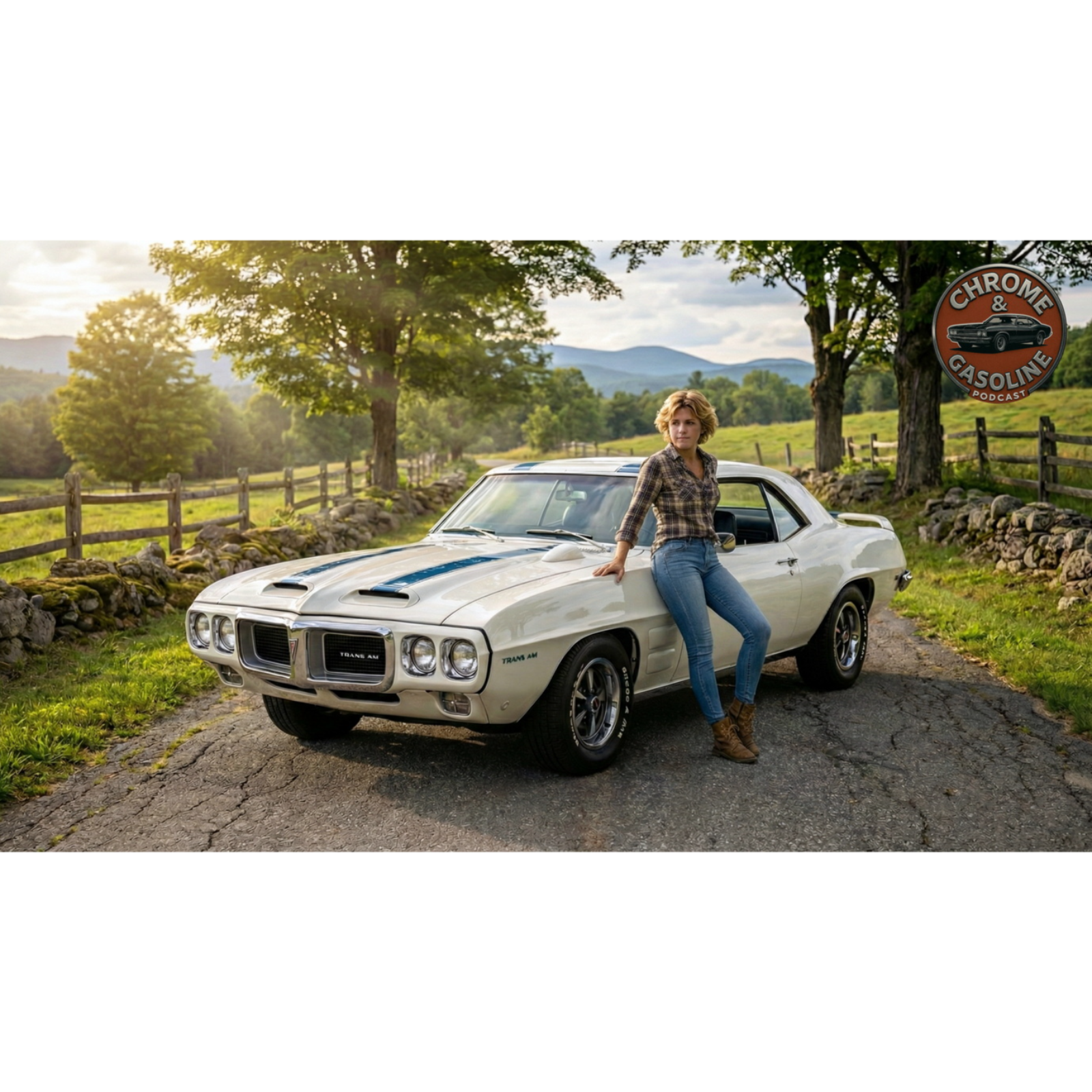
The 1969 Trans Am is famously associated
with a bright high contrast scheme
often remembered as a white body
with blue striping and accents.
It's the kind of combo that looks clean,
aggressive and slightly like
it should come with a helmet.
Even if you don't know cars,
you see that and think, okay,
that one probably has opinions
and that color strategy matters
because it turns the car into a rolling logo,
not a brand logo, a personality logo.
You don't pick that scheme if you want to blend in.
You pick it because you want the car
to be noticed from across a grocery store parking lot
and you want the shopping cart guy to whisper, nice.
Interior vibe, late 60s sporty American.
You're not getting space age luxury.
You're getting driver focused simplicity
with enough gauges to make you feel
like you're monitoring a small reactor.
The wheel in your hands, the view over the hood,
the sense that you're sitting
in something designed for driving, not just traveling.
Time for a comedic segment.
If cars had dating profiles,
1969 Trans Am profile, height low,
hobbies, cornering, flexing
and making Camaro's nervous, love language, throttle,
looking for someone who understands
that original is not just a word, it's a lifestyle.
It's funny because it's true.
This car attracts a certain personality.
People who like it tend to like it loudly
and that's part of the Trans Am magic.
It's not universally polite.
It's divisive in a way that makes it memorable.
Also, the badging and graphics do work.
They communicate intent.
They tell you this is not the base model
that quietly commutes.
This is the version that makes you check your reflection
in the storefront window as you walk away
just to see if the car is still looking back.
So yes, styling is subjective,
but the 1969 Trans Am has a very specific visual mission.
Look like a road racer's cousin who moved to America
and started lifting weights.
Next episode, we'll talk about the driving feel
and the real world quirks
because every classic car romance
has at least one moment where you realize your date
in a very charming mess.
Episode four, driving, feel and real world quirks.
You're listening to Croman Gasoline with Alex
and now we get to the part where fantasy meets asphalt.
What does a 1969 Firebird Trans Am feel like
when it's actually moving?
First, perspective.
A car like this comes from an era
where the steering is more conversation than command.
You turn the wheel and the car replies
in a slightly slower accent.
Not bad, just different.
The feedback can be surprisingly alive,
especially compared to modern cars that isolate you
like you're driving inside a padded envelope.
When you roll onto the throttle,
the whole car communicates,
the nose lifts a little, the rear settles,
and you get that classic American performance sensation.
The engine is not just pushing the car forward,
it's rearranging your expectations.
You don't need a racetrack to enjoy it.
A two-lane road in a little space
is enough to understand why people keep talking about these.
Handling-wise, track-leaning for 1969
is not the same as modern sports car.
The Trans Am vibe is more like an athlete from the 60s,
strong, confident, maybe not obsessed with stretching.
It can feel planted when it's set up right,
but it also reminds you that tires, suspension bushings,
and alignment matter a lot more
when the car is old enough to have memories.
Brakes?
Many cars of that era ran a mix of disc and drum,
depending on options and setup,
and the key lesson is this.
Leave yourself room, not panic room, just respectful room.
Driving a classic teaches patience and planning,
which is funny because the car looks
like it's allergic to patience.
Now for quirks, because every great relationship has them.
Hot starts can be a thing on older V8s,
especially if everything isn't perfectly dialed in.
Fuel and heat do a little dance,
and the car sometimes decides it wants a moment
to gather its thoughts.
You learn the ritual.
Two pumps, maybe a little feathering and a mild pep talk.
I'm not saying you have to compliment it,
but it doesn't hurt.
Also, old car smells.
Gasoline, warm vinyl, a hint of previous owner's choices.
Modern cars smell like marketing.
Classics smell like reality.
And the one small fix cycle is real.
You'll do one thing, then another thing, introduces itself.
Hi, I'm the next thing.
But here's the twist.
For a lot of enthusiasts, that's not a downside.
It's part of the hobby.
It's mechanical companionship.
The car demands attention and rewards you
with moments that feel earned.
So the driving experience is a blend, charisma, muscle,
and just enough vintage imperfection to keep you humble.
In episode five, I'll tell you a personal story
that explains why, even with all the quirks,
the 1969 Trans Am can get under your skin in the best way.
Episode five, Alex's personal anecdote.
Welcome to the final episode
of this Chrome and gasoline series.
Alex here, and I promised you a personal story,
so let me cash that check.
A few years back, I was driving through a small town
on a gray morning, the kind where the sky looks like
it forgot to load the blue texture.
I stopped at a little gas station
that also sold beef jerky, ice,
and questionable life advice.
You know the type.
The bell over the door probably hadn't been replaced
since the Nixon administration.
Out by the pumps was a white firebird with blue striping
and it wasn't trying to be subtle about it.
The car sat there like it owned the air around it,
not loud, not revving, just existing with authority.
Even parked, it looked like it wanted you to stop
whatever you were doing and pay attention.
I did the cool thing, which is to pretend
I wasn't staring while absolutely staring.
The owner was an older guy in a faded jacket,
hands that looked permanently stained by honest work
and he was wiping the windshield
with the slow confidence of someone
who's done this a thousand times.
I made small talk like a normal person,
which for me means I immediately asked the question
every car person asks, is it what it looks like?
He smiled like he'd heard that line
since before I had opinions.
He said it was a 1969 Trans Am
and he said it the way you say the name of a friend
who once helped you move a couch,
familiar, respectful, a little amused.
We talked for maybe 10 minutes.
He didn't brag, he didn't recite specs.
He just told me what it felt like.
He said the car had a way
of making errands feel like events.
He said the engine pulled like it meant it.
He said people waved at it,
even people who didn't know what it was
because it looked like something important.
Then he tapped the hood lightly
like you'd tap a dog that understands
the rules of the house and he told me,
you don't really drive it.
You and it agree on a direction.
I walked back to my car and I remember the smell.
A mix of fuel and cold air
and that faint warm metal scent
you only get around older machines.
I remember the way the stripes looked against the dull sky
like the car was providing its own weather
and here's the part that stuck with me.
That moment wasn't about owning the perfect car.
It was about the way a car
can become a moving scrapbook.
The 1969 Trans Am especially
feels like a snapshot of ambition.
Pontiac aiming high,
building something with race bread swagger
and leaving a mark big enough
that we're still talking about it like it's a person.
That's why I love doing this on chrome and gasoline
because sometimes the spec sheet is interesting, sure,
but the real horsepower is the memory it makes in your head.
All right, that's it for this run.
I'm Alex and I'll catch you next time
when we find another classic that refuses to be forgotten.
If you're an HVAC technician and a call comes in,
Granger knows that you need a partner
that helps you find the right product fast and hassle-free.
And you know that when the first problem of the day
is a clanking blower motor,
there's no need to break a sweat.
With Granger's easy to use website and product details,
you're confident you'll soon have everything
humming right along.
Call 1-800-GRANGER, click Granger.com or just stop by.
Granger for the ones who get it done.
About this episode
The 1969 Pontiac Firebird Trans Am is celebrated for its bold design and performance-oriented spirit, marking the beginning of a legendary muscle car era. The episode dives into its striking aesthetics, including the iconic white body with blue stripes, and the powerful 400 cubic inch V8 engine that defines its character. With segments like 'chrome math' and personal anecdotes, the host shares insights into the driving experience, quirks, and the emotional connection enthusiasts have with this classic car. The Trans Am's ability to turn mundane errands into memorable events is highlighted, showcasing its lasting impact on car culture.