You know, this is one of those topics that no one really wants to think about, but if you're
a parent, a homeowner, married, or helping take care of aging parents, it's something that
honestly deserves a little attention.
I'm talking about estate planning.
And before you tune out thinking it's complicated or expensive, that's actually why I want
to mention trust and will.
Trust and will makes estate planning feel way less intimidating than it sounds.
They offer modern, attorney-designed wills and trusts that you can create online.
The process is surprisingly straightforward.
In fact, you can create a will in as little as 30 minutes.
That includes things like guardianship for your kids or pets, how your assets are distributed,
and even healthcare directives.
Don't wait until it's too late.
Protect your loved ones with trust and will, the most trusted name in online estate
planning.
Go to trustandwill.com slash future to get 20% off.
That's trustandwill.com slash future for 20% off.
Trustandwill.com slash F-U-T-U-R-E.
Episode 1.
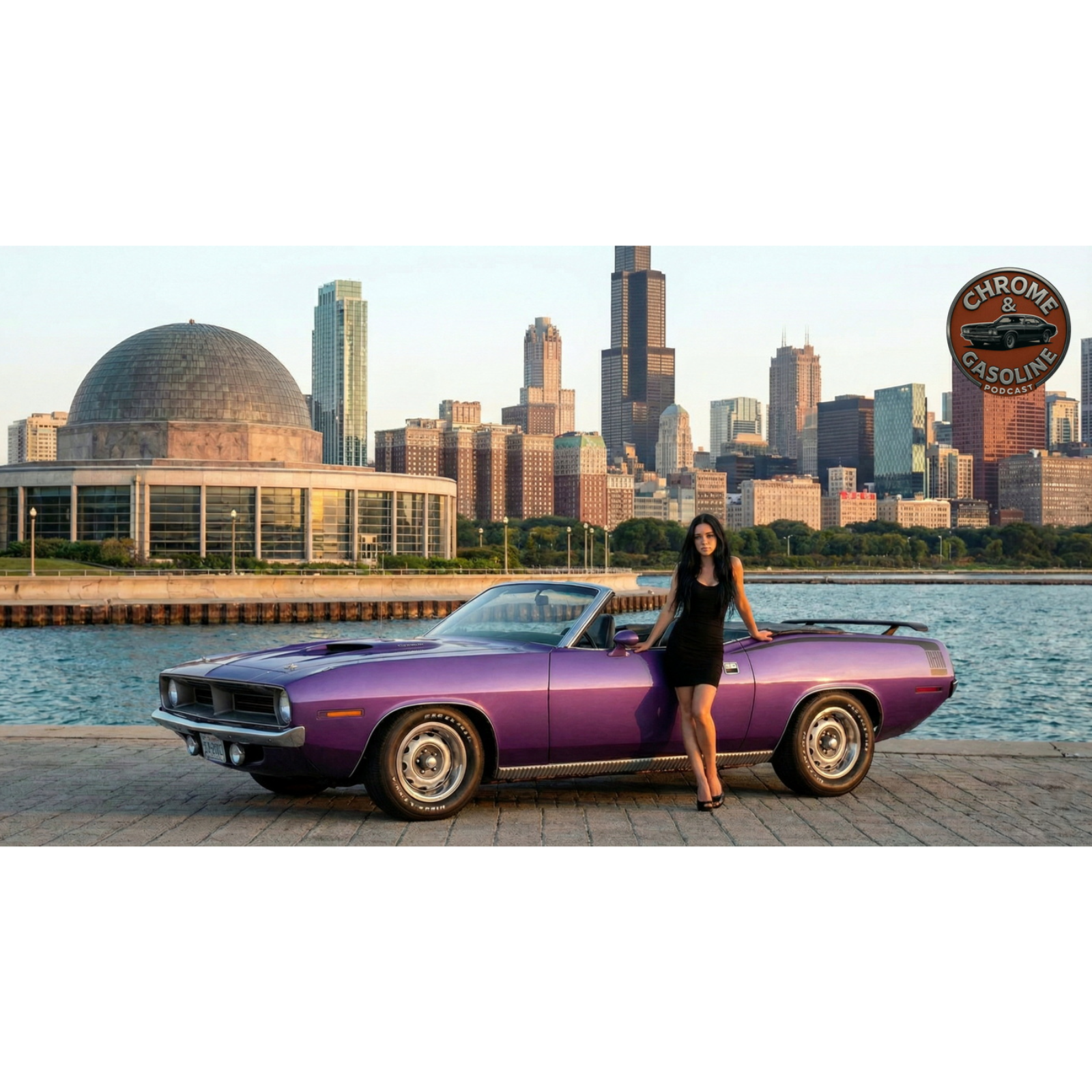
If muscle cars had a royal family, the hemicuda would be the cousin who shows up late to dinner
wearing sunglasses indoors, revs the engine in the driveway, and somehow everyone still
forgives him, the 1970 to 71 Plymouth.
Cuda sits right at that peak moment when Detroit was still handing out horsepower
like Halloween candy, and the world hadn't fully become the please initial here that you
understand fun is not guaranteed era.
Let's translate the name, because it sounds like a threat.
Cuda is short for barracuda, and yes, it's named after a fish, the kind of fish that
looks like it's been cut off in traffic its whole life.
Plymouth took the barracuda and offered a more performance-flavored version called
the cuda.
Everyone let you season it with whatever engine you dared to order.
Hemi is the famous 426 cubic inch V8 with hemispherical combustion chambers.
The engineering bit matters, but the real takeaway is simple.
It was built to breathe like an Olympic swimmer and hit like a bar brawler who did cardio.
You don't need a whiteboard.
You need to understand that when people say Hemi, they're not whispering a specification.
They're invoking a folklore creature, it's a word that makes grown adults lower
their voice as if the engine might hear them.
Now, Mopar myth translator time.
When someone says it's a real Hemi car, what they mean is, please admire me responsibly
and also do not ask what I paid because my spouse is somewhere nearby.
When they say numbers matchin', that means every bolt has a birth certificate, and
I will get misty eyed if you lean on the fender.
And when they say it's an investment, that means I'm emotionally attached but I'm trying
to sound like an adult.
The 1970 model year was a big moment because the Barracuda got its e-body redesign, wide
shouldered, short deck, and ready to pick a fight with wind resistance.
The Cuda badge was Plymouth's way of saying, yes, this one is supposed to be rowdy.
You could order plenty of engines, but the Hemi option was the top shelf stuff.
The are you sure?
Like emotionally sure?
Check box.
It wasn't the easy button, it was the I accept the consequences button.
Visually, the Hemi Cuda is all business.
Long hood, tight cabin, and the kind of stance that makes modern cars look like they're
waiting for a permission slip.
With the right hood setup, sometimes including the iconic shaker scoop, this car doesn't just
hint at power, it advertises it, like a billboard that also burns gasoline.
It's equal parts performance and posture, a car that looks fast even when it's parked.
Which is convenient because you'll spend a lot of time parked while strangers appear
to tell you a story that starts with, my buddy had one, even if their buddy was three
years old in 1971.
But here's the part people forget.
The legend isn't only about speed, it's about timing.
Insurance companies were starting to side-eye horsepower, emissions rules were tightening,
buyers were changing, the window for ordering a factory new streetcar that felt like a drag
strip confession was closing.
That mood, peak muscle, last call energy, is baked into the sheet metal.
So if you're wondering why the Hemi Cuda became a unicorn, it's not just because
Hemi.
It's because it was the perfect storm of design, performance, in a rapidly shrinking
moment in history.
And yes, it also helps that it looks like it could win a fight with a parking garage.
Episode two, the Hemi.
Cuda doesn't just sit there, it looms.
Park one, next to a modern car, and the modern car immediately starts checking
its posture and promising to eat more vegetables.
The 1970 to 71 styling is the kind of honest aggression you don't really get anymore.
No fake vents practicing for a Broadway audition, no screens the size of a toaster oven, just
sheet metal with an attitude problem.
Start with the proportions.
The hood looks like it was designed by someone who thought subtlety was a French pastry.
The fenders have that muscular swell, like the car is flexing even while it's shut
off.
The roof line and rear quarters have this planted coiled look, like the car is waiting
for you to say something disrespectful.
And the grill?
It's not smiling.
It's evaluating you.
The whole front end gives off I don't lose arguments, I end them energy.
Chrome therapy session, pull up a chair.
Why do people get emotionally attached to Chrome?
Because it's jewelry for machinery.
It's the car equivalent of cufflinks.
It says, yes, I'm here for violence, but I dressed up for it.
And on a CUDA, the bright work is just enough to frame the menace, not turn it into a disco
ball.
It's tasteful intimidation, which is the best kind.
Graphics matter too.
Some cars wore bold side stripes and call outs that didn't whisper what they were.
They announced it loudly in block letters, in case the exhaust note wasn't clear
enough.
The famous hockey stick style graphics show up in this era, and it's hilarious that we
named a stripe after a sport, like the stripe itself might check you into the boards.
Color is the other half of the personality.
Chrysler's high impact colors became part of the identity, brightness as a lifestyle
choice.
It's like the paint is yelling, don't worry, I'll be seen.
And even when the car isn't painted in a loud shade, the shape still reads
loud.
Black Hemi CUDA whispers, but it whispers, I know where you parked.
Then there's the hood situation.
Some cars wore the shaker, an engine mounted scoop that moves with the engine.
It's the world's most charmingly unnecessary honesty feature.
Modern cars hide their engines under plastic beauty covers, as if they're
embarrassed.
The shaker is the opposite.
Look, the engine is alive, it has opinions, it also vibrates when you
make bad decisions.
Inside, the vibe is pure early 70s, functional, slightly brutal, and not
pretending it's a spa.
The gauges are there to inform, not to support you emotionally.
If the car is unhappy, it doesn't send a notification, it sends a smell.
And if you've ever sat in a classic Mopar, you know the scent profile.
Vinyl, a hint of gasoline, and a trace amount of American optimism.
Some cars had four speeds with that pistol grip shifter, which is
basically a factory installed handshake that says, you and I are about to
have a conversation.
The seating position feels like you're part of the car's plot, not just a
passenger.
Visibility is old school.
You can actually see the corners, which is a novelty now.
The doors close with that solid, heavy-era thunk that makes you
believe you're safe from everything except your own right foot.
And that's it, the design magic.
Everything you see makes you expect the experience.
The car looks like it should sound like thunder and smell like warm
gasoline.
It looks like it will punish weak ankles and reward commitment.
It's a role in promise, one that, if you take it seriously, politely
asks you to keep both hands on the wheel and your ego on a short
leash.
Episode 3
Let's talk about the hemi the way it deserves to be talked about.
With respect, a little fear, and the understanding that it will
absolutely ruin your definition of reasonable.
The 426 hemi is one of those engines where the name became bigger than
the metal.
People don't say it like a part number.
They say it like they're naming a hurricane.
On paper, it's a big displacement V8 built for serious breathing and
serious RPM.
In the real world, it's a personality.
It's a factory engine that came out of a time when high performance
meant you should probably own a decent set of tools, know a guy, and
accept that your gas station knows you by name.
The street hemi setup used dual four-barrel carburetors, and it
wasn't trying to be subtle.
It was trying to be alive.
There's a crispness to how a properly sorted hemi responds.
Like the throttle isn't a suggestion, it's a switch.
Rapid factory horsepower ratings can be their own rabbit hole, so I'll
keep it honest.
It was very fast for its time, and it stayed fast even when the
decade started trying to calm everyone down.
The car doesn't need a brag sheet.
It has an exhaust note that sounds like it's filing a complaint
with the laws of physics.
Now, another Mopar myth translator moment.
When someone tells you, it's streetable.
That means, I have redefined streetable to include occasional drama,
frequent fuel stops, and spontaneous attention from strangers who have
never once asked about your feelings.
When they say, it's a beast, that means, it can idle in traffic like
a grumpy bulldog, and it will not apologize.
And when they say, it likes to rev, that means, if you lug it,
it will judge you.
The thing about the hemi option in that era is that it wasn't
the easy button.
It added cost.
It could be more demanding to live with.
It wasn't necessarily what the average buyer wanted for commuting,
unless your commute involved a drag strip and a personal vendetta.
So the hemi cars were never everybody had one machines.
They were somebody checked the box machines, and that makes them feel
like factory approved mischief.
Imagine the driving experience in the simplest terms.
You turn the key and the car doesn't so much start as it
announces itself.
The idle has that slightly impatient rhythm,
like it's tapping its foot.
You roll into the throttle, and the front end
gets light in a way that makes your brain do math.
You don't need to be a professional driver to feel it.
You just need to be aware that physics is about to collect rent.
And yes, there's a practical side.
Big block muscle is generous with torque and also generous
with fuel consumption.
The engine bay generates heat like it's trying to cook you
a small lunch.
The brakes and tires were designed in a different era.
So by modern standards, you don't drive this car so much
as you negotiate with it.
That's part of the charm.
It demands attention.
It's not a background activity.
But when everything is sorted, the reward
is that raw, mechanical connection.
No filters, no curated soundtrack piped through speakers,
just the feeling that you're controlling a large,
loud idea from 1970 that somehow still
makes total emotional sense.
It's a reminder that driver engagement used
to be spelled with capital letters and occasional sweat.
It also teaches you restraint.
A modern performance car flattens the experience
and makes you feel like a hero.
A hemicuda makes you earn it.
The steering isn't feather light.
The chassis talks back and the rear tires
will happily convert confidence into tire smoke
if you treat throttle like a light switch.
When it all hooks up though,
it feels like a clean punchline,
loud setup, instant payoff.
Episode four, here's where the hobby gets spicy,
1970 versus 1971.
If you're expecting a dramatic makeover,
it's more like two siblings wearing different shoes.
The basic body and vibe are the same.
E-body muscle with a hood long enough to host a picnic.
The changes tend to live in the details,
trim, small styling cues,
option groupings shifting around,
and the kinds of year to year tweaks
that make one person shrug
and another person open a binder
like they're presenting evidence in court.
And speaking of court,
the concourse courtroom is now in session
where the prosecution is a guy named Rick
who owns Calipers.
Exhibit A, your hose clamp
appears to be from a different zip code.
Exhibit B, this stripe is 3 16ths of an inch too happy.
Exhibit C, that paint has the wrong kind of optimism.
The judge is a retired engineer
who hasn't smiled since 1984.
The jury is 12 people who all whisper,
that's still a beautiful car though.
Here's the balanced truth.
Those small differences can matter,
especially for originality and high level restoration.
They also don't matter at all
if your goal is to enjoy the car
without turning your weekend into a forensic investigation.
A well-sorted CUDA that looks right, drives right,
and makes you grin is doing the job.
The job is not to win an argument on the internet.
The job is to make your inner teenager shout yes.
For a lot of folks,
the real 1970 verse 1971 conversation
is less about which year is better
and more about which one you encountered first.
That first sighting becomes your baseline
and then every other car
is either correct or suspicious
like you're auditioning as an extra
in a detective show called Originality Unit.
Keep your sense of humor.
These cars were built to be driven,
not to be turned into a stress test.
Now for the elephant in the garage,
originals, tributes, clones, recreations,
whatever term people use
depending on how brave they're feeling.
Because real Hemi CUDA cars are such a big deal,
there's a whole universe of cars
that started life as something else
and later got promoted.
That can be totally fine
as long as everyone is honest about what it is.
A tribute can be a blast
and a smart way to experience the look and feel
without the anxiety.
An undisclosed clone is just a magic trick
where the truth is optional and the bill is not.
Documentation matters.
Tags, VINs, paperwork and expert eyes,
these cars live at an intersection of history and money
which means details aren't just trivia.
Their identity.
If you're shopping,
the smartest move is usually the boring one.
Verify, verify again
and bring someone who is not emotionally
in love with the car yet.
Enthusiasm is great
but enthusiasm has a terrible track record with receipts.
Restoration versus preservation
is another fork in the road.
Some cars are time capsules,
some are projects,
some are restored in a way
that's basically a very expensive reimagining.
None of that is automatically wrong.
Just know what you're looking at
and decide whether you want a museum piece
or a machine you can actually live with.
If you want to drive it,
modern upgrades can be sensible.
Just don't pretend the car came from the factory
with 2025 level stopping power.
History is charming
but gravity stays undefeated
because ultimately, 1970 or 1971,
the point is the same.
It's a CUDA with an attitude
and if you're lucky enough to experience one,
original or tribute,
your face will understand before your brain does.
Episode five, The Hemi.
CUDA didn't just become a car,
it became a symbol,
one part performance,
one part poster ink
and one part my uncle swears
he almost bought one in 1972.
This is the machine that lives in garages, dreams
and the corner of every conversation
where someone says,
they just don't make them like that
and then immediately forgets
that we also used to smoke on airplanes.
Pop culture helped, of course.
The shape is instantly readable.
Even people who don't know a camshaft from a milkshake
can look at a CUDA and understand the assignment.
Go fast, look angry,
leave no room for nonsense.
It's the kind of car that makes strangers
appear out of thin air with stories.
Some are true, some are spiritually true.
All of them are delivered
with the confidence of a courtroom witness.
Mopar myth translator returns for closing arguments.
When someone says, this is the baddest one,
that means please ignore the fact
that baddest is impossible to measure
and just enjoy the vibe.
When they say, it's a legend,
that's usually code for I remember a poster,
a magazine cover or a neighbor firing one up at 6 a.m.
And I've been chasing that feeling ever since.
And that's the heart of it.
The legend is bigger than the spec sheet.
Yes, it's a serious performance car from the muscle era.
Yes, the hemi option is the big headline.
But what people really fall in love with
is the whole moment.
Detroit at full volume,
styling that doesn't apologize
and engineering that feels like
it was signed off with a wink.
If you ever get the chance to be around one today,
two things happen at once.
One, you appreciate it as history
because it represents a short window
when factories sold street cars
that felt like they were one bad decision away
from the drag strip.
Two, you realize driving one in modern traffic
is like walking a tiger through a farmer's market.
Everyone wants a photo, the tiger wants to run
and you're just trying to act normal
while holding the leash.
There's also the modern reality.
Roads are smoother, cars are quicker
in a quiet, efficient way
and your average commuter crossover
will happily outbreak an out corner of vintage muscle car.
That's not an insult, that's progress.
The CUDA's charm is that it doesn't care.
It's not trying to be modern,
it's trying to be memorable
and it does that by being unapologetically mechanical.
Heavy controls, big sensations
and feedback that arrives
without a customer support ticket.
So here's a respectful public service announcement
from your friendly neighborhood car nerd.
If you're driving a CUDA,
Hemi or otherwise, be the hero, not the headline.
Warm it up, keep it sorted, give it space
and remember that traction in 1970
was more of a suggestion than a promise.
Save the bravado for the bench racing stories.
Use the right lane for the reality
because the best part of the Hemi CUDA
isn't the bragging, it's the grin it triggers.
It's the way it turns grown adults into excited teenagers
pointing at badging and hood scoops
like they just discovered fire.
It's ridiculous in the most American way,
loud, bold, slightly unreasonable
and somehow beautifully honest about exactly what it is
and maybe that's why it endures.
The Hemi CUDA is a time machine you can touch.
It turns a parking lot into a small event.
People lean in, point, smile
and suddenly you've got three generations
talking to each other without a phone in sight.
A car can't fix the world
but it can absolutely improve a Tuesday.
That's a pretty good legacy for a fish named Koop
with an engine that sounds like thunder
learning how to speak.
It's tax time, y'all.
If you wanna file free, this next one's for you.
Now taxes is so free
Take all tax, riddish and only roughly
37% of file is qualified
Double form, time 40 returns only
Now this is tax time
Loves that jam.
Up next, commercials.
And to a TurboTax free edition,
see if you qualify at TurboTax.com slash free.
No schedules except for earned income tax credit,
child tax credit, student loan interest and schedule 1A.
About this episode
Exploring the legendary 1970-1971 Plymouth Hemi Cuda, this episode dives into its unique design, powerful Hemi engine, and the cultural impact it has had over the years. The hosts discuss the car's aggressive styling, the significance of the Hemi engine, and the emotional connections enthusiasts have with these muscle cars. They also touch on the differences between the 1970 and 1971 models, the importance of originality in restorations, and the myths surrounding the Hemi Cuda. Listeners will appreciate the blend of technical insights and nostalgic storytelling.