There I was, scrolling my phone, then someone cracked open a Mountain Dew Baja Cabo Citrus.
I grabbed my own and took a sip.
Next thing I know, I heard a rip. My friend tried the splits and skinny jeans.
The crew couldn't stop laughing. But hey, not a drop of Baja Cabo Citrus was spilled.
Have a blast with Mountain Dew Baja Cabo Citrus. A punch of tropical citrus flavor.
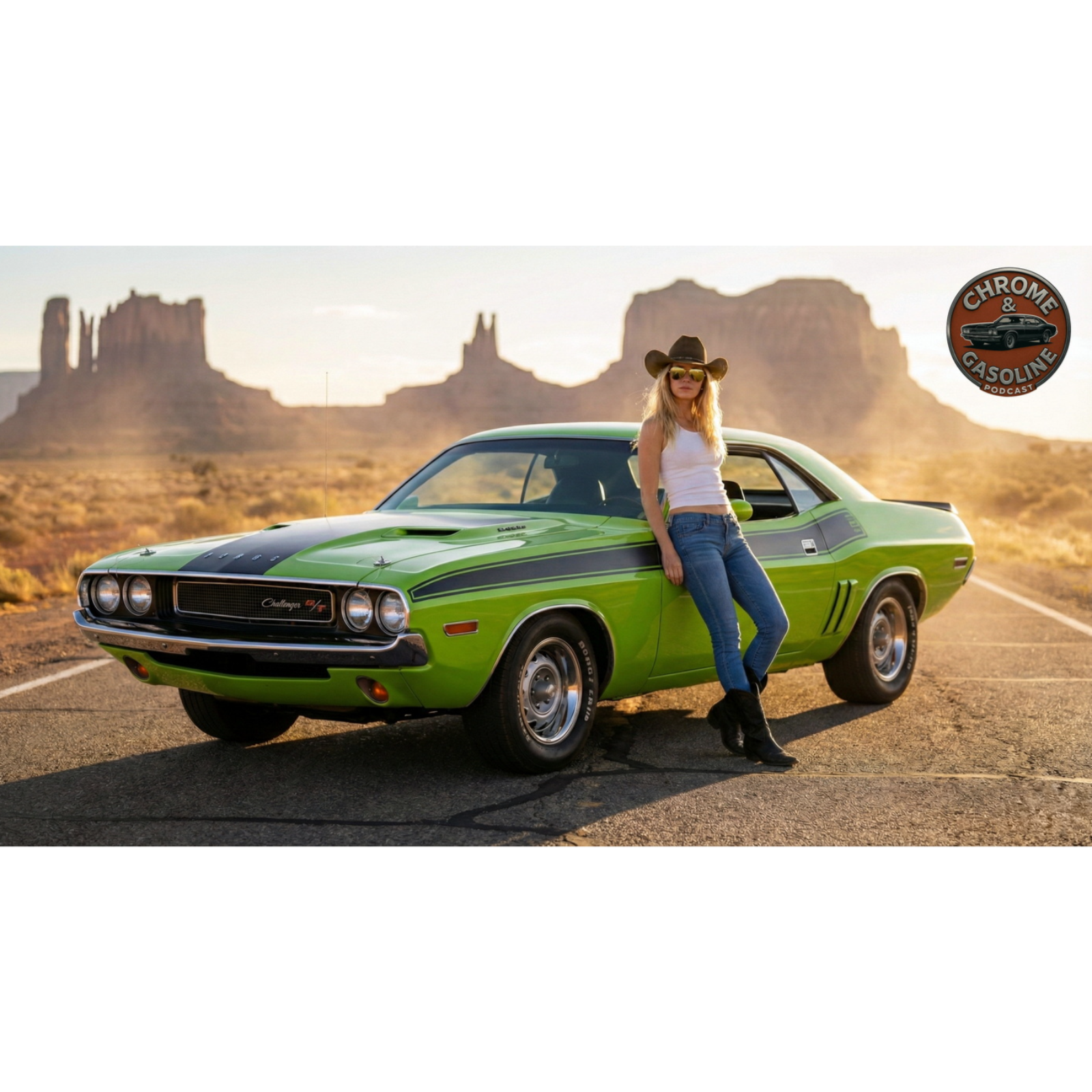
The 1970 Dodge Challenger arrived like it kicked open the showroom door, pointed at the stereo and said,
Turn that up. It had this presence, low, wide, and unapologetically long hooded,
like it was designed by people who thought subtlety was something you caught from being too close to a sensible sedan.
Here's the thing about the Challenger. It showed up a little late to the pony car party and somehow that made it cooler.
The Mustang had already been doing its thing. Camaro and Firebird were well into their rhythm and Dodge rolls in with,
Sorry, I'm late. Traffic. Also, I brought fireworks.
That late arrival meant Dodge had years of watching what everyone else did right,
and what everyone else did while staring into a mirror saying,
This is definitely what the youth want. And the youth did want it.
Or at least they wanted the idea of it. A car that looked like it could outrun homework, responsibility,
and your friend's older brother who always had opinions about carburetors.
The Challenger's vibe in 1970 was equal parts Street Brawler and Boulevard Cruiser.
It wasn't just a bargain bin racer or a stripped, noisy punishment device.
It could be that, sure, Dodge would happily sell you performance,
but it also had a kind of big coupe swagger.
A Challenger could look like it was headed to a drag strip or like it was headed to steal your date
and then politely return them at a reasonable hour, because it has manners.
Dangerous manners, but manners.
Let's do a quick 1970s brochure translator, because you can't discuss this era without decoding it.
When the brochure says exciting performance, what it often means is,
it will light up the rear tires if you breathe near the throttle.
When it says road hugging stance, it means it's wide enough to make you reconsider old drive-through lanes.
And when it says luxurious interior appointments, it means there's vinyl, but it's confident vinyl.
Many anecdote time.
I once watched a guy at a cruise night explain his Challenger to a teenager as if he were delivering a sacred text.
He's pointing at the hood and he goes, this is the business end.
The kid nods like he understands.
Then the guy points at the rear and goes, this is where the arguments happen.
Honestly, best explanation of rear-wheel drive I've ever heard.
Culturally, the early 70s were the moment when car companies were still swinging for the fences.
Big power, big looks, big personalities.
But the world was changing faster than the ad agencies could pivot.
Emissions rules were tightening.
Insurance companies started looking at muscle cars like so.
You're telling me this thing is basically a rolling poor decision?
And fuel prices and the whole national mood were evolving.
The Challenger lived right on that cliff edge between anything goes.
And alright, everybody calm down.
That's why the 1970 to 1974 window is so fascinating.
You're watching a car trying to remain itself while the rules of the game keep shifting.
It's like watching a heavyweight boxer being told mid-fight that punches will now be graded on manners.
But no matter the year, a Challenger is a Challenger.
It doesn't whisper.
It doesn't ask permission.
It just sits there with that long nose and wide shoulders like it owns the block.
And even parked, especially parked, it radiates this message.
I'm here to look good and cause minor emotional damage to modern traffic.
And yes, it had rivals.
But the Challenger didn't feel like a copy of anybody else.
It felt like Dodge took the pony car idea and said,
Sure, but what if we gave it a little more room to be dramatic?
Which is also what I say when I order dessert.
Episode 2. Design, stance, and interior vibes.
A.k.a. the car that poses for photos.
A Challenger doesn't just have styling.
It has posture.
You know how some cars look like they're waiting for instructions?
The Challenger looks like it's waiting for a green light and a reason.
The proportions are the whole story.
Long hood, short-ish deck, and a body that feels wide in a way that reads as confident, not clumsy.
The fenders have that muscular curve that makes lights slide across them like it's being paid.
It's a car that photographs well because it's basically always doing the hero shot angle by default.
And the front end, depending on trim and details, can look friendly-ish or like it's mildly annoyed with you.
The grille has this, I'm not mad, I'm disappointed vibe that works beautifully
when you're idling at a stoplight next to a modern crossover that's trying its best.
Now, 1970's brochure translator returns.
If the brochure says bold, exciting styling, it means we put enough character lines on this thing to qualify as facial expressions.
If it says driver-oriented cockpit, it means the gauges are where you can see them when you're pretending you know what oil pressure should be.
And if it says available convenience features, it means you can have comfort, but don't get carried away.
This is still a car with an attitude.
Inside, the Challenger's interior can range from business-like muscle to 1970's lounge where everything is upholstered.
The dash has that classic period feel. Simple geometry, big readable gauges, and the kind of switches that click like they mean it.
The seats? Often more comfortable than people expect, especially if you're used to the myth that all muscle cars were torture racks with steering wheels.
This is where Respect the Hide comes in.
If you find one with a surviving original interior, original seat material, original panels, the whole time capsule vibe, you treat that like museum property.
You don't slide into it with keys in your back pocket. You don't throw a greasy jacket on it.
You approach it the way you'd approach a priceless painting, except it smells like old vinyl and ambition.
Mini-Anecdote. I once saw a guy with an immaculate original interior refuse to let his buddy sit inside.
The buddy says, come on, I'm careful. The owner says, you eat barbecue chips in your sleep. That's not an argument you recover from.
Another design thing people forget. The Challenger can look elegant in the right setup.
Yes, it's a muscle car, but it also has that long upscale coupe feel. It's not just go fast, it's a rive.
Like you're pulling up to a fancy place, except your fancy includes rumbling.
The car has enough visual weight that it doesn't need to shout with wild add-ons.
It can, obviously. This era loved stripes, scoops, and decals like they were a personality test, but even clean and simple, it carries itself.
And that's why the Challenger's design stuck. It's not a delicate car. It's not trying to be cute.
It's a confident slab of American taste from a moment when taste meant chrome, stance, and the belief that the road was your stage.
You don't drive a Challenger so much as you star in a scene with it.
Episode 3. The Driving Feel, the Power Menu, and Mopar Family Dinner.
Let's talk about the part everyone brings up first. Engines and performance. Here's the safest, most honest way to put it without drowning in numbers.
Dodge offered a range. You could get a Challenger that was more about cruising, and you could get a Challenger that was about turning gasoline into noise and questionable decisions.
The performance trims and packages existed for people who thought responsible was something you did after.
But I don't want to spec dump you into a coma, because the Challenger isn't just about horsepower on paper. It's about the feeling.
The feeling is, you're sitting behind a long hood looking out over a car that seems to occupy its own zip code, and when you roll into the throttle, the car responds like it's been waiting all day to prove a point.
Steering in these cars tends to be more conversation than laser precision.
You don't flick a classic Challenger around like a modern sports coupe. You guide it. You persuade it. You and the car negotiate.
And when it hooks up and goes, it's not a delicate ballet. It's more like a confident shove.
The car moves with authority. Ride comfort can surprise people too. A Challenger can be a solid cruiser.
That long wheelbase feel, the sense of heft. There's a grand touring bruiser quality to it.
You can picture it eating highway miles with the kind of relaxed menace that says, yes, I can behave. I just prefer not to.
Now, let's do Mopar family dinner, because this is mandatory. Imagine the Challenger sitting at the table with its relatives.
The charger is there, of course. Big, bold, slightly dramatic, acting like it's the lead in a movie.
The CUDA shows up earlier than everyone, louder than everyone, and somehow leaves tire marks in the driveway while parked.
The Challenger? The Challenger sits back like, I'm not here to argue. I'm here to look good and make everyone else insecure.
Then the Mustang and Camaro are outside, honking. Because they weren't invited, but they're going to tell you what they think anyway.
The Challenger's response is basically a slow blink. Not disrespectful, just completely unbothered.
Driving one today is also about learning its rhythms. Brakes feel different than modern stuff.
The car talks to you through the seat and wheel in a way new cars don't. There's more sensation, more mechanical honesty.
You become part of the machine instead of simply operating an appliance that happens to go fast.
And yes, if you have a high performance setup, the rear tires will absolutely have opinions about your life choices.
The Challenger is the kind of car that can teach you humility at low speeds in a parking lot.
It's not always I am speed. Sometimes it's I am drama. Respect the hide returns here too.
If you're lucky enough to drive one that's original, you treat it gently. You let it warm up. You listen.
You don't demand modern perfection from something built in an era when traction control was a right foot in a prayer.
Because when you drive a Challenger, you're not just driving a car. You're driving a time capsule full of attitude.
And once it gets under your skin, everything else starts to feel a little too quiet.
Episode 4 1971-1974
The world changes and the parking lot. Anthropologists take notes.
By 1971, the party was still going, but somebody had started collecting the cups.
The early 70s were a turning point for performance cars in general. Regulations and market pressures were shifting.
Insurance costs took the fund personally. Emissions requirements changed how engines were tuned and how manufacturers approached power.
And the whole industry started moving from how fast can we make it to how can we make it fast enough while staying out of trouble.
So the 1971-1974 Challenger years live in that evolving reality. The car remains handsome, remains a Challenger, but the era pushes back.
The result is a range of cars that can be very different in personality depending on configuration and year.
And that's why people argue about them politely, loudly, and for decades.
Let's do parking lot anthropology because if you go to any cruise night, you'll meet the same Challenger owner archetypes like they're a fixed cast of characters.
First, the historian. This owner knows details, and even if they don't tell you the details, their eyebrows do.
They'll say, interesting, the way a judge says it in a courtroom. Their trunk contains a folding chair, a microfiber towel, and a binder.
Second, the restamod philosopher. They'll tell you they kept it tasteful, which means it has modern brakes, modern suspension, modern comfort, and possibly a stereo that can summon dolphins.
They will also tell you gently that originality is great for other people.
Third, the barn fine dreamer.
This person is convinced that a perfect Challenger is sleeping in a shed two towns away, and the owner is basically ready to sell.
The car does not exist, but the dream is very real.
Fourth, the survivor guardian.
This is where respect the hide becomes a lifestyle. They'll look at a repaint the way a chef looks at ketchup on steak, not angry, just deeply, spiritually sad.
Ownership reality today? Let's keep it grounded. These are older cars. Rust can be a thing, especially in places where roads get salted.
Parts availability varies by what you're looking for, but the community and aftermarket support can be strong for popular classics.
The biggest thing is condition and honesty. A clean, well-sorted car is a joy.
A neglected one can become a full-time relationship, not a hobby, an emotionally complex relationship with bolts.
And if you're shopping, the smartest mindset is, buy the best example you can afford, and don't let the glossy paint hypnotize you.
The shiniest car in the lot might be hiding stories under the carpet.
Meanwhile, the slightly scruffy honest car might be the one that drives like it wants to be driven.
Through 74, you're also seeing the muscle era transitioning. The Challenger becomes a symbol of a moment that's fading while it's still happening.
It's like a great band on the last tour before everybody goes solo. Still good, still charismatic, but the industry's priorities are moving.
And yet, people still love these cars because they're not just transportation. They're role and identity.
You can't park a Challenger without making a statement. That statement might be, I love classic design.
It might be, I enjoy mechanical things. It might be, I consider straight pipes a personality trait, but it is always a statement.
Episode 5, The Challenger Encounter, is a true-to-life story with lessons and laughs.
So, I'm at a swap meet. Not the cute kind with artisanal candles.
The real kind, dusty, loud, and full of men who can identify a carburetor by scent, like it's a truffle.
I'm walking past tables of parts that look like they were excavated from a pirate ship when I hear two guys arguing in the sacred language of classic cars.
Confidence statements with zero proof. Guy 1 says, it's a real performance car. Guy 2 says, it's a tribute.
Guy 1 says, no, it's real. Guy 2 says, it's real. Real suspicious.
And that's when I see it. A 1970 to 1974 era Dodge Challenger.
Sitting a little off to the side like it's trying not to get involved. The paint is shiny enough to reflect your regrets. The stance is perfect.
The wheels look ready for a magazine cover. It's the kind of car that makes you forget your own name for a second.
Naturally, I do what any rational person does. I walk toward it like I'm being pulled by gravity.
The owner is standing there with folded arms. The universal posture of, yes, I know what I've got.
He's not rude. He's not friendly. He's in that calm middle zone of a man who has answered the same questions a thousand times
and can see them forming in your mouth before you ask. I start with compliments because I'm not an animal.
I say it looks fantastic. He nods like he hears that sentence in his sleep. Then I do the slow walk around
because this is part admiration, part investigation, and part ritual dance.
Here's where respect the hide kicks in. You don't touch without permission. You don't lean.
You keep your belt buckle at a safe distance like it's a loaded weapon. This car isn't just clean. It's protected.
The interior looks like it's never been argued with. The seats sit there with that delicate surviving original vibe.
Like if you sat down too hard, a tiny historian would appear and slap your hand with a pamphlet.
I ask the owner if it's original. He says, depends what you mean by original.
That is the most dangerous sentence in the classic car universe because original can mean numbers and paperwork.
It can mean factory correct parts. It can mean it still has the same spirit.
Or it can mean I bought it as a rolling shell and I gave it a second life with the budget of a small nation.
So I do my best Alex voice and keep it friendly. I ask what's been done to it.
He starts listing upgrades and I realize we're dealing with a restamod philosopher, modern brakes, improved suspension, cleaned up drivability.
Maybe the car starts easily and doesn't vapor lock if you look at it wrong. The goal is not museum perfection.
The goal is to drive the thing without needing a support group and I get it. I really do.
But then I hear guy one and guy two again drifting closer like sharks smelling drama.
Guy one points at a badge and goes that right there tells you everything.
Guy two says badges are stickers with confidence. The owner doesn't flinch. He just smiles.
It's the smile of someone who has watched a thousand debates crash into the rocks of reality.
Then he says you want to hear it run. Now this is the moment.
This is the moment where your brain says be cool and your soul says yes.
He turns the key, the engine fires and whatever's under that hood, whatever specific setup, whatever exact combination of parts.
It has one undeniable quality. It sounds alive. Not just loud. Alive.
The idle has that slightly uneven pulse like the cars tapping its foot. Waiting.
People nearby start drifting over. You can literally watch the parking lot anthropology happening in real time.
The historian appears eyes scanning details. The barn find dreamer appears whispering I've got a lead on one just like this.
Someone's kid appears staring like they've just seen a dinosaur. Guy one says told you. Guy two says that doesn't prove anything.
Guy one says it proves it's awesome. Guy two pauses then says fine it proves that and that's the lesson.
A challenger can be a concourse correct time capsule a carefully restored classic or a tastefully updated driver.
People will argue forever about what's right but the challenger's real power is simpler.
It makes people feel something. It gathers strangers. It sparks stories.
It turns a dusty swap meet into a little theater where everyone briefly agrees that machines can have charisma as the owner shuts it down.
He looks at me and says it's not perfect but it's mine.
And honestly that's the most authentic sentence you'll ever hear about a 1970 to 1974 Dodge Challenger.
If you're an HVAC technician and a call comes in Granger knows that you need a partner that helps you find the right product fast and hassle free.
And you know that when the first problem of the day is a clanking blower motor there's no need to break a sweat.
With Granger's easy to use website and product details you're confident you'll soon have everything humming right along.
Call 1-800-GRANGER click Granger.com or just stop by Granger for the ones who get it done.
About this episode
Exploring the 1970-1974 Dodge Challenger reveals a car that burst onto the scene with a bold presence and a unique swagger. The episode dives into its design, performance, and cultural significance during a time when muscle cars faced evolving regulations. Anecdotes about car culture highlight the Challenger's ability to spark conversations and debates among enthusiasts. The discussion also touches on the driving experience, showcasing the car's blend of power and comfort, while reflecting on its lasting impact in the automotive world.