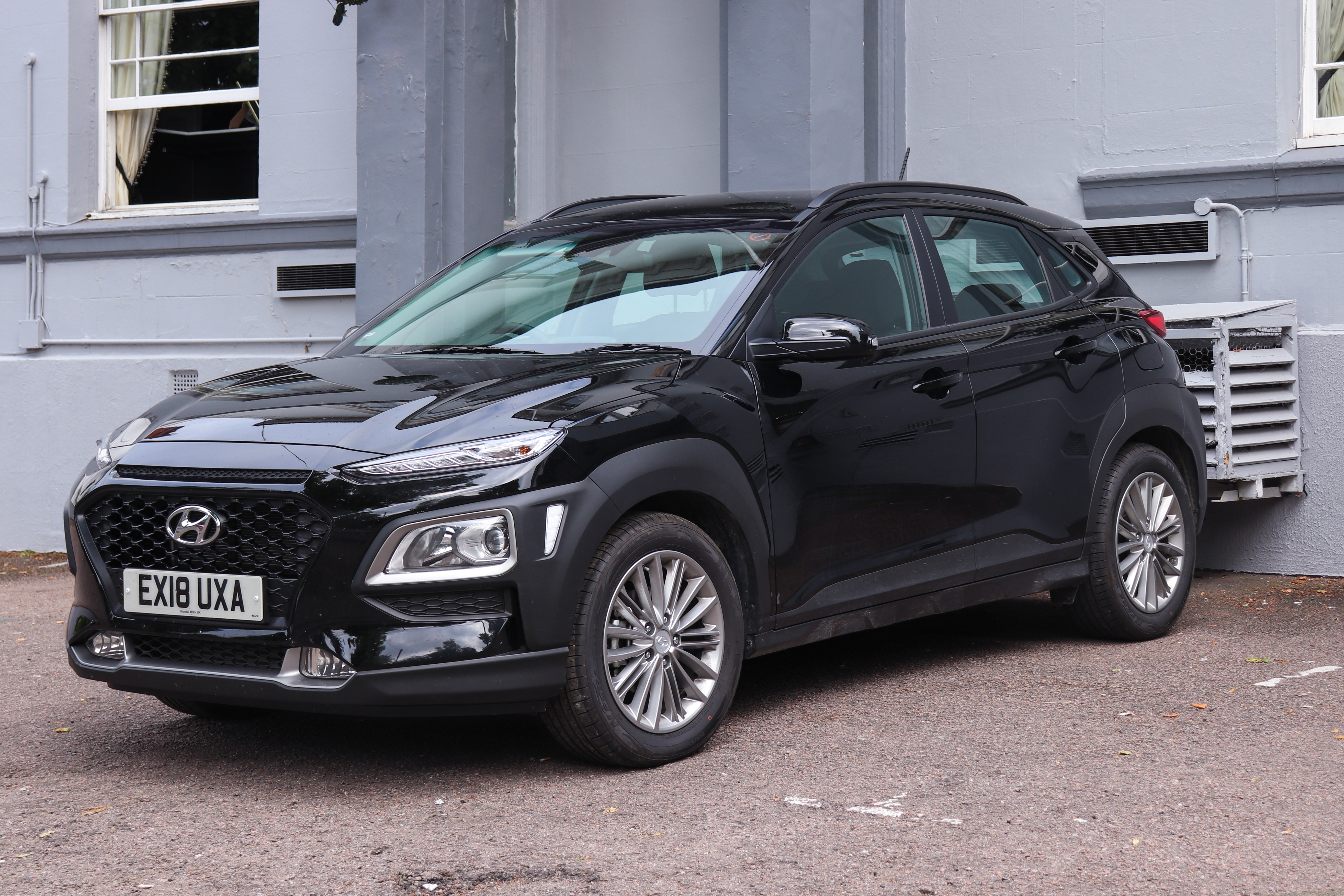
The Hyundai Kona is a small SUV that is budget-friendly and has many useful features. The 2025 version is designed to be practical and efficient for everyday driving.

The Mazda CX-30 is a small SUV that looks good and drives well. It's popular because it has a nice interior and lots of tech features, making it a great choice for people who need a practical car but still want something fun to drive.
Trim levels are different versions of the same car model that have various features. Some might be basic, while others have more luxury or technology options.
A naturally aspirated engine gets air from the atmosphere without any extra help from a turbo or supercharger, which can make it feel more predictable when you press the gas pedal.
Turbocharged means the engine has a special device that helps it produce more power by forcing in extra air. This makes the car faster and more powerful.
A continuously variable transmission is a type of automatic transmission that can change gears smoothly without any noticeable shifts, making the ride feel smoother.
Paddle shifters are buttons or levers on the steering wheel that let you change gears in a car without using a clutch, giving you more control while driving.
A turbo engine is designed to make your car go faster by using a device called a turbocharger, which pushes more air into the engine. This helps the engine produce more power without needing a bigger size.
A CVT is a special kind of automatic transmission that can change gears smoothly without feeling like it's shifting. This can help the car use less fuel but might feel different to drive compared to regular automatic transmissions.
The Honda HR-V is a small SUV that is very practical and has a lot of space inside for passengers and cargo. It's known for being reliable and comfortable, making it a good option for people who want a useful vehicle for everyday use.
Blind spot warning helps you see cars that you might not notice when changing lanes. It uses sensors to let you know if there's a vehicle in your blind spot.
Understeer is when a car doesn't turn as much as you want it to, making it feel like it's sliding forward instead of going around a corner. It's something to be aware of when driving fast.
Automatic emergency braking is a feature that helps stop the car if it thinks a crash is about to happen. It can help prevent accidents by applying the brakes on its own.
A blind spot camera system helps drivers see areas around their car that they can't normally see. It shows a video feed of those spots on a screen, making it safer to change lanes or turn.
H-Tex is a type of synthetic fabric that looks and feels like leather but is easier to clean and take care of. It's used in car seats to give a nice appearance without using real leather.
A heated steering wheel is a steering wheel that gets warm so your hands don't get cold when driving in winter. It makes it more comfortable to hold the wheel when it's chilly outside.
Dual zone climate control means that the driver and passenger can have different temperature settings in the car, making it more comfortable for everyone.
Wireless Android Auto and Apple CarPlay let you connect your phone to the car's system without using a cable. This way, you can use apps and music from your phone on the car's screen.
The Hyundai Palisade is a big SUV that's great for families because it has lots of space and comfortable seats. It also comes with many modern features to keep everyone safe and entertained during trips.
A high-mounted brake light is an extra light on the back of a car that turns on when you brake. It helps other drivers see when you're stopping, especially if they might not see the regular brake lights.
A hybrid powertrain uses both a gas engine and an electric motor to help the car use less fuel and produce fewer emissions. It can save you money on gas and is better for the environment.
This award is given each year to the best new cars and trucks in North America. A group of experts tests and reviews the vehicles to decide which ones are the best.
LIVE
Looking for good solid transportation, the 2025 Hyundai Kona elevates that and I'm here
to tell you all about it.
Fuel economy, driving dynamics, and the tech.
And I'm not going to waste your time, let's get to it.
In the current automotive climate, the popular opinion is affordable new vehicles have all
but vanished.
My unpopular theory?
People aren't paying attention.
For example, Hyundai Kona.
It's fairly roomy, looks good inside and out, and comes standard with features unheard
of 15 years ago.
And it's not alone in the marketplace.
Cross-hoppers have tracks and Vista, Taos, CX-30, Niro, Corolla Cross, HRV, Crosstrak and
Kicks to Test Drive.
That's a lot of choice.
Out of all those competitors, let's say you go with Kona.
Know that there's quite a price spread between the trim levels.
A base SE with front-wheel drive starts at about $26,000.
That includes destination.
This is a top trim all-wheel drive limited, the most you can pay, just crests 35 grand.
Now, in my humble opinion, the sweet spot is the N-Line S front-wheel drive.
It starts at 31 large.
It unlocks the more powerful of the two gasoline engines.
Oh, and there's an EV version too.
FYI, for 2026, Hyundai will rejigger and simplify trims.
N-Line is gone, kind of replaced by SEL Premium.
You'll figure it out.
The base naturally aspirated 2.0-liter 4-cylinder, ekes out 147 horsepower and 132 pound-feet
of torque, fairly high in the rev range, and Kona weighs some 3,200 pounds.
N-Line, SEL Premium and Limited remedy the power deficit with a 1.6-liter turbocharged
4-cylinder, pumping out 190 horses and 195 pound-feet lower in the rev range, delivering
more satisfaction in the scoot department.
In addition to more gusto, the turbo shifts gears.
It gets an 8-speed instead of the 2.0-liter continuously variable transmission, paddle
shifters for manual cog swaps too.
Don't expect anything like a head-up display in here, but there are basic drive modes to
play around with.
Optioned with lockable all-wheel drive, there's up to 8.3 inches of ground clearance.
Kona is not an enthusiast car.
It's not meant to be one.
With the turbo engine, this will spool up to 60 miles an hour in just under 8 seconds,
so it's relatively quick.
Now, compared to the naturally aspirated engine, this has a lot more low-end torque and grunt
off the line, so it's more satisfying.
So it's not just about more power, although we all want that.
It's about the power delivery, test-drive the two engines, you'll see what I mean.
The transmission goes about its business seamlessly, and since it's a geared box, there's none
of the CVT's rubbery drone.
Overall, the cabin is moderately quiet, seems like there's less road noise than HRV and
kicks.
The seating position is more car-like, you're not sitting way up high in Kona, and visibility
is pretty good.
There's a little bit of a blind spot in the back D-pillar, but there is blind spot warning,
and as far as ride quality goes, it's pretty good.
The one thing is when you hit broken pavement or potholes or railroad tracks, you're going
to feel those because of the larger wheels and lower-profile tires.
This is a mainstream suspension setup.
Cornering skills are respectable, with the expected understeer in hard maneuvers.
CX-30 might be a little more athletic, or maybe think outside the box and shop Volkswagen
GTI, it starts at 34,000 bucks.
The EPA rates the average fuel economy of the limited all-wheel drive at 26 miles per
gallon, and if you're wondering what the naturally aspirated would score, it's just a couple
better, but this much more enjoyable to drive, could be worth it.
Oddly, there's no hybrid available, I know Hyundai produces one, since sister Kia Niro
gets it.
All Kona's come pretty well-stuffed, with a very good package of Active Electronic Safety
Tech 8S.
If you go with the N-line and the limited that's raised up a bit, a better automatic
emergency braking program, the question is, will you need it?
Hopefully not, hopefully you'll never be in that position to find out.
One standout tech in this class is the blind spot camera system that offers up a view when
signaling.
Good stuff considering Kona's price and positioning in the market.
Inside, choose between two colorways, black or this gray that brightens the cabin during
dreary Seattle winters, it really is a thing, people.
This lets more light in too, or less, materials might be hard, but they look good.
These are touched all the time and feel just as solid as ones in more expensive cars.
Piano black haters, we'll find none of that in here.
Seats are covered in either cloth or this H-Tex stuff, real leather is not available,
but limited does get vented chairs, unexpected.
The drivers is powered, the passengers is not.
8-speaker Bose sound is good, don't expect symphonic.
Maybe I'm just familiar with Hyundai's user interface, but I find it straightforward.
Touch response, layout and flow are easy to get used to.
Pay attention to these when shopping, they're an important part of a car, keeping in mind
that after a few weeks or months of ownership, most can become second nature.
To get into different functions, you can use natural voice commands that allows you to
keep your eyes on the road, I really like that.
This doesn't have a wake phrase like, hello Hyundai, you have to use this button here.
Turn on the heated steering wheel.
Turning on the heated steering wheel.
This works pretty well for simple commands, but complex ones, not so much.
This is a Kona, so let's try this.
Play some Hawaiian music on SiriusXM.
Sorry, I didn't hear that clearly.
Play some Hawaiian music on SiriusXM.
Sorry, I didn't understand that.
Try saying commands to see what voice commands can be used.
Some of these systems can actually handle that request.
And this is the part of the interface talk where I normally say, after the trial period
is over, you have to pay for a data plan to make this fully functional.
But Hyundai makes BlueLink free for the life of the car, at least for the first owner.
Let's also applaud Hyundai for these physical controls.
Luxury cars seem to be eliminating them.
And yes, that is dual zone climate.
Wireless Android Auto and Apple CarPlay are standard on all Konas.
The charge pad comes on upper trims.
There's a decent amount of room inside this car.
So there are all sorts of storage slots and cubbies in here.
Some of them are clever, like the dividable center section.
Some of them are expected.
Don't use cup holders, push them out of the way, and gain another compartment.
If you're new here, I'm five foot nine and my Levi's inseam is 32 inches.
To begin with, this cushion does not slide for an aft max out leg or cargo room.
Sitting behind myself, headroom is okay.
Knee, leg, and footroom quite good.
These cushions are extremely comfortable.
They're high and long enough for excellent thigh support.
Getting my size 11s through here, that's a little tight, but certainly doable.
Hyundai does offer bang for the buck, but don't expect built-in sunshades,
a separate climate zone, or heated seats back here.
This is not a palisade.
Also missing in action, a pocket on this seat back.
Dang.
Door pockets are on the small side.
You can put a can of Coke here or here if you only have two passengers in the back.
There is a bit of a spine here that'll cut into foot room for anybody sitting in the middle.
My suggestion, keep it to a couple back here.
You can put three thinner adults back here, but to keep everybody comfortable, two.
Two is good.
Slight cosmetic changes are coming for 2026 Kona's.
Nothing drastic compared to this 2025.
Ekatronic gray metallic paint will still be available.
Kona has a distinctive swoop to the design.
It's hard to make things look unique when aerodynamics are so critical.
Some automakers reuse existing elements to lower development costs.
That's not happening with Kona.
Unique light bars broaden the visual and give it a more spendy look.
Everything down to the high-mounted brake light is designed specifically for this car.
The contrasting cladding is significant, but doesn't venture into Subaru territory.
I'll point out the low-mounted turn indicators that some folks love to hate.
They might be more susceptible to damage,
but there's no research finding them less safe than mid-height-mounted units.
And FYI, studies have found amber signals are safer than red ones, but I digress.
Unique to the top trim is an automatic tailgate.
It is not kicked open.
You just hang out by the back with the fob in your pocket or purse, and voila!
It's great when you have your hands full, and if you don't like it,
you can turn it off in the settings.
The hard security shade is designed to stow against the seatback.
No need to leave it at home.
These little tabs hold it securely, and check out the bag hooks.
Most luxury cars don't get a spare tire for whatever reason,
and Kona offers the choice of stashing things out of sight,
or opening up a little extra cargo room.
It's easy to reach in and drop the backs, too,
expanding the space to nearly 64 cubic feet.
Excellent in class.
I wouldn't expect a pass-through or 40-20-40 split at this price.
And even with all the seats filled, there's 25 and a half cubes happening.
That'll help get the chores done, scoring a half-dozen in the TP trunk test.
Getting a luxury badge for 35 grand means a use to Audi, Lexus, Cadillac, or whatever.
Premium brands have always cost more money, and always will.
Kona comes with Hyundai's 10-year 100,000-mile warranty,
and as the first owner, you'll have the luxury of knowing the maintenance history.
Kona is a pleasant machine.
It drives well, it has distinctive exterior design, the interior is very nice,
the tech is great, and the price is right.
I do wish it had a hybrid powertrain.
Hyundai has those in its arsenal.
Not sure why it's not using them.
Solid, affordable vehicles are out there.
Kona is one of the choices.
It may not be luxury transportation, but it is the luxury of transportation.
My platinum hair signals haven't been around a while.
Aren't I supposed to be the boomer shouting, cars are too expensive these days?
My sympathy is if you're kept from the vehicle of your dreams.
If you believe in numbers, using real figures from the U.S. Bureau of Labor Statistics,
car prices are 96% more expensive in 2025 than in 1980.
But adjusted for inflation, they actually take up less percentage of a family's average income.
Plus, there's safety tech unheard of back then.
They're also better built, in many cases significantly so.
One reason why the average vehicle transaction price is around 49 grand these days?
Consumers are choosing to buy larger and better equipped vehicles.
Of course, it wouldn't be one of my videos without thanking Martin Campbell.
He takes the pictures for the thumbnail, he drives while I shoot running footage,
and he keeps me honest because we both drive the car and then we compare notes.
For starters, without knowing how much it costs, you guessed.
35.
Dead on. See, he's a professional.
What do you think of this car?
That's not bad.
It's a good starter.
It's a little road noisy for me.
Yeah, well, we drive electric cars.
We're spoiled.
Remember to check out Martin's Instagram channel.
Speaking of photography, I'm proud alum of King Television in Seattle,
the NBC affiliate known nationally as a photography powerhouse.
Quality video is the foundation of my reviews, and I'm always looking for fresh backdrops.
Sometimes that means asking forgiveness, not permission.
You are trespassing.
Please leave the area.
This area is under video surveillance, and you have been recorded.
Here's the thing.
I'm not on their property.
It's the street, which I had to explain to security.
This is what I go through sometimes to give you decent visuals.
Instead of leaving you with a fun fact, some personal news.
I have been selected to be on the jury for the North American Car and Truck of the Year Award,
or NACTOI.
Every year, 50 automotive journalists vote on the best car, truck, and SUV.
I know a lot of these writers.
I'm honored to be on the jury.
And I'm looking forward to being fitted for my smoking jacket and learning the secret handshake.
I am good about getting back to people.
I really am.
Or one of my followers will answer your question.
It's a great community.
That's Driven.
I'm Tom Volk.
About this episode
The 2025 Hyundai Kona stands out in a crowded market of affordable vehicles, offering a blend of style, technology, and performance. With a range of trims from budget-friendly to more luxurious options, the Kona features two engine choices, including a turbocharged variant that enhances driving dynamics. The episode highlights the Kona's spacious interior, advanced safety tech, and user-friendly interface, while also addressing its limitations, such as the absence of a hybrid option. The discussion also touches on broader automotive trends and the evolving landscape of vehicle pricing.
There's nothing quite like the 2026 Cadillac Escalade IQ. Fully electric, it slays range anxiety with an EPA-rated range of 460 miles and can take on 100 miles of travel in just 10 minutes. Efficient? No. The IQ achieves its mission the good old fashioned American way- throw a lot of resources at it (the pack is rated at 205kWh for starters). It's large, it's heavy and it's polarizing. But darned if it isn't impressive. Tom Voelk checks out a Premium Sport trim dipped in Deep Space Metallic paint and Harbor Blue cabin. At 155 grand as tested it's a pricey machine, but easily half the price of a Celestiq for the glass half full crowd.