The Tesla Model X is an electric SUV that has unique doors that open upwards. It has had some quality issues in the past, but it's known for being spacious and high-tech.
The Tesla Model Y is an electric SUV that is similar to the Model 3 but larger. It had some quality issues when it first came out, but those have been addressed in newer models.
The Mazda CX-90 is a type of SUV made by Mazda. It has a design that allows for better handling and performance because it drives the rear wheels instead of the front ones, which is common in many cars.
The Mazda CX-70 is another SUV from Mazda, similar to the CX-90, but it may be smaller or have different features. It also drives the rear wheels, which helps with handling.
Mazda is a car company from Japan that makes various types of vehicles, including sporty cars. They are known for creating cars that are enjoyable to drive.
Spark plugs are small parts in a car engine that create a spark to help start the engine. They need to be changed from time to time to keep the engine running well.
Plug-in hybrids are cars that can use both electricity and gas. You can charge them like an electric car, but they also have a gas engine for longer trips.
The Nissan Leaf is a car that runs on electricity instead of gasoline, which means it doesn't produce exhaust fumes. It's important because it's one of the first electric cars that many people could afford, helping to make electric cars more common. People talk about it because it's a good option for those looking to save on fuel costs and reduce their environmental impact.
An EV, or electric vehicle, is a car that runs on electricity instead of gas. They are usually better for the environment and can cost less to take care of over time.
The Toyota Prius is a special type of car that uses both gas and electricity to help save on fuel. It's known for being very good on gas, which means you can drive further without filling up as often. People often mention it because it's one of the first cars that made being environmentally friendly popular.
The Ford Maverick is a small truck that is budget-friendly and comes with a hybrid version. It's great for people who need a truck for work or everyday activities.
Subaru is a car company from Japan that makes vehicles, often known for their ability to handle tough weather and terrain. Many people who own Subarus really like them and stick with the brand.
The Ford Mustang is a powerful sports car that has been around for many years and is famous for its speed and cool design. It's popular among car lovers because it looks great and drives fast. People talk about it because it has a rich history and is a symbol of American car culture.
The Toyota RAV4 is a type of car called an SUV, which is bigger than a regular car and can hold more people and stuff. It's popular because it's reliable and good for families or anyone who needs extra space. People often mention it because it offers a good mix of comfort, space, and fuel efficiency.
High voltage means the electricity in the car is much stronger than what you find in your home. It can be dangerous if you're not careful when working on the car.
An oil dipstick is a long, thin stick that you pull out of the engine to check how much oil is inside. It's important to make sure there's enough oil to keep the engine running smoothly.
The Rivian R1T is a new electric truck that runs on batteries instead of gas, making it better for the environment. It's designed for both everyday driving and off-road adventures, which makes it exciting for people who like outdoor activities. People talk about it because it's one of the first electric trucks that combines power with eco-friendliness.
LIVE
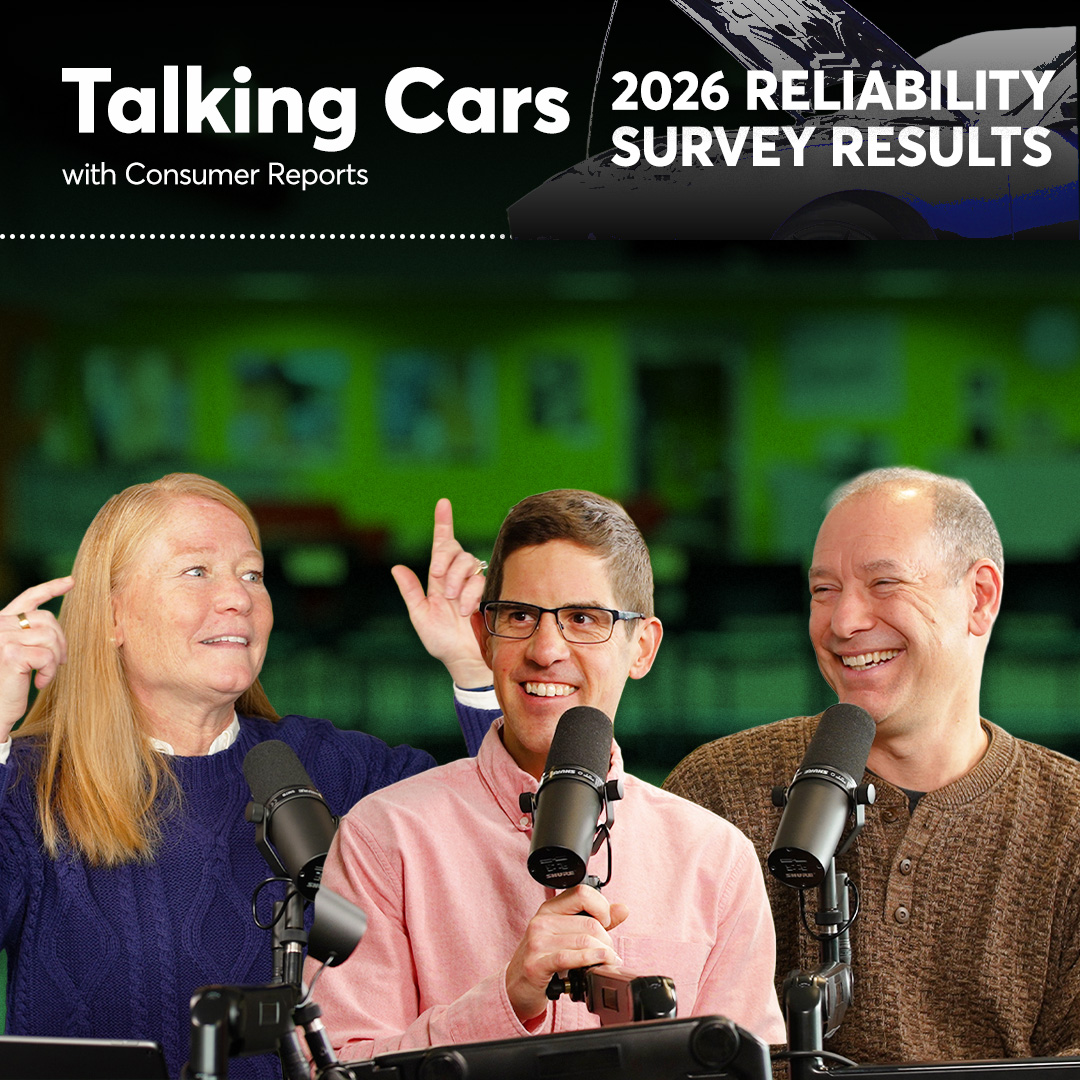
Hi, and welcome to Talking Cars.
I'm Jennifer Stockburger.
I'm Steve Ellick.
And I am Jake Fisher.
So, Steve, you're looking pretty good, rested, et cetera, despite the fact that you and Anita
have been burning the midnight oil for reliability.
The time of year where Steven and Anita are crunching all of the numbers on reliability.
So, we're going to jump right in, any big blockbusters, new news, et cetera, about reliability.
I mean, there are a couple of things.
Big news, as always, is Tesla.
It's now top 10 in terms of new car reliability, which is a big change because in the past,
they've had issues with the Model S, the Model X, there's just a bunch of features
and a ton of stuff in those cars.
And the Model 3 and the Model Y had build quality issues.
Examples of pieces of hair being in the paint or mismatch panels, that's in the past.
Their build quality for the Model 3 and the Model Y are much improved.
It's like the story of they're a new brand or they were a newer brand.
They've been around for 12, 13 years now.
They've figured out the build quality part.
They're starting to get how to build cars kind of like the legacy automakers used to know.
Their powertrains have always been pretty solid in terms of reliability.
So, that's one big, big thing.
I remember when they were building them in a tent.
Yeah, exactly.
Remember for a while?
Those days are gone.
I mean, look, I need to tell you about build quality.
I mean, there was like some reports that the trunk wouldn't close.
Things like that, and there was electronic issues.
There was all different types of problems with that.
What you would expect with a new automaker, with building a new plant and all these things,
but they've been around for a while.
That's the thing.
Also, they're not really redesigning.
Yes, they've redesigned the 3 and the Y, not major redesigns.
They aren't huge changes in those.
It's the evolution rather than the revolution.
They're more evolutionary, and then you look at the Tesla model, you look at the
S, and it's kind of like, wow, it's been around for a long time without redesign.
It's like, who does that?
And but when you do that, you don't really change the things that work or you refine
the things that don't work.
You finally get it right.
Exactly.
Well, it gives confirmation to time under their belt.
I mean, I think you said, Jake, when we were talking, they're the only automaker
with a five to 10-year-old purely electric vehicle fleet out there, purely electric.
So it's kind of neat.
Now, interestingly, before we get off Tesla for a minute, I think you had said,
that's new car reliability.
I want to make sure we differentiate.
When you look at used car reliability for Tesla, the picture is not as glowing.
Yeah, they are dead last for used car reliability.
I mean, and that's the beauty of having all these lists that we have.
We have new car reliability.
That's, you know, one way of looking at it.
We have used car reliability.
If, you know, a five to 10-year-old Tesla, that is back to that.
You know, when they were building an intense kind of era and those are still unreliable.
So it really depends on whether you're looking for a new car reliability or a long term reliability.
And to be clear about it, so I mean, that list is really, you know, we call used car
reliability, but it's really five to 10-year-old vehicles out on the fleet.
Right.
And what's interesting about that is, you know, and yeah, we do all these lists,
but, you know, sometimes it can be confusing because what we're not saying is like,
oh, this car is really good when it's new, but when it gets older, it's not good.
We're looking at different vehicles, right?
So when you're looking at the new car, we're looking at cars that are model year,
you know, the last three model year vehicles.
When we're looking at the other list, we're looking at what they were producing
five to 10 years ago, which was different.
And again, they were going through those growing pains and they didn't
quite have it quite right.
So it's not necessarily from that their vehicles all aged poorly.
It's that they were built at a time when they weren't as good being built originally.
That's right. Yeah.
I mean, you look back in time and, you know, we weren't recommending some of those vehicles.
We weren't recommending those vehicles.
And lo and behold, five years, 10 years later,
they're still have more than a fair share of problems.
These vehicles now that we're seeing are pretty problem-free.
We'll see what happens five, 10 years down the road.
It could be very different.
And then there are opposite examples like look at Mazda and they use car
reliability, the five to 10 year old cars.
Mazda is like third place in used car reliability this year for new car
reliability.
Mazda's, I mean, they've dropped a substantial number of spots.
They introduced the CX 90 a couple of years ago, the CX 70.
These are ground up, you know, rear wheel drive platforms,
longitudinally mounted engines, new transmission, everything.
And it kind of bucks that trend of what we say of conservative,
evolutionary redesigns.
These things are brand new.
And, you know, it shows with new car reliability, it's dropped the Mazda.
Yeah.
And that's a company that's a kind of changed their way, right?
And you look 10 years ago and what was Mazda, right?
They were kind of inexpensive, fun, simple vehicle, sporty, a lot of road noise,
you know, a little noisy, but kind of now they're kind of almost
trying to be this luxury automaker, right?
They're very kind of quiet and cocoon like.
And it's a different animal.
They got the turbos, you know, they're all throughout
the line. So, yeah, it's it's it's more about the company changing
than it is about, you know, they fall apart when they get old.
That's not really what we're talking about.
And I think that Mazda, that was reflected in the road test scores, too.
We didn't love the more recent Mazdas like we did the older Mazdas, if you will.
Yeah. Any other big news in there?
Not necessarily shocking, Toyota's first this year again.
And that's because they have improved the unreliable vehicles
that they had in the past, like in the last couple of years
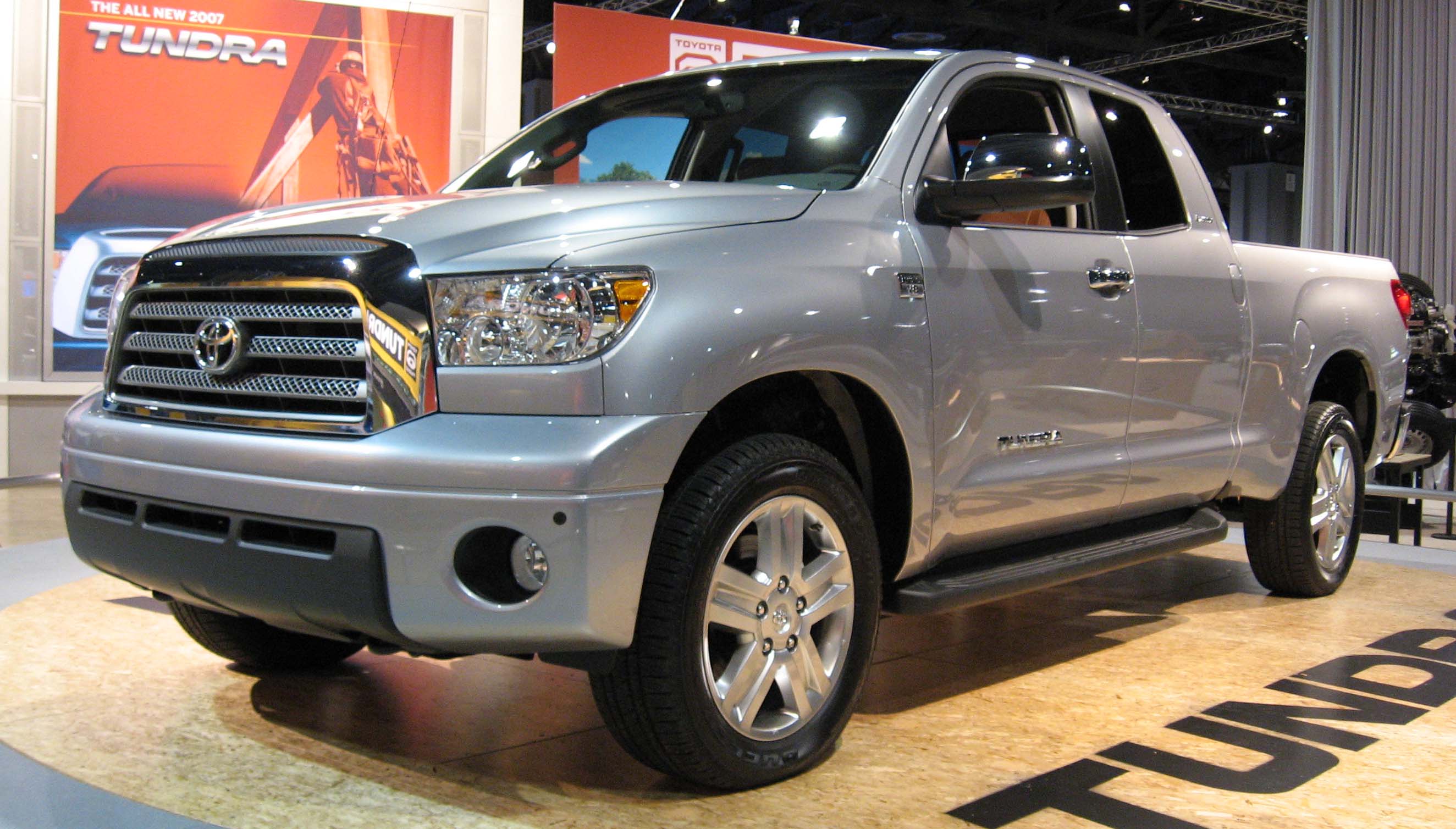
over the redesigned Tundra and Tacoma, they are better now.
The Tacoma is above average.
The Camry redesign last year has improved.
So that's maybe not that much of a surprise, but it's worth noting
that, you know, Toyota just has the same plan, just continue
conservative redesigns and evolving their cars.
And it pays dividends in terms of reliability.
Speaking of evolution, not revolution, just look at Toyota.
Yeah. I think you said, too, Buick and Lincoln are up there in brand.
So Buick and Lincoln are that's another interesting list
is we look at maintenance and repair costs.
So they are one of the least expensive brands to maintain, which is interesting.
They're, you know, Lincoln's a luxury brand.
You'd think, whereas you have other luxury brands like Mercedes and BMW,
which are expensive to maintain and repair, you can go out and get a Lincoln.
And it's really just utilizing Ford parts, which are inexpensive.
So, so, so, yes, we have many lists from our survey.
And in maintenance repair is one of those.
Now, previously, actually, it was Tesla that we were looking at five,
you know, going back 10 years of maintenance and repair costs.
But, yeah, they were kind of out pointed.
It was it's Buick and Lincoln and even Toyota and Hyundai.
And these cars are actually doing better in the long term.
And I think it's exactly what you said.
You know, it's it's a combination of being reliable,
but it's also a combination of having parts that are cheap.
Yeah. And and yeah,
maybe Buick's aren't quite as reliable as Toyota,
but like the parts are just cheaper.
And it's just very easy to and cheap to maintain.
And that, you know, Tesla stole this pretty well
because, again, the maintenance there is simpler, right?
There's not a lot of you're not changing timing belts
and spark plugs and all that.
I think you said there's kind of two ways to get there.
You can be super reliable and never need a repair,
or you can have some repairs, but your cost or your your parts are inexpensive.
So Toyota doesn't need them a lot.
Parts may be more expensive, but you don't need them a lot versus.
It's it's cost versus convenience really is, you know,
what you touched on, Tesla electrification in general,
you know, I'll let you elaborate.
Yeah, I mean, that's another big point this year for new car reliability.
Electrification in general, when we talk about EVs and plug-in hybrids,
they tend to be about 80 percent more problematic than gas cars
when you look at the last three years.
And that is a trend that we have seen.
That's been similar the last couple of years.
The reason behind it is because it's still new technology.
Not only are the powertrains new, they have batteries and electric motors,
which, you know, the charging unit and the inverters can fail.
But even their climate systems, like their heaters,
are different on an EV or a plug-in hybrid.
And so we do see these types of vehicles be more problematic for now
until they can work out the kinks.
Both EVs and plug-in hybrids, yeah,
because they have to have all that additional equipment.
But that's it, you know, until they could work out the kinks.
And then if you're looking, right, well, in Tesla and Nissan, right?
I mean, the Nissan Leaf has been around for a long time.
They're in their now the third generation they're going into of that vehicle.
So it's like, you know, if you're interested in your concern about
reliability or not, you don't want to have like the early adopter problems.
Look for an automaker has been doing a far longer time.
Exactly. So in a perfect world, an EV should be less costly to maintain.
But it has to get to a certain status quo in terms of newness and get there.
And because there are so many new so many automakers getting into the game.
Yeah, they're going through the same learning curve.
But the sweet spot of electrification is hybrids in terms of reliability.
I mean, as far as a trend, they are the most reliable.
And the reason behind it is they're being built by reliable automakers,
like Toyota and Lexus and Honda.
I mean, Toyota has been building the Prius for a quarter of a century.
So they have this technology down already.
Yeah, it's just it's not as new technology, right?
And to your point before, it's like when you have a hybrid vehicle,
you don't have to have a little electric heater.
You don't have to have the heat pump doing the AC.
You still have normal ways of doing these things.
You don't have to have a charging system.
There's no plug that goes into the car.
So it's actually, you know, again, it's not that they're more or less reliable
than gas counterparts.
It's just you're not taking a hit for the complexity,
but you are gaining so much in terms of fuel economy.
And and actually, you know, in these days, it's refinement too.
They tend to be quieter and smoother and all these things.
But to your point, they have the components of both.
You'd think that it would be more complex
because now they got an electric system and a regular,
you know, internal combustion engine system.
You think it would be more complex.
What's interesting about too is your point, it's reliable.
You know, a lot of a lot of the automakers that do hybrids,
they sometimes don't have the turbo, for instance.
You know, so like, for instance, we see so many small displacement
turbos now that are but sometimes the hybrids don't have the turbo.
So so there's complexity other ways for sure.
And they add quiet and refinement and all that.
Sure. The other element that that all it recently came up
on an episode of the smoking tire podcast where we got to mention
because the idea was owner satisfaction,
which is the other piece that comes out of these big surveys
that you crunch the data and the the dichotomy that can happen
with either a model or a brand that people love
but isn't necessarily commensurate in terms of reliability.
And I know there were a couple of those.
I think the one they talked about was Rivian.
Yeah. And that's the classic example of Rivian owners.
You know, they expect a certain thing when they buy the vehicle.
And I think, you know, Rivian delivers on that.
That sends their owner satisfaction scores super high.
It's it's the question we ask is if you had to do it all over again.
Would you buy this car again?
And Rivian scores excellently for that.
But those same owners will tell us all the issues that they do have
with their car. Right.
So they are last for new car reliability.
And it's just this interesting dichotomy between the two.
Yeah. So I mean, please go check out all these lists that we have.
You can see them.
They're all available in front of the paywall.
So if you're not a member, you could see those and like Rivian.
Yeah, it is dead last when it comes to reliability.
It is number one when it comes to owner satisfaction.
And I think that's exactly right.
It's what did they expect when they bought a Rivian?
I would guess they didn't choose the Rivian
because they wanted the most reliable vehicle.
You know, you're you're getting a new automaker with a new plant
and new technology and you're getting a lot of stuff that you want.
And maybe they're they understand that they may have
their more than their fair amount of problems.
Yeah, I'm always surprised.
Maybe I'm not surprised.
A couple of things we worked on over this past year
where reliability trickles into other areas.
So working with Emily on safety.
When we ask people what makes a safe car in your mind?
One of the top answers is it safely gets me from A to B.
It gets me where I need to go.
And the word was reliably.
So reliability is not just I don't have any problems.
It's it trickles into people's perception of what's a safe car.
We did the sustainability survey, specifically asking people
what to you makes a sustainable or a environmentally friendly vehicle?
Of course, fuel economy comes right up at the top range, all that.
The second answer, I can keep the vehicle for a long time
without having to get rid of it again.
It's reliability that interweaves to all these other topics
that we touch all the time.
So I just feel like the data and again, why you want to need
to spend so much time on it.
It's a big part of everything.
And that's a big part of I mean, the other thing
that we have the list of the overall score, you know,
which automakers make the best vehicles.
And and our overall score is very unique
because we're bringing in reliability.
I mean, yes, there's other I've seen the Internet
and there's other sources of which are the best cars or what,
you know, what autojournalists likes this car better than the other one.
But we're bringing in all that safety
information and reliability information, which is so important.
And just going back to the safety idea of reliability,
you know, and we talk about reliability,
we talk about all these different things.
And and yes, sometimes there's paint and body issues.
But we weigh the problems that are safety related about not,
you know, the major issues, engines,
transmissions, electric motors, charging problems,
things are going to keep you straight way more.
And that's also something different.
There are other sources of information about, you know, quality or what not.
We're really the only ones that are heavily
weighting those things that are safety related, very.
So even if there's issues with like the paint or something like that,
we'll talk about them, but that's not going to make it.
So we're not recommending the vehicle for that.
I think it's good point just briefly,
Stephen, because our members, you know, not our members often say,
you're biased or et cetera.
I just want to make it clear this reliability data, it's not our data.
It's your data. It's our members data.
Just give a quick rundown of how the data is collected,
what you do with it, how many vehicles we get
and just to give people a sense of where it comes from.
Yeah. So we collect these in two surveys during the year.
And we ask what problems did you experience with your vehicle in the last 12 months?
We ask our members about that.
And this year we had about 380,000 vehicles represented in our survey,
which is huge.
And then we crunch the numbers on that and look at what problems they have.
There are up to 20 potential trouble spots that we look at,
where, as you mentioned, Jake, some of them are more severe than others.
If your transmission needs to be replaced,
that's more important than a in-car electronics problem
that can be remediated by an over-the-air update.
So a transmission problem or an engine problem will be weighed more.
We take all of that into consideration and way to get this overall verdict.
And when we calculate reliability within a model year,
that is when it is compared relative to other model years.
If you look at a 2024 model, like a 2024 vehicle called a Toyota Camry,
we look at how it compares in reliability compared to other 2024s.
Is it above average, below average, average?
And then we take the last three model years to predict our new car
predicted reliability, as long as there wasn't a redesign during that time.
So way more goes into it than that, but that is probably the highest level
explanation of Stevens bags under his eyes for the last couple months.
But way more goes into it.
But to your point, you give us this data and we calculate based
on what problems you reported to us to tell you what it is.
So you told us that Toyota is the most reliable brand.
Yeah. And I think it's interesting.
And I don't want people, it's always, you know, I think it's important
to make clear to people that we don't expect cars to be trouble free as they age.
It's just what is the expectation of that older car to other models
of that same vintage, you know, we expect things to happen.
But are they happening more than your Toyota Camry example? Perhaps.
So if your cars are reflected in that data, you rock because it's it's
an extensive survey. It takes some time to fill out.
And we hopefully made it easier, made it easier to get to.
But look for all of the lists that Jake talks about brand level, model level.
It's big consideration in what becomes recommended for the next model year
in that new car prediction.
So I think it's interesting, too, that when we when new reliability data
comes in, that's the time that we open up those overall scores
because they can be reshuffled, change with new reliability data.
But it's also the time that we look at our road test scores.
Are we changing something in there?
We may make some tweaks in terms of safety.
This year, we're chugging at cargo a little bit.
So but also there's some really nice things that have been done
in consumerreports.org in terms of how you look at
the ratings. Yeah, our ratings are completely new.
Our digital group, you know, headed by a fabulous Nicole Lucas
has just completely redid the way our ratings are.
So I just kind of invite people to go check it out because you can go
sort by a zillion different aspects, including like things like that came up
on talking cars like cargo. How about the how high the cargo is?
You could actually sort by those filter by those.
So it's just really, really nice to be able to kind of like compare
these vehicles, resort them and just there's so much information
that we collect on this information.
Just actually just allow you to kind of play with that data.
The whole experience is way better now.
You can tailor it to your compare from someone who just bought a car.
Absolutely use those compare charts of lining up next to one another.
My rich line and my Ford Maverick.
That's what it really came down to. Good choices.
So yes, tons of new data.
Look at consumerreports.org.
It's all coming out and you will see all the reshuffling
and Stephen will get some sleep.
So moving on to your questions.
We love them. Keep them coming.
Consumerreports.org slash Talking Cars.
Anyway, you want to give them to us.
The first one comes from Jeff in Calhoun, Georgia.
I have mobility issues that require me to buy cars with the gas cap
on the driver's side.
Why do Subaru and other manufacturers put the gas cap on the passenger side?
I can't tell you how many times,
Jeff, when I pulled up to the pumps here and gotten back in the car
and come around because forgetting, even though just so everybody knows,
there's a little arrow on that little fuel pump near your filler,
near your gas gauge that tells you what side it's on.
But theories, theories for Jeff.
Well, being a car nerd, you know, these are the types of things
that keep me up at night, too.
And my theory on it is that it comes down to convenience versus safety.
So if it, if say you run out of gasoline, you know, and you're on a road
and you're pulled over in the shoulder, it's far safer to have that gas can
or whatever and fill it from the passenger side
because you're not standing in front of traffic.
So generally Japanese vehicles, European vehicles,
they generally go for safety.
The domestic vehicles go for convenience
and usually they're on the left side, but the Japanese cars.
Now there are some Japanese cars
that are actually designed for the American market and they'll be a certain way.
But many of the Japanese cars, even though they're on the passenger side,
when they come to the US market, they switch where the steering wheel is
and suddenly it's on the driver's side.
So it's kind of a mix when it comes to Japanese cars for those reasons.
That's that's my theory.
That I mean, I always thought it was about safety as well.
But also at this point, I feel like certain manufacturers
have kind of gotten set in their ways.
Some are on the left side, some are on the right side.
And I think there's a good reason for that, too, in general,
because people like to pull in, you know, to a gas station on the right.
If all the gas caps were on the left side,
I feel like there would be too many on the same side.
Whereas, you know, if someone coming from the other direction,
they could go to the opposite side or they could go to the opposite side.
So it's almost like instead of having to turn around.
And I think at this point, it's just it's about
the flow in the gas stations.
I love it.
I also think there's a brand expectation.
If you've been a Subaru loyalist,
you want it on the side that you expected to be on and all of that.
But I think and I do think probably so much more rare
that you run out of fuel, though.
And on older cars, didn't they used to have them sometimes in the back?
Like you open up the license plate on the Buick's.
And then they were there.
It was under the Mustang logo in the back, in the rear of the car.
Which is unsafe for other reasons, I suppose.
Yeah, but more convenient to go on either side.
Yeah, there you go.
It didn't matter where the filler was.
But the big issue now is electric vehicles.
Right.
Because now it's not marked generally at all in the cars,
but it's not even left and right.
It's front or rear. Yeah.
So I know every time I pull up in a
charter station, I feel like I have to move the car three or four more times.
It's like a game, like I'm going to pull in here.
One of the odds that I've got this charter in the right place.
How many times have you gotten in, backed it up or turned it around?
Maybe it's just me.
Definitely done it.
Next question comes from Tarot in Los Angeles, California.
I'm looking for advice on how to save money
and maintain my 2020 Toyota RAV4 hybrid by myself.
With rising costs and inflation, I've become more concerned
about car related expenses and want to do what I can do on my own.
So far, I've changed the oil, replaced a side mirror
and taken my car to Costco for tire rotation.
I also plan to change the air filter soon.
So best resource we have is Mike Croson.
So we're going to go to Mike and get his take
on what are the easiest and most cost effective things you can do
while still maintaining your car at home.
Let's go to Mike.
You're absolutely right.
You can save a lot of time and money
by doing some of your own vehicle maintenance on your own vehicle.
So I would recommend is first taking a look
at your owner's manual because there will be warranty
and service information that's included with it.
And there's a lot of great information in there.
For example, being in California, it's great.
You're not going to have to deal with rust,
but also you have additional warranty
coverages on your vehicle.
So there might be some items that you
even have to repair yourself
and you can get those taken care of for free.
But also Toyota has done most of the work for you.
They've listed out a maintenance log on your vehicle.
So it tells you what to check and when
and when the things need to be replaced.
Now you can go through that
and figure out what you're comfortable with.
And if you're comfortable doing it,
save yourself some money and take care of that
or have a professional do it.
But some of the things you can do
are your oil and oil canes, tire rotations,
check your tire pressures.
You can do wiper blades or washer fluid.
You can do bulbs in a lot of cases.
And if you're having trouble, maybe learning how to do those.
There's a lot of great online video resources
that will help you take care of those yourself.
The one important thing is, though,
you mentioned you have a RAV4 hybrid.
When working on any hybrid vehicle,
you want to make sure that you're safe
because there is high voltage.
So let me show you what that looks like.
So under the hood of any hybrid vehicle,
there's a lot going on.
But the one thing you want to make sure
is that you don't touch anything
that is this bright safety orange.
Those are the high voltage cables and components
and you absolutely want us to hear clear of all of those.
Let's come on in and take a look at what those look like.
All right, so we've got our engine.
Our oil dipstick is right here.
Our oil fill is back here.
But on this side, above our transmission,
this is all the high voltage electronics.
And these are the orange cables
that we definitely do not want to touch.
And you want to kind of leave all that stuff
to a professional.
But just taking a look under the hood here.
Your engineer filter is going to be right in here.
That's very easy to take care of.
Certainly something you can do yourself.
Your cabin filter is actually going to be inside the vehicle
behind your glove box, but it is kind of located in this region.
And that's another great maintenance item
that you can take care of and save a few bucks.
So certainly for tarot, filters are an easy one.
Jake, I think you did a did you do a short or something?
Yeah, back in the days of COVID, I think I did it.
I did a was it a live thing or something?
But yeah, I did a video with my son and we were going through
and changing the interior and engine,
the interior filter and the engine air filter.
Yep. And it's crazy easy.
So I mean, I mean, I my heart goes out to you, changing oil is messy.
You got to get out of the car and then sometimes the pain
changing the filters, super simple.
Yeah. And it's funny, we've gotten charged.
You know, we've been been in the dealer or wherever we are
at the repair shop for something else.
And they've said, you know, why don't you let me do the filter
while we're here?
The part doesn't cost anything.
But boy, the labor does.
And they have to charge in 15 half an hour increments for labor.
So now you're looking at for a simple job of a cabin air filter
or an engine air filter, 110.
Well, it's kind of funny, too.
It's like, or if you change your oil, right?
And they'll they'll take the filter out and they'll show it to you.
And they're like, see, it's dirty.
Should I change it?
And it's like, no, it's like, you've already done the labor.
Because there's no labor involved.
It's like two clips and you're done.
But again, they're charging you for some labor, which is very expensive.
We would love to hear like, let's let's open.
Is there maintenance things even on a 2020 RAV4?
What do you find is most cost effective or that you're doing at home?
We'd love to hear your responses.
We'd love to hear your responses for Jeff.
What's your theory on why the fuel fillers are on different sides of the car?
Maybe there's something we haven't thought of.
So get back to us.
The last it's not even a question.
It's a comment comes from Mark in Fisher's, Indiana.
Hello, Talking Cars podcast.
While listening to your recent podcast about tires, you answered a question
from a listener in Colorado about all wheel drive on EVs in the snow.
As a Rivian R1T owner, I am partially biased, but wanted to
highlight that there are some vehicles that do have a snow specific mode in their EVs.
In particular, the Kia Hyundai and Rivian EVs all have some form of snow mode.
Now, your listener didn't highlight whether he's having trouble stopping
or having trouble with the instant torque accelerating.
But that's what many of these snow modes do is adjust the torque
application when you're accelerating and also adjust the one pedal drive
characteristics when you're decelerating to adjust for the slipperiness in snow.
Maybe that answers this question or maybe not, but it's worth another
look for him to investigate Rivian and Kia EVs in particular.
Thanks so much.
Thank you, Mark.
And he's right on the money.
Because if you look at Rivian site, it says the snow mode in their Rivian
makes the pedal response gentler for smoother acceleration and it uses lower
regenerative braking setting to prevent wheel lockup during deceleration.
I go back to our old school advice of in the snow, drive like you had a hot
coffee cup on your dash, make your movement smoother, easy acceleration,
easy braking, and that's what that snow mode to Mark's point does in the Rivian.
I would personally drive my Rivian if I had one all the time in snow mode, knowing that.
Yeah.
Well, I mean, also for, you know, that really rapid deceleration that you get,
you know, that's could be annoying.
And yeah, you could put in a snow mode and get rid of that the only way.
Yes.
We didn't realize that.
I think if I'd known Mark's answer then or if I'd checked it out, I might do that.
And of course, you know, Ryan and Gordon stressed the importance
of having the grip, you need to have that grip as well.
But thank you, Mark, great advice.
Love that too.
If anybody has great advice for others that are asking these questions on the podcast.
So with that, that will do it for this episode.
Check out all the new, new, new presentation, reliability,
owner satisfaction, scoring consumer reports.org.
We've talked about brand a lot.
But again, if it's an individual model you're interested in, of course,
that will all be available with new data at consumerreports.org as well.
Thanks for watching.
Thanks for listening and we'll see you next time.
About this episode
The latest reliability survey results reveal significant shifts in automotive reliability, particularly highlighting Tesla's rise into the top 10 for new car reliability, despite its poor standing for used cars. The discussion also covers Mazda's drop in reliability due to new models, Toyota's consistent top ranking, and the impact of electrification on vehicle reliability. The hosts emphasize the importance of understanding the differences between new and used car reliability and share insights on owner satisfaction, particularly with brands like Rivian. The episode concludes with practical maintenance tips for DIY enthusiasts.
Consumer Reports' latest reliability findings are in, we share which brands deliver the most reliable cars, trucks, and SUVs in 2026—based on comprehensive survey data from hundreds of thousands of CR members. We break down how major automakers, including Toyota, Tesla, Subaru, Rivian, BMW, Mazda, and Honda, compare; how EVs and plug-in hybrids stack up against traditional gas models; which used cars offer the most dependable performance; and whether luxury brands truly provide an advantage over their mainstream counterparts. We also address why some automakers place the gas cap on the passenger side of their vehicles and offer advice on simple maintenance tasks you can perform yourself to help reduce car-related expenses.
SHOW NOTES
-----------------------------------
00:00 - Introduction
00:30 - New Car Reliability
02:51 - Used Car Reliability
05:57 - Big News
06:40 - Cars Least Expensive to Maintain
08:22 - EVs/ Plug-in Hybrids Reliability
10:04 - Hybrid Vehicle Reliability
11:34 - Owner Satisfaction
13:18 - Importance of Car Reliability
15:27 - How CR Gathers Reliability Data
19:55 - Question #1: Why do some car manufacturers put the gas cap on the passenger side and others on the driver side?
23:09 - Question #2: Which simple maintenance tasks can car owners perform on their own to help reduce car-related expenses?