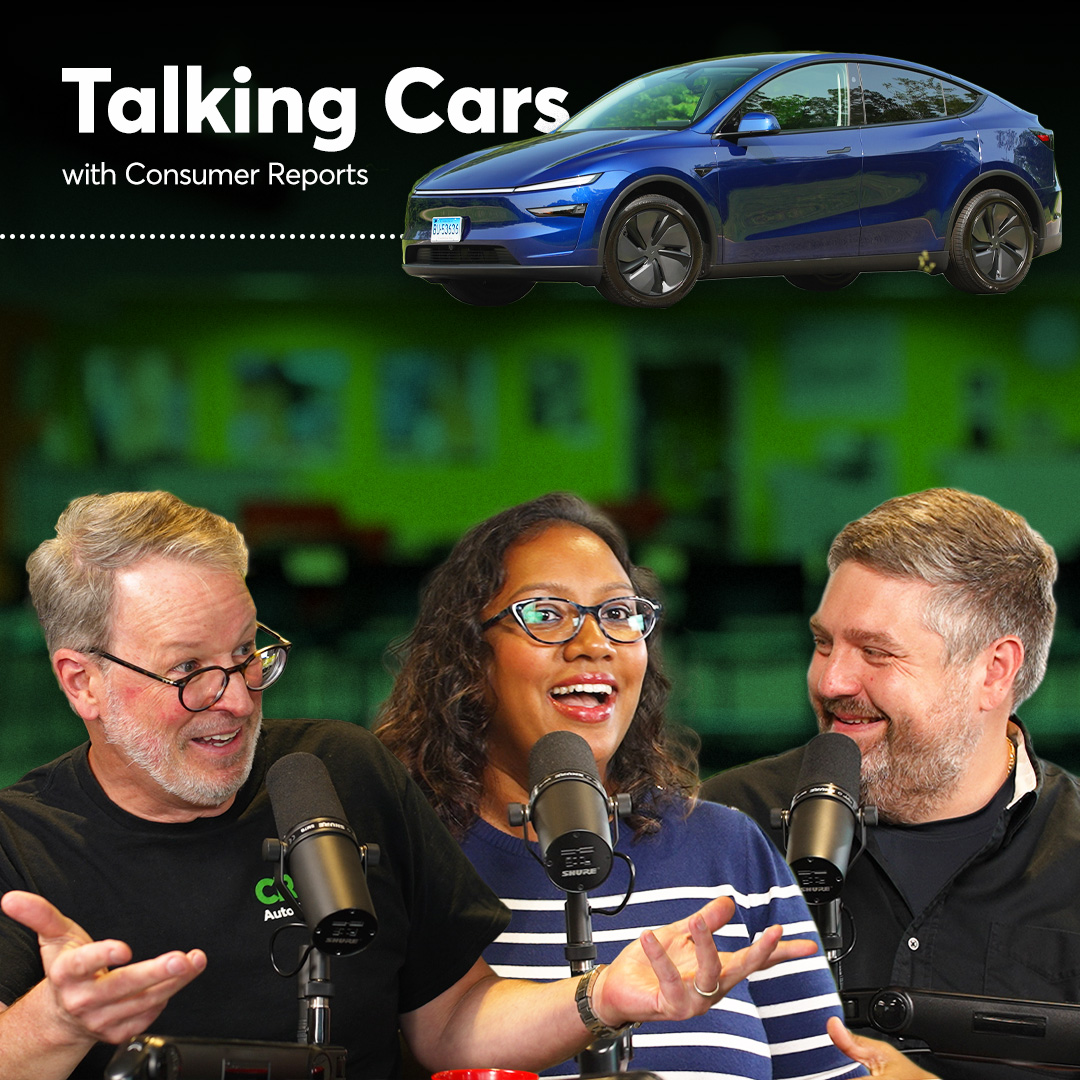
At Consumer Reports, we love answering your questions, but right now, we have some questions
for you.
We want to hear about your car, your products.
Did you have problems?
Did you have no problems?
Did you like your car?
Do you don't like your car?
Either way, we want you to tell CR about it.
Go to ConsumerReports.org slash tell CR.
We really appreciate it.
Hi, and welcome back.
I'm Mike Quincy.
I'm Emily Thomas.
I'm Michael Croson.
So we have a very important car, some would say a special car.
This is the Tesla Model Y podcast.
We're very excited to talk about this.
A lot of people, certainly in our audience, are real interested in Teslas and everything
we have to say on them.
So this is an update.
So we're just going to just hop right into it, okay?
This is an updated version of the Model Y, the second time that we've tested this
car.
Changes for this year include acoustic glass for a quieter interior, more soft touch materials
in the cabin, a touchscreen for the rear passengers, which my 20-something-year-old sons had lots
of fun with, and updates to the controls.
There's also a new front-end styling with pretty sleek-looking headlights.
I mean, it really does kind of grab your attention if you like that kind of thing.
This is a really super important car for Tesla.
It is the company's best-selling model, and it is among the top sellers of any
EVs going.
So there is a lot riding on this.
The Model Y starts at $34,000, and we checked the box for the all-wheel-drive long-range
model, which added $14,990, which used to be able to buy you a good-used car.
We also got the tow package, special paint, and adding up these options, and the $1,390
destination fee.
The total came to $52,380.
And as you guys know when you talk about EVs, most people want to know that magical
number.
The EPA rates the driving range at the long-range all-wheel-drive version at 327 miles, which
is pretty good in my cross, and you know something about small block of the 8, so 327 is a nice
round number here.
It is.
Yeah, I enjoy that number, and I will say that we are going to test that on our
electric vehicle highway range test, so we'll actually see does it live up to that 327
miles?
Does it do better?
Does it do worse?
That will happen this year.
Right.
A good day to get out of the office and stop staring at a computer and just drive and spend
the day driving.
Sure, he loves it.
And actually, I like it too.
They let me do this.
So let's kind of take our awesome audience into this car, and Mike, I'm going to start
with you, and we're going to talk about your impressions, how you think it drives,
and a whole laundry list of other things.
So I'm actually going to start with getting the car, because I was tasked with purchasing
this Model Y, and you do this online or through the app.
And it's actually sort of an easy process, at least on the surface.
But some of the issues we had, some were 100% my fault, and I take full responsibility
for those.
Shocking.
Our fault.
Our fault.
The way the Consumer Reports does some things and the way we're set up some of them
were our fault, and then some of them were definitely Tesla's fault, and the
whole thing didn't go smooth.
Right, and just as a reminder, in case the audience doesn't know, we buy all
of our own test cars anonymously.
We contact the dealers and try to make the deals, and then only tell them that
we are from Consumer Reports at the last minute right before delivery.
Yeah, we wait as long as we can, and that's part of one of the issues that
happens with Tesla.
So I actually went through four cars before we got this car.
We ordered a first car the day, like the minute that it went live, and that
was a, it was like a first edition or launch edition.
I'm going to get that name wrong, but basically it came with a bunch of
options.
It was all sort of bundled.
We did it because we wanted to get in line, we wanted to get the car
quickly, and the day that they actually released a VIN number in the app, they
send you messages and like, hey, congratulations, you now have a VIN
number, send us all your registration information, send us your
insurance card, all that kind of stuff, Tesla actually released a
non-launch edition car that was about $10,000 less because it came
with a few less options, and most notably did not have FSD included
within that bundle.
So it was a lot less expensive, and we decided that that was actually
the car we wanted because it's more representative of the cars that
most people will buy, right?
Because the launch edition was such a narrow window that it was
available, so I had to change cars.
So this was our fault, and that was actually a pretty easy process
to do.
I actually reached out to the Tesla fleet center, I guess you'd
call it, you know, it's where a business would go to buy a car.
Right, and again, anonymous Michael Crosin.
Yes, and essentially what happens there is they were like, okay,
cool, we can change that, what do you want?
So I spec'd out a car, and they're like, perfect, we'll sign
it in in a couple of days, or we'll send you an RN number is
really what they call it, it's your insurance order number.
So that was car number two, and weeks go by, and they told us
this, that we'd sort of go to the end of the line because we
were starting over again, fine.
It was over a long weekend, it might have been over the New
York Auto Show, I was out for a few days, and I think I
combined it with an extra day or two off, and I didn't have
the app on my personal phone, I had it on one of the CR
phones, and I didn't have that with me, and they only
communicate through the messaging in the app, and because
they sent it, and I didn't send the insurance like immediately
or within a couple of days, they canceled that order, we lost
the spot, so we lost that car, so that was car two gone.
So then I had to get to car three.
So I go through the whole process again, so we get car
three, car three, we got a VIN number, we put the
insurance on it, sent all that out, and car three was
damaged in transport, it was damaged by hail.
So we had to go into car number four.
Not our fault.
So car number four is the car that we ended up with, and some
of the CR stuff, it's a little difficult to register our
cars, because it is going to a business, and at some point
we have to do the flop from like being in my name or Mike
Sam Ramley's name into the business name, and what's
happened with Tesla, particularly in the past, is when you
go to get the car, whoever was buying the car, their name
is on the reg and the title along with consumer
reports, and that's not good for a number of reasons.
I don't want a car that I didn't pay for, now
there's tax implications and all kinds of stuff.
So I was working on this, once soon as the car basically
arrived, this is your car is here, let's schedule your
delivery, tell them who we are, we need to straighten this
out, and that's where the fleet kind of section comes
in because they should be able to facilitate
registering into a company.
This took two and a half weeks to sort out, very
upfront with it, the whole thing, and still on the
day of pickup, there we were still dealing with this.
My name was on all the documents and we had to go
through and fix all of that.
Tesla made a big deal about changing the buying and
delivery process.
You know, we're going to upend everything because
automotive retail is whatever and now we're just
going to do the Tesla thing.
It doesn't sound like they're making progress.
Well, I think you have to take as insane as your
story is, I think you have to take it with a grain
of salt because we have to change the reg and
all of that into the business side, right?
And because we operate as a business, we have
limitations.
We do a hundred percent that I don't know as wonky as
our experience and I say ours very loosely was I
don't know if that's still representative of like a
regular consumer experience.
And typically I would say you're right because we
even run into that at traditional dealers.
So a hundred percent we might not have a typical
buying experience, but someone else might, especially
if they're buying it for a business, you know,
they own a business, whatever they want to
Tesla, they can run into the same thing.
So I mean, we're going to be saying this quite
often during this podcast, you know, your
results may vary a hundred percent by Tesla and
you're in and out in 10 minutes.
And it could be great.
And the initial part of the app was wonderful.
It was very easy, just select some boxes, you
know, you submit everything and like you have a
car, you have to call anybody and you have to
go to a dealership.
That's all very nice.
It's just if you're have anything that deviates
from like the Tesla road map, you run into
like a real roadblock and then it becomes
difficult.
So just something to be aware of.
Wow, I don't want to like harp on it too
much, but it was a trying experience.
And and and we eventually did, you know, get
the car, get it registered.
We're going to circle back to you, but I
want to I want to stop and the registration
was still wrong, though.
Mary still had to go to the DMV to get the
registration fixed.
All right.
So they're not really revolutionary,
revolutionizing the car buying process,
but that's probably a different podcast in
and of itself.
We can get back down to the hardware of
the car and Emily, you spent some time
with the Model Y.
What were your impressions so far?
I actually really like how it drives.
I think like it's pretty quick.
The steering is nice and smooth.
It's not too heavy, which can be a
challenge for me.
I like it when it's a little bit lighter or
like at least medium weight.
I found the driving itself to be
enjoyable.
I wasn't comfortable all the time, though,
because the ride was still pretty stiff.
And I know it's an improvement.
I like, I get that it's an improvement
from the previous version of the Model
Y, but it still felt very abrupt for
me.
And I think over time, like I would not
be comfortable having that vehicle.
Like the seats itself were comfortable,
but it was just like anytime we went
over any sort of like bump or rut in
the road, you felt all of it like
come up through your lower back.
And I have lower back issues.
So I was like, this is just not
conducive for my well-being.
Plus we have a ton of like construction
going on around us.
So like we're feeling it a lot more
right now as you're just commuting
back and forth to work.
So the ride itself would be enough
for me to be like, I can't personally
do this vehicle unless everywhere I
drove is just like really beautifully
newly paved roads with zero issues.
Just not Connecticut.
Yeah, not Connecticut, right?
But like it handles everything else
really well.
Like it handles like the turns really
well and like all the curvy roads
that we have here, like for the
country roads and stuff.
So like driving it itself was
pretty nice.
You can see really great out of the
front.
The other piece that would be a deal
breaker for me is the rear visibility.
It's like you get this sliver.
It's like looking through a mailbox.
Oh, that's a really good analogy.
Very nice.
Yeah, you get like my preference
is that when I look in the rear
view mirror that the rear windshield
like fills the entirety of the
rear view mirror, right?
Like I'd like to see it take up
the whole space.
And this is like, like you said,
like a mailbox slot.
That's excellent.
And then it's like so much worse
at night.
Yep.
At night, I just felt like I had
no idea what was happening behind
me, which I really didn't enjoy.
So those itself are probably
just off the driving experience
alone are the two deal breakers
for me.
If that rear visibility improved
and that that ride really wasn't
so stuff where like it was painful
for my body, then I could
consider it from that perspective.
I mean, it's interesting you
mentioned the ride.
So this is our second Model Y.
The first one I think was a 2020
and when I started, that car
already had miles on it.
So it wasn't a new car.
And I think I described that
thing as like a bucket of bolts.
It just rattled and sweet.
No, it did.
It rashed over every bump.
It had lots of interior noises to it.
That quick creaks and like,
like they just put it together.
And so this one is definitely
improved, but the ride still is
not fantastic.
You're right. It is definitely harsh.
And if you're on new pavement,
like out on our track, it's great.
But if you're going through
construction zone or something like
that, or potholes and manhole
covers and things like that, it's
rough or just older roads.
Yeah.
Half the roads in my town have
like those little like asphalt
patches, right?
So like a hundred percent or
anything that's not a smooth
pavement.
And you feel everything.
So two track wagon trail.
It's a whole thing.
No, I'm kidding.
I'm kidding.
But so so we've come
into really the ride.
But like day to day livability.
It's I mean, I don't understand
why people buy these cars,
but there are some things.
Let's talk about some things.
Let's talk about the key card.
I should have grabbed it off the board.
You get a little credit card,
basically, that is your key to the car.
And you can hold it up to the B
pillar to lock and unlocks.
You have to present it and wait a
second and it'll let you in and
all that kind of stuff.
Then you have to put it on.
Maybe.
Maybe you have to put on the
the angled holder, which is also
a phone charger.
I just find the key card a little
cumbersome because it's in my
pocket or is in my wallet or what
did I do with it?
I might be holding things.
And then it's just an awkward
juggle of how to do that.
The door will actually
the door sort of like has like an
auto open to it as you like try
to pull the handle to it all
kind of happens at once.
And that's a little awkward
because the handle isn't great.
The handle doesn't present itself.
Yeah, it's like it's almost
like you almost you have to
like quite or quite need two
hands.
You sort of almost need to
like pivot the handle.
So the larger part comes out.
Yeah, you have to like push the
back, grab the front.
Which is it's hard.
I mean, I have I have small hands.
So that's a lot.
My my handspan doesn't always
let me do that well.
And then for the kids, they had
a really hard time with it.
And I was worried that they
I was really worried that Nima
was going to pinch his fingers.
So it's interesting you mentioned
that. So I did a bunch of
errands with my father and
he has pretty decent sized
hands, but he was worried that
he was going to pinch his
fingers because he didn't really
understand how it worked.
And just sort of being older and
having a little bit of arthritis
and not the same dexterity that
he once had.
It just became an awkward sort of
a situation.
Then just imagine combining that
with having to use the key card
to try to unlock the vehicle.
And if you have things and if
you have stuff, you're carrying
something right to your hand.
Now, I will say you can set
your phone up as a key.
And this is probably what
right. I would.
Others will do.
Most people are probably right.
They that's how they're
getting around having to use
the key card.
We just go for the full
experience and we do both.
Yes.
The other challenge I have with the
key card is like it never quite
did what the action I wanted
it to do.
So I would be trying to unlock
and it's like locking again.
All that makes it really
frustrating.
And I get that.
You know, I think I was just
chatting with somebody like,
well, it's the same darn
handles, though, as before.
And I'm like, yes, but
that doesn't make it a good
design. No.
No, it doesn't.
But hold your horses, bud.
I'm agreeing with you, by
the way.
My point was over time,
we've seen more and more of these
like electronic door handles.
And I think we've seen enough
variation in design to be able
to say like.
In the landscape of electronic
door handles, these aren't great.
It's not just like, OK, it's
not great for this car.
We've seen it implemented much
better where when you unlock
the vehicle, the handles
present, it's less
work on the user.
Right. And it's more obvious
that, hey, your car unlocked
because now the handles are open
to you. So the Cadillac OPTIQ
or OPTIQ is I like to call it
basically have the same door
handle. It's of the same design.
But when you unlock that car,
the handle comes out and presents
itself. So you have something to
grab and it's really easy to open
the door.
And I didn't come up with this.
This was Joe. So I'm going to
credit Joe with this. But when it
comes to door handles, best
case scenario is just that it
works. Right.
There's there's not a lot of
upside to getting fancy with a
door handle.
I think this is going to be a
theme, I think, I hope, as we're
talking about the model Y, it
could be simple, but they make
it complicated.
Now, you know, and just to run
my own defense here, you know,
we get tech and sometimes the
new tech is awesome.
But sometimes it's complicated
for complicated sake.
And that's what aggravates me
about the novel.
I don't know if they're trying
to make it complicated.
They're trying to make it novel.
But they're not they're not
trying to make it simple.
Right.
I don't know. I'm not on
their team. I don't know what
they're trying to think right a
place where Tesla was a front
runner in a lot of this stuff
and they came up with things.
All the other auto manufacturers
are like, hey, they're selling
a lot of cars.
We should do some of the things
that they do.
I'm going to get to it.
So they see this happening.
They do the things.
Now we're how all these cars
that have this stuff that are
Tesla like and none of them
are all that great, but every
car has some of this stuff.
OK, but some of it is done
better. But we're certainly
the way up in the room is
is the controls, the touch
screen, the day to day
usability, just, you know,
using the center screen
to select drive or reverse
and stuff like that.
So I want you guys to kind of
like reflect on on that kind
of, you know, get day to day
livability.
Yeah. So to set it up
for people, maybe haven't been
in one or they haven't seen
what the interior looks like.
You don't have a driver screen,
right? There's no driver
cluster. Everything
is in this center screen,
which is like a giant iPad.
You do have a turn stock,
which is a huge plus.
It is. Right. Turn signal stock.
You have a round steering wheel,
also a plus, also an improvement.
Cough, Lincoln, right?
I mean, yes.
Steering wheel should be round.
Steering wheel should be round.
This one is. I was very happy about this.
I take the small joys.
I don't like the steering wheel
in this car, though.
That's why it's round,
but I don't like it.
But it's round at least.
Yes.
And then to your point,
you do have to like change gears
right by using the touch screen.
So you have to get used to that,
which once you kind of figure out
that that's where it is,
it makes sort of sense
because you're like at least moving
the car in the direction that
you want to shift
or you want the vehicle to move
like the little car icon on the screen.
So that part is fine.
I don't like not having
a screen in front of me.
I like to have my driver controls
right where I can see them
speed and the directions
and everything.
We're like, I like to have that there.
And so I found that I kept having
to look over to the side.
Right.
And one, it was just like,
right, I got like a crick in my neck
by the end of the drive.
But also it just
it forces you to keep your eyes
off of the road.
And if if Maddie was here,
Maddie is our human factors expert,
right? She would say that
that's not a good design
that anything that's forcing you
to keep your eyes off of the road
is not a safe design.
I'm pretty sure that's what she would say.
I'm putting words to her mouth.
Oh, no, no, no, no.
I think they're safe there.
Yeah.
But when when design
decisions are potentially
affecting the car's safety,
I mean, that's we do it
consumer reports.
We're going to point that out.
Right. And here's the other piece of it.
Right. So people who are buying this car,
I'm going to assume you're buying it
for a couple of primary reasons.
One, the charging, right?
Yep.
Charging is great.
The network is great.
You like this novel
concept and design of a vehicle.
And you're trying to get
that full self driving package.
I feel like the devil's advocate
person would be like, well,
you don't really need to be
staring at the center screen
because the car is going to drive for you.
You can just relax and look forward.
Now, as a safety engineer,
I don't have that much faith
in the system to do that.
So even when I was trying out
full self driving, I still had my hands
on the wheel and my foot hovering over
the pedal ready to take over at any moment.
Which is what every car company's
lawyers are going to say,
you still need to be engaged in driving.
It says supervised in parentheses.
So but maybe we'll let you talk
sure through the stages first
before we get all the way there.
Sure. So Tesla has three different
let's call them levels of crews.
Control. Right. So the first is
traffic aware cruise control,
which is basically what we know as
ACC or adaptive cruise control.
It uses speed and distance
to follow the car in front of you.
So it will speed up, slow down,
depending on your settings and depending
on what the car in front of you does.
Then there's auto steer beta,
which is that plus it keeps you in the lane.
Lane center. So in theory,
you can kind of take your hands
off the wheel momentarily.
You know, if you want to like open
a water bottle, but you really kind
of need to keep your hands on the wheel.
The car just sort of keeps you in the lane.
And then there is full self-driving
FSD supervised.
And the idea behind this is you can
enter in a destination in the nav
from a parking spot
and it will take you from point A
to point B, your final destination,
whatever errand you're running to work
or the store or whatever.
And it will take you the whole way
there. And other than clicking
go on the steering wheel,
you may have to pay attention.
You're supposed to pay attention,
but it will do everything for you.
It'll signal, it'll stop,
it'll accelerate, it'll get you there.
And so you experience this.
Yes. So just the other day,
we had to go to dealerships.
So I was like, let me take the Model Y.
I want to drive it one more time
with FSD just before the podcast.
And it took us from here at the
track all the way to the dealer
that we were going to.
It dealt with a construction zone
where we actually had to cross over
the double yellow like through a
lane of cones.
And there was a piece of equipment
in the road. And then there was
people in a car turn.
And then you'll see in the video
that a car comes in front of us.
It dealt with it perfectly.
I was freaking out the entire time
and did not trust it,
but it was flawless through this
construction zone.
And then it also dealt with two
really tricky intersections later on.
One had a road that the road is
kind of wide together and it's up a
hill and you really can't see
the car crept forward.
So actually it could get a better
view, much like you would as a
driver. I thought the car was
going and the video guys
will have to clip a piece of audio
from the car. I might have said
something as we were about to,
I thought we were going to crash
into an Nissan Rogue, but the car
just crept forward so it could get
a better view. The road passed
and off we went.
And there was another intersection
that has like six roads at all
interchange and merging.
And it was set up on the
hurry setting, which the car is a
little more aggressive.
Actually, I think in this case it
was a good thing. I don't know
how you would have got through the
intersection in chill mode
because you have to be aggressive
in this intersection. And I thought
we were maybe going to t-bone a
car, but it went in right behind
it and made the turn successfully.
And it was actually really
impressive.
So I mean, the technology is
there. It works.
I'm not not going to pay
attention. I'm not going to not
keep my hands near the wheel.
We would still highly encourage
you to keep
your hands at the wheel.
Pay attention. There was nothing
relaxing.
It's not relaxing.
No, I was really impressed
though, because I was skeptical
of how it would navigate
various situations, how well it
would follow the directions.
Right. So which is why I kept
watching the screen to be like,
is it going to make the turn that
it's supposed to make? Because
like we're getting really close
and maybe we're not on the lane
that I think we're supposed to be
in yet.
I will agree with that. It does
things differently than I would.
It breaks a little later.
I would have like lifted off the
accelerator and allowed a little
more distance in certain
situations. I would have switched
over a hundred percent sooner.
But I was impressed with how well
it could follow the directions
and like get me from point to
point. What I really didn't
like about the system,
despite how well it navigated
certain things, it would just
disengage.
Yeah. And that was my experience
as well. I
thank God I was
paying attention to take over
because it would just suddenly
be like disengaged.
I'm like, oh, all right.
Well, I guess I'm back in.
Right. Like it's like put me in
coach, but like there's like no
warning. Right.
And so it would just turn off
and like sometimes it would do
it like in the middle of a
curve. Yeah. I was
coming off and off ramp and
about to merge and it's like
disengaged. I'm like, all
righty then. I guess we're
just I'm now merging for
the car. When you're thinking
that it's going to do these things
for you because that's how it's
advertised. Right.
And some merges it could handle
others it didn't.
And so it would just turn off.
But it's not giving you enough
warning. If you are a person
who's really being like, well,
I can chill during
this drive.
Yes. And just be
hands and feet off that
might put you in an unsafe
position. We're not there yet.
I don't think no.
And I think from from using the
system, what I've observed
is, you know, you have the
image on the screen that
shows lines and the cars in
front of you and if there's a
person on the side of the road
or cones or whatever.
And it looks pretty far ahead.
At least that's what it shows
you. But I think what it's
reacting to is actually pretty
close to the car.
It's looking just ahead of the
car because you can be
mid corner and the
corner tightens a little bit.
The car sort of hasn't
anticipated that. So it
jabs the brakes.
It adjusts the steering.
You do a little bit of kind
of hunting through the lane.
That's not super smooth.
And I don't really enjoy that.
But like when I drive, I'm
looking all the way through
the corner and I can see that
there's a decreasing radius
turn. I can manage the speed
and the steering and all those
kinds of things.
But they teach you in my
other complaint with that
is that it seems to hit
everything on the road.
Every pothole, storm drain,
manhole cover that I could
avoid is very easily
with a little pressure on the
wheel and just kind of get
around them. Then add in the
fact that it doesn't ride
all that well. You're
crashing over all these
things, trying to use a
touchscreen and then you hit
a bump and you select the
wrong thing. And that
gets really frustrating.
Yeah. So this, you know,
kind of the in
theory, it's just be more
relaxing and stuff like that.
And in Emily, you're
you're you're really smart
to kind of be pre
you know, you're proactively
preemptively fighting back
on criticisms like, well,
you know, you won't have to
deal with the type with the
center screen if it's taking
care of them. However, and
I'm probably I can't speak
for everyone. But I know
that I'm making lots of
micro adjustments when I'm
driving, such as the
climate system. It's too
hot. It's too cold.
I want to change the air
flow. Now with Tesla and
with some other unfortunate
automakers, you have to go
into the center screen to
adjust the vents. Now back to
your point of distracting,
you know, distracting
controls, taking your eyes
off the road. See, see this
this kind of just my climate
setting is like to open the
climate. It's at the bottom
of the screen. Right. So
you're not just looking over
you're looking down. You're
really eyes off the road.
You can you can have when
I was driving at the speed
up, I had like the nav
system or my music on the
right side is because this
screen can be split. So you
have something on one side
when the so to make these
adjustments, you have to hit
the little icon on the lower
left corner of the screen
to bring up the car. And then
you get a massive menu of
things to deal with to
fiddle with and whatnot. And
this is something that
Tesla, you know, really kind
of if I can use the term
pioneered, like many years
ago. And listen, the car
the car company had this
incredible buzz, right?
Like, oh my gosh, look at
this dazzling tech and look
at this neat things you can
do it. Isn't that amazing?
And and but what has
happened in the years
because the Tesla buzz has
that's a bit cooled a
little bit in the last few
years. The problem is that
when you're when you're
designing and bring a new
car into production, it
takes years. So they so
other car companies thought
we should be like Tesla.
We should mimic them
because they're cool.
So so so the way that I
look at Tesla and the
automotive industry overall,
and I've got a number of
car executives to admit this
to me because when they come
to visit the track and we talk
to them stuff like that, I
said, so to me, it seems
like the car business is not
that different than high
school. In high school,
there's like one or two
kids that everyone thinks
they're cool or they're
beautiful, whatever they're
wearing certain clothes
and they're they're
listening to certain bands,
they go to the parties
and everyone wants to be
like them. So they buy
the same brand of jeans
and sneakers and whatnot.
And I said, it seems like
the auto industry is doing
the same thing.
They're just they're all in
high school and they want to
be like Tesla.
And so we're seeing all these
designs that are very Tesla
like from a number
of different car companies
and especially with their
EVs. Absolutely.
And this to me is really
unfortunate.
I mean, I don't disagree
with you. I think some of
it, though, is based in
there's reasons for this,
right? Elon has been
quoted as saying the best
part is no part.
And what this essentially
means part for him, but not
for not for the car.
We talked about trying to
do not be so I think we
talked about it for a second.
The simplest version of
something tends to be the
best. If you don't have a
part in the car, that part
can't fail and break.
You don't have to go in and
have it serviced and all
that kind of stuff.
So I think a good example
of this is the center
console lid.
There's no latch on these
Teslas. It just kind of
has some friction there.
But latches break.
People lean on them and
they don't line up
right. And they break.
And I can't say how many
latches I've replaced on a
center console lid.
You'll never have to do that
on Tesla because it doesn't
have it. So it makes the car
easier to build,
theoretically less expensive
because there's less little
parts you need.
And there's nothing to go
wrong. So that's a good
point to it.
But then there's all the
other stuff that they
don't include.
And that's sort of when
the bad design comes in.
And sometimes you do need
a part.
Sometimes switches are
better, but switches are
expensive. There's lots of
little parts and you have
to build them and people
spill sodas into them
and then they have to be
repaired and all that
kind of stuff. So I see
why they do what they do.
It makes the cars easier to
build. And that's really the
car makers sort of goal.
They want to build these things
fast. They want to build them
cheap and they just want to
roll them out and collect
their money.
Right. But you need to go
into the center screen
to open the glove box.
I don't see that as as
advancing automotive
technology.
I think they do that because
they can. They're still a
latch there. Right.
So so so back to my back
to my high school point.
It's like car companies are
focusing on party tricks.
They want to do something
that's good. Oh wow.
Look at that.
Well, yeah. We see that for all
kinds of things.
It's not the same thing as
design. We see that with like
headlight design. We see that
with all kinds of stuff.
And it doesn't make them
safer because there's
there's more distractions
going on.
I can't disagree with that.
OK. And that's where we get
into the people are like,
well, you get used to some of
these things. Right. If you
drive this car every day,
you know where to go to
open the glove box.
That's a fair point.
But I get that.
I don't think some of basic
controls you should actually
have to think about or have
to get used to.
Right. You should just be
able to do the thing you
do. Right.
And so, you know, like people
get used to being in jail.
Doesn't mean I want to go to
jail.
But to your point, though, I
think as an industry,
right.
From the consumer feedback,
there is plenty of consumers
that are like, hey, listen,
like I do want simplicity
when it comes to basic driving
tasks. And so you have
like CR is looking at how
can we evaluate distracting
controls in vehicles
and like focus on safety
critical components or safety
critical tasks.
Euro NCAP has made it
as part of their roadmap
and evaluations that you will
have to look.
You will have it will require
physical buttons for
safety critical driving tasks.
So I think as much as we've
gone full swing pendulum,
you know, to having
everything in the touchscreen,
I think a lot of them are
going to have to scale that
back because there's a
recognition that, hey,
safety is important.
You have to have safety included
in your design.
And there are things that people
need to be able to do quickly
and excessively
while they're driving.
There's no way around it.
Some of the other safety things
I did want to bring up.
So for example, the blind spot
warning. Yes. Right.
The blind spot warning indicator
is this tiny little red
dot in the A pillar
kind of like behind the speaker.
Now, does it work?
Yes, we're glad we're glad
to have it.
Is it technically a blind spot
warning indicator?
It is.
My gripe is for a manufacturer
that prides itself and touts
technology, advanced technology
so much like surely
you all could have implemented
a better one. Right.
That is more obvious.
That's easier to see that.
You can only see if you're
looking at it. Right.
Yes. Right.
So I think they could have
done better there.
I will say when I.
So I had to put the kids
car seats in the back seat
with their lower anchors.
Right. They're still like kind
of hard to access
because they're really tight
and close to the cushions.
I really like that
a lot of the Teslas
have integrated head restraints
in the back, which makes it
really hard for like
car seat installations
because you can't make any
adjustment to allow for better
compatibility, but this one
didn't. It has adjustable head
restraints. So I know
it's a small thing,
but I got very excited
about that because it made it
a lot easier for me to support.
It's just not a small thing.
To use for the car seat design
or car seat installs
and it has a rear belt minder.
So not only can
you see when
your rear passengers are buckled
up, you'll get an alert when
they're unbuckled.
If you have a child seat
in that same position test
has always done a really good
job of like, you can kind of
tap that same position to
indicate that, hey, there's
a car seat installed here
so that you don't have to get
the reminder for like, you
know, a harness car seat.
So that is good.
They still don't have a rear
occupant alert.
They have the
the system for, you know, if
you have a pet in the vehicle,
you can like do the cabin
overheat and or protection
and that's exactly what
it's called. But the system
where it will allow for you
to cool the cabin.
Yeah, there's for both a pet
and it even says in the display
like it's 72 degrees in here
and I'll be back.
But there's also then the
feature that you can set a
threshold that if it gets to a
certain temperature, even if
there's nobody in the car, it
will turn the fan on.
It might just be a vent or it
could be air conditioning or
heat to kind of maintain the
temperature. You can set your
like upper and I think lower
limit to. Yeah.
So so I mean, it's not all new
tech is bad. Some of it is
awesome. Some of it's really
good. They have that rear
screen in the back that the
kids really liked. But I
didn't like because they kept
trying to lean to reach
it because it's low, right?
It is very low. It's low and
it's in the middle.
And so the safety mom is
like, don't do that.
Just sit upright because they're
out of out of position.
So there are things that are
done well. There are things that
could be improved.
I'm always going to look at it
from a safety lens and be like,
hey, how could they have made
safety better? How could they
have had more intention
for safe design?
And that's where I think
they have opportunity to grow.
Right. Right. Sure.
Yeah. Now, as we when a
car company sticks with a
particular model and they
redesign it, they refresh it,
we're always hoping to see
advances. And certainly have
seen a few here, you know, for
me, this model Y is like a lot
of electric cars. Super fast.
I mean, yeah, it wowed
my sons with incredible
acceleration just merging on
the highway. I'll agree the
rise is pretty stiff.
That handling feels really sharp
to me. The steering is a little
quick. You very move the
wheel just a little bit and
it darts over. It has kind
of a really kind of a dead
on center feel. And it
doesn't re center itself very
well coming out of a turn.
So I think that was kind of
unfortunate. So for you know,
from a driving perspective, I
didn't find it all that
satisfying. And but you know,
to me, it's it's it's just
goes the controls and and
that and the tech that is
there just to wow you.
That's what takes that's
what detracts the driving
experience for me. I just
got out of the Hyundai Ionic
nine, one of our new EV
test cars. And I can I
get in that car in about 30
seconds, set the mirrors, set
the seat, pair my phone.
I've got Android Auto, which
Tesla does not have. So
that's another kind of a deal
breaker for me with this
thing. And and I, you know,
in talking to a number of
our colleagues about this
podcast, about the model, why
we had to make sure that we,
you know, as always, give
kind of a balanced approach.
And and Alex said one thing
that was I thought really,
really important. And I don't
want to say it before I
forget is like, if you're
driving a Tesla right now,
you're going to love the model
why you're just going to love
it. OK, because it does all
those Tesla things that you
like. And in some ways it got
better than the last one.
However, and this is more my
perspective, if you're new
to EVs, there might be a
different car or a different
car company to start.
In other words, you want to
say I'm thinking about getting
an EV or like entry right
into Tesla and how it
is so untraditional for better
or for worse than other car
companies that that might be
a bit of a shocker.
So I would I would think
though that that for for me
at the end of a working day
here and I'm going to go home
and I got to get a car to drive
home. I want simplicity.
I want ease of use.
If you hold up Tesla keys or a
Hyundai EV keys to me, I'm
taking the Hyundai like every
time.
But that's that's just me.
I know I'm in the minority,
but so be it.
Anyway, this is just our
initial impressions of the Model
Way. Check out our first drive
and Consumer Reports dot org
and circle back to to our
awesome website for our final
test results, which brings us
to one of our favorite parts
of every podcast.
And that's taking your questions.
We love your questions, text
videos. Just go to CR dot org
slash Talking Cars.
That's CR dot org slash
Talking Cars.
And if we use your question on
the podcast, I'm sure Super
Producer Dave Abrams will make
sure you get some auto test
swag, a t-shirt, maybe something
cool like that. I don't know.
Anyway, we had a couple of
questions.
The first is Vincent from
Connecticut, Connecticut.
Local guy. Wow.
All right. So Vincent writes,
when you mentioned in your
reports that you paid a certain
price for a vehicle, are you
just quoting what the MSRP
cost is? Or are you quoting
what CR actually paid
for the vehicle?
And I was thinking about this
question, Michael, as you were
talking about your buying
experience and paying for it,
all that stuff, I was like,
foreshadowing.
But I thought I would answer
this question. I bought about
170 cars for the CR test
program, and I
will say that the price that
we pay varies widely.
We are using
Consumer Reports dollars.
So our members are paying
fee to see our stuff.
We get money donated to Consumer
Reports all the time.
It keeps the lights on.
It keeps us, allows us to buy
all of our cars.
And so we're always trying to
get a good value.
So as I'm, you know, anonymous
Mike, just buying a car,
I'm trying to negotiate a deal.
I'm trying to get money off
of the MSRP.
Now, the problem that we face
is we're often buying cars
that are brand new.
They're hot.
They're in huge demand.
And we want to be among
the first to get them.
So we can then test them and
report back to our audience.
That means there's less
negotiating room.
If you're buying, let's say a
you're just going out to buy
a new car and there we're
in calendar year 2025,
there might be a leftover 2024
model that you're going to
get us just a smoke and deal
on.
We don't have that luxury,
unfortunately.
And to reflect during COVID
when supplies were really,
really tight,
we unfortunately had to pay
over MSRP for a number of our
test products.
And that hurt me greatly as one
of the car buyers around here.
Trust me. So basically
when we publish the price
of the car, that is the MSRP
at that time.
It is maniacally
insane to try to always keep
on top of car pricing
because it's always changing.
So we're not going to send
people into our database
adjusting a car price up or
down 10 or 15 dollars because
the automaker announces a price
change. So it's just like we say
that moment in time.
This is the MSRP.
This is a sticker and that's
what we put down.
But you know, as you say, you
know, your price may vary, your
experience may vary.
It's a great question.
And yes, what we pay,
what we pay, it's all over
the place, which brings us
to our next question.
And this is Jake from Georgia,
not Jake from State Farm.
I've been a consumer report
subscriber since 2015
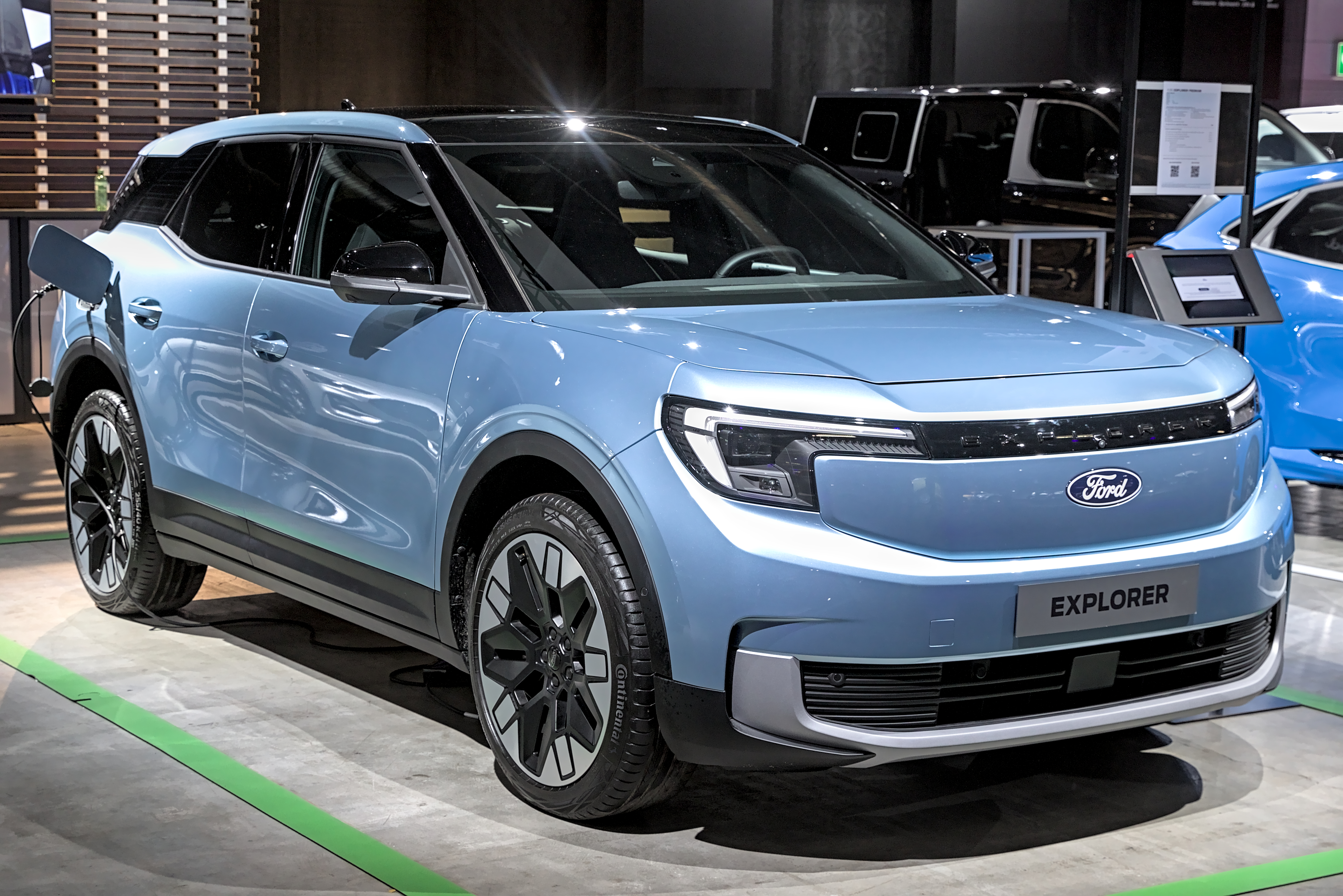
when my 2003 Ford Explorer
gave out and I picked up a used
2012 Mazda 3
as my first post-college
car. It's been incredibly
reliable with under 100,000
miles and still going great,
but it's too small for my
needs and not comfortable for
my monthly road trips to
Charlotte or Nashville.
I wanted to part ways since
2019, but then COVID
hit and the car market went
crazy.
I'm looking for something new
used or possibly a lease with
a max budget of $50,000.
I'd like a gas or hybrid that
is comfortable and spacious,
preferably with adaptive crews
and driver assistance features,
but I don't want to rave for
like my fiance drives.
I work from home and average
about 50 miles per week.
Would love to hear your thoughts
on what models might suit me best.
Love these kinds of questions
because then we get to all go
and it's like, well, if I
were buying it to this.
So let's so let's spend Jake's
money, Emily, and let's start
with you.
I'm going to save Jake some money.
So my recommendation is to
get the Hyundai Tucson hybrid.
Even a new Hyundai
Tucson hybrid
starts.
I'm looking at the hybrid SEL
trim line that starts
at thirty seven thousand nine
hundred and sixty.
Now he could go up and get
like the sportier like N
trim line of the hybrid.
If he wants that, everyone
I know that's ever owned a monster
is like, I like the sportiness.
And so like if that's still
something he wants, he could do
that. But the reason I chose
this is because one, it's in
your budget to it
comes with standard
safety and convenience features
like the ones that you mentioned.
So not only are you going to get
a B with pedestrian detection,
highway speed, a B blind spot
warning, rear cross traffic
warning, but you are also going
to get standard adaptive cruise
control plus their lane centering
assist.
We own this car, like this is
the car that my husband recently
bought.
Maybe like a year ago.
Yeah, he traded in his A3.
It was a sad day for him.
But it's great.
It has like decent enough space.
The driving is smooth.
You know, the seats are comfortable.
You can turn on that
lane centering, even
if you're not using the adaptive
cruise, but it does have adaptive
cruise. And I'm with you, Jake,
like adaptive cruise for me is a
deal worker. If it's not there at
this point, I need to have it.
Me too. And so I think
if you're going to be doing these
long drives, it would be a great
option. And also go for the
SEL because you'll get the heated
seats. Nice.
And again, if you're going
to be doing long commutes, you
should do that. Treat yourself.
I'm totally with you.
I think that is a great pick.
I've taken the last of Tucson
Hybrid on road trips, a great
cruising range, simple controls.
Come back to that simple control
thing. Yes.
Excellent, excellent pick.
Thank you. Mr. Croson, onto you.
So I'm going to go on some thin ice
here. I hope you have winter tires.
Jake said he does not want to
rap forward like his fiance has,
but he specifies as to why.
There's an issue there.
There's a story that I think one
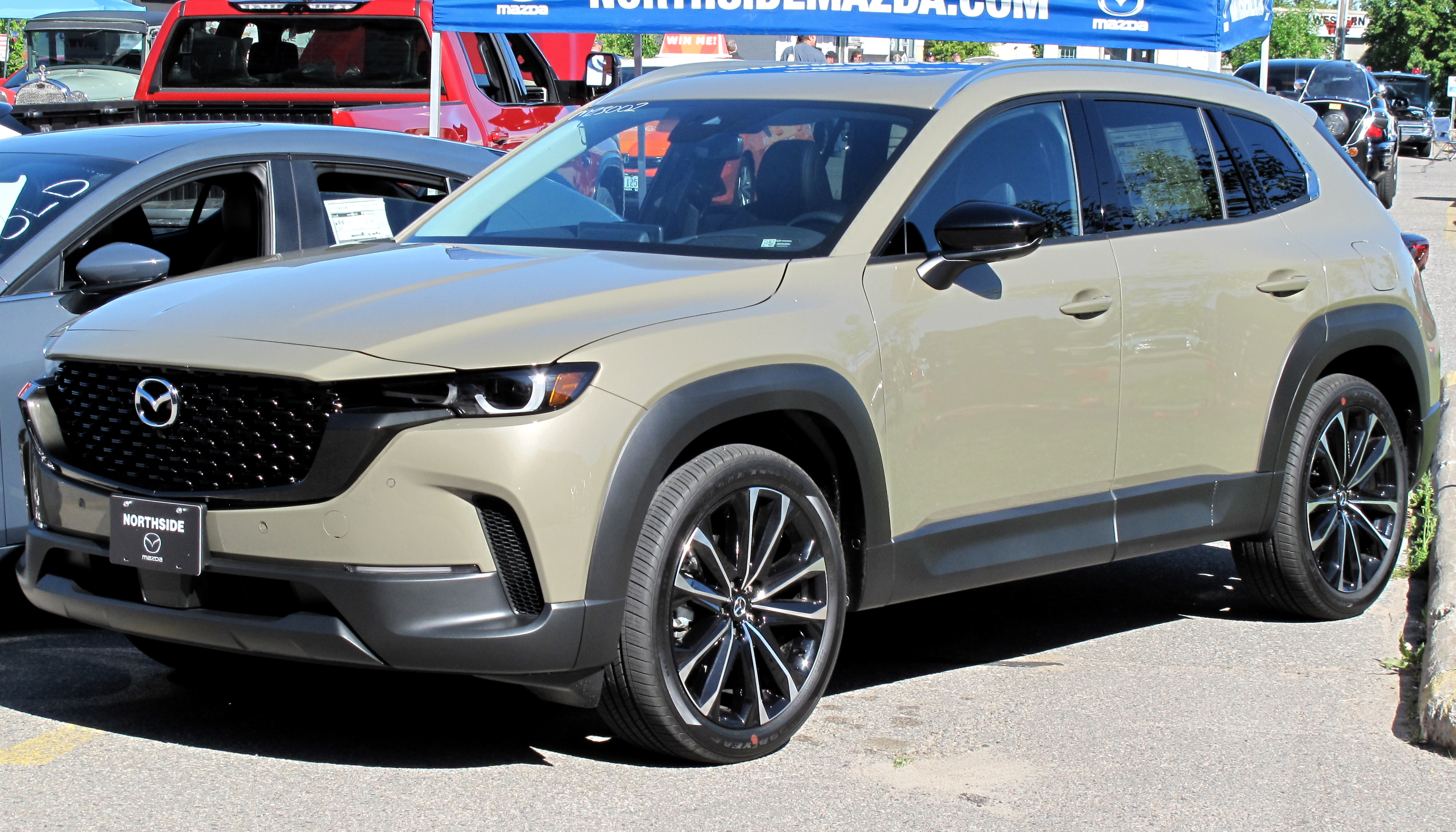
possible choice might be the Mazda
sticking with Mazda because, again,
the sportiness of people that buy
Mazdas like Mazdas.
The Mazda CX 50 Hybrid, which
is essentially a RAV4.
Don't tell him.
In a Mazda 2.
Right. It's like the.
What did you tell me?
It's a wrap.
It's like the RAV4 hybrid engine.
It's the drivetrain from Toyota.
So it's better than a lot of the
other Mazda drivetrain stuff,
especially the hybrid stuff.
But it's a little fancier.
It's definitely stylish.
It's a better style as well.
It is.
The problem with this car is
it does ride stiff,
especially if you get the bigger
wheels, which you kind of want
because it looks better that way.
And the seat is stiff.
I don't find the seat comfortable at all.
And that's a deal breaker if you're
going on road trips and stuff.
So Jake, we need to spend a little
time in this car to see if it works.
Do a decent test drive.
Yeah. But coming out of a Mazda,
it might, you know, be of the similar
flavor and feel that that it works.
Right. And you have to do the center
controller too.
That's an option.
I have another option here.
What really got me here was the
50 miles a week on average driving
that he does to work from home.
So Jake is a prime candidate
for a plug in hybrid.
I was wondering if you were going to go there.
Yeah. So there's a couple of choices there.
I would, I basically narrowed it down to
I would look at a certified pre-owned
Lexus RX plug-in hybrid.
Nice. Good. Good one.
It's a great road trip car.
You can plug it in.
He's going to be able to drive around
basically as an EV.
I used to live in Charlotte.
I know what the traffic there is like.
It's kind of like a racetrack on the highway.
You get a little power to kind of move along.
I also love the BMW X5.
I was just still looking for Mr. Croson.
There's the BMW X5 plug-in hybrid,
but you do not want to have to be
responsible for maintaining one of those.
So I would stay away from probably the German stuff.
I love our RX hybrid.
Like that was a comfortable car.
It drove really nice.
Good family. Yeah.
That was a good pick.
Yeah. I was thinking about that.
But I think I was looking like too new.
And so it was out of the price range.
And I was like, he wants to
splurge a little more.
You got to go certified pre-owned
to get under that 50 mark.
And then it might be like 51-52.
Nice. But it's close.
Yeah. That's a good one.
So what I love about this question
is the complexity of it.
Usually we just get I need a car, blah, blah, blah.
But so Jake went from a Ford Explorer,
a real trucky SUV right into a Mazda 3,
which is one of the nicer driving small cars
that's actually really engaging.
It's very sporty. I really like that car.
But then he mentioned this one word, lease.
I'm like, ha, leasing.
That's interesting.
Because the way I look at leasing cars
is there's a number of cars in our ratings
that we like to drive that do well in our testing.
But they're below average, say, in reliability.
But a lease means that the length of the lease.
You don't have a long-term ownership of it.
The length of the lease and the warranty
are about coincide.
So if anything happens, you just
bring it back to the dealer and whatever.
And so I was thinking about how his driving experience
with the Mazda 3.
And I went sedan.
I went lease a Genesis G70.
Oh, yes.
Oh, that's interesting.
An elegant interior, comfortable ride, good seats.
You guys have really good pick.
This is a good car, as I love that.
And just a really nice car to spend time in.
And I say lease because the G70 is
below average in consumer reports and reliability surveys.
So it's a little caveat.
But it's fun to drive.
Oh, yeah.
It has, again, you're getting the standard safety
equipment plus those convenience
features like the adaptive curves and length centering.
You're going to get that heated steering wheel.
I'm pretty sure.
And the heated seats.
About $46, $47,000 for an all-wheel drive four-cylinder
model.
But these are not super, super popular.
So I'm thinking you're going to be able to swing
a great deal at the Genesis dealers.
Because everyone's buying SUVs and everyone's
buying sedans, which hurts my heart.
Besides why.
Because he is looking for spaciousness.
And I mean, G70s, that's a great pick.
I love that car.
But is it going to give him more room than what he has
right now?
It's going to give him more room than a Mazda 3.
Yeah, for sure.
OK, all right.
Not as spacious as your guy's picks.
But if it's just, it sounds like he's not married.
I don't know if he has any kids.
Yeah, whatever.
Anyway, Jake, get back to us.
Let us know what you decide.
We're actually real curious if any of our picks
make sense to you at all.
That will about do it for this episode, which
was orchestrated and conducted masterfully
by super producer Dave Abrams and edited by Andrew.
I still play hockey, Belize.
And of course, Anatoly, the great Shomsky.
As always, check the show notes for more information
on the vehicles and topics that we discussed.
Just a reminder, keep your questions coming.
Send everything to cr.org slash talkingcars.
Thanks so much for tuning in.
We'll see you next time.
About this episode
The latest update on the 2026 Tesla Model Y dives into its new features, including acoustic glass for a quieter ride, enhanced interior materials, and a rear passenger touchscreen. The hosts share their experiences with the car's purchase process, which proved challenging due to Tesla's unique sales model. Driving impressions highlight the Model Y's quick acceleration and handling, though concerns arise about ride stiffness and rear visibility. The discussion also touches on Tesla's tech-heavy interface and the implications for safety and usability, making for a comprehensive look at this popular EV.
This week, we share our first impressions of the updated 2026 Tesla Model Y. A smoother ride, upgraded interior, and quieter cabin are just some of the improvements in this refreshed all-electric SUV—but it's not without quirks. We break down its performance on our test track, the challenges with Tesla's delivery process, and our concerns about the vehicle's controls and so-called "Full Self-Driving" system. We also answer your questions about roomy, comfortable gas or hybrid alternatives with modern safety features, and explain how Consumer Reports buys and tests vehicles—including whether we pay MSRP.
More info on the 2026 Tesla Model Y here: https://www.consumerreports.org/cars/tesla/model-y/2026/overview/?EXTKEY=YSOCIAL_YT
Join CR at https://CR.org/joinviaYT to access our comprehensive ratings for items you use every day. CR is a mission-driven, independent, nonprofit organization.
SHOW NOTES
-----------------------------------
00:00 - Introduction
00:36 - Overview: 2026 Tesla Model Y
02:49 - Buying Process
08:34 - Driving Dynamics
10:01 - Visibility
11:04 - Ride Comfort
12:07 - Access
15:29 - Controls
18:58 - FSD "Full Self-Driving"
25:02 - Infotainment System
27:54 - Build Quality
30:06 - Safety Features
34:17 - Final Thoughts
37:25 - Question #1: Is CR quoting the MSRP price when publishing the price paid for the vehicle?
40:03 - Question #2: what is a roomy, comfortable gas or hybrid alternative with modern safety features under 50K?
----------------------------------
First Drive: The Freshened Tesla Model Y Includes Improvements but Keeps Some Warts