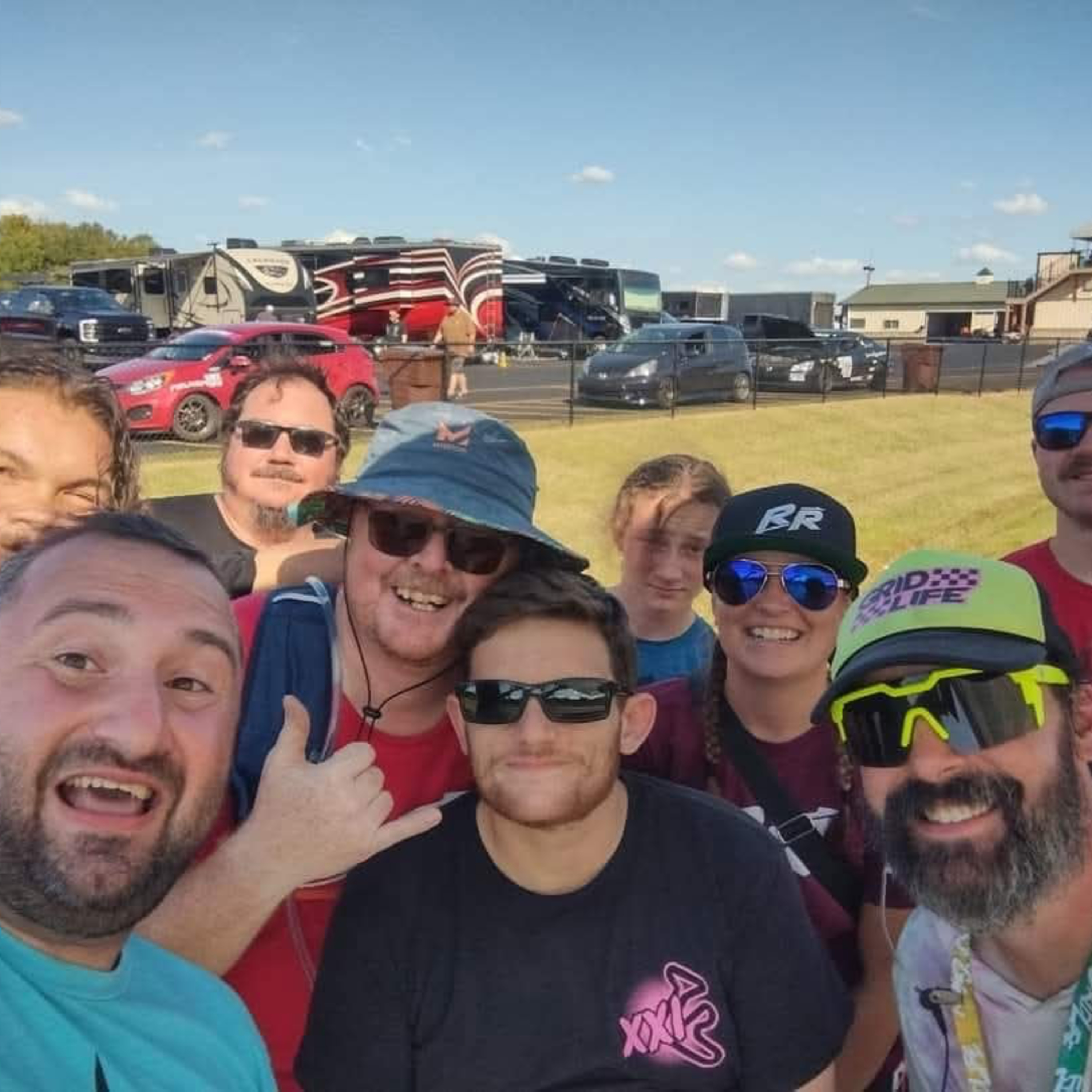
Track walking means people go look at the race track on foot before driving. They’re trying to understand where to brake, where corners start/end, and what the track looks like in real life.
Tuner culture is the world of people who modify cars—sometimes for speed, sometimes for looks, and often both. You’ll see lots of custom parts and setups.
Car show season is basically the part of the year when car events are happening a lot. People usually try to have their cars ready and looking good for those shows.
Car show culture is the world of people who show their cars at events. They care a lot about how clean and well-kept the car looks, and that same attention to detail can help you notice problems sooner.
The “paddock” is the area at a race event where teams park, prep cars, and work between sessions. It’s where you’ll see hands-on maintenance, setup changes, and the day-to-day track workflow.
A flagger is a trackside official who uses flags (and sometimes signals) to communicate conditions to drivers—like cautions, incidents, or track status. The host highlights that this was their first exposure to racing.
A burnout is when the driver makes the tires spin to create smoke and heat. People sometimes do it to show off, but it usually wears out tires quickly.
Drifting is when a driver makes the car slide sideways on purpose while still trying to steer through the turn. It looks cool, but it’s risky—especially outside a closed track.
They’re saying social media changed car meet culture. Instead of just enjoying cars, people start doing things to get attention online, which can make events feel less genuine.
They mention a Toyota Camry being involved in a crash. A Camry is a very common everyday car, so it’s a relatable example of how accidents can happen even outside of racing.
“Cars and coffee” is a meet-up where people bring their cars and hang out, usually in a parking lot. The point here is that it can get less exciting over time if it turns into more of a spectacle than a car community.
A “project car” is a car someone is working on as a hobby—fixing it up or upgrading it over time. They’re saying they didn’t really have one growing up.
The Lamborghini Aventador is a very expensive, high-performance supercar. The point here is that some people buy cars like this mainly to show off, not because they truly love cars.
Low riders are cars that are customized to sit very low and look flashy. People in that scene often spend a lot of money making them unique and show-ready.
The Kia Sedona is a minivan known for practicality and comfort rather than performance. The speaker uses it to make a point: an enjoyable trip can come from the experience and route planning, not just from having a sporty car.
“Caged it” means adding a metal safety frame inside the car. It helps protect the driver in a crash and gives a safer mounting point for racing seat belts.
When there’s an accident or debris, a safety car may come out to slow everyone down. That gives officials time to fix the track without cars racing at full speed.
A networking event is when people get together to meet and connect. Here, they’re describing a car show that’s meant to feel social and friendly, not just formal.
LIVE
Hi, I'm Scott and I'm Seth and I'm Chris and we are track walking tonight's we have
a gentleman. You've seen him in the grid life grid. You've seen him around the
paddock. I'll say used to do a podcast. You still have a podcast. I know you don't
do many episodes anymore, but you're deep into the car culture and that whole whole
genre of things. It's Chris Francione.
How you doing? Good. How are you, Chris? I've been good. Well, I've been I've been
best of my abilities, but I've been enjoying the time that I've had the last six months
in winter and I'm ready for car shows. He's and I'm ready for track season. Yeah, so
bad. Yeah, I was gonna say before we started the show, we made you stop talking because
you you just said you went to like the the kickoff car show of the Chicago area of the
year. Yes. So there's two shows that happen in the beginning of the year because as we
in the Midwest have to deal with winter, we have our winter builds, right? Everyone is
eager to show off their stuff. So for the media, the Chicago auto show happens in February,
usually the first second week. And the media present guys sort of get their kind of get
their itch. And then the car show people have their kickoff game of the season is a show
called World of Wheels and Tuner Galleria. And World of Wheels is basically muscle cars
and low riders and stuff like that. And then upstairs is Tuner Galleria, which happens
only on Saturday for the last 17 years. And it's all tuner culture. So everything from
twin terminal Lambos to mostly Hondas and, you know, JDM stuff. So
dang, I guess I'm most impressed and surprised that people have their cars done that early
in the season in the Midwest because in race car land, people are like just waking up from
hibernation right about now. Yeah. I definitely noticed there's a difference in that trend
because like car show people, they immediately then winter time, that's what they're doing
nonstop. And then for you guys, because of how intense the season is, you decompress and you
go on vacation and you try to reset to get ready for the what I call consider an Ironman challenge
for six months, doing track stuff and working on cars and breaking stuff and trying not to hit
your head up against the, you know, core support. Well, car show season, like, aren't you supposed
to have your car done and show worthy and then just like show it? I mean, don't get me wrong. It
seems like car show season should be like a pretty chill thing of just like going to places, but
you shouldn't have to be working on your car during season, right? I don't know that much about
car shows. You're gonna tell me. Uh, the car shows are, I mean, from my experience, I don't have that
firsthand experience of what I've seen. People put on modifications, but they usually wait until
the winter time because they're not doing anything and they spend all that, that free time working
on their car, right? Um, but I'm not going to lie. When taxis and rolls around, they still,
you know, go into those first couple of cars events, they're, they're putting money like we are in
their car. Probably after this, we can get into like what, what got you into the car show scene
and your involvement with it and stuff, but before we get there, like I assume not all,
but some car shows have like awards. It's a competition. Is that right? Yeah. Yeah. So
there is a competition aspect on people bringing some type of personality or uniqueness to their
vehicles, right? At least from what I've seen. I'm not, again, I haven't never participated on this
level and we'll get into that later. Um, but the, um, there is like a form of competitiveness that I
see that people really want to show what they can create and show their personality and their
reflection of themselves and their vehicles and show it to everybody else. And it gets competitive.
I've seen so many people talk shit like people do in the paddock occasionally and other organizations,
um, or wherever it may be, right? And like that guy does this and that with this car and I do
this and this with my car and I think I'm better or I think this way and I think it's better. And
it goes both ways in the car show world and the car world. It's kind of weird or track world and
the car show world. So it's kind of weird. Yeah. So we've got the, yeah, like you said,
the whole notion of showing what this person can do or showing, you know, their own style or,
you know, expression, stuff like that. And I guess like for me, where it would be difficult,
because I think a lot of the reasons why people in race cars are working on their cars is because
a lot of that's based on a pretty level surface like in a box. Here are your rules.
Fastest time wins. Like it's a very objective, blatant, brutal measuring system
where in car shows, it feels a lot more subjective where, you know, we might be doing
cleanliness or like, I know there are different categories of shows and stuff like that. So it's
like I, it seems like it would be the competition that would cause these, these owners to like
really keep developing their cars throughout the year. But if it's more individualized like that,
yeah, like you said, it seems like it would just be like, here's the current revision.
And I'm just going to keep it the way it is through this season and then update it
this next season. Like there's not as much urgency is what I'm thinking anyway.
Okay. So the best way I can describe it is it's, it's an art, right? It's an apple versus an orange,
but we're still talking fruit. It's a common saying I use all the time in my day job.
The, it's an art form, but you have to compare it to a person
using art as like car shows is like painting on a canvas and you're reflecting your personality.
You can tell a lot of person, a person about their personality and their vehicle. You can tell
a lot about them with what kind of shoes they were. The canvas, right? They're the Bob Ross,
they're taking their time painting happy little trees. And but in the track world,
it's really competitive. While it is an art form and dancing, it's like figure skating,
you're dancing on ice and you're dealing with judges that are, that are judging you on performance
more than that subjective judgment and judgment style that you mentioned before,
that's more personality based. So if that makes sense, again, apple and an orange, but still kind
of fruit. Does that a good answer? Yeah. Whenever, whenever I really think, I've known a couple
people who have done like car shows year after year and it seems exhausting because you always,
but you can't just show up with the same car for four years in a row. I mean, it's the same car,
but it has to be evolving and that sounds exhausting. Like knowing you have to build
something that you really like and then knowing that you have to change it. Sounds horrifying.
Sounds like I've been watching you guys do in the past for the last four or five years.
That's about to say kind of sounds like race cars. I don't know what you're talking about.
Yeah. Well, I mean, I guess that's the thing, race cars sound terrible too. So yeah.
It is an evolvement, right? Like you are evolving. The best way I can describe it for car show people
is I think it's more of a personal battle of evolving oneself. And it's an adaption of
change of learning how to work on your vehicle and better yourself, kind of like how Scott takes
it and consideration of how you do something is how you do everything in the track world,
if that makes sense. You have to keep evolving in the track world,
but it really depends on how you're evolving. Is it a personal battle? Is it an engineering battle?
Like for your skillset, like the learning kind of wrench on the car and being more efficient there.
I mean, for example, to bring up car show culture, I remember Eric Cattil talking about in your
podcast specifically of keeping your car really clean and being able to find leaks faster.
So it's, I think it just depends on what you're going for and a personal battle. But again,
like I said, Apple and an orange, we're still talking fruit. Good answer. So where did you
come from, Chris? We need to get it, like we need to step back. We're doing car show stuff.
We know you've been around the track paddock forever. Where did it? Why? Where did you come
from? Where did, how did this happen to you? I just came out of a hobbit hole one day and
I found a saw a car and I was like, that's my thing. I grew up in Chicago. Southwest suburb
is in a town called Timley Park. I grew up born in 96. Sure, you guys were getting out of high
school then. Seth, I think maybe. I was, no, I was well into college then. Oh, okay. So yeah, so
you know, I'm a young kid compared to everyone else in the paddock to everyone's, you know,
who was this podcast to see me. But I got into cars when I was five. My dad was a dealer in
the dealership world. He'd always come home with demos and dealership all different kinds.
I've lost so many counts from man carries when that was around here in Chicago. He's worked
for Kingdom Chevrolet. He's working for a small independent. We've had our own lot. He's been
a lifer. So he's been all over. I mean, I currently work for Mannheim right now. So that tells me an
idea of like, it's, Apple doesn't fall far from the tree. So just cars. Yeah, he's a poker guy.
That's his hobby, but I'm a car person. That's what I like. But I remember actually just telling
the story to my therapist the other day. And I was telling him we were in a tornado. We're gonna,
we're in a tornado or like a crazy burst. And I was freaking out about my matchbox cars at like
five or six years old. My mom got so fed up with me crying about them that she went outside and
formed this storm risked her life to go get my matchbox cars. And she did it. So I mean,
I was obsessed since I was like five, but I played like Need for Speed and was playing video games.
So that's where that show car culture came from. But eventually, to give you kind of like the
fast forward after high school and go into car meets, go to car shows for years. I was working
at my dad's dealership. And dad, I'm fearless in this. I'm sorry. I was young. I was stupid. I
didn't like working with my dad as much as I originally thought when I first started there
because I was a little bit of a rebel and I wanted a job doing something cool. And I saw Savannah
Allen, she was a flagger at the Autobahn Country Club. And I went to go explore what the job
market was like in the racing world. And I loved it for six months. It was great. It was great
working there. And here's the thing though, right? I had zero racing experience prior to me
working at the country club. So like that was my first introduction to racing was working as a
flagger in the frontline. So how did you come across Savannah?
I don't know if I want to answer that question, but she's probably going to critique me later.
I thought she was over because she was a car girl and I was an idiot back then and not mature
enough. I friendered her on Facebook because I was like, Oh my God, she's in the car or she's a
girl. And everyone don't care who says that you've done at least one to be listened to podcast.
So I remember watching her post a video of this guy named Antoine who is a Canadian
stockbroker, I think I remember at the time and he would just drift cars around the track and he
was drifting a brand new Hellcat in the rain with her. They do every year an employee appreciation
day where the members have to go in the flag stands and the flag the flagger stations and
they will actually give ride-alongs to all the staff members. So that was the employee
appreciation day. And it was so cool looking at what she was doing and the video that she was taking.
I asked her and messenger like, what is this? And she's like, Oh, it's my job. I work at the
country club and it's racing. Quick Google search and I applied immediately. So
what, what kind of car shows were you going? Like, how did you find your way into like the car
meat culture? What, what years were this? How old were you? I was in high school. So I started off
doing auto shop. I missed it the first year you would take advanced auto shop. You're sucking
your high school and how my high school worked. So I took the first year of high school and my
senior year, if that makes sense, or sorry, first year of auto shop in my senior year.
And all my friends were in the second year and they started talking about like people going to
cruise nights and car shows and I'm like, what's that? And when I was 18, my friend at the time,
Pat and I took his dad's a Michigan B.C. Eclipse in 2014. Yeah, I graduated in 2014.
And we went to what was called like steak and shake. It was a local car meat spot.
And we went there and I was shocked, this community of people that were all hanging out.
This is right before social media started ruining everything. I swear to God, this was like
peak and everything was great. And if someone did a burnout, it was just like the, this was
the very end of like forums working for this sort of thing, right? Yep. Yeah, that's about right.
Uh, this is, uh, this is the popular time when lower whacker, if you know when I'm talking
about Chicago, the lower whacker to explain to you guys is like this underground tunnel system.
Yeah, the underground tunnel system, there is a side area that you can hang off right up on the
river with all the homeless people and people would go down there and go drift. They'll go
race, they'll go drag race. And it was just a bunch of kids, honestly, just doing stupid,
stupid. Yeah, I can swear on this, right? Yeah. Okay. You stupid shit. I mean, really stupid
shit. I mean, all state would not do the jingle, you know, or state farms. They would just laugh.
So, um, we went down there and, um, it was so fast and furious ask. I realized I was in the
city of Chicago at 11 o'clock in the night and I didn't call my mother where I was at.
I was at a party or something earlier that night. So I disappeared for six hours and she
calls me and she was 11 o'clock at night. Where are you? And I'm still young. I'm still her baby.
And I'm totally where I was and she flipped. And her boyfriend at the time calmed her down. He's
like, we did the same thing with her kids. We go down Lakeshore Drive in the city and go enjoy
ourselves. So fast forward. I kept going down there for about a month or two and we almost
got arrested. And I was like, I'm never doing this again. We had a, we had a, in lower whacker,
there's these two pillars and it's a big area next to these like big garage doors and people
go drifting. So the local, uh, track rat drifters would go out there and drift around in tandem
around these poles and there's just them doing donuts and like, you know, stock K two forties
and my buddy decides to be a show off and he's really attention eating. He goes up to the like
right next to him and is watching him and he's recording with his phone and out of nowhere,
a Chicago PD car goes flying around the corner and he's going after the drift cars and
it was one of those moments where you could see the cop look right and then looks back at us left,
looks right and then goes, wait a minute, what the, and he's like, I'm going after them. And we
basically peeled out around him, you know, top, basically jumped the gun, hit him slam on his
brakes and we took off. Probably one of those stupidest things I ever did in my life and I'm
no control of the situation. And I remember we were booking it down. I have 57, I have 57
and I 94 just to get home because we were scared. And I told Pat, I was like, I'm never going back
down there again. And a couple months later during that season, there was someone that died.
Car got flipped over, set on fire because it almost hit a crowd of people. They were,
they rioted. So a lower whacker immediately like that was a shit show, more than it already was,
you know. And I still had the bug though, right? You go to that first car experience,
you're like, I gotta go see what this is. So I started going to cruise nights, started off
going to cruise nights, started going to cars and coffee, started progressing into
like classic car events. And then eventually when I was working up the track in between this
this transition, found you guys, accurate life. Yeah, that, that's an interesting progression
because until you get to the track events, the, those events keep getting more and more stationary,
like less action oriented and more, let's hang around some cars, pinkies out with some
some nice coffees and stuff like that. So I know what you mean. I know what you mean.
But you have to look at it in a more deeper perspective. It's still a community aspect,
just like red life, just like autocross, just like going to car meets.
I get that, but it's still a trajectory. Why, what, what was, was that just like,
after the, the fire and the, the running from the police and stuff like that just
seemed like a better way to go for a bit?
It was a more mature crowd. I'm on, I'm an old soul. I'm 20, I'm 30 now, excuse me. Ha,
what's my edgy gun? The, the maturity was really nice and I love hearing stories. I love
hearing stories. I always loved hearing stories in the paddock. I always love hearing stories in
the car show world. I was talking to a bunch of older guys that were doing street racing in Chicago
and back when it was way easier and there was no cameras around, you know, and it was fun. And
this is when the Hemi and Dodge market was hot and people were just checking vins at car shows and
stupid stuff like that. So that's when I ended up just kind of transitioning, but it did eventually
start getting stale, you know, seeing the same stuff over and over again. I mean, I remember
when I first started getting into cars, I went to a car show called Supercar Saturday and over
the course of two years, it turned to regular car Saturday. Supercar Saturday for Chicago was
like this massive event they did in the Virtue suburbs and you would see everything from a
Dodge Daytona to a Lamborghini Aventador to, you know, some random guy brings, you know, some type
of radical, you know, and just brings off the trailer. And eventually it just started getting
old because everyone wanted to be a part of the event and they would get there as early as possible
and eventually it was just BMWs and Audi's and there wasn't anything special anymore. And it seemed
like you're going to anything and it was just starting to get ruined by people. This is when
social media started taking over the attention span of people, you know, sitting at the end of
cars, like the parking lot, watching people leave, people showing off, crashing into cars.
I actually knew someone that actually was, he went viral when his car crashed into a Camry
leaving out cars and coffee. And I remember watching, he was a good friend of mine at the time
and I remember watching the hell he went through. He literally had to go ghost, dark, social media,
everything until the court case was over. And even after that, he still, still hears about it today.
Yeah, it's an interesting point about cars and coffee kind of getting stale because, you know,
you do have different cars, but, you know, people are developing as drivers,
people are developing their cars in the car show community, you know, even if it's on a slightly
longer time scale. Like we said, you know, people are developing their cars and their trucks and
doing new paint jobs and new mods, stuff like that. But the cars and coffee crowd generally,
I guess it would depend on your locale, but generally, yeah, there are a lot more stock cars
with a few kind of exotics, but it's the exotics that kind of bring out the crowd.
Otherwise, it's just a bunch of people hanging around, maybe some cool cars, but like,
you know, you see that on your way to the grocery or something like that.
You want to see something special. And I think the problem with that is, and over time is,
when I got older, and I think this is the real reason as they stopped going to car shows,
it turned into less relatable. And that's how I think I got hooked on motor sports and the
grassroots level. I'll be honest with you, I don't care about MSA, I don't care about F1,
I care about grassroots because it's relatable. I'm a poor boy, dude, I grew up poor.
I didn't have a lot of money. I never had a car, like a project car. I think, I know,
I had a project car for a month. So long story, different time. But it's going to those car shows
eventually, as you get older, you start realizing people are showing up with a car payment, trying
to show off whether it's Lamborghini or Aventador, it's still a car payment, you know, or a lease,
or something, right? It just gets tired and stale, you know, it's not,
it's not passionate car people, it's just people that bought a car. That makes sense.
And they just want to show off, kind of like you have a watch enthusiast and then a guy that just
bought a Rolex. You know, when you talk to the guy that's talking about Seiko's and like Rolexes
or whatever the watch brand is, and not really a watch guy, but I've heard a lot of conversation
about it, you'll start to realize you have a watch enthusiast, you have a watch guy.
There's a car guy, I think a car enthusiast. That makes sense. So,
I don't know if you guys agree with that. It's, yeah, it's a different world. There's, it's,
I've known some people who, so I was in the Porsche community for a while.
And the Porsche community is, as that really took off, whatever, it was eight or 10 years ago,
or even earlier than that, when the prices, especially the air-cooled cars, just went stratospheric.
People would just buy an air-cooled 911 and then have it. That's it. And that was their street cred,
was they decided to buy a 911. And that was odd to me. Like I didn't, I'd never really got,
I mean, as someone who has bought a 911 and then, you know, autocrossed it 10 times and then put
it on a lift for seven years, I'm probably not the guy to throw shade about that. But,
um, yeah, it's, it's different. I get where you're coming from.
I feel like it's a person that buys their personality that makes the car,
like they buy the car to make it their personality, then the person
making the car their personality, if that makes sense. That's, I think, the difference between,
like, people that customize cars and people that just buy them. So, if you go to cars and coffee
versus, like, World of Wheels or the car show, I was telling you guys the Super Bowl one,
it's a lot more of a different crowd because I feel like the passion, you know, is very divided.
So. Okay. So that's, that's where I like you. Before we talk about the show,
you talked about GMT 800s on, on dubs coming back into style. Yeah. Dubs and spinners.
Like, nobody accidentally ends up with a GMT 800 on spinners. Like, that's a thing that they do
on purpose because that's, like, they want to throw that out there at the world.
Yeah. And I find that very interesting. I mean, you kind of look like low rider culture.
You know, I wish I had Andrew here right now because he built low riders, but it's, it's,
for them, it's like a family mural and it's a reflection of their personality and their heritage
and their, their, their whole universe, right? Right. Dub culture, I feel like is,
I know, I don't know if I'm saying this correctly. So do please apologize and I'm not trying to be
politically wrong here, but I think it's like hood, hood culture is like, you spend a lot of money
and things that you care about. And I think car culture is popular, but it was huge rap culture
back in the time, right? When Atlanta was, you had people like ludicrous and you had people like
big timer and I'm sorry, I'm listed off names, I shouldn't name, but I'm looking back at history
now of rap culture, you know, back in the 2000s, that's how you showed off. You bought these nice
cars to the point where it got so popular in pop culture. They made a video game about it called
Midnight Club Dub Edition. They took the dub magazine and they were able to label it on a
video game and the whole soundtrack is the dirty south of rap music and pit bull and, you know,
most of these big names and you're racing SUVs and color paint jobs and big rims and spinners and
it's just an arcade game to have fun, but it was such a pop culture phenomenon that eventually,
fast forward now, we're bringing it back to people that are in their 40s and 30s and have money and
they want to relive that, you know, when they saw their play, played with them in their kit.
Kind of like the collector car market with pondas right now.
I've been in Houston for the last 25 years and the slab culture and
swangas and like Houston is sort of like the far west of the south as far as car culture goes,
but we've got it's a very unique place to live and I love, I love driving down the road and seeing
somebody, you know, in an old Buick with swangas that are sticking whatever 18 inches out each
side and like that dude is not, is doing nothing accidentally. He 100% woke up this morning and
went, I am going to show the world who I am and he is. Yeah, it's amazing. You're a lot and proud.
Yeah, you're, you're showing the world. This is my personality. This is me and I love that.
I remember talking to Andrew. So those who, we joke that he's my hetero life mate, but we're
just best friends and everyone always makes an assumption that we're dating. We're not.
It's a running joke with us, but we, we're literally like buddies when it came to doing car
stuff. I got him into grid life. He got me into low riders more. He started telling me how they
build low riders and they're extensive, right? And some guys will spend $10,000. Some guys will
spend $100,000 to engraving the frame to reinforcing it, plating it with chrome. Now imagine just
fast forward $100,000 low rider car. You imagine someone not like taking this thing out anywhere,
right? They're going to be trailering it and they're going to polish it with a diaper.
Nope. Andrew has video of people swinging on three wheels, you know, back and forth on
Lakeshore Drive, missing potholes, hitting switches, you know, just having a good time and
these guys are just a lot and proud with these cars they spent well over, you know,
$100,000 in a lifetime on because it's them showing off themselves and it's great. It's awesome.
I'm not remembering the name of the show, but there was, I swear it was on Netflix
and I don't remember who hosted it. It wasn't like a well done show, but what was interesting
about it is every episode they would go to a different place in the United States and they would
get together, like they would explore and then get together two different groups of car or motorsport
people and then basically like give them each a taste of the others culture and then like just
kind of leave it at that. And I remember that there were, were they called swangers when they
have the, like the, the wire wheels, but like right well out from the actual tire. And then there
was this group of guys who rode super lifted ATVs with like 26 inch wheels on them and but they do,
they would go like through water and like they would like still do thing ATV things with them.
And just like the, the diverse niche car cultures out there is really wild.
So go find that show.
No, I love the world. I love the, I, we make our own world too small sometime by,
by focusing on the things that are important to us.
The world's big and exciting and I love talking about this stuff because I don't,
I don't get to see it as often as I'd like. So this is, this conversation is fascinating to me.
I love it. It's a refresher.
What's that?
You consider a refresher?
Can you hear me?
Refresher, he said.
Oh, okay. Yeah. No, this is like, yeah, this is, this is all good. We should.
Yeah. Sorry. I have a, I have an audio leg sometime.
Um, so my next question for you was going to be what you've been around all these cars
for a long time. What have you been driving in this?
In, in this decade, in this, this 15 years that you've been immersed in
car culture, like what's been your part in it other than an observer and things like that?
So I've never really had in a car. I've had a daily driver. I currently own a 2009 Honda Odyssey
EXL. It is a car that I bought originally during right for the COVID market, exploded
like three or four months and I couldn't get rid of this car because I couldn't find anything else.
I couldn't find anything else. Um, the biggest issue that I had with, uh, before then was I had
two cars. I had a 2015 Hyundai Lancer GT that I had for two months. I love that car so much.
I like those cars a lot.
I liked them a lot more when I, when I met, um, Bob Miller.
Yeah, Bob loves those cars. I like those cars, but Bob loves them.
I really liked it. It was a peppy car. So I live, I lived at the time, uh, if you live in Illinois
or Chicago and you've heard of a place called Starbrock, which is like the closest like twisty
elevation road you can go on. It's huge for bikes and motorcycles and it's either you go an hour
east of Chicago to go to Starbrock or you're going an hour and maybe 20 minutes and some
change like up north to Wisconsin enjoying like back roads. For me, that was my backyard going
to college. So, um, I was, uh, in community college at the time and I would go basically drive this
car around and then I would also go work at Autobahn. So I was working at Autobahn at the time
and I was late for a race. I was late for a radical race that we're doing for members and I ended
going on a side road and I'm gotten to a rack at 45, 40 miles an hour to the point where the
Pontiac Grand Prix that I hit in 2006, 2007 Grand Prix did a 360 or 720. Um, and
car was both totaled. I had the car for two months and then I owned a 2005 Hyundai Sonata
that I loved because I didn't care. It was a, it was slow car fast. It was, it was an automatic
slow car fast and trying to drive that through Starbrock with the Bodie suspension was the
most hilarious thing to do while listening to Eurobeat and I'm, I'm proud to say that. I don't
care. I don't let anyone judge me for what I, what I own because it's like I still experience, um,
this is a term that I just heard. I was healing behind the steering wheel.
He held behind the wheel. Okay. So I will say one of the most enjoyable driving experiences I've
ever had was in a, what was the Kia minivan that they made, whatever, eight or 10 years ago?
Sedona. Yeah. So I was in Kia Sedona. Kia Sedona with my entire family in Puerto Rico, a rental Sedona
and we drove all around the island of Puerto Rico and I would look at the map and it would be like,
we're taking this road to get there. And I had the best time driving the shittiest minivan
all over Puerto Rico. So you're right. It's, it's very independent of the car. Um, I think
I took the Odyssey up till Lime Rock Park. The first year grid life went there with Matt,
Matt Crow, DJ Rob, Rebecca Cone, and on the way back, we ended up, I fall asleep and I woke up
and we were in a back road somewhere in Pennsylvania and he was whipping this thing because from the
mountain down in the back. And I got to say it was actually kind of fun to see someone drive my car
with good experience. Uh, don't be wrong, man. We did it with Honda Fits. I really think there
needs to be a minivan series. Well, we did, we did have that one. It was, that one was,
that one was too good though. That was so good. It was team HMA. Yeah. Yeah. Yeah. They're actually
the ones that inspired me to go want to track my car. Um, I wanted to track that car so bad,
but I just couldn't come to terms with it because of my financial stability and health issues. At
the time I could not justify going to do a track day on my own, my only car. And I'm glad I didn't
because there was a lot of problems down the line that I found that I was like, okay, maybe
this is a good idea. I didn't do this. Well, it was wild as I think that was being an adult,
irresponsible. What's wild is I think that that particular minivan was probably the most tame
of the road course minivans that we've come across
because the previous generation Odyssey that they had, they had turboed
and the Toyota Sienna that they had, I forget what they had done, but it made a lot more power.
Oh, the factory Toyota one that they brought on one lap. Yeah, that, that was a wild car.
So I had a bunch of custom stuff on it. It's kind of funny that the one that like went racing and
GLTC like pretty stock block. It just had like safety, suspension and big brakes.
That was about it. Yeah. So I've actually followed the team HMA guys for a while and
they're not for a while since they showed up the paddocks and I've looked at their old videos
of one lap America with Brock and all them. And yeah, they've had some crazy cars in the
craziest one I saw was they had a 2007 or 2008 Odyssey. They turbocharged it. They caged it.
They stripped out the interior. They did an Acura 6 speed Acura type S or Acura TL type S 6 speed,
which has a limited slip differential in it. Tires, brakes, like everything and they trailer that.
And I think they did pretty good, but you're going fast forward to out of the box. They took,
you know, a car with paddle shifters and did what they needed to do for regulation and tires and
grip and brakes and they were done. So the fun, the best story I have about that Odyssey is the
first year they brought it on one lap. It still had the, it was, it was a pretty fancy Odyssey when
they got it from the factory. It still had the built in vacuum. You can check out the car and it
still was there and still worked the first year that they did one lap. They sucked out their car
with the built in vacuum. My favorite memory with that van was I remember a team HMA showed up
and they were at GLTCs Midwest fast and it was such a hot and greasy track weekend and
everyone's slipping and sliding. We're not having a good time. I'm up in the paddock tower and we're
watching, uh, Rudd's Racings S10, days of Thunder S10 battle out with the Odyssey for last, the last
place or who was going to get second to last. And it was awesome watching everybody in the tower,
watching them battle it back and forth and switch positions every half a lap. We were screaming in
that tower for the people in the pack of the pack than the people in the front of the pack. It was,
it was pretty cool to watch that car race and actually push it.
Don't knock until you try guys. It's funny. It's fun.
So from, from working as a flagger at Autobahn, that's how you found your way into grid life?
Yeah. We worked, uh, I worked a Sunday. It was, we nicknamed that, that, uh, that, that,
that weekend got memed on Facebook that it was the eighth or ninth layer of hell. It was so hot,
so hot. I had Ken Cain at the time. He was my first impact at Autobahn Country Club.
He was coming into five, going into five, goes off, pulls a Jackie Ding because Jackie Ding at
the time was driving the S 2000. I think it was still super charged and he was pushing it all
the time like he usually does. Problem was he didn't save it like Jackie Ding. The M2 basically spun
and went and it just clipped the front bumper just enough where it ripped up the radiator cooler
and the car had to get flat bedded out. But he was a scary corner. It was almost a scary time.
And, uh, I think he worked for an insurance company at the time and, uh, he made some jokes
that was really funny and I was like, oh, cool. Um, you're like the first person in my corner
station since I started working here. Nice to meet you. Talked about grid life a little bit
and then later in the day, an instructor shows up and this is back when the one lap,
or no, the chop top limo was picking people up. So picking and dropping people off. And I
talked to an instructor and I fell in love with it. Uh, it was pretty cool. And I started watching
videos of Matt Farah doing track racing and I was like, oh, these guys are kind of serious.
And when I was watching you guys, um, how do I describe it? You had guys in radicals
and spectators that were getting outpaced by people. And like, I saw, I can't think of his name.
Um, Pugsley, Pugsley, uh, not Pugsley, uh, Pulsie. Uh, he has a 900 horsepower Evo time
attack car. Yeah. Yeah. I saw that car go faster than radicals. And I was like, okay.
I think I'm, I think I'm going to go to one of these guys events next year. And then I saw,
as I saw the festival videos and I was like, I'm definitely going to one of these events next year.
And I did. And then the funny thing was, is the first event I went to,
I, I actually never went into festival grounds and I left at 10 o'clock to go back to my hotel
to go to bed. I only cared about the racing. It was awesome. I was going to ask if it lived up
your expectations. Oh yeah. And I only did half the stuff. I came into the VIP day and I thought
it was really cool. The only problem I had, and I'm not going to mention his name, is I had a big
guy that was, uh, on YouTube a lot and stuff like that. That was really rude to me, but I think
that was the only bad altercation I had with anybody that weekend. And I didn't care. You know,
it's just how he is. I, I have, uh, I saw everyone else and I was so happy. Everyone was just
super nice to be there and just joyful and I love the vibes and I was hooked and everyone went back
after 2019's tropical girl life. And yes, I was on top of that hill and that blew through.
It was scary. Um, I never looked back. I went to all the events I can go to, um, message Adam
immediately because prior to me coming to the event, I realized I could volunteer and I was like,
I'm just going to come to your event and I'm going to see what it's like. And if I like it,
I'll come to your next event. And I was at, ironically, the next event after Midwest Fest was
Audubon Country Club and I quit at the time. I was no longer working there. So all my fellow
employees were driving by and the bus looking at me and I'm in pit lane. So I was going to ask,
I was going to ask you about moving on from Audubon. Uh, what was the, the impetus for,
for not like you founded this place, which was awesome. And then did it stop being awesome or
did you just need to move yourself onto something else? Don't make your hobby your job. I'm just
going to say that. So I've, uh, I made a, I made a hobby my job and, uh, I didn't enjoy it as much
as I did and, uh, pay wasn't really great at the time. It was just how minimum wage was.
It was a still a minimum wage job. You know, it's really good for people that are retired,
but, uh, for a kid that was in college, I needed to make a little bit more to cover
book costs and stuff. And, um, I was also living an hour away. That was the biggest
factor. Everyone else I was talking to, uh, to give you a reason how dedicated I was to this
hobby and that job. I lived in Ottawa at the time and I would drive an hour each way to work. So I
wake up at 545 in the morning and I would literally throw my clothes on, jump, drive an hour and be
at work for 715, be there until about 515 and then drive back and be home, eat dinner, shower,
in bed by pretty much eight o'clock and repeat. So I had barely had like an hour or two to myself.
I love that job for the four or five months I was working it.
Yeah, that sounds like that would get old because that's every week. I mean,
it's just about every weekend when they're running, right?
Every weekend's basically your, your, your Monday, Tuesday, Wednesday, as I would call it.
Um, your busy beginning of the days of the week and then your rest of the week is kind of people
coming out doing HGs when they have the time or scrubbing tires and that was the problem.
It was really fun to work on the weekends, but it wasn't really as much fun to work on the weekdays
and it dragged on, it dragged on a lot. Because you're just sitting out at a flag station.
You have to be there for insurance requirements, even if it's a guy scrubbing his me out of tires,
getting ready to respect me out of the following weekend and he's out there for
three hours because no one else wants to come on track because it's rainy and I'm stuck in the
rain sitting under umbrella, you know, watching him go by and go by and go by and that's the
definition of insanity. Yeah, you can't really be on your phone scrolling, I suppose, if you're
manning a flag station. You definitely cannot be on your phone when you have cameras as good
as they do on that track. So you get a, you get a, you get a really nice safety car that comes out,
picks you up and you're gone and I don't blame them, you know, because I think the biggest thing
I took away from that job and I think Gritter and I think Niedu, Kyle for this is um, you really,
really try to take people's safety and consideration because you never know
the risks of danger until it happens. I've seen cars go into corner stations. I've seen
what Port-A-Potty get knocked over once and it was an EVO at a Subaru event, actually. Yeah,
it happened at five, it happened at corner five. I saw my coworkers almost get hit by a car.
It's scary, you know, I think once working grid life, it got even more scary because
you're all my friends. I remember Ben, I think Ben had his car catch on fire because his K-24,
the oil filter backed out, exploded, oil all over the headers, immediate fire and I remember
running out of that tower in a panic. I didn't even remember what I was doing, but like
it's uh, something I take really in consideration when I'm working with you guys,
really do because you're all my friends at the end of the day and I think that's one
of the greatest things I took away from Autobahn Country Club. But again, it's,
it's not really something that I want to make my job. I want to make my hobby.
So you've given us some insight about flaggers. Give us some insight about working pit lane.
What's uh, what's that job like? What's, what was your experience like?
I don't know where to start. Here's a question for you. What do you think about flaggers?
They're not flaggers pit lane officials. Well, when you're, you're in the car, right? And you're
the driver and you're going through your mindset, preparing to go on track and you see me or you're
coming off track after an incident and you see me or I'm coming to talk to you and I've done that
occasionally and you're just in the zone. What do you, what do you guys think of pit lane people?
And I'll start from there. That's too diverse of a question.
I know, uh, because you've got the bottom of, you've got the bottom of good. You've got the
people who are kind of doing the hand motions, like as you're leaving, um, right before you get
split. Uh, you've got the people who, yeah, will come and talk to you while you're just sitting
there waiting to go out. That's, you've got the black flag station. I mean, there's,
there's so many roles. Um, I think the, the natural difficulty in communicating with drivers
is you're dealing with people with helmets on in loud cars.
And so that communication is difficult when you guys have, you know, a limited amount of time
to grid cars in particular positions, that information getting communicated to you
is very difficult. Like it just seems like the communication is hard all around.
It is. Um, but it's a job that I enjoy because I'm, I'll be honest with you, uh,
someone told me in the paddock once it was the best seat of the house and I was able to talk
to the drivers and it was an experience I really enjoyed, but it was helping my friends enjoy a
form of escapism while I was also enjoying my own escapism at the same time. Um, leading up against
cars, um, excuse me, not leading up cars, lining up cars to go out on track for a race,
because GLTC was my favorite, you know, time attack, whatever it was. Um, it was awesome.
I just always enjoyed it as an experience being, uh, a pit lane official because, uh,
it made me be involved in, and the reason I enjoyed it mostly for grid life is I was
involved in the community and everyone treated me like I was one of them.
I'm sure you're happy to hear that.
I had my moments. Let's be real.
Everyone has their moments. I actually remember one. I have, uh,
here we go. Go for it.
I had one, not with Scott. It was, um, it was Ben Mitch and he was like, bro, I'm trying to like
focus and concentrate here. I got to win this and I'm like, my bad dog. And I snapped a picture
of his helmet and it's one of my favorite photos. I got a three angle, like a three angle shot of him
like preparing, holding his visor mid, mid down. He looked so cool for the moment you yelled at me
and he came back later. He was like, I'm sorry. I'm sorry. I'm like, bro, dude, I don't care.
My job is not to talk to you that way and you're right. You're preparing. You're doing your thing.
You spent money to be here. Um, I saw you as my friend and I still see you as my friend.
You're just doing your thing and it's understandable. Same with you, Scott.
You're, you're in the zone. You're preparing to put yourself in battle, not a deadly battle.
Well, it could, well, it's dangerous battle, but you're battling amongst your friends and you
want to make sure you're not going to make a mistake, but you also are doing it to make sure
you're, you're keeping yourself safe. You're doing as best as you can and you're keeping
others safe at the same time and you're putting on a show. Meanwhile, you look left and there's
20,000 people staring at you. No pressure. Yeah. That, that part never bothered me,
but what, what I did learn pretty early on, and this was just more for me is I'd put,
I have a mere advisor. So I'd just put that down far enough and
half, like more than half the time my eyes are closed anyway. So somebody came up to the window,
like unless they announced themselves, I've no idea. No idea. Somebody's standing there.
And sometimes they did and you know, I'd try to, I'd try to listen, but yeah, I've got
a little earbuds in to communicate, which further blocks the noise. So like somebody has to like
yell in my face for me to hear them. And at that point it's like,
yeah, it's not the best communication environment, let's say.
If you were exactly, I was just saying exactly the opposite. If I'm on grid, when I used to do
time trial, but even when I race motorcycles now, if I'm sitting there waiting to go out,
the last thing I want to do is hang out in my own head. Like I would,
I love for people to talk to me on bikes. It's easier because if the,
especially if the bikes aren't running yet, we'll sit there and we'll talk to each other because
we're only, you know, two feet from each other. But when I was doing time trial,
like having a grid guy come up and just talk to me for a second made sitting on grid so much
better than sitting there in my own head. Yeah. For me, it was like really a,
I mean, it came down to at the time, like a mitigation of anxiety kind of thing,
but it was, I would love to have been out of the car, like walking around or like being in my head
out of the car or like hanging out with people. But the, again, the communication to the grid
workers to the drivers wasn't always consistent. So it's like, I couldn't always count on getting
five minutes. Sometimes it was like, Oh, you have two, which is really one. And it's like,
for me, like I've got these belts and like they need to get tightened and I need to be sure.
Like there are all these steps and stuff. And if I'm like rushing feeling rushed to do that
before I go out, like it's is enough of a panic that I just didn't want to deal with it.
I always tried my best on that, by the way. I feel so self-conscious when we do that.
But it's like, I can't see, I don't have vision, like to see halfway down pit lane to see Adam
or Cone or anybody like put up three fingers. It's so hard. So I don't have radio communication
either. So we try our best to communicate that with you. Yeah. But I mean, they've got radios and the
call doesn't like, they don't get to decide the call comes from the tower. And sometimes tower is
busy with something else. And they're like, Oh crap. You know, they look at the watch sort of
thing. So it happens. I mean, I feel like I'm responsible for adding to the vibes, at least
in our products, right? You guys see me. You see me with my little gloves on. I'll put on like neon
gloves or I'll be with my hands and I'll be giving you guys like hand signals or I'll be screaming
stuff, you know, and it'll just make people laugh. And right before they go out on track.
I think I've screamed once like rock and roll, let's go, you know, knocking on my head like it's
war, you know, like we're in Vietnam or something. And one of the drivers just took his head and
started laughing and just giggling right before he's going on track. And it gets him and thinking
of better headspace to have that euphoric feeling of laughter and adding to the vibes of where
they're at. They're reminded sometimes that they're not at a serious race series, you know, they're
well, it is a serious race series now. But at the time when I was first starting is very
fun, you know, and Honda Fitz were just getting on track. You know, those are my favorite ones
to scream at because you can just scream silly things or joke with them. But at the time,
the biggest thing about pit lane stuff to go back with Scott, we've been doing competition stuff
for so long, I forgot HPD. I was their buddy or HD buddy, you know, they come in and talk with me
kind of like Carson, the disappointed dad face, you know, these guys coming on track,
they're a little nervous. I'll talk to them a little bit and see how they're doing. If they're
having any problems, I'll point them to go talk to you, talk to their instructor. If they need
some pointers, and maybe I heard about on track or I'll really, you know, conditions with them,
you know, it's just my job to communicate and add to the vibes. So I think it's an important job
at the end of the day. So
so you're not doing that role anymore. You are now what what is your role in the car community?
I wouldn't say that I'm never going to do it again. I
I would like to go back to grid life. I just have some major health issues right now that are
currently becoming an issue, and I'm not really sure how to pivot with it. So as of right now,
I'm currently doing not or car organization. I run a thing called project automotive, which is
just a side hobby. That's my Instagram account. And project automotive is basically us celebrating
car culture and trying to reinforce the community. As I came back to the car show world, I realized
it's in shambles. And I'm trying to take what Chris Stewart and Adam Jabay and Sean Fettin and
the whole spec ops team was really creating those vibes and trying to bring it to car shows and in
the sense of building this community. I think people have gotten really lost in the car show world
and their personalities, their egos, and they need to leave all that stuff at the door. So I'm
not even kidding. I this podcast probably coming out like next couple weeks. So I'll just say it
now, but I'm sitting up a car show right now that's like a game night. It's like a grid life
game night, but it's a networking event. And for shits and giggles, I decided to go put a bouncy
house in this. So you're going to go in this garage. There's mood lighting. The same flood lights
that they've used at the festivals I've seen, they're amazing. I've just bought a bunch of them.
Setting up all this mood lighting. I got PlayStation. I got Gamecube, Smash Brothers,
Gran Turismo, Need for Speed Underground, all this stuff that we're setting up. And in the middle
of all this, there's going to be a massive bouncy house. And it's just all adults. There's no kids
coming to this event. All adults. So I want to add this not seriousness, but people having this
community aspect and enjoying themselves. Because I think people took car shows just way too seriously
with their egos that it causes a lot of problems, a lot of social problems. And I think at the end
of the day, this hobby still needs to be fun. If you're not having fun, what's the point?
And the health issues that you mentioned, I know you've shared with Becky and I over the years.
How much do you share here is totally up to you, but what's been going on with that?
So the biggest thing for me is I have struggled silently in the paddock for the years that you
guys have known me. And I've always kind of started playing the fiddle. And I don't like playing the
sad violin. I'll usually stop because I just sometimes people hear mismatched information
that I'm sick or I got a lot of problems. But I have an autoimmune disease, autoimmune hepatitis
that is destroying my liver. So I'm currently in need of a liver transplant. And on top of all
that, with medication I've taken over the years, it's caused mental health issues. It's caused
a lot of appearance issues, stuff making me self-conscious, mental health definitely.
It's a mess, needless to say, of my life when it comes to my health issues that has cursed
everything from my ability to love cars as much as I have to owning vehicles to holding a job.
Yeah, man, it's hard, but that's kind of the short story. I can go in more depth if you want,
it's up to you. I really care. Yeah, and it's one of those that you can live with it, but
it affects everything you do effectively. The timing of when you can go do things,
because I know you've had some extended stays in hospital,
how long you can be out in public, how long you can go do this one thing. And it's not even
time bound, but it's just things change rapidly for you.
Yeah, I currently struggle right now making it through four hours into the work day. I have to
go take a nap at my job now, which I work from home, so my bed's right there. I literally
take a nap for an hour and then go back to work. I don't eat lunch anymore, because it sounds nice,
and trust me, it does for a normal person, but for myself, I wake up and I go four more hours
and at the end of the day, I'm exhausted again. And right now, I'm planning two car shows that
is taking extensive planning. So I literally come off of work, go back to sleep for two hours,
try to recharge my batteries. I'm up until two, three in the morning, go back to bed for three
or four more hours, go back to work. It's been a violent cycle the last two months, but it's
just gotten worse to the point now where I actually have just started my campaign. I'm trying to find
a living donor and trying to speed up the process, because even my doctors are telling me that the
chances of me like a liver transplant works is you get tested by scores. And depending on where
you're score at, it marks your priority of being on the transplant list. And while I just finally
got it on the transplant list after a year of tests and of nonstop repetitive tests of all
different types, finally being on the list is nice, but it's just a phone call. They give you
a phone call and within 72 hours, you're scheduling a surgery. I mean, they even told me to pack like
a suitcase to get ready for this. I have to prep my room for recovery for, you know, six weeks.
I have to find a nurse. I have to find all this stuff. And it's, it is mentally exhausting
and draining. It's like, it sounds like a truly terrible version of waiting for a baby to arrive
where you like you're preparing for this event, but like you have no due date, so to speak. It's
just like, it happens. Yeah. Uh, get a phone call and that's your water breaking. So yeah,
it's kind of like that. Um, it is kind of a weird comparison because I just made this
comparison. My buddy Sam is a part of a place called the Chicago car collective in Chicago.
And it's a big like collector car store facility. I started doing car shows with him and
he was, uh, we're talking and I told him, yeah, I need a liver transplant. He looks at me and he
shoots over and he's like, Oh, I had a liver transplant. I had two of them. First one, because
this is also a risk. Your liver is a foreign object once you put a new liver in there. So
your white blood cells will start attacking at your immune system and you'll go immediately
and deliver failure and you'll die. So you have to take anti-rejection drugs for the rest of your
life. Sometimes during those surgeries, um, when you get a liver transplant, uh, it'll reject
automatically and you have to go in another one. So you're back on the priority list and you're
going through this whole surgery. And it's a big mess. So he was telling me, um,
you know, with Sam, the gift of life and you just had a kid and I told him to get,
have giving someone the gift of life is one of the greatest gifts you can give somebody.
Whether you bring a child in this world and I never thought about it in Sam's case,
someone giving him a liver and hopefully in my case, someone doing the same thing for me.
It makes you extremely grateful for where you're at. I'll be real with you where I'm at right now.
I've been trying to enjoy all the moments I can and if I do get this and it does go successfully,
I can guarantee your ass I'm never holding back and trying to live life the best because this is
a scary experience, whatever you're going through because it is a game of life and death.
I, um, I was telling you, it's a, it's a smack at my pride because I'm a man and I can't take care
of the situation myself. I have to ask people for help and I don't want to, but I have to.
And that's why I'm so open about it now. I don't care. You're not going to judge me.
Who judges a person for this? So you're weak because you need a liver. Like nobody says that.
Your bloodline is weak and your ancestors were poor.
Yeah. So what's, what's, you said you, you have the, the campaign going for this,
what's the process for finding a donor and for people trying to do this
to, to see if they're a match that could donate to you? Because I don't know how this works. I've
never, I've never participated in it before. So I have two choices. I can either get a donor,
like someone passed away and they're an organ donor and that process is a lot harder,
or I can get someone to donate a chunk of their liver. If you do not know this,
the human body is very, very versatile in many different ways and the liver will actually regenerate.
My body, my liver's too serosed and too bad where it will not regenerate. And I also have
autoimmune issues. So it's just not going to happen. So I have to go basically put a healthy
chunk of liver to help basically my liver regenerate from least what I understand from this
scenario. The process of you guys is you just need to be a blood type compatible
and you need to be within a certain age range. And you know, I think certain health standings,
you're not going to pass away during the surgery yourself. The process of you doing so, if you're
interested in anyone listening to this, if you share it or if you actually submit for it, there's
a form. You'll contact Ray Sean at the hospital. He's my care coordinator and campaign advocate.
You basically just go through a questionnaire and you get tested and we go from there. We
schedule the surgery. And the recovery time isn't as bad versus donating a chunk,
where I read online, I think within like three or four weeks, you're back to work
versus like getting a full transplant. Like if I did, like if I got a full transplant, I would be
in the hospital for a lot for a bit. And like the recovery time is like two months at home.
It's kind of hard. So I'm kind of hoping to find a donor more than actually
getting a liver donated, if that makes sense. Sure. So
Well, yeah. And that's obviously one of the reasons why we wanted to have you on.
I really appreciate you guys a lot for doing this. And help get the word out to
you know, people who may not be aware that, you know,
we all struggle with something and sometimes quieter than others and stuff. So
that link is in the show notes. Please click it, take a look, blood type to your thing. And
it would be a big help for a car, bro, to improve his life because like you've been,
I know you've been dealing with this for years, but like it's been bad enough for years that it's,
you know, it's really affected your, again, like you said, your ability to hold a job,
your ability to do things and go places like it's mental health, stability, being able to go
and have the independent freedom of certain people. But yeah, it would mean a lot for you guys to
actually like visit the link if you can, especially those in the track world that I've met or cross
pass with in the paddock. Because while I may not be a big part of your life, you've been a huge
part of mine. Some of the greatest stories I tell and some of the greatest people I've met
are through that paddock. And definitely if it wasn't for that meeting, I wouldn't be the person
I was today. I'd be a lot more immature and I wouldn't know some of the great lessons that
I've learned from you guys as you, sorry to tell you this as you suffered. I watched you guys suffer
doing the track stuff, but it was a definitely learning experience. So it's much appreciated
in any effort or any form of help you guys can give. Of course. Well, where can people go to
follow you, kind of see what you're up to and all of that stuff.
So you can follow me on Instagram at Project AtoMoto, which is basically me posting stuff,
or you can find me on Facebook at Christopher Francione, but most importantly for the liver
transplant stuff. And I do plan on sharing it on my Facebook a lot more. It's Christopher Francione
Driven to Succeed. My famous quote that I've been opening up with a lot of my posts is dirt,
don't slow you down. So perfect. Well, all of that will be in the show notes,
top of which will be the, it's not a donation link, but you know what I mean. It's the link
to get tested, get checked out and see if you'd be able to help Chris kind of take some of his
health and his life back. It'd be great. Get re-controlled the steering wheel.
Deal with that slip angle. Well, Chris, thanks for taking some time out to come and talk with us.
We do appreciate it because the perspective of flaggers and grid workers is one that as drivers
we all see, but we never get, or we don't get to hear frequently. Let's say it's always,
it's always refreshing to put yourself in other people's shoes and gain a different
perspective. And I always try doing that with any of you guys in the paddocks,
but I would love to dig more deeper into this. You guys have some questions in the future.
But thank you for having me on. Absolutely. Chris, thanks for your time.
We are at track walking podcast on Facebook and Instagram. The discord link is where we hang out
and share run videos, share what we're working on, arrow engine suspension, all that good stuff.
So all that's in the show notes, but Chris's link is the one that you should press for this week.
Sharing this episode in particular is much appreciated on a number of levels.
And so that's going to do it for us this week. Chris, thanks again.
Thank you so much for the three of us this week. I'm Scott.
And I'm Seth. And I'm Chris. We are track walking. We'll talk to you next week.
About this episode
Chris Francione drops into Track Walking to connect car-show culture, track paddock life, and the people who make events run. He compares the subjective “art” of car shows to the performance-driven track world, then recounts how he fell into it—from early dealership influence and Lower Wacker street-racing chaos to volunteering/working at Autobahn and eventually Grid Life. The conversation turns serious with his autoimmune hepatitis and liver-transplant campaign, plus how listeners can get tested to help. Along the way: dub/spinner nostalgia, social media’s impact, and why community matters.
Chris wants more bouncy houses at car shows... Seth wonders how someone can be a flagger as a job... and Scott wonders what drives car show owners to develop their vehicles...
Chris Francione joins us to talk about the car show scene, flagging, working grid, and loving all things cars - and the people who drive them.
PLEASE!! Visit this link to find out if you could be the living donor Chris needs to get his health back, and be able to put more good energy and work back into the community!