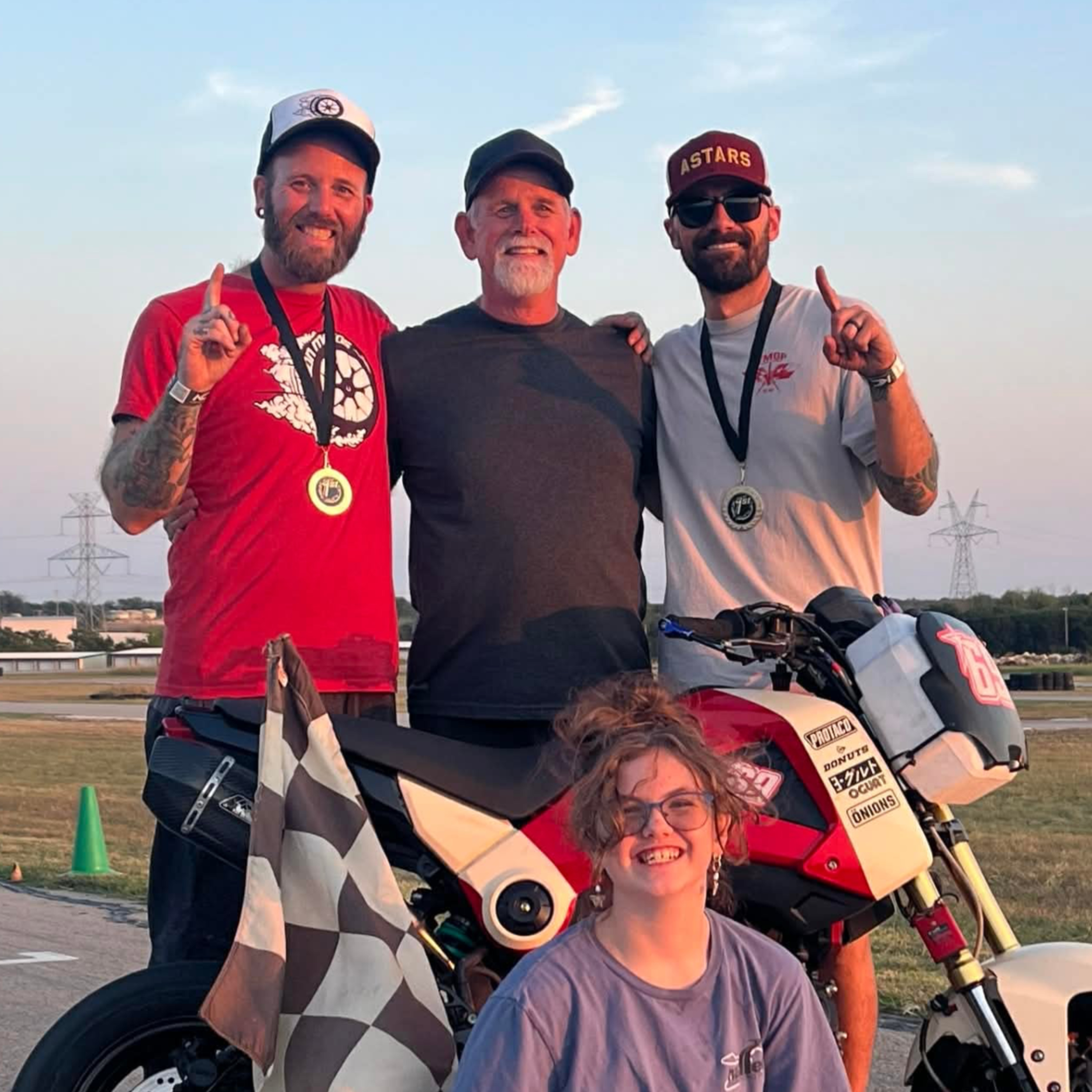
I'm introducing Scott or I'm just getting in the way here
because I actually have a bike guy guest tonight.
And I'm so excited that I get to introduce somebody.
I'm not sure.
When was the last time you let off the intro?
It's clearly been a while because that
was way too just not even thought about for me.
Yeah, yeah.
So tonight we have the local current fast grom guy.
He's super fast.
He is the middle generation of a three generation race team.
He is basically a full time soccer dad.
He is the owner of his own motorcycle shop
where he specializes in the bouncy squishy bits
of motorcycles.
And he is an all around good guy to have in the paddock.
It is Carl Eason.
Daddy.
So I want to start off this whole thing
by the biggest confusion that I had when I met you, Carl.
And you showed up in the paddock with your dad
and your daughter.
You guys were good at racing immediately.
And I was like, oh my god, this is one of those families that
grew up racing.
And they've been racing for decades and decades and decades.
And I'm going to get all the best stories about Carl racing
motorcycles as a child.
And I talked to your dad.
And that's not the story at all.
No, not at all.
So why don't you lead us into how did you end up doing?
Like what's the story of how you ended up
playing with motorcycles in general?
Well, so going way back, so my dad did ride motorcycles.
He rode all growing up.
And then when I was young, he still had a bike.
And so I would ride with him occasionally.
And then that bike ended up getting parked.
And it was for a very long time.
Did you go sit on it in the shed
and just be like, something, man?
Honestly, he took me to preschool a couple of times
on it and things like that.
And then don't really remember much of it after that.
OK.
I don't I don't know.
I honestly don't even know at this point or if he remembers
why ended up getting parked if it was if something broke or if it
was just they got busy because dad stuff.
Yeah, dad stuff.
I'm the oldest of five.
So it was very likely it was just busy.
But then when I was in college, I had a Nissan 240SX.
And one day it just stopped working.
And at the time, I didn't really know anything
about mechanical things outside of I
can change some brake pads and oil.
And so I decided I'm going to buy a motorcycle
because that's what I should do instead of fixing my car.
It's the practical decision at that point.
Like why would you want to ride to drive something with a roof
when you can drive something without a roof?
Right, yeah, exactly.
And so I scoured Craigslist because that was the place
at the time and found a bike that I was interested mostly
because I could afford it.
Did you know bikes?
Did you have an interest in bikes so that you sort of were like,
I think I want this type of bike or were you just like anything
under $600?
No, not really.
I mean, I didn't want like a big cruiser, that style of bike.
And when I started thinking about getting motorcycles,
I started looking around.
And the cafe racer craze was pretty hot at that time.
So then that was like everything I was seeing
was because that was the hot thing.
So I was like, hey, that's pretty cool.
I think I want to get something that is either like that
or I can make it like that.
I love how when you're like, I don't have enough mechanical
ability to fix my car, but I should definitely get a bike
and then build it to be cool.
Yeah, yeah.
The optimism of youth is so good.
Right.
So I found the bike.
Dad went with me to go check it out
and make sure I wasn't getting hosed on something.
I had never ridden a motorcycle at that point.
So he test-wrote it for me.
Perfect.
Yeah.
And so then I paid $1,050 for it.
And we put it in the back of the truck and drove it home
and got it out.
And my dad said, so you haven't ridden like one
of your friends' dirt bikes or something hanging out
or whatever that I just didn't know about.
I was like, nope, never.
It's like, all right.
Well, this one is the clutch lever.
Did you at least know how to drive a manual transmission car?
Yes, but not extensively.
Perfect.
Yeah, yeah, exactly.
So yeah, he had me kind of ease down the driveway a few times
to figure out the clutch.
And then I took off and rode off through the neighborhood.
Now you're a motorcycle rider.
What was the first bike?
It was a 1982 Honda TwinStar.
I don't know exactly what that is.
That's so.
So it's like the engine-wise, it's
the precursor to like the Rebel 250.
Oh, OK.
But body-wise, it still had that kind of street-standard style.
So it had like the flat-bench seat type of setup.
It wasn't full-on tiny cruiser.
No, Scott's got a picture of it there.
There's a picture of it right there.
That's pretty red.
Yeah.
So I rode around the neighborhood, came back,
and the next day I started unbolting engine guards.
Because you know, those are heavy.
And that's not the spirit of a cafe racer.
Take all the parts off, loop the frame.
Cafe racer stuff.
Yeah, so yeah.
So then I rode that pretty much everywhere for several years.
And just like everything about transitioning to motorcycles
just went well.
You just figured out how to ride and didn't have any issues.
Yeah, I just signed up for the license class,
which was pretty funny because I rode to it.
I had several people do that at my license class as well.
I had a guy ride a Hayabusa to the license class.
Nice.
That was a great move on his part.
Yeah.
So yeah, got signed up for that pretty quick.
And then yeah, I just rode to work, rode everywhere.
If it was raining, I put a rain jacket on over my riding
jacket, and if it was fit snowed, I went slower.
That was so cool.
So you just decided you were going
to be a dedicated bike guy?
You're like, no, I'm not going to get a car too.
I'm going to be the bike guy who rides a bike everywhere.
And a bike will be like, I will be about the bike.
The bike will be about me.
I'll be a bike guy.
Yeah, pretty much so.
And how old were you at this time?
Uh, that would have been 21.
Yeah, 21, 22.
So like you knew what it was like to have air conditioning
and heater on your car.
OK, fully.
Well, to some extent, I mean, I had a 91, 240.
It is, you know, AC and heat was sometimes.
Gotcha, OK.
Yeah, that's a strong lifestyle choice.
So yeah, it was, yeah.
So how you're 21 years old, you're a bike guy now.
How do you and we ask this question with car guys
all the time, how do you go from being like,
like I like motorcycles to I think I'm
going to race motorcycles.
That's a good idea.
Because that's a jump that most people don't make.
Right, very true.
So I had I had that bike.
And then in 2010, I moved to Phoenix
to go to MMI, the Motorcycle Mechanics Institute out there.
Guy, you were all in a being a bike guy, weren't you?
I love that.
Yeah, I was straight for it and figured, you know,
my my best shot at doing this to preface that I was working
in a bicycle shop, mechanical at the time.
OK, you know, when I when I got into that.
So I had gained some mechanical knowledge.
Did bicycles predate motorcycles at all?
Or was that something that was sort of brainless?
No, I rode bicycles a lot.
And that was kind of some of the like commuting factors
and things like that.
I commuted on bicycle heavily.
OK, and so like the transition was like, cool,
this is like that, but faster.
And I'm not as tired when I get there.
You could die, but you're actually slightly less likely to die.
You get smushed on a bike.
So, yeah, but yeah.
So I went out there and while I was out there,
I ended up buying a ninety six YZF six hundred.
So that bought a sport bike.
Right. Sport touring, but sport bike. Yeah.
And had fun on that.
That was that was good.
I had it for probably eight months or so.
And another kid in one of my classes was like, man,
I really want your bike.
So I finally gave him a number that I could go by something else with.
He said, OK.
But that kind of got me a taste of sport bike.
And so the roads are the roads around Phoenix
aren't terrible for that sort of thing, too. Right. Right.
Yeah. And you can you can go off and and there's
all sorts of canyon roads and things like mountain roads and stuff
all around the death bowl that Phoenix is.
So so so we would, you know, every weekend
we were out of Phoenix going, you know, Sedona, Flagstaff,
you know, all the different places that had more interesting
stuff to see and roads to ride or drive on.
So coming from a guy who's not a bike guy.
I know very basics.
I know what a cafe racer is because my wife really likes them as well.
Yeah. So coming from that twin star to the sport bike.
Like, I know the sport bike has more power.
What what did you enjoy about that bike?
What like what really drew you to that class of bike?
Um, it was
definitely like between those two bikes, big jump in power.
You know, and really smooth, far better suspension.
You know, so it rode better, went faster, easier.
You know, it was just and it wasn't a super sport.
So it wasn't like totally aggressive as far as the the riding position.
So it was reasonably comfortable to hop on and go ride for hours and hours in time.
You know, I've ridden plenty of all kinds of different bikes at this point.
And super sports are fun on a racetrack, but going out and I don't want to ride
three hours on complete super sport, just totally crunched in.
So you have become reasonable at some point, which is nice.
Yeah, you know.
So you're in Phoenix, you you now you have to buy another bike.
Yeah.
So where does where does that take you?
So that leads me to
meeting a guy and buying a 1988 R 100 BMW.
Ah, yeah.
So another step.
Yeah, that's a step in a totally different direction.
Totally different direction.
Yeah.
But the amazing thing about that is those airheads are incredible engines.
And, you know, it only makes 60 horsepower or something like that.
But it's set up and designed to do 100 plus literally all day.
Right.
Just, you know, Scott, that's that's BMW's boxer twin.
So it's a yeah, you're looking at a twin cylinder air
cooled Porsche type thing right there.
So it's they're pretty neat, pretty neat bikes.
So were they like, were they transverse?
Like, I'm just thinking of a boxer engine seems really wide sticking out.
Yeah, they stick right out into the wind.
That was BMW's thing is they're like, well, if it's air cooled,
we got to put the cylinders in the air so they stuck them right out the side
of the motorcycle and they sit there right in front of your feet.
Just doing their cylinder thing.
I was going to ask if your legs help to transfer some of the heat away
when they inevitably touched it at some point.
Well, during the winter is like having warmers right from your shins.
There's your built-in heater.
Finally, a bike with a heater.
Yeah.
So rode that until I moved back to Texas.
And then
bought a
2013 CBR 500 R.
That was the first first brand new vehicle I'd ever bought.
Oh, yeah, you just treating yourself to like a grown up purchase there.
Yeah, it was.
You know, they were reasonably priced and for for what they offered
is pretty solid package.
Yeah, to roll it off the floor for like like six grand something like that.
Right. So really, you know, pretty, pretty solid deal.
And you haven't had a car during you haven't had a car during this whole time.
No, so my my wife had a car.
Oh, that's helpful.
Yes. And so like, you know, she would she would, you know,
if we needed to go to the grocery store or that kind of thing,
you know, unless there was something small, I pick up while I'm out,
you know, we'd take the car and do that.
But she would ride along with me for fun rides and stuff.
But yeah, we had we had her car to take us around.
If we needed to take the dog somewhere or something, go hiking, whatnot, we'd do that.
This is like most things in life.
Like like if you want to be the coolest guy, you know,
being married to someone who is nice and practical is makes it so much easier
to be a ridiculous like a ridiculous car guy, a ridiculous bike guy,
anything if you're married to someone who is a solid person.
Life is so much easier.
For sure. Yeah, absolutely.
To the extent that I was still working on bicycles
while I was going to school for motorcycles.
So I'd go ride all the time.
So when I bought the BMW, I welded up a rack
so I could put one of the roof rack trays on the back of the BMW.
So I could put my mountain bike on that and ride out to the trailhead
and then pull the bicycle off and go ride and then load it back up and ride home.
This is the whole I heard you like bikes.
So I put a bike on your bike thing.
So you so you went from a guy who could barely change
a set of brake pads to a guy who's welding stuff on the back of his bike now.
Yeah. OK.
Just checking that that seems like a big step.
Full commitment.
Yeah, but making the jump to racing.
So after I moved back to Texas, went and did a track day for my birthday
and said, wow, this is cool.
I want to do more of this.
Everything about motorcycles, but better.
Yeah. So then I got hooked on doing track days
and then decided that I wanted to.
You get my race license before I turned 30.
So then I started, OK, what all do I need to do that?
And figure out, you know, just take a class and then go do some corner working
and stuff's pretty simple, actually.
Turns out it's not that hard, right? It's really not that hard.
It's like, well, so that went quicker.
And then my long term goal was a short term realization.
What was so why did you why did you want to go from doing track days
to doing actual racing?
What was the the draw there?
Are you a competitive person by nature or was it just something else to do?
I'm very competitive.
OK, yes.
Where does that come from?
I think.
I just I'm naturally competitive.
I think I always have been.
OK, my dad's competitive in things.
So I think he kind of I got some of that from him.
But yeah, I just always I mean, growing up, I was ultra competitive.
So like when I started playing soccer, I got super heavy into that.
That was my thing.
That was, you know, I'm going to play soccer forever.
And so it was I'm going to be the best on the team.
So I'd, you know, come home from school, eat my snack, you know,
watch a cartoon and then go out and practice and then go to practice.
Practice before practice and then practice after practice.
I was you were that kid.
I was all in.
I was that kid.
I walked around the house with either a soccer ball or a tennis ball at my feet.
Just walking around.
So I just that was there was always I was a kid that brought the soccer ball
to school for the recess time.
Yeah. Amazing.
And being the oldest of five that must have made your house nice and peaceful as well.
Oh, yeah.
Yeah.
So there's there's one thing about being competitive,
but then there's another thing to like enjoy
to practice and enjoy the like the skill of getting better at something.
So like when you were walking around with that soccer ball and stuff,
were you doing that to like have that as your identity and like be seen
as the kid who was playing soccer?
Or did you have it around to like always get some dribbling practice
and kicking practice in?
I think kind of both.
Mostly I wanted to have that skill development.
So I have constant touches on the ball and control of the ball
because I saw that as kind of getting because you could be fast.
But if you didn't have control, the ball didn't mean anything.
And you could be big, which I'm not.
So I, you know, I didn't have the physical advantage to, you know, bulldoze
somebody to get the ball.
So if I could have the finesse and the skill,
then that would give me the edge to be a better competitor and.
Take, you know, if I could you did that all the way through high school.
I did. Yeah.
And you didn't want like at the end of high school, you're just like, oh,
no, I'm done with soccer or what was I got recruited to play for college.
OK. And so I I showed up and pretty quickly realized that that was.
Going to be my college life.
It was like that was that was it.
It was like I was going to go to class and then I was going to be either
gym session or practice session or training, you know, all of that.
That was the the sole focus outside of the actual classes.
And I wasn't I didn't, you know, get like scholarships or anything.
So it wasn't a monetary advantage to committing all of that.
And it was like, I think I'd like to have some more fun.
Then just wake up, go train, go to class, go train,
go to sleep and do the same thing the next day.
So I stayed at the college, but I.
Politely declined continuing to be on the team.
Did was there any any sense of loss, like because that had been your identity
for a while, like you were the soccer guy.
Yeah, there definitely I was I was kind of lost for a minute.
Trying to figure out what to do at that point.
But it wasn't completely foreign either,
because in high school, I tore both of my ACLs back, back to back.
So you like tour one, fix it and tour the other one.
Immediately one fixed it, literally the next tournament
that I was capable of playing in toward the other one.
And that's actually, I actually hear that's very common.
Like I come from a water sports background.
And inevitably when whenever anybody pops their first ACL,
there's a line that's like your second one will go,
because now you don't have that support in one leg.
The other leg kind of carries that extra support.
And it's if you continue, it's likely likely to be a thing.
Yeah, for sure.
Jeez. So yeah.
So I mean, with with going through that, I kind of.
Had a little bit of a sense of.
Life without.
That identity as soccer is who I am and what I do.
Which during that in high school,
I kind of focused on artistic stuff.
As like, like what sort of artistic stuff?
Um, like drawing and a little bit of painting wasn't huge
in the painting, but took an interest in photography a lot.
And then I ended up as a photographer and photo editor
for the yearbook in high school.
Newspaper publications and stuff back when they back when they used to do that.
When yeah, when that was a thing we we still shot on film.
So we would we had a dark room.
So we would go and shoot the event and then come back and develop.
That's cool. Yeah.
So it was it was pretty cool that that they kept that around for us.
So you were like learning how to shoot football games and going.
Can I hope you took a picture that is usable?
Right. Yeah.
Now I might shoot four or five rolls of film and come back and OK.
I hope there's at least three pictures in here.
That's really cool.
That had to be kind of right at the end of that that time period.
Yeah. Digital was digital was out, but it was still expensive.
So for, you know, school budgets, you know, like I brought
I brought my own camera to to use for that kind of stuff.
And so it was at the time, you know,
a half decent digital SLR was a thousand plus, you know, and for
shooting high school newspaper pictures for class.
It's that's not.
Right. I love the good dark room, too.
I still remember hanging out.
Chemicals, I mean, I was just going to say that that for a time period,
if you had any school that was built sort of like post 1930,
they all had dark rooms built into their floor plan for for decades and decades.
My my high school did as well.
So nice. It was very cool.
Yeah. Good times in there.
Well, good. I'm glad you had something else to like getting lost as bad
when you have something that's your thing.
That's the thing that you do that identifies you as a person.
And that's kind of hard to walk away from that.
Yeah.
OK, so you I got distracted here.
So you you needed a motorcycle license to go racing because that was just
like you watched people racing and you were like, well, I have to compete with them.
Like that's their competing.
So I must compete just naturally like that.
Uh, yeah, kind of.
I mean, I said, you know, the.
The track days were a lot of fun.
But there would be racers that would come to the track days, right?
And get practice in and set.
And it was like, man, those guys are going quick and I'm learning, you know,
but like I also know that in order to be better, you have to.
Uh, you know, train with people who are better, you know, and and there's one thing to do.
Practice at a track day and there's another thing to.
Race, right.
And so it's like, well, if I want to be better at this, I want to be fast like that guy.
You know, I want to go and race and try to be better than someone else.
Yeah, it's bikes are really interesting because the skill and speed level between.
Novices and people who like just race at the club level, like the distance apart is so much
bigger than it is in, in car guys.
And I don't, Scott, that's not to say anything bad about how much better you are
than new people in cars.
Like I'm just imagining if I got on track with a bike for the first time.
How slow I would be, would be wild.
Yeah.
Well, I mean, my, my first time on a track, I was incredibly slow.
No, it's like, I don't know if I should be doing that.
Right.
So quick question.
You had mentioned that, you know, that one of the best ways to get better and faster is to learn
from people who are better and faster than you.
And there's a lot of humility in that for somebody who really likes to compete.
Um, because a lot of times competition is about kind of demonstrating what you're good
at and trying to beat other people, like trying to like place higher.
So where, where did this notion of like learning from people who are better than you
come from?
Was that just part of the, the soccer thing?
Um, yeah.
I definitely think that some of that came from that for sure.
Um, because, you know, it would, uh, we practice and playing, uh, you know, level
up teams and such to push ourselves so we, um, so that we could be better players.
Um, you know, we'd practice with some of the other either older teams, got more
experience or other, you know, higher level teams, um, and stuff, just to get the, you
know, experience.
Cause if you're paying attention, you can learn from, um, those guys.
Um, and so kind of, but I'm also, I'm, I'm super competitive.
I'm also super competitive with myself.
So I will say, okay, this is what I did, but what, how much better can I do?
How I want to beat myself versus the last time either last session on the track,
last race on the track, last practice session on track.
What can I, how can I be better than me?
I also want to beat other people.
I want to win, but if, but if I can at least beat myself, right?
That's the first person to beat is you.
Yeah.
Yeah.
How did racing go when you started?
Um, because the, the, what is the beginner class?
It's, there's intermediate, there's expert.
There's, what do they call you guys?
When the, the provisional.
Yeah.
Proven novice, provisional novices.
Yeah.
So when they say you do your, you get your license class and then you do your
provisional novice until you've completed two races over two race weekends.
So two race weekends, two races each without crashing.
Okay.
And then corner working at least two full days of cornerery.
So, and then you, you're now a novice motorcycle racer.
Yay.
So, so you're provisional for a total of four races to prove that you're not going
to kill someone else or yourself, hopefully.
No, no helicopter rides.
Yeah.
No, that didn't come till way later.
I'm going to have to ask you about that.
So, so how was like, how was the experience of racing?
Was it, was it what you were looking for?
Did you go there and you're like, yep, this is where I needed to be or?
Yeah, it kind of satiated that hunger for competition that, you know,
like the having, having not competed really in anything since finishing soccer
in high school, where I was dead set on competing on a consistent basis.
It was like, you know, so that, that gave that filled that like hunger and drive.
So it was like, after the first race getting out there, it was like, well,
that was awesome, a little bit scary, but awesome.
And then the next race, it was like, all right, buys her down.
It's flip a switch, it's go time.
And I'm hungry.
Let's see what we can do.
And, you know, even if, if I was second to last, if I as long as I wasn't last,
okay, I had made progress.
So I know in bike racing, there's, there's the smaller bike classes, the,
the 250s and the 400s.
And then, you know, you get up to the leader bikes, which are insane.
Yeah.
Um, did you look at the leader bike classes and go, I want to like, I want to
race with those guys or what is it?
What is it?
Look, I've never, I've never sat on the grid of a big bike, a big bike grid
and looked at what's going on.
But yeah, how does, how does it feel with the possibility of moving
classes and racing like big, scary things?
Hmm.
To be honest, I really enjoy the smaller bikes.
Um, and I've weirdly enough, I've never really had a super desire to go race
in like formula one on the leader bikes and, and such.
That's, I don't, there's, um, somebody early on said, you know, Hey, it's
a lot more fun to make a slow bike fast than it is to ride a fast bike slow.
And I kind of took that to heart said, okay, let's see how fast we can
make a slow bike go.
And so that kind of became the challenge of, you know, let's see, let's see
what I can do on a smaller bike.
So I, um, when I got my race license and all that, it was on the CBR 500,
uh, which fell into the lightweight class, um, you know, comparatively, it's
a little heavier than the other bikes, um, but decent power wise, um, and handled well.
So, wait, this was, you bought this bike brand new at a dealership,
yep, roaded around as a street bike for years and then converted it to a track bike.
Uh, I, so I bought a set of, uh, race plastics, hot bodies, body kit for it.
And I would ride to work all week and then take all the street plastics
and lights off, put the race plastics on, go do a track day on Sunday.
And then Monday, I'll put all the street stuff back on so I can get a
work on Tuesday.
That's insane.
And then when I started racing, I would ride and then that, you know,
Thursday or Friday, I would swap everything and then head to the track
Friday afternoon and go race for the weekend.
And then Monday, switch it all back so I can ride to work on Tuesday.
That's Scott, that's even slightly more mentally ill than you driving
the Miata on the street when it was fully caged and all that stuff.
Is it like, is it?
I think it, it's in the same category, certainly.
Okay.
And I put 24,000 miles on that bike.
Wow.
You're doing slash racing it?
And you didn't, you didn't crash it?
Oh, yes.
You did crash it.
Yes.
I was going to say, like, it seemed competitive enough that you
must have found the limit of the bike.
I did.
Yeah.
I had, I had a few low sides, which were not a big deal.
Just kind of slide off, pop back up, you know, foot peg or, you know,
something little there.
Um, 2018, I did have a big one.
That was the, the helicopter ride.
Oh, so what happened there?
Um, it was at Crescent on the one seven, going clockwise.
Okay.
Um, so coming off of the start, I think it was the 500 Superbike class.
Um, coming off the start, we went through, uh, big bend.
And on exit of big bend, um, drifting out and then, uh, all of a sudden
I feel something is I'm, I'm looking, you know, off down the straightaway.
Right.
As I'm drifting to the outside of the, the exit of the corner.
So all of a sudden I feel something and I look over and there's another bike
that's come around on the outside, but didn't get past me as I'm drifting out.
Right.
So my handlebars lock into the tail of their bike.
And we both drift off of the track.
Oh no.
Which at this point, we're, you're not going slow there either.
Fifth gear pin, right.
Which even on a 500 is moving pretty quick.
Right.
And, but as we, as we leave the track, the, the gap to the grass jolts the bike.
So they separate and I get like pile drive into the ground.
Oh yeah.
Yeah.
And it just goes fump and slaps you down on the ground like that.
Yeah.
Yeah.
And really the reason that I know most of that is because I had a camera
mounted on the front of the bike because you don't remember sitting on the grid
going, man, this is taking a while to get the race started.
And then waking up in the emergency room, going, I can't move my bike.
You took a helicopter ride and you don't even get to remember it.
I don't even get to remember it.
Oh, that's the worst.
Yeah.
So apparently I did come to, um, and even talk to a couple of people,
including my dad on the side of the track.
But yeah, I was lights came on, but nobody was home at the time.
Great brain injuries are wild.
Yeah.
It was a trip and the next week is kind of in and out.
So yeah, it was pretty gnarly.
So other than smushing your head, did anything, you hurt anything bad?
Um, I fractured my C six, seven and T one vertebrae.
Oh, yeah.
So had to wear one of those fancy collars for several weeks.
That was okay.
But they didn't have to put you in a halo or anything like that.
No, thankfully, I didn't have to have surgery or anything like that.
Okay.
And it was, yeah, got, got pretty lucky.
So apparently when the helicopter landed, there was like a whole team ready.
And they pulled me out and they're like, I thought you said this was a high
speed motorcycle crash, Mike.
Well, yeah, but he had full gear on.
So he's got like this 50 cent piece, bit of road rash on his butt.
And that's about it.
They're like, well, the rest of us are going to go treat people who need
more help on this guy having worked in an emergency room.
There are like certain protocols that like, if the patient meets these things,
like you get the full trauma response, which is probably what that was,
like they're, they're prepared for everything they show up.
And I've seen it.
It's almost a disappointment for the doctors and nurses.
And they're like, oh, this is it.
I'm going to go back over here.
This dude, I mean, he's fucked up, but like he's correct.
Yeah, exactly.
So that's scary.
And you still were, when you got better, you were like, well, of course,
I'm going to keep racing.
Yeah, pretty much.
I love bike guys.
Yeah.
So where along this journey of stuff
did your dad look at what you were doing and think, yeah, I need to do that, too.
So he
he got another bike.
Not not right after I got my first bike,
but not that maybe a couple of years later.
So when I said I'm going to do a track day for my birthday, he said, well,
I want to do a track day, too.
So he went with me.
So he started doing track days at the same time I did.
Was he, I know you said he's he's super competitive, which I can
so I can see him going, well, I'm going to do a track day and do it better than you.
But.
And did he look at racing the same way as you and went, well, we're here.
He he didn't jump in until much later.
It I think.
I think once I when I started doing endurance racing in C.
M. R. A. He was kind of like, well, this is kind of interesting.
He would go with me to a lot of the races, not all of them, but the ones he
could and help me out in the pits and stuff.
And, you know, I was like, oh, this is, you know, this is cool.
And then I jumped on an endurance team.
That was a lot of fun.
Um, and then we decided me, him and Tony, generally decided, let's do an
endurance team in C. M. R. A. So we, the three of us bought a Ninja 250 to
build as a, as an endurance bike.
So he got his race license and said, well, I'm going to do that.
And then maybe I'll do some sprint races later, but I want to, I want to jump
in on this endurance racing because that seems like a lot of fun and a lot
of seat time for the money.
It does seem like a lot of fun.
It is a lot of fun.
When, when, when I met you guys, the three of you, yeah, you were kind of
just finishing that up.
Yeah.
We, we did several seasons and then Junie, um, turn, she was getting closer
to turning eight, which I knew was the minimum age for TMGP.
So that guy said, Hey, would you like to try doing this with me?
And she said, yeah, that looks like fun.
All right, cool.
Did you really know?
I mean, TMGP and CMRA in Texas are kind of related to each other.
Did you really know about Texas mini grand prix and what was going on with that?
Um, I, I did, um, several years before that, um, Tony had seen some stuff
with the Grom series.
Okay.
And so he used to race those on the big tracks as well.
And so he said, Hey, have you seen this TMGP?
And I said, Oh, I don't, I don't know.
So I looked it up and was like, now that looks like fun.
And so for, for a couple of years, uh, I made it to like maybe one to three
races with TMGP.
Um, and I just, I took, I had a, uh, bone stock CRF 80.
Uh, and I put scooter tires on the stock wheels and went out and did, you know,
a couple of races that I could squeeze that I could manage to put between
CMRA races, um, and come and do, you know, this is a lot of fun.
We should do more of this.
And then, uh, Junie started getting older to be able to do it and said, Hey,
you want to do that?
And then I said, Hey guys, what if we endurance with TMGP instead of CMRA?
And we can do sprints and endurance all with that.
And she can come with us and do all of it.
And we might actually be able to afford to do all of that.
Even though you, you were racing, you were endurance racing the smallest, least
expensive class of big bikes.
It's still considerably more expensive than, than racing little bikes.
Yeah, absolutely.
And we did it as cheaply as possible.
We were racing on takeoff tires and whatever we could do.
So how was the transition to being a race dad and having your kid out on track?
You know, she's eight years old, which is the youngest you can, you can legally
race with TMGP, but the practice sessions in Texas.
Me and Grand Prix are just open, so everybody's out there going the speed
that they're going to practice at and your eight year olds going out there.
Yeah. How was that?
I'd be lying if I didn't say it was nerve wracking.
There was definitely some like, OK, I, I can't just follow her around.
You know, I can some, but, you know, I can't, I also can't just sit behind her.
So I would try to lead her some and I'd take off and I'd come back around
and I'd kind of sit behind her some and, and do that.
Help try to guide her and, and whatnot.
But yeah, I mean, as, as respectful as everybody in TMGP is, because it really is,
you know, from, from a racing standpoint, everybody really does a pretty good job
of looking out for other, other riders, especially if they, you know, they're
little or they, you know, kind of seem unsure or very new.
Then I think, I think us as an organization, TMGP as a family really does a good job
of kind of watching out for that.
So that, that definitely helped.
But as a dad, it's still just like, I know what can happen.
Well, well, that's the thing is she, she did get bonked.
She did. Yes.
Was that her second season racing?
That was kind of so she, she turned eight in September and the next week
was the next round.
So literally she turned eight, we went that weekend, got a race license,
and she raced the last three rounds, September two, two rounds, I think.
Okay.
So then it was like the, it was the spring season.
So her first full season.
Okay.
Going, going out.
Yeah.
And then, yeah, she got, it was just one of those
unfortunate moments for everyone.
Yeah.
You want to describe what, you want to describe what happened because it was.
Yeah.
So going down, going down the straightaway at Katie,
leading up to turn one, there was, she was towards the end of the straightaway.
And a pack of guys were coming up the straightaway and there was three of them.
And they kind of split at the last second to go around her.
And the third rider had nowhere to go at that point because the two in front
split without enough time for him to see what was happening and avoid.
Well, he said he had no idea she was there.
He was just tucked in behind those two guys and then they went,
they, they dodged around her and he didn't know where to go.
No, absolutely not.
You know, so he, you know, he bonked into the back where they, you know, fell down.
And she fractured her wrist.
So of the possible outcomes and injuries, it's really not, not that bad, you know.
So mom took her to go get x-rayed and checked out and said, yeah, it's, you know,
you're going to have to go get a cast when you get back home and whatnot.
And she came back to the track all wrapped up and she didn't think that
fracturing her arm was cool, but she, but she, she honestly took it like a champ.
Like I was, I was really worried that she was just going to go, yeah, okay,
I don't want to do this anymore.
This isn't, you know, this is that would have been a fair response.
Yeah, for sure.
You know, it's, and so I was like, well, I hope that doesn't end up being the case.
But if it is, that's, you know, it is what it is.
I'm not, you know, and, but her primary concern was how long she's going to have
to have the stupid cast on because she was going to miss the next rounds of racing.
Right.
She, she, she, and so I said, all right, cool, we're, we're on.
Awesome.
Yes.
So, and which, which was awesome.
And she did, she got back out there immediately.
She had some definite mental blocks to work through and particularly at Katie,
particularly at turn one.
And that took a long time to push past that and get, get past, but she did.
And now she's fast.
She is this, this last season.
And so Scott, this last season, she went from, I don't see, she wasn't tentative,
but she, she just wasn't quite there.
You could tell she was like right on the edge of figuring it out.
And she went out and she really got a knee down.
And as soon as she got a knee down, she was like, oh, now I get it.
And then you could watch her almost every session.
She was like faster, faster, faster.
And it was such a beautiful thing to watch her like all of a sudden,
like, yeah, she's got it.
She's going.
Yeah, it was a lot of fun.
She also, she is very, what's the word?
Turns out she's very data driven.
So I threw the race box on her bike and started showing her lap times and, you know,
her lines and stuff on there.
And so when she could see, she could see a actual quantitative improvement.
She said, oh, and I think that was kind of a switch that said, you are improving.
You are doing better.
You are learning, you know, and so then she would go out.
And if she did better in that session, we would look at that and she'd get excited.
And then she'd go out with more confidence and improve the next session.
So then at that point, every race and every session, she'd go out.
When she had the data, she would go faster.
Does she want it to beat herself?
She, yeah.
Weird.
Wonder where she gets that from.
Yeah, so she's, she definitely got my competitive nature.
Yeah, I've seen that in the last year and a half where she got, you know,
she got to where she was properly racing people.
And when she's in a race with someone, it's a beautiful thing to watch.
Yeah, it's a lot of fun.
And to see it off the, off the track or a minor that it's okay,
there are going to be faster people, but that's, that's a good thing.
You have someone to strive with and learn with and go faster with.
So it's, you know, don't, don't let yourself beat yourself up too much.
If you, if you don't win.
Right, right.
So we're recording this podcast.
You're recording this podcast and I can see your shop and your background.
What I want to like briefly go into, you went to MMI.
Yep.
And they taught you to be a motorcycle mechanic.
And you were like, I mean, not only did you do that, you were like,
I want to do this as a job.
What was the journey from turning wrenches in school, working in a bike shop at the time,
to coming back to Texas and being where you are now?
So I, so I moved back to Texas and then started looking for shops to jump into.
I, I got a service rider position at one of the local shops.
It's not there anymore, but started out there and had a, had a friend that I had met that
was working at the dealership here in Georgetown.
And they were going to have a position opening up there.
So I came filled out the application and then started badgering the shop foreman
until he would give me an interview.
Did you just like a hang out and talk to him across the counter and be like, hey, hey,
I tried to talk to him and stuff.
And then I'd call every couple of days.
So when, when can I come in and sit down?
What's the deal?
What's going on?
And to kind of badger them.
And then he finally, he finally gave me an interview and decided to hire me, which I
wasn't good at interviewing at the time.
So I was not sure what he saw, but he saw something and said, okay, let's give us dumb
isotronic persistence is what he saw.
Yeah, probably at least he'll stop calling me if nothing else.
Exactly.
And so hired me on as a, as a service rider, which is a pretty normal kind of
flow through the, through the shop.
And so jumped on there and then got bumped into the setup tech position.
So I'd uncrate vehicles and put things together and do some
light accessory installs, things like that.
And then got bumped to like the green lane kind of tech.
So I'd do tires and a little changed all the quick, you know,
you know, on a Saturday, we'd have a line at the, you know, first come, first serve
tires and all the changes and stuff.
So that was two lifts set up, ready to go.
Just, yeah.
Hammering through that and then kind of worked my way up, got sent to a bunch of
training opportunities with more of the manufacturers and stuff.
So worked my way through there.
And then when, as I started getting into the track and the racing and stuff,
I started learning that, you know, as far as things that you can do to your motorcycle to
have a better time at the track or in general, biggest bang for the buck was suspension stuff.
Because you do a bunch of power stuff, but if you can't get the power on the ground
and handle it, you know, then it doesn't mean anything.
And so I started kind of learning some of that, flew myself to a couple of trainings
to learn some more in depth from some of the experts in the field.
So that was not the shop doing that?
That was you taking the initiative to learn that stuff?
From that facet of things, yeah.
Because in the dealership, it's not really the focus isn't on performance stuff.
It's more maintenance, warranty, that kind of stuff to do some accessories here and there,
but not a lot of performance.
And then when it comes to suspension stuff, it's like, yeah, sure, we can do a fork seal here or
there, but you're not revalving outside of that, right?
Yeah, you're not doing the full meal set up and, you know, having the customer with the bike to
sit on it and see what things are doing and feedback and all that kind of stuff.
That's just not part of that.
So so I started kind of doing some of that at off hours as a side thing
to help pay for one, the training and two, the racing stuff.
Okay.
So then that kind of built up and built up and built up and then finally
said, I'm going to take off and do this full time and left the dealership and opened my shop full time.
And just sort of like, yeah, I'm going to do that.
That's going to work.
That's a big step.
Yeah, it is.
It was definitely a big step, but I had started doing the side work doing suspension and engine stuff
2018. So it's kind of built up several years.
So I had pretty solid kind of regular customer base already at that point.
So it wasn't, it wasn't like a total, you know, and there was, there was definitely times where it was
like, I could go home and make more money tonight.
You made it work.
Then staying clocked in at work.
And so I was like, you know, I was kind of like, well, if I don't have the capacity to do that
in that, so I think I'd be a lot happier if I jump and do this.
So let's, let's take a leap.
Fantastic.
Yeah.
So mostly road bike stuff, dirt bike stuff.
Like how is, how is that split in the world of people who think they need better suspension?
There's, as far as this split on that goes, the dirt side of things, it's almost most,
I feel like heavily dirt riders kind of expect that they need set up.
They're going to need changes.
Like the bike's not going to have the suspension fully figured out that they want for them.
Why is that?
Is it just because rider weight is different and skill is different that you can't sell?
Like if I go buy, you know, a Honda dirt bike, Honda race bike,
it's not going to be right.
Right.
It's, yeah, there's, I think partly skill level has a lot to do with it.
Okay.
You know, having the bike set up and sprung for a new rider or an intermediate rider
or an expert rider, you know, if you're riding a class at the motocross track,
you know, you need a very different setup than what, you know, if I go and buy a brand new 250
Alpha 4 right now, my setup's not going to be what an A rider on the track is going to be set up for.
You know, like my, my dirt skills are not that good.
You're not going into triples of the track.
Right. Yeah. I like to trail ride and have a great time, you know, I'll, I'll roll around the track,
but flying 100 feet through the air is not on purpose for me.
It's really cool to watch and I like setting stuff up for other people to do that.
But it's, but a lot of the, the street stuff really isn't so different,
but the amount of abuse that the suspension is going through is significantly different,
if that makes sense.
So why?
It's, you know, riding on, on pavement, like, yeah, there's some bumps here and there,
there's, you know, maybe a catch a pothole or something, you know, but for the most part,
it's pretty smooth.
And so you don't feel as much unless it's very wrong.
So it's really the high speed movements that break your shock down quicker.
Right. So you, you know, hitting breaking bumps on a motocross track or roots or rocks on a trail
or something like that, that's going to cause way faster shaft velocities and suspension movements
that are going to transfer, you know, into the chassis. And so having that stuff set up
to get that feel that you want, because the whole point is to isolate the rider from
whatever you're riding over is basically the point of suspension, you know, with,
with the effect of knowing what's happening underneath you, you know, but keeping that
so you're not just, oh, that was a root, that was a rock.
You know, but, you know, so controlling all of those movements, yeah, the off road,
going over all of those things, it's constant and creating a steady influx of shaft velocities
that you don't see on the road. Unless you just live somewhere with really, really bad roads.
Watch for dirt roads or something like that. Yeah. So it's, but, but, you know, setting up
street stuff is honestly equally as important. It's just a lot of people don't until they
until they decide they do want to try it or they hop on somebody's bike who has had it done.
And then they go, wow, this actually could be a lot better. Like it feels okay, you know,
it doesn't feel bad. But then you get on something that is set up and you go, wow, this is
pretty nice. You don't know it's good until you feel it and you're like, oh, that's so much better.
Yeah, exactly. And so it's, you know, which is kind of a double edge thing, right? Because,
you know, yeah, it's so much better. But now every time you jump on something that's
not set up or in stock, you go, wow, this is awful. It's terrible. I hate stock motorcycles.
Yeah, bike guys seem so much more, I guess one of the things in cars, you know, when you start
doing any track cars or any performance driving, like you got to get new shocks. Yeah. But, but
for cars, you just buy something like you just are like, yeah, this shock should work and you just
buy it and it may have clickers on it and you may do some stuff with springs. But it's not until you
start doing Scott levels of nonsense, like really calculating spring rates and then having shocks
valved for those spring rates. It's like a weird thing to do in the car world. And that's a really,
seems like a very common thing to do in the bike world. Yeah, yeah, definitely.
Like I've revamped my own forks several times. Yeah. And I'm just a shrub that I mean, I don't
know anything. And I know very, very few car guys who have ever opened up a shock for any reason.
Right. Well, I'm wondering if some of that just isn't that one, like to physically get to them
is much easier. Two, you only have a couple. And then three,
if just everything just isn't smaller and kind of easier to take apart and like look at
I like, I don't know, it just seems on a bike because everything's exposed. It's easier to get
to it's there's not as many of them and they're just smaller. It just it makes it seem much less
daunting, I guess. Yeah, I can see that. I don't know. Yeah, bikes, bikes do wear all their,
all their mechanical bits on the outside for the most part. Yeah. I mean, you've got the
plastics to take off on sport bikes, but like everything's there and cars wear all their,
all their stuff on the inside. So it's a, it's a difference. Mechanically, it's a much, what's it?
You got to do stuff. Like you've got to fully align it afterwards.
Really, if you're taking stuff on and off, that's, that can be a pain.
Yeah. Yeah, I can definitely see that as much less user friendly from that aspect to be able to
just put it all back on and, all right, I assembled it correctly and torqued everything, right?
It's back together. Yes, it's pointing in the right direction. It'll probably be fine.
The full honesty, I ride plenty of my bike on the track plenty of times where the handlebars are
crooked because the forks are crooked in the triples and I'm like, huh, that's not straight.
Oh, well, and I'll ride it all day like that rather than adjust two bolts to get it straight
out. So I'm a terrible mechanic.
So we're running out of time, Carl. This is terrible. We have so many things to talk about.
Is there, is there anybody in particular that you like want to thank or talk about or anything
associated with racing or the shop or, I mean, we do need to say the name of your shop
at some point?
Well, definitely wouldn't have made the jump to have my own
business and go through all of the process that that is without my wife. Of course, Chelsea,
she's a saint, frankly, puts up with me. It's pretty incredible, honestly.
But also, I mean, every step of the process from going with me to test ride the motorcycle I wanted
to buy, my dad has been through every step along with me, willing to help how ever he can. So
that's definitely would not be in the position I am without him. So definitely support network
support networks kind of amazing in like, it's pretty, yeah, it's pretty incredible. So I'm
definitely lucky. Your shop is the Reason Motos in George, in Georgetown, Texas. Correct. And you
do motorcycle stuff. Motorcycle stuff. Yeah. So definitely heavily on the suspension side. It's
kind of specialized. But also do engine work and maintenance stuff as well. So not just solely
bounce sticks. But race, race bike stuff, street bike stuff, dirt bike stuff. Yeah, yeah,
pretty much all of it. You know, I've got everything from
Ovali 190 to Goldwing 1800 in the shop right now. So it's pretty much the whole range.
It's the range. Yeah. Yeah, keeps it interesting, makes it for a fun day every day.
Well, thank you for talking to us, Carl. This was, this was fun. I like learning more about
the people I race motorcycles with. So it's fun. Thanks for having me.
I want to see you do all the social, social shout out to yourself.
What's that? No, you do all this. I don't know how to do this. You do this at the end of the show.
I don't know what's going on. We are at Track Walking Podcast on all the platforms and the
Discord link is where we hang out these days. Click it, join. It's a good time. But yeah,
once you, once you lead us out, Seth, since I stepped on your, stepped on your feet and
rained on your parade earlier. For the three of us, I am Seth. I'm Scott. Crap. I messed it up.
No, no, that was on me. You don't know what it's like to say anything after me, do you?
Nope. Have a good week.
About this episode
Carl Eason’s path from a first Craigslist motorcycle to becoming a track racer and suspension-focused shop owner is equal parts practical and competitive. He started with a 1982 Honda Twin Star, then moved into sport bikes, BMW airheads, and a new CBR 500R he later converted for track use. After a near-fatal 2018 crash that sent him to a helicopter ride and left him with vertebrae fractures, he kept racing—now alongside his dad and, increasingly, his daughter in TMGP. The episode also dives into his “data-driven” race coaching, plus why suspension setup matters so much on both dirt and street.
Karl was the most disappointing emergency room patient... Seth actually didn't know a bike by name for a change... and Scott thinks bike owners play with stuff more because parts are smaller...
Karl Eason joins us to talk about his crappy 240, buying a bike before he could ride, the riding year-round, and racing on an inter-generational endurance team!