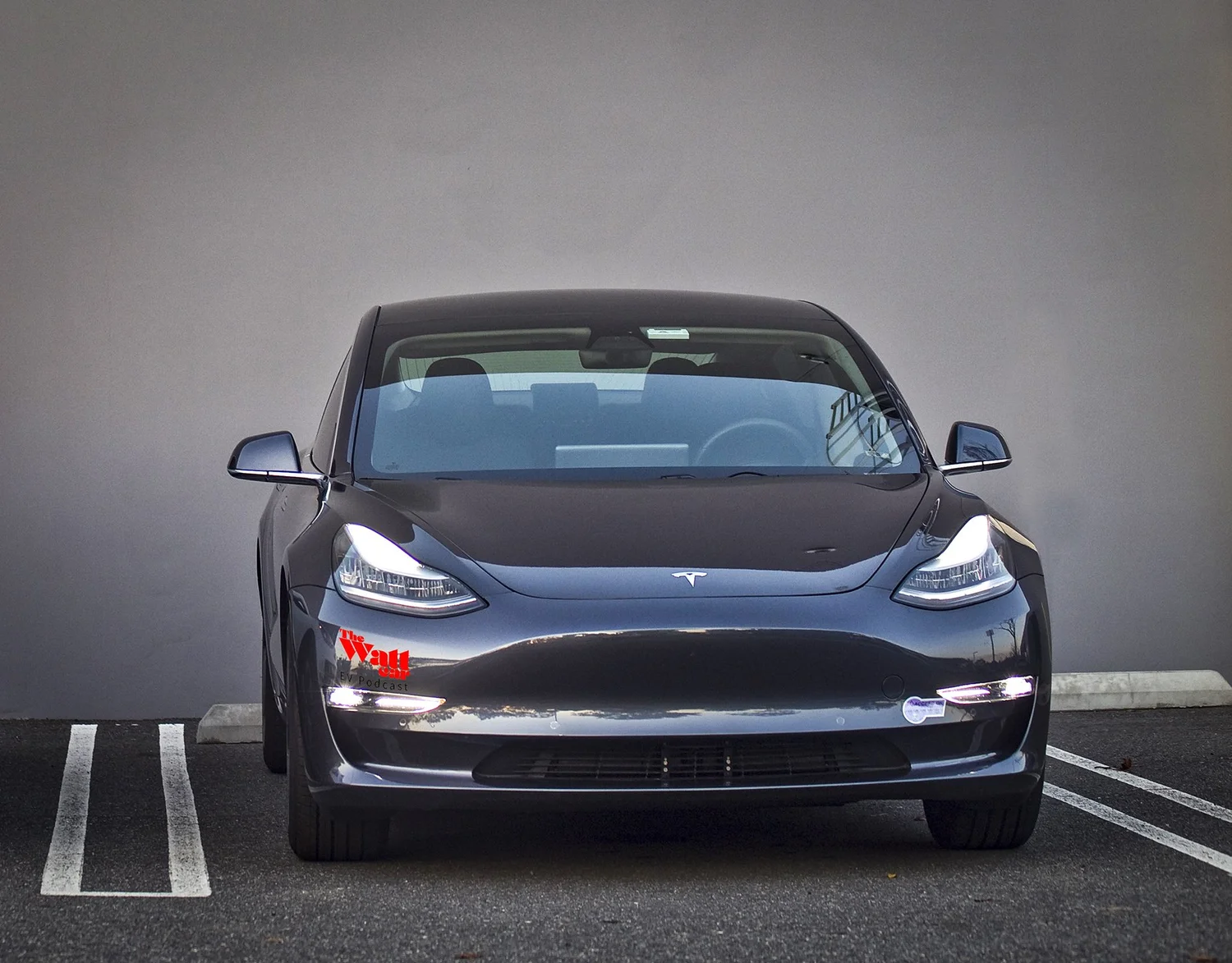
This is the WhatCarEV podcast for Thursday, August 21st, 2025, Episode 237, Ed's Cost of Ownership.
Different kind of episode this week.
We are going to run down Cost of Ownership, I think, that's what we're doing.
That's for my car.
So, you have, what do you have?
We're going to do this on the brand new 2019 model 3 SR Plus.
You need a new car.
What's up with that?
Well, anyway, we'll get to that.
I'm Phil Royal.
I realized, after last week's episode, I don't ever say anymore, because I just got
tired of doing an introduction for myself, and I got tired of saying, however many years
of experience in the automotive industry, whatever, you can go and listen to other episodes.
I'm doing it again.
I'm just breezing over it.
I came up from the magazine biz, if that tells you anything.
In the Paleolithic era.
Yes, where we chopped down trees and we made import tuning magazines.
Not import tuner.
But it was an import tuning magazine.
This is pre-doom scrolling.
Yeah.
Well, it was around, I guess, forums were pretty big because a lot of people on forums told
me to go and kill myself back then, so now they do it on social media and there's rules
and requirements.
Anyway, the point being, I've been doing this for a while, also, youtube.com slash
at The Walk Car, you can see our smiling faces, and then TheWalker.com slash nothing, and you
can look at our blog that doesn't get much of any attention anymore.
All right, my turn, Ed Sanchez, owner of a brand new six-year-old Tesla Model 3, as we
were about to get into.
Original owner of a brand new 2019.
Original owner.
Let's see, gosh.
Four plus years as a podcaster, I guess that's the new hotness, the new old hotness.
Yeah.
I don't know.
Anyway, been enjoying doing this with Philip.
I know we have a small but enthusiastic audience, I'd like to think.
Tiny but mighty.
Tiny but mighty, like that.
Anyway, I hope you've been enjoying this journey with us more to come.
We got some stuff cooking in the background, but sometimes these things take a little
more time to kind of coalesce than expected.
Sometimes they've happened, and then at the last second, they don't.
They don't.
Or sometimes they happen after kind of being on the back burner for months, and then all
of a sudden, boom.
Boom, here we are.
So anyway, but let's get into it today.
Yeah, so this idea came around.
I've read so many blogs and whatever that's like, here's my real ownership cost.
And I'm like, I don't really know if any of that's true, whatever.
I know somebody with one of these.
Tell me, tell me what the cost of ownership is.
Because I, so not to get political, but, but I'm about to, I live in California, you live
in California, and a lot of people are like, California is so expensive.
You should go and live in Texas where I've lived, or you should go and live in Florida
where I've got family members.
And you know, they have no income tax and yada, yada, yada, and I'm like, I'll give you
California is more expensive to live in.
But at the same time, the government is going to get its money.
You may not think it's getting its money because they're not charging you this tax.
But guess what?
They're charging you this amount on this, which is more.
You are getting the blood sucked out of you one way or the other.
So to bring that back to EVs, I'll have an EP.
Why am I on this podcast?
I'm leaving.
So my opinion has always kind of been through like as fuel fluctuates, and I've known people
that have gone out and bought like a cheap car as price fuel goes up.
And it's like, it's always cheaper to drive the vehicle you have, no matter what.
It's always cheaper.
Don't go and buy a new car.
Don't spend $50,000 on a car that gets.
Yeah.
Don't buy a new car to save money.
Yes.
That the math doesn't math on that.
But I've never worked out on an EV what the cost of ownership is.
Now your cost is going to be slightly different because my cars are older because I do drive
cars until they're in the ground.
Like my newest cars of 2011 and my oldest street driven cars in 99.
So like I drive old cars at this point.
The idea of spending $50,000 on an EV, I'm like, I'm not going to save any of that
money.
I got kids.
I got other commitments.
I've looked at used ones, but I'm not quite ready to bite on the used market, especially
coming out of COVID.
Like that was not so crazy if you bought a car coming out of COVID.
But now the prices are all kind of dropping down.
And once again, I'm looking at, okay, you know, maybe the next used car I get is something
like your car.
Maybe it is a 2019.
So what is it going to cost me though?
Like what's your, what's your, that's what I wanted to know.
Okay.
It's me, Ed.
So make me buy your car.
That's what this episode is.
Yeah.
So they'll, so they'll task me with trying to put together as detailed a like cost summary
as possible about my car.
So I went back through the way back machine, tried to add up everything I could think
of off the top of my head and kind of going back like as I say goes soup to nuts.
I don't know if you've heard that, but like it's a very common EV expression.
Yes.
So kind of, you know, everybody in the pool, what does this cost?
And also a little bit of a comparison to, to an ICE internal combustion vehicle.
What's more expensive?
You know, this and that.
So I guess I'll just go through it line by line.
So my biggest single expense by far in terms of category other than the purchase price
itself.
Well, no, I take that back because if you go down the list, you'll see there's
another one that no, because no, I only had to do that once.
So never mind back to my original premise.
You're like, why do I own this piece of crap?
No, it is tires.
So a couple of reasons for that is even though I have the SR plus, which is
kind of the base model, I would, I would still, and, you know, we could
get into this in terms of definitions.
I would still consider the model three kind of entry level sports sedan.
So, you know, it's a step up, I'd say, from like a Camry, Altima, generally,
in terms of specifications, you know, not size, ability.
No, but well, yeah.
So I mean, it's the difference between like, say a Passat and a three series,
I guess, kind of sure.
I don't know.
Anyway, so some some of the equipment and I guess consumables, if you want to
call it that, or what might be a little more expensive than like an equivalent,
you know, kind of bread and butter midsize sedan.
So one of those things, one of the big items really with any car,
but especially with EVs, we'll get into this as tires.
So I've gone through three sets of tires in 82,000 miles.
Now, the length of time between those tire changes
has changed because I've changed specs and brands of tires each time
in a quest to lengthen that period.
So the original equipment on
on this, I believe, were Michelin.
I don't know if they were pilot sports.
That might have been the performance model, but they were Michelin tires,
which is well known.
I'd say more of a premium tire brand, generally a little more expensive.
And they had a UTQG.
I can't remember how much we've discussed about this on the podcast,
but it's a tire wear rating.
So the higher the number, the longer they're expected to last.
So generally, yes.
Generally, yeah.
So performance like you what's very popular track days out across
everything is 200 UTQG.
Yeah, for three tires, pretty low, pretty low.
If you get into perform like
Toyos, I think they're R's or they're double R's.
One of those might be a 40.
And then you get to some zero.
Yeah, you get to some.
I don't know what my Hoosiers are.
If I don't think they're 40, I think they're just not.
I'd have to look it up.
They I think they have to have actually a UTQG rating
to be DOT tires.
But yeah.
So anyway, 200 is a high performance.
Yeah, street tire.
My original equipment, like a memory serves me correctly.
I think they were Michelin.
They were 500, which is pretty common for kind of an all season touring type tire.
And those started showing signs of significant wear at 16,000 miles,
which I was like, what, you know, I was I was kind of surprised by that.
So I had to replace those a lot sooner than I was expecting.
So so I replaced those with some Continentals with the 700 UTQG
and those held up much better.
I think I think I probably got about 30,000 out of those,
which, you know, in the greater scheme of things, you'd say,
wow, that's still not very good, but it's almost double what my first set was.
So I actually put two sets of those on of the.
It was the pure contact.
What was the 700 UTQG?
And then the latest set I put on were also Continentals.
But it those the ones I just put on were 840,
which is almost the highest UTQG you can get.
I think the highest currently on the market was 860.
And I can't remember.
Yeah, I've had like seven close to 700 UTQG.
I can't even imagine.
I can't even imagine those had no traction in the rain over a paint stripe.
If you accelerated, you'd spin the tires like it was not even accelerating fast.
Just like they're so hard.
So so this is that was one of my concerns about these is like,
are these going to be completely useless on the wetter?
And is it going to be like totally slip slidey?
Yeah, they actually.
I think have pretty decent grip.
I haven't driven them extensively in the rain.
But they haven't felt like slippery or unsure.
So, you know, I don't know what kind of alchemy Continentals doing,
but somehow they've managed to have a high UTQG and fairly good grip.
I mean, not as good as like an ultra performance tire, but still pretty good.
UTQG is largely a made up number by manufacturers.
To kind of on the honor system.
Yeah, very much so.
So there are tires like, for example,
because my Bailey Wicke is performance cars and whatever is there were tires
when everybody was going to a 200 Treadwear tire, all the the
clubs and everything were requiring 200 Treadwear tire before that,
there was one club that was requiring it was like 140 Treadwear
and there was a tire that was rated at 140 or 160, whatever that tire rating was.
And then the bar got moved and everybody said, oh, it's got to be 200
Treadwear, not 140. So guess what?
Treadwear that tire had the next year. 200.
Now, there are there is testing and they don't want to fall victim to like
the feds coming in and investigating.
Yeah. But it's still they had like 140 stamped on the tire in the next year.
It was 200. So very easily UTQG and traction are not necessarily a one to one.
But it is an indicator.
So my anecdotally, what I've been told
about UTQG is it's mainly a yard, an internal yardstick for that brand.
So basically the UTQG per brand is relative to its lineup of tires.
So let's say I mean, Continental is a pretty big company.
They probably have track or performance tires.
So they probably have some 200s and 400s.
I know they have a lot of 500s. 500 is a very common.
Yeah.
UTQG that kind of indicates mid high range for Treadwear up to, you know, 700, 800.
So it's not necessarily one to one correlation across brands,
but it's like within that brand's lineup, this is where this tire is in the hierarchy.
So among Continental's tires, this is one of the highest in terms of tread life.
Anyway, long story short, it's been, on average, probably about 1200 bucks
each time for all four so that if you do the math on that, including installation
and, you know, other bone whistle add ons, that's about 300 bucks a tire.
So anyway, so that's we'll call that 3,600 bucks for the tire changes
over 82,000 miles, you know, which some may think that's high.
I, you know, it is what it is.
Your tires nearly done at this point, like, because if I take 82,000 miles
and write it by three, then that gets to like 27,000 miles.
And when I just pulled up my chart for my Kia Optima,
my tires are due for changing and that was almost on the nose 30,000 miles ago.
So it's not that far off of.
Yeah, but but at the same time,
I mean, I don't know what the UTQG is on the Optimus tires.
But I actually I don't have them on this time.
I bought some cheap like U.S.
General Tires, but the ones before were like EV distance tires
that I put on like eco blah blah.
Yeah, they were designed for an EV similar tire size.
And I got that and it actually bumped up my fuel economy.
I like I think it might have gone up upwards of two miles per gallon
on the freeway. It's pretty good.
It was a pretty big.
Now, those were the ones that could not for the life of them
could not get traction in the rain.
But they sure helped.
I mean, Southern California was that one day a year.
I got to worry about that.
It's just not an issue.
Yeah, I'm not concerned.
I'm not losing sleep over that.
If I lived in Maine, totally different scenario on this.
But yeah, no, it's they decreased rolling resistance
does not necessarily mean decreased traction.
But it is.
So, yeah, to your point, though, I'm hoping, I mean,
you know, me, Mr.
Fancy, new shiny thing, you know, the latest greatest.
I'm hoping Matt's arrives.
Exactly. My sapphire.
Yeah, I'm hoping this this will be
the last set of tires for this car that I own it.
Maybe not. Maybe one more.
But I'm thinking with the 840 UTQG.
I'm hoping these will go 25.
You know, 30,000 miles.
Yeah, I think that's a reasonable amount.
Now, I had
Corolla for years over 300,000 miles on a Corolla.
I could make a set of tires last 100,000 miles on that car.
But the difference is that car weighed just a hair over 2600 pounds.
There was no weight in the back and it was all freeway commuting.
And then I put on larger tires.
I did 17s off of an FRS, because whatever, I'm a nerd.
And so you've got
increased rolling diameter.
You've got a wider width.
Everything was kind of getting me toward
longer distance and you could it was easy.
Here we're talking in stock size.
You've got stock size.
I got stock size on my my gear.
There are tricks you can do.
Yeah, I don't think that's bad.
I don't think 30,000 miles out of the set of tires is unreasonable.
I think 100,000 miles out of my Corolla was
edge case. Yeah, it was very much an edge case.
And I could not repeat it now because I'm not a super commuter.
Yeah. So anyway, so for all that
we wanted to have 15 minutes on tires.
Exactly. Charge port door.
I was initially having some issues with that.
It was being kind of wonky.
They came out to my house, replaced that under warranty.
I don't know what the out of warranty cost on that.
I'd imagine like 200 bucks or something.
Yeah.
I've gone through two 12 volt batteries.
So EVs still have like a high high voltage and low voltage system.
Most are still now the Cybertruck is 48 volt,
but most EVs are still 12 volt for the low voltage,
which is basically cabin and flotainment kind of accessory stuff.
And high voltages for the motor and powertrain.
So anyway, I would say two batteries is a lot for 2019.
Considering it's 2025.
Yeah. I mean, one, it gave me the warning.
The other the other time they replaced it is when I went in for my HW3,
which I didn't. Well, we can get to that later.
The hardware three upgrade, which I think is me flinching money down the toilet,
which which you might have come around to my side on that.
While they were doing the update, I guess the update drew so much power.
It killed the battery, which which I was already at that point
on the second battery and it killed that one.
And just as a courtesy, they replaced it because they said, you know, hey,
they, you know, they did it while it was under our custody.
We'll just give you a new one.
That's crazy. Yeah.
So, you know, whatever it's like, OK, cool.
So supposedly, and the only reason I know this is I recently
replaced the battery on my mom's just got a 2012 Infiniti 37.
And I went to O'Reilly to get a battery.
It was almost three hundred dollars off the shelf.
And I was like, what the heck?
Yeah, supposedly the for my car from the Tesla service center
is only eighty six dollars, which was kind of dirt cheap for actually.
Yes, because I don't know anything about Tesla battery.
So once again, I said this on previous podcasts.
I don't know what I'm talking about,
but that's not going to stop me from telling you, saying my opinion.
There is no requirement for there is no cranking amps requirement.
I mean, there will be a requirement of the output of the battery
in order to get the BMS to start and all the stuff is that.
But like you don't need three hundred and fifty cranking amps.
No, because there is no cranking.
There's no cranking.
So you could go with a much smaller battery.
And I have not seen a Tesla 12 volt battery, but I'm going to guess
it's like motorcycle size that is not like a class 35,
that it's not the huge, huge battery.
So mine, I have seen it.
It's pretty standard size.
I would say it probably looks like something you'd find in like
a Corolla or Centra or something.
It's pretty conventional looking.
Wow.
The newer ones have gone to a lithium ion 12 volt.
Yeah, that's smaller and smaller and lighter and whatnot.
But I think through, I want to say 2020 or 2021,
they have the conventional lead acid 12 volts.
Anyway, the good the good thing for me is those are exceptionally cheap.
Even through the Tesla service center.
It's got to be due to cranking out requirements, though.
It's got to be because if you want high cranking amps,
you got to pay a lot of money for that.
Mm hmm. Yeah.
And like you said, on Neve, you don't you don't need that.
So they could, even if it's the same physical size,
they can be going with a battery that does not have the output
that the others do.
Maybe it's yeah, I'm trying to look at pictures of one.
They are a little smaller.
They're like Honda size.
Now, is that the lithium or the lead acids?
I'm just looking at it's hard to tell.
I'm just looking at Google images, but they're like Honda size.
Honda size is it's a little narrower.
I actually run one in my race car, run a an Optima for a Honda.
And it's a narrower than a than a standard like Group 35 battery.
It's it's. Yeah, but I mean, but it's fairly conventional, though.
Yeah, it's it is from what I'm seeing, it's a little bit smaller.
And that's why it would be a little cheaper
plus the I mean, not that's why, but the it's got to be the crank cams.
Yeah, anyway, so they're they're fairly cheap.
If I have to replace another one on my own, I'll probably just.
Just get one on my own and do it myself.
Anyway, so side repeater.
So this was an interesting one.
So I think you remember because I talked to you about this.
So it has the side repeater.
So there are eight cameras total around the car.
Two of them are in the little, you know, flashers.
It's got a built in like the side.
Side repeaters plus the cameras together.
And this this really wasn't an issue until Tesla activated the camera view
because when I first got my car, when you turn on the turn signal,
you know, there was no change on the display or anything was.
I remember this. Yeah.
And then all of a sudden they activated the side, which I liked
because I think Subaru was one of the early adopters of this or no,
not Subaru Honda. Yeah.
No, I had a civic that you'd indicate and it would show the right side.
Basically blind spot camera. Yeah, it was great.
And during the day, I thought, oh, this is really cool.
You know, this is a really handy feature.
However, at night and what's interesting is is reading on some forums.
This is actually an internal light leak.
It wasn't I thought it was just like a reflection from the outside.
No, it's internal.
I guess the ceiling and the circuitry was kind of, you know,
some inadvertent crosstalk.
Anyway, it'll blow out the yeah, it basically blow out the image.
So every time that the flasher went on, it would just like flash a white on the screen.
I'm like, that's really annoying. Yeah.
So again, when on the on the interwebs,
some some people claim they were able to get Tesla to cover it under warranty
and because I guess they made enough of a stink about it
that Tesla's just like will find go away.
I tried to do that. They said, no, they said go away.
They told me to go away.
So they said, they said, no, these are these are actually working as intended, which I'm like, OK.
And they said, we'll we'll do it for 250 to replace the two of them.
And with the newer model that didn't have the light leak issue,
I was like, I thought that was reasonable enough.
So I'm like, yeah, go ahead and do it.
A lot of the things that you spend your money on, I'm like,
why in the world have you done that?
I would have spent it 250 on that 100 percent.
No, because it was it made a noticeable difference
in the functionality, it got rid of the light, those blind spot cameras,
like that Honda, it was like a game changer having that it.
That is like a requirement on a new car for me.
Yeah, so I don't I don't regret spending the money on that.
I think it was well worth it and took care of the issue.
Anyway, so there's that.
See brake pads, I still have the original brake pads front and rear
original pads, original rotors. That's impressive.
Yeah, thickness still looks really good.
Um, a lot of that comes back to the regenerative braking.
So generally while driving, I don't have to apply the brake
until I'd say maybe the last like 50 yards coming up to a light.
Otherwise, the motor just kind of slows the car down.
I just kind of gently, yep, have to apply a little bit of pressure.
I did an article, you can search for the walk car.
I did an article on regenerative braking, which does sound a bit like
why would you do an article on that?
But it's interesting because Tesla's, unless I'm completely
mistaken on my memory here, Tesla's, I don't know the modern,
like new, new ones, but like your car, if you got on the brake pedal,
it would use physical brakes.
But if you use one pedal braking, it uses regenerative braking.
Porsche does it the other way.
And if you get on the brakes on a Taycan, then when you hit the brakes,
it does regenerative until it needs an assist on top of that.
They do a different way, but Porsche doesn't do
regenerative braking like one pedal braking, one pedal driving.
So they've gone the complete opposite way of what Tesla has done.
So the because you do one pedal driving, you're using regenerative
more than whereas I don't like one pedal driving on the EVs that I've tested.
So I like I've tried if the car allows it, turn it off, turn it on.
And I prefer I think it's from habit.
I think I get used to it, but right now I prefer
using the brake pedal and not not one pedal driving.
And on a Tesla like yours, I would go through brakes more
even if I was a more careful driver.
Just have a habit.
Just because the car is using would be using its physical brakes more.
So learn what your car is.
Is the log story here.
Learn what your car uses.
If you want to be easy on the components,
if your car does regenerative braking when you do one pedal driving
and not regenerative when you don't do one pedal
when you're getting on the physical brakes, you might want to change
the way you set up, you know, you're the other thing to add.
And the nice thing about I think probably a lot of EVs have this,
but Tesla's, especially you can customize a lot of the settings.
Yeah. So one of the settings I have is what they call creep mode.
So it emulates. Hey, hey, careful.
It emulates a conventional automatic in that
if you let off the brake at low speeds, it'll kind of creep forward.
Whereas one of the modes, it'll if you let off the throttle,
it'll come to a dead stop.
But I found it's easier to maneuver at low speeds,
like backing out of parking spaces, low speed maneuvering.
It's easier to modulate with with that a little
where it automatically kind of goes a little bit
and you modulate it with the brake rather than having to do the throttle
every time I found that was kind of.
It is a lot easier to be to creep in life than it is.
Anyway, that's neither here nor there.
But I find it just more familiar, easier to.
So I have that on.
But yeah, wiper blades, you say 50 bucks a set.
Yeah. So 20, they're 25 each.
I guess that's about right. I cheap out.
I just bought some wiper blades when I spent 15 bucks,
but I bought the cheapest thing and the next level up was like 20 and then 25.
So yeah, OK. So not not exorbitant.
Again, real easy DIY, you know, pop them in, pop them out.
Cabin air filters, 30 bucks a set.
I've replaced those twice, so 60 bucks.
OK, this next one, you've really ribbed me pretty good
on blowing my money on this.
And granted, this was discretionary purchase.
So consider this purely optional.
I got the puddle lamps that that spell out the Tesla logo
when you open the door.
And you you said, oh, my God, that's the biggest waste of money.
They didn't have them that just said Elon Musk.
But with that salute, no, just kidding.
No, so I opted to do this again.
The installation, the DIY installation was like
really pop out the old ones, pop in the new ones.
I think they look cool.
Are they worth 130 bucks? I don't know.
I mock it.
But like the Mustang has the the horse.
The lamps are awesome.
Yeah, it is. They are cool.
I don't know. I thought they were cool.
I was like, sure, why not?
Anyway, this OK.
So this one was the biggie in terms of a single repair.
This has been the biggest so far.
So I noticed on my last tire change,
they said you have really uneven wear front to rear.
And so most tire place, they just slap on the new tires.
Yeah, you know, they don't care.
This last place was was actually pretty thorough
and did then underbody inspection
and inspected all the suspension components.
And they said, yeah, your front bushings are completely shot.
And evidently, I found, I guess, on the earlier Model 3,
this was kind of an issue of premature wear of these bushings.
So anyway, how those replaced came out to over $1,600 on the roof,
which, you know, I wasn't thrilled about.
But it's hopefully this is a one and done something I won't have to do again.
Yeah. Anyway, so that was done.
So now we're going to start getting into fuel cost.
And this is where it gets interesting and highly variable.
This will depend a lot on where you live, how much you pay for utilities.
If you charge at home, if you predominantly use superchargers,
so I calculated my consumption on average,
it's coming out to 274 watt hours per mile,
which on an MPG basis, your favorite.
Yeah, I love that. Love that comes out to about 123 MPG average.
So I would say roughly triple or quadruple equivalent ice model.
And if you're strictly going by strictly by energy consumption,
I know it's you can't really make an apples to apples
correlation between energy consumption between ice and EVs
because they're just kind of different animals.
But for what that's worth.
So again, I'm not a math major.
You know, you can you can pillory me in the comments saying,
oh, Ed, you don't know what you're talking about.
Your math is all off.
YouTube.com slash at the walk car.
Anyway, here's so this is my math on this.
So this is 82,000 miles.
Going by that consumption figure, I estimate I've
consumed about 22,468 kilowatt hours over the time I've owned it.
So the figure I used kind of as an average,
this includes DC fast charging, home charging,
kind of an average of all types of charging.
I'm estimating I paid an average about 35 kilowatt hours, excuse me,
35 cents per kilowatt hour.
That's all in factoring everything in.
Again, it's kind of a ballpark figure.
But OK, going off that, I've spent just below eight thousand
dollars on fuel over six years,
which I know seeing that figure right in front of you seems like, wow,
that's a lot. Yeah. But over six years,
it's not crazy. I know people with SUVs and stuff like that.
I mean, you could probably say the same about your super duty.
I'm sure you feel a fill up has been more than 100 bucks a tank on that.
Oh, yeah, sometimes, sometimes.
So really, that's that's really not all that bad.
I estimate on an annual basis, my fuel cost is about 1,300 bucks.
So, again, I didn't know what to compare that to.
For California, which has some of the highest gas prices in the US,
supposedly the annual average is about two thousand dollars
from what I could find online.
So lower than that.
But it's not 50 percent.
It's no, no, it's I mean, I don't know whatever that is.
It's like two thirds.
Yeah, it's 60, a third last 40, 45 percent.
I don't know. It's anyway, it's good.
Yeah, it's a significantly less.
It's not a reason to spend 50,000 on a car.
Your break even is.
Many like at the beginning, where I was saying,
the if you're looking to save money,
the answer is not going to spend $50,000 on a car.
If the car that you've got is already fine.
But if you were looking at should I get this car or this car
and you're all you are buying a car, this is that is significant.
If you can save seven hundred dollars a year.
Yeah, fuel costs on fuel and that is something to average.
And that is in California.
If you live in like Washington state or I mean, I'm trying to.
I mean, I've heard of kilowatt hour rates
as low as like 11 since a kilowatt hour in some places.
Well, the flip side to that is fuel is also
usually pretty cheap in those things.
Well, that's true.
So it's kind of a slight scale.
I don't know if it's a one to one kind of relationship or whatever.
But here in California, we pay a lot for electricity.
We pay a lot for fuel.
I would assume if you're not paying a lot for electricity,
you're probably not paying a lot for fuel.
Yeah, but I think the Delta is because even in like cheap state,
it's like Texas and, you know, different places.
I'd say now it's I want to say like 250 gallon.
I'm just kind of throwing that out.
Yeah, based on the amount I've traveled.
California, it's 87 hovers around four bucks, give or take.
Again, depending on where you are.
Whereas the the difference in the kilowatt hours
is actually greater than that.
So like my off peak, I think is like 20.
Twenty seven since a kilowatt hour, my on peak is like over 40.
Yeah.
But in some of those states, it's like 11 since a kilowatt hour,
like 24 seven.
Yeah, anyway, I forgot all my on peak was.
But when I worked it out, it was cheaper to go to like a supercharger
than it was to charge at my house.
No, I mean, I do that all the time.
Like if I had a brain fart and forgot to top off my car
and I need to drive somewhere a little further away,
I'll look at I'll look at my watch and like look at the time of day.
And thankfully, there's a supercharger station
literally walking distance from my house.
I'll just charge there because it's like it's cheaper
for me to charge there than to charge.
Yeah, that crazy.
But anyway, so yes, you will see some fuel savings
pretty much across the board no matter where you live,
but but it will vary considerably.
So my total cost of ownership to date
non fuel and again, this is was about fifty six hundred dollars.
OK, and then including fuel came to about thirteen five.
So one thing I didn't think about this,
maybe I should have put this into offset.
I didn't include the tax credit I got for this,
which at the time was thirty seven fifty.
So it was half the seventy five hundred was the top one.
Then it kind of phased down.
So I got thirty seven fifty.
So, you know, if you want to factor that in or not,
but all in not including the tax credit,
this is cost of vehicle fuel maintenance, everything.
I'm at a little a little under fifty
thousand dollars over six years.
So there you have it.
Yeah, so it's not.
So you put in
oh, so you say here today, 13 so.
So you've got in our little show notes for reference,
average cost of operation of a car is twelve to thirteen thousand a year.
When I look that up, because I was like, that's kind of bogus.
It's not, but it includes insurance registration.
In on. So OK, so on that point,
it may be about on par if you were to throw an insurance.
And especially if you like me, I by used,
I take liability only insurance, my insurance will be less
if you buy a new car and you finance it, even if you don't.
So I still I still have a comprehensive on a new.
Yeah, I still have comprehensive on mine,
even though I'm no longer financing it. Yeah.
Thankfully, I was able to find an insurance company
that could offer me a better rate than what I had previously.
I think.
I'm trying to think I think for the year,
I think maybe I spent about three grand on insurance.
Wow. Yeah. No, I mean, if you were to factor that
and that would probably raise the insurance.
It's got nothing to do with EVs necessarily,
but it really is a what are you comfortable with?
I'm comfortable with I've got a car.
I've got a Yukon.
It's old.
If I get into a fender bender and it's my fault
and it doesn't demolish the car, I can go and buy a suburban
similar model for probably 1500 bucks with a blown engine
and just scavenge the parts that I need.
Take the front clip, replace it on my car.
I'm I'm willing and able to do that work.
So I am willing to to take the money savings
from full comprehensive to liability
and know that one day I'm going to screw up, get in a car accident.
I'm going to spend a weekend rebuilding a car
with a new car. You can't really do that.
And with Tesla, it's like there is no cheap model three.
You could just go and buy for a thousand bucks somewhere.
And although the use prices on them are
I mean, get them for below 20 now.
Yeah, but it's not like if fairly decent shape.
If I needed doors, a fender and a hood for my Yukon,
I can go and buy a suburban for a thousand bucks
and blow an engine and transmission and I can change these things out
and then just sell the car, the leftover car for scrap.
That is a doable thing with EVs.
In most cases, it's just not the case like a modern EV.
Anyway, you're looking like you said they're reasonable,
but you just buy a new car at that point.
You'd spend 20,000, 15,000, whatever it is.
Because I think I'm seeing Model S's drop down.
It's been a little while since I looked,
but some of the older ones, like they're getting down to my territory.
Yeah, but I mean.
Personally, I mean, I wouldn't buy a Tesla.
I'd say older than like 2018.
Oh, what's the fun in that?
You need old or I don't know.
Well, old, old.
I mean, I've heard a lot of stories
about like 300,000 mile plus Model S's.
So they'll they'll still run and they're still fine.
But it's like there are some issues
when in terms of like parts availability or like anyway.
So, yeah, I mean, to your point, if I were to factor in insurance,
it might be about par with the average,
but you will see savings, I think in terms of maintenance,
in terms of fuel, insurance can vary.
Did you include in here your hardware three update?
Oh, no. No, maybe I should have.
Now, I was going to say, because that was a big ticket item.
Well, because hardware three from 2.5 to three.
So you could do you could try out FSD.
Yeah, which I did for a while.
And then they said, oh, guess what?
We're not supporting that anymore. Yeah.
So I mean, that was discretionary, as were the puddle lights.
I mean, if I can do that,
maybe I should include the lights.
I mean, I like that you included these things.
But at the same time,
like I don't remember what the hardware three cost was,
but it wasn't insignificant as a thousand bucks.
Thousand bucks.
It's not actually that bad considering, you know,
if you were going to use FSD, it just turns out that you got it.
And you were like, hey, I don't drive enough.
Yeah. Right after.
Well, no, I did the free trial
because it came with like a 30 day free trial after you did the upgrade.
It was fun. It was kind of a party trick, you know, it was kind of.
But it wasn't like a game changing like, wow, I have to have this.
It was like, yeah, it's cool, but it's not so cool.
I'm going to pay 10, 10 bucks a month in perpetuity.
Yeah. Well, and you should be said, you work from home.
Yeah. So like, I've got a friend that got a mock E
and he did the Blue Cruise, whatever.
And he was driving at the time.
He was driving in to Burbank long distance.
And he loved that.
Like he was he went from working from home to having this long commute.
And he was like, this is game changer.
This is like absolutely changed his life,
getting that car with some kind of autonomous system,
you know, that worked on the freeway.
So I could totally see if you were commuting
like when I was super commuting, when I was doing 90 miles each way
through LA, that would have changed the way I operate it.
Is something like a self driving system.
So it would have been worth it in your case.
I think it I think you're right.
It was a party and also I misspoke.
It's it's about a hundred bucks a month for the subscription.
Yeah, 10 seems to be for the service.
Yeah, I was like, it was 10 bucks.
I'd say sure. Yeah, yeah, a hundred bucks a year.
Yeah, a hundred bucks a month, though.
I was like, not worth it.
Yeah. So anyway, is what it is.
So, so interestingly, according to recurrent,
I was surprised by this, if this is true.
They're claiming the battery capacity in my car is only 50 kilowatt hour,
which is tiny and it was supposed to be.
I mean, Tesla doesn't say.
Yeah. Yeah, they're kind of cage.
But it was wasn't it generally agreed on that it was 60?
60 or like 55, I don't know.
SR plus was known to have the smallest battery.
Now, is this 50 because it's usable or because of degradation?
Don't know. OK.
So let's.
I mean, I say on the high side, maybe new with maybe 60.
I was I'm thinking more like 55, 57.
So that's still on small side, because typically the newer EVs
I'd say are like 70, 80 kilowatt hour bigger,
even even for kind of entry level models.
So what's your mileage, your range gone from and to?
It's gone down quite a bit.
I mean, knew the rate, the EPA rating was 240.
Soon after I got it, it went down to 214.
Then after that, like 205, I think my current max range
charged to 100 percent is about 190.
So I mean, you're looking at about a 20 little
give or take about a 20 percent degradation from new.
Isn't it like 30 percent is where they consider?
Yeah, 30 percent.
You're eligible for warrant battery replacement or warranty.
So if mine degrades, you know, a significant amount more,
then I could go in and I think.
I think the cutoff is 70 or 150,000 miles.
So within the next day to 12 months,
if my battery kind of goes to put, I could say, hey, I want a new one.
Yeah. No, you're not going to hit the mileage.
You're going to hit the timeline.
Yeah, I'm going to probably time out rather than hit the mileage.
Yeah.
And honestly, if it gets to 70 percent out of warranty,
out of the battery warranty coverage,
I'm probably just going to get another car at that point.
Yeah, just because I think probably the replacement costs
will probably be about what the car is worth.
You should write when the warranty is about to go up.
I don't know how they work this degradation thing,
but you should take it to a service center and have them test.
Do a battery test.
Yeah, and just see if it like if you can.
And they might they might voluntarily say, oh, well, you know,
you're right on the edge, so we'll.
Yeah, I think that was not a charity.
But yeah, it would make a huge difference in retail value,
I'd imagine if you've got a brand and also to the replacement one
for my car would be an LFP, so a little heavier,
but better capacity, better longevity.
And I think I might have brought this up before.
Supposedly with the retrofit LFP packs on the SR pluses,
they actually replaced the rear springs
because the LFP packs a little heavier
so that I'd get new rear springs.
Oh, it's worth it just for that.
So anyway, honestly, if I were able to get the LFP pack under warranty,
I'd probably consider keeping this for another three to five years.
So I was going to say that is I could see you getting the new battery pack
and being like the thing with these cars is like everything's an upgrade.
So like you were getting bored of the car,
which is I think probably why you got the hardware three upgrade
is because it was you're not excited by the car anymore.
You needed something new.
And then you do this update and you're like, oh, it's this new toy.
The puddle lights was I mean, that's not an EV thing, whatever.
But it's just another thing.
I feel like if you went in and they were like, oh, yeah,
your batteries degraded is thirty one percent or whatever will get you a new
battery, you'd get it and you'd be like, woo, I've got an LFP.
And you'd be like, we're in LFP shirts all of a sudden.
And she'd be like, it's something that's kind of fun.
Meanwhile, like my Yukon, when the transmission blew up on it,
I put a new transmission in.
I wasn't like in love with the car again.
It didn't like bring any joy to my life.
Like I've now got a car that I can continue to drive.
But it seems like with EVs, it it's almost like when things break,
it's not a one for one like, oh, well, now it's back to the way it was.
It's like it at least in your case, it got better.
No, the LFP pack would be a definite upgrade in terms of capability, longevity
and the motors. I mean, earlier on some of the early model,
this is an early model three has had some motor failures,
but there are plenty of cases of Tesla's two hundred thousand
plus miles on the original motor.
Yeah. So my concern is not about the motor.
It's about the battery pack.
And if if I could get it replaced under warranty, I mean, I'd probably
I could see myself easily putting one hundred and fifty thousand miles on this.
So and it would probably still be fine.
Yeah. I mean, there's none.
You don't have like weird screeks, rattles.
You don't have like window issues.
Doors won't unlock.
No, I mean, it's
did I just touch on a topic?
No, I mean, you know, there is a little more.
I mean, maybe I've just become acclimated to it.
I thought it did have a lot had a lot of wind noise when I first got it.
But that's because everything else is so quiet.
You notice other noises more.
Whereas, you know, with other cars, you'd hear the engine more.
You'd hear other like mechanical noises more. Yeah.
And now with an EV, you just hear everything else.
But yeah, anyway, TLDR, I don't regret buying it.
I've really enjoyed the ownership experience for the most part.
Relatively low maintenance costs.
EV driving experience, the instant torque, just smooth power.
Big fan of that.
And that actually, OK.
Man, we're already nearly 50 minutes on this.
But that is a point that everybody talks about the performance
or ludicrous mode or all this.
I don't have any of those.
And your car is still fast and fun.
Oh, yeah. No, it's it's a blast to drive.
The idea that you need to go zero to 60 in two seconds
or three and a half seconds is just not.
It's bogus that.
Well, I mean, I'm not going to I'm not going to rain on anyone's parade.
It's cool. But again, it's kind of like the idea that you have to party trick.
Yes. Yeah. You know, you know, it's fine.
And mine's plenty quick.
Yeah. So I'm perfectly happy with the performance.
So like I would not hesitate to buy a vehicle like yours
with that acceleration like that.
It's plenty fun, you know?
OK, let's carry on.
So you buy it again.
I buy it again. I'm not other than you're not going to when it comes
Well, no, I mean, I so I'm kind of curious about the low cost model.
Why they haven't officially revealed it yet.
I the one thing I do miss is prior to this I've
well, I prior to this, I had a sonata, which is a sedan.
But I've had several hatchbacks and I really love the versatility of hatchbacks.
And I was really disappointed when they unveiled the Model 3
that it just had the conventional little trunk.
Yeah, I was like, oh, man, I was hoping for like the Model S,
you know, a lift back with a large opening, large cargo area.
Didn't have that.
That's essentially what the Model Y is, you know, little little bigger,
a little taller, but a lot more cargo versatility.
So it's probably if the low cost model
wise is, you know, convincing enough, maybe that I'm kind of holding out
for the Rivian R3 if they stay in business long enough,
which I hope they do, but but there are a lot of other, you know,
there's the EV6, there's the Ionic 5.
There's I mean, even it doesn't particularly excite me,
but I'd probably look at it when it comes out, the new bolt.
I mean, you know, so there's a lot more options now than when I first got mine.
Yeah, I was going to say, what did you cross shop into?
That's what you cross shop now.
What did you cross shop in 2019 slash 2018 when you were looking for your car?
I really nothing.
I really, I really wanted a Model 3.
At that point, and that wasn't like any EV that you would.
Well, OK, so so when I bought my sonata, the car I had previously,
I kind of wanted a volt, volt with the V.
But it was such early days when they were first coming out,
the availability was kind of sketchy and dealers wanted markups and all that.
And they said, oh, well, you know, we can't guarantee delivery till this
date or blah, blah, blah.
And I was like, I'm not willing to wait.
I want something now.
Yeah, so I went ahead and got the sonata.
So but if I could have gotten one, I might have gotten a volt at that time,
which is, you know, 2011.
Yeah, it's just interesting that like
you go to 2018, 2019 when you were shopping for your your Model 3
and the only choice then because you're only going back like six years.
Your only choice, then, if you wanted a modern EV
of that price range and and size and everything was basically that or the
bolt, yeah, or I guess the leaf.
Yeah, exactly.
So so what I'm saying is you you really only had that one car.
Yeah. And now you're like, oh, well, I'd consider this.
I cross shop this.
And I, you know, I still like this, but, you know, I definitely go and try this.
It's it's crazy that that's six years.
Yeah, we have gone from an industry where there was a leader
and then one or two other cars that you would
you go in, OK, humor me, I'll go and I'll look at them.
But now you'd probably have a lot of pretty compelling options.
You'd probably sit there with your list and get it down to three or four
legitimate.
I could see myself in any of these three or four cars
of everything that's on the market.
They're in your price range.
They're available. They get the range you want.
They they're an ACS.
They're all of this stuff.
It fits. It checks every box and to go from like, I don't know.
That's crazy to me.
It's like, you said when we launched this blog
and before the podcast, it was like it was late 2019.
And you you were like, I'll just wait, you know, like three years.
Like the world is changing.
You were the skeptic.
You're like, I had no idea.
This wasn't even on my radar.
And I was like, all right.
And I sure will do it.
I'm like, yeah, you know, if we're going to do something,
we're both in the automotive industry.
If you're going to do something, do something on the cutting edge.
Don't do what everybody else is doing.
So that was how this all came about.
And sure enough, like it's crazy that just stays in my mind.
Like you just because we were sitting there
like that Mediterranean place, whatever it was.
And and that was what you said this.
And I was like, oh, Ed, you know, oh, Ed,
you're just so naive and idealistic.
Yeah, like the the the automotive industry is not going to change
that much that fast and a holy cow, you know, that's crazy.
It is a few more years.
I think we're going to see a lot more changes.
I think I stand by this.
I think 2030 is going to be the year when the dam is
breached with Chinese brands in the US.
I think they're coming, you know, whether we're prepared
or we like it or not.
So you're saying 2030 Chinese cars, 2035 flying cars.
When do we get those?
Well, I mean, they already have a flying car in China.
But it's, you know, anyway,
there is the whole thing about FAA approval and all that.
Oh, whatever, whatever.
Anyway, so that's my wrap up on my Model 3 ownership experience.
Your mileage, your costs may vary.
Do your homework, but.
You'll save in some areas, you'll pay more in others.
But I don't regret it.
I've enjoyed the ownership experience.
I'd buy another EV.
I'd even buy another Tesla, I know.
But yeah, despite everything.
But yeah, there you have it.
It'll be interesting in the next few years
because my key is getting up there in mileage.
And I imagine I've got a few more years.
And then that's when I'll be used EV shopping
for something like your car.
Yeah. And again, you have a ton of options now.
Yeah. Low mileage, relatively low cost,
still assuming battery health pretty good.
It's just you have to 40 volt service at your house.
So yeah, I'm set up here.
Like I'm all equipped for it.
I just am missing the car.
There you go.
So that'll be our episode in 2026.
Phil gets his first EV.
To be fair, I've driven them.
Yeah. Tested them.
Yeah. But to live with one.
Yeah, I just haven't lived with one
for an extended period of time.
And I keep looking at renting one
at every trip, every work trip I go on.
I look at renting one.
And every one of those, I look at, man,
I don't want to be that guy that is like,
all my coworkers are like, we'd be there by now.
We'd be there by now.
Yeah.
Because when you get a new, you get a new vehicle,
you go to an area that you don't know.
Everything's difficult.
Everything's difficult.
Anyway, everything we talked about
will be in the show notes.
You know how many links that's going to be?
Zero.
Because it's all.
Well, there's one.
I did.
Did you?
So, well, no, I did this a while back.
I kind of did.
This is on my personal channel.
Kind of a summary of my ownership experience.
If you want to watch it, it's there.
There you go.
That link will be in the show notes.
Nothing else will.
We've got other things, but mostly,
Monly, whatever, YouTube.com slash at the walk bar.
If I can speak anymore.
We've got, I keep not promoting it,
but the walk car dot com slash store,
that's still up there.
I just haven't done anything with it.
It needs to go away.
YouTube.
Beautiful tariffs.
Yeah, it's just life just became difficult at that point.
So, what else do we have?
The next couple of weeks are going to be busy
for both of us for reasons.
We have no idea what we're doing.
We might take a break first time in four plus years.
Yeah.
If we do it, it'd just be like one week
because we were just looking at our schedules
and we're like, I don't know.
But it depends, whatever.
We'll figure that out.
If there's an episode, guess what?
Like and subscribe on YouTube and it'll just pop up.
And if you do, we're on all the other players for podcasts.
If you subscribe there, it just shows up.
If we take a week off, you won't even know it
other than it won't be the chore
that you have to listen to
as somebody called us a while back.
Man, we're getting a lot of mileage
out of that negative comment.
That was great.
All right.
So we'll see you in a week or maybe not.
All right.
See you.
About this episode
Ed shares a detailed breakdown of his ownership experience with a 2019 Tesla Model 3 SR Plus, discussing costs associated with maintenance, fuel, and repairs over six years. Key expenses include tire replacements, battery maintenance, and a significant repair for suspension bushings. The conversation also touches on the vehicle's performance, regenerative braking, and the evolving EV market. Ed reflects on the overall enjoyment of owning the car and considers future EV options, emphasizing the importance of understanding ownership costs in the context of electric vehicles.
What is the real cost of ownership of an EV? This week, Ed goes through his experience with his 2019 Tesla Model 3 SR+, and he brings the receipts … literally. Has it been a good experience? Would he do it again? Will his next car be a Tesla, or even an EV? Listen to find out!