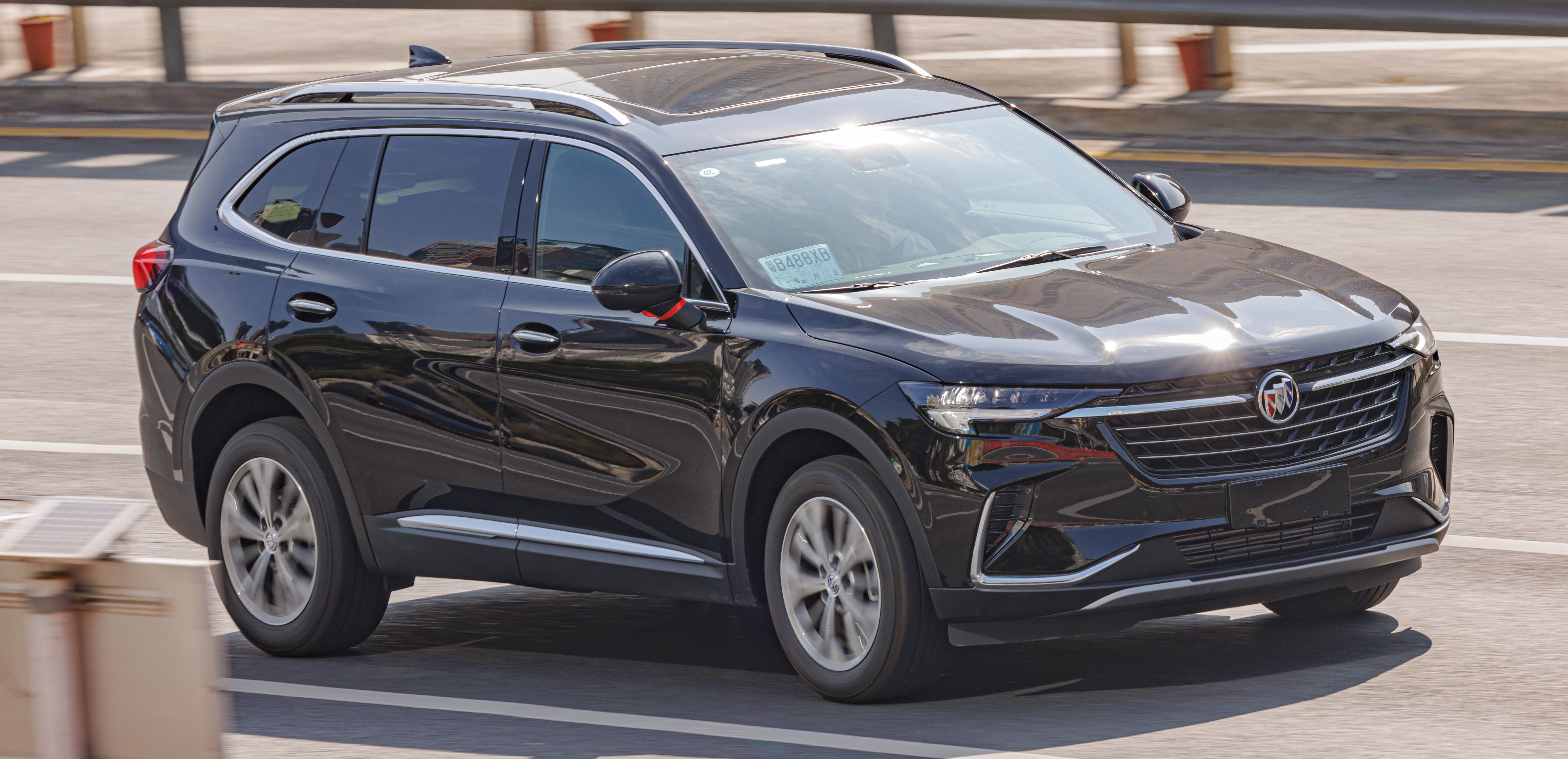
The Buick Envision is a small SUV made by Buick. It's designed to be comfortable and has many modern features that make driving easier and more enjoyable.
CAFE standards are rules that help make cars use less fuel. They set goals for how many miles a car should drive on a gallon of gas, which helps save energy and protect the environment.
The Chevrolet Equinox is a type of vehicle known as a compact SUV. It's designed to be spacious and comfortable, making it a popular choice for families.
The Chevy Trailblazer is another small SUV from Chevrolet. It's a bit larger than the Trax and offers more space and features for passengers and cargo.
Bunker fuel is a type of fuel used by cargo ships and large boats. It's very thick and can cause a lot of pollution when it's burned, which is why it's considered dirty fuel.
Congestion pricing means you have to pay to drive in busy areas, especially when there's a lot of traffic. It helps reduce traffic jams and encourages people to use public transport or electric cars instead.
A plug-in hybrid is a car that can run on both electricity and gasoline. You can charge it by plugging it in, and it can drive a certain distance using just electricity before it uses gas.
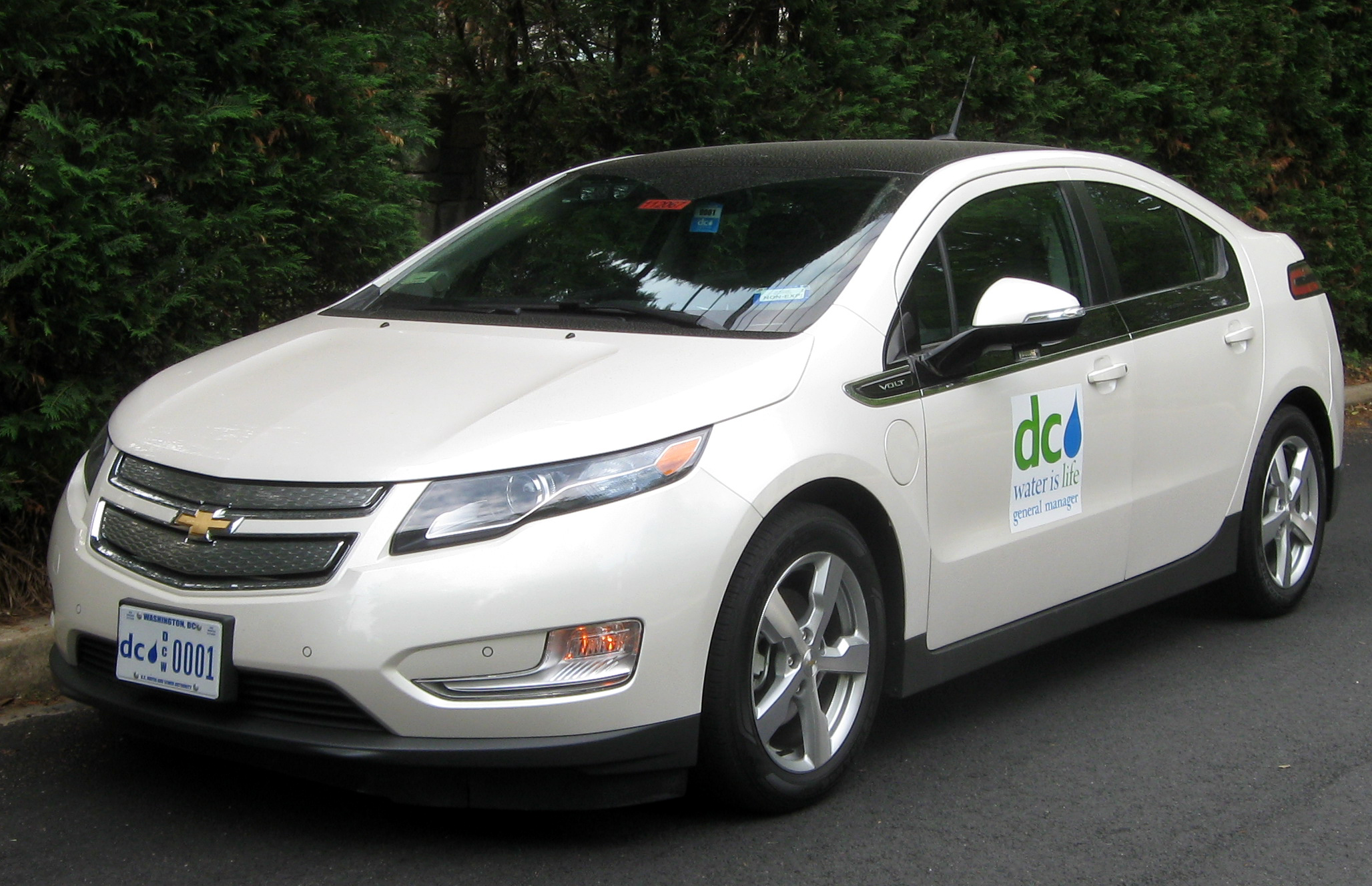
The Chevrolet Volt is a car that can run on electricity or gasoline. It was designed to save fuel by using electricity when possible and switching to gas when needed.
The Volkswagen ID. Buzz is a new electric van that looks like the old VW buses people loved in the past. It's designed to be eco-friendly and is great for families or anyone who needs a lot of space.
Car
Ford Mach-E
The Ford Mach-E is a new electric SUV from Ford that offers a sporty design and electric performance, similar to their Mustang cars.
ISO 15118 is a set of rules that helps electric cars and charging stations talk to each other. It makes charging easier for drivers by allowing them to just plug in and start charging without complicated steps.
The Nissan Leaf is an electric car made by Nissan. It's popular because it's affordable and practical for everyday use, making it a good choice for many drivers looking to go electric.
The Dodge Charger is a big car that looks sporty and can go really fast. People like it because it has a lot of power and is fun to drive, even though it's also a four-door sedan that can fit the whole family.
An EV, or electric vehicle, is a type of car that runs on electricity instead of gas. They are better for the environment and can save you money on fuel.
The Ford Mustang Mach-E is an electric SUV that carries the Mustang name. It’s designed to be fast and fun to drive, just like the classic Mustang cars, but it runs on electricity instead of gas.
The Hyundai Ioniq 5 is a new electric car that looks stylish and has a lot of tech features. It's popular because it can be customized in different ways.
The Toyota Corolla is a small car that many people buy because it's dependable and doesn't use too much gas. It's a great choice for anyone looking for a simple, easy-to-drive vehicle.
The Tesla Model S is a fancy electric car that can go really far on a single charge. It's known for being high-tech and can even drive itself a little bit, which makes it very popular among people who want something modern and eco-friendly.
The Volkswagen Tiguan is a small SUV that has a lot of space inside for people and their stuff. It's a good choice for families because it's comfortable and has some cool technology to help keep everyone safe.
Mazda is a car company that makes cars that are fun to drive and often look stylish. They are known for being a bit different from other brands, and some of their cars are very light, which helps them go faster.
LIVE
This is the What Car Evie podcast for Thursday, January 29th, 2026, episode 255.
The Bolt Shall Live Again.
Or maybe it won't.
Forgive us if we talk about the same thing this week that we talked about last week.
I don't think we did, but maybe we did.
This is the problem.
So, item number one on the rundown here, I'm like, I've talked to somebody about this,
and we texted, Ed and I have texted each other about this.
And it seems so familiar to me, and I'm like, I don't know if we've talked about it or
not, and you know, I'm not going to go back and listen to last week's episode, that's
old news, so.
Always forward.
Yeah, even if it means we can't remember what's behind us.
Who's we?
I'm Phil Royal.
What's that?
Who's we?
Oh, yeah.
Okay.
That's where I was going to.
I'm Phil Royal.
I am one of the co-hosts here.
I am one of the people that points you to youtube.com slash at the What Car, so you can see our
smiling faces instead of listening to the audio, the yucky yucky audio only version.
And I also should send people to the whatcar.com slash store to buy paraphernalia, even though
I keep threatening to take that down.
That term sounds so dirty for some reason.
Paraphernalia?
Anyway, it's not moist paraphernalia.
For what?
I don't know.
I used to, I used to say what my experience was, go back like 30 episodes and listen to
the intro there and you'll hear that I've been around the block.
I don't know.
That also sounds dirty.
Anyway, at Sanchez, been around the block a few times myself.
Anyway, but we've been doing the podcast audio for more than five years and I think video
for, I want to say over a year now.
I don't know exactly, but I think so.
Sounds about right.
Yeah.
Anyway, so here we are once again talking about the wild, wild world of EVs and some interesting
developments last week that we'll jump right into.
Will we?
Okay.
I guess I should pull the notes up.
We will.
Okay.
So the first item, stop me if you've heard this one.
You can fast forward like a minute or two if we did indeed.
Talk about this last week.
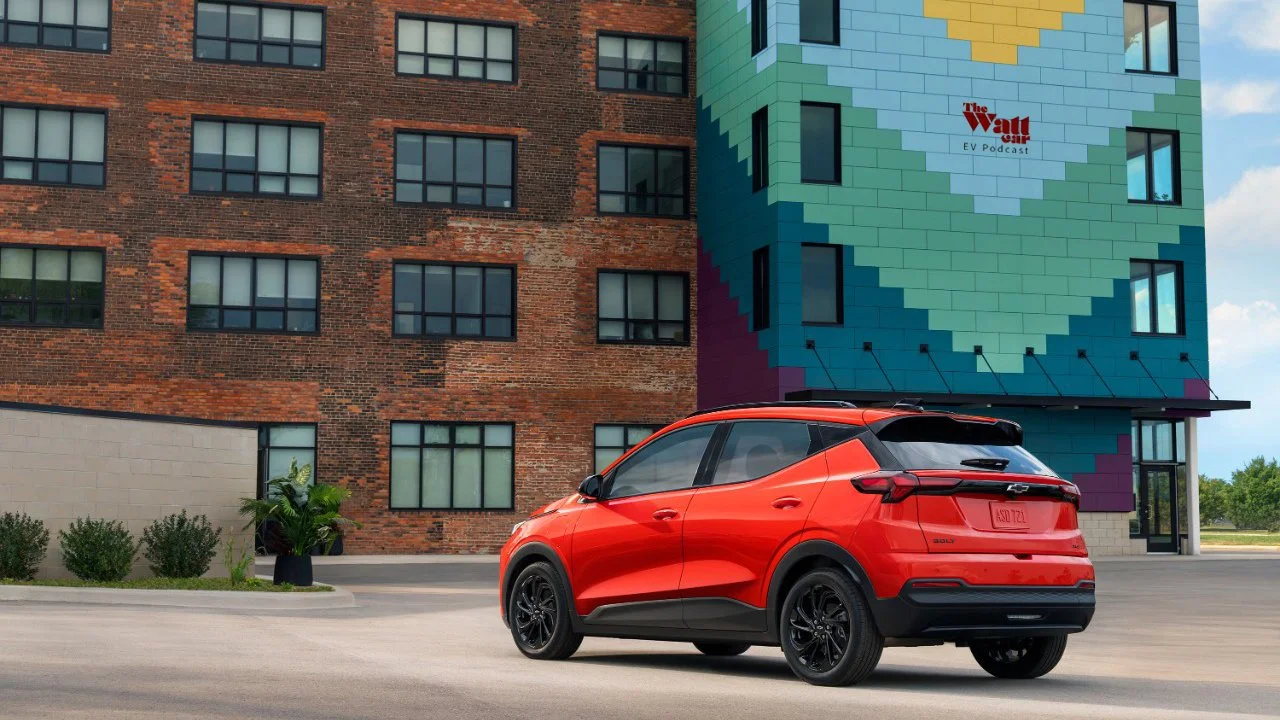
The bolt, the Chevy Bolt was dead.
No, it was alive.
It was good.
Before it was dead.
Then it was dead.
Then it was alive and now it's dead.
I'm sure we've talked about this.
I'm so sure that we've talked about this.
I think I know where you might have gotten that from.
Because you remember GM said it was a limited time offer.
Yeah.
They were bringing it back for a limited time, but they didn't elaborate on that at the time.
Yeah.
Anyway, so they're killing it because the, I guess they need the manufacturing plant to
bring Buick back to America.
So clarify they're killing it again.
Killing it again.
Okay.
So yes.
So they had it.
What was that again?
It's alive.
Then they killed it.
I think what was it last year?
Like 24, 25?
Well, and it also tried to kill itself, remember, back in the day.
Massive battery recall.
Yeah.
Yeah.
The bolts tried to burn themselves off of this planet.
And so then they stopped production and they started production again.
I can still find bolts for sale that don't have the battery replacements that people
are saying that you can like apply for it or something.
I don't even know.
Like I would have thought that's long gone.
But anyway, I recently in the last like couple of weeks, I would say caveat emptor.
Yeah.
Yeah.
So they're taking the manufacturing plant, which is where in Kentucky, Kansas, I think.
Okay.
Kansas.
Kansas, I want to say.
And they are making the China, the currently China built Buick Envision Envision Envision
and it turns out Sherry the Chevy Equinox will be manufactured at this place.
So there is they can't, okay, Buick sold 42,000 envisions last year and in 2023, which is
last time that the bolt had full production, they sold 62,000 bolts.
So I guess this plant can produce about as many Buick's as they need.
And then I guess they'll use the extra manufacturing capacity for the, for the, well, I mean, on
the surface, this seems kind of counterintuitive since they sold more bolts than envisions.
But I guess they scale back in vision production because I'm assuming it was being affected
by the China tariffs.
Even though it's not an EV, which was 100%, but I still think even the ice or maybe the
100% tariff was across the board, maybe it was all vehicles.
It's impossible to know.
I thought it singled out EVs.
I don't know.
Anyway, but it was hit with enough of a tariff, I guess, that GM kind of penciled it out and
said it'd make more sense if we built this in the US.
Well, and the $7,500 tax credits gone.
So the EV is now going to be even more expensive.
That means if they want to offer lower pricing on that to sell the EVs and they're going
to be getting less profit.
And I imagine the Buick is pretty cheap to assemble.
And they could probably make more profit.
Basically, they can just they've got the ability to scale up on something that is an
affordable product that they can sell cheap, manufacture even cheaper.
And it's an easy slam dunk.
And all the CAFE standards or whatever, the EPA requirements are like out the window now.
So at least for the next couple of years.
Yeah. So they don't need to.
So anyway, did we talk about that?
If we did talk about that last week, tell us how dumb we are down in the comments on
the YouTube channel.
We'll take better notes than we did in the last week's episode.
Yeah. So yeah, I don't know if there's much to say about this.
I mean, other than the fact that GM really hyped up the reintroduction of the bolt and
then there just as soon as they brought it back, they're killing it again.
So classic GM move.
But so I will say considering they've killed it, they've created it, killed it,
created it, killed it, created it again and now killed it again, that the bolt will live
again at some point in the future.
It has a really good track record of not being dead yet.
Yeah, I who knows?
I mean, obviously, almost all automakers are always seeking higher margins.
And even though consumers want low cost TVs, the OEMs don't like them because they don't
they don't make good margins on them.
So they'd rather sell you a more expensive crossover or, you know, SUV or whatever.
But anyway, so we'll see.
Yeah. But my bet is it will come back in some form at some point.
I would say as an SUV, since everything goes away and comes back as an SUV,
but this one kind of started as a crossover.
I mean, I think there's room if you look at GM's overall product lineup,
there's room for something smaller than the Equinox, even if you're talking about
like EVs. So there's an Equinox CV and a gas or ICV not related in anything other than name.
The EV model is actually a little bit bigger than the ICE model.
So right now, GM has their kind of entry level.
I guess you'd call it a B segment crossover.
The Chevy tracks, then, you know, Buick has a couple of variants.
Actually, Chevy has a couple.
The trailblazer and the tracks, they're two kind of variants of the same model.
And then Buick has the Envision and the.
They're all in something on on core, I think this is straightforward or easy.
Anyway, so I mean, from like a marketing packaging standpoint,
there's room for something smaller than the Equinox.
They need more models and to subdivide existing subdivisions
of segments that they've already subdivided.
That's what they need to do.
Yes, that's definitely that's the name of the game, I guess.
So anyway, so yeah, so rip bolt, but we'll probably rise again someday.
Anyway, I'll tell you what else is rising is EV sales in Europe.
So I kind of had to unpack this a little bit because
if you look at the pure numbers on this, it's a little misleading,
but I think I kind of figured out how they got to the the headline they got to.
So all right, so I'm packing a little bit.
Yeah, no, go for it because I see it's not straightforward.
No, but tell me not really.
So the headline that that's it was reported in, you know,
Reuters and of course, like most news outlets now are paywall.
So I just went straight to the source.
So I figured why not, which was not paywall.
So it says the headline is electrified vehicles.
Some even say like EVs outsell ice for in Europe for the first time.
But then you look at the infographics and you look at the figures
and you're like, OK, how are they?
How are they slicing and dicing this?
So this, but I was able to find a breakdown like per segment
and the percentage of each segment.
And then if you put it together, it kind of it kind of makes that narrative.
But it's a little like, you know, same goes.
It depends on what your definition of is, is so anyway.
OK, so I'm just going to go down the categories and the percentages.
And then we'll get to how they came to that conclusion.
So this is vehicle segmentation.
New car sales in Europe for 2025.
So what they call petrol or Americans would call gas cars was 26.6 percent.
Especially for an EV, like, I mean, I guess 3,000 pounds is fine.
So you being a former Miata owner, so for you for it to get any cred in your book,
it would be like 20, 2,500 pounds.
Or I mean, what's, I guess, what's your benchmark for being like impressed?
Okay.
So I don't know.
But the first Miata comes out and it's like 21, 2,200 pounds.
The NA.
Then the second gen of the NA comes out and it was a little bit heavier.
I don't remember any of the numbers, but it was like, say, 2,300.
Then the NB comes out and it was like 2,350, something like that.
And then the NC comes out and it was like 2,600 or 2,700.
Yeah, so it really poked up.
It failed.
Nobody wanted it until it hit like five years old on the used market
where people could actually like buy them for cheaper.
Nobody was buying those things.
Nobody was racing them.
Nothing because it hit that 26 or 2,700 pound mark.
And it was like, it's not fun anymore.
So they come out with the ND and the ND goes back to like 2,350, 2,400 pounds.
And that sells like gangbusters.
But loaded Miata's are pushing 40 grand now.
Yeah.
Yeah.
I mean, I don't know if you do inflation adjustment where that is.
Oh, the first I saw something about that with Miata's in the first gen one
was like significantly more expensive than the current one is for now.
Oh, inflation adjustment.
Yeah.
Yeah, it's quite wild.
But 3,000 pounds is a lot for a small two-seater sports car.
I mean, I'm not.
It's a lot.
I'm not disputing that, but it's moving in the right direction.
I mean, personally, like I said, I think I would be impressed if Mazda were to do a Miata EV
and they were able to get it like 2,800 pounds.
2,800 pounds, let's say 35 grand, 250 mile range.
I'd be like.
Yeah.
I think 2,800 pounds, you start the conversation.
I think you're right.
I think that's in the range.
But 3,000, you're like, yeah.
But well, when they came out with, I think it was the ND,
that they were saying we trimmed everything.
Weight was such it's their whatever.
I forget the term for their with it.
Like you're they look at every ounce and they were they were like,
we cut six ounces out of the rear view mirror.
We cut, you know, when they went around and they tell you, I remember even like the dipstick,
they it's like on the ND, it's like supposedly like a wire.
Yeah.
The first I went on the ND long lead and because they invite me, but not Volkswagen,
not Volkswagen.
But there, the car that I was sat in driving around for a couple of days was the seat,
which they eventually rectified was basically like a hammock.
It was like mesh that went across because they cut out all the weight that they could
and my back was killing me.
Yeah.
But so you think they went too far in pursuit of trying to I think they got it about right
for what the car is.
But what I'm my point is, is that they were they were chasing ounces them.
How do you do that with a giant battery pack?
It kind of is what it is.
So there is no there you can do all of that.
But at the end of the day, you've got like a 1500 pounds skateboard underneath car
is just what it is.
And you're not cutting ounces out of that.
So they're going to have a really hard time getting down there.
Yeah.
And maybe solid stays the answer and maybe they get there.
But I don't know if Mazda is the one that's going to be able to do it unless they get
consumed by Toyota or a Chinese company.
Yeah, possibly.
Let's call it a day because this is the longest episode we have had for a while.
And I need to get out of here to do.
Like so.
Yeah.
Show notes.
Links can be found in the show notes.
Where are the show notes?
They are somewhere in your phone.
The files are in the computer.
Just watch.
You get that reference.
I was getting I was in a office, whatever.
Long story.
Anyway, they were showing Zoolander.
So I watched Zoolander.
It was awesome.
Um, I don't remember what else I was talking about.
And I just like popped my piece there.
So, oh, store.
Thewatercar.com slash store.
Buy some merchandise.
Go back if you listen to this episode and watch the episode.
YouTube.com slash at the what car.
We're on social medias.
Share us.
It's about all I was thinking of getting off of certain ones.
We're on blue sky.
We're on threads.
I don't do anything with that.
I just post stuff.
I'm like, why even have the account?
So I maybe YouTube is where it's at.
Yeah.
It's like YouTube and maybe Instagram,
although we need to start putting our shorts on Instagram as well.
I think I think that'll be our next move.
I'll talk to our show social media manager and make that happen.
We'll see what could happen next week is more of the same.
I got to end this before we hit one hour
because we're getting out of control with these episodes.
And somebody needs to listen.
All right.
See you.
About this episode
The episode dives into the tumultuous fate of the Chevy Bolt, which has seen a rollercoaster of production highs and lows, now facing another potential discontinuation. The hosts discuss the implications of GM's decisions, the rise of EV sales in Europe, and the impact of changing tariffs on the EV market. They also touch on California's increasing EV market share and the latest developments in charging infrastructure, including GM's new partnership with Electrify America. The episode wraps up with insights on solid-state batteries and the future of EVs.
The Bolt is back, but not for long. This time, Chevy is killing its affordable EV to make room for Buick production. Is this the right move? We ponder the decision on this week’s podcast. We also discuss GM’s plug-and-charge compatibility with Electrify America, air quality shifts due to EV adoption, and more.