The Nissan Rogue is another type of SUV that is smaller than the Highlander but still has plenty of room for people and their stuff. It's known for being easy to drive and having good safety ratings.
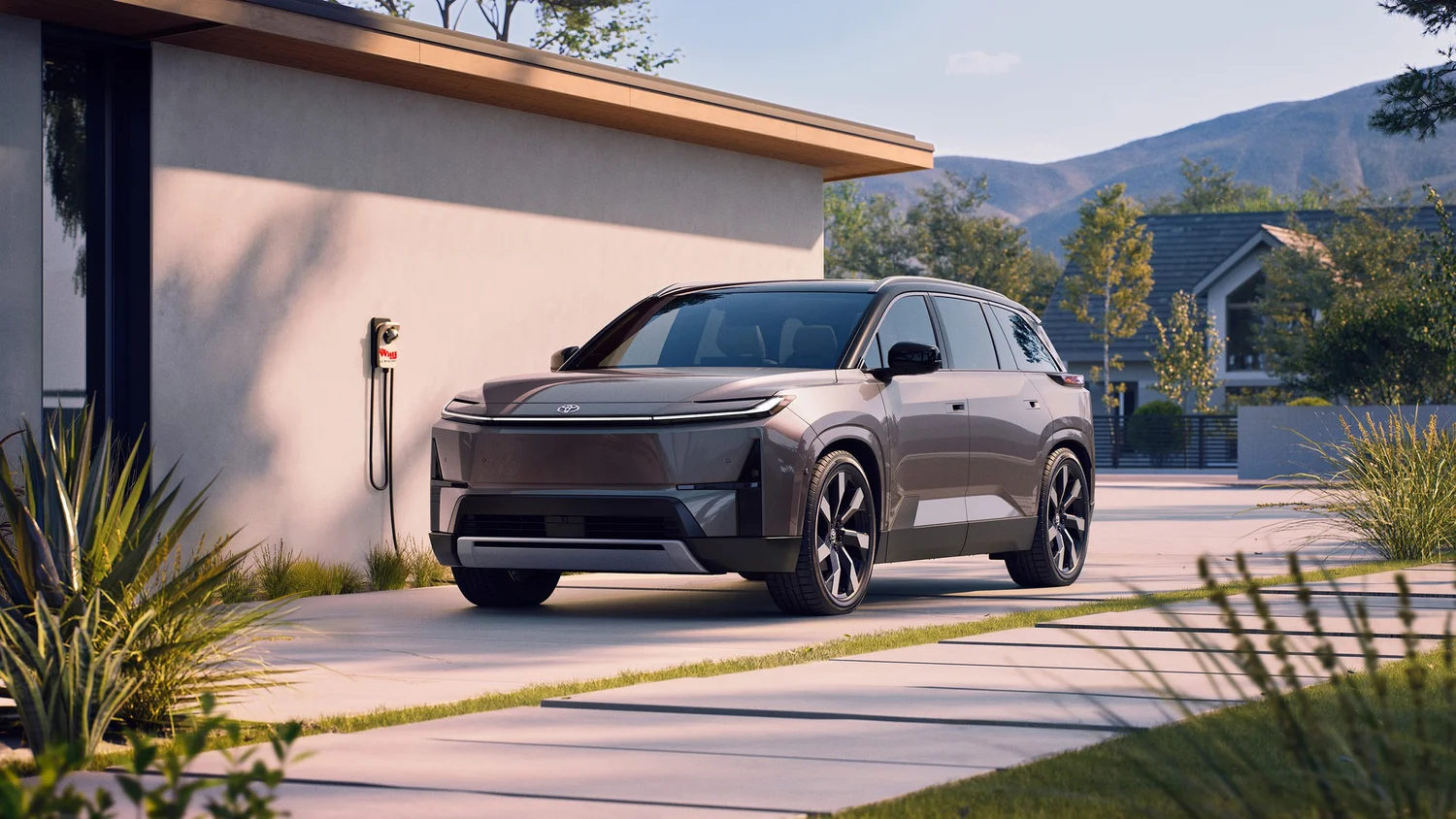
The Toyota Highlander is a type of SUV that has a lot of space inside for passengers and cargo. It's a popular choice for families because it's reliable and comfortable.
The Toyota Land Cruiser is a big, tough SUV that can handle rough roads and off-road adventures. It's popular because it's built to last and can carry a lot of people and gear.
The Toyota Grand Highlander is a bigger version of the Highlander SUV, designed for families who need extra space for passengers and luggage. It's a great choice for those who want more room in their vehicle.
An electric vehicle, or EV, is a type of car that runs on electricity instead of gasoline. They are better for the environment because they produce less pollution.
EV means Electric Vehicle. It's a car that runs on electricity instead of gasoline, and it's part of a growing trend to make cars more environmentally friendly.
The Mercedes-Benz SL is a fancy convertible car that is both stylish and fast. It's designed for people who want a comfortable ride with a touch of luxury.
The Tesla Model Y is an electric SUV that doesn’t need gas to run. It's known for being roomy and having cool tech features, making it a popular choice for families.
The Tesla Model 3 Performance is a fast electric car that can go from 0 to 60 mph quickly. It's part of Tesla's lineup of electric vehicles and has many tech features.
A supercharger is a fast charging station for electric cars. It helps you charge your car quickly, so you can continue your journey without waiting too long.
A plug-in hybrid is a car that can use both electricity and gasoline. You can charge it by plugging it in, and it can drive a certain distance on just electricity before it needs to use gas.
Level two charging is a way to charge electric cars faster than using regular home outlets. It uses a special 240-volt outlet, which helps you get more power to your car in less time.
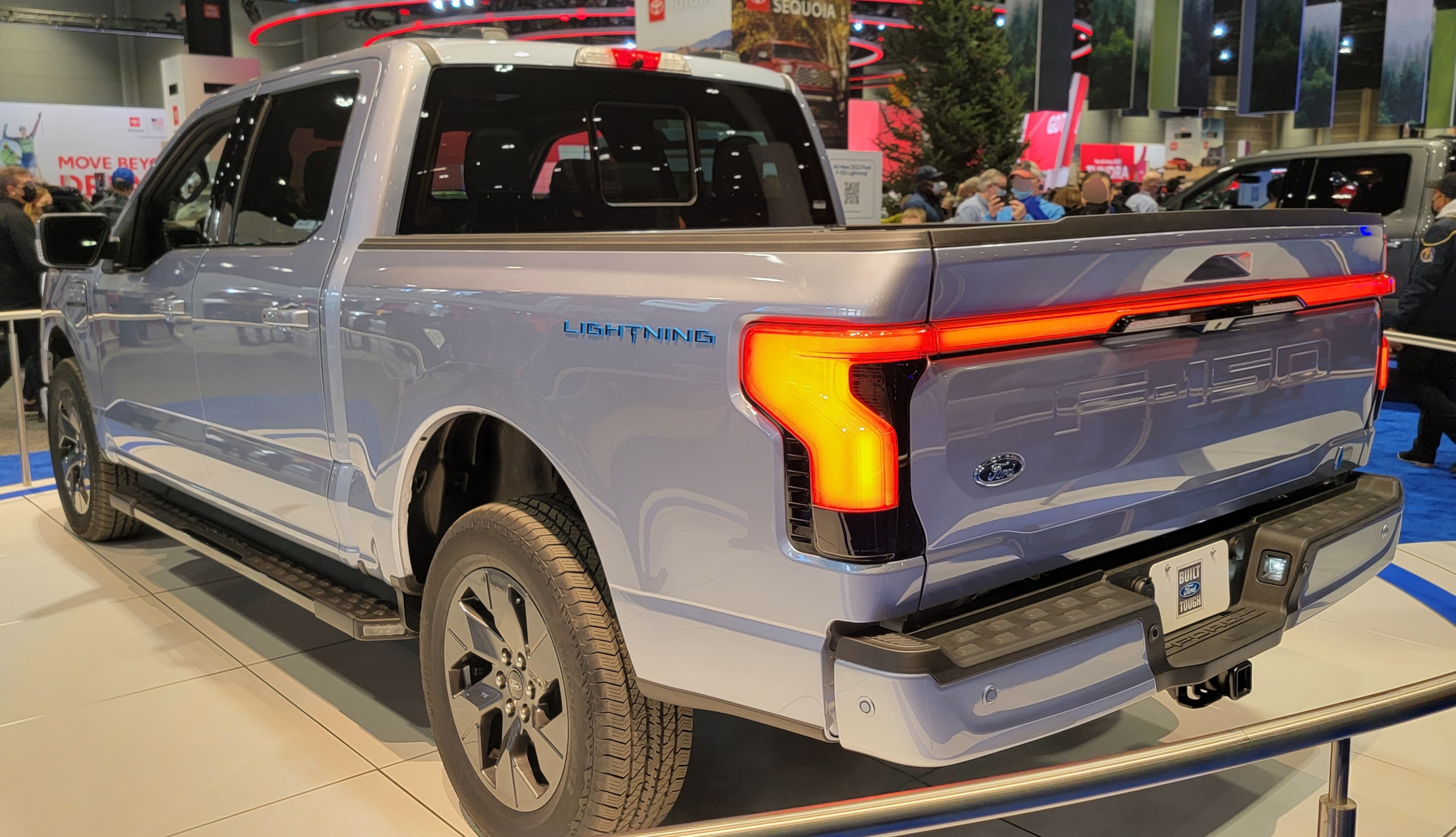
The Ford F-150 Lightning is an electric truck that can be used for many purposes, just like a regular truck, but it runs on electricity instead of gasoline.
Level one charging means plugging your electric car into a regular wall outlet at home. It's the slowest way to charge, so it takes a long time to fill up the battery.
The Tesla Semi is a large electric truck made by Tesla. It's designed to carry heavy loads and is part of the move towards electric vehicles in the trucking industry.
'Range' is how far an electric car can go before it needs to be charged again. It's an important number for people who want to know if they can drive their car far enough without running out of power.
'Tesla miles' means that some people think Tesla says their cars can go further on a charge than they actually can in real life. It's a way of questioning the company's honesty about how far their cars can really drive.
Torque is a way to measure how strong an engine is when it comes to turning things. More torque means the engine can pull heavier loads or accelerate faster.
A kilowatt hour is a way to measure how much electricity is used. If you use a lot of power for a short time, or a little power for a long time, it all adds up to kilowatt hours.
The Ford F-150 is a popular pickup truck that can carry heavy loads and tow trailers. It's known for being tough and useful for both work and everyday driving.
The Chevrolet Silverado EV is an electric truck that doesn't use gas. It's made for people who need a tough truck but want to be kinder to the environment.
The Tesla Cybertruck is an electric truck that looks very different from regular trucks. It's designed to be strong and useful for many tasks, and people are excited about its unique style.
The Tesla Model S is a fancy electric car that can go really fast and drive a long way on a single charge. It's one of the first electric cars that made people excited about going electric.
The Subaru SVX is a cool-looking sports car from the 90s that stands out because of its unusual design. It's loved by fans for its fun driving experience.
The Chevrolet Corvette is a fast sports car that many people love for its cool looks and speed. The newest version has a special engine design that makes it even better to drive.
The Infiniti Q50 is a nice luxury car that feels comfortable and has lots of tech features. It's a good choice for people who want a stylish and smooth ride.
The Ferrari Luce is a new electric car from Ferrari, showing that they are making cars that are better for the environment. The name change means they are focusing on a fresh start with this model.
The Pontiac Fiero is a small sports car from the 80s that was different from most cars because its engine was in the middle. It's now a classic car that some people really like.
LIVE
This is the What Car Evie Podcast for Thursday, February 12th, 2026, episode 257.
When will then be now?
If all goes to hell during this podcast.
Which is a possibility.
And it's all Ed's fault.
Because, well, is it your fault or is it the power company's fault?
It's the...
Or the housing association.
Well, probably my geographic vulnerability.
We're prone to outages and interruptions here.
Anyway, we started this podcast.
We didn't even make it to the podcast before Ed had a power outage.
And hopefully there's enough juice in the lines to get us through the next 45 minutes.
That gone for now.
I could plug back into my anchor, but...
Well, we may end up finishing this on that.
I am Phil Royal.
I am one of the podcast hosts here.
And I'm also the person that says go to youtube.com slash at the What Car instead of listening
to us.
So then you can see our beautiful smiling faces.
And this week, I am presented in more light.
Because I am trying a new bulb out in front of me.
I just noticed that actually.
Yeah, I'm really...
I was going to say I'm really dark.
No, I'm like the pastiest white guy you'll find.
But I'm...
I look like one of...
Normally I look like one of those old TV, like on 60 minutes where they shadow the person
and then they garble the voice.
Like that's how I kind of look before.
So I'm trying a new light.
We'll see.
I don't know.
We'll try out different options.
So that was youtube.com slash at the What Car.
I also say go to the whatcar.com slash store where you can buy a What Car paraphernalia
and help support the podcast because this podcast is brought to you by us.
Because we also have other t-shirts there, EVAF, Charge, Hydrogen is Future and Always
Will Be.
Hopefully soon there'll be a...
What was the one that I keep forgetting to make?
Well, Solid State.
Solid State Batteries of the Future and Always Will Be.
Maybe...
Leave a comment down below if you're watching youtube.
Tell me if you want that shirt.
And I will make it and you will order it and you will help support the podcast.
Ed.
Ed Sanchez.
Because I'm owner of probably far larger ring light than I need, but my face is well illuminated.
I bring to the table, I don't know, my reasoned opinion and expertise on various topics for
whatever that's worth, experience and automotive content creation and bring you a grab bag
of many different topics this week, many of which just broke in the last couple days.
So it should be an interesting discussion today.
Maybe if you're into things like Toyota Highlanders and Nissan Rogues, which we've already lost
half the audience.
Ed.
Ed.
Ed.
Ed.
Ed.
Ed.
Ed.
Ed.
Ed.
Ed.
Ed.
Ed.
So, over the past, I don't know, about a month or so, Toyota's been teasing these photos
of like, you know, a taillight strip and this and that, and people were speculating,
oh, what is this?
This mysterious new model.
And then I guess a couple days ago, they showed a video kind of showing a little, the rear
corner, and it said Highlander.
And I don't know if you've noticed the new Toyota badging, but like there are hybrids
or nonplugins, say HEV, and the plug-in hybrids, PHEV.
And this one said BEV, which is a new one.
So well, in Toyota land, that could just mean it has a battery, not that it's a 12-volt
battery.
Yes.
Anyway, the speculation is this has not yet been confirmed, but that for 2027, the Highlander
will be EV only, which for Toyota is like, what, the last thing you'd expect to hear
from them.
However, if you still want hybrid or internal combustion, don't forget they also have a
model called the Grand Highlander now, which is a little bit bigger, slightly stretch wheelbase.
More grand.
More grand.
So anyway, so if you're going to, you know, if you're culling it on to gasoline with your
cold dead hands, they'll still have the Grand Highlander supposedly.
Other than that, we don't have a whole lot of info on this.
Speculation is going to be probably 80 to 90 kilowatt hour battery.
If I had to guess, I'd say 300-ish range, give or take.
Power output, I'm guessing around the 400 horsepower, maybe I'd say 350 to 400.
But again, nothing confirmed yet.
So anyway, but this would, this would be a big, big change historically for Toyota.
So I would say with your spec, which we will already know by the time this comes out, what's
the point?
But I would say based on what your specs are, where you're like, and you set all those numbers
and that all sounds great, prepare to be disappointed because if Toyota can do anything, it's come
in slightly under what you're expecting.
So it could be 270 mile range and charges at a 140 kilowatt rate and like, it'll just
come in, it'll come in below what you want.
You don't think they learned their lesson with the BZ4X?
No, but I was thinking that this would be the BZ4X replacement then, or BZ replacement.
No, Highlander's a little bigger.
The BZ is kind of in a weird, I mean, some people says kind of like the EV RAV4, but
size-wise, it's kind of in between the RAV and the Highlander, the BZ is.
So I don't think this is going to replace the BZ, I mean, maybe.
So could this be the death knoll for the BZ in the way that if they take Highlander fully
V is the next one, the RAV4 to go fully, to have a fully V version and then the BZ is gone.
I think more likely is they may rebrand the BZ as the RAV4 BEV.
Well, either way, either way, the name being gone, like this is the end of the beginning
of the end for the BZ badge.
Yeah, I see BZ ultimately going away because it's confusing.
It doesn't have a whole lot of recognition.
I mean, RAV4 is, you know, depending on the quarter, the first or second best-selling
non-truck in the world.
Yeah, and I can't imagine them doing EV only for that.
I could see that being hybrid plug-in and fully V, but I could certainly see this if
they're taking the name Highlander and they're going to say EV, even if it's not EV only,
even if it's EV and a nice version or hybrid or plug-in or whatever.
I kind of think that's the writing on the wall for BZ, that RAV4 is next and BZ name is gone.
My guess is BZ is ultimately going away and how soon, who knows, but yeah.
But I don't think this will be like revolutionary, solid state, blah, blah, blah.
It's Toyota, expect to be slightly disappointed.
It'll still be great.
It'll still be solid.
I want Toyota, I think Toyota is the one that can win all of this, but they do it by conservative progression.
Yes, however, that being said, I don't disagree with you fully, but I think they kind of
learned their lesson with the BZ4X.
Did they?
Because, well, I mean, they will fix this by dropping the 4X from the back.
Well, the specs on the refresh, I think were pretty substantive upgrade from, you know,
the model they introduced.
I mean, enough where, you know, the first gen, I was like, don't even bother, not worth it.
It's pretty universal.
Everybody said that.
Yeah, the refresh, it's like, OK, well, now it's actually somewhat competitive.
So I mean, who knows, I don't know, but we will find out more tonight.
We will talk about it more next week, I'm sure.
When then will be now.
When then will be now, yes.
So speaking of more SUVs with the plug.
We're going to find out the age of the listeners here as to know if they have any
idea if I'm just talking gibberish or if people know what I'm what I'm referencing.
What were you speaking?
Were you talking about something else?
I'm still I'm still off thinking about space balls.
OK, Nissan announces rogue P have pricing.
Yes. So speaking of being under underwhelmed or overwhelmed, I guess,
depending on your perspective, starting at 47,485 for the SL trim
and 51,485 for the platinum grade, the fancy model.
Considering this is basically a decontented outlander P have, I'm like.
I was going to ask, how does the price compare?
I believe it or not.
I think the outlander is slightly more expensive, actually,
which doesn't speak for who for the value proposition that in my mind, but.
You know, so just just for, well, this is a family show, so I don't want to
drop too many bombs here, but I was going to say for something in giggles.
I'll let you fill in the blind smiles and giggles smiles and giggles.
There you go.
I can I looked up Model Y pricing.
So and I started, I didn't start with the base model because that's kind of
universally, I shouldn't say we're vile.
That's too strong a term, but a lot of people are like, don't bother.
It's it's too decontented.
It's too cheap.
So I started at the premium rear wheel drive as the first step on that ladder.
So Model Y premium rear wheel drives, forty four and nine ninety.
So basically forty five premium all wheel drive, forty eight nine ninety.
So we'll call that forty nine and the performance all wheel drive, fifty seven
four ninety, we'll call that fifty eight.
So, you know, and I know some of you say, oh, well, you know, it's apples
and oranges, one's a plug in hybrid, one's fully V.
But honestly, for that price range, I think they might possibly be
crushed up a little bit and I'm sorry.
I just, you know, you call me a Stan or a fanboy.
I still feel the Model Y is much more desirable than a rogue.
One of my neighbors has an interesting problem.
Yeah, he bought a Model 3 performance used last year, maybe.
And since then, he has started construction on his or not really construction,
but redoing the front and back yard.
And it's turned into a contractor nightmare.
There's lawsuits, there's all sorts.
He's not allowed to finish his yard at this point until this gets resolved.
So he has no driveway, he has no front yard.
He has half a backyard and he can't touch any of it until the legal aspect is resolved.
He cannot park his Model 3 on the driveway and his cable will not reach his car on the street.
So he has to charge at the superchargers and there's one five minutes from the house and that's fine.
Also, his wife, who it's her car, got a new job and is now driving 40-something miles into L.A.
and 40-something miles back in stop-start traffic.
And if she leaves the house at like 65 to 70 percent, she gets back at like 30 or 35 percent.
Something like that.
Without charging?
Without charging, but has no home charger.
So now they have to go.
They can't even try to level one with the thing and she's going in every single day, so it simply wouldn't work.
So now they've got to go to the supercharger and he's now in a situation where it's like, does this car work for us?
So back to the Rogue and the Model Y and yes, I could see that you would go,
oh, the premium all-wheel drive is the same price as like a base model Rogue Pee-Hav.
But they have now, their life has changed a lot in the last year.
And suddenly he's there, when I was talking with the other a couple days ago, he was going like,
I don't know if EVs are for me, like at this point.
Which is what the situation is.
They just put all the solar on their house, like, and then everything has changed.
Well, not until they can access, you know, their garage.
Yeah, when they can, if they could park in their driveway, that changes that.
But they're in the middle of, like, they don't know.
They have no idea at this point.
And it's unfortunate that you could spend $49,000,
have one thing, or in that case, do things change in their life,
and suddenly a plug-in hybrid is the better answer.
Okay, I will grant you that.
I will grant you that plug-in hybrids make more sense for some people.
And I don't want it to sound like I'm just-
And you don't even need to charge them.
I know that's a pet peeve of yours.
Yeah, and I don't want to sound like I'm just dumping on Nissan,
but the Rogue would not be my first choice.
Oh yeah, I'm with you.
Getting, I mean, if we're going to come full circle with Toyota,
I think I would probably do a RAV4 plug-in hybrid over Rogue.
I mean, for a variety of reasons.
I'm not saying the Rogue is necessarily a bad car,
but it wouldn't be first, it wouldn't be top of mind for me
if I was shopping for that category of vehicle.
Yeah. No, I'm with you.
I'm with you on that.
And I'm not saying EVs are not the answer.
I'm just saying where you're going,
well, the Rogue, it's uphill battle because just compared to the Model Y,
and I'm going just in one use case here from a guy that I know down the street,
he is in a situation where all of a sudden,
the EV looks like the mistake at this point.
No, again, I'm not, this is more,
it's more model specific than Phev versus EV.
Like I would say for that circumstance,
yes, a Phev might make more sense,
or even just a standard hybrid for that matter.
Yeah. And I would say given the choice between the Rogue and the Model Y,
premium might take the Model Y.
Yeah, I mean, come on, let's be honest.
But it is interesting how real life steps in,
and all of a sudden, you've got something that doesn't make sense.
This reminds me, and we've discussed this ad nauseam in the past,
but people that say you can get away with the level one treasure at home.
Yeah, I could, but I don't go anywhere.
Yeah. Well, if you're work from home, yeah, you could.
I've been consistent in saying the optimal EV ownership experience,
I would say requires, I'll die on that hell.
I would say requires level two, 240 volt home charging.
For no sweat, no, really no compromise experience.
Because, I mean, now, granted, I mean,
let's say you just did a long round trip commute,
you just got a call, grandma went to the hospital, your wife's in labor, whatever.
All at the same time.
30 miles away. Yeah, okay, then it's like, oh crap, what do I do?
Thankfully, in California, there's enough superchargers where it's kind of like,
you'll figure something.
Yeah.
But with the level two, I mean, almost the only type of vehicle that would kind of stretch
this case would be like a long range lightning or a Hummer EV.
Because I think even at a 50 amp outlet, I still think that they're like 13 or 14 hours
overnight charge.
For my car, it's like six hours overnight or seven.
Even on 30 amp, it's like, I think 30 amp is like 10.
It was 50 amp.
Well, my max is out at 32 anyway, but basically, plug it in when you get home,
wake up the next day, full charge.
No sweat.
Level one, you're, you know, depending on your state of charge when you come home,
it could be two to three days.
Yeah, when I had several EVs that I was testing, and I tried to charge one here, and my
You tripped the brake.
Yeah, I kept tripping the breaker.
So I was trying level one, and it was not, it wasn't doable.
So I drove the car down through my bicycle in the back, drove like a mile from me to charge it at
a level two, a public level two, and then just rode my bike back.
And then like six hours later, and at least it restarted the cycle.
And then I could go for multiple days with a level one at that point, just kind of trickling
the little bit of driving that I do.
I think we've, we've talked about all that before, but it never hurts to talk about it again.
So go out, buy yourself a road.
TLDR, no TLDR, if you want an EV, have access to a 240 volt charging at or near your home.
Yeah, I'll tell you something, it would take a very long time to charge on a level one.
I think possibly in, and we're talking to order of weeks, potentially.
I was thinking longer than that, but mentioned this one in months.
Possibly months.
In fact, I'm waiting when this finally, finally gets out.
I can't wait for the first YouTuber to try to plug it on a home,
charge it on a home wall outlet.
Yeah.
See how long it takes.
All right, what are we talking about?
Tesla.
The Tesla Semi.
All right.
So they recently styled it.
I don't know if you saw the, so they kind of re-styled the styling a little bit.
And they finally, I guess, dropped some of the specs on it.
And by that, you mean released them?
Or did the usual Tesla and lowered the specs?
Well, when you say they drop the specs, do you mean that?
Well, they dropped the specs and raised the price.
I dropped the specs, I mean, they announced them.
Well, I'm about to counter you with they did drop the specs, but carry on.
All right.
It's what do you mean they've redesigned it?
It looks like the same.
Well, maybe not that particular link I sent you.
Okay.
But they used to have kind of more or vertical headlights and they switch it to more horizontal.
Oh, I'd never noticed that.
Anyway, so they changed it up a little bit.
Anyway, so here this is the quasi semi almost official official according to Tesla specs.
Quasi semi semi specs.
Yes.
Semi semi specs.
Standard range, 325 mile range, long range 500.
Presumably this is what the trailer attached.
I mean, yeah, they've always been a little vague on that, but it would have to be because nobody's
like a semi if you attach a trailer and it dropped it to like 100 miles.
Nobody would buy it.
And do you think these are real miles or do you think these are Tesla miles?
Like Tesla is known for overstating and under delivering when it comes to range.
Do you think that now this is industrial that they have to?
They've had them out in the field with like test fleets with like,
you know, Pepsi, Frito Lay, SIA, that's a truck fleet company.
So they've had these out with customers testing them out and I'm assuming
they've collected enough data on this to be pretty confident with these with these figures.
So.
But they have Tesla street cars out there that everybody knows doesn't get what they say that
they're supposed to get.
They don't update those numbers.
So anyway.
So may or may not be expect around 325 for a standard range 500 miles and we're going to
guessfully loaded with 80,000 pounds.
Well, 82,000 is gross.
Okay.
Minus the cap.
So I don't know if that's like with the we'll say a 60,000 pound payload.
Anyway.
So rated for 82,000 gross combination weight.
I think diesel semis are rated.
I think I want to say 86.
So this slightly slightly lower than diesel class seats, but, you know, still in the ballpark.
Well, it's lower.
It's lower numerically and the rig's going to weigh more.
So it it's like a double hit.
Yeah.
But, you know, anyway, but here.
So here's I found this pretty impressive.
So, you know, again, your favorite figure in PGE.
Well, you skipped a spec that you put on there, which is which is what
three motor electric powertrain.
Which I assume that's their big Mamba Jamba one is what I'm guessing.
So interestingly, I'm wondering if it's basically,
I don't think it would be the plaid motor per se, but the output.
So it's 800 kilowatt output, which for hearse purrs is 1072.
So I don't remember what the hearse purrs output was supposed to be, but I looked this up back in
2017, when they originally said that they were going to release this, they said quad motor.
And then in 2022, when they said again that they were going to release this, they said quad motor.
And here we are.
And they're saying again that they're going to release this.
And now they're saying tri-motor.
So just they dropped the specs.
Well, okay.
Whether it makes a difference, I don't know.
I just found that.
It's kind of like, I mean, they could have had an engineering reason for it.
I'm sure there's a reason.
Maybe they didn't need it, whatever.
It's just, I mean, they might have said we don't need it.
It's lower, lower the cost, increase our margin, you know, whatever.
Anyway, is what it is.
So just under 1,100 horsepower.
I don't know the torque figure, but I imagine it would be
good typical diesel trucks or like 2,000 something pound feet.
So I'm guessing close to that.
Anyway, MCS finally, they did confirm it's going to use it.
It's going to have an MCS port.
And we talked about that.
I want to say like three years ago or something with Charin.
So it's actually going to use the MCS chart plug.
My understanding is actually going to have an MCS port
that the industry is kind of, I want to say congealed.
The industry has congealed on MCS.
The industry has congealed.
The industry's kind of come around and kind of settled on that
as being the like high power class eight charging standard.
So that's going to be it up to 1.2 megawatt fast charging.
So I'm trying to, I did read somewhere.
It's pretty, you can add basically, you can add a lot of juice
and relatively short period of time for such a massive battery.
Anyway, the long range battery, they think is going to be about 900 kilowatt hours.
And I cut you off as you were about to talk MPGE.
Okay.
Okay.
1.7 kilowatt hours per mile efficiency, which doing the math comes out to almost 20 MPGE,
which for a class eight truck, I don't know about you.
I think that's pretty impressive.
Standard pickup trucks, EV pickup trucks.
It seems like they get about two miles per kilowatt hour.
Is that, am I looking at that right?
Yes.
Two miles per one kilowatt hour, something like that.
So it takes two kilowatt hour, whatever.
The number is this is 1.7 kilowatt hour per mile efficiency.
So is this one?
Assuming loaded.
Yeah.
So trucks are getting, I've just talked to myself, I've just confused myself.
What are the pickup trucks getting now?
Because like you put an airstream behind a Rivian and you get one,
maybe 1.2 miles per kilowatt hour.
Yeah.
This is giving you 1.7 kilowatt hours per mile.
So what is that in miles per kilowatt hour?
Oh, now you got me all screwed up.
Yeah.
So my understanding is like F-150 lining or like an every Rivian R1.
They're basically one, I think they're about one kilowatt hour per mile towing.
Yes.
Unloaded there.
They get double it.
They lose half the range.
400 and 500
watt hours per mile.
Because kilowatt, kilowatt, so one kilowatt is 1,700 watt hours.
Anyway, so loaded there and again, I'm assuming this is consumption with the trailer.
This is actually really impressive because if you're talking about like
lightning or Silverado EV or something, this is not that far off from the efficiency they get towing.
Well, that was what I first, this is where we need to stop because I've confused myself.
That was what I was thinking, but it's not.
It's the opposite.
It's 1.7 kilowatt hours per mile is what the semi gets.
And the lightning will get unnot towing like two miles per kilowatt hour.
Okay.
So that's like four times as much unloaded.
Yeah.
Yeah.
Anyway, so it's a very, it's a very, it's going through a lot of juice to go through one mile.
But it's also pulling 60,000 pounds.
Yeah, but I mean, I mean, still, I mean, considering something that massive,
getting the equivalent of 20 miles per gallon.
Yeah, no.
So now where you put that into MPGE, that does look pretty attractive.
I mean, I would, I would guess, I don't know what 18 wheelers get.
I would guess that they get nine, six.
Based on what I've found between six and eight miles per gallon,
which I mean, all things considered, considering that their size and their load,
that's actually pretty impressive in its own right.
Because towing, I'd say with like a 2,500, 3,500 HD diesel truck, I mean,
I'd say based on what I've seen, those are between, I'd say 12 and 14 towing.
Yeah, one of the YouTubers that I follow, they've got a big new Ford diesel,
and I think they get like 16.
That's really with the trailer.
Yeah, pulling their air stream.
They're 30, 30 foot to 32 foot air stream.
No, they get surprisingly good.
They even says like how good it gets because his previous Ford was the diesel,
but then it was diesel, but it was the non, there's the new like
superpower edition one.
So he went from the non superpower one to the high output.
And the high output one gets better economy than the previous one that he had,
which wasn't the high output, but goes through death at twice the rate.
Yeah, that's, that's the other factor.
So anyway, very efficient.
So this is getting, getting back to where we were getting out.
So they're saying price of 290,000 for a long range version.
So I guess when they first showed this, they, and which at this point is almost 10 years ago,
at this point, I think.
That was not to derail you, but this was 2017 when they made this announcement
with a promise that it would be on sale in 2019.
Okay.
And then in 2022.
There we are, almost 2027.
Yeah.
And then in 2022, they said, and I forget what time they gave them.
But in 2022, they once again said it was nearing production.
So here we are 2026 and they're saying, guess what?
We're nearing production for the third time since 2017.
Yeah.
Carry on with your numbers.
So quite big, big price jump from what they originally announced.
Again, I mean, if you look back at the Cybertruck, oh $40,000.
Yeah, that didn't happen.
But you know, I guess adjusted for inflation.
It's not that traumatic.
Anyway, the world's completely different from what it in 2017.
What did they say in 2017?
Do you remember the price?
I think they said 180.
Okay.
All right.
And now they're saying almost a decade ago.
So, but what's interesting about this is.
What's the price now?
$290 is the price now.
They're saying.
So we went up a little bit.
So I guess there are other EVE classades on the market right now.
I guess those are like around $400,000.
So relative to that, it's cheaper.
But I guess a typical classade diesel, the figure I found was $172,500.
I'm going to say like $180,200 for a typical classade diesel.
So quite a bit more than that.
But considering the fuel and maintenance savings relative to a diesel,
based on what I could find, they said the payoff would be about four years.
And you've got to note $290,000 is for the long range version.
So you could, if you were doing shorter hauls, get away with,
I mean, who knows what the short.
I don't lower price.
I think I saw somewhere the short range, I think was like a quarter mil.
So it's not really that much cheaper.
So I think for the difference in range and capability,
I mean, I mean, $40,000 on a classade truck is, you know.
Yeah.
But fleet buying is completely different from, like for us, we'd go,
oh, you're already spending $250,000 once an extra $40,000.
You might as well get the thing with longer range case you need it.
When you're talking fleets, they'll go, okay, well, that's $40,000.
We have zero need to go further than what this already goes.
Well, that's just the thing.
If it's outside of their use case, or like why pay for something we're not going to use.
So even if it was only a $20,000 difference, if somebody's buying a fleet of 10 or 15 of these
things and they know that they don't need it, that's $20,000 saved here.
And then you've got an increased efficiency because you're not pulling as much.
And you know that you're carrying the batteries.
So far, yeah.
Yeah.
So it is a completely different world when you're talking fleets.
Yeah.
So anyway, but again, they're not on the road and mass.
They, you know, again, you know, this was almost 10 years ago they first announced this.
They're promising they're going to be like rolling off the assembly line later this year
for what that's worth.
Mark, my words.
Yeah.
So I don't know, maybe 2027 or 28 when it's finally happened.
I mean, we're getting closer.
As long as they produce it at some point, we're always getting closer to the date,
as to when this thing will go into production.
It's just so crazy that people believe a word that comes out of Elon Musk's mouth
at this point when you've got.
Well, for me, it's like they will eventually accomplish what they say, but three, five,
maybe 10 years later.
10 years later.
Where's the roadster?
Yeah, good question.
And that's going to have like rocket boosters.
And it's supposed to fly.
There's been so many promises on that thing that it's ridiculous.
Anyway, so continuing on, this is not directly, I guess ties into Tesla, but this is more
regulatory.
So China, they're going to institute a ban on retractable door handles.
So Tesla kind of popularized those originally with the Model S and later with the Model 3.
So they're kind of flush door handles, but I guess China sees those as a safety hazard.
So basically in like first responder situations where they can't open the doors,
if there's like a battery fire accident.
So according to what I could find, it says all new models introduced after January 1st,
2027, there must be a recessed space that's at least 2.4 inches wide, 0.8 inches tall,
and one inch deep for a hand to operate the handle, which can be semi flush or simply
a traditional door handle.
Locking mechanism must be designed so that in a crash that results in airbags deploying
or battery fire, the doors on the non impact side can be open without tools.
It said for existing designs. So I guess what that means is cars that have been introduced
prior to January 1st, 2027, they have till January 1st, 2029 to redesign their doors
to be in compliance with this.
Which could majorly affect Tesla because they don't really do redesign.
So Tesla will probably, well, they may have till 2029 to because they just came out with,
you know, new versions. So I don't know how they're going to factor that in.
But yeah, they're probably going to have to comply with this too.
And my guess is this may be global because other than like charge ports and some regional
differences and like the infotainment systems and stuff, Tesla's usually the cars around the
world really don't vary that much in terms of like styling door handles features. They're pretty
common. So I can't, I can't see them making, although, you know, China is a big market,
they, I mean, maybe they'll just make a China specific design. But I see this potentially
being global. And especially if NHTSA sees this and says, Oh, that's actually a good idea,
we're going to do that too. So or Euro NCAP for that matter. But it seems like these types of
door handles are getting more and more kind of regulatory and safety attention. So even though
the starting in China, this could go worldwide where, you know, the other kind of, you know,
IIHS, NCAP, these other kind of safety bodies will say, No, you need to have this.
You don't have to go far back before door handles all stuck out or kind of stuck out,
like it on my F 250, they don't stick out at all. But there is exactly to this requirement.
There's a little pocket, there's a little pocket where you can stick your finger in. So it's flush,
but you can put your finger in the weird part is, and I guess it's just the way you come up
and you grab the truck that it makes sense to the openings that way, but they're kind of reverse
as to what you would want for aerodynamics. It's kind of weird on the F 250s, but
I, I can't remember where I was going. Oh, I can actually something popped into my head.
I don't know if this is what maybe it's the thing that popped out of my remember,
do you remember the Subaru XT? Do you remember those? There's a really like futuristic.
And then the cheese wedge, the cheese wedge. It was not the SVX. It was the one before that.
Yeah, it was the, the, with the pop up lights and stuff.
Subaru, what'd you say? XT. XT. Yeah.
Yeah, the little cheese wedge. Yeah. Okay. Yeah. You know, call it that.
So they basically had effectively kind of a flush mounted. So it was kind of weird. So
so looking at it, it looked flush, but the bottom part was like this little plastic flap
that you just kind of gently kind of pushed in and then you could grab the upper handle and
pull it up, but it was effectively kind of flush. I don't know how many of these survived. It
seemed like it seemed like over time that something would break on it, but I mean, I don't know.
So, I mean, I guess that's one way you could kind of keep it like really flush and sleek, but
so this is a lot of like safety stuff. And maybe this was where I was going with my thought.
We'll never know. We'll never know where my mind was going. But in these cars, like yours,
your model three, which I got to tell you the first time I went to get in that car,
I was waiting for the, for the handle to present itself to me and it didn't. And I'm like,
how the heck do I work this thing? I'm on the on the.
Yeah, you got to thumb it and then it pops the thing out, which I would have thought would be
a fine workaround for something like this, because that's a very mechanical thing for you to grab
on. Well, yes, no, you couldn't do it with big gloves. You know, like firefighter gloves probably
aren't thin enough to go in there. But is it because I don't remember. I don't drive around
in model threes. You do. Is it a mechanical engagement on yours? Because I know that there
were issues with like the C8 Corvette, where somebody like died in one during a fire because
it was an elect, even though it's a physical handle, it's an electronic signal and I'm not,
I'm not trying to discount what happened to that poor. I don't, I can't remember if it was a,
just a one person or a couple. Yeah, I don't remember the details. There is a mechanical
override. Yeah. But I guess when they bought the car, nobody showed that to them and didn't
demonstrate like, oh, just in case, you know, it makes you wonder on this. Yeah. Oh, now I remember
where I was going to go with this. Where were you going to go? I was going to go with. Remember
back when I lose my train of thought again, if I do that. Back before EVs, a lot of most door
handles with the exception of like my F-250, whatever, they, they would protrude and then EVs
came out and I thought, well, that's interesting. Like, why have we not flushed them before? It's
more aerodynamic. You're going to have greater efficiency. Why did nobody think of this? It's
so simple to do. Why, why would they not do that? And I think the reason why nobody was doing it
is probably manufacturing was cheaper or whatever. But I think a lot of it was safety driven, that
there were a lot of, that was, it was an industry that would have groups of people that would come
together and they'd have focus groups and they'd have all this and they'd be like, could you use
this and can you do that? And there would be so much thought that went into it. And then lawyers
would look at it and go, well, you know, we can't open it in the event of a fire or an electrical
failure or whatever. And you would end up with very simple, but utilitarian devices like functions
of vehicles. Then EVs came out and they did it very much like software companies. They just
did what we wanted and we discovered with, as they were doing this, that all of a sudden
these, what we thought were requirements by whoever it is that makes these requirements,
at least in America, that those didn't actually exist. Like they came out with all of a sudden,
like people had kind of gone with a steer by wire system, but it had had a default mechanical
system that would work that would, it was on like a Lexus or whatever it was.
Infinity, it was the Infinity Q50. So there was a, the manufacturer had put in a
fallback. Yeah. And then Tesla, Tesla just does it and they just do, here you go. We're doing
steer by wire. And then they've got these other, there's been, I'm drawing a blank,
but there's been multiple occasions with EVs where they have just, I think the, the steering
wheel was another one that, yeah. And then all of a sudden they had to rewrite the rules
based on the steering wheel that was put in. We, I think what I've learned is there were a lot of
implied, much like with the presidency, there's a lot of traditions and assumption that you will
just behave and EV companies have not behaved to what the status quo was for good or bad.
And now countries are now having to go, oh, wait a minute, let's actually write some of this safety
in because we can now no longer rely on the companies putting the safety first. I think,
I think the approach has been in the past. Wasn't that a good point worth waiting for?
That's definitely worth waiting for. No, I think to your point though, traditionally
the auto industry has been very cautious and like they kind of brainstormed the worst case
scenario, you know, nuclear apocalypse, can you still open the door or whatever? Right. So how
do we design it? Where worst case scenario, it still works. Whereas I think the EV industry,
Tesla and some of these other startups, they'll look at the US vehicle safety codes called the
FMVSS. I don't know if you've heard of that. But it's basically all the rules and regulations
surrounding steering, brakes, door locks, airbags, whatever. And they look at from the standpoint
of what is specifically prohibited and or required. Not like what's the worst case scenario and let's
make this like super bulletproof. They're like, what are we specifically allowed or prohibited,
allowed to do or prohibited from doing? And they're like, so technically if we do this,
it doesn't technically break the law. It may not, you know, may not really meet the spirit of the
law, but technically we're compliant. So I think that's the approach that's been taken a lot of
times. So, you know, getting back to this China ruling, one thing I didn't see and maybe it's
buried somewhere in the fine print, I didn't see it, is nowhere did I see anything that required
a mechanical fallback that did not require power. Basically it said, well, your door handle has to
look like this, it has to have this big of an opening for a little pocket or stuff. But even
like some of the newer Mercedes or BMWs, it's still an electrical actuator to unlatch the door.
And to your point on the newer Corvettes, it's an electric actuator.
Nowhere did I see anything where let's say total power failure, the 12 volt system,
you know, you know, goes dark, you know, no, you know, the high voltage batteries on fire,
whatever, where basically in the event of a power loss, basically a little,
you know, a little, little solenoid or something would engage like a mechanical fallback
where it wouldn't require any electricity whatsoever, you could still open the door.
Which would be very, I didn't see that. It would be super simple to do that. Yeah.
Yeah, basically, it's always retracted with power. And then when you lose power,
the spring pops it back in. Yeah, you know, then you have a mechanical fallback where you can just
so I mean, like I said, maybe it's buried in there and I just didn't read it closely enough.
But I found it kind of interesting that they didn't require that.
Well, we now know based on Google Analytics that our listenership is higher or maybe it was the
website, but I haven't actually looked at it. We have a lot of Chinese. We have a lot of Chinese
listeners. So I guess we must be saying something important, I guess. Maybe they're learning to
speak English, listening to a podcast, which God help them if that's the case.
But yeah, so it's kind of interesting. So I guess the question is if this is just going
to be China or this basically going to be global. I know this kind of breaks away from,
you know, Tesla's like super sleek, like aesthetic. But I'm just going to be interesting to see how
they get around this. So I don't know if you remember on the Mach E. And I don't know if I'm
a huge fan of this either. And I can't remember if this is the front and the back door or just the
front. It had like this little metal protrusion. So there was actually an actual kind of handle
on the door. So even though the latching actuator was electric, there was a little grab handle to
like open it. I don't know if that's the right approach either. Yeah, I don't know how
I mean, I guess we'll find out in like a year or two.
Yeah, that's one of the things I don't think I mentioned it. But one of the things that is kind
of shocked me since EVs came in with the door handles on cars and how much they changed,
like such a tiny element of a vehicle has nothing to do with whether it's electric or not.
But how much that that world has changed door locks.
Well, I mean, I think, you know, both EVs and regular cars since Tesla came out,
I think other companies have been a little more daring in some of their design,
little more adventurous in their design decisions saying, well, if they if they can do it, we can
do it. You know, where's the before they're like, Oh, no, we can't do that. Yeah, you know.
Anyway, Canada is also changing things with EVs. Yes, what are they doing?
Quote, EV mandate. So I guess prior to most recent version,
they were targeting 100% EVs by 2035, much like California. So now they've changed it to
where they expect it to be 75% EVs by 2035, but it's less like less prescriptive. Like before,
I think it's specifically said EVs, whereas this new goal is more, I don't know if it's like CO2
based or like, you know, they say we don't care how you get there as long as you get there.
So presumably fuel cells, plug in hybrids, E revs, whatever. But it does still come with
money attached, unlike the US now. So they're still offering up to five grand for EVs and
2,500 for plug in hybrids. Vehicles have to be under $50,000 to qualify.
And I found this kind of interesting considering the, you know, the deal
that we talked about last week or the week before, and be made by countries, Canada has
free trade agreements with which excludes China currently, even though, I mean,
isn't that what Carney just announced, like a trade deal with China? But I guess that's
not free trade. I don't know. Well, vehicles must be under $50,000 to qualify for the rebate.
And they made by countries, Canada has free trade agreements with which excludes,
no, they didn't. I don't, I don't know. But the thing with China was they were reducing the tariff
from like 100% to 6%. To like six. Yeah. So that doesn't, I don't know what free trade means per
say, but it was a tariff decrease, not necessarily a change in trade agreements. There was a,
it was a decrease from 100% to 6% for the first 50,000 EVs that came in from Canada.
So it's still kind of conditional. It's not exactly free trade. Yeah. So anyway,
and I guess those, those, the big wads of cash only are only good for 2026.
After that, going through 2030, they're going to reduce a little bit each year.
So if you want to want the maximum cash, you gotta act fast, I guess.
Which is like standard fare for any of these things.
Anyway, phase them out with time. So if you want government money for EVs, go to Canada, I guess.
Or, or California. I mean, we discovered they're giving away, what is it,
like 50 cents an EV or something near to compensate for the.
The pencil's out too. Yeah. Yeah, we did the math and the math ain't math and.
Yeah. Last item, I think, is about BYD.
Yes, they're suing the US government on tariffs.
Why not? Why not?
So this was filed on late January of this year in the US court of international trade
by four of BYD's American city areas, BYD America, BYD coach and bus,
which actually builds buses in Southern California. I don't know if you knew that.
BYD energy and BYD motors, companies argue the tariffs enacted through non-executive orders
under the IEPA International Emergency Economic Powers Act exceed presidential authority.
So basically, they're telling Trump he overstepped his bounds and they're not the only ones.
There are a lot of companies and organizations that that are claiming that.
There's a case that's lined up to go to the Supreme Court on this exact thing.
I think this case is still in the Supreme Court and they have an issue to final ruling yet.
But I mean, if they do that, then basically a lot of his tariffs basically collapse.
All of them go away because that's the argument. And he said Trump's quote was something like
that this would be catastrophic if they ruled against him being able to do these tariffs.
Well, from a budgetary standpoint, yes. His whole first year of this term
would basically all the tariffs would be overthrown. Now, the interesting thing here,
I can't remember if you said it or not, but they're asking for money back.
With interest.
With interest. So this would not only be like catastrophic, but it would be catastrophic
in that we wouldn't have the government wouldn't have that extra income coming in.
No.
But they'd also have more money that has to leave than what they brought in.
Yeah, this would be really bad for Trump if this were to be overturned.
And returned with and then you set the precedent and then the floodgates open and now everything
is going to come after it and say, hey, pay up. Yeah.
It's wild, but I can't wait for this to get overturned if this gets overturned because
of some car parts I want to order from Australia. And right now we're like insanely expensive.
Like some of them won't even ship.
Yeah.
They're just like, it's too complicated. We're not doing it.
Well, as you're talking specialty parts, like, you know, it's not.
No, this has affected a lot of foreign trade. I mean, I know my wife,
you know, like getting some cosmetic products from Europe.
And after the tariffs were enacted, they just said, we're not shipping to the U.S. anymore.
Yeah.
There was some stuff that I used to order from Australia. They would come into the
envelope. There was a way that you could get things in as long as it fit in an envelope.
And then it wouldn't have to go through the tariff thing. And that went away.
And then they stopped shipping to America. So I consequently stopped ordering because it wouldn't
arrive, which I mean, and these are just small things. But, you know, the very niche industries
that I'm ordering from, but it's still affecting bottom lines here.
So between BYD and the Supreme Court, this could have some pretty major ramifications.
I imagine we don't have a timeline on this.
Well, however, however fast or slow the wheels of justice turn, I guess.
Yeah.
So yeah, we'll see. I mean, the Supreme Court may rule before this. And so this whole thing could
be moot. But I don't know if they're like coplanetiffs in the Supreme Court case or
I don't know.
There is one more thing I kind of wanted to touch. Oh, wow, we're really over time.
We are over time. What do you want to talk about?
Oh, the Ferrari interior? Or do we want to save that for next week?
We could go to, so what they've released?
Well, first of all, they renamed it from Electrica to Luce.
I guess that's better.
Light as opposed to electric. I mean, I mean, like, like Electrico,
Carmen Electrica, like I don't know what they were going with that.
Okay, so they've renamed it and then they released this dashboard picture.
So I guess the big thing that's got the whole industry abuzz is it's digital,
but it's not it's not flat screen. So there's actually some like some gauges and stuff.
And there's actually physical needle in one of them.
And they're acting like this is like revolutionary, I guess. I don't know.
I just looked at this. I mean, thank goodness it's going to be an SUV and not a sports car.
And that's what we determined. I mean, it's got to be an SUV.
Yeah, basically, yeah.
But this is it's just so uninspired.
Just so incredibly.
Granted, they just showed a buck. It's not the full fledged interior, but it's just like
dash steering wheel, center display.
That's got like like it's got an oh crap handle attached to the center display.
I don't even know what's going on with that.
They put a clock in the center display.
Like it's got toggles. There are elements that I like.
It's got some physical buttons, even though they'll be controlling digitally,
you know, whatever, but they're still physical buttons.
And I like it just like I don't like all of it.
The gauges in front of you.
Okay, they're cool. They're in like their little round pods. They're cool,
but they're in a big square like.
Yeah, I'm not.
I look at it and I think hasn't Hyundai done this already?
It just doesn't wow me.
I don't know.
Just there's a couple knobs and buttons on the steering wheel.
Never mind the fact it was designed by Johnny Ive.
Was it?
Yes.
Then how is it not the thinnest ever?
Anyway, yeah, I'm kind of I'm kind of with you.
I'm kind of I don't hate it.
I don't I guess I don't see how revolutionary it is.
It's kind of, you know, it's an interesting approach.
And it's I do think it's interesting.
They're kind of going away from this like buttonless, like sterile, flat screen,
hegemony that like everything has to be just this flat, you know, display, no physical.
They're like, no, we're going to put some toggle switches and some little binocles and,
you know, bezels on it.
And so visually, it looks kind of interesting.
I mean, I don't know.
It's different.
Sure.
So I'll have to see the whole thing.
Maybe the seat.
I mean, the seats will be awesome.
So maybe with all of that, it'll be great.
I I'm just not feeling it.
But at the same time, like when Mercedes unveiled their grille and it was just the grille and I
was like, oh, that's awesome.
And then they put it on the first car and I was like, that's amazing.
And then they put it on the second car and I was like, I don't like this anymore.
Yeah.
So this could very much be this for me.
They'll show the rest of the interior.
But just stand alone.
Maybe because I've been looking at a lot of like sim racing rigs and stuff.
I just look at this on its own and go.
That looks like a poor sim rig to me.
Like it just it's not someone I even saw a comment somewhere that said the steering
wheel looked like a Fiero steering wheel.
Well, no, good.
Then I'd like it.
Not enough for you.
Look enough like a Fiero wheel.
Yeah.
It needs more crappiness to it if it wants to truly dive into that Fiero.
What should people do?
They should go to youtube.com slash at the what car and rewatch this whole episode.
Because why not?
And then if they scroll down, they'll see the links are in the show notes.
I know the links are in the comment and click more.
It'll tell you in the click more.
Yeah.
And if you have the ADD, click on the shorts tab.
Yes.
And you'll get like half of this episode presented in 30 second increments.
Yes.
Just the bad parts, though.
We're only doing the bad parts of the episode in shorts.
There's other things to know, but I don't really know what they are.
Orgo.com slash store help support us because as I said at the beginning,
this episode of the podcast is brought to you by us.
So that would help us out.
Yes.
Until next week and more on the Highlander EV, I guess.
Yeah, well, then we'll be now and we will know and we can see how dumb we were.
I can't wait.
I can't wait.
See you later.
See you.
About this episode
Power outages and lighting experiments set the stage for a lively discussion about Toyota's upcoming Highlander EV and Nissan's Rogue PHEV pricing. Hosts Phil and Ed delve into Toyota's shift towards electric vehicles, speculating on the Highlander's specs and its potential impact on the BZ lineup. They also compare the Rogue's pricing against Tesla's Model Y, highlighting the evolving landscape of EVs and hybrids. Personal anecdotes about EV ownership challenges add a relatable touch to the technical discussions.
As the Toyota Highlander goes all EV, what does that mean for the rest of Toyota’s lineup? Is the RAV4 next? Will the bZ be put out of its misery? We discuss the possibilities on this week’s podcast. Plus, Tesla’s Semi nears production (this time maybe for real), China bans retractable door handles, and more!