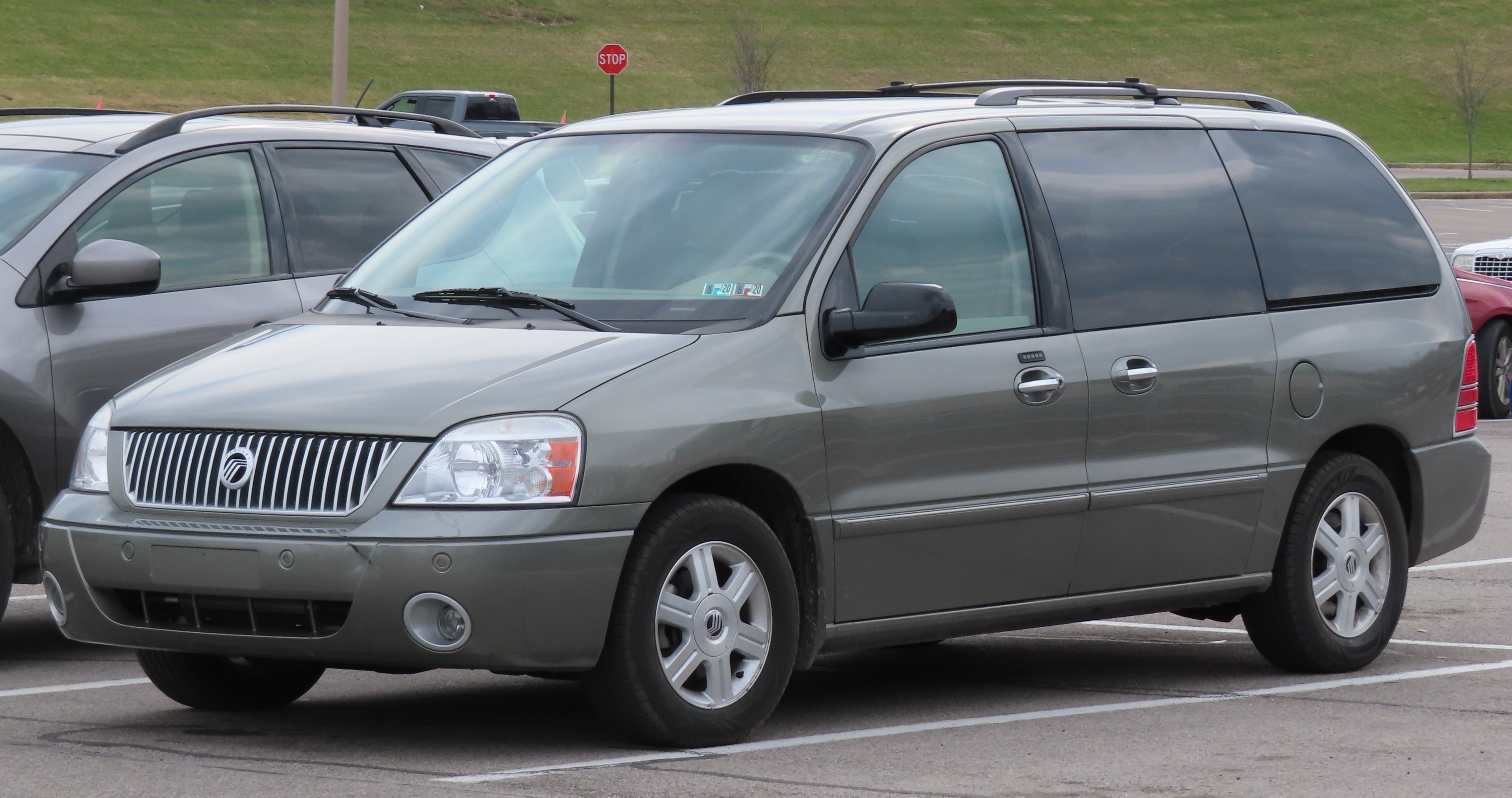
The Mercury Monterey is an older-style vehicle name. In this podcast, it’s mentioned while talking about how expensive diesel fuel is in a specific area. The point is about fuel cost, not electric charging.
Southeast Asia is a region of multiple countries that the speakers call out for rising EV uptake. This matters because EV growth outside the U.S./Europe can shift global demand for batteries, charging infrastructure, and energy policy.
EV adoption just means how many people are starting to buy and drive electric cars. The discussion is about whether world events could make that happen faster or slower.
“Gas lines” refers to long queues at fuel stations during shortages or supply disruptions. The episode contrasts the 1970s—when the U.S. was highly dependent on imported oil—with today’s situation to illustrate how energy security affects consumer behavior and policy.
The energy market is global means oil and fuel are bought and sold across countries. So even if one place has enough fuel, events elsewhere can still affect prices and supply.
Some trucks are built so the driver sits more forward, closer to the front wheels. That can make the whole truck shorter, which helps in places with stricter length rules or narrow roads.
Drag coefficient is a number that tells you how “slippery” a vehicle is through the air. A lower number usually means the car wastes less energy fighting wind.
Concept
coast to coast MCS charging
“Coast to coast” means chargers across the whole country. The idea is that if fast chargers were common everywhere, long trips in EV trucks would be much easier.
Torque is the force that helps the vehicle get moving. Electric motors can deliver that force right away, so the truck can feel like it accelerates quickly.
Home charging means plugging the electric car in at your house. It’s convenient because you can start each day with a fuller battery instead of hunting for chargers.
Range anxiety means feeling nervous that your electric car’s battery won’t last long enough. It usually happens when you can’t charge at home and have to depend on charging stations.
The Hyundai Ioniq 6 is an all-electric car (a sedan). They’re talking about whether it could be a good option for someone later, depending on how the market treats it.
Lamborghini makes very flashy, high-performance cars. The discussion is about whether brands like this can keep selling gas cars because their customers want the “show.”
Downsizing means using a smaller engine but using technology like turbocharging to keep it feeling fast. The hosts are saying some people didn’t like it because they thought the cars lost character.
A V10 is an engine with 10 cylinders. It’s usually associated with higher performance, and the speaker is saying people notice it even if they don’t know much about cars.
The EPA test is a standardized way the government measures how efficient a car is. For EVs, that includes an estimated driving range. Real life can be different because weather and how you drive can change results.
It means a company tries to lock up lots of ideas with patents. The point being made is that patents can be expensive, and spending on them might not lead to a real product.
Ground clearance is how much space there is between the bottom of the vehicle and the ground. More clearance usually means it can handle bumps and rough roads better.
LIVE
This is the What Car EV Podcast for Thursday, March 26th, 2026, Episode 263, Slate's biggest
competitor.
You filled up your diesel truck recently?
Uh, thankfully not.
I am very thankful that my truck is gasoline.
I very specifically bought a gas powered F-250 many years ago because when you look at the
maintenance behind a diesel truck, there's a lot of maintenance that goes along and there's
like the high pressure fuel system and then on the F-250s that I was looking at, there's
like a pressure thing that sits like between the banks on the engine bay and then there's
like a swirl pod in there and you've got all sorts of problems and I decided to get-
Yeah, so this was, like I said, this was the older one and so I went the gasoline one
and I've been proven right, I think, that okay, towing is a little more difficult but
the maintenance is better and now the case with diesel gas, the diesel fuel, I'm definitely
being proved right going with something that takes 87 octane and yes, this is an EV podcast.
I'm Phil Royal, I'm one of the co-hosts here along with Ed and I point you to youtube.com
slash the walk car to see our smiling faces.
You can listen to us.
The numbers keep going up on our audio podcast downloads but I would like the video version
to also grow because that looks more impressive, I guess.
And then you can see that we have faces for radio.
Yes.
Yeah, oh, you go, you go, your turn.
Okay, my turn.
All right.
Ed Sanchez, likewise, many years in the biz more than I care to share but here to bring
you the latest and greatest in the world of EV's alternative fuels and lately gas and diesel prices.
Since when did this EV podcast turn into like a fuel watch?
Fuel watch, yeah, since a couple of weeks ago evidently.
So you want to care to guess the diesel price I saw a few days ago?
Well, by me, it is $6 and I want to say $39.9.
Okay, that's pretty high.
Yeah.
I mean, from there it could be anywhere because the gas station by me is pretty cheap, pretty
sure that they get this off the back of another truck and they siphon it into their own tanks.
Yeah, that actually as crazy as a sound, that actually doesn't sound too bad because the
price I found as of, I think about three days ago, 745 a gallon for diesel in the Monterey area.
I think that's on the high side.
I looked on gas buddy and I think it's like around mid to high six.
This is kind of the consensus around here, but yeah, that's where we are.
And all of that costs everybody more money.
Let's go to something else.
Hydrogen.
Hydrogen power is what we need on everything.
I think about it.
I think that's what we need on everything.
Let's solve the problem.
So I'll start a company named Nikola.
I'll roll a truck down a hill, get some funding, and then we'll go from there.
We'll see what happens.
Saffo.
Well, no, I mean, you'll just get pardoned at the end.
Long story short, you just get pardoned.
What do you actually want to talk about this week?
Fuel.
Fuel.
Continuing on last week's adventure.
We're going to talk about explosive liquid some more.
Yeah, energy, energy policy, alternative so forth.
Not the whole episode, you guys.
So don't fast forward.
It's not the whole episode this time.
Yeah.
If your eyes are starting to roll back in your head, don't worry.
It'll get better, I promise.
So this is a study from a energy think tank, I'm assuming, called Ember.
It's reported by The Driven, which is an Australian automotive news outlet.
Which is claiming EVs have already displaced 70% of the oil coming out of the Persian Gulf for whatever that's worth.
I guess the point being greater adoption of EVs would lessen the price shock and economic kind of ripple effect of high fuel prices.
I don't know if I can believe that number, but okay.
No, they're claiming EVs have displaced the consumption of 1.7 million barrels a day of oil coming through the Strait of Hormuz.
The actual number they're estimating, I don't know, I'm assuming this was pre-war, 2.4 million barrels a day.
I think that was probably just Iran.
Not even, I don't think that's all the Persian Gulf.
I think that was just the estimated output of Iran.
So it goes on to say, if countries were able to more rapidly replace imported oil using transport with EVs,
they believe fossil fuel imports would decrease by a third, saving around $600 billion per year, for what that's worth.
And they also note the market uptake in some developing countries have gone up pretty considerably for EVs, specifically Southeast Asia.
It's like it's on the double digits.
That's the thing that we really want to watch coming out of this whole war.
However this ends, however long it goes, what will be the fascinating outcome will be in a year, in two years.
How did EV adoption change?
How did certain countries change?
Did it jumpstart anything?
Or, I mean, it changes minute to minute, everything changes.
As of the time that we're recording this, Trump is saying, well, we're not going to attack what we were going to attack.
We're going to do a five-day moratorium or whatever it was on us blowing things up.
Or else.
Or else.
Yeah, who knows.
But if this ends up being short-term, I don't think this is going to affect EV adoption that much.
But if this turns out to be a longer term, then this could definitely affect EV adoption within America and across the world in developing countries that are like, you know, we just can't.
Like, if you don't have the poll to get the fuel, like you're a smaller country and you're like, well, the boat just passes you by because it goes to another country where people can make more money.
Then, yeah, you're going to go and build your solar panels and create your own energy and move on.
To be fair, the difference between today and the 70s is the 70s, the U.S. was highly, highly dependent on imported oil.
We produce very little of our own relatively compared to Saudi Arabia, Middle East, so forth.
So when, you know, Middle Eastern countries cut off our oil, those gas lines were not fake.
There was literally no fuel.
We were running short on fuel.
Today, we've got plenty.
It's just that the global, the energy market is global.
So all these price fluctuations kind of ripple through everything.
But in terms of actually being short on oil or gas, that's not the case.
We've got plenty of it, but it's because pricing is global.
That's why everything goes.
So where the U.S. relatively speaking is in a pretty good position relative to other countries like Southeast Asia, like Japan, for instance, like other countries where they import 80 to 90 percent of their oil.
So something like what's happening right now is potentially truly catastrophic for them.
Whereas for us, it's just, I don't mean to downplay it.
I mean, when we're paying almost eight bucks a gallon for diesel, that's not great.
But I mean, it's not like the U.S. is eminently going to run out of oil or fuel.
It's just that we're paying a lot more for it.
But some of these other countries, it's kind of like an existential threat.
Can you imagine telling somebody back in the 1970s when they thought they were running out of fuel and they were lining up and it was the end of the world?
Can you imagine telling them that like 30 or 40 years later, they would voluntarily be lining up for fuel at a Costco to save like five cents to a gallon?
I mean, the lines are the same.
They're just doing it by choice at Costco instead.
Well, also even then, you know, telling people that have like 700 horsepower sports cars and stuff.
Like what?
They get 30 miles to the gallon.
Well, not quite, but on the freeway.
Fair enough.
I mean, the Corvette was there.
I don't know about the C8, but the early C6, C7, they were getting like.
Well, I mean, they're about 350, 400, but anyway.
That's all and getting like 28 miles to the gallon.
So TLDR with that one is for these countries that are much more reliant on imported oil.
It's definitely having a pretty major impact on EV sales.
I think we're a little ways out from that.
I mean, I know we covered that Edmunds report.
So it is having an effect, but it's not like a not like an outside effect.
It's just kind of kind of at the at the periphery.
People are EV curious right now because they're getting scared of the price of gas.
But when I, so I filled up my Yukon, I got a big, big old, I got a lot of gas guzzling things.
And the price difference for filling up like a half tank was like six bucks.
It really wasn't that different.
So it's not at the point where it's like, you know, I can't fill up.
I can't afford it.
But that's if it's short term.
Now, if it's going to be 12 bucks a tank every time additional for years, yeah, that begins to add up.
But right now I'm like, yeah, you know, I'll only put 50 bucks in this time.
It'll cost me an extra $6 to fill that up, you know, for the half tank and whatever.
It depends on how long or short this is.
There's an I figure with midterms coming up.
The people in power right now in America need to very quickly turn this around because this is not what you want in a midterm year.
This is like, I'll tell you who would probably most like to turn this around or truck drivers if they're paying six, seven bucks a gallon.
Because guess what?
Those things have 180, 200 gallon tanks.
In fact, I just saw a YouTube video, a guy, I think he said the fill up was it was over a thousand.
It was like $1,200 or something.
And since he worked for like a fleet, he's like, well, the company pays for it.
So what do I care?
But I could see how independent truckers are like, yeah, it's like a gut punch for them.
And you even see like, there's, I mean, this isn't exactly where you're going, but you see local car transport people that make their money.
With like an F 450 dragon little, you know, five, six, seven cars around from dealer to dealer or whatever.
And doing those guys are independent.
Those guys are all paying for their diesel.
Like it's got to change.
But where you were going was specifically with some eyes.
And Jay Leno is model again, that's was shown what about 10 years ago?
Yeah, it was 2017.
I want to say only in production yet.
It was 2017 that Tesla unveiled the semi and said it would be out by 2019.
And I believe they showed it alongside the Roadster if I'm not mistaken, which of course is selling like gangbusters now.
And then the semi was then I ran through this a couple of weeks ago.
It was because now I'm going off memory.
So I'll get it wrong.
But it was like, it was debuted in 2017.
They said it was going to be out 2019 and 2019 they said it was going to be out in 2021.
They said it was going to be out in 23.
And now supposedly they're once again gearing up to put this into production.
There's at least like Frito Lay and Pepsi has some on the road.
I think on this video.
So this is a video, of course, you know, Jay Leno always gets to drive the cool stuff.
So they let him drive the new one.
So it's been so long since they've announced it even before it's gone into production.
It's already had a refresh.
That's, that's how long it's been.
So the newer one looks like the new model why it's kind of got like the thin, thin headlights and stuff.
But anyway, um, so yeah, so it was coming.
It's kind of a long video.
I think it's about 45 minutes or so.
And of course he's chatting about all those, you know, you know, coal power and steam powered.
Yeah, as he does Jay Leno manages to work in a watch somewhere in the conversation.
Yeah.
And so the Tesla guys were like, Oh, yeah, that's that's cool.
Yeah.
Anyway, so these are the big takeaways.
So a lot of people thought, Oh, they're just doing the center steering position just to be cool and edgy.
But they claim the reason for that was it allowed them to narrow the cab, which optimized aerodynamics.
So they said there was actually a functional reason for doing that.
It basically allowed them to narrow the greenhouse and reduce the frontal area for more optimized aerodynamics.
Also, Elon told them that it needed to have a center seat because that's cool.
Yeah.
Well, I mean, and the other thing too, I didn't even really think about this.
I'm assuming this would be allowed potentially allows it to be sold in both right hand and left hand drive countries.
So anyway, assuming that center, I don't, I don't know any of the laws.
I know McLaren did the center seat.
So there's nothing new.
Yeah.
So potentially if they want to sell it in like Australia, UK, whatever.
And I remember going back, they said they've, you know, looked at global like regulations and requirements for, you know, heavy trucks and they claim it anyway.
Yeah.
Well, but in there, we're getting distracted.
But and once again, I don't know trucking.
I don't know it at all.
But they run in Europe.
They seem to run a cab over design more.
And I thought that that was for overall length requirements.
And this is not a cab over.
This has got a front.
No, but it's not exactly conventional.
No, but it, if, if they were going to try and go to Europe or maybe to Australia and countries where they have different length requirements, this might not work there.
Even though the steering wheel is in theory on the quote unquote right side.
Yeah.
I mean, it's, it's kind of a, it's kind of a, I don't know if I'd say wedge shape because it's more curved, but it's, but it's certainly not a traditional cab over.
It's not, it's not traditional cab over, but it's also not a conventional.
It doesn't have like a 10 foot long hood.
Yeah.
It just kind of has a good old Peter built the way God intended them to be made.
Yeah.
And I say that a little tongue in cheek, but I actually really like the square feet.
It's like, that's a truck to me.
That's a look.
Yeah.
Okay.
So he drove, did he drive it on the street out of curiosity?
I'm assuming he has a CDL, but it's crazy.
Or either, I don't know what the rules are without, but you know, he's Jay Leno.
So he just did it.
I don't know.
Just kind of whatever.
This time he didn't do with the trailer.
He did it.
I think the last time he did it with the trailer attached this time, he just did the cab.
But anyway, so they're claiming a drag coefficient of about 0.40, which is actually really impressive because that's
actually even a little better than like a Ford F-150 Lightning.
I think that's like 0.4445.
Typical class eight is 0.55 to 0.75.
So pretty, pretty sleek for what it is.
They're claiming about 20% cheaper total cost of operation.
And they claim that margin actually improves in high fuel cost areas like California, among others.
And are in high cost times.
Well, I mean, so that's the other variable that they didn't really get into.
And I was actually curious about it.
And I kind of crunched some of the numbers.
So you'd have to have the cost per kilowatt below 50 cents for this to really pencil out.
Above that, it's kind of a wash.
And you know, I've seen some superchargers that were over 50 cents per kilowatt hour.
Again, superchargers are not like a flat fee.
It varies by location.
And even in my nav, it'll even say this is like one of the higher cost options close to you.
So it'll actually flag it.
It means the electricity is better.
Higher quality.
Yeah, it's like putting premium.
Anyway, so, you know, of course, you know, there's a whole kind of
maybe not so much as there were a few years ago.
Of course, there's this whole subculture of like Tesla fanboys, right?
They're always like, oh, Tesla's great.
Is this and that?
And one of them saying, oh, is this the end of diesel trucks?
Short answer is no for many reasons.
The main one being charging infrastructure, which if you think the charging infrastructure
for EVs in general is not great, it's even less way less than that for trucks.
So there's that.
You know, if we had coast to coast MCS charging, then yeah, say great.
But yeah, we I'd say probably at least a decade out from from that being a reality.
But they said these have been well received by drivers.
They like the they like the torque.
They like the power.
These accelerate quite a bit quicker than diesel trucks.
They're quiet.
So, you know, from that standpoint, I think that probably find a pretty eager, eager audience.
But yeah, there's it's going to be quite a while till these are common on the roads.
Mm hmm.
Yeah, 2019.
Yeah, probably 10 years from now.
But anyway, so we'll see.
So kind of cool.
You know, if you're a Geoleno fan or, you know, you're just kind of curious about it and got your lunch hour to kill.
Check it out.
He recently and I don't know how long ago this was, but I watched the video like last week.
So I'm probably really outdated.
He drove a slate.
Oh, did he?
I missed that one.
Yeah.
And I mean, he worked in his old steam powered cars and his wash and all that stuff.
And they're just giant infomercials, really, because it's one or two representatives from the company and they're just talking nothing but good things about their about their vehicle.
Yeah, but it was an interesting little look inside the slate.
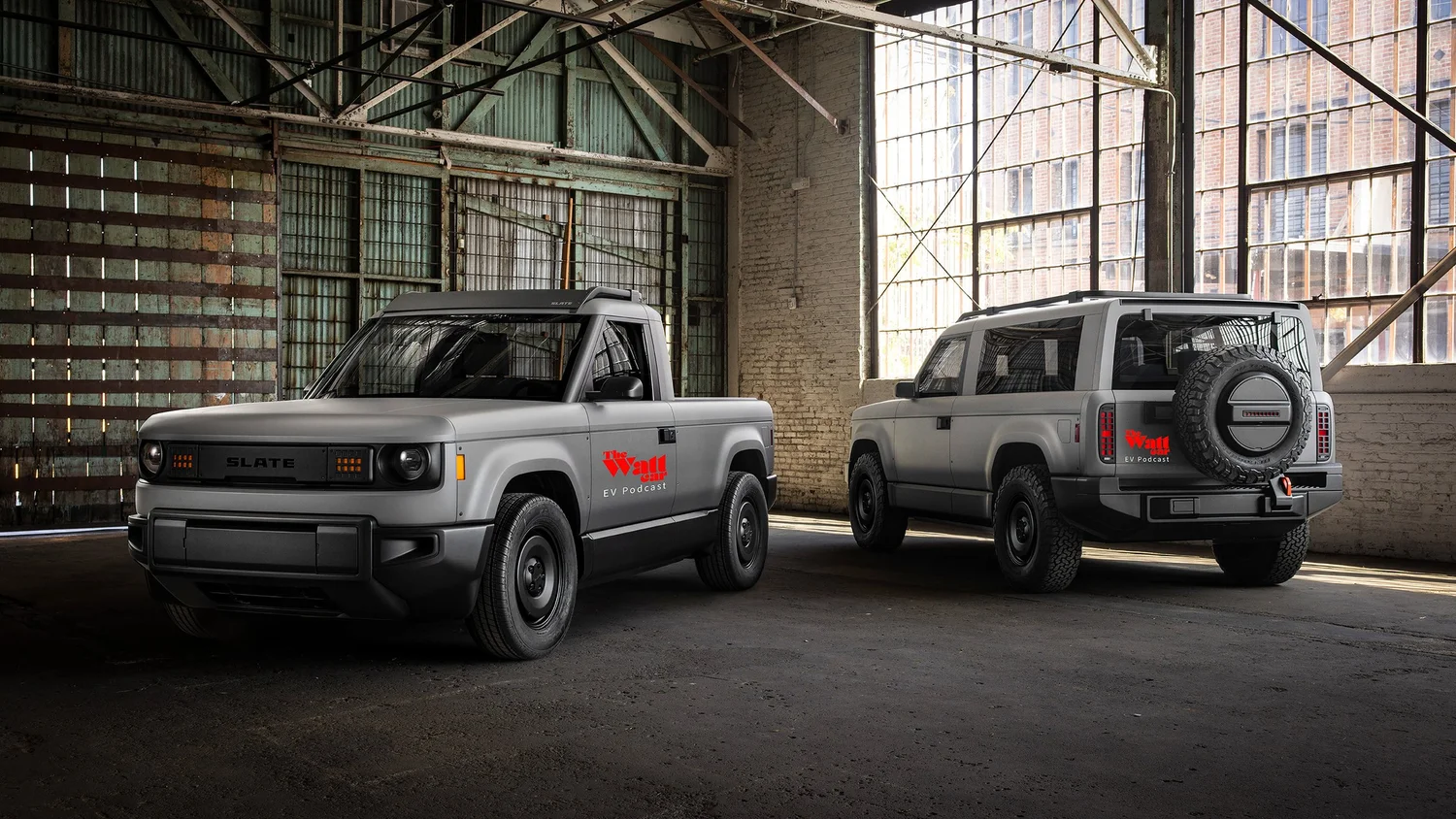
And by the end, I kind of wanted one.
But at the same time, I realized that their idea of a pickup base that you can then convert to something like a SUV, the SUV is going to suck.
Like absolutely going to suck.
The truck, though, I think could be a decent purchase.
I'll tell you what I think the biggest potential threat to this, to the slate is, is, is the Ford.
The Ford, you know, kind of, you know, if they can meet their price target they're talking about with that, that thing will demolish the slate.
I mean, like, like in every, in every sense.
But if that ends up coming in at like 4045 and slate can stick to the 25, then I think slate has a chance.
But for between 25 or slate, let's say like 3233 for the Ford with power windows, AC, you know, all the bells and whistles.
I mean, I think only like really hardcore nerds would get the slate.
I think most people would say, you know, Ford's got so much more stuff and it's nicer and it's better finished.
Yeah, I didn't realize how bare bone the slate was.
Like you have no gauges.
You, or at least the model he was driving had no gauges.
You've got no stereo.
You've got no speaker.
You've got nothing.
It came with, I think air conditioning is like the only standard thing in it.
It's remarkably cheap.
But would make for a good new first car potentially.
I just don't know how big that market is for people buying their college kids.
Again, I think a lot of people kind of look back in the past with the rose colored glasses about, you know, crank windows and knobs and buttons and analog this and that and manuals and stuff.
But the reality is when it comes, when the rubber meets the road, it's time to actually put down real money for something.
I think people tend to go toward, you know, more features, more amenities and conveniences.
So that's kind of what I see going against the slate.
And the other thing that kind of goes against it in that idea of you've got a high school or college kid and you're buying them their first new car.
You remember a few weeks ago, I talked about one of my neighbors.
They've got a Model 3 performance and his wife, it's her car and she got a new job.
She has to commute into Beverly Hills and by the time she gets there and gets back, she has about 15% charge left.
They're doing construction with their house.
They only just managed to get it so they could park their Model 3 on the driveway again so they can charge the thing at home.
So she's got range anxiety.
So they're going to buy her a gas car.
They're going to buy her a used commuter gas car.
And I said, hey, I'll buy the Model 3 off of you.
I got five grand.
I'll pay you that Model 3 for four.
They didn't take me up on that.
But they're going to save it for their eldest who starts driving soon.
And it's going to become his car because he'll only be going around town.
And I think that that's a market, the used EV market is that's a good first car.
These are still modern vehicles.
These are still plenty safe.
They are using all the modern, especially the Teslas are using all the modern charging technology.
And I think when you go in and you look at a slate and you go 25 grand for somebody's first car and it's got all these, you know, barely anything.
Or you could go and buy a Model 3 for like 10 to 15 and it comes with all of the same charging infrastructure.
I think that could be Slate's biggest competitions used EVs potentially.
Yeah.
It really, I couldn't.
They're going to hold on to this for one or two years until their oldest starts driving.
And I really couldn't come up with an argument to get rid of it.
When they said that, I'm like, yeah, it's a good plan.
Like, yeah, hold on to it.
Like, don't even buy anything else.
Not even a Lexus EV?
No, but my friend is still driving.
Remember that other friend that I had that bought the BZ, the Lexus?
The wall outlet?
Yeah, that she's still driving it.
Still, still loving it.
Still plugging it into the wall?
Yeah, still level one charging and loving life.
I guess whatever you can make work.
Yeah.
All right.
So Lexus is coming out with something new.
I should tell her to buy something else with a bigger battery so she can level one charger
for longer.
I guess.
So Lexus already has one EV, the RZ, which is like basically a rebadged BZ.
Yeah.
So now they're doing, they're going sedan.
Because sedan sells so well right now in the market.
They definitely need to tap into that.
So Lexus doing an EV version of the ES, which is kind of their bread and butter sedan.
So, yeah, so they're going to offer this front wheel drive, all wheel drive, native
Nax charging port, performance, okay.
Not amazing, but you know, as we've said before, fine.
For what it is zero to 67.4 for the front wheel drive, 5.1 for all wheel drive.
Interestingly, a hybrid model will follow the EV, but I guess they're going to launch
with the EV and then follow up with hybrid, which makes me wonder if this means a Camry
EV is happening at some point because they do, the ES and the Camry do kind of share
a platform typically.
So.
And 70, did you say 74.7 kilowatt hour batteries?
That's not a bad size.
10 to 80 percent charging 30 minutes.
It's a Toyota.
It's a Toyota.
It's what you expect.
Middle of the road spec wise, but you know, solid, reliable.
And we'll get to this in a second.
Companies are killing their EVs and Toyota is now kind of doubling down.
Yeah.
I'm curious what they know because so far now looking back with what we know, it sure
looks like Toyota got it right.
They went and stuck with hybrids for a good amount of time and they still do.
It's not like they've gotten rid of all hybrids.
In fact, if anything, they're, I mean, some, some model lines are hybrid only.
The newest Camry, you can only give us a hybrid, the new RAV hybrid or plug-in hybrid.
Corolla, you can still get as a gasser, but they may within the next couple of years,
that might go all hybrid.
I'm going to use them as like the bellwether for weather, how this war is going, how fuel
prices are going and how they are reading the tea leaves.
Yeah.
If they kill this off, like with, did Scout actually kill off the EV version?
But I know that they.
I think they have.
They just haven't announced it.
They didn't think effectively.
And like Ram's done it.
It's gone.
That they kind of killed them before they arrived.
The EV version and they went with the hybrid or plug-in version.
And I'm curious here if they're saying, well, we're going to make a hybrid model coming
later, are they just going to skip over that?
I think it's going to be a real telltale sign with Toyota as to how they play this out.
Here's my like big picture thought with Toyota is.
And this has been kind of the way they've operated for decades.
They're very, very conservatively managed, fiscally.
They're very like fiscally cautious.
And they typically only invest in things they think are a sure thing.
In fact, I would say the original Prius was kind of an anomaly because I was at the time
kind of a moonshot and was considered kind of risky.
But they really, they really believed in the concept and they just kept pushing through
with it and they got a hundred percent right.
Yeah.
And they ended up being a huge success.
Like you look at Tesla and you say like Tesla redefined, you know, the automotive industry
and they're making everybody go to EVs and yada, yada, yada.
Toyota was the one that did that for, for hybrids.
They completely changed the industry.
So my, my thought is they were like, we've already invested, I'm turned by EVs.
We've already invested, you know, billions or tens of billions in this.
We're not going to, we're not going to write that down.
So they saw that what was happening with Honda and like these other companies that, you know,
saw EV demand kind of dropping off and they're like, well, you know, F it, we're, we're just,
we're going to just write this off, bad debt, you know, all that.
I think Toyota was like, no, we're, we're, we're too far into it.
We're going to stick with it.
Um, so I, like I said, I think Toyota's playing the long game.
This may be a few years till this really pays off in a major way, but whereas a lot of their competitors
are going to have to go back and start from square one and kind of rebuild all over again.
Toyota's like, nope, we're just, we're going to put these out there.
We'll continue to improve and iterate.
So by the time, you know, Honda finally gets back into the EV game or whoever, Toyota will already
probably be a generation or two ahead just from their slow continuous evolution and iteration where
the Toyota model will conceivably even be ahead of whatever their competition has or, you know,
competitive with like, I mean, for instance, Hyundai is kind of,
Hyundai seems pretty all in on EVs, you know, as, as a market segment.
So they're, they're pretty advanced, but like a lot, you know, Honda, among, among others recently, they're like,
you know, forget it.
No, it's interesting you say that though, because as Lexus is announcing the ES EV that I believe Hyundai
just announced the death of the Ioniq six for the US market.
Yeah. So yeah.
Well, I mean, again, sedan's nobody.
What are we talking about?
Although I don't know if you saw the fine print, they will continue to offer the Ioniq six and,
but I think it's like a special order only.
Like, you know, they might have one in the showroom to like show off.
But like, yeah, I didn't know what to make of them still offering the end.
I couldn't other than they probably produced a bunch of nobody bought them and then they just keep selling them.
Like, yeah, I, I don't know.
Costs more to recycle the Ioniq six was kind of an oddball.
I mean, I thought it was kind of cool.
They did it, but it was like, you know, anyway, I kind of view the Ioniq six as a potential future car for me.
Oh, I'm sure in a couple of years, or even if now, I don't know if you've looked at the prices.
I'm sure they're just going to like tank.
Nobody's going to want them.
They're funky looking vehicles or sedan and not an SUV.
They've got really nothing going for them.
So, I mean, other than it's on the right platform, they do.
Hyundai's do have this one quirk on the EVs.
What's it called?
Is it the sound thing you're talking about?
I am. No, it's the I am.
See, it's the voltage converter or something.
Yeah.
That they've had some trouble with.
Oh, have they?
I know that they do.
It's 800 volt.
It's some acronym.
It's like IMU or something.
Anyway, keep an eye out for that.
I don't know.
There's problems with everything.
So, you just buy it and you don't go and buy an ocean.
Well, yeah.
Unless you really like to live dangerously.
Yeah.
Okay.
So.
Speaking of luxury EVs, this one is maybe a little more luxurious, I'd say.
Now, Bentley is reading different tea leaves.
Yeah.
Because they're killing four out of their five planned EVs to which I say Bentley was
planning EVs.
Yeah.
Maybe we've talked about one of them.
I don't remember talking about five Bentley EVs.
Yeah.
That was kind of news.
I'm like, oh, really?
Okay.
Yeah.
So, in further news, the EVs that nobody knew was coming are no longer coming.
They're not coming.
And you couldn't afford them anyway.
And they're sedans, which nobody wants anyway.
So, who cares?
Bentley is out of the EV game.
Except for one model.
What's the one model?
This article, this was auto express.
This is a British outlet.
Do we report on anything American?
Can we talk about America?
Everything.
All your sources are foreign.
Yeah.
Well, if we get to this last one, that's a little bit America.
But anyway, so they had a model called the Urban SUV, which I mean, I don't have no idea
what that is.
My guess is it maybe vaguely shared some parts with like the Cayenne or something.
So, the Cayenne or Macan.
So, my guess is it'll be related to that.
That's still on track for a 20-27 debut.
They say they're going to do hybrids and pheas in the near term.
So, they're not getting out of EVs altogether, but just scaling way back.
So, there we go.
They need to not.
They just can sell unless they are required to sell EVs, which it seems like everybody's
backpedaling now.
And so, maybe this is the answer to that as far as the countries that are backpedaling
on those requirements.
But Bentley, Lamborghini, Ferrari, Rolls Royce, the high high end, I think they can get away
with selling gas.
Like, they can be the ones selling the fastest horse when everybody's gone to cars.
They can do it.
They're after a different audience than us.
Yeah, I mean, I think that audience just, I think being a spectacle still holds appeal
to them.
So, for a lot of them, like loud, you know, crackly exhaust and like that's part of the
appeal of the vehicle.
So, when you take that away, it's like.
Yeah, what's a Koenig seg if it's quiet?
Like, it's some things need to be, they need to have some experience with them.
Now, Bentley's and Rolls Royce are different.
They're known for being quiet.
So, you think EV is kind of like it's a very natural thing, but at the same time, I don't
know.
I think somebody having like a W16 engine, you know, under the hood, even though their
driver is the one who drives it.
I think that there's value to that, to people, to that market.
Well, for some four and a half million dollar car.
For some people, cylinder count is still kind of a thing.
I mean, I even remember like in the 2010s when there was this big trend toward downsizing,
even going from like V6s to turbo fours, you know, there was a little bit of pushback
to that.
Like, oh, they don't feel special anymore.
Oh, it's only got a four banger and they're like, well, it's just as fast and gets better
fuel economy and blah, blah, blah, and they're like, oh, I don't care.
I tell you, we talked, we started this talking about my truck and I can tell you because
I've got the V10.
How many people that I talk to that don't know vehicles and they're like, oh, it's a
gas powered.
Is it a V8?
And I go, no, it's a V10 and even non car people exactly.
They do this.
Whoa.
It's a V10.
I'm like, yeah, it's the same thing they put in our Vs like it's, it's a V10.
And it, it impresses people.
It makes them stand back.
And I think that if you go to somebody that wants to be in that world of just saying something,
you own something that impresses them.
It's like you own a Monet.
If you do it, not, I mean, I'm going to say this, I don't own a Monet.
I don't know why people do it, but my impression is you don't go and buy a Monet or a Picasso
because you necessarily enjoy that art.
You purchase that to say that you have a Monet or a Picasso to somebody while sipping champagne
somewhere and they go, oh, wow.
And then you tell the story behind it.
Nobody asked, oh, well, what does the, what does the Picasso look like?
No, you're, you're telling the story of how you came to own this Picasso.
My, one of my family members owns a Picasso.
I couldn't tell you what it looks like.
It's not a famous one, but he owns it.
And I believe he owns it.
Just to say he owns it.
Like it came up for sale.
It was in the right price range.
It's on as well.
There you go.
And that's, that's where I put long story short, Bentley, kill off your EVs.
All of us listening to this podcast don't care.
Sell to the people who are not listening to this podcast or hundreds of millions of dollars.
Sticking with the ultra luxury theme.
It's a name that was big, I'd say probably about 15 years ago.
And then it kind of faded away for a while.
But you remember Maybach?
I just saw a Mercedes Maybach the other day.
They do not look luxury anymore.
It looks like it was one of the ass classes that was two tone paint.
Oh, yeah.
Yeah.
And I was like, wow, that somebody spent a lot of money.
Somebody spent a lot of money to try to look rich.
Well, that or they bought one used and they're going to pay a lot of money
to their mechanic anyway.
That's another conversation.
Uh, so Maybach, and this is two, I guess, two American ears.
This makes absolutely no sense.
But Maybach is evidently getting into the minivan game.
Sweet.
Yeah.
It aren't minivans dead.
Just likes it.
And is Maybach gone?
Well, no, actually, I heard, I saw a story the other day there.
Minivans are making a comeback.
And I guess Gen Z is like at the forefront.
They're suddenly, they think minivans are cool again.
I can see a lot of parents.
Their parents had SUVs and SUVs are stupid.
Things skip generations.
They skip generations.
I just had this conversation a couple of weeks ago with a parent from with one
of my other kids and his son was wearing something and he was like, hey, dad,
how do you like it?
And he's like, oh, that looked great when like my parents wore it.
Like, but he didn't want to wear it because his parents wore it.
And so he skipped it.
But now his kid doesn't want to wear what his dad wears.
So he's wearing what his granddad used to wear that he's unaware that
granddad used to wear this.
Was the Pearl Jam or whatever.
Or Duranduran.
Anyway, okay.
So what's going on?
Maybach minivan, sweet.
Yeah.
So Mercedes is coming out the VLE, which is kind of a, you know,
bougie minivan, but this is like ultra bougie.
So this is going to be the Maybach.
They're calling it the VLS.
So they're positioning it as like a, they're calling it quote purpose built VIP
shuttle built with the singular focus of making the rear seat experience
exceptional for two people.
So that's a strange thing to say.
So, so Lexus has like an ultra Luxe minivan, like in the Asian
markets called the LM.
So it's basically like luxury jetliner, you know, rear seats, TV screens,
you know, little, little champagne coolers and stuff like that.
So probably somewhere along the lines of that.
I'm sure this is going to be well into the six figures.
Um, I'm assuming they're going to sell this in the US, but I just, I could see,
you know, if the math pencils out, I could see like library fleets, maybe buying
these, um, I don't, I don't really see these taking off and with the
consumer market in the US.
What do you think?
It's just going to be too expensive.
Nobody's, yeah, no.
Yeah, but, you know, I think this will be like air, like private jet
shuttles for VIPs or luxury resorts, stuff like that.
Um, and I honestly think that's what they should focus on.
Now, you know, if they plan on selling this in China, believe it, believe it or
not, luxury minivans are like a huge market in China, but US.
No, I don't know.
I'm not buying.
No.
All right.
We've got a grab bag of, uh, kind of random stuff.
Let's pick one of these.
What, which one do you want to talk about?
Okay.
Um, well, uh, let's see.
BMW, Mini, Mercedes, I haven't even looked at these.
Um, Mercedes outperform EPA range estimates.
Long story short, Tesla doesn't go as far as they claim.
Big surprise, right?
Yeah.
Like shocked, said no one.
Um, but also Lucid and Rivian underperformed by quite a bit too.
So yeah, that's the weird part is Lucid.
Yeah.
Like that should be like their bread and butter of, um, like that should be, yeah,
they should be the ones that hit the number that they advertise.
They're claiming big numbers and they should be able to hit.
This gets, this also is like, how did they test?
Well, this gets back to like the whole, like the EPA is a very specifically defined
test.
So you can, if you specify specifically to that test, it'll do really well on that
test, but real world could be very different.
Um, I mean, and kind of this is probably a flawed analogy, but I mean, maybe it's
like the EV version of diesel gate, you know,
but that's what I thought.
That's like a caught with this couple of years ago.
They got caught.
The range estimator on the vehicles were wrong, that it was giving the wrong
numbers.
They was proven like in a court, somebody sued.
It was a thing and I think we did an episode that I called like EV gate,
something like that, nothing, nothing.
Yeah.
Even though it's what you buy an EV on a lot of times.
Range.
Yeah.
Let's, I think that's why nobody was buying a hundred mile EVs.
You buy, you buy the range you think you'll need, but having owned one for about
seven years, I know not to, I think what we put to factor in the fudge factor.
I think what we learned and Tesla knew this probably, and that's why they
fudged everything on their range is that everybody wants a higher range.
They say they want a higher range, but there's at some point where you don't,
well, there's at some point that you don't notice that you're being cheated.
Yeah.
So if you say, oh, I want a 300 mile range EV, but if you only, if the thing
could only give you 260 miles, you bought it because it said 300 and you were
going to have range anxiety if it was under 300, then you get it.
And they lied by, in this case, this test said 44 miles.
So say now it's a 360 mile range and you don't notice and it's not been a big deal.
So I think that somewhere there's a sweet spot that's well lower in range than
what everybody thinks that there is.
It's probably like 180 miles is probably honestly.
I mean, so if you go back, we've covered this a little bit.
If you go back, there have been some interviews with Peter Ronson, the former
CEO of Lucid, and he, he said he thought the ideal EV was one with like a 30
kilowatt hour battery and 150 mile range, which seems really weird for Lucid
because they're known for like, you know, these super long ranges.
He's super high-end, you know, EVs, but he's like, from an engineering standpoint,
he says, let's see, ideal course, that's dependent on a charging infrastructure
that can support it.
But I mean, I can tell, I can tell you with my SR plus, first of all,
the NAV system is kind of proactive.
And if you're getting low on charge, it'll tell you where to charge.
It'll say, you know, we recommend you pull off the stop and charge.
At which point you go, yeah, I'm going to go to the next one.
Yeah, I've had my own experience with that.
But anyway, so I know you're a big fan of the Cybertruck, right?
Love it.
Actually, I don't mind it.
I don't, it's not for me, but I don't, I'm not offended by it.
I'm more offended that there are multiple companies making EV trucks that can't
do the truck thing that I need, which is why I have a V10 F-250.
Because I actually tow with it, tow race cars and campers with it and no EV truck.
But you want to tow something.
Yeah, I want to tow something useful.
Yes, but it needs to be useful.
How would you think about towing a battery?
I can't believe that this is a thing.
They have Tesla has apparently applied for a patent to tow your
battery behind your Cybertruck.
Yes.
So this is interesting.
I don't get it.
I don't.
So years, this is not a new idea.
Years ago there, I did the one lap of America.
And it was, I believe the first year that they allowed a trailer.
So you can't tow your vehicle, but your vehicle could tow something.
And there was a guy that did, he had his Honda Civic and he had his
little Harbor Freight trailer and it was full of nitrous bottles.
And then he just used nitrous on one lap.
And this all, I mean, I don't know, one lap rules because I haven't looked
them up in the last two decades, but probably all this is really old information.
But one of the guys, he had an old Corvette and he had a trailer, a utility
trailer that he towed behind it that was nothing but a giant gas tank.
And then he had a tube that came out of the side of what into his Corvette.
And then he had a switch and he could fill up his own gas tank in the Corvette
from the trailer.
So he'd turn the pump on and he could refuel on the road.
So Tesla apparently must add an engineer that year in one lap with me
because they went, oh, look at that.
We'll just do the same thing with a Cybertruck and we will have a utility
trailer that you tow with, I don't even know how big is the battery.
It's got to be at least a thousand pounds of battery.
Yeah, it didn't really get into specifics on a single axle in their drawing,
their patency.
I don't even know if this is legit.
This is on electric links in the show notes, everything we talk about.
This is on electric written by Fred Lambert.
He usually gets everything pretty darn close to right.
Yeah, but he's he's also kind of I don't know if I'd say anti Tesla is more anti
Elon, but he's he's a cynic.
Yeah, that's mild way of putting it.
But and I mean, I am too.
I think he's more so than me, but probably not much further.
But in looking at this, I look at the picture.
I don't know what applications normally look like for patents.
But this looks like this was drawn by like.
Uh, maybe a 14 year old.
I know maybe 10.
This is not a lot of patent applications are kind of just wire frames.
They're not not even that's not uncommon.
How big are the tires on a Cybertruck?
I couldn't tell you the answer, but they're pretty big.
They're pretty tall.
Look at the size of the wheel and tire combination on this trailer.
Those have got to be like 35s, 38 something like that on the back of this trailer.
It's a single axle, single axle, five thousand pound capacity.
So you could have a pretty if you do the big axle.
And that's assuming that it's a standard axle and not an axle.
And I don't know.
I don't I don't I don't get it.
I don't know why you would want to tow your battery.
I don't know why you wouldn't just put this in the bed of the truck.
Tesla already came up with that concept and then killed it.
But why would you ever want to tow your battery?
In California, you're now limited to 55 miles an hour on the freeway
with a single axle.
As soon as you blow a tire, which you will eventually you're stuck inside the road.
So stuck out to me is what was not there.
Is that I didn't see any mention of it being powered of being motorized.
To me, that that is the more compelling proposition
is basically a motorized utility trailer, kind of like the.
The the Detlef's home cocoa, but but just a utility trailer,
either for a car or cargo or whatever.
To me, that, I don't know.
Yeah, I did think it was a little weird, but you know, it doesn't know.
This is I mean, they just patent everything.
I guess that's the answer.
You just patent everything.
But this it still costs you like ten thousand dollars to do a patent.
So, yeah, but ten grand to a company is like,
but it's ten grand that you didn't need to spend.
When you headed up the Department of Government Efficiency,
I would say part of the not efficient
part of running a company is when you spend ten grand
on the idea of a trailer that's got a battery in it that you're never going to make.
Why? Nobody and nobody else is going to use this idea.
Like nobody's going to take this because it's a bad idea.
Anyway, yeah, maybe I'm not understanding.
I didn't read the patent.
I'm just looking at the pictures that some ten year old drew and.
You're just not getting the perspective is even wrong.
Like everything's wrong about this.
Everything is wrong.
The size, look how tall this would be.
It's as tall as the roof of the cyber truck and the ground clearance.
This is like an this is like an off road trailer.
This is really this is really hidden.
Oh, man, I did not know I had this rage in me for this.
And everything we talk about links to the show notes
where the show notes, if you're watching YouTube down below,
if you're listening with your ear holes in some kind of podcast,
audio only land there, click a button, swipe up left.
I don't know what I don't know.
I don't know podcast.
Did I say YouTube dot com slash at the walk car?
If you listen to this, go back, watch the episode.
It's amazing.
We cut different the camera angles and we don't cut in other footage
because, you know, that would take time and neither of us have that.
We're on all the social medias.
Don't follow us, but share our content that helps.
You know, I've started.
Yeah, tell tell me exactly our Facebook page.
We've got a few thousand followers, whatever.
The reason that I like stopped trying to promote that or whatever.
It's like 81 percent of our views of the videos that we post on Facebook
and our social media posts.
It's like 81 percent or non followers.
It really doesn't matter if you have followers.
So I stopped attempting to grow the thing
because if 80 percent of your viewers don't, it doesn't matter.
It just doesn't matter.
And what is more effective than that is somebody just sharing this podcast
on their own personal page and that's it's word of mouth.
That's all it is.
We're I think I'm out of ideas.
I've got my list of things I usually talk about at the end of the podcast
and I've gone on so many rants.
I don't know what I missed.
So I'm just going to stop may.
So we recently had some special guests a couple of weeks ago.
We may have another special guest coming up.
Yeah, you're working on that.
That is in the works.
I think it will be a very interesting episode.
From what you've told me, it's going to be a very interesting episode.
It would have been an episode that I would have been on a different side of.
I'll have the same questions, but I would have been on the other side of the spectrum
just three to four years ago.
Yeah. Interesting.
My opinion is completely changed on it.
So I am quite looking forward to this.
Yes. And we actually have if we're even still doing the store,
we have something in the store that would go along with it.
But I'm going to. Oh, we do.
The one car dot com.
The one car dot com slash store go and find the t-shirt that matches up
with a potential future guest.
Yes, I'm going before I go in another way later.
OK, bye.
About this episode
Fuel prices, EV adoption, and the long game of automakers take center stage. Hosts debate a think-tank claim that EVs have already displaced most Persian Gulf oil flows, then zoom in on what today’s $6+/gal diesel means for drivers and whether it will meaningfully accelerate EV sales. The Tesla Semi’s delayed production gets fresh attention via Jay Leno’s drive, with aerodynamics and cost-of-ops claims discussed. Other segments cover Lexus’ ES EV plan, Toyota’s hybrid-first strategy, Bentley scaling back EVs, range-testing realities, and a quirky Tesla patent idea for towing a battery.
With the world’s energy sources being uncertain thanks to the war, let’s talk EVs. For starters, Jay Leno recently drove the Tesla Semi (which has already undergone a redesign) and the Slate (we reveal Slate’s real competitor). Also, Lexus unveils a luxury EV sedan, Mercedes is working on a Maybach minivan, Bentley kills (most of) its future EV lineup, and more!