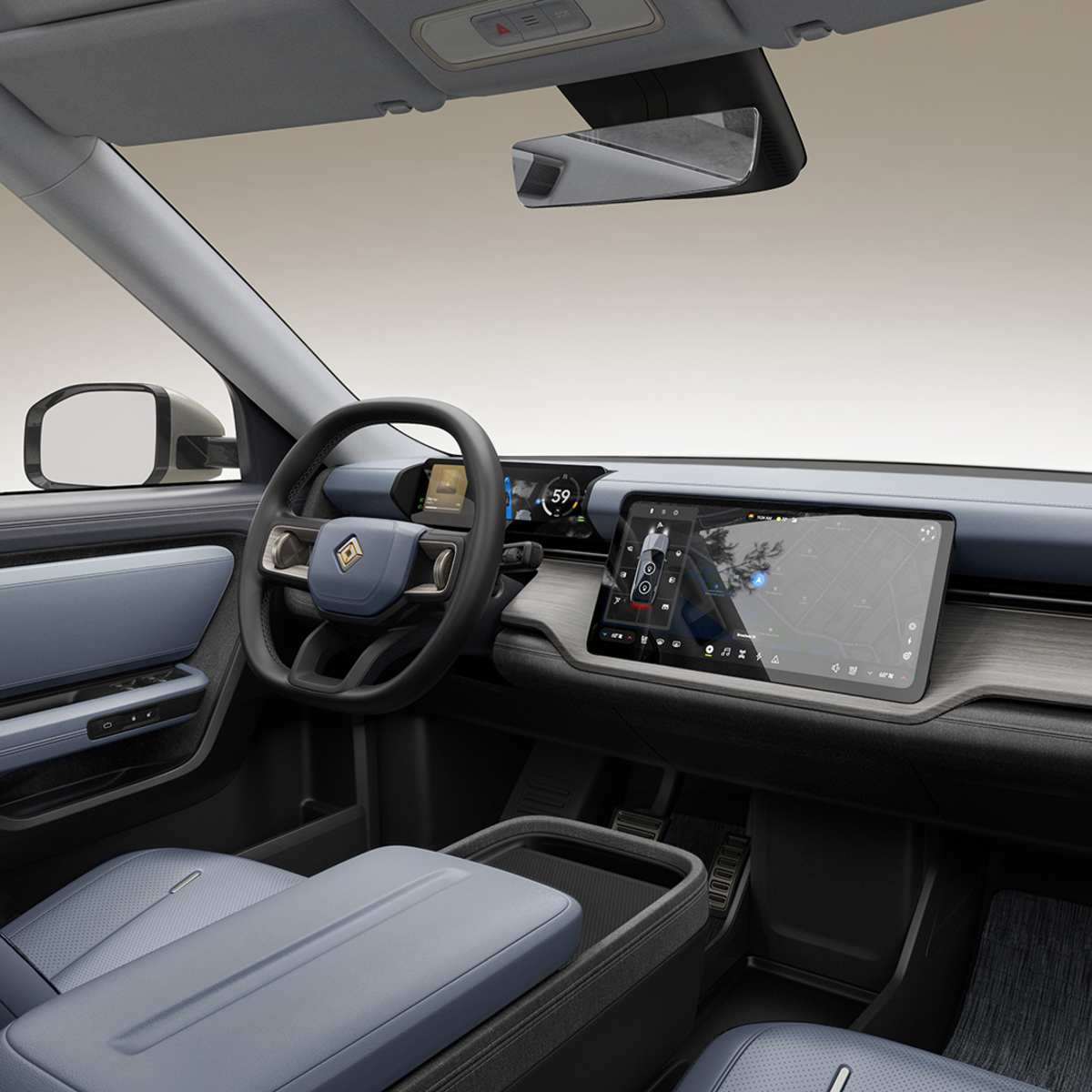
Electric propulsion just means the car uses an electric motor to move instead of a gasoline engine. In an EV, the battery provides the electricity for that motor.
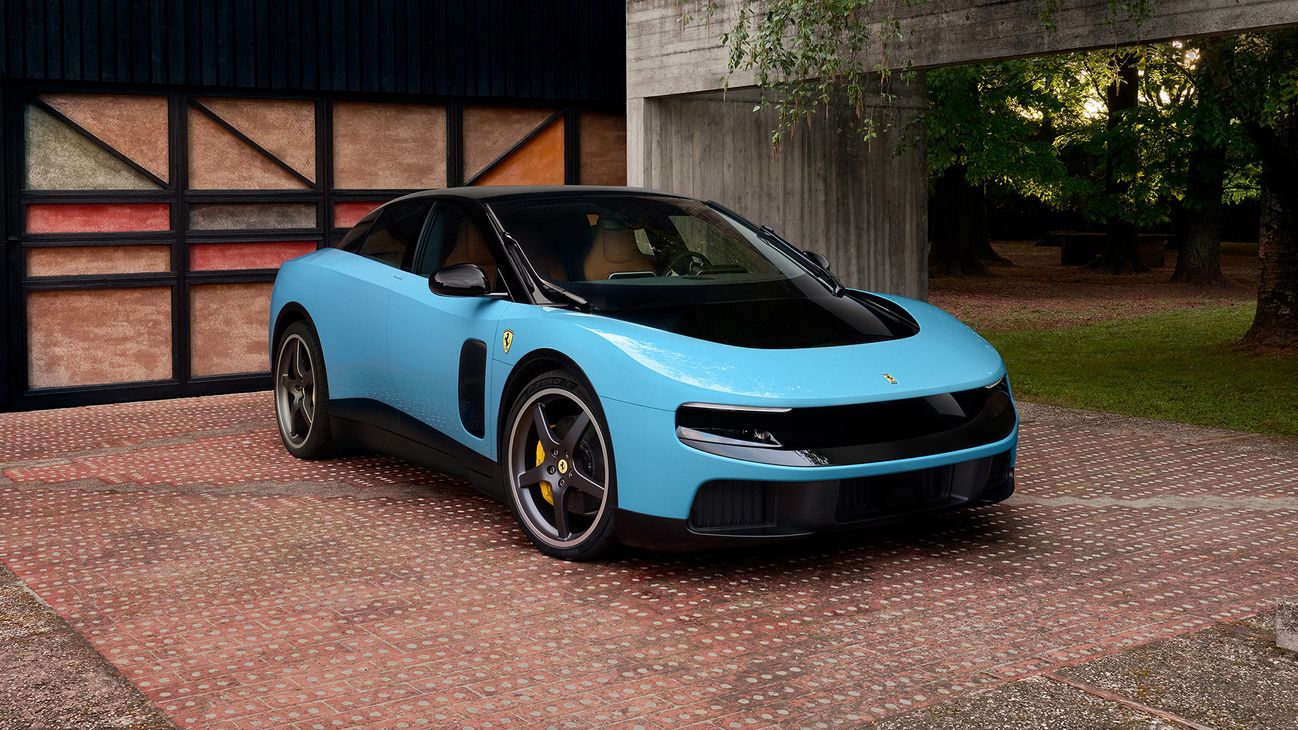
They mention “Ferrari Luce” as something they talked about last week. It’s Ferrari’s EV-related topic name, used to connect the current debate back to electric-car arguments.
An EV’s charging door is the little panel that covers where you plug in the charger. This one is described as having a neat flipping motion to reveal the port.
The Porsche 928 is an older Porsche grand tourer that’s famous for headlights that move up and down. They’re using that as a comparison to describe how the EV’s charging door flips around.
The Hyundai Ioniq 5 is an electric SUV made by Hyundai. It’s designed for everyday driving and aims to be practical, not just experimental. People mention it a lot because it has a lot of features and a unique design for an EV.
Because EVs are very quiet, some cars add made-up sounds through speakers. The goal is to make the car feel more like a traditional gas car when you drive.
EVs usually don’t shift gears like gas cars, because they often use a simpler drivetrain. Some EVs still try to mimic the feeling of shifting so it feels familiar.
An internal combustion engine is the kind of engine used in most gas cars. It makes power by burning fuel, and this segment is comparing EVs to that familiar experience.
Some EVs still have a front grille shape, even though they don’t need it the same way a gas engine does. It’s mostly there because people recognize that look from traditional cars.
The Henry Ford “faster horse” idea is basically: people usually want upgrades to what they already understand. In this discussion, it’s used to explain why EVs try to feel familiar instead of being completely different.
They’re comparing gas/diesel cars to horses. The idea is that, after electric cars take over most daily driving, gas cars might stick around mostly for special uses and enthusiasts instead of being the default for everyone.
Range Rover is a luxury SUV brand/model line from Land Rover. The host mentions it as an example of the kind of expensive vehicle people buy for lifestyle rather than basic transportation.
The Range Rover is a large luxury SUV made by Land Rover. It’s designed to feel comfortable and upscale, but it can also handle rough roads. People talk about it a lot because it’s a high-end vehicle that many associate with premium comfort.
“Super Duty” refers to Ford’s heavy-duty pickup trucks. The host is using it to illustrate the idea that expensive vehicles tend to show up in luxury or hobby settings.
Lotus is a sports-car brand that’s known for making cars focused on handling. The host mentions Lotus because the company has said it wants to switch to electric cars mostly or entirely by a certain year.
Lamborghini makes very expensive, high-performance supercars. The host is using it as an example of a brand that might remain more exclusive as the market changes.
“Fully electric” means a vehicle uses only electric motors powered by a battery, with no gasoline or diesel engine. In the context of automakers like Lotus, it refers to a planned product shift away from internal combustion toward battery-electric vehicles.
The powertrain is everything that makes the car move and sends that power to the wheels. In EVs it’s mostly the motor and drive system; in gas cars it includes the engine and transmission.
It means how the car feels in your hands and feet—like vibrations and response you can sense physically. The speaker says gas cars can feel more “communicative” than EVs.
The GMC Yukon XL Denali is a big family SUV with three rows of seats. Here, the host talks about the V8 engine in it—how it sounds good and even how the gasoline smell shows up when it’s cold.
A “six liter V8” means the engine has eight cylinders, shaped like a V, and it’s about 6.0 liters total. In plain terms, it’s a bigger engine, and that usually means a more satisfying sound when you start it.
“Stock exhaust” means the exhaust system is the one the car came with from the factory. The exhaust affects how the engine sounds, and the host is pointing out that even the factory setup sounds good.
“Runs rich” means the engine is using extra fuel compared to air. When the car is cold, it often needs that extra fuel to start smoothly, and that can make the gasoline smell stronger for a bit.
A “commuter car” is the car you use for normal daily driving, like work and errands. The host is saying that people often buy something practical first, but they still want it to feel enjoyable.
“LS engine” is a name people use for a popular GM V8 engine family. The host is basically saying that even when they’re shopping for something practical, they might still pick an engine they know they’ll enjoy.
The host means a car is treated like a basic tool—just something you use to get from A to B. They’re saying that, at some point, people started caring about cars for different reasons.
A fuel crisis is when gasoline becomes scarce or much more expensive. The host is saying that this pressure pushed car buyers and companies to focus on saving fuel.
The Ford Pinto was a small car from the 1970s. The host brings it up because it represents the time when people started caring a lot more about fuel economy.
The Volkswagen Beetle is a small car with a very recognizable rounded shape. Older versions are often remembered for being simple and having a unique feel. It comes up in discussions because many people think of it as a car with “character.”
The Volkswagen Rabbit was a small Volkswagen. The host is using it to show how tiny some fuel-economy cars were compared with huge American cars of the time.
EVs are cars that run on electricity instead of gasoline. They use a battery and electric motors to move the car.
Car
Miata
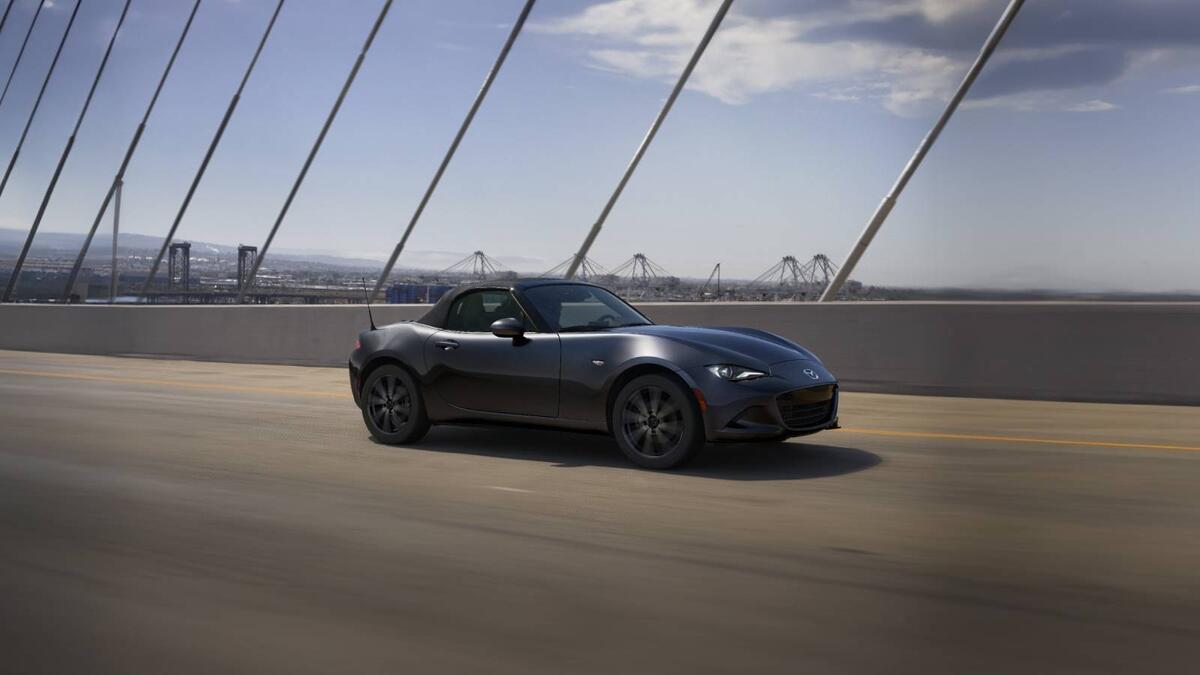
The Miata is a small, fun sports car made by Mazda. People like it because it’s simple, light, and feels great to drive—so it’s often used as an example of an “enthusiast” car you can actually afford.
The Miata is a small two-seat convertible made by Mazda. It’s meant to be fun to drive, with a light feel and simple, direct handling. People bring it up because it’s an easy car to enjoy on twisty roads.
That phrase describes an engine size and layout: about a 2.0-liter engine with four cylinders. The idea here is a small, straightforward engine that could keep the Miata feeling “pure” even if the brand also goes electric.
Car
Rolls Royce
Rolls-Royce is a luxury car brand. The point here is that an older one can be fun and fancy, but it’s usually expensive and work-heavy to keep running day to day.
They’re talking about a future where gas and diesel engines go away completely. The host is saying that even if we move to electric cars, people may still miss the old stuff.
Climate change is the long-term warming and other weather changes caused by pollution in the atmosphere. Here it’s mentioned as one reason people want to move away from gas-powered cars.
Electrification just means cars moving away from gasoline engines and toward electric motors. That can be fully electric cars or hybrids that use both gas and electricity.
Fuel injection is how a modern gas car feeds fuel into the engine. It helps the car start better in cold weather and usually doesn’t need to idle very high for long.
RPM means how fast the engine is spinning. The point here is that with fuel injection, the car doesn’t need to sit at a very high idle speed for a long time after starting in the cold.
Idle is how fast the engine spins when you’re stopped and not pressing the gas. The point here is that newer gas cars can settle into that low idle right away instead of needing extra warm-up time.
Valve lash is a tiny gap inside an engine that affects how the valves open and close. If an engine needs it, that gap may have to be checked and adjusted so the engine runs right.
Beta vs VHS is an old video format rivalry where the one that won wasn’t necessarily the “best” one. The host is using it to say that what people choose in the real world can depend on more than just technology.
Disc brakes are the common braking system where pads squeeze a spinning metal disc to slow the car down. They tend to handle heat better than older drum-style brakes.
Subsidies are money the government gives to make something cheaper. Here, it’s about incentives that can make electric vehicles easier to afford compared with gas cars.
Acceleration is how fast a car speeds up. The speaker is using it more like a metaphor for how quickly things are improving or slowing down.
Term
$150, $200 a barrel
Oil is priced by the barrel, which is a standard amount of crude oil. If oil gets more expensive, gas and diesel usually get more expensive too, which can make EVs look better on cost.
The Morgan Plus 8 is a sports car made by Morgan. It’s built to feel traditional and fun, and it uses a gasoline V8 engine. It may come up when people talk about how older performance cars can be expensive to run compared to newer options.
TCO (total cost of operation) is the full cost of running a vehicle over time, not just the purchase price. For EVs versus diesel or gasoline trucks, TCO typically includes energy/fuel costs, maintenance, repairs, and sometimes downtime—so fleet managers can compare which option is cheaper overall.
Fleet managers run and plan for businesses that use lots of vehicles. They care about keeping vehicles working reliably and minimizing total costs, so charging and operating costs matter a lot.
Charging infrastructure is the system of places and equipment that let EVs plug in and charge. If there aren’t enough reliable chargers—especially for trucks and buses—EVs are harder to use day to day.
Term
MCS charging
This is a fast-charging setup designed for big trucks. The goal is to put chargers along common long-distance routes so the trucks can keep going without running out of battery.
This means looking at what a vehicle costs over the long run, not just what you pay to buy it. With electric trucks, the higher price up front can be balanced by cheaper day-to-day running.
The Tesla Semi is an electric big rig (semi truck). Here they’re talking about how it feels on hills—more power going up and easier slowing going down.
“The Grapevine” is a well-known mountain pass route in California that’s used as a real-world test of how vehicles perform on sustained grades. Because it involves long climbs and descents, it’s a good benchmark for electric trucks’ power delivery and braking behavior.
Regenerative braking is how an electric truck slows down while also recharging its battery a little. Instead of wasting speed as heat, it turns some of it back into electricity.
Place
Eisenhower pass
The Eisenhower pass is a mountain road pass. They’re comparing it to the Grapevine to talk about which route is steeper and which one is longer.
Class 8 refers to the largest commercial trucks—think long-distance freight. When EVs start working well in this category, it can change how quickly EVs spread in the real economy.
PACCAR is a big company that makes heavy-duty trucks. When they talk about EVs, it’s important because they can help bring electric trucks to the market for businesses.
Volvo is a truck maker. If they’re mentioned in an EV trucking conversation, it usually means they’re working on electric versions for commercial fleets.
An E-axle is basically the electric version of a truck’s drive axle. It’s a packaged unit that helps turn the wheels using electric motors, and it can sometimes be added to older trucks as a retrofit.
A retrofit means taking something that already exists and adding new parts to it. In this context, it’s about updating trucks to work with electric drivetrain components instead of buying entirely new ones.
Car
Peterbilt
Peterbilt makes large trucks used for hauling goods. The host brings it up to compare the electric truck idea to what fleets already buy.
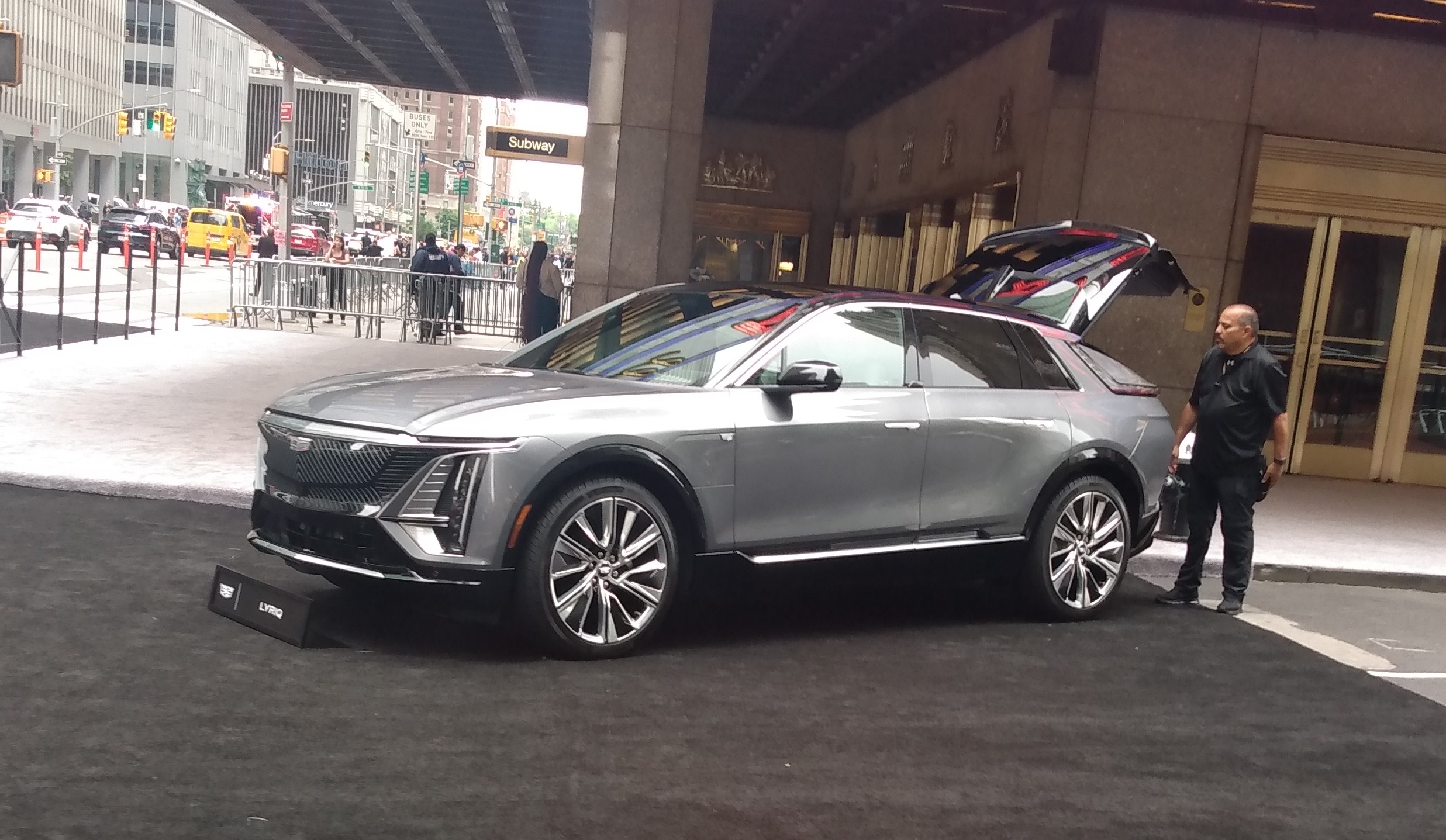
The Cadillac Lyriq is an electric SUV from Cadillac. It’s meant to feel comfortable and smooth, with a quiet ride because it doesn’t use a gasoline engine. People bring it up as an example of Cadillac’s electric vehicle approach.
The Rivian R2 is an upcoming Rivian electric SUV/pickup-family EV that’s meant to be easier to buy than their bigger models. The host is talking about EPA ratings, which are government-tested numbers that help you compare efficiency and range.
EPA ratings are standardized fuel-economy and efficiency numbers published by the U.S. Environmental Protection Agency. For EVs, they’re commonly used to compare range and efficiency across vehicles using the same testing framework.
MPGe is a number that tells you how efficiently an electric car uses energy. It’s like the EV version of miles per gallon, so you can compare EVs more easily.
Bigger wheels can change how the tires roll and how much energy the car needs. Here they’re saying the R2 with 21-inch wheels got better efficiency than the 20-inch setup.
The 20-inch wheel setup can come with different tires than the 21-inch version. They’re suggesting the 20-inch tires may be better suited for rougher surfaces, which can affect efficiency.
The Tesla Model Y is an electric SUV, meaning it runs on a battery instead of gasoline. It’s built to be practical for everyday driving, with room for passengers and cargo. People talk about it a lot because it’s one of the most common EVs you’ll see.
An air dam is a front-end body panel placed low to the ground to manage airflow under and around the car. By controlling how air moves near the front, it can reduce aerodynamic drag and increase downforce (more grip) at speed.
Downforce is the “squeezing” effect from the air that presses the car down onto the road. That can make the car feel more planted, especially when you’re going fast or turning.
The coefficient of drag is a measure of how “slippery” a car is through the air. A lower number usually means the car wastes less energy pushing through wind.
Multi-link rear suspension is a more complex way of connecting the rear wheels to the car. More link arms help the wheels stay in better position over bumps and during cornering, which can make the car feel more stable.
Pivot points are the joints where suspension links rotate to allow controlled movement of the wheel. Their locations strongly affect how the wheel’s angle and position change under braking, bumps, and cornering.
“AI design” means using computers to help create or improve car designs. Instead of a person starting from scratch, the computer can try lots of options and suggest better ideas.
Wheel bearings are what let your wheels spin smoothly. If they’re low-friction and well-sealed, they can help the car use less energy and last longer.
Car
GM Hummer X concept
The GM Hummer X is an electric Hummer concept car. It’s a preview of what GM might build someday, but it’s not the same as a car you can buy right now.
Pillar-to-pillar screens are big displays that stretch across the front of the cabin. Some people love the immersive look, while others think it’s too much visually.
A rear mount spare tire means the backup tire is attached to the back of the car. Some off-road vehicles do this because it keeps the bottom of the car clear and makes the spare easier to reach.
The Lamborghini LM002 is a weird-but-famous Lamborghini: an off-road SUV from the 1980s. It’s notable because it shows Lamborghini doing something totally different from a normal sports car.
“Miles per gallon” (MPG) tells you how far a car can go using one gallon of gas. If it’s around eight MPG, that means it uses a lot of fuel.
LIVE
This is the What Car Evie Podcast for Thursday, June 4th, 2026, episode 276, superiority complex.
If you're watching on YouTube, youtube.com slash at the What Car.
If you're watching there, you will notice I look a little different today, slightly
different background and possibly some technical problems.
Hopefully not.
Yeah.
I am on a different, on a backup computer at this point.
We'll see how this goes.
A lot of last second manipulation of things.
So we'll, we'll see how this goes.
And I'm just, I don't know if I'm going to get beings or what I'm, my computer's going
nuts right now.
Let me close things down.
I'm Phil Royal and I am hopefully going to be able to power through this episode while
directing you to youtube.com slash at the What Car to watch us.
Any podcast players where we're also located for audio version and the what car.com slash
store to help support the blog and the podcast with some paraphernalia, some of which has
our logos, like the hat that Ed's wearing and some of which don't and say things like
EVAF and other hodges in the future and always will be.
Yep.
That one's on there.
Charge.
We've got a couple of them.
As far as my work experience goes, who cares?
Been doing it for a while.
That's all I need to know.
Ed Sanchez likewise been doing this awhile.
Um, and, uh, yeah, every now and then we get and experience some technical difficulties,
so to speak.
Um, but we managed to hack our way through them like we're probably going to do for this
episode.
Hopefully, hopefully if you see me adjusting my headphones at all, it's audio production,
believe it or not, that was part of my college degree and it's very difficult when things
don't work exactly the way you're supposed to have them, especially when I want them
exactly the way they're supposed to be because that was how I learned and sometimes they're
not.
Sometimes they do not perfect and so you end up wearing half a headphone and talking generally
into the sky and hope that something records in some form or fashion.
I think it's a little ironic technology is going to be a big part of today's episode.
It is.
Now, you wanted a slightly different episode and, uh, I guess we're going to get to it.
Yeah.
Like philosophical, I'm not a big thinker.
So there's problems.
I, I, I react to problems as a thrown at me.
I don't, I don't do a good job.
I think, uh, I think you'll, I think you'll get into this.
All right.
I think we got some, uh, some juicy discussion today.
So what have you got for me?
All right.
So I'm, I'm kind of a self-described nerd.
Um, I don't, I don't hide it or nor am I ashamed of it.
Uh, so I sometimes you are wearing a shirt with back to the future meeting, um, dinosaurs.
That shows my sense of humor at all.
Anyway, so, uh, one show I, I watch on weekend sometimes is, uh, Farid Zakaria GPS on CNN.
If you're familiar with that, it's kind of geopolitical kind of show about various topics
and whatnot.
So anyway, so I was watching this past weekend and, um, he had a segment on AI and while that
segment did not directly relate to cars, um, I think it will tie nicely into what we're
going to talk about in a little bit.
So his quote was, we humans don't always seek perfection.
Sometimes we seek authenticity and soul and he goes on to say, that's why H I human intelligence
matters not because it's faster than AI, not because it's more efficient.
It isn't, but because it is embedded in consciousness, emotion, morality, memory, relationships
and lived experiences.
So I think that kind of sets the stage for, for our EV podcast about EV cars.
Yes.
Well, for the next topic.
So anyway, what he said is when I read that, I, uh, it, yes, I agree.
And it shows like, why do we want to send somebody to the moon or somebody into space?
We could just send robots, but it's the human desire to explore.
It's the desire to put a human somewhere we can send and we do send robots to Mars.
But there is a desire to put people on Mars, even though it makes absolutely no sense to
do it.
It's because of that complicated and dangerous.
Well, and the, the soil wants to kill you there.
Like it is literally that uninhabitable that the, the dust will kill you.
Yet we still want to do it because it is the human experience.
It's the emotion.
It's, it's the excitement of that.
It's why you televised the moon landing.
It's why you do, uh, people in race cars and not autonomous race cars.
It's the excitement of the person doing the thing.
So yes, bring this together somehow.
I just tried with cars, but, um, okay.
So that was lame.
Um, this is a video.
I, it's actually a little over a week old.
So this isn't necessarily like a brand, brand new video, but, um, I, it was compelling enough
that I think it was worth discussing.
So this is a Jason commissa of Hagerty fame.
Most recently before that, I think he was with automobile and he's been in the biz for a while,
but he does these really kind of, um, I think pretty entertaining and high production videos for Hagerty.
Um, you know, looking at, you know, kind of historic automotive trends, new cars, you know, face to face kind of comparisons, so forth.
Anyway, uh, he was on with Doug Demiro, who's kind of, I'm just going to say,
he's kind of a polarizing figure in the automotive enthusiast community.
It's like, it seems like people either love him or hate him.
Anyway, he's, he's got a very specific brand.
I'll just, I'll just leave it at that.
But anyway, so Jason and Doug were on this, um, this, uh, this video podcast.
I don't even know, I don't know if it was, uh, Doug's or Jason's or some others.
But anyway, we'll have a link in the show notes.
So people can watch it.
I can't bring it up because YouTube probably, well, no, the computer will take it.
This computer should be able to take my last one.
I don't think would.
But, uh, YouTube would probably take us down on a copyright strike.
Yes.
So anyway, we're, we're just going to discuss it, but, uh, they'll be a link in the show.
Click the link and watch it.
So Commissa said gasoline is too, is far too precious a resource to be wasted on those who are not enjoying the act of combusting it.
So that was his hot take, deep take, whatever kind of take you want.
I'm guessing that he thinks that he is one of the people that enjoys combusting it.
But ironically, he's also, um, a fairly big fan of EVs too.
Well, I mean, yeah, I like EVs and I also like gas powered vehicles.
It just sounds very, um, uppity and superior.
Like, yeah, I mean, yeah, it does.
But, um, you know, I think it's a good discussion though.
Um, and Demiro, uh, replied, he says, this isn't controversial.
This is brilliant.
So, um, and then, uh, Commissa went on to say, if you don't think electric propulsion is a superior transportation solution is because you haven't spent enough time in an electric car.
So that's a pretty bold statement too.
And on the surface, it would seem like they're kind of contradictory, but I think it makes sense.
It kind of plays back to exactly what we were just talking about with the Ferrari Luce last week.
He's saying that the electric propulsion is a superior transportation solution, transportation.
If you enjoy driving like the act of driving, then there's combustion vehicles.
Driving is recreation.
Yes.
Yes.
Yeah.
So if you're just looking for transportation, there's electric.
And I think that's what he's getting at.
Yeah.
Pretty much.
So, which is kind of where I was with the Ferrari of why they, the Paris Anguis of the superior vehicle to the Luce.
I saw a video in the last week, not to get distracted, but, you know, hey, squirrel.
I saw a video in the last week where somebody actually said something good about the Luce.
Yeah.
There are few and far between these comments that are good.
The charging door is pretty neat.
Okay.
It's the best review I've seen of it and it is a pretty cool charging door.
It goes in and then flips around.
It's like looking at Porsche 928 headlights when they go up and down.
It's kind of like that.
Yeah.
So, okay.
Good.
Back to you.
So, yeah.
Now, I think this does get down to if you see driving is just a chore as point A to point B,
or you see it as fun as recreational activity.
I still think they're fun to drive EVs.
You know, the one I personally haven't driven it, but I've read a lot of reviews on one that
comes to mind is the Hyundai Ioniq 5M.
But the irony about that is one of the things that makes it fun that a lot of reviewers bring
up is the kind of fake noises and gear shifts.
So, even at that, it's still emulating the experience of an internal combustion engine
to give it that kind of tactile experience.
Yeah.
I think that's just because that's what we know more comfortable with right now.
Yeah.
That's why EVs have grills, things like that.
It's just because our mind can't grasp this other thing.
It's the whole Henry Ford, if he actually did say it, if you ask somebody what they
want, they tell you that they want a faster horse.
Yeah.
You know, I think Steve Jobs had a similar thing about if you ask people what they want,
they just want a bigger iPhone or something like that.
Yeah.
They want an iteration, they don't want a ground-up invention.
I think it was something along the lines of they don't know what they want until they
see it.
Yeah, it was something like that.
Yeah.
It was a very similar quote to the Henry Ford, it's just 100 years later.
Yeah.
So, I guess my kind of running commentary on this is, and I've made this analogy before,
I can't remember exactly when, but internal combustion vehicles are kind of becoming
like horses.
And if that seems like a weird analogy, horses didn't die off as a species, even domesticated
horses didn't go away once motorized vehicles came onto the scene.
But over time, they became more of like a hobby for the wealthy.
You know, you go to equestrian events, you know, you see like Range Rovers and $100,000 plus
super duties and like luxury air conditioned trailers for the horses.
And I mean, some police departments still have a small, you know, horse fleet.
I know that sounds kind of fun.
Yeah, depending on the area, like if you're going to be patrolling a park or something
along those lines.
But by and large, they're not, I mean, it's a very small part of most police forces, patrol
units, if any.
So, I kind of almost see internal combustion kind of going the same way.
And that, and you know, sadly, I think in most cases, it's going to be limited to more
expensive, more exclusive vehicles that, you know, and it's going to be predominantly,
I think luxury brands like Ferrari, Lamborghini, Porsche, Lotus, and even though, and I bring
this up because so I think a couple of years ago, Lotus at some point made a commitment,
they're going to be predominantly or fully electric by a certain date.
I think maybe they said, here it was like 2035 or 2040, but pretty recently, their CEO,
I'm sure I'm going to butcher his name, Feng, Feng, please forgive me, I'm not a native
Chinese speaker.
He was quoted, this was on motor one.
He said, certain customers simply enjoy the thrill of driving a car with a powerful engine,
even with some lag in the power delivery.
A smooth powertrain is good for those people who use their car for daily commuting.
However, those who purchase performance cars make the decision in the pursuit of driving
thrills of entertainment.
They just want to have fun.
I found this kind of interesting because he came from I think more of like an engineering
background.
He's obviously Chinese and I feel that the automotive culture in China is pretty new relative to
the West.
If you want to use that term broadly, which ironically also I would say encompasses Japan.
Japan, Germany, US, UK, Italy, that more established automotive culture that was established in the
20th century.
He just recently got into performance driving and racing and he said that was the light bulb
moment for him when he really understood kind of the visceral appeal of internal combustion
as opposed to electric because when you're approaching it from an engineering standpoint,
they say, well, electrical propulsion is superior.
It's much more efficient.
There is the issue with the weight and the power density of the battery relative to gasoline,
but in terms of the propulsion itself, from an objective engineering standpoint, it's hard
to argue that ICE is superior.
It's inferior in almost every way, but it doesn't have or I should say electric motors
don't have the same kind of experience, the sound, the vibration, the tactile feedback
of an internal combustion engine.
I mean, it does add a dimension to driving even in the mundane.
So I have a Yukon XL Denali with a six liter V8.
It's just it's three rows.
The reason I have it is to just get the family to and from things.
It is purely purchased for conveyance of the family and also towing in a pinch should
my pickup truck die.
And yet when I turn it on in the morning, I do enjoy hearing it.
The V8 sounds really good on it.
It's a stock exhaust, completely stock car, and it just and there is the smell of gasoline
because it runs rich when it's cold and it is an experience.
And I think that's partially because I'm a car guy.
And I I hear that and I like it.
It adds another dynamic to driving what is otherwise a completely boring machine.
Yeah, so I can't.
I've always been a car guy, so I can't imagine where his direction, his journey of not being
a car person and then driving something exciting and going, oh, wait, this can be more like
to me because I've always been.
Yeah, to me and probably you cars have always been more.
The idea of getting something boring came about years later.
Like when I'm like, oh, I just need something that does this.
I just need a commuter car.
I just need this thing.
And then I can buy something with less features, less whatever.
Even there, I go and buy a V10 or I buy like a variant of an LS engine or something.
I buy something unique.
I mean, I feel, you know, I'm sure people might have different opinions on this.
I feel the era of cars just being kind of a utilitarian appliance.
I would say kind of probably started in the 70s.
And the reason I picked that era is that was the first major fuel crisis.
Enter the Pinto.
Pinto and that's kind of where the Japanese got their foothold and really kind of grew
into the global autumn of juggernaut.
Honda, Volkswagen really, they kind of capitalized on that whole time period.
Well, yeah, but so and I think some of those early models, I mean, certainly the Beetle had a lot of
character.
It wasn't particularly fast.
But you know, it had a lot of character and it had kind of this cult following.
Toyota came in with very solid, well built, efficient vehicles that were relatively fun
to drive.
And I think it was a big wake up call for a lot of people that they didn't need this 25
foot long, you know, behemoth that gets like eight miles per gallon.
You know, they got into something that was, you know, a lot smaller and got like 25, 30
miles per gallon.
They're like, wow, you know, this is actually kind of cool.
I mean, literally the Volkswagen rabbit was like the length of the trunk of a Cadillac.
Yeah.
So, you know, I would say that's probably been the past 50 years where you kind of had this
bifurcation among automotive consumers of enthusiasts and everyone else.
I mean, I think as long as there's been cars, there are people that saw them predominantly
just kind of functional conveyances.
But I feel, and I think this honestly is kind of reflected in the state of automotive media,
which we both kind of came from of just kind of this massive consolidation.
I mean, when I started, there were, I mean, there were like 50 plus.
I'm sure if you looked at the entire sector, maybe at its peak over 100 different car magazines
of one sort or another.
Even when I started, it was probably at least in the 40s.
Oh, well, well more than that.
I mean, they kept 50 plus.
Yeah.
I mean, they in every iteration of magazine killing.
For the magazine company, we work for it.
It was like every time they got acquired, they'd kill off 20 to 40 publications.
They did that multiple times.
They did it multiple times.
Until multiple times.
Effectively two.
Yeah.
From, you know, 50 plus.
Yeah.
So, yeah, but I think I kind of see that being the future is, you know, enthusiast models
and kind of commuter pods.
I think, I mean, I don't know what the Lotus CEO was kind of saying as far as was he implying
that if you want something exciting, that you have to get combustion, or was he just
saying it was a type of vehicle like the sports car versus, because like going back
to what Camissa was saying in this, like what could be construed as some kind of superiority
complex of, well, he's a driver.
You know, we're, you and I are enthusiasts.
We get it.
And so, yes, we're going to want, we're always going to want a combustion vehicle.
Like you have your EV, but you also have an enthusiast combustion vehicle.
It's not really an enthusiast one.
It's an enthusiast to you.
Well, yeah, I mean, it's kind of nostalgic.
It's, yeah, I wouldn't say it's a traditional enthusiast vehicle.
It's something that you have.
Something I want to do some things to.
But it's something that you have that is not, there's no reason to have it other than
the love of that item.
Yeah.
And the, but the idea, what I wonder with Camissa is, is he implying that you can't get that
in an EV?
Because I think you can definitely get the passion in an EV.
I've not driven a rematch Nivera, but I'm going to guess that there's a little special
something like how I said Ferraris, there's something special about driving a Ferrari.
I'm guessing there's something special about a rematch.
And I mean, I don't think he was saying, making it this kind of like binary all or nothing
kind of scenario.
He's like saying there is a place for combustion vehicles, not like.
Yeah.
And there's a place for EVs, even enthusiast oriented EVs, but that the, the era of kind
of mass market internal combustion, the inference is that's coming, that's coming to a close
at some point where for variety factors, you know, environmental regulations, you know,
just consumer demand that that's going to dwindle.
And even though from the American perspective, that's kind of hard.
You know, the vast majority of car sales are still internal combustion in the US.
And, you know, at least for the past couple of years, interest in EVs has kind of kind of
dropped off a little bit.
But then you have, you know, these geopolitical things that pop up and you know, kind of renews
interest in more efficient technologies, as was the case in, I think was 2008, 2022, you
know, when COVID hit, you know, the financial and economic markets kind of exploded or imploded
whatever you want to say.
So, I don't know, I just hope, I think going forward, it's going to be more of a focus on
using collector cars.
I think that the one car I see still as a standard bearer for attainable, like, enthusiasts,
an attainable enthusiast experiences, I want to probably say the Miata, you know.
Now, it is funny, when you were saying before about, I can't remember what cars you were
talking about, but that there would be potentially the, that there be gas vehicles that are the
enthusiast vehicles, like Ferrari and whatever, because that's what we're talking about.
And the car that came to my mind was exactly what you just said, the Mazda is the Miata.
I could see there being maybe a version of the Miata that's electric, maybe, but I could see
Mazda going all electric and then having the Miata as a gas-powered two-liter four-cylinder
engine, like what it is, a pure just driving experience.
It is the horse, as you say, that you just kind of have around.
And maybe you are paying $8 a gallon, but you're only driving it on the weekends or
for special occasions, things like that.
I mean, I knew a guy years ago, he had an old, late 70s, early 80s Rolls Royce, and he would drive that around.
What?
Like, okay, you could fill it up, you could put gas in it, you could drive it.
But the amount of maintenance that goes into something like that.
That's ridiculous.
That is not something that you daily commute.
And so that was kind of his enthusiast vehicle.
And, you know, it's not fast, it's not particularly good at anything, but it's the horse.
It's something extravagant, something fun.
Yeah.
So, I'm hoping the regular guy enthusiasts will still have something to live for in the future.
I think, I mean, I see that day probably long after we're both gone, I'm sticking around.
I mean, I think it would be a sad day when, and I'm saying this as an EV owner and an EV enthusiast.
It'll be a sad day when, you know, combustion is completely banished off the face of the earth.
But I think, you know, we have to reconcile our love and nostalgia for that with the realities
of economics, climate change, all that.
I mean, I think that's kind of unavoidable.
I mean, I've read a story the other day where they're projecting within the next 100 years, New Orleans is going to be underwater.
And kind of they game-planted in every which direction, you know, levees, docks, seawalls, all that.
They said it's, there's no way around it.
Maybe I'm wrong, but isn't New Orleans basically just wash off of the river anyway?
Like, I thought that that was literally what it was, was it's just that they've built a city on the wash that's come out of the river.
And then it's kind of built up over the years.
They built a city on it, and that's truly what it is.
So the fact that it would go away doesn't shock me.
So, I mean, maybe when we're old men, we'll be taking like water taxis, you know, in New Orleans.
Yeah, I think one of the questions that you pose, you like, had notes and I'm trying to find is,
the case could be made that electrification is just another step in automotive evolution, like radial tires, fuel injection, disc brakes.
And I kind of feel like maybe that's more apt than the horse comparison.
And I wonder if that's why that's so slow to a different branch of the discussion.
Because yeah, I think right now it's such a charged subject now.
I mean, some people I talk to, if you say anything positive about EVs, they just instinctively kind of recoil and well, you're leftist coming.
Well, yeah, you're gonna you're gonna take my big block out of my cold dead hands.
You know, it's just this instinctive just, you know, kind of kind of offense to it.
But I think if anything more than anything, it can this can be an and instead of an or that when you look at things like radial tires,
those were better and they were safer.
There was a reason to go to them.
You look at fuel injection.
It is superior in that you can actually start a car in cold weather and it doesn't idle at 2,500 rpm for 10 minutes.
If that's after you get it started and you can go up and down hills and the car doesn't like spotter is 7000 feet that the fuel injection was superior.
It made the driving experience better.
I think part of the problem with with electrification is that it doesn't cars are so good.
Gasoline cars are so good now that you say it's superior and it is an EV is superior, more technically superior.
It's more energy efficient.
You could get into the accelerations better, but we always say like we don't need as fast of a car as what they provide.
So you throw the acceleration out.
Who cares about that?
Nobody needs that.
And most people don't get in their car and floor it.
They just drive like a sane human being.
But gasoline now in cars is so good or I guess gasoline cars are so good that when you start the car, they don't even warm up anymore.
Like it instantly idles down to a thousand or below 700 600 rpm.
It is just you fire it up.
It's smooth.
It goes.
It's a refrigerator.
It's an appliance.
There's no adjusting any points.
There is no tinkering with valve lash.
There's none of that.
You get in the car and you go and I the idea of EV is being so much more expensive.
I think and they don't really provide something to your day to day person.
You can say, well, technically technically they're superior, but we just had this conversation like technology doesn't always win out.
The right technology like rarely wins out.
Beta versus VHS.
Yeah, there's many indications of the wrong technology.
It was the easier technology or the one that had better marketing was the one that won out.
So I think it's going to be a very slow transition.
You come up with a combustion powered vehicle and you put it up next to a horse and it is obviously superior.
You can go further faster and you not have it a sweep up poop in the end.
So it is obviously superior.
You look at fuel injection.
You look at disc brakes.
All of these things are obviously superior.
I don't think I think gasoline is so gasoline powered cars are so refined now that it is a difficult transition to make.
And so without the government subsidies, we're seeing exactly that play out.
We're seeing what was a sweep going up to something that levels off or decreases in its level of acceleration.
I don't think EVs are losing ground.
I think they're just not gaining as they were before.
I think we're still...
I don't think we have really any clarity about how the whole situation in the Middle East is going to turn out.
I'm still hearing people sounding the alarm bells about $150, $200 a barrel oil, supply disruptions, $8 plus diesel, which is already a reality in some cases in California.
And the national average going to $5 or $6 gallon.
Man, I would love for the gas to come down to $5 or $6 a gallon.
That would be great.
I think at that point the conversation may change a little bit with people in...
But I think it gets to the transportation portion of the conversation with EVs and buses, trucks.
These are the first things that should electrify.
These are the things that would affect the price of living.
If you can suddenly not buy diesel, then you can suddenly get your beer cheaper.
That's why ironically, I think...
And again, this is just speculative, but that's why I think you could see the class A truck market potentially electrifying on a percentage basis faster than the overall automotive market.
I think right now that is very true.
Now that we've lost the personal vehicle incentives to purchase, monetary incentives to purchase.
Well, I mean, they still have at least on a state by state level, California has pretty significant incentives for electrifying commercial trucks.
But beside that, I just think cost of TCO, total cost of operation.
Oh, yeah, yeah.
I think fleet managers are just going to look at that and just say, this is no brainer.
And I feel that Catalyst is going to be the charging infrastructure.
There is a dense enough network of MCS charging in whatever freight corridors, whether that's California, Texas, Midwest, East Coast,
that even with the higher upfront costs, the total cost of ownership equation will be so compelling for electric trucks.
And the drivers that drive them love them.
They're like, I just started a story about a...
I want to say he was a driver, I think for covenant transportation, I think.
I'm not exactly sure, but he, you know, obviously, you know, diesel truck driver most of his life.
He was part of a trial for the Tesla Semi.
And he was talking about going over the grapevine.
And he was just like, this thing is so much better.
Just the power going up the hill, the regenerative braking going down the hill.
Yeah, the grapevine is like an extended six or seven percent grade for miles, miles and miles.
And it's a real test pulling over that.
It's not as steep as what was the Eisenhower...
Yeah, the Eisenhower pass.
I don't think it's quite as steep as that, but it's longer.
Yeah.
I'm pretty sure it's a longer duration on going north, going south.
It's a steeper climb, but for a shorter duration.
So maybe going south with grapevine is like the Eisenhower pass.
Yeah, so one side steeper than the other?
Yeah, yeah.
Anyway.
Anyway, it's a long story short.
It's a big hill.
It's a big hill.
It's a very hard on trucks, both uphill and downhill.
You know, I think the big determiner, like I said, charging infrastructure range, safety
driver experience, I think you could potentially see the table flip pretty quickly for EVs in
the Class 8 market.
Potentially.
Yeah.
That's not a foregone conclusion, but yeah.
I would say at this point it has to happen.
I think it's the only way that you get the price of goods down.
Well, I mean, honestly, I think they're going to be supply constrained, you know, whether
we're talking about, you know, Pacar, Volvo, Tesla.
I think they're probably going to have order books, you know, years.
There's going to be a lot of hodgepodge trucks with those E-axles.
They're going to be starting to retrofit stuff because I don't think this is, I think this
is political, whatever.
I don't think there's a way out of the war we're in where we get out and it's the way
it was.
I think those days are gone that we have messed up that relationship to the point that it
never goes back to the way it was.
It might not be as expensive as it is now.
Oh, I think it will come down.
It never goes back to the way it was.
It will always be expensive that we have utterly destroyed relationships that were necessary
to keep that level.
Well, I mean, those are those are gone.
Even, even like the best case scenario outcomes that I've seen, they said the new floor for
barrel of oil is probably going to be about 80 bucks.
Yeah.
Whereas prewar, it was like 60, 60, 70 was kind of the sweet spot where it made sense
for, you know, drillers to invest in new wells and they could still make a decent profit.
They weren't losing money.
But yeah, I mean, I think post war, it's 80 is going to be the new floor.
I think for a while, 100 is going to be the new 100 plus that will be the new norm.
So yeah, the incentive that really pushes what you were saying, that really pushes the
truckers, that whole industry of goods transportation.
Yeah, I don't I don't see how there's going to be a choice because I think margins are
going to get so squeezed or like, and, you know, with half of that, just going to fuel.
This does not make sense.
I was at the grocery store the other day, paying five dollars for a gallon
of milk for something that was three dollars and fifty cents last year.
Yeah.
And I looked at the person I was with, I was like, at some point, we literally can't
afford to eat like this is too expensive and it's only going up.
It's only getting more expensive.
Something has to give because you are literally at the point where I don't earn bad
money, but I am looking at this going, do I need milk?
Like, do I actually need this?
And here I am.
I live in Southern California and a great area.
And if you're watching YouTube, you see, you know, I got surfboards.
You've got like I'm doing fun stuff.
I've got disposable income, but boy, that disposable income certainly goes away.
If I want to continue to enjoy life, something's got to give.
And maybe it's milk, maybe it's ice cream, maybe it's snacks, maybe it's all these things.
And as soon as people stop buying things that are optional, then there's no demand
on the manufacturing side for that.
And then those companies start going out and that truck drivers don't have as much
to put in their trucks and the price of gas now or the price of transport goes up
because there's fewer items in the vehicle.
Like, I mean, it truly is in a horrible escalation point where it's something
that could be really, really bad, like a cliff.
Yeah. And we're right there.
Which kind of reemphasizes.
So everybody go out and buy a Tesla semi.
It's like right now, like by the Peterbilt.
By the Mercedes, by anybody that's got it.
Yeah.
I need somebody to invest in that.
So I don't.
So I'm going to force my milk again, guys.
So it sounds like the takeaway from the Lotus is that rather than, you know, pushing full
electric, even though they do have some EVs and some really good ones.
In fact, just last week, we talked about the Avaya, right?
As being the way to do an EV sports car.
Yeah. They also have the Electra.
If you're, you know, looking more of like a SUV type vehicle.
Yeah. If you don't want to spend 2000000 dollars on a supercar.
Yeah.
So it's which I mean, maybe we could discuss this next week.
I think we're kind of too far into get into it now, but that potentially
the future of ice performance will be hybrids of some sort.
And if you could still make a.
I think it is.
I think it is.
Yeah, we're there and what what that's going to look like and feel like.
But anyway, so speaking of a very high end EV.
So to go from five dollar to go from five
dollar complaining about five dollar milk to something else that you can't afford
to a 400000 dollar Rolls Royce.
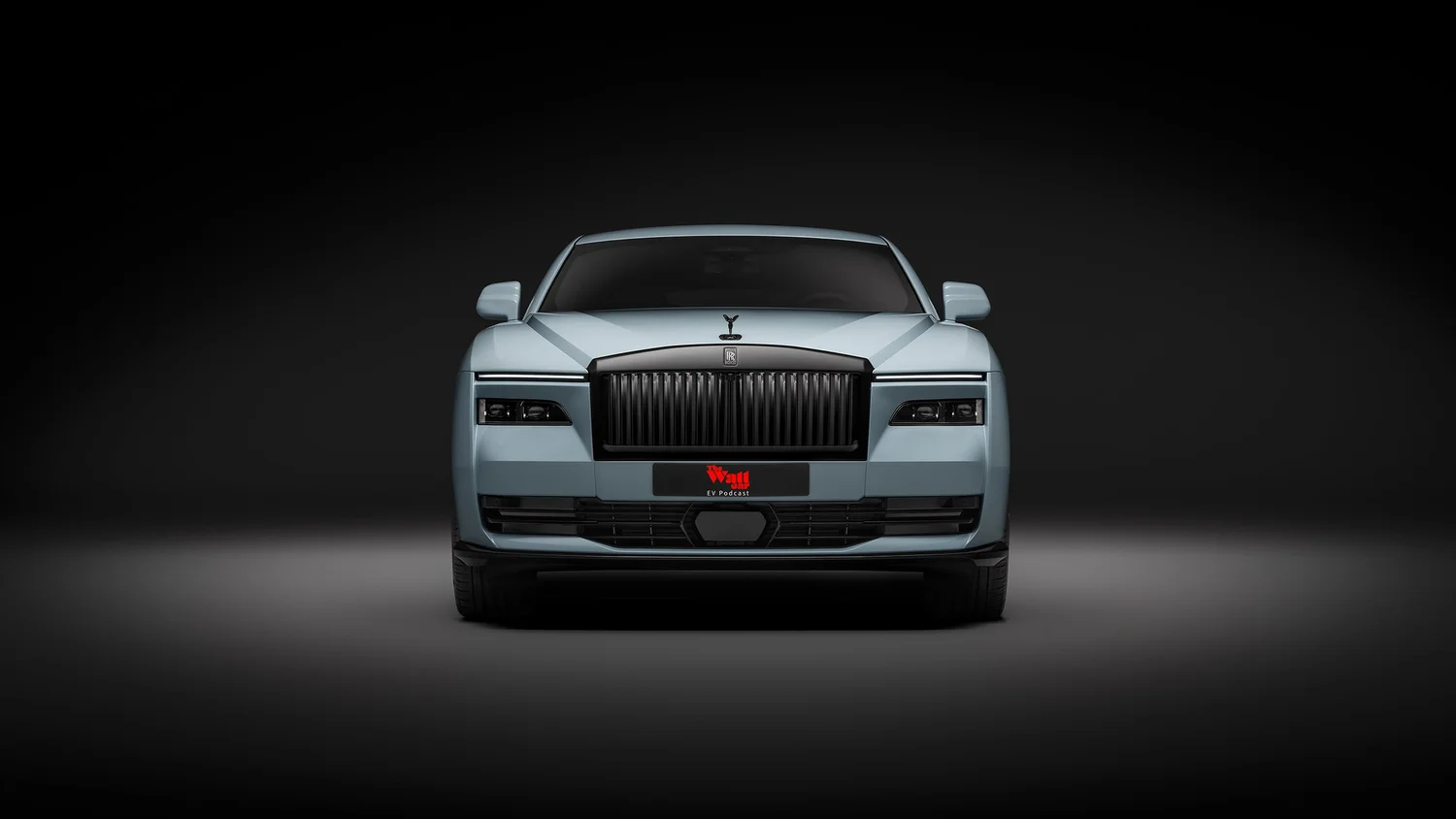
Yes. So the 2027 Rolls specter
is getting some tweaks for the 2027 model year.
A little more power, a little more range and a little quicker charging
and North American models getting an export, which is really not
earth shattering news at this point.
That's pretty much most of the industry.
So anyway, I mean, for those people interested in that, I mean, cool.
Mm hmm. Not my budget, but.
Now, I mean, it and it goes to the the idea of like, this is a great example of EV.
Like I don't want an electric Ferrari unless it's going to be insane.
So I don't want a luchae.
But when it comes to a Rolls Royce, I want something that is an EV.
I want massive amounts of torque.
I want exactly what Rolls Royce has spent a hundred years plus
producing, which is massive horsepower and refinement in you can't hear the engine.
Smoothness and silence. Yeah.
Yeah. And it's exactly 100 percent what an EV should be.
Yeah. So this is one case where I think electrification actually accentuates the brand.
I think EVs are actually perfect fit for Rolls Royce.
Yeah. And and it accentuates their brand values of effortlessness, quietness,
all that fits perfectly.
I've said it before, even about Cadillac, where it's cool and as much as an enthusiast
following is the V some of the V models had.
I personally feel electrification is a better fit historically for the Cadillac
brand overall, you know, quiet, effortless, smooth.
Yeah. So like, you know, the lyric
escalate IQ, all that great fit for the brand.
So yeah.
So this next item, this is kind of interesting because this is a brand that I would
I would say you could consider an enthusiast brand,
but it's also an EV native brand.
And so they've managed to kind of
kind of build their vibe around being electric, but also being very capable.
Yeah.
So we finally have some info on the
Rivian R2 on their on the EPA ratings and pretty, pretty impressive.
That they do everything in MPGE because I love that.
Yes, your favorite figure.
Yeah. So what I found kind of interesting about this is the R2 performance,
the 21 the model with 21 inch wheels actually had better efficiency than 20 inch wheels.
I'm guessing the 20 inch might be more kind of an off road kind of tire.
Yeah, it is a little one is more kind of street oriented.
Yes, kind of backward from what we used to.
But yeah, that's you're probably right.
Both right in the ballpark with the Model Y.
Which is impressive because the R2 is about 800 pounds heavier,
which so it's a pretty significant difference.
And at least outwardly, the R2 looks a lot boxier.
But as we've discussed, like appearances and like drag are not always.
Yeah, some correlate.
Exactly. So many times.
So I race cars and one of the things that is a
trick that you could do with them for aerodynamics is you throw a flat front
on the front of the car and it's completely counterintuitive
because you've got a car that's got a curved like a V nose.
But then you where it goes down from the hood and it would normally like suck back a little bit,
you go straight down and you add this air dam and it's actually a superior
front end for aerodynamics and downforce.
And so the R2 is probably right in there.
I don't know if we I can't remember.
We've actually seen the coefficient of drag number with it.
I want to say it's like 0.24.
Don't quote me on that.
But much much sleeker than you'd think looking at it.
You know, just looking at it, you'd say, oh, that's probably like 0.35 or whatever.
Yeah, but it's quite a bit better.
So anyway, we're also at a point where tech is like with phones
and computers, if you just buy the next year one, the next one,
it's better because it is newer.
It has got newer technology and the Model Y
is getting a little long in the tooth as part of the problems that
Tesla has with taking long times between redesigns.
They do little things here and there.
But if somebody else comes up with something, it's got the advantages
of the last few years, like technology changes constantly,
especially now with like AI being able to like come up with this.
I was on a modeling.
Yeah, I was I was in a.
It was it was the MX five was the N.D.
Longlead that I went on and I'm sat there in a room
getting talked to by boss engineers.
One of them is Dave Coleman and he was saying
and the Rears, he was explaining all the engineering
awesomeness and he was saying in the rear is a multi link rear suspension
and he pulled up this diagram of the multi link rear suspension.
He's got like five or eight contact points, pivot points on it.
And he said, if you want to know what like multi link, when you hear that,
what that means is a computer designed it because no engineer would ever come
up with anything like this, but this is a superior design.
It's just you would never as a person, your mind doesn't think this way.
You need a computer to say, this is how you want it.
And right now with like AI design coming in, you're going to see a lot
of things potentially like this, where they put it in and they go,
design me the front end design.
This is the basic way I want it to look, but now make it 20 percent better.
Or this is the the engineering outcome or objective.
Yeah, this level of efficiency or this, you know, whatever.
And the computer will go blew up, spit it out like it did with multi link suspension.
So yeah, I think that that's possibly one of the things.
There's many reasons why this is probably as efficient.
I mean, it could be better wheel bearings, you know.
Oh yeah, there's a lot of little variables that could be.
Yeah. So one more off road EV, I'm assuming it's an EV.
So GM showed a Hummer X concept.
Do you remember the the H three?
There were actually two versions.
There's an SUV SUV in a pickup.
Yeah.
So this seems like they're trying to bring up, bring back the H three,
but in an electrified version, but GM is saying concept only.
No plans for production.
So kind of cool.
So I guess they're opening a new design studio in Pasadena.
So everybody's designed to pass Adina.
So this is kind of the commemoration of that, I guess.
But yeah, it's got all the normal, it's got all the goodies
that all the off road guys like, beadlock wheels,
multi-matic shocks, 73 inch tires,
a removable tires, you say, 77 inch.
OK.
So pretty big, yeah, pretty, pretty chunky.
And, you know, of course, they got to throw their,
you know, they got a virtue signal a little bit.
So eco-friendly parts have snap fits and mechanical fasteners
instead of adhesives.
I guess that makes them more recyclable or swappable.
So anyway, kind of cool.
I'm all the screens in the world.
All the screens in the world in the interior.
I can't say I'm a big fan of the pillar to pillar screens, but.
This design, a little overkill.
You you mentioned the H three, which was kind of like a big failure
and flop and kind of a design snafu.
Oh, those screens look like they you can get some or all.
Yeah, I think I'd get the some rather than the all.
But this design is I love it.
This is no H three.
This is like an erector set or what do they call it?
A tech tech.
Lego Technics.
Yeah, Lego Technics.
That's what it is.
I like this.
It could be better, but I like it.
One of the photos you brought up there with the rear mount spare tire.
It almost made me think of the Lamborghini LM002.
Not that one.
Yeah, no, I'll try and find it.
There we go.
That one. Yeah.
That's what it kind of reminded me of.
So, yeah, the Lamborghini that was all the awesomeness in video games back in the 1980s.
Yeah.
Yeah, I think that that got about eight miles per gallon.
I think.
Yeah, maybe that was made for that Lamborghini.
I'll get the story wrong, but that was made for army or something.
It was made for like a Saudi prince, something like that, that he wanted some off-road thing.
And so he like got this made and this is where I'll get it completely wrong.
But he like had this made and then Lamborghini went and produced them after that.
And then they got ordered for whatever it was for they were going to get ordered
for the army or whatever it was.
And then like that didn't happen.
There was something, but it was like a one-off.
It was like a custom thing.
Yeah, if I'm wrong about that story, make a comment down below in the YouTubes.
And you can tell me that I'm wrong.
YouTube.com slash at the what car is where we are.
And while you're doing things with the what car and your fingers are familiar with that,
go to the what car.com slash store, help support the podcast, because that's how we get.
That's how we support all of this stuff, because this episode is brought to you by computer.
Yes, help me buy a new computer within the next week, because I don't know what I'm going to do.
I can't use this one all the time.
So where are we?
We're on social media, but don't like us.
We're on various social medias.
Sure.
Don't don't like us, but share the content.
Share the YouTube video or go to the what car.com.
You can share with you posts there that have the, you know, how the internet works.
I'm the one that doesn't know how the internet works.
Anyway, next week, who knows?
Hopefully we'll be doing this.
Hopefully this episode comes out because
like it right now, it's like like with electrification.
It's a giant unknown as to how successful this is going to be.
Best of luck and maybe see you next week.
About this episode
“Superiority Complex” weighs what “superior” really means in EVs versus combustion. The hosts frame the debate with human motivation—people explore even when robots might be more rational—and then get practical: EV fun comes from emulating ICE cues like sound, shifting, and even grille styling. They also argue electrification is the next step in automotive evolution, but adoption hinges on economics and charging infrastructure. The episode ranges from charging-door design to trucking, luxury EVs, and off-road concepts.
Does electric propulsion mean a vehicle is in some way less enjoyable to drive? A recent video by Jason Camissa somewhat implies that, and we can’t help but discuss on this week’s podcast. In other news, Lotus recommits to ICE development, Rolls-Royce updates its Spectre with NACS and more, Rivian R2 looks efficient, and Hummer reveals a wild new concept car.