This is a big car show that focuses on American muscle cars and Corvettes. It's a place where people can see many classic cars and learn more about them.
The Chevrolet Corvette is a famous sports car from America that people love for its speed and style. It has been around for a long time and is known for being fun to drive and looking really cool.
The Ford Mustang II King Cobra is a version of the Mustang car made in 1978. It's known for its unique design and is part of the Mustang family, which is a popular sports car series.
The Shelby Mustang is a special version of the Ford Mustang that is designed for better performance and speed. It's famous for being powerful and has a strong racing history.
The Ford Galaxy is a big car that Ford made from the 1950s to the 1970s, designed to be comfortable for families. It has a lot of space inside and was also used in racing, which shows it can be fun to drive too.
The Ford Galaxie is a large car made by Ford in the 1960s. The 1964 version is known for its stylish look and was a popular choice for families.
Car
Chevrolet 427
The Chevrolet 427 is a powerful engine used in some Chevrolet cars, especially the Corvette. It's called 'Big Block' because it's larger and gives more power.
National Parts Depot is a company that sells parts for old cars. They help people fix and restore classic cars to make them look like they did when they were new.
Unrestored original cars are classic cars that haven't been changed or fixed up since they were made. Collectors like them because they are in their original state and tell a lot about the car's history.
The Ford Galaxy 500 XL is a large car from the 1960s that was known for being comfortable and having strong engines. It was a popular model for families and those who wanted a lot of space.
The Vintage Certification Program checks classic cars to see if they are in good shape and still have their original parts. It helps to prove that the car is a true classic and not a modified version.
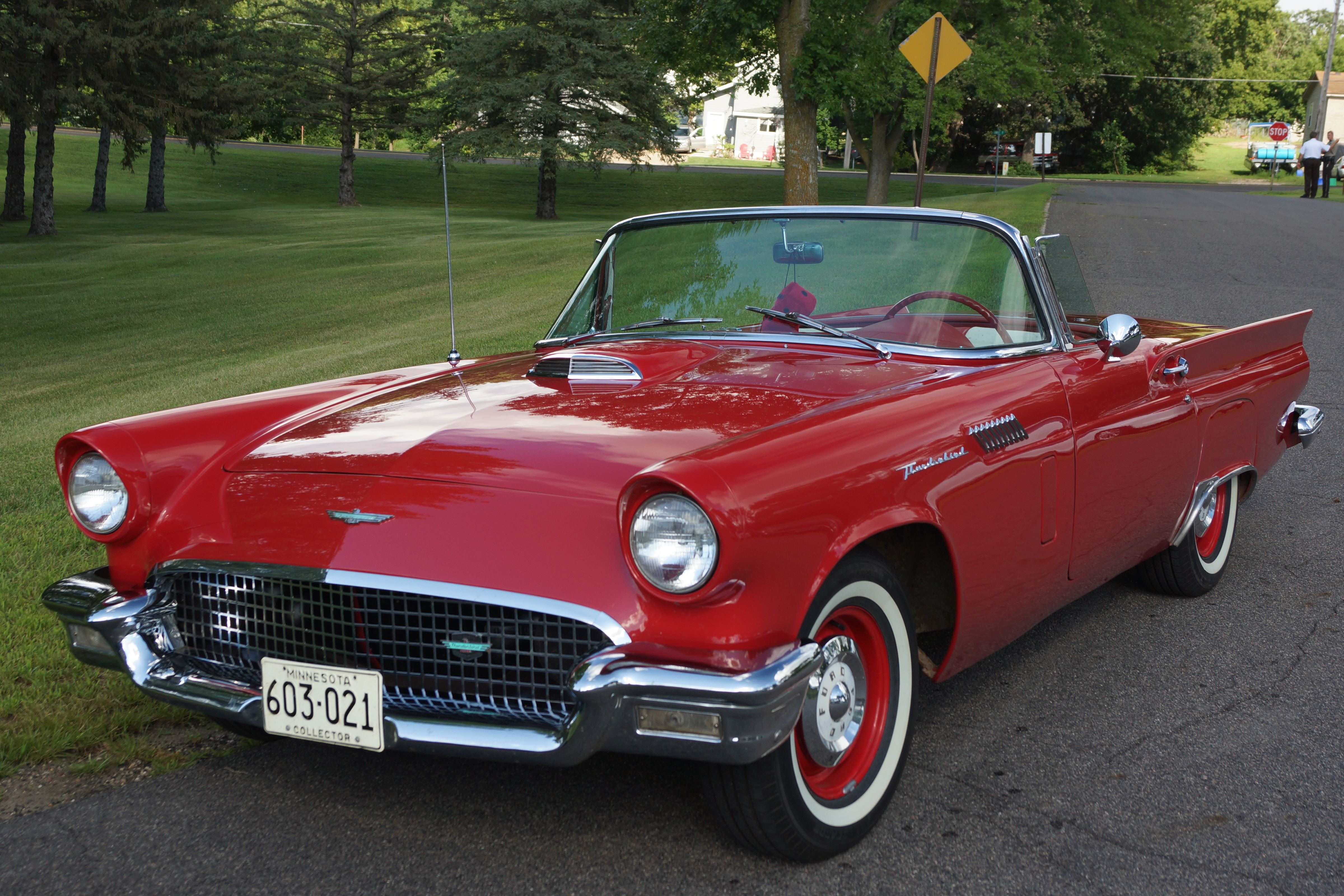
The Ford Thunderbird is a well-known car that was made for many years. It's famous for being stylish and having nice interiors, making it a popular choice for those who like luxury cars.
Data tags are labels on cars that show details about what features and options the car has. If there are more letters and numbers, it usually means the car has more features.
OE certification means the parts are made by the original manufacturer or meet their standards. This is important for ensuring the parts fit and work well with the car.
Mopar judging is a way to check how well a Chrysler car has been restored to its original condition. It helps ensure the car is authentic and valuable.
Leather interior means that the seats and sometimes other parts of the inside of the car are covered in leather, which looks nice and feels more comfortable than regular fabric.
The Chevrolet Impala SS is a sportier version of the Impala, famous for being fast and stylish. The 1964 model is especially popular among collectors because of its classic look.
The Pontiac GTO is a classic American car that became popular in the 1960s for being fast and powerful. It's considered one of the first muscle cars, which means it was built for speed and excitement.
The Plymouth Roadrunner is a classic American car from the late 1960s that was built for speed. It has a unique look and was made to be affordable for younger people who wanted a fast car.
The Chevrolet Camaro Z28 is a special version of the Camaro that is built for speed and performance. It became popular in the late 1960s and is loved by car fans for how well it drives.
LIVE
Welcome to the Collector Car Podcast.
Hey, this is Greg Stanley.
As this post, it is Thanksgiving Day.
Hopefully, you are with friends and family
enjoying a wonderful dinner, maybe a turkey dinner,
maybe something non-conventional.
But whatever you're doing, hopefully,
you're having a great time with family and friends
and thankful for all of those around you.
I am actually traveling down to Georgia as we speak,
Thanksgiving morning, to visit family and friends
for the weekend, so really looking forward to that.
But I just came back from an incredible trip
to Chicago for the Muscle Car and Corvette Nationals.
Now, if you've never been, it is quite the show.
It is one of the best muscle car shows in the country,
very well curated.
And if I had to come up with one theme
for the entire weekend, it was muscle car colors.
It was just an amazing display.
The short term is called macaquan
for Muscle Car and Corvette Nationals.
And it's funny, as my wife, sometimes she loses track
as far as where I'm traveling to, which I do as well.
And she asked me, she knows in Chicago
and she knows Muscle Car and Corvette Nationals,
but she said, are you going to Chicago?
And then I said, you mean, macaquan, you know?
Anyways, so great show, great time.
The best, the most enjoyable display.
Now, if you're watching on YouTube,
I'll throw out some pictures here.
I really enjoyed was the creativity
in the watermelon Mopar display.
So they were all green and pink
and the owners even had watermelon shirts
to go with it, very, very inventive,
very, very creative.
Some of the other stuff that was really cool to see
was a collection of 1978, 1978 Mustang II King Cobras.
One in every color, which was really cool to see.
I'm assuming it's every color.
There were eight there.
I think they were owned by the same owner
and they were immaculate display,
displayed very, very cool.
Colin Colmer was able to curate eight, I'm sorry,
nine white 1965 Shelby GT350s.
And yes, white is a color.
Black is the absence of color.
And so that was a very cool display,
including two arm models, one of them,
which was the rarest, most known Shelby of all time,
the flying Mustang that has sold twice
for around $4 million.
Wayne Creny had his GT350 there as well.
That was a really cool lineup to see.
And then I did a bunch of interviews.
So that's why you're here.
That's why you're listening.
So what do I have coming up?
I have Rich Schmidt from MPD, National Parts Depot fame,
with his Unrestored 1964 Ford Galaxy.
That is a really cool story because it only has 12 miles.
And there's another one, its sister car, next to it,
that has even fewer miles from new.
I review the most highly-optioned Hammy Kuda
ever known to exist.
And it has an amazing story,
such an amazing story that it will actually be a,
well, I have a follow-up podcast about it,
which goes into some of its amazing
international ownership history.
And then, you know, I love Corvettes.
My favorite year is a 67.
I found the owner of a 1967 Big Block Unrestored 427 car.
Very, very cool.
Then an owner, his first collector car, 1964 Chevy
and Palo 409 425 horsepower,
four and a quarter horsepower red
and Palo, that was really cool.
So even more coming up on this episode,
but where am I heading to next?
Well, after Thanksgiving, I've headed to California.
I'm going to visit the Peterson.
I am going to Jay Leno's garage, but only as a visit.
I don't know that Jay will be there or not.
Hopefully I'll be able to take some pictures
and put those on my newsletter.
So again, if you're not on my newsletter,
please shoot me a note.
Greg at thecollectorcarpodcast.com,
I'll add you to my newsletter
as pretty much every Monday, every Sunday,
every Monday, just where I've been traveling.
What cool car stuff have I been uncovering?
So, but let's get to the episode.
As I said, hope you're having a great time
with friends and family for this holiday season.
Imagine a journey so rare, it only happened once.
That's the spirit behind once,
exclusive one-time only adventures
that will never be repeated.
Our next experience, American Muscle Legends
takes you trackside with the most iconic cars in history,
complimented by luxury accommodations
and behind-the-scenes access you simply can't buy.
Spots are limited.
When it's gone, it's gone.
You can learn more at discoveronce.com forward slash muscle.
RM Sotheby's is the world's largest collector car auction house
by total sales.
They are the preeminent market maker
of high quality collector cars and collections,
regardless of size or complexity,
by working in partnership with the Sotheby's team
and its network of 80 offices in 40 countries,
RM Sotheby's has established the largest client network
of any collector car auction house in the world.
Join the RM Sotheby's family
by connecting with one of their car specialists
at RMSotheby's.com or contact me directly
at gstanly at RMSotheby's.com.
Good.
All right, so I've got Rick Schmick here,
previous podcast guest.
Rick, how you doing, buddy?
I'm doing great.
How are you doing great?
Good, good.
Now, you have NPD, National Parts Depot,
and I know you love to collect preservation cars,
unrestored original cars, right?
Yes, yes.
Now, I believe you're actually standing
beside one right now.
Is this one of your cars?
It is, it's what I would call one of my very extreme examples
of an unrestored preserved car.
Explain that.
It's never been titled,
it's never been registered for the road.
Really?
It's a brand new 1964 Galaxy 500 XL, 394 speed,
and it's got 12.1 original miles on it.
What?
12.1 original, I did not know this
when I asked you to be on the podcast.
Yeah, it's still rolling on the original tires
and hoses and belts, that's why it's here
in the Vintage Certification Program,
just because it's a absolutely perfect,
well-preserved brand new Ford.
So tell us about the Vintage Certification Process.
What is that like?
Oh, it's fantastic.
It's, you know, you get the cars here,
they put it up on a lift, they spend an hour or two
just really picking through every last detail of the car,
and you do have an unrestored survivor
if there's something that's not quite correct
or something where a previous owner has been in there
and done something, they'll find it.
And some people take judging the wrong way.
They don't like to have their car critiqued,
but it's invaluable to us.
We learn everything we possibly can
about a car that we put through this program
so that we can fix it and make it as right as possible.
With this car, there's not a whole lot to learn
because this car has never been tampered with
and we've had it in our ownership since 1993.
Wow.
And since we maintain a dealer's license,
I've never had to title it and it came to us on MSO
because we purchased it from a retired Ford dealer.
So that's how it's made its entire life
without ever being registered or having a license plate.
So what Ford dealer did you buy it from?
The gentleman's name was Bob Mercer.
Okay.
Bob Mercer Ford in Hickman, Nebraska.
He was in business up to 1970.
Right, right.
And then at that time, Ford pulled his franchise
along with a lot of other small farming dealerships
in that area because the big city dealerships
were complaining that they were undercutting them
and taking away too much business.
But Mr. Mercer between 1962 and 1970
set aside one vehicle a year.
And in 1993, he placed an ad in Heming's Motor News
trying to sell all nine of his Fords
and my dad wound up buying five of them.
Wow.
This 64 is one of them.
Do you mind popping the hood?
Let's take a look at some of this original goodies here.
I know one of the best thing about these early cars
is these, the stickers, you know?
Yeah, the battery okay sticker is barely hanging in there.
You know?
Oh, wow.
It's pretty well preserved,
but you can detect some patina with it
because when things sit.
Yeah, and storage is very key.
You know, since cars been with us,
it's always been an air conditioned
climate controlled storage.
Right.
But prior to coming to us,
Mr. Mercer kept all of his Fords
in a retired school bus barn,
which is basically a concrete block building
in the middle of Hickman, Nebraska.
So you said 12.1 miles?
12.1 miles.
So they didn't really drive these
even at the factory much, test miles or anything.
Usually the cars would line up,
by the time they got it out of the factory
out into some holding lot and then onto a train
or onto a truck.
The dealers usually receive the cars
with about two miles on it.
Oh, okay.
Yeah, two or three miles on it.
What's this piece of paper right here?
I don't know.
Oh, it's a tag.
Oh, it's the antifreeze tag.
Wow, that's amazing.
Do you mind opening the interior
just to take a quick look?
So it's black with red interior.
Is that a 390?
Yes.
Engine?
390 four barrel, X code.
Oh, four speed car.
Yes.
Wow, look at this interior.
The interior is really the highlight of the car
because the XL option is what got you this bucket seat
and console interior with the molded door panels
and it was very upscale.
It was kind of because Ford took a lot of pride
in its Thunderbird interiors of the same era.
Right.
And when you bought a Galaxy 500 XL,
you really kind of got that rich,
expensive Thunderbird interior in the Galaxy.
Now what's interesting is this is what, a 64?
Yes.
I have a 63 right next to it, don't we?
I know that's not yours, but.
This car came from the same collection in 93.
This is one that slipped through our fingers.
Ah.
It went out to Oregon.
Like I said, we got five of the cars out of that ad.
This is the first time these two cars
have been near each other since 1993.
Are you serious?
Yeah.
Well, you can probably buy it today.
Yeah.
Well, thank Rick.
Always appreciate it.
Thank you.
Appreciate it.
All right, I have Mike Mancini here
with American Muscle Car Restoration.
Now, Mike, we met a couple of years ago.
Six or seven now, I think it's been.
And I was in my food business, and I just dropped by
to see what you're up to.
And I was like really blown away
by the quality of work you do up there.
I appreciate that.
I remember your visit.
Yeah, yeah.
And so you'd mostly do Mopars,
but I know you do other stuff too.
But this is one of the most significant
Hemikutas ever, correct?
That's right.
This is the highest option Hemikuta
that anyone knows exists.
It's got 30 options on it.
And it's a real special car.
It was exported originally to Kuwait.
And so it has just an unbelievable eye candy
assortment of options that they checked off the box.
Yeah, and I see that.
It says it's one of four export Kutas known.
And these are famous for having their data tags here
with the more numbers and letters,
the more options basically, right?
Correct, yeah.
This is considered a two-tag car
because the options were so plentiful
they overran onto a second tag.
And that third tag designated that this was a Hemifender car,
which was issued to all Hemi-equipped vehicles.
So the Hemis had a slightly different fender?
Yeah.
Is it to do with the motor mount shock towers?
No, it was just to accommodate the 15-inch wheels.
Oh, for the 15-inch wheels, okay.
All right, well, walk us around the car a little bit.
If you would, show up maybe some of the rarer parts
or the unique options.
I know there's one in the back I want to see.
And just point out a couple of the cool things
that's a part of only this car.
Sure, this restoration was a new old stock and assembly line,
only type of restoration.
It was done with OE certification in mind.
So most of the parts are very, very difficult to find,
especially for a Hemi.
So you've got original parts such as battery cables,
radiator hoses, fan belts, all the weather stripping.
The weather stripping's original?
I mean, original OE old stock, yeah.
Oh my gosh, wow.
Spark plug wires, even this fuel hose,
this is new old stock.
Now they do reproduce this, but if you had them side by side,
you'd notice a significant difference.
So there's a tremendous amount of parts,
like these shaker drain hoses, those are original.
None of this is reproduction,
none of it's bought from a catalog.
What was the hardest part to find?
The hardest part to find,
we would have to go to the trunk compartment for that.
Oh, okay, let's check that out.
Now is this hugger orange?
This is Hemi orange.
Hemi orange.
EV2.
I'm not a Mopar expert, let's be upfront.
So the hardest part, I'd say the two biggest parts
on this car that are trick
are this new old stock trunk weather stripping.
I've only seen one in my entire career.
Wow, okay.
And the difference is they have an indicator mark
molded into the rubber and they have a skinned construction
so they wrinkle around the corners.
If you bought a reproduction,
it's just a flat piece of molded rubber.
Now for the average person,
we would have zero idea, right?
And even with zero idea, like, you know,
to the average person, hey, it's a piece of rubber,
right, so how difficult can it be?
But for this level of restoration and certification
and provenance and historically importance of this car,
that's what you want.
Well, when you're building a car for OE certification,
that's the ultimate in Mopar judging.
It's even beyond NCRS Corvette judging.
They put the cars on lifts
and they spend about four or five hours
on one car going over every single square inch
inside out, top and bottom,
to check for originality, correctness and condition.
And so it's a very, very stringent process.
And so if you don't have parts like this,
you will lose points.
The second biggest part would be this trunk mat
and halfway through 71,
they switched from a rubber mat to a foam backed mat.
And I happened to be lucky enough
to find a new old stock roll of it
on eBay several years ago.
Oh my gosh, wow.
Unfortunately, the roll is about 30 feet long
and there's only about 10 feet of good material on the roll.
So I was able to make a mat for this,
but we were able to stamp it
with all the correct markings
that we matched to another original 10,000 mile survivor
that we had at the shop.
So this is a true representation
of what would have come on this car from new.
And this is something that no one else would be able to have
because the material is unobtainable.
And I was fortunate enough
and lucky enough to find that material.
And there's one more thing that came to mind parts-wise.
These tires on this car
are 1971 date coated new old stock tires.
I was gonna ask you that when I saw those.
That's amazing.
And they were in absolutely pristine condition.
These were purchased at an auction
and every tread still has all of the ink markings
from the original Goodyear manufacturing plant.
Holy cow.
So you've really found some treasures just for this car.
The car is a treasure,
but then you found other treasures to build the car,
right?
Absolutely.
Well tell us about the slats on the back.
This is so cool to see the way you can unhinge them.
The rear window louvers was a rare option.
And actually some states,
they barred you from ordering them
because of obstruction laws.
But this is a very rare option.
And one of the neat things about this car
is they really checked up all the boxes
and it's got all the eye candy options.
The rear spoiler, the front spoiler, the louvers,
the vinyl top, the billboard stripes.
Now, U.S. production on a 71 Hemikuta
was 59 cars.
And total Kuda production,
there was only about roughly one third of cars
were actually factory ordered with this stripe.
So it's very rare.
You see it on every Kuda,
because everyone loves it,
but really factory delivered it was very rare.
Do you mind opening the door
just to tell us a little bit about the inside?
I mean, this thing looks like it's on the showroom floor.
I mean, you've got the plastic on the...
Well, we've gone through everything right through.
It's factory ordered with the leather interior.
That was a very rare option.
And when you order the leather interior,
you've got these wood grain inserts on the door panels.
Oh, wow.
Another rare option is power windows,
a six-way adjustable seat, which was very rare.
Wow.
Rally dash, four-speed console buckets.
And right there, it has a dictaphone cassette player
with a microphone.
So if you're running down the road
and you want to record a message to yourself,
that was the option to do so.
Oh my gosh, that's nuts.
Wow.
And inside here, so we carried through
with the originality-based restoration.
This is original carpeting.
You can tell by the insulation is very different
from what they come with today.
So carpeting, headliner was constructed
from new old stock material.
All of the plastic panels are the originals.
This dash pad is new old stock,
which is incredibly tough to find.
Most of the reproductions are when you have them
remolded, they won't be sharp, crisp like this.
They have softer lines.
So this is something that the judges certainly look for.
Wow.
Incredible.
And we just go right through.
Pretty much every single component is new old stock.
Weather store, weather stripping,
roof rail, weather stripping, everything.
Now, I know that this was quite a story,
the history of this car,
how it came to the current owner.
So I'm gonna do another podcast episode
with the expert that helped source this car,
which will go into the history a lot more.
But I really appreciate you reviewing this car,
telling us about some of the cool stuff
and just showing the amazing work you do at your shop.
Thank you so much for my pleasure.
Hey, I appreciate it, Mike.
All right, it's Sunday morning.
I just have to show this off.
This incredible Mako shark motion performance.
You can see the fish scale paint job,
which is incredible.
But I do have to talk about the Shelby's here.
So GT350s, 1965, I think there's nine of them here.
But you know, I love Mustangs.
You know I love Shelby's.
And I often get asked if I could only have one car
in my collection, what would it be?
And I'd have to say it'd probably be a 350, 65.
But here's the most iconic Mustang Shelby ever.
There's two R models here.
And this is it, the flying Mustang.
You can see, that's not the most famous picture,
but that's one of them.
So this car is such an historic car.
And I believe it was sold for $4 million twice.
So then you have another R model next to it.
And then the rest of these are street cars.
But they're still rowdy Shelby's.
Here's Wayne Carini's.
And for his collection, when I was in his garage
a couple of years ago, I asked him,
if you sold all your cars,
what's the last car that you would sell?
And he said it would be the GT350.
So just had to capture these Sunday morning while
it's kind of quiet here and not too many folks.
So incredible lineup.
All right, so I have Kelly Jabwin here
with this incredible 1964 Impala SS.
Kelly, how you doing, buddy?
I'm good, how you doing?
Good, good.
Well, my uncle has a 63 Impala, not an SS,
but he's had it ever since 66 and it is a 409 car.
And so when I saw you with this line
of incredible 409 cars, I said, I got to talk to you.
So if you would, tell me what we're looking at
and how long you've had it and where you found it.
Sure.
So thank you for having me.
So this is a 1964 Chevy Impala SS, 409, 400 quarter.
400 quarter?
Yes, sir.
Oh, nice.
I had this for about four years now.
Okay.
And I got it out of Iowa.
Why did you want this car?
The Impala has been my dream car since high school.
Being a 409 and a 400 quarter,
just like the icing on the cake.
So was it a 64 you wanted or was it a 62?
64 is what I wanted.
Why the 64 specifically?
I like the lines, the body, it's iconic.
Yeah.
You know, the 63, 62 is subtle differences,
but the 64 is always the style that I always liked.
So what I've always liked, I always liked the 63
because my uncle's and I've been drilling over it
since like the 80s, but you know, they're so similar
and my favorite part is on the back here, the ribs.
I just think where it's like a faux convertible top here.
Oh yeah.
That is like my favorite, but I don't know why.
I just think that thing is so cool
that it has the faux convertible top.
Do you mind opening the door just for me
to take a quick look?
So red on red.
Yes.
Anything, so you got the center tack.
Is that strictly 409 cars?
No, I believe you can get into other variations.
Okay.
So you've got bucket seats, SS package.
What's underneath the glove box over there?
So that is a accessory piece.
Tissue dispenser.
Tissue dispenser.
Yeah, this is an accessory wheel as well.
So wooden wheel, 16.5 in diameter.
They also made the 16 inch diameter,
but that's more for like car barriers.
And what's the little knob underneath there?
That's the four-way flasher.
Oh really?
Yeah, I got a lot of accessories.
Wow, that's cool.
I've never seen that before.
And then I have like a vanity mirror
that came with it.
I'll show you the book that I have.
Sure.
That's a little.
Well also, do you mind opening the hood for us?
Yes.
Let's take a look at the four and a quarter,
425 horsepower engine.
Wow, that's beautiful.
Now one thing I always remember is this glass bottle.
It's not always the easiest thing to find, right?
No, they make the reproductions,
but you could find it,
but I'm trying to get everything either NOS or OEF.
Wow, you're big on the reproduction.
Now how nice is it to drive?
Do you like?
It's nice.
Yeah.
Just hearing that engine roar.
Yeah, it's nice.
Do you drive it very often?
I do.
My wife and I will take it for the weekend cruises.
I've driven it to several shows,
but just nice weather though.
It's not coming on the snow.
Yeah, yeah.
Yeah, take care of it.
So you mentioned a book.
Can you show us?
Yeah, sure.
Oh, I like the front license tag too.
New York World's Fair.
Pretty cool.
All right, so you, oh wow, what is this?
This is the accessory booklet
that you could buy at different accessories.
Wow.
Gotta be careful with that thing.
Okay.
Oh yeah, okay.
So it's the factory accessory booklet for the Impala.
From radios, that's where you would
highlight your tissue box.
Wow, trailer hitch, luggage.
All sorts of great stuff.
Wow.
The bumpers, those are accessories
that's on the car, front and back.
Oh yeah, there's the tissue box.
Yeah.
Wow.
Well, Kelly, thanks so much
for bringing this to McCacken
and really enjoyed looking at your car.
Thank you.
Thank you for having me.
Enjoy the show.
All right, so I have Fred Rutherford.
Fred, how you doing buddy?
I'm good.
How are you today?
Good.
Well, I love 67 Corvettes.
It's like one of my favorite of all time.
And when I saw this car
in its unrestored state with unique colors,
I said, I gotta talk to that guy.
And I also know you.
So I thought that'd be cool.
So if you would tell us a little bit about this car,
how you got it, why you wanted it.
So it's a 1967 Coupe 427 big block,
390 horse, 4 speed survivor.
I found the car for sale
and I had a 67 Corvette convertible survivor,
but I'm really a Coupe guy.
I love Coupes.
Yeah.
All right, so the goal here was to get triple diamond,
which we feel pretty strong about that.
We don't know it officially, right?
They've not officially announced it,
but we know what the sheets were
and what the numbers added up to.
They have a point system of a thousand
and you can't lose any more than 50 points
to achieve triple diamond.
So you've got the first two bars
and this is the third to get the triple diamond.
Okay.
Well, now when you found it,
obviously original survivor car,
there's some rare parts.
Did you do, did you know
like what parts were missing when you bought it?
Were there some unpleasant surprises later?
You know, it's an unusual survivor
because it has 109,000 miles.
Okay.
So survivor cars have very low mileage
and as we went through the judging,
we found small things change,
but they were only service items.
Okay.
You know, say the heater core got changed,
they took the heater box off and put nuts on,
but they didn't put all the correct nuts on.
Right.
So we had to find and source original correct nuts.
The wiper blades are,
there's three different Tri-Co wiper blades for 67.
These are the later 67.
Okay.
So it's hard and expensive
to find the correct NOS wiper blades.
Now what's the color combo?
Cause it's a unique color combo here.
It's Elkhart blue with a till stinger,
which is kind of almost a tone on tone.
And it's an original stinger.
So it's original.
All the paint even hears original
besides all over the car.
Elkhart blue was the second rarest color to black.
And most of these came with a till interior,
which is pretty unusual.
Well, and also what's so cool is you see the patina,
you see the paint issues call it,
but that's what you want to see on a survivor car.
Yeah. I mean, you see the wear through on the ridges
where it's been buffed some
and you see crazy on the paint.
And it's kind of what you look for for a true survivor.
You know, it's interesting on these cars
when they were painted,
they didn't have a lot of paint down here.
Yes.
Paint on the bottom of the fender,
up under the fender wells,
up under the gills.
Right.
And the bottom of the doors.
They didn't bend over and paint those areas.
So when you have a car up in the air or survivor car,
you really see where the...
That's what you want to see.
You want to see.
You want to see that.
Yeah.
Do you mind popping the hood?
I know there's an interesting story about the air cleaner.
So to have an original air cleaner on these cars,
this is a reproduction that has yellow paper,
but an original one of these
are anywhere from around $5,000.
$5,000 for an air cleaner?
For an original air cleaner
that cost more than the car did new.
Right.
So yeah.
So the air cleaner today costs more than the MSRP
on the Corvette when it was new.
That's incredible.
And there's a guy here with three cars,
65, 396 big blocks,
and all three have original air cleaners in them.
Wow.
He puts them in the morning, takes them out at night,
takes them back to the room with them.
You don't want to have them disappear
all the time.
Sitting around.
You might show me in the interior a little bit.
Not at all.
Now, is that the faux wood steering wheel
that was in 67?
Yes.
Okay.
That's the correct steering wheel.
The best thing about this, my friend, Kurt Richards there,
he got everything working on this car as it's designed to.
We didn't realize you get to Bloomington
and they asked to do an operations.
Oh, okay.
So I had to turn the defroster on.
Well, everything from 40 years
came out of the defroster everywhere.
But everything works on the car
as it's designed to the clock, the windshield washers,
all the lights on the dash, the courtesy lights.
But door panels are original, seats are original,
floor mats are original.
So those would have been clear
back in the day are translucent, right?
Yeah.
And I'm convinced the guy that had this car,
it was in Connecticut for two years.
And then in 69, a gentleman bought it with 21,000 miles
and then he moved to North Carolina.
So it was in North Carolina with him till 2008.
Every old change, entire rotation for 3000 miles
from 69 through 2008, he wrote by hand in the owner's manual.
Wow.
And I'm convinced he was a blue collar guy
that really took care of it
for it to survive in this many miles
in this kind of condition.
Well, the other thing I love,
which when I see it, I actually love it,
you got the original dealer placard back here.
Was that Russell?
Yep, it came from Russell's Chevrolet in Connecticut.
The tank sticker was on the car, we had it verified.
We got the delivery paperwork from Russell Chevrolet.
What does that say, Fairfield Connecticut?
Fairfield Connecticut, and it's still in business.
Oh, and you got the tag.
Wow.
The license plate frames, the Corvettes came new
with two of those, one for the front and one for the rear.
And those are original, they're out reproductions.
They were with the car as well.
Can you pop the trunk?
Can you pop the trunk?
I'm just kidding, there's no trunk.
Almost, but no.
Well, thanks Fred for bringing such an incredible car
to Muscle Con Corvette Nationals.
The most incredible show here.
I highly recommend it.
All right, this is one of my favorite parts of McCacken
is the vintage certification area.
So these are all unrestored cars
that are here to be verified
and they check everything, including date codes
of the tires, the hoses.
So we have a 64 Ford Galaxy 500 XL owned by Rick Smith,
who you would know if National Parts Depot.
Here's a 63 Galaxy XL, Boss 429, unrestored.
Next is a GTO Judge, 1970.
Beautiful blue color.
Then we have another GTO, 66, I'm sorry,
Pontiac Tempest Custom, four door.
So you don't see four doors often,
but this is an unrestored six cylinder car.
That's pretty cool.
It's kind of like a light yellow with tan interior.
Then we have a 69 Plymouth Roadrunner.
Now this is the, I think it's called the A12 option.
It's a beautiful medium green
where you have the blackened out hood
that goes on the hood stands versus hood hinges.
And then a 75 Chevrolet Corvette.
And then the last one is a 1970 Camaro Z28.
So just incredible preservation cars, and they're here.
You can see to the left,
you see quite a few of them up on lifts.
I believe these are part of the verification process
as well.
They really look at every nut and bolt,
which is just a cool thing to see.
All right, it's Sunday morning.
I just have to show this off.
This incredible Mako shark motion performance.
You can see the fish scale paint job, which is incredible.
But I do have to talk about the Shelby's here.
So GT350s, 1965, I think there's nine of them here.
But you know, I love Mustangs.
You know, I love Shelby's.
And I often get asked if I can only have one car
in my collection, what would it be?
And I'd have to say it'd probably be a 350, 65.
But here's the most iconic Mustang Shelby ever.
There's two R models here.
And this is it, the Flying Mustang.
You can see, that's not the most famous picture,
but that's one of them.
So this car is such an historic car.
And I believe it was sold for $4 million twice.
So then you have another R model next to it.
And then the rest of these are street cars,
but they're still rowdy Shelby's.
Here's Wayne Carini's.
And for his collection, when I was in his garage
a couple of years ago, I asked him,
if you sold all your cars,
what's the last car that you would sell?
And he said it would be the GT350.
So just had to capture these Sunday morning while,
it's kind of quiet here and not too many folks.
So incredible lineup.
About this episode
Greg Stanley shares his experiences from the Muscle Car and Corvette Nationals, highlighting the vibrant displays and unique stories behind various classic cars. Notable features include a creative watermelon-themed Mopar display and a collection of 1978 Mustang II King Cobras. Interviews with car owners reveal fascinating tales, such as a 1964 Ford Galaxy with only 12 miles and the highest-optioned Hemikuda known. The episode captures the excitement of the event and the passion of collectors, making it a treasure trove of automotive history and culture.
This week, I'm taking you inside the Muscle Car and Corvette Nationals — the most vibrant, personality-packed show on the calendar. From rare option combinations to one-owner time capsules and the people who've preserved them, MCACN never disappoints.
We'll kick things off with the highest-optioned Hemi 'Cuda ever produced, a car so loaded it borders on mythical. Then we move to a completely unrestored 1967 Corvette, a survivor that still carries every factory quirk, fingerprint, and fastener from day one.
And of course, the best part of MCACN is always the owners — the storytellers, the historians, and the characters behind these machines. You'll hear colorful tales of discovery, decades-long stewardship, and the passion that keeps the American performance era alive.
If you love high-octane history, quirky provenance, and hearing the stories that never make the display placards, this episode is for you.
A special thank you to our new sponsor, Discover Once, curators of one-of-a-kind automotive adventures you'll never experience twice. Learn more at discoveronce.com/muscle.
And as always, huge thanks to RM Sotheby's for their continual support and for making so many of these automotive dreams possible.
Listen to the "Octane FM: Shift, Rev, Repeat" album on Spotify!
Stay connected with The Collector Car Podcast—find us on our Website, Instagram, Facebook, YouTube, or reach out to Greg directly via email.
Join RM Sotheby's Car Specialist Greg Stanley as he brings over 25 years of experience and keen market analysis to the world of collector cars. Each week, Greg dives into market trends, interviews industry experts, and shares insights—with a little fun along the way. New episodes drop every Thursday and are available on Apple Podcasts, Google Play, Spotify, or wherever you get your podcasts.
Learn more at www.TheCollectorCarPodcast.com or email Greg at [email protected]. Interested in consigning a car at an RM Sotheby's auction? Contact Greg directly at [email protected].