The standard way we buy cars where a local dealership acts as a middleman between you and the company that built the car. Laws usually protect these local dealers so car makers can't bypass them and sell directly to you.
A modern electric car brand that started as a performance division of Volvo. Even though it is designed in Sweden, it is heavily owned and manufactured by a Chinese automotive giant.
The BMW X5 is a premium, mid-sized family SUV made by the German automaker BMW. It is designed for people who want a spacious, comfortable vehicle with a high-end interior and a smooth, powerful ride.
The Genesis G70 is a small, upscale four-door sedan made by Genesis, which is the luxury brand owned by Hyundai. It is built for drivers who want a fancy, comfortable car that is also fast and fun to drive.
The Hyundai Genesis was a large, comfortable luxury sedan made by Hyundai. It was designed to offer the high-end features and smooth ride of an expensive luxury car but at a more affordable price.
The Ford F-150 Lightning is a fully electric version of the popular Ford F-150 pickup truck. Instead of gasoline, it runs entirely on battery power, meaning it does not have an exhaust pipe and can be charged at home or at public charging stations.
The most popular pickup truck in America, built by Ford. It is famous for being incredibly versatile, used by everyone from construction workers to families.
A legendary American sports car that started the 'pony car' craze in the 1960s. It is famous for its sporty looks, loud engine options, and affordable price tag.
A small, cheap car from the 1970s built by Ford. It is unfortunately famous for a safety issue where getting hit from behind could cause the gas tank to catch fire.
subscription model, and the bottom line is, auto dealers are still making quite a lot of money
on average across this country. So, I think that it's going to change, but it'll still be a very
powerful, lucrative, and enduring industry in our economy.
We see a lot of consolidation. We see different threats to the industry. Do you think consolidation
strengthens the industry, or does it threaten the entrepreneurial spirit of local dealers and
small single points that have given back in interesting ways over the past decades?
I think it's both, Sam, because I think that the smaller dealers are watching what the larger
dealers are doing, and they're trying to figure out, you know, that term steel, sharp and steel,
competition makes us all better. So, if you see a public company coming up with a better website
than what you have, it's not too hard for you to call your service provider and tell them,
fix this, I need to be more transparent on my pricing, or I need to be able to deliver vehicles
to the consumer. So, I think that the better the larger consolidators do, it's going to enhance,
in some ways, the performance of the smaller retailers. Now, there are advantages that are
pretty powerful, some of the larger retailers, you know, where they can consolidate all their
inventories on one website. So, if you go to the Hendrick Automotive website, you look for Chevrolet,
they're going to have 20,000 new Chevrolets on there, you know, versus if you go to the
store out in the country, they might have 40. Those are powerful advantages. So, I think that
there are going to be some benefits of scale, besides just maybe saving some money on accounting
or IT, having that ability to transact wherever the customer is, however, with whatever,
those are powerful advantages that larger retailers have. But the smaller folks have
the advantage of really being connected more to their customers and more to their communities,
and that still matters to consumers. A lot of people want to shop with somebody they like
that might see them at church, they might see them at the ball park, they might see them,
you know, at Walmart buying a fishing rod. They still like that connectivity.
And smaller retailers can just respond faster. For instance, if a public retailer comes up with a
new policy, they want to implement. For them to go and train 200, 300 stores about a new policy,
that could take months or years, versus if, you know, you all are kind of, you've got a big
enterprise, but you're probably able to implement something within weeks or months. If you're an
individual, you can implement it tomorrow. So, the smaller you are, the faster you are. Yeah.
So, we talked a little bit about AI, and you were on the Cardiola Ship Guy podcast with
Yossi talking about the impacts of AI and automation and automotive from an economic standpoint.
How will that change the way cars are sold over the next 50 years? And how do dealers
looking to acquire new points or add points, how should they be thinking about the economic impact
of automation and AI in those valuations, Alan? It's a great question. I don't know that we really
understand it yet. You know, it used to be you'd go to the internet to gather information.
Now you're going there and it's telling you what you should do. You know, what's the,
what's the best midsize SUV, luxury SUV? Now it's telling you buy the Genesis G70 or buy the X5
versus before it would give you links, pay links to different resources. So, I think that, you know,
if you're in the auto sales world, probably need to be good at feeding AI models why the
products you're selling are desirable. And you probably need to make sure that your website or
your advertising or whatever you're communicating with your customers is hitting on the questions that
they're going to be asking their AI model. And so I'm a, I'm not an expert AI, but I can just
anticipate the way it's going to change. People already come to dealerships kind of knowing what
they want to buy before they choose. That's going to be where I think the best sales people are
going to be doing their business. Yeah, interesting. So on the first block with Don Hall, I talked about
Polestar being blocked from future U.S. sales. That's a big signal within automotive. From a
valuation and investment standpoint, presumably you may have sold or had a dealer who bought one
of those points. What does that tell you about the risk around the Chinese linked brands? And
should that be, should Polestar dealers be shut down in the U.S. this next year?
I mean, we feel bad for, you know, the Polestar people because we're friendly with them. We know
they built, put up millions of dollars, et cetera. So it's tough, kind of unfair
that they are penalized this way. They should have been given some exit ramp, some controls,
perhaps in the software. But this is a message to, to the Chinese government, I think in some
ways, and to American companies and other companies that they're not going to allow this industry to
wither and die the way other industries that we built over the years has withered and died. I
used to be furniture factories starting from Greensboro all the way up to the mountain.
Now there's some furniture stores and maybe a handful of kind of bespoke furniture makers.
But that industry got wiped out. And I'm sure my friends in the Midwest look around at the
factories and the warehouses and the train depots and everything else that are sitting idle and
saying that happened to us and whatever those industries were. So I'm a fan of what Senator
Moreno is saying, even though it's a little bit ironic that the US is now trying to wall itself
off in competition. I thought about my history. I'm not sure I have the names right, but I think
it was in the 1800s, the US sent a ship to China, an admiral, a navy to force the Chinese to open
their trade to, to the US and other markets. Force will be went and said, Hey, you got to
trade with us. Stop these trade barriers. And here we are, ironically, you know, 150 years
later doing the same thing in reverse. And we sort of shut down competition with the Walmart
model, right? Walmart companies went in through cheap pricing and cheap products and unified
pricing kind of drove out competition. Some of the mom and pop stores, this is sort of, it seems
to me what the Chinese are trying to do in a global marketplace, take cheap inexpensive EV vehicles
and just flood the market with it. And they've been successful. And some people say, Hey,
it's pretty decent product. But it's an interesting strategy from Senator Moreno to say, Hey,
we will never allow a Chinese vehicle to come into the US, even Polestar one that's built here in
the US, right, but owned by a Chinese manufacturer. Is it justified? Allen Hague.
Our economy, big part of our economy is from auto manufacturing, the supply chain that goes
into that auto retailing is a massive generator of wealth for entrepreneurs. And it makes me
a little bit concerned to think that we would open up this market totally to an industry that's
supported by a government that has hostile interest to ours. It's not the same as when the
the Germans came in the 1950s and the Japanese came in the 70s and the Koreans came in the 80s
and 90s. I don't think they were receiving massive subsidies and they weren't targeting our industry
and they didn't have software that could control the cars and everything else.
So I think Senator Moreno grew up in Ohio, you know, it's auto manufacturing hotbed and was an
auto dealer. And I really like one of the things that he said is he likes the notion that one of
his constituents could be single mom working at a Honda plant or some other factory in Ohio
and could provide a great living for her and her family. And that to me is what we stand to lose
if we have what I would say this new entrant coming that has perhaps some different objectives
than just making some money for their shareholders. Yeah, yeah. So I asked Aaron this, I asked Grant
Cardone this Don Hall, what advice would you give to a dealer coming into this automotive business
looking to buy a franchise dealership in 2026 about the next 50 years? What sort of advice would
you give that individual before we go into the roundtable next? I would say to start before
you buy the store and identify who your operator is going to be that we see such an incredible
variance and performance among same franchises, same market, different outcomes based upon who's
leading the organization. So despite AI and the other technologies that are available from our
friends at Cox and other people, the individual is leading the organization is still the biggest
determinant of success. So before you buy that asset, know whom you're going to be have running it
and maybe even consider making them a permanent partner by selling them a stake in the business.
That would be my advice to an acquirer or is make sure you start with the right talent that's
going to be sitting in that chair. Alan Haig, President Haig partners, thank you so much for
joining this 4th of July, Cardiola Ship Guy, Daily Deal Live Special. We're going to bring you back
as part of the roundtable. Thanks for being here sharing your perspectives today. My pleasure.
All right, what a great episode we've had so far talking about the history of automotive in America,
but more importantly, what does the next 50 look like? Let's go back to our roundtable wrap-up
today, this holiday special. Joining us again, Don Hall, President CEO of Virginia Auto Dealers
Association, Alan Haig, President Haig partners, Aaron Ziegler, President Ziegler Auto Group and
Grant Cardone, CEO of Cardone Capital. Welcome back gentlemen. All right, this is the lightning round.
Most American car ever. Aaron, let's start with you. What's the most American car ever,
in your opinion? Going with a Ford F-150. Grant, what's your choice?
Well, I had a 66 Mustang when I was a kid, so I got to stay with that.
All right, Don Hall, give it to us. As a young Marine, I had a Ford Pinto.
Oh, the explosion risk. Alan Haig.
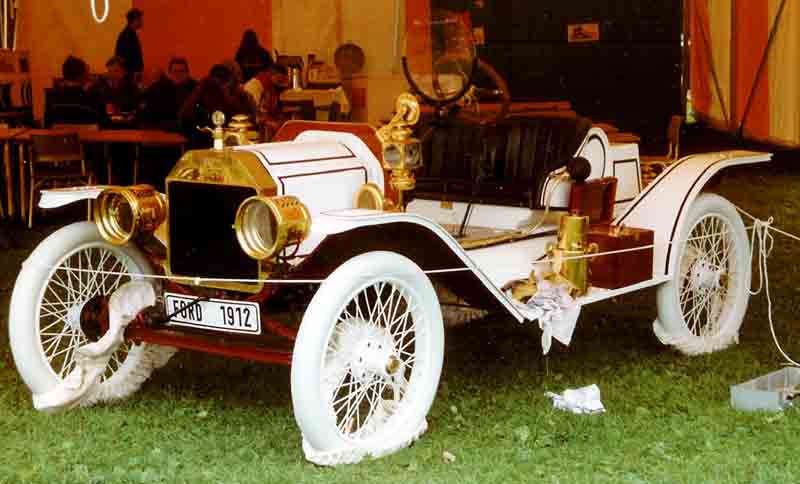
Air, no air. That's right. I'm going to take us back to a previous century and say the Model T.
I think that's what kicked off our industry. Very good. What is the most American automotive
moment when we think about historically, the moment that might have defined automotive going
forward? Alan Haig, we'll start with you and then go, Aaron. It might have been the time I snuck
out of my parents' house and took the car a couple of years before I got my license. That's what
kicked off the auto industry for me. Very good, Aaron. I think Henry Ford creating the assembly line.
Yeah, very good. Grant? Yeah, that's where I'm at, Aaron. I thought, based on what Alan said
earlier, the assembly line, man, just automating things so that you have a system. Yeah. Don
Hall, I'm going to ask you a different one. What's the biggest threat to auto retail today?
Technology can be or could be, but the biggest threat is that sometimes we get caught up around
a little world doing what we're doing and not thinking about the bigger picture. We're in that
great business with outstanding opportunities. They got lots of folks on this today who because
of this industry, we have been greatly blessed and you too can be greatly blessed with the right
attitude, the right mentality and work your ass off. Yeah. Grant? Yeah, two things. Distractions
and the individual. Yeah. Yeah. Aaron, what's the biggest opportunity in June of 2026 in this
auto industry today as we move forward into the next 50 years? You know, it's funny because I
look at threats as opportunities and as the world changes, just embrace what's going on and be there
before everybody else out there. If you see things that others don't, that's the greatest
opportunity that you've got. During COVID, you saw the used car opportunity. Many said it would
crater, it didn't, it rocketed. Grant Cardone, what's the one thing people don't see right now
that's about to happen that represents a huge opportunity in automotive?
The one thing they don't see. Yeah. I mean, I think everybody again relies on,
you rely on some hack that's going to somehow get you through. Don mentioned the basics earlier. Guys,
the basics will always help you and people don't get good enough at the basics. So
go back to block and tackle. AI and dealerships, a weapon or a threat?
Opportunity to learn a lot, understand what the customers are reading, and then to be able to
dispel and or inform what the real world is or is not. One of the quick comment Grant made
this a minute ago, the FTC could be looked at as a very threatening thing. As Aaron said,
this is an opportunity. Negatives are opportunities if looked at properly. Wow, we get to redefine who
and what we are and get people that outstanding buying and service experience that they deserve
and they will have and people like Aaron will deliver that. Yeah, I think AI is a great opportunity.
If you learn from it, you embrace it and like what Don said, what's going on with the FTC,
I'm excited about it. It's going to improve the industry. It's going to improve the
dealer's relationship with the customers. It's going to take out those. There's very small
percentage of bad actors. Most dealers are great people out there, but it'll take out a few of
those bad actors and kind of put everybody on an even playing field going forward. You think about
AI. It's a really broad term out there. It seems like everybody's into AI. Everything is AI these
days. So you got to kind of decipher through it too and see what's really valuable and what's
just kind of the BS out there. But I think it's exciting times in our industry. One last question
as we wrap up, open to everybody. What's one thing dealers thinking about the next 50 years
should never stop doing? Something that's being done today that we should never stop doing?
Never stop loving your employees. Take care of your employees. They're going to take care of
you and create that world-class culture. And customers too, right Aaron? I think they take
care of the customers. They'll take care of you too. So I think make it easier for customers to
transact. I think that's one thing that AI could do in a way. And then at the same time taking a
mass amount of costs, compensation costs in particular, out of the dealership cost structure
right now because there's a big opportunity for dealers to make more with the same or fewer people.
A loved, respected, appreciated employee will make sure you have what Alan just said,
a very happy customer. Think long-term, Mr. Dealer, long-term take care of your people.
They will take care of your customers and you will have a great experience for the next 50 years.
Great. Yeah, community network with your, go ahead Alan.
No, please. A network with your community. It's still going to come down to prospecting,
keeping your funnel full. Who knows you? Who do you know? Who can you connect with? You got to
have deal flow. Yeah. Alan, did you have anything there? I was just going to say that Aaron is
doing an excellent job showing you that it's still possible for you to have 100 dealerships before
you said you want to retire. Oh yeah. Is that even going to be the number? Who knows? All right, so
yes, or more. So, hey to you, Don Hall, Alan Haig, Aaron Ziegler, Grant Cardone. Thank you so much
for being part of this July 4th. Everybody enjoy this fantastic and incredible weekend. So, thank
you for being here. Happy 4th, guys. Happy 450th birthday, everybody. Amen. Hoorah. I love it.
All right. Fun episode today. Thanks for being here on this holiday weekend. However, you're
enjoying the holiday. Enjoy it well. Go Coast Carson, host of our actually at the Juliet race.
And to you, our Daily Deal listening audience, thanks for watching Daily Deal Live. We break
down the biggest moves in the car business as they happen. Don't forget we're live here every
Monday, Wednesday, Friday. So, if this is your world, hit like, hit subscribe, turn on those
notifications so you never ever miss a beat. And we'll see you next episode. Thanks for being here,
everybody.
About this episode
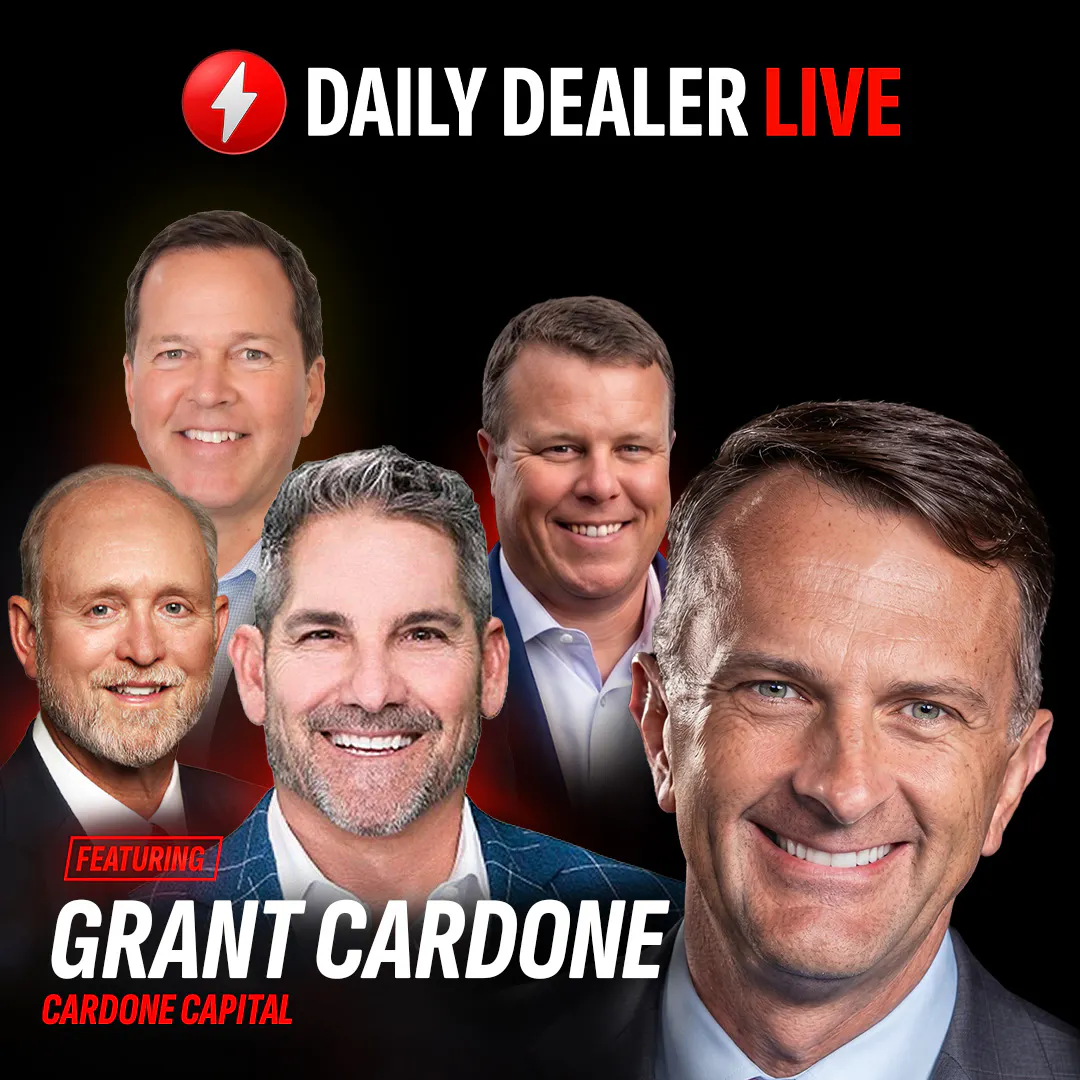
Celebrate America's upcoming milestones with a forward-looking panel featuring industry heavyweights Don Hall, Grant Cardone, Aaron Ziegler, and Alan Haig. The discussion tackles the future of auto retail, debating whether the traditional franchise model can survive the rise of AI, direct-to-consumer sales, and evolving subscription models. A major highlight includes a sharp debate on the economic and national security threats posed by Chinese automakers entering the U.S. market, alongside a critical look at recent FTC regulatory pressures demanding greater advertising transparency from local dealerships.
Today's show features:
- Don Hall, President and CEO of Virginia Automobile Dealers Association
- Alan Haig, President of Haig Partners
- Aaron Zeigler, President of Zeigler Auto Group
- Grant Cardone, CEO of Cardone Capital
This episode is brought to you by:
Podium – Most AI is a black box. Podium's is yours to control — and it increases conversion by upwards of 26%. Check it out at http://podium.com
Check out Car Dealership Guy’s stuff:
CDG Circles ➤ https://cdgcircles.com/
CDG News ➤ https://news.dealershipguy.com/
CDG Jobs ➤ https://jobs.dealershipguy.com/
CDG Recruiting ➤ https://www.cdgrecruiting.com/
My Socials:
X ➤ https://www.twitter.com/GuyDealership
Instagram ➤ https://www.instagram.com/cardealershipguy/
TikTok ➤ https://www.tiktok.com/@guydealership
LinkedIn ➤ https://www.linkedin.com/company/cardealershipguy/
Threads ➤ https://www.threads.net/@cardealershipguy
Facebook ➤ https://www.facebook.com/profile.php?id=100077402857683
Everything else ➤ dealershipguy.com