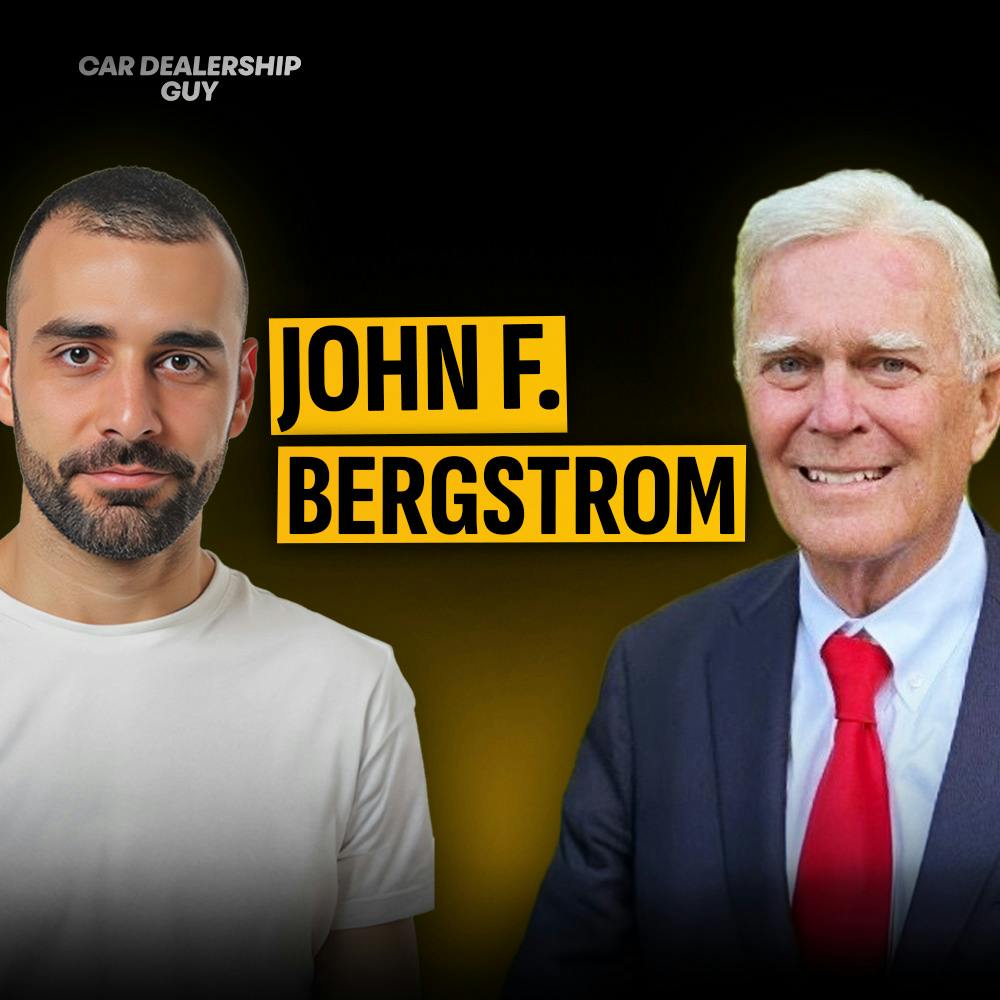
50+ Dealerships Later: The Car Business Lessons of an Industry Legend | John Bergstrom, Executive Chairman of Bergstrom Automotive
Car Dealership Guy Podcast
50+ Dealerships Later: The Car Business Lessons of an Industry Legend | John Bergstrom, Executive Chairman of Bergstrom Automotive
Car Dealership Guy Podcast · Aug 26, 2025
Annotations will appear as you listen
0:00
62:47


LIVE
Today I'm joined by John Bergstrom, Executive Chairman of Bergstrom Automotive.
After 50 years of building one of the most respected dealership groups in the country,
John isn't slowing down, he's accelerating. We dive into the lessons behind his long-standing
success, the strategies fueling Bergstrom's expansion and his vision for the future of
the dealership empire. A big thank you to our sponsors for making today's episode possible,
Impel, Openlane, and CDG Dealer Consulting. And now let's get into the show.
John Bergstrom on the CDG podcast. John, welcome.
Thank you. It's fun to be here.
It's great to have you on. How does it feel to be going on a year 52 of running Bergstrom Automotive?
Tell us about that.
It's probably the same as the first year and the 12th year and the 31st year.
We Ted Tariff start today, that'll be exciting. But Bergstrom Automotive has been a good ride.
And we certainly had some hills and valleys, but put it all together, it's been a good 50 years.
You know, I'm clearly just a bit younger than you, but I know my, I think my mom always
says, she's like, you know, you get older, you still feel the same in like your head,
but you still feel like a kid. And, you know, again, I'm in my 30s now. I have kids, you know,
I can understand that to an extent when you say it probably feels the same.
You know, there's certain things that don't leave us, right? The body ages, the mind
stays the same. So it's a bit profound, but I do think about that, right?
I'd love to understand a little bit about your beginnings in this industry.
I mean, 50 plus years with, you know, a mission, a consistent mission, that's,
you know, it's the, it's called like life's work, right? It's a very big deal.
And I'd love to know how you got into this industry to begin with.
First off, I want to go with your mom.
Please.
In a lot of ways, it doesn't feel any different than a long time ago.
When we started a new challenge and this business is full of challenges and
opportunities, this whole thing about tariffs today, it's another lump in the road and try to do it,
but it's also a wonderful challenge, you know, an opportunity to maybe, maybe shoot the lights out
and figure out a way to turn it into an advantage instead of a challenge.
So I think your mom was on the right path.
And a quick question on that, though, is tariffs the top thing on your mind today?
I mean, of course you have your super diversified brand mix, although you mentioned it twice.
And it wasn't, it was actually not the first thing that I was going to bring up.
So I'm curious to know, is that, is it just simply because tariffs go into effect right now?
Is that why it's top of mind or is there any other reason?
Obviously, tariffs going into effect today, the obvious thing people would think about is, gee,
this is going to create a new challenge.
I'm looking at it from a different point of view.
Our business has been unusually good for the first seven months of this year.
I think at least the last four have been good because of tariffs where people are moving in
advance and trying to purchase a car now and avoid the cost of the challenge.
And in this thing, I believe that a lot of the people overreacted to it.
I think it's probably a two to $5,000 change and relative to the cost of a new car or truck,
I don't think that's seismic.
So I think we'll be just fine, but it's interesting and we're watching it carefully.
Who do you think is going to absorb those two to five thousands?
Or will it be absorbed across the entire value chain?
How do you think about that?
It would seem to me that General Motors and Ford both are very close to the U.S. market as their
total focus and they don't want to lose share.
So I'd be very surprised if there was any kind of significant change in price.
If there is a change, it might be a tweak in what they're doing on incentives,
but I believe they both make great products.
They're both selling well and they both need them to continue to sell well.
So I don't think there'll be a big change there.
All right.
Well, we'll dig more into that.
So take us back a little bit because I have a thousand questions as usual.
So we'll start with the first one.
But what brought you into this business?
I've always liked cars from as far back as I can remember.
Sport cars and fun cars, not necessarily generic cars.
And I wanted to be in the car business and there wasn't a Chevrolet dealer or
General Motors dealer in our community.
And I thought, go to college, do a good job, get out, apply to be a dealer and start your business.
It didn't work that way.
General Motors turned me down and said, you know, you did a good job in college.
We like the fact that you want to be a dealer for us, but you don't have enough money.
And I could have told him that ahead of time.
But the reality is that was one of those things that it not only was difficult for me to accept,
but it was also a motivator to try and figure out a way to get going, get started.
And we started a bar.
Now, you have to remember that my parents made a significant financial sacrifice
sent me to Marquette University, which was a Jesuit school and expensive.
And then I decided I'm going to open a bar.
So that was not exactly perfect as far as what they would have hoped.
Caused a little friction.
It had a wonderful parents, but yeah.
And reality was that there were already 60 bars in our community.
Why did we think we would be successful?
And the interesting thing is we were amazingly successful and didn't know what we were doing.
You know, it was we we built this place.
We called it the old post office was in a good location,
but that was because we could buy it cheap.
But it was in the central city of our little town and we made it fun.
We lots of lights, lots of noise.
And I had this thing in my mind that if I could get people that that really felt we cared about them,
that they would come every day or frequently.
And how we were going to do that is I was going to play a game with our employees,
our team, that you had to learn their name on the first visit, the first name,
and what they like to drink.
And then when they walk in, we'd say, Wayne, it's good to see you this afternoon.
Thanks for stopping in and slide Brandy and Coke down the bar too.
That doesn't sound like a big feat, but it's challenging when as your scale grows and confusion
and busyness and all that.
But our team got good at it.
And I can tell you for sure that we weren't any cheaper than anybody else.
And we weren't having a product that was any different than anybody else.
But what we did do is they knew we cared about it because in one way or another,
we were inviting them into our little family.
And we did that for a couple years successfully and we're able to transition from that
and have the money that we needed to start a dealership for Chevrolet here.
And it worked out pretty well.
So that was your first franchise, Chevy, right?
Yes. And I've always respected them because they gave me the chance.
I still wasn't a gold-plated opportunity for them.
But I had harassed them quite a bit in that two years.
And they, I think, maybe even made a mistake as far as how they went through the process.
But they gave us a chance and it's worked out well.
For many years, I can't tell you exactly, but many years,
Chevrolet has been first place in this market ever since.
And I've driven a General Motors car every day since then because they gave us that chance.
And we grew from about 30 employees to about 2,500.
So that whole thing was a little bit like when you listen to the investment guys
where they talk about their ongoing interest, giving them a return.
Each time you made a person feel like you cared about them and were genuine,
and they bought a car from you and you remembered their dog's name
and you said hi to his wife first.
And you listened and made sure that if they had a problem, you took care of it.
It just continued to grow and it does today.
And even though we have all of the complicated technologically things
that we have to change because this business changes so fast,
we keep going back to that base premise of make sure people know we care about them,
remember their name, sew up a little bit, make eye contact, smile, shake hands,
and shake hands with the wife first, not the husband.
It's that little stuff that gets them so that they, in one way or another,
say this place is different than the other places that we bought a car from.
This episode is brought to you by Impel AI,
is retaining customers a top priority for your dealership.
Bringing them back to your service drive takes more than good service in the base.
It demands proactive, personalized, and consistent outreach that's impossible
to scale manually, but there is another way.
Impel AI reaches customers on their preferred channels at the right time
with timely outreach for service milestones, inspection dates, recall alerts,
tailored incentives, and more.
It feels more like a concierge service than marketing.
Schedule appointments and email or text without lifting a finger
and free your team up to do what they do best.
Provide white glove service and build customer relationships that foster loyalty.
Future-proof your service drive, visit impel.ai-slash-service-drive-today
or click the link in the show notes below.
John, you mentioned a level of loyalty to Chevy that you have
and given your experience and what Chevy did for you,
but it got me thinking about just a broader conversation of American-made vehicle
and how it feels like that has declined in relevance.
And basically, it feels like it used to be more important.
And my question to you is, do you feel like I'm correct in that statement?
Like, do you feel like the average consumer still embodies those traditional values
and sees the importance of buying that American-made vehicle?
What's your take on that?
It's an interesting question because 20 years ago, it was a critical situation.
I want to buy America.
I think people today will want to buy a vehicle that gives them quality, dependability,
pride in what they do, and whether it's made in Mexico or Germany or South Korea,
isn't a big deal.
It's pretty hard to even tell apart which one, John.
In other words, it's almost like it's a luxury belief to think like,
hey, can only buy this or that.
At the end of the day, what you're saying is that it's where can I buy the highest quality,
the most affordability?
That's essentially what's driving the consumer decision nowadays.
And innovation, I believe, is a big part of it.
But if you drive a large SUV and you get an in and out of a Chevrolet Tahoe
or a Denali, maybe, or an Escalade, or Ford's new Expedition,
those are the best sport utilities in the world.
And there isn't anybody else that's got something that can say, gee, I'm better.
And I've got better engineering or whatever, cheaper.
And in our part of the world, the middle part of the United States,
a major part of what we sell are those type of vehicles.
So it's one of those things where General Motors and Ford have earned their chance
and are doing it very well.
I want to fast forward along the way you've opened many stores.
One of the interesting parts about your business is you own 30 stores up until 2019.
From 2019 till today, you've nearly doubled your group.
Talk about exponential growth.
From 1982 to 2019, 30 stores and then almost doubling in six years.
You're also part owner of the Packers.
And we slightly started having a discussion on this.
And it seems like you're very passionate about football.
So let's kind of break down this piece by piece.
Let's start with the growth.
What's contributed to this really explosive growth in the last six years?
And I'm saying from the perspective of has this simply been a function of
redeploying capital from these really profitable years?
Or has this also been a more strategic company decision that involves succession?
Like why now?
Why so much growth in such a short period of time?
What's driving you at this part of your career?
First off, you said this very good profitability or something like that.
I don't want anyone to get the wrong idea.
This is not a gold mine by any stretch, but it's a very good business.
And it's a business with scale you can do pretty well.
But we weren't putting gold coins into a barrel and trying to figure out what we're going to do.
When we had enough money to have enough equity to go in and buy a store,
I would work hard on doing that, look for that opportunity.
And then simultaneously, as we put a plan together on how
we ran the culture of what our stores are, that made a big difference because
we could then measure how we're doing against what our plan was, and then we could say,
this is an opportunity we can take another step.
And we looked for places.
I started writing letters 10 years ago, maybe 12, to a group of dealership owners
that I would like to buy if they would sell it.
And I would write them in January each year.
I didn't know them outside of maybe who they were.
You didn't know them at all, right?
It was just cold letters.
Just who they are.
And I would write them a letter and say, if you ever want to sell us,
if it would work for you, I would work real hard to make it easy for you to exit.
And we'd take care of your people, and we would do whatever we could to make sure that
you and your family had what you wanted, and we and our family would have what we are.
And we have never had a problem in a closer.
It's worked out very well.
And I think that gets around where if we sell it to John,
he'll do what he says he's going to do.
Most of these deals are done either having a hamburger at a restaurant for lunch
or on a telephone call.
And one of the best transactions we've ever had for us and for the seller,
I believe, was done in 10 or 12 minutes over a telephone call
on a brand in the city that a lot of people would like.
But harassment would be too strong.
But I'd contacted him a lot of times.
He knew what he wanted.
He wasn't going to give it away cheap.
But it worked out very well.
And I think with a pattern of that developing, we've been able to grow.
And we're going to continue to grow.
We're excited about it.
And so far, this whole business of treating people respectfully and nicely
has worked out pretty well.
When you said that most of these deals were done over a hamburger,
and of course it started with the letter,
a story came to mind where I once learned about a tech investor
that was gobbling up lots of deals.
And the community, lots of investors were asking,
why is this specific investor getting so many deals?
And what they found out was that, of course, he had earned trust.
But he was also going into these deals and from the get-go,
giving up and not attempting to take control.
Which at the time, it was a very taboo thing.
It was like, you invest at this stage, at this scale, you take control.
This investor came and said, hey, you get hypothetically,
let's say 51%, I'll take 49.
And this person won the market.
And I always think about that because I think it's a lesson
in it's a bit different from what you're describing.
But it comes to mind as a way of, when you brand yourself as a person that is,
I don't know if the word right word is easy,
but that is fair, is able to do deals, that compounds.
And I'm curious to know if you feel like that's contributed in part to
your ability to grow this way, just your reputation really,
and the compounding effect of that trust,
to the point that you just described being able to have a lunch
and align on high level terms of a deal that quickly.
It's pretty remarkable.
Well, 30 years ago, I hired a very talented and very good person
who was our first in-house attorney and just a very, very important hire.
And it's been terrific for our company.
But I drive them crazy in that every time I buy something,
I write notes on a cocktail napkin or some kind of a note card.
And then I take a picture and send it over to him on my way home.
And I say, we just bought this, and Bob has a stroke.
And I haven't been able in 30 years of him training me
to either make the changes myself or have him get used to it.
So they behind the scenes do a lot of other work.
But we do a closing.
I've heard closings that take days and people are counting widgets
and titles and all that stuff.
We do closings in two hours.
And the first half hour is trying to figure out where the men's room is
and a cup of coffee and stuff.
And we, I shouldn't say this because maybe it'll change,
but I haven't ever been in a contentious closing.
I don't want to be in a deal where both sides aren't happy.
I want to be in a way where we wish each other luck.
And in a lot of ways, we're making that family wealthy.
And they've worked a long time and never had a big check.
All of a sudden, their whole world changes.
And in that whole format, you do the same thing on the financial side of it
in that you build relationships with the financial institutions
where they trust you and know that you're not going to do something
that isn't appropriate.
It is one of those things that makes this business wonderfully exciting
in my opinion because you're starting that game over every month.
And you're starting it over with every purchase.
And you end up with probably the best type of business
that is left in America where you can start with a small nest egg
and a desire to work and work with a group of friends of yours
and turn it into a great business and in a lifetime become successful.
What do you say to people that say that's just not possible anymore?
These assets have gotten too expensive.
I don't believe that at all.
You couldn't start with less than I started with.
And when you work on it, I work with our son Tim every day now
and have for the last 20-some years.
And we don't ever look at this thing as somebody doesn't have a chance.
In fact, frequently we're in a position where we're trying to convince people
that this is a wonderful opportunity.
Maybe not.
They don't even have to take the risk of owning it.
Maybe you buy it, set it up, get it running and have them run it
and pay them on a basis of what it makes.
And all of a sudden, he's not worrying about his student loans anymore.
It really works.
And then that person, if they wanted to take the risk to grow,
can go buy a smaller one and start from nothing.
As a rule, they like medium-sized ones or larger ones if they're really talented people.
But I think if I had a grandson today that walked in the office and said,
I want to start in the car business, but grandpa, I want to do my own thing.
I would wish him very well and he will do very well.
It's hard work.
Frequently you run into people that think hard work is kind of eight to four and five days a
week or something like that.
That doesn't work in this business.
I wake up early, read the Wall Street Journal summary and the New York Times summary,
take a shower, get to work by seven, and stay here until seven.
And it isn't like I'm going to sweat to death working.
But if I ever got the idea that I could go play golf three days a week,
that just wouldn't work.
You put a lot of emphasis on the human, which I think makes a lot of sense.
I'm curious to know, what's your visceral reaction when you see stuff like the
advent of self-driving cars rising, online sales growing,
Carvana or CarMax has their online and many dealers offer it as well.
But these type of experiences where the human is not as relevant to them,
at least on the facade, what's your take on that?
Do you think the human is losing its relevance in this business?
Is that a trend or do you think this is just an alternative way
that is not going to take over?
How do you think about that?
There's three parts to that.
The human piece you need to build a relationship.
Without the relationship building, the glue that they have to come and get a car from you
is gone.
I do think that we will win if we show people we care.
If we go the extra mile to take care of them when they're having a difficult day
or when the car doesn't work or whatever they need, they're going to be loyal to us.
And it's that same thing of compounding interests that we talked about earlier.
And I don't think I'm going to get that out of AI or robotics.
We sell a fair amount of cars on the internet, maybe 25 to 30 percent in the used side,
and maybe 16 or 17 percent if you put everything in new together.
So we're certainly not going to take on Carvana.
But we're in a position, I do believe, that against Carvana,
we can win in the markets that we're in.
I believe the reason people go to Carvana is they're not happy
where they're looking for a car now or their history, their experience,
or the whole car buying or selling or servicing, then didn't go well.
And if you look at the markets that we're in, we're doing well.
It's going fine.
And that's all based on caring about the person and building the relationship.
The second part of that, that autonomous part,
I have supercruise on my car right now.
I like it.
I think that it's going to get better.
I do believe that it's going to work very well at Marquette University in Milwaukee,
where you've got density, or San Francisco.
But I'm not looking at all like it's going to take over.
I've been on the board at Kimberley-Quark for over 30 years.
So I've traveled all over the world to director meetings.
And I've seen bullet trains in Beijing.
I've seen a whole cadre of different opportunities of whether they're going to do
cable or whether they're going to do buses or whether they're going to do subway systems.
I've been in one of Elon's tunnel things.
I just don't see that solving the problem in America.
Far apart.
And you have to have a car.
New York City you don't, but I don't have to worry about New York City.
And what I have to worry about is to have a cost-effective, safe,
pleasant experience for people who need to get in their car to go to work or go to school
or whatever they're going to do, go to the grocery store.
And I don't think that's going to change.
It's quite a juxtaposition.
Kimberley-Quark and auto business love to know how that came to be.
And how you compare those experiences.
I hear you.
I think there's something to be said there.
I do agree with you that the relationship can compound.
And it's a beautiful thing when you can just have someone that you can reach out to
and you know you'll be taken care of.
I would say my concern is what happens to the people that have already defected
and have gone the other way.
And then how do you get up to try again?
If you believe that your experience is great.
And look, I would tell you from having not ever bought a car for you clearly,
I don't live in your area either, but have looked at research, Bergstrom and what you offer,
it's clear that you're listening to the customer.
You have your fingers on the pulse with just the way you're offering, such as your guarantees,
your pricing guarantees, your return guarantees.
It's all marketed on your website.
You said it's possible to have it compound.
You're not a believer yet.
But if you would come into this place and just spend some time with us
and we didn't figure out some very complicated thing, it's like you want to be treated
or how I'd like my daughter to be treated.
We were in the Saturn business.
It was a great business for us.
And that's where we got our one price start was with Saturn.
But that whole thing was, I know if somebody comes to one of our six Saturn stores,
they're going to leave there happy.
The car is a generic box.
It's nothing too special there.
But I'll tell you, those people love the way we treated them.
And we sold a gazillion of them.
But in kind of a macro look at it, we're in one of the smallest cities you could
possibly think 20,000 people here.
But we'll sell 40,000 cars in the expanded area that I think what we represent
is what does that?
It's certainly not because they think they can save $100 or $1,000.
It's about they're going to be treated right.
We work hard at that.
Between every single day that we hire somebody and when we put them on the line to work,
they are told that orientation and their interaction with our people,
their job is to make the guest happy.
And look at that customer like a guest, a guest into our business,
or a guest into your home if you want to keep it simple.
And if you do that, whatever decision you make,
as long as your intention is to make them, we're going to stand behind you.
And if it costs $200 or $10,000, we're with you.
Now, let's not go crazy, but if you forget to put the oil bolt in the bottom of an engine
and they fry an engine, and we have to go pick them up,
and they're at that team saying to them, you ruined my engine,
I think what you ought to say is, we're going to give you a new one.
And somebody might say, the old one had 78,000 miles.
And I'm going to say, I don't care.
You know, we screwed them up.
We want them to trust us and we'll put a new engine in.
We'll let you use a car.
Well, we're putting that engine in.
They'll tell a whole bunch of people and that will come out.
And there isn't a week that somebody doesn't get into the system here
that says we've smashed their car up, not in a big way,
but when it's in for service or something like that.
Every single person that works for us knows to say,
we're really sorry that that happened, ma'am.
And we try to be as careful as we can.
But what day works for you next week?
And we'll let you use a car and we'll take the dent out and get it fixed.
And I'll have people come to me and say, you're nuts.
You know, eight out of 10 of those people are conning you.
And I'll say, I don't know which one is and which one isn't.
And I want to treat people appropriately.
So we're going to do that.
And I look at that as a cost to doing business.
And that works for us.
Now, I'm not sure that's going to work in Chicago.
But again, that's not the marketplace that we want to be in.
We want to be in a marketplace where we can get involved in that community.
The things that are important to us are not just that we sell cars
and that everybody that in one way does business
and everybody thinks we're okay people or good people.
We want to make a difference in the communities where we have dealerships.
We will leave the effort to build a Boys and Girls Club.
We'll make a major donation.
We'll put people in there to fundraise.
We'll work trying to figure out what's the best facility there is.
And it isn't because we're good guys, totally.
Yeah, I think we're doing good things.
It's the right thing to do.
But you're making a difference in the community and they need some help.
And people know that.
They figure it out and then they do business with you.
I believe that there's a much softer, better way to do this business
than a lot of people try to do it.
I have a very good friend that says to me,
how many hot dogs can you eat, and we laugh at each other?
But what that means is we're doing okay.
We can afford to do things to make it.
To think long term.
Yeah.
Well, and just even today, I don't.
We're involved in the Catholic school system.
And my son, Tim, does a great job working with them.
There's five different schools in our primary communities here.
And he constantly wants me to get more involved
in trying to figure out directional stuff for leadership things.
And I'll say, no, that's your deal.
But the only thing that's important to me is that we don't turn some family down.
I never want to get to the point where we got to say,
we don't have enough teachers or we don't have what we need.
So as long as we keep doing that kind of stuff,
and it's not that one religion is different than the others,
just happened that my mother was Catholic and married a Presbyterian death.
So she won, what most spouses do.
And we ended up with this situation.
When that young child and his mom shows up at the door
and they can get an education that's got discipline and respect,
I'm not into ultra religious stuff.
I think we win as an automotive viewer in that time.
And we don't put a sign up on it that says our Chevrolet store paid for it.
What we do is make it very clear in that community that we want to help.
But it works.
This episode is brought to you by Open Lane,
the leading online dealer marketplace for used cars.
Open Lane is making wholesale easy so dealers can be more successful.
And all this August, they're spitting up an entire month of excitement
with Dealer Fest 2025.
If you've never used Open Lane before or it's been a while since you have,
you're eligible to earn up to 2,500 in buy or sale fee credits.
Open Lane provides dealers with a fast and transparent way to source or wholesale vehicles
with a nationwide network of dealers,
in-depth condition reports powered by AI,
robust buyer and seller guarantees,
and the industry's most competitive fees.
Learn more at openlane.com or click the link in the show notes below.
As you grew from the 80s till 2020, and would you say that growth was linear
and were these always the values of the group?
Like did this evolve over time or was this ingrained in you as a child?
The first time I ever sat down with our group when we started our business,
I remember saying that we're going to work hard,
we're going to get good at this,
and we're going to be the biggest automobile dealer in Wisconsin.
Well, I thought that was like climbing Kilimanjaro,
and reality was it didn't take very long to get there.
And then we started saying, how do we do this in a bigger scale?
And we've always done that.
First, we wanted to hit a billion dollars in sales,
and then we wanted to get $2 billion in sales,
and we're going to do that this year.
I think it's good to keep stretching.
I don't have any interest in status quo.
How does that impact other parts of your life?
I mean, why did you get into NFL as an example?
I can see whenever you say the name Green Bay Packers,
there's a smile, you seem happy, and there it is again.
What brought you to that, to the NFL?
Everybody's got a hobby, something they like and want to do.
And I got a call 30 years ago saying,
we'd like you to come and be on the board of the Green Bay Packers.
I said, I don't know anything about football.
Wow, that's a big, that's a steep curve right there,
from not knowing anything.
I didn't know anything about football, and not really about it now.
But they said, that isn't what we want you for.
We need somebody for marketing.
And one of our directors says, you're good at this,
and we'd like you to join.
Finally, we said, I'll do it for a year.
And if I do a good job, and if it works for you,
we agree I'll stay for a while.
Well, I did that for over 30 years,
and ended up with six of us running the Packers,
and had a lot of fun, made great relationships.
But it was always just a hobby, a sideline thing.
My wife and I had traveled a lot, we'd go to all the games,
and we'd get to know a lot of the players,
and a lot of interesting things that was fun to do.
And we just had a good time doing that,
and I don't want to be too brash.
But our Green Bay Packers have won the World Championship
in football 13 times, and nobody else has.
And we're from the smallest market in professional sports.
And we don't have guys that are getting put in the slammer
for crazy things that they're doing.
And if we do, they get out the next morning,
and then they get a bus ticket and go work someone out.
Because that's not how our people are going to behave.
When people come to a Packer game, 82,000 seats,
and we don't have people getting in a flight in a stance.
And as we travel and see other places,
that's a totally different experience.
It's incredible.
Would you compare, I don't know how involved you are today
with Packers day to day, but would you compare
running an NFL team to a dealer group?
Like, what are the similarities there?
There's a lot of similarities, actually.
But the thing that most people think about
when you run a football team, a baseball team,
I would think would be the same.
They think about calling plays or picking a fellow that's fast.
Running a football team, that's one part of it.
But then you've got to run the business.
You've got to have a stadium.
You've got to have all the important people.
You have a labyrinth of challenges
that you've got to work your way through.
Television contracts and radio broadcast stuff,
and putting all that together,
selling the stuff that says Green Bay on it.
When you think that there are 32 teams in the NFL,
and we sell more Green Bay Packer monograms,
logoed wear, than all but one team.
And that's because Charlotte Ford has an unlimited checkbook
in Dallas, and her dad likes her.
And so she builds stores all over the place
to sell cowboy stuff.
And then she goes south of the border and sells it.
We don't have those two options,
but we outsell everybody else.
And we do it in a way where people are proud.
They'll buy it as a gift for their grandson,
or for their husband, a quote for his birthday or something.
And the economic part of that makes us more than competitive,
because we do very well doing that stuff.
Most people wouldn't even think about that.
I think protecting the brand and the culture of who you are
is critical in an auto dealership,
and it's critical in a ball team.
There's no doubt about it.
And so there's a similar,
they're also, the leverage part of it is incredibly important.
I work with a lot of young people in our stores
when we start running dealerships
and put them in as general managers.
And if they're not careful, they think they're rich
because they're dealing with 10 million dollars a month.
But what they don't realize,
and they haven't figured it out yet,
is only 400,000 of it maybe is theirs or ours.
And then the federal government gets 200 of that.
So now you get a very small piece.
The football business is very much the same.
They are not wildly profitable.
Over term, they get there.
And it's a decent business, but it's not a great business.
If you think they're worth five billion dollars,
and let's say the best one,
and this is just me guessing,
but the best one makes 250 million.
What sense does that make?
That's a 5% pre-tax return.
So car business in a lot of ways is the same deal.
You handle tons and tons of money,
and you give most of it back to the manufacturer or whatever.
And you end up with a modest amount
until you figure out a way to build that into a substantial network.
And a lot of people in America have.
A lot of wonderful people that do great things.
I was really sick about six or seven years ago with cancer,
and the prognosis wasn't good.
And I ended up at MD Anderson in Houston.
And you wouldn't believe the people
that you knew a little from a meeting or something like that,
that reached out and said,
we're pushing for you.
What can I do when we're praying for you or hanging there?
And I do believe that this business has a lot of wonderful people,
despite how they might be portrayed sometimes or imagined.
But I will never forget that.
I spent 23 weeks in the hospital.
I'll never forget that.
Because I have people that run manufacturing companies
known all over the world that would stop their airplane
and come in for half an hour just to say hi.
I had fewer friends that came from everywhere for a pep talk.
Have a couple of them that called me every week.
And you just realize how good people are,
what they do to help others.
When you're building projects like we get involved in,
in this dealership business,
it's amazing how many of them will send a check and say,
go to a good walk or whatever.
A lot of good stuff come out of this.
Would you say, how did that moment
change your perspective on anything or did it?
I mean, I have to imagine it was pretty,
you know, just a life altering period in your,
you know, going through a health scare like that,
to say the least.
So how did that, how did that shape you?
First off, I don't want to whine about the ones in my life.
So I don't know if I want to go there.
But I, when they, when I first found out
that I was sick within 24 hours,
they told me to get my fears in order.
And I worked that day.
That's the normal way I'd work in there.
That gets you tuned up.
And then when you get to the place
where you have the best shot at getting better,
there are amazing places in this country.
Starting with what I had at MD Anderson,
but Mayo Clinic and Hopkins and so on.
There's a bunch of, and these people
are brutally honest with you.
Your shot isn't very good here.
You do think about it.
But in my situation, there was no chance
that I was going to say,
I'm not going to do this or make me comfortable.
It was, come on, we're going to fight this thing
and we're going to win it.
We're going to do whatever it takes and don't screw this up.
And yeah, you think differently.
But you also, I think, are in a position
that you have more respect and value
for America and the United States.
So they didn't send me to wander.
And there are some screwy.
The healthcare system, yeah.
Yeah, no.
And there were no barriers to whatever it takes.
Let's get this fixed.
You briefly touch on some of your management
or team members that maybe think they have X amount,
but they really have X amount,
like don't overspend or plan wisely.
Again, going back to your scale,
over the last five or six years,
how has that impacted your group's management style
or has it?
Meaning, how are you today functioning as a group?
35 different brands across 50 plus, 60 plus rooftops.
I'm butchering that number right now.
Many rooftops.
How does that functionally work, right,
between centralizing management,
decentralize decision making?
It seems like you are culturally
and your values that are important to you.
You've spoken about this.
It's the pillar of this business, right?
This is what you've been built on
and why you've been successful.
And so how do you actually manage these stores
and what type of autonomy do you give
these different stores and leaders?
How does that work?
Three of us run the company day to day.
My son, Tim, who is very much in operations
and very good at it.
And John Hogarty, the young attorney that we hired,
who keeps us within the lines on what's we go.
And then we run these businesses independently
and we put a leader in that business
and give them a set of metrics
of what we would like this to be.
That person always has worked with us
for a period of time.
We're not going to hire some guy
to a boss place and put him in there.
And so they're going to know how we want to do business.
And we stay close to her.
We stay very close to her.
Up until just recently, I was in every store every month.
And between Tim and I, we do it now.
But it's really one of those things where
you've got to protect that culture.
And the culture is we're going to build
one-term relationships with people
and we're going to be very successful doing it.
And we're going to make a difference because we do.
It's pretty simple to portray it.
Sometimes it's hard to give people to believe it.
But once they understand that's what we're going to do,
it works.
It sounds to me like you're a pretty decentralized
management style in that case,
where the leader has lots of autonomy,
then in a way they call their own shots.
Am I reading that correctly?
We're not that liberal.
We have very defined metrics that you're going to play.
What that person does that runs that store
more than anything else is he protects the culture
and hires new people.
That's what they're a cheerleader.
And they make sure that we don't get out of sync
of where the challenges are and not treat them appropriately.
The relationship between the manufacturer and the dealership
in a lot of places is contentious.
Not terrible, but a debate seems to be part of the program.
We don't believe we're partners.
We're going to work with them.
Now, I could say no if I don't think
that that's appropriate for our company,
but we'll do it respectfully.
And for most parts, I'm the one that will deliver that message.
We're saying, I understand you want nine chargers,
and I have two electric cars.
So I understand the rule.
I just can't get myself to spending the million bucks
until somehow or other I can get the car.
So I'm not going to write you a letter.
I'm not going to have you somehow get embarrassed or whatever.
But just help me understand how that one makes sense
if you were in my chair.
And we're doing this together.
I want to be the best partner you got, and we do.
And so our people understand that.
You mentioned Tim several times,
and I'd love to know more about that relationship
and how your son, I mean, how he's grown
within the organization, right?
How you split the duties today.
How you see the future.
Talk to us a little bit about that.
I think most of us are really proud about kids,
but let's just talk about your specific question here.
I have never believed that people should spend too much time
in a country club.
He came to work with me.
He was 11.
He's washed cars.
He's worked in every department.
He went to Merckett University, did a really good job.
And he's done a really good job working with us.
I talk to him four or five times every day.
And we have fun.
We throw the football together today.
Almost every day we throw the football back and forth.
We talk as we do it.
And it isn't something that's doing whiteouts or something.
It's 10 or 12 yards apart, standing in the parking lot,
or they do it regardless.
Tell us more, right?
So he's been with you since he was 11, clearly.
I mean, his whole life.
What does that relationship look like today?
How are you just split up duties?
And again, eventually it's going to transition
to some form of succession.
I'd love to know how you think about that.
I have no interest in retiring.
I look at every month like a new game.
And we're going to start from zero.
We're going to get there and try and get better.
We also are looking for the opportunity
to find really talented young women and men
that want to work hard and grow and be successful.
And it really is one of those things
where I'm incredibly proud of our people,
where they get awards from different manufacturers
and different communities for the good work they've done.
So I don't want to give that up.
I have no interest in sitting in a rocking chair.
That doesn't turn my crank.
And playing golf, I'd never be good at it.
So I don't want to do that and embarrass myself.
So I'll do it a little bit enough
so that I get invited to dinner afterwards.
But this whole thing is more than a job.
It's a major part of our lives.
Our family who understands it, we live that together.
But we've been blessed.
When I look at where we're going,
I don't see any reason why we can't double our size again.
Why don't we just sit here and say,
let's put this map together, figure out how fast we can
accumulate enough capital that we could do that.
And I fully plan on being here when we do.
I don't think it's one of those things where you're saying,
I know better or anything.
I just want to be able to contribute to it.
One of my heroes in this business is a guy named Joe Holman.
And just a wonderful man from the Northeast, big four dealer.
Wonderful gentleman.
He had the chance to get to be friends with him over the years.
He never complained once, ever.
He worked hard.
He liked the business.
He had fun.
But he was in his 90s when he was told it's time to come to heaven.
And I have a number of friends my age that we talked to,
if not weekly, maybe the other way, if not twice a week,
maybe at least once a week,
where we're talking about where we're going from here.
There isn't anybody talking about bailing.
That isn't the discussion point.
The discussion point is, this is a really good business.
We've got some interesting challenges.
How are we going to do it?
What do you think about it?
How are we going to make the changes?
This whole business of attracting young people
that haven't been put in the work environment
where they had to put in significant hours and days
and get them to be a leader of a business
that's probably $150 million a year, that's a challenge.
So you've got to start with those people
right from the get-go set.
What's your dream?
What do you want?
And how are we going to get this done?
There's a lot of things to work on.
This episode is brought to you by CDG Dealer Consulting.
We all know the right tech can make or break a dealership,
so don't guess and don't do it alone.
Backed by insights from 500-plus dealerships
and completely free for dealers,
CDG Dealer Consulting audits your tech stack,
recommends the right products and vendors,
and secures guaranteed best pricing.
Our team then guides your rollout, integration,
helping you avoid costly mistakes
so you can hit the ground running.
So discover dealership tech that actually works
at CDGDealerConsulting.com
or click the link in the show notes below.
That's CDGDealerConsulting.com.
When you speak about challenges, John,
do you see anything on the horizon
for this business that's existential
or given your experience?
This is just part of the journey.
There's always ups and downs.
It's another blip on the radar.
How do you think about it?
I mean, naturally, you're clearly an optimist, right?
You've gotten this far and you're thinking about doubling.
You have to be optimistic to think that way.
I don't think we have any relative to other crises we've had.
We have anything to dang.
It's going to keep me from sleeping.
If we could buy a couple of the stores that we want to buy today,
we'd buy them today.
I think this is certainly a difficult period
with electrification.
And I think all of us understand that electrification,
if we could figure out how to generate
electricity to charge the battery, would be very good for a world,
our grandchildren.
We have nine grandchildren.
I have a granddaughter that's pretty precocious.
And she gives me a difficult time sometimes
about the automotive emissions and all that stuff.
And it's fun, a little bit, a little twisting.
But she called me one day on her way to school
that she had driven past a Ford store we have
that we put up a solar grid
and we're going to run the dealership on solar.
She thought I was the best grandfather in the world.
Boy, is that ever cool.
You're doing that because you're making a difference
in an environment, our atmosphere, and our carbon footprint.
And she's 14 years old or something like that.
I do think we're going to go there.
We're going to have to change governments.
But we'll be back in electric.
I drove an electric car with today.
Works great if I'm not going too far.
And so I have the pleasure of having multiple cars
so it depends where I'm going.
But my wife is driving an electric car today.
She's proud of herself for doing.
Now, I understand that if they cost too much
and we don't have a network to charge them on,
and if we're going to burn coal and natural gas
to generate electricity to charge the battery,
a lot of that stuff doesn't make sense now.
But we're going to get there.
And I hope that we get there sooner and later.
And that will give us a whole another level of opportunities.
Yeah. No, I think the electric, the drive is actually great.
I enjoy it.
But I agree with you.
It's going to, it'll scale over time as, you know,
more better infrastructure and better,
better assortment, really better vehicles.
But I do wonder when you think about the macro level,
it's typically not what dealers pay attention to.
And I think for a good reason, because, you know,
in this business, you control what you can control.
But you're sitting, you know,
you're in a different league than most dealers.
You are. I mean, you've also have the benefit
of a lot more experience in most dealers.
And so any concerns on like a macro level?
I don't know, like debasing the dollar,
the federal debt is at crazy levels, all these things, right?
Does that ever go through your mind?
No. You need a car to get from point A to point B
in the United States.
There is no alternative.
But unless we're going to start walking or whatever,
I don't understand.
So we're in a situation where we need transportation needs.
You're going to have some autonomous stuff.
You might have some public stuff, but not an awful lot.
And especially where we are.
As Americans, we've figured out a lot of stuff
and we'll keep figuring out stuff.
I've been on the board of a power company for a long time.
And I've watched that change where they went from nuclear
to no nuclear to now they're thinking,
how do we get nuclear going again?
If we could get nuclear going again, and I think we can,
just takes too long in the permitting process.
But if we could and do it.
And solve the energy issue.
Yeah, it would solve a lot of problems quickly.
More quickly because it'd take a long time to get there.
But in 10 years, if you had somebody that could just scale it and say,
this is where I want to be in 10 years,
this is what we need to do as a government and a people,
you'd get out of burning coal and natural gas
and you'd be sitting there saying, why were we so worried?
We would be in a better place.
I do think that we're in a problem that we have to recognize and deal with in it.
We want to respect our government.
And we want our government to be truthful and transparent.
And respectful and all those things.
And I worry about that.
And our kids worry about that, frankly.
Well, how did we get so far to one direction?
We got to deal with that and I suspect that's a problem,
but it's also one that time is going to take care of pretty quickly.
We've sold about 8% more cars this year than last year.
And if I would have read the periodicals or whatever,
each month of the way, they would doomed it this year.
We've got to be mid-16s right now for this year.
It doesn't get much better than that.
And we ought to figure out a way that we don't overreact
if there's a group of people that aren't it.
We're used to this.
This is part of it.
It's going to have hills and valleys.
Well said, John.
John, before we wrap it up, what message would you leave
to all of our listeners?
Lots of dealers, industry partners, vendors, investors.
What message would you leave a piece of advice to the industry?
Okay, I'm going to do that in two pieces, okay?
Let's go.
I'll do even three or four, however many you'd like.
It is fine.
I am very concerned that the electric cars be manufactured in China
and with labor rates at a totally different level
and construction timeframes, how that's going to affect
the rest of everybody else working and involved in the world.
So if I walk to a showroom in Beijing today,
I can buy a very nice car for less than half
that I can buy it in the U.S.
And the quality is there.
You could drive them, slam the door, that whole thing.
Then you think, how is that going to change the jobs
that go into building parts or assembling cars in the U.S.
at a whole different labor structure and rate?
I think there needs to be some kind of an understanding
that people are going to get paid for adding value, not for hours.
And we've got to figure out how to make that work.
So that's one issue to think about.
The other issue to think about, and it's much more fun
and it's one of those things that is so American.
This is a great business.
This is a business where if you want to work,
if you want to take inertia, the drive that you have inside you
to lead a team to be successful, you can do very well yourself.
You can make the people that work with you very successful and proud.
And quite frankly, you can supply a need
for the people that make this country run from coast to coast.
So lots of good stuff in this business.
Beautiful said.
Can I ask you selfishly what advice you'd give me?
I think you're doing okay.
If you're my son, let's do it that way.
Let's do it.
Find something that you want to do that you can be really good at
and then don't quit.
And I think that's pretty good advice from a guy that's been around a while.
Find something that's fun that you really like.
I mean, this is pretty fun.
I get to chat with people like you and learn.
So someone asked me, someone younger than me asked me,
they're looking to find their professional path in life and whatnot.
And I say this very humbly.
Like I'm always learning every single day and trying to get better.
But I think one of the things I've picked up on is that
there's a lot of success to be found where different types of experiences
and disciplines converge.
And if I think about myself, I think, okay,
so first I was a dealer.
Then I founded this online venture backed startup thing.
And then now I'm in the media business where I'm using more of my creative brain
and it's more of a marketing type of gig.
But ultimately, I feel like that's, of course, we are a subject
that we're super familiar with.
So I try to reverse engineer certain things.
And I feel like that was, anyways, that's the advice I gave him.
I said, you know, everyone's advice sucks because everything is unique to you.
No one can tell you what to do.
But I just think trying different things, experiences are just invaluable.
And as you pick up different disciplines and try to overlap them,
I think this specific person, they started their career being like a DJ and parties.
And then from there, they went to work at a venture capital firm.
And so I was like, oh, imagine, and then they founded like a company.
So I was like, oh, imagine if you create a company that somehow builds tech-enabled
software for DJs.
Like, I don't know.
I'm just trying to think.
But anyways, that's my two cents of how I thought about it.
Hopefully I didn't put him down the wrong path.
No, no, I think you're underselling.
Saying you're a DJ is a little bit like saying I'm a car dealer.
Some people might look at that in a different way.
But what you do is you're provocative.
You get the discussion going.
You push it.
You make the difficult question.
And I think we all win from it.
I've learned from watching your podcast with other people
that I've learned that the way they look at it certainly has
a strong perspective that maybe I should concern myself with.
So I do think that if you and your son ever were in a conversation
where you're trying to guide them from what you've learned in your life,
the bottom line in that one would be your dad has faith in you.
And I've done the best I can to get you started.
I'll be here for you.
But this is a great country and you have a great opportunity.
Go get it.
That's a hell of a way to end the episode.
I lied.
I do have one more question.
Any favorite episodes?
I know you mentioned you've listened to some.
So any favorite episodes?
Any favorite podcast episodes where you specifically felt like you learned a lot?
No.
I don't know.
Not specifically.
John Bergstrom, Bergstrom Automotive.
Hopefully we get to meet in person at a Packers game at some point.
You know, I hope it's in February.
That's my birthday.
Also when they play the Super Bowl.
Okay.
I know.
We'll see.
We'll see if that happens this year.
I mean, I'm right outside of Philadelphia.
So we're coming off a bit of a good year.
So to say the least.
You are.
We'll have a really good season and it'll make a lot of Monday nights more fun.
Sunday afternoon, Sunday nights.
Now I guess even more.
Nice.
Yes.
So there's opportunity coming soon.
Two more weeks.
I love it.
John, we'll have two weeks.
Time does fly.
Thanks for coming on.
Been a pleasure.
Had a ton of fun.
Thank you.
All right.
Hope you enjoyed that episode.
Please give the podcast a rating.
Consider subscribing to the show and check the show notes for links to what we talked about.
Thanks for tuning in.
I'll see you guys next time.
About this episode
John Bergstrom, Executive Chairman of Bergstrom Automotive, shares insights from over 50 years in the dealership business. He discusses the strategies behind his company's rapid growth, the importance of customer relationships, and adapting to industry challenges like tariffs and electric vehicles. Bergstrom emphasizes the value of treating customers with care and respect, which has been key to his success. He also touches on the future of the automotive industry, the significance of community involvement, and the lessons learned throughout his career.
Original notes
Today I’m joined by John Bergstrom, Executive Chairman of Bergstrom Automotive. We discuss his legendary 50 year career in the car business, the exponential growth curve his dealership empire is on, Why he has no plans for retirement – and much more.
This episode is brought to you by:
1. Impel - Impel AI helps you drive loyalty with proactive, personalized service outreach that scales seamlessly. From service milestones to recall alerts and tailored incentives, Impel makes service outreach feel more like a concierge service than marketing. With AI-powered service scheduling via text and email—your team can stop managing calendars and focus on delivering exceptional customer experiences. Future-proof your service drive today. Visit @ https://carguymedia.com/40nWpRj
2. OPENLANE – The world’s best online dealer marketplace for used cars, bringing you exclusive inventory, simple transactions, and better outcomes. Learn more @ https://www.openlane.com
3. CDG Dealer Consulting - The right tech can make or break your dealership—so don’t guess, and don’t go it alone. Backed by insights from 500+ dealerships, CDG Dealer Consulting audits your tech stack, recommends the right products and vendors, and secures guaranteed best pricing. Our team then guides rollout and integration, helping you avoid costly mistakes and hit the ground running. Discover dealership tech that actually works @ http://www.cdgdealerconsulting.com
Check out Car Dealership Guy’s stuff:
For dealers:
Industry job board ➤ http://jobs.dealershipguy.com
Dealership recruiting ➤ http://www.cdgrecruiting.com
Fix your dealership’s social media ➤ http://www.trynomad.co
Request to be a podcast guest ➤ http://www.cdgguest.com
For industry vendors:
Advertise with Car Dealership Guy ➤ http://www.cdgpartner.com
Industry job board ➤ http://jobs.dealershipguy.com
Request to be a podcast guest ➤ http://www.cdgguest.com
Topics:
00:07 Key to 52 years in auto?
01:08 How did you overcome early challenges?
05:10 Secrets to bar business success?
09:23 Building a successful dealership how?
18:47 Why are community relationships vital?
33:37 Lessons from 30 years with Packers?
35:06 NFL vs. auto dealership management?
38:31 Overcoming major health challenges?
49:40 Future of the auto industry?
Car Dealership Guy Socials:
X ➤ x.com/GuyDealership
Instagram ➤ instagram.com/cardealershipguy/
TikTok ➤ tiktok.com/@guydealership
LinkedIn ➤ linkedin.com/company/cardealershipguy
Threads ➤ threads.net/@cardealershipguy
Facebook ➤ facebook.com/profile.php?id=100077402857683
Everything else ➤ dealershipguy.com
Car Dealership Guy Podcast
Car Dealership Guy
0:00
62:47