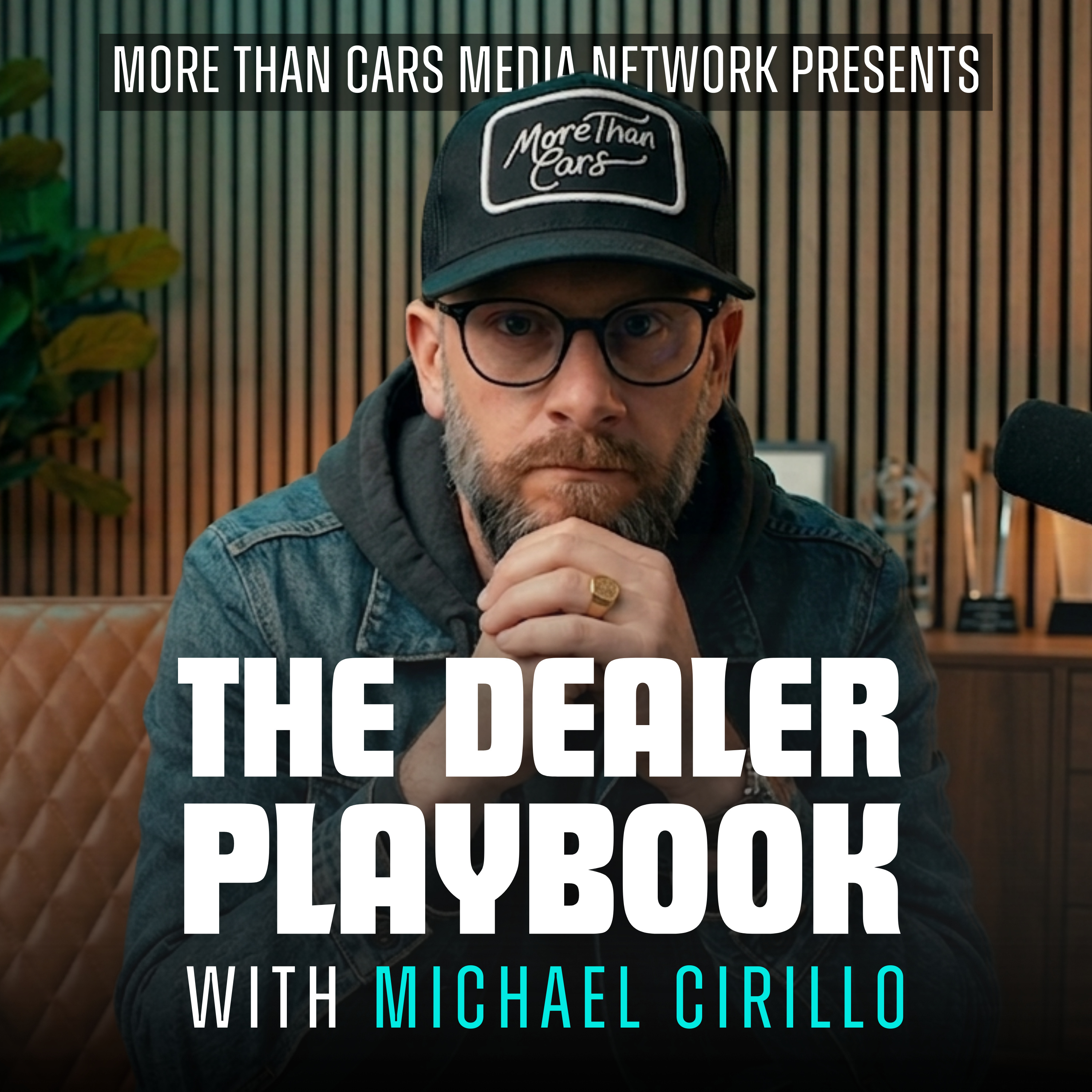
"8 Hours To 2 Minutes" — The Response Time Fix That Sold More Cars Across 100 Dealerships | Paul de Vries, Founder DCDW
The Dealer Playbook
"8 Hours To 2 Minutes" — The Response Time Fix That Sold More Cars Across 100 Dealerships | Paul de Vries, Founder DCDWThe Dealer Playbook · Apr 14, 2026
Paul DeVries runs a business that helps car dealers use better online tools and systems. The goal is to help dealers respond to shoppers faster and sell more cars.
DCDW is the short name for Paul De Vries’ dealership-focused digital workshop. It’s basically the company behind the ideas they’re sharing about improving how dealers work.
The Ford Ranger is a pickup truck, meaning it has a cargo bed in the back for hauling things. It’s designed to be useful for work or chores while still being easier to drive than bigger trucks. It might be mentioned because it’s a common choice for people who want truck capability.
Lead handling is what a car dealership does after someone shows interest. It includes answering quickly, following up, and guiding the customer toward buying.
Speedy response is the idea that dealerships should contact leads immediately to improve conversion rates. The underlying concept is that customer intent decays quickly, so faster follow-up increases the chance of reaching the buyer while they’re still interested.
Concept
AI
AI is computer software that can help respond to customers and handle repetitive tasks. The point here is to use it to move things along faster, but not replace the human when it matters.
Data privacy means protecting customers’ personal information. If you’re using AI or automation, you have to be careful about how customer data is collected and used.
A handoff to a real human means the chatbot or automated messages eventually connect the customer to a salesperson. The goal is to use automation for speed, but still get real help when it counts.
They’re talking about a simple, repeatable checklist of steps for handling leads. The goal is to make sure every call follows the same winning process.
It means you have to check the results you’re trying to get. If you don’t look at what’s happening, you can’t improve it.
Concept
six percent rule
They mention a “six percent rule” as a guideline for tracking progress. The idea is that where you are in the process matters, and you should know it so you can act.
They’re talking about how fast a dealership gets back to someone who shows interest in a car. The quicker they respond, the more likely they are to start a real conversation and sell the car.
They say it worked across “100 dealerships,” meaning it wasn’t just one dealer trying something new. That suggests the approach could be used in many places.
Lead follow-up is what you do after someone shows interest, like calling or messaging them again later. The idea is that good follow-up turns “not today” into “maybe later,” which can lead to more sales.
Online leads are customer inquiries generated through digital channels (like websites, ads, or forms) that dealerships can track. The speaker emphasizes that online leads are measurable—cost and return on investment—making them easier to manage and optimize.
ROI (Return on Investment) measures how much profit or value you get compared to what you spend. The speaker highlights that online leads come with clear cost and ROI visibility, which helps dealerships decide where to focus.
“Boycotting an EV” here refers to discouraging or refusing to sell electric vehicles rather than meeting customer demand. The speaker argues that if the market wants EVs, dealers/brands should sell them instead of trying to block them.
Online-first models emphasize digital shopping and lead capture before a customer ever visits a dealership. The segment frames this as part of the direct-to-consumer approach used by some Chinese EV brands.
The dealer model is the normal way most cars are sold: a local dealership sells the car for the brand. The claim is that it’s the approach that reliably helps brands sell more cars.
MG is a car brand. Here it’s mentioned as one of the brands that works with dealerships instead of trying to sell only through its own direct channels.
This refers to policy and regulatory frameworks affecting how EVs are sold, marketed, or distributed. The speaker suggests current rules may be slowing adoption or creating friction, and that changes could improve EV sales outcomes.
The speaker emphasizes that “Europe” is not one uniform market—there are many countries with different cultures and languages. For EV sales and dealer operations, this matters because marketing, compliance, and customer expectations vary by country.
Concept
Germany
Germany is where they plan to start expanding in Europe. It’s a big, important car market, so doing well there can be a good sign for the rest of Europe.
Market share just means how much of the business in an area you’re winning compared to other sellers. If you gain market share, you’re selling more than competitors.
LinkedIn is a website/app for professional networking. People use it to connect with businesses, share updates, and find customers or partners.
LIVE
All right, gang, here we are dealer playbook podcast. I have my dear friend. There's not
many in this industry. Actually, there's not. I don't think anyone in this industry I refer
to as my dear friend Paul DeVries. Thanks so much for joining me. Thank you. Thank you,
Paul. You are the founder of the digital car dealer workshop. I've had the privilege. I consider it
truly a privilege to have come to Holland and to Belgium to speak at your events. Yeah. One of
the things that I love, you might not know about this beautifully dressed man is your love for
country music. Yeah. In between sessions. Yeah. In between sessions, country music,
like and and the the European, I call them the European contingent looks lost. Yeah. But you're
enjoying yourself. Me enjoying myself. Absolutely. On sack, brown band and all the other stuff.
And I went to two concerts, no free concerts. Actually, every major counter started coming
to Amsterdam. I will be there. Is country music popular in Europe? It's getting it's getting
better. More and more popular. Getting better. But America is not getting more popular in Europe
anyway. So that's right. And you always bring a much more global perspective. But before we get
started. Yeah. I asked you specifically about country music before you get started. I've been
wanting to do this for a year. Your dear wife helped me pull this off. I need to come under here. I
guys, I have something for Paul. I've been wanting to do this for a year. Just give me a second.
Yes. Ever since you brought me this last time, which was so enjoyable. I loved it, by the way.
And audience love you as well. Oh, shucks. Just here we go. I'm going downstairs for a minute
from Kara and from myself. Yeah. This is for you. I feel like to listen to the Zach Brown band.
You need to have an authentic Texas cowboy hat. Amazing.
That's amazing. Now you probably know why your wife measured your head. These are in the side
if you need them to make it a little more snow. She did it when I was asleep. Oh, guys, the best.
Now these are in here. Tell me he does not look like a star. Oh my gosh. Like a Texas Ranger,
right? Oh my gosh. So there you go. That is a Stetson cowboy hat directly from Texas. I know the
brand. That's one of the best. That's as real as it gets. These are, you know, if you need it tighter
or looser, I don't know. There might be other ones in there that you can pull out. It's amazing,
friends. And that's to clean it. So we can put this in or do you want to grab this and we can
repackage it and we can actually get on with our lives. But I wanted you to have that. I've been
thinking about it ever since. It's amazing. Ever since we came out, I said, Paul needs a Stetson.
I really appreciate it. Thank you. Yes, I'm so glad. I'm so glad you like it. Okay, so now
you've been in the room in so many conversations with OEMs, with big companies, data companies,
your own businesses that you have a tremendous amount of data on lead handling and call handling and
speedy response. And I know, I know, let's get this out of the way. Everyone's talking about AI.
What I like about your position, though, is this idea of speeding up human connection.
I got to get you connected to a real human being. So what are you seeing out there as you walk the
halls? What's your vantage point? My advantage point is that if you have a real problem and a
real problem and can be a solution for your transportation, you want the real person to
handle that problem. And to have a conversation only with AI is not giving you the solution you
want or the conversation you want. And of course, AI is tremendous, is great. And can you have a lot
of advantages? But I just walked the whole expo, finding five booths without AI. It will not work
out. And it's over exhausted right now at the moment. The human thing, the human touch still
works like our relationship as well cannot do that through AI. Right. So what do you think the
appropriate balance is? How do I use AI responsibly? Responsibly is more about data, about privacy,
but to work it on lead handling skills, for example, is of course, if you don't have the dialogue yet,
and you have to follow up, that's something you don't want to do with a human. Because a human
cannot proceed in those tasks, day in, day out, without even being bored, or going away, or
whatever. AI can do that perfectly. But if you have an hand razor after that, they react to the
email message through AI or WhatsApp or text, then I need a real human to be interacted with that
person. I will never let the AI doing that. Something that I think is tremendous. You
have solved speed to connection. Emer, who was just here off camera, said he says first to contact
is first to contract. Yes. Yeah, first, but speed is selling you the dialogue, dialogue will sell
you the appointment and appointment will sell you the car. Right. Often people say, if I could just
get them in my dealership, I'm going to sell them. Sure. And I will say, if I have to first them in
a dialogue, I will win. You have a series of steps that you teach that make the perfect call
handling. Is it 12? 12 steps? Six. Six steps. Six steps. And do you know why? Why are there six
steps? Yeah. I represent a company from the US. And because I'm stuttering, I cannot pronounce
the name always correctly because I'm going to stutter. So I made an old presentation with six
steps to never mention the name and still selling the product. Is that real? That's how we come
up with six steps. Could there be, but I mean, I guess that kind of forced you to streamline the
steps. Yeah. But if I present the six steps to an OEM, for example, and I'm trying to sell
cold rip, now I'm pronouncing it correctly, but most of the time it's hurting my stomach to push
that out. But I don't want to say it. So I do an old presentation about six steps. And then they
come up to me, what do we need? And then I can say, because then I'm in a selling mode. Right.
Right. So let me ask you this. Is anything going to change about those six steps?
I don't think so. I don't think so because the first step is speed. The second step is helping the
dealer with scripting, so training. The first step is making the salesperson the most important
one. So not the AI, especially not the BDC. And the fourth step is just a data layer. One
data point is never a data point. Step five is inspect what you expect. So as a basketball coach,
you have four quarters and four timeouts. If you don't know the score, you cannot change the
techniques. So I have to know the steps in the six percent rule where I'm at. And step six is
coaching. And all those five steps are helping the third step. The salesperson is all becoming
the salesperson. So give me a drilling piece. I don't know shit about that. You have to train
me to use that tool, right? Right. So it's all about the people anyway. So that's why I love your
phrase. And you are the company, love people more than cars. It is.
Yeah. This seems to be a common thing that we all arrive at. We all start talking about technology,
but we always end up back at the human experience. It's the thing we all actually desire. Nothing
will replace AI would not feel any joy watching you put that Stetson cowboy hat on your head.
But I will always remember and enjoy. Or if you watch me to present the six steps to an OEM
and knowing what you know now, yeah, I will always laugh. I'm going to circle around something
like back in the day when I when I needed to order Coca Cola at the bar. I always said Pepsi
because I cannot pronounce Cola. And then they say we only have Coca Cola. I said that's fine either.
But I think Pepsi is better anyways. We can we can divert on that. We should debate it. Yeah.
Okay. I know you in one way as being the one that took what a 12 and a half hour response
time average to two minutes or something like that. Eight hours and 20 minutes with an OEM
Toyota to two minutes and 30 seconds on 60,000 leads and 100 dealerships.
What happened as a direct result of speeding up the connection?
More dialogues. And if you don't better do the process, but you have more dialogues, you still
sell more cars because you have more dialogues. But in salesperson, not a BDC because a BDC is
like an heroin that makes your life better for one second and then is worse. Yeah. But if you
train your salespeople to follow up leads online leads for sure, they will follow up
trafficking your showroom or proposes did not buy the same day to follow up those leads also
actually better. They are going to be better salespersons anyway. And the online lead and
that's why I'm loving online leads is the only lead you know what it costs when it came in and
what return on investment was. Be better at it. Right. Along with that, you brought up coaching
is the last step. Yeah. You've worked with, I don't know, I want to say hundreds of
BDC agents, thousands potentially. But not everybody has the knack. No. What do you do to
vet people or find people or to identify that they might be good at doing this process?
Yeah. So most of the people we train in the Netherlands are salespeople in the shop, right?
Right. In the dealership. And I always tell them selling is not something what you teach by experience
but by learning the craft. And you can do 20 years of experience where you did it 1990 years
incorrectly. So I need only an emphatic people, people with loving people to connect and to be
patient, etc. And I can train anybody on the sales skills. What sort of process do you have?
But I mean, yeah, they're everywhere. But what are you, are you just sitting at dinner and saying
I like the way she served us or I like the way he? No, for a special, we have our own BDC. I'm
the co-owner of a BDC where we have about 70 people. And that's a lot and fire fast. Yeah.
Because I don't know in the first conversation somebody has it or not. I don't know.
When I was in Europe last, you shared that there are, I want to say 30 EV.
Oh, yeah. The Chinese brands in the market. 35. What are you seeing in Europe that is happening
at a faster pace that maybe isn't here yet in America? First of all, boycotting an EV
like you are doing here is not making you better. So that's something you have to
reorganize or rethink that an electric car, if the market is demanding for it, you should sell it.
And I think the leaders will sell it if they have it. But the Chinese brands are very good in EVs.
But they are very arrogant in the way they want to sell it. So they have direct to consumer models.
They have online first models. They are having do it by myself models. In the end now, after three
years in the market, most of the brands are like this. And most of the brands are returning to the
dealer model because that's the only model which actually works. So the brands are doing good,
BID, MG, for example, the OEMs, which are working with the dealers.
So we need to rethink the regulation that we have around EVs. Hold on. I just have to point out,
Tom Cruise. Tom Cruise has come to our booth and is taking photos of us right now. What's next
for you? Is it go deeper on the model that you have? Is it there's some evolution that needs
to happen? What are you thinking about? No, I want to expand in Europe. We are now in five
countries. And what a lot of Americans thinks that Europe is one, it's actually 32 different
countries with more than 40 languages, with more than 50 cultures. And you have to find your way
in every country. And we will start with Germany, which actually are seven different cultures in
one country to go there deeper. And it's our neighbor. We are culturally fit with the Germans.
We are the obnoxious, the little brother who knows it better. And to gain more market share there.
I love it. Well, you know, hopefully you know how much I love you and your wife, your family's the
best. I love having you on the show. I love how matter of fact you are. How can those listening
and watching connect with you and learn more about what you do for work? The best way and that's
the coffee machine of automotive, especially in the Netherlands, is LinkedIn. I know for a fact that
we talked 12 years ago, 15 years ago about that, that topic why it's so important for us. Right.
On our first conversation on the podcast. You know, I do LinkedIn more because of you. Yeah, I know.
Okay. But it should be more. He knows. It should be more. It should be more. So on LinkedIn,
Paul De Vries, 1972. And then you will find me. Paul De Vries, thanks so much for joining me on
the dealer playbook. Hey, thanks for listening to the dealer playbook podcast. If you enjoyed tuning
in, please subscribe, share and hit that like button. You can also join us and the DPB community
on social media. Check back next week for a new dealer playbook episode. Thanks so much for joining.
About this episode
Paul de Vries, founder of DCDW, argues that faster lead response creates more real conversations—and that those dialogues, not AI chatbots, drive appointments and sales. He breaks down his “speed to connection” system into six steps: speed, scripting/training, prioritizing the salesperson over BDC automation, a data layer, “inspect what you expect,” and ongoing coaching. He shares results from cutting an OEM response window from hours to minutes across 100 dealerships, plus insights on Europe’s EV retail shift back toward dealer models. The episode blends practical call-handling strategy with a human-first stance on AI.
Is your dealership struggling to convert online leads into showroom appointments? You’re not alone. Many automotive professionals focus on getting leads, but miss the critical step of engaging them effectively to drive sales.
Here’s what you’ll get from this episode:
Implement Paul de Vries’ 6-step lead-handling process to increase appointments.**
Understand the crucial role of speed and human connection in online lead conversion.**
Learn how to best integrate AI to support, not replace, human sales efforts.**
Discover how to build a team that excels at lead follow-up and customer engagement.**
Paul de Vries, founder of the Digital Car Dealer Workshop and BDC co-owner, shares his proven methodology for dramatically improving lead response times and, most importantly, turning those leads into sales.