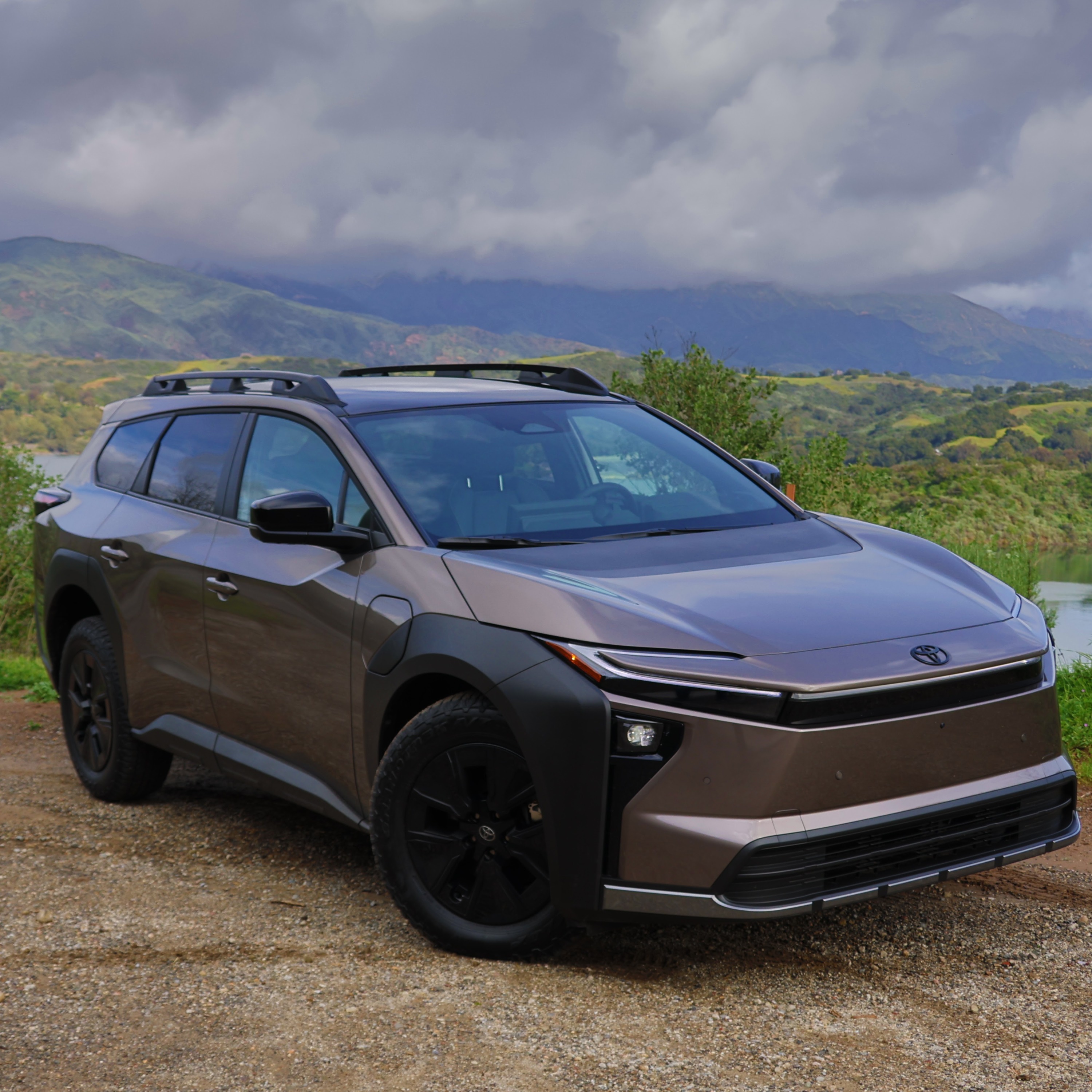
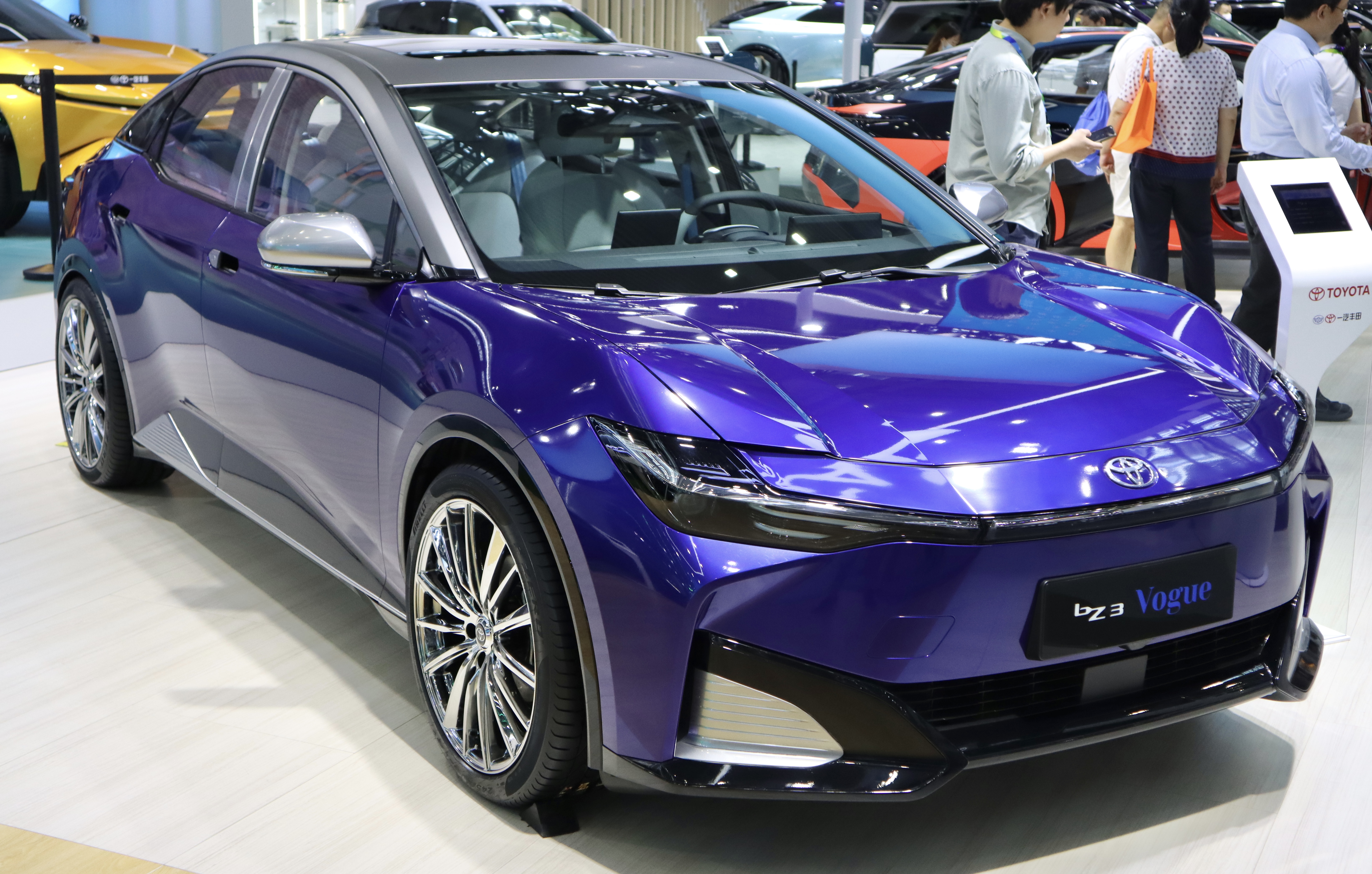
The Toyota C-HR is a small SUV that looks different from other cars, making it stand out. It's great for city driving because it's easy to park and has a comfortable interior for passengers.
The Toyota bZ4X is a new electric car that doesn't use gas, which means it's better for the environment. It's designed to be a practical and stylish SUV, making it a good choice for families or anyone who needs extra space.
Battery electric vehicles are cars that run only on electricity and don’t use gasoline at all. They are better for the environment because they don’t produce exhaust fumes.
Torque vectoring helps control how much power goes to each wheel of a car. This makes it easier to drive, especially when turning or driving on rough surfaces.
X Mode is a special setting in some cars that helps them drive better on rough or slippery surfaces. It makes it easier to handle tough conditions like snow or mud.
Torque delivery is how the engine's power is sent to the wheels. Sometimes, it can be set to send more power to the front wheels or the back wheels, which helps the car handle better in different situations.
All-terrain tires are special tires that can handle different types of surfaces, like dirt, mud, and pavement. They have a unique design that helps them grip well no matter where you're driving.
Ground clearance is how high the bottom of a car is from the ground. Higher ground clearance helps a car drive over bumps and rough surfaces without getting stuck or damaged.
The Toyota RAV4 is a popular family car that has a lot of space for people and their stuff. It's known for being dependable and safe, making it a great choice for everyday use.
LIVE
[SPEAKER_03]: All right, so with the CHR and the woodland, you have two new variations on this platform that started with the BZ4X now, BZ.
[SPEAKER_03]: So let's start up with a little bit of what has changed, what is evolved from a platform perspective, if anything.
[SPEAKER_03]: And what other technical changes have been made, [SPEAKER_03]: to these vehicles to get to where they are today from from what we saw last year with the BZ.
[SPEAKER_02]: Yeah, for start with the BZ4X, the 2022 and then we started with that vehicle and then we had a lot of voice from the market like range and charging speed and some infotainment or the kind of things.
[SPEAKER_02]: So we decided to have a better battery EV kind of this way.
[SPEAKER_02]: And then to do that, we include Bacchi, we have a bigger Bacchi right now, and also we changed mode, which has a single covered ECU, the control system, and also Bacchi, yes, it has parcels, and also we have the we change the heating system, the battery, and the heating and [SPEAKER_02]: And then with these changes, I think we have a very good estimate for the battery EV to catch up other competitors.
[SPEAKER_02]: And then from that, that is a BSD-26 model, LSEO.
[SPEAKER_02]: And then from that model, [SPEAKER_02]: We think we want to cover more lifestyles and then this is a good daily ACV and then what if people want to have a more space and a more power and the more open-minded style lifestyle and then that is a busy woodland right now and then what if [SPEAKER_02]: There is a single couple and small family, much to have a more emotional lifestyle, or emotional kind of styling car.
[SPEAKER_02]: That is a CHR, so we have now three variations to cover a lot of lifestyles.
[SPEAKER_00]: Was this mostly an expensive feedback from the original, or the original book of business?
[SPEAKER_00]: Or did the information come from to inform the changes?
[SPEAKER_02]: Well, we have marked both source of the information like from U.S. and from European countries and many people talk about essential battery EBE performance and also the, what if we can have a bigger one or smaller one that kind of voice also we have to regulate to study also deal with also deal with also deal with
[SPEAKER_01]: product from Makyotsu Kato Soy not the Nanka Kufushmashtvan, Utturando, Shehchar to BZU Nakadeh.
[SPEAKER_02]: Well, the platform-wise, we already established a good platform for the BZ4X, so we use that include BZ platform for the reference.
[SPEAKER_02]: And the Shehchar is actually a little bit modified.
[SPEAKER_02]: It has a shorter wheelbase, but still similar components.
[SPEAKER_03]: The CHR, even though it has a shorter wheelbase, and still has the same battery capacity.
[SPEAKER_03]: Did that pose any problems with packaging, or was there enough space?
[SPEAKER_03]: And from the original wheelbase, and when you shorten the wheelbase, was there enough space to still package the battery?
[SPEAKER_03]: Okay.
[SPEAKER_00]: What's the relationship with super-like?
[SPEAKER_00]: Is it a cooperative development relationship?
[SPEAKER_00]: And then your engineers and your engineers work together?
[SPEAKER_02]: We work together to make a powerful and then we make a Toyota-owned kind of car.
[SPEAKER_02]: Like a true suspension tuning with that kind of things.
[SPEAKER_02]: And the super-ro is doing their tuning.
[SPEAKER_02]: So, basement, we call the develop.
[SPEAKER_02]: And then each model, it's kind of separate tuning.
[SPEAKER_03]: So earlier during the presentation this morning, there was some discussion about the off-road capability and all of the for the woodlet.
[SPEAKER_03]: Can you talk a little bit more about what some of the capabilities are with the BC woodland in terms of going off-road.
[SPEAKER_02]: you know what what's been done from a software perspective to enhance the capability if anything well due to the busy yeah i think for the udon i can say the two things one is a more poor now it has the was sixty seven on the front was sixty seven on the rear it hasn't got solid one yes that's clear what that's clear what yeah [SPEAKER_02]: So it has more power than the BC, which is good for the off-road kind of powerful driving, and the other one is that we have special edible decontrol for the wooden only, which is the that logic is sensing the rotation difference between the right-hand side tyre and the left-hand of the tyre, where you can't cornering.
[SPEAKER_02]: I say the inside time outside pie and then using that information to adjust the torque amount between the front and rear, it which is the almost the understeer control, I say.
[SPEAKER_02]: So that makes you easy to drive on the [SPEAKER_03]: ruffled and also the it's it's good for the omelette too so it's more like precise line traces we can yeah so it's gonna ask drive right if you're trying to make it follow the what the driver's asked or a little more big sound a little more precisely okay is that part of X mode?
[SPEAKER_02]: Not that that's not part of that as well, it is in the petty's assitals that I export.
[SPEAKER_00]: Okay, so the base bc doesn't have that.
[SPEAKER_02]: Best bc doesn't have.
[SPEAKER_02]: We started with with it.
[SPEAKER_00]: Okay, so it's worth $1.
[SPEAKER_03]: One of the things you mentioned was the basic tuning making the woodland a little more wear biased in terms of the power delivery.
[SPEAKER_03]: You know, you've got the same size motors on there, but are you using using the front are using the rear more of the Toot and dialing back the front motor output and biasing the torque delivery towards the rear axle motor fan.
[SPEAKER_02]: Yes, because we have a bigger motor for the woodwind.
[SPEAKER_02]: It's normal situation basically at a 50-50, we are using the talk, like a 50-50.
[SPEAKER_02]: But it can change, it's changeable between 30, 70, 70, 30.
[SPEAKER_02]: So it depends on the raw surface.
[SPEAKER_03]: Yeah, I'm driving it today on the curing roads up here, you know, for given the type of vehicle it is, you know, it feels very, very nimble in response to them.
[SPEAKER_03]: So it's quite fun, even on the altering tires.
[SPEAKER_03]: Um, so, uh, and another thing we mentioned, um, you know, it's got slightly more ground clerks than the base BZ, uh, and that, uh, I take it as, just due to the, the tire size, all right, you get a little, well, a little taller tire than what you've had on the BZ.
[SPEAKER_03]: Yeah, okay.
[SPEAKER_03]: Yes.
[SPEAKER_03]: Um, good.
[SPEAKER_00]: At lunch today, the journals were sitting around talking about the driving and, and talking about the lack of one step.
[SPEAKER_00]: And one pedal, one pedal, one pedal, one pedal, is that something you would ever consider doing if you got a lot of feedback from consumers.
[SPEAKER_02]: Yeah, we have a lot of advice from the customer and the dealers and the many people.
[SPEAKER_02]: And currently we are not using one pedal system because we want the light on the customer.
[SPEAKER_02]: I mean that we want customer to decide where they stop and where they go.
[SPEAKER_02]: We won't pedal, it's kind of relining on the system when you stop, but for the safety, we won't customer to decide where to stop.
[SPEAKER_02]: Now you want to stop.
[SPEAKER_00]: some more engagement from the current and more responsible and responsibility for the cost number.
[SPEAKER_02]: So the safety is just full of safety.
[SPEAKER_03]: Yes, okay, given that something that could be done entirely in software, you know, that's the sort of, then require a hard workchained.
[SPEAKER_03]: Is there any possibility that you would consider making that option for drivers who do want that option?
[SPEAKER_02]: Well, hopefully it's a future plot.
[SPEAKER_02]: We'll think about that a bit, that kind of tree.
[SPEAKER_02]: Yeah.
[SPEAKER_02]: Okay.
[SPEAKER_02]: We'll stick with our idea right now.
[SPEAKER_02]: But, okay.
[SPEAKER_03]: Yeah, going beyond the power train system, the interior, obviously.
[SPEAKER_03]: You've got the same interior upgrades that you did to the BZ last year, which is great.
[SPEAKER_03]: The infotainment system, it's still the previous generation now of Toyota Multimedia system.
[SPEAKER_03]: Was there any consideration, or I guess, does this platform, with this platform support using the newer system that just recently launched on the RAV4?
[SPEAKER_03]: Are you reading platform based all day?
[SPEAKER_03]: Is that something that could be targeted into these be able?
[SPEAKER_03]: Goop in the future.
[SPEAKER_03]: Okay.
[SPEAKER_03]: Yeah.
[SPEAKER_03]: Would that require updates to the electronic architecture, or could it be done on the existing platform?
[SPEAKER_03]: This is the last form we can do there.
[SPEAKER_03]: Okay.
[SPEAKER_01]: Great.
[SPEAKER_03]: Because I think that is a that is a nice update.
[SPEAKER_03]: Right.
[SPEAKER_03]: I do.
[SPEAKER_03]: I do like that system.
[SPEAKER_00]: I don't know.
[SPEAKER_03]: That's right.
[SPEAKER_03]: Yep.
[SPEAKER_03]: One thing for me personally, that's nice to see with a car like the Beesie Woodland, I am personally a fan of station wagons, station-lion plug-in factory, you know, we had several of them when our children were going up, and I think, you know.
[SPEAKER_03]: We'd prefer cars to SUVs, so it's nice to see an option in that shape of car, because you get the extra utility that extra space in the back there, but it still drives like a car site.
[SPEAKER_03]: Congratulations for day during our birthday.
[SPEAKER_00]: You're a tad, it was to be more something you'd want to be.
[SPEAKER_02]: Yeah, possibly I like this one too.
[SPEAKER_02]: And then you was, it's kind of rare.
[SPEAKER_02]: But when you look at the European market, it's still there.
[SPEAKER_02]: So the globally, I think, of that wobble style, is still okay.
[SPEAKER_00]: Is it more of a marketing thing?
[SPEAKER_00]: People just don't like station wagging in the U.S. Eid, Eid, Eid, Eid, Eid, Eid, Eid getting any better?
[SPEAKER_00]: It's like mini van.
[SPEAKER_03]: It does a lot of things going to come over and crossover.
[SPEAKER_03]: It doesn't matter what it actually is.
[SPEAKER_03]: Let's call it a crossover.
[SPEAKER_03]: People will buy it.
[SPEAKER_00]: If you know, we're the marketing thing.
[SPEAKER_00]: Yeah, we're not typically calling you the station.
[SPEAKER_00]: Right.
[SPEAKER_03]: It's a way.
[SPEAKER_03]: It's a crossover.
[SPEAKER_03]: You know, how does crossover do that?
[SPEAKER_03]: To be fair, most of what is labeled as an SUV or a crossover in the U.S. Market.
[SPEAKER_00]: It's a... That's true.
[SPEAKER_03]: That's true.
[SPEAKER_00]: Or station market.
[SPEAKER_03]: Or station road.
[SPEAKER_03]: Yeah.
[SPEAKER_01]: other hatchback or a station like, it's not really an SCP, but an station while I actually did an Undercloser 300 official name is, oh yeah, it's the issue, but yeah, and the biggest line procedure is because I showed me an station, option name is an Undercloser, it's the station places, yeah, no, no, no, no, no, no, no, no, no, no, no, no, no, no, no, no, no, no, no, no, no, no, no, no, no, no, no, no, no, no, no, no, no, no, no, no, no, no, no, no, no, no, no, no, no, no, no, no, no, no, no, no, no, no, no, no, no, no, no, no, no, no, no, no, no, no, no, no, no, no, no, no,
About this episode
Masaya Uchiyama, Toyota's EV Chief Engineer, discusses the evolution of Toyota's electric vehicle platform, starting with the BZ4X and expanding to new models like the CHR and Woodland. He highlights improvements based on customer feedback, including enhanced battery performance, charging speed, and off-road capabilities. Uchiyama also addresses the tuning differences for the Woodland model, which is designed for a more adventurous lifestyle, and touches on the future of one-pedal driving systems. The conversation reflects Toyota's commitment to adapting to market demands while maintaining safety and driver engagement.
While we were in Ojai California last week to drive the 2026 Toyota bZ Woodland and C-HR, friend of the show Tanya Gazdik and Sam sat down for a chat with chief engineer Masaya Uchiyama.
Our Sponsors: * Check out BetterHelp: https://www.betterhelp.com