ADAS means Advanced Driver-Assistance Systems. These are smart technologies in cars that help drivers stay safe, like warning you if you're drifting out of your lane or helping you park automatically.
Under car specialty means being really good at fixing parts of the car that are underneath it, like the suspension and exhaust. This is important for keeping the car running well and safe.
An alignment specialist is a mechanic who knows a lot about making sure a car's wheels are lined up correctly. This is important for how well the car drives and how long the tires last.
Steering angle sensors are parts in a car that track how much the steering wheel is turned. This information helps the car's systems know how to react when you're driving, making it safer and easier to control.
HVAC means Heating, Ventilation, and Air Conditioning. It's the system in cars that keeps the inside comfortable by controlling the temperature and airflow.
The Tesla Model Y is a type of electric car that looks like a small SUV. It's known for being very efficient, meaning it can go a long distance on a single charge, and it has lots of high-tech features. People talk about it because it's changing how we think about cars and the environment.
A repair shop business model is how a car repair business plans to make money and serve its customers. It includes what services they provide and how they run their shop.
A transmission is a part of a car that helps it move by transferring power from the engine to the wheels. Rebuilding a transmission means fixing it when it's broken so that the car can drive again.
A differential is a part of a car that helps the wheels turn at different speeds, especially when going around corners. Rebuilding it means fixing it so that it works correctly again.
LIVE
This is the aftermarket radio network. Hey everybody, Carm Capriotto, remarkable results radio. 10 years, Joe, I don't know if you know that, but we're into our 11th year now of doing this. So many episodes. I'm calling when I'm doing it finally. It just hit me the other day and says, you know, we're into episodic education because the content keeps flowing. And especially in the automotive aftermarket radio network where we produce seven podcasts a week and it's all about making
us either better leaders or smarter business people and all of life's stuff that gets thrown at us and how we deal with it. Look at everyone. Please support our sponsors. We sure do appreciate them. Take your NAP Auto Care Center to the next level with the NAP Auto Care Gold Certified Program Gold Certified Shops. Well, they stand out.
You'll trust and enjoy exclusive benefits designed to drive business growth. Contact your NAP Auto Represented today to get started with Gold Certified.
Hey, did you know that NAP Auto Care has onsite training plus six days a week support? It all starts when a local representative meets with you to learn about your business and how you run it. After all, it's your shop. So it's your choice.
Let's prove to you that tracks is the single best shop management system in the business. Find NAP Attracts on the web at NAP ATR ACS dot com.
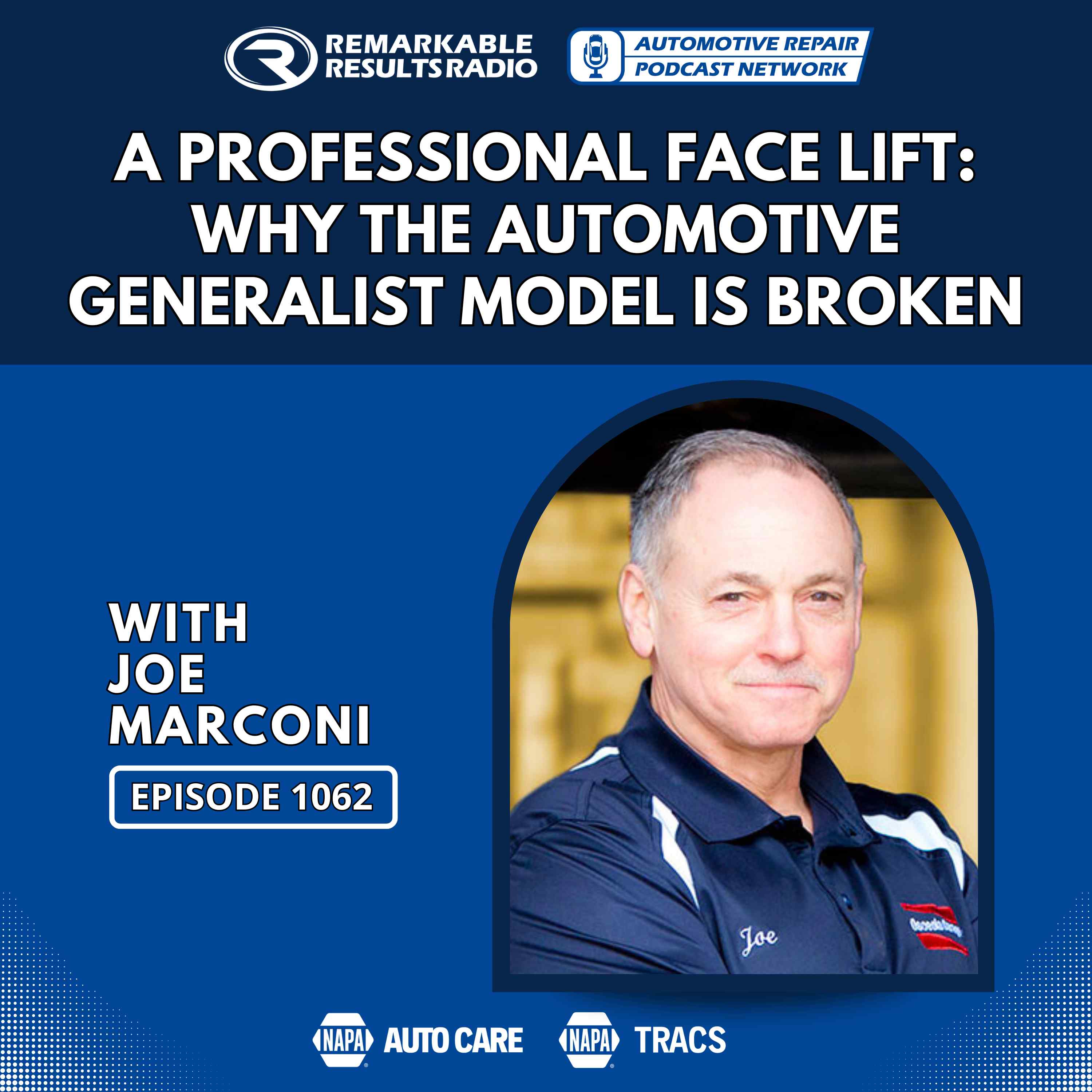
I'm with Joe Marconi. Hello, Joe. How you doing? Calm. Always a pleasure being here. Always. It's so great to have you. I haven't had you on in a while. A former shop owner elite worldwide coach.
And also key lever polar for the auto shop owner auto shop owner dot com. It's a shop management network and resource. I'm subscribed. I'm on it and I'm looking through some of your posts and I love the way that you go back and you pop some that you've written a while back.
And so Joe writes this article, you know, kind of like the reality of what modern automotive repair is going to be like. And all Joe does is he drops the word specialist in there and I said, I better send Joe the most recent version of the rise of the specialist and he read it double check that we're online.
And I'm thinking, okay, we got to get on and we've got to do a show because this in my opinion, Joe, we're at a crossroads in our industry and you brought up so many incredible.
If you will parallel concepts that I was working on about all of the specialists that exist in the medical field and how we kind of I'm not saying we thumb our nose Joe to what we have to do in the challenges that we have as generalists in our industry.
But we're asking our people to know so much about so much too much. You know, when I first started back in the 70s mid 70s.
It was different. A lot different. We all know this. I mean, back then I was kid around back then we had three things that kept us in business.
General Motors Ford and Chrysler. And you know, you think about it. And it's far on call was not yet as it is known today, you know, the foreign vehicle.
You can become very proficient back then we call this house mechanics, automotive mechanics. You become very proficient, you know, Ford General Motors Chrysler, if you learn one system, you learn the ball.
And you can become an A level what we call back then a master level technician or a miss level mechanic and ASC when you attain that master level, you are pretty good.
This is not 1975 anymore. You know, you fast forward. I mean, if you think about it, can you truly expect even a master level technician to try to well, it's going to diagnose evolve check engine light.
Then jump to a draft ability problem on a Honda, then jump to a diesel, you know, maybe a suspension problem of diesel. It's just different these days. The expectations are way too high.
I was listening to one of Matt Fonslow's podcasts the other day. His 200th. He was celebrating. No, I saw that. That's amazing.
And Matt was out there explaining that he's got a laptop for Ford and a laptop for GM and a laptop for Audi and a laptop, and he's got a closet and he has it.
I think he controls the heat, the humidity. He's got unbelievable investment, even though he may buy used and then get it partitioned the way he needs it or wants it.
And Matt is trying to be as much of a specialist generalist get that right.
And we should listen to Matt Fonslow because he speaks from a different vantage point and you could be but you listen to what he's saying is becoming a specialist on multi vehicles.
But in one particular area, you know, you can jump around jump around and it's too difficult these days.
Yeah, he's the technologist is I'd like to call it or the technology specialist in the business.
And if our owners could stop for a moment and think about the word special T and Joe, I want to do a show really bad on where's our future going with special T's.
You know, we could think of EV hybrids, ADAS and all of those require different kinds of education.
Some in the case of ADAS, some equipment, some space that say I got this special space over there for this and all by the way, my technologist, he's got his own bay, his own computers, his own tablet, his own key to the closet.
And if you think about under car and all that's going on with that and the electronics of that all to have an alignment specialist today is really more of an under car specialty.
Yeah, let me touch on that point and this is what got me thinking to a number of years ago and I was still had my repair shops, I hired someone from Greece.
And he came over and he was an under car specialist, he specialized in steering suspension problems, so he knew everything there is to know on the car.
When I first hired him though, my mindset was still in the old way of thinking well, you have to know everything you got to be able to diagnose a car every day.
So, but he proved to me that he was so good wasn't a suspension steering problem that he couldn't solve, there was an alignment that he couldn't figure out.
And so he knew everything steering angle sensors of the very beginnings of eight aspects then he understood that because he was trained in one area and what that showed me is that you could become very, very good in one particular area become a specialist professional.
I eventually changed his status.
He became a top level paid technician or specialist on the car specialist because of his proficiency in that area, so just think about that.
Everything I have been saying of late Joe on a lot of the podcasts that I've been doing and I'm driving this P word P.
You know, when you say a P word in a microphone, it's called a plosive and it's very difficult if you're, you know, recording commercials are doing a podcast not to have a plosive, but the P word in my vernacular of late is the word professional.
See and professionalism and for us top shops, they'd have no problem with this. They got it. They adopted it. They joined elite. They got coaching and they said, how am I going to really be super successful?
And I'm sorry, that's the word profit to the P words profit. You see, make a lot of money doing this stuff, bringing my passion leading people and, you know, being the shop that people know like and trust.
Joe, I think in your article part of your talking point was a professional facelift and that requires a mind set.
It does. You know, we all have an obligation and if you go back in time, the shops of the 60s, 70s, which I was brought up with, they didn't convey that professional look.
And it was not a place where you thought about, let's face it, cleanliness, organization, we've changed through the years.
And I give a lot of credit to the shop owners today that are really trying to make that difference.
If we're going to get two things, respect and the profit that we deserve, we have to change.
You have to keep changing on the same course that we're developing right now in terms of the look of our shops, the professionalism of our service advisers.
That the frontage, when you walk into a facility, everything has to just scream at you saying we are professionals.
You know, to your point with the push that you're doing with rise and change in the terminologies, how we think that mindset shift is happening.
That's why I was so excited to be here today because we just got to push a little bit more and keep on the same path.
But the image of what we convey to the public is so critical.
That's your point. And I love your point about the image that we create.
Even though people aren't waiting today and we don't like waiters to a certain degree, the waiting room still needs to be professional.
There needs to be a leather lounge chair in there, just in case.
But if not, it is really telling my client, hey, if you want to come in here and sit for a few minutes, be on the phone, do a little work.
God bless you. We've got a comfortable place for you, but it goes back to what I've talked about in the rise.
Oh, by the way, anybody wants a copy of the rise, remarkable result stop is forward slash rise, pick up a copy of it.
Joe, it's almost like you put this article out in 2024 and I was starting to release version one FYI for everybody.
We're at version 23 and here's how it happened.
Is so many people have picked this up. I always care about what people think their thoughts to me.
Carme at remarkable results dot is and so much positivity has come back to me.
Hey, did you think about this? What about this? Here's another title. Here's something else we should do.
And all I kept saying is, whoa, this is great. It's becoming a collective community, if you will paper.
I didn't copyright this. I want everybody to take this and run with it.
So it was like our image is so critical and it's my mechanic or my tech and part of the argument that I have.
And there's a lot of people say, Carme, people listen, 90% love it, 10% say, I'm staying right where I am.
I love the word tech. That's great. But I see ads for nail salons that they want to hire techs nail tech and HVAC and
hell, I saw an ad for a Zamboni. It was kind of an ad is this. Hey, look who's driving the Zamboni on the ice this week.
Here's our new ice technician technician. Yeah.
So we've seen shirts at breweries that say their beer technicians and it's really should be probably a specialist if if they're into hops.
And so the point that I was making and that you're making also about the word special is their specialty is how it affects our client, Joe.
And the words every word we say to our client is registered with them. It's thought about by them. They gain confidence from it.
And if we just keep using lazy language, it's not going to help the reputation we're trying to create.
We made the parallels to the medical field both you and I do this, but it's some people don't like that analogy, but it works. If you think about it, you have radiologist oncologist neurologist cardiologist and on and on and on.
That little just at the end kind of clarifies what they do.
Now again, I go back to what I said in the very beginning. This is not 1980, 1975 anymore.
There are some people out there that can get to that level.
You know, but even the math funnels of the world and I give them a lot of credit for what he does.
You know, he specializes. Think about it. He is a technology specialist in one different than one area.
And to your point to when you're talking about the consumer, how to satisfy and take care of your clientele.
It really this whole concept of specialization fits right into that wheelhouse because the business model will change too.
The business model has to change. You cannot be in my opinion.
There are very few shops out there. Some claim to be I will challenge them.
I've been in this business for more than half a century. I will challenge because I lived it to be all makes all models, all repairs.
Just the equipment and tools alone and information you need. It just doesn't make sense anymore. It really doesn't.
I want to talk about that a year and a minute, but Joe, are we preaching preaching?
I hope not.
I hope this instead of preaching.
I've given this keynote so much this year. I'm doing it at Asta this year.
I've got so many other things planned, three more speeches in the next month.
And I keep getting, you know, it always changes a little bit.
And when I'm all done, people line up business cards. We're talking about a lot of needs stuff.
And I says, did it feel like I was preaching to you? No, Carm.
You're trying to advance the industry.
You are passionate about where it needs to be heading.
You're talking about professionalism. You're hitting some of us top upside the head because sometimes the answers are right here, but our intuition
are common sense isn't allowing us to see it and then do something with it, which is why in my document the rise.
The rise of the specialist on the second last page. There's a implementation chart is that listen here. Here's here is what you have to do to make it work.
So we're really not preaching. I think we're sharing our passion here.
That's what it is. I'm very passionate through the years. I've become very, very passionate about this industry because it's the only industry that I know and I've seen the good debate and the ugly.
And there's a lot of things that are really good about this industry. They're really all we help keep America moving. Let's face it.
Nothing happens without transportation. So that's what we do. We're part of that.
But, you know, if you sidestep the medical field a little bit and go into sports, look at a football team and a football players.
It's not just a football player. There's quarterbacks, running backs, receivers. There's the alignment.
They all specialize in one area. Now, shop owners out there. If you could have your people specialize, your professional specialize in a particular area.
They can become better and better and better. Productivity improves, profits improves and guess what?
Your clientele, your customers will also benefit from that. There's so much with this concept that again, we need to run with it, push it.
And I like calling it preaching, but we need to share our passion, right?
Now that you know what it takes to become a Napa Gold AutoCare Gold Certified Shop, let's talk about the real value, what you get when you achieve gold.
This isn't just about status. It's about tangible benefits that grow your business.
Gold certified shops receive premium placement on NapaOnline.com at no additional cost.
With millions of site visits each year, your shop will be one of the top options consumers see when they search locally.
That visibility, it means more cars in your bays.
You'll also get $1,500 annually in marketing funds for pre-approved, co-branded messaging, helping you connect with your community while benefiting from the national reach of Napa branding.
Combine that with preferential referrals and you've got a powerful marketing advantage.
Gold certified status enhances consumer confidence with an extended 36 month, 36,000 mile piece of mind warranty and local labor coverage, proving you stand behind your work.
You'll also gain access to award-winning Napa AutoTech training for technicians and service advisors helping improve efficiency, reduce comebacks and support retention.
Additional benefits include Napa credit card financing rebates, year-round peak performance promotions, Napa Tracks shop management software, smart sign pro customer engagement displays, a team tool rebate to invest in your technician's success and a $300 annual credit toward master technician or blue seal ASE certification.
Gold certified membership is designed to help you recruit, retain and deliver the best experience to every customer.
Are you ready to elevate your shop, contact your local Napa representative today to see if you qualify and start your journey to Gold certified, contact your local Napa sales representative today to see if you qualify and start your journey to Gold certified.
Let's face it, your shop management system is the single most important tool in your shop, period.
Napa Tracks was built from the ground up to make your business more profitable and efficient.
We provide an extensive set of tools to increase and track profitability in real time.
Napa Tracks offers the industry's best post sale support hands down and we train your people on site.
Yep, on site and we offer remote refresher training 10 times a week and customer support is open six days a week.
If it's a call, visit the website or join our Facebook community today to learn more.
We'll prove to you that tracks is the single best shop management system in the business.
Napa Tracks is always customized and tailored for you whether you're a one-man shop or a large multi-bay or multi-location company after all, it's your shop.
So it's your choice.
Visit us on the web at Napa Tracks, that's n-a-p-a-t-r-a-c-s.com.
When I say the word preaching, I always have my tongue firmly implanted in my cheek when I say it because I always like to inside a riot from people.
What do you mean you seem to be almost like pounding on the podium? I said, good, I'm glad you felt that.
Because I think to make a major change that were kind of you and I are advocating, I really do think it takes a little pressure from the sides to make that happen.
When I think about the future of our young people coming in our industry and doing the college or the high school thing and coming out and maybe getting into an apprentice program somewhere,
when I think of a doctor and I don't know how many years maybe it's six years they have to go to be a doctor.
I don't know this. Maybe it's total 10.
But there's a point in time where you have to decide as that's doctoring student if you're going to specialize.
Right, exactly, exactly.
And again, as we always clamber into the medical world, Joe, and we kind of bring that in and draw some parallels, right?
I started to think about the young people coming in and we want to show them career paths.
And the specialty stuff that we need really young, great talented people in.
This isn't a slam dunk.
Just think about this.
We complained about the technician shortage.
We complained about the employee shortage in our field.
If you to specialize and take this and run with this concept,
you will open up more opportunities for more people.
If we got to do our part, we got to promote that in the schools and the communities about this is a real life viable opportunity
and alternative to afford it for a six year college degree.
But look at the pathways that we could provide by specialization and offering more career paths for more people.
It's just, again, it's an old brainer.
I do see apprenticeship programs in the beginning that mimic the same things that the medical field does.
You got to learn a lot about all different things.
But it comes in point in time where where where where is your path going to lead?
Will it be towards specialization and technology or undercar or mechanical transmission?
Whatever it is, you know, but just think about that concept.
And I guarantee you, like I said earlier, when you do this,
that person can become very, very productive and proficient,
which puts a lot of money to the bottom line and more importantly helps a lot of people.
Your clientele, your customers, you will help them in much, much better.
So when we went all the way around?
You're right, Anjo.
You know, when I think about talking to parents at the school level,
you said we are so...
Nothing moves without transportation and we are transportation.
The word is and COVID laid this on us essential.
We're essential.
I look at the trucking industry as essential.
I think of the automotive repair as essential.
Even automotive manufacturing isn't essential because there's probably enough vehicles out there to be it new and used.
If we had to stop everything we were doing, like COVID did to us,
manufacturing can stop.
Not every bit of manufacturing can stop.
But certain, but to repair the things that we know provide transportation.
So bringing in the young people and explaining them that we're such an essential career choice
and we specialize.
I'm sorry.
That's just like, ooh, gives me goosebumps to think of sitting down with a young person who wants to be a mechanic.
And mom and dad don't want you to be a mechanic, but you, you're gifted this way.
You want this.
You're going to go for it.
There's so many benefits if we as an industry open our arms and embrace it differently than we have in the past.
Well, you know, it is changing somewhat.
And we look at there was a few articles in the Wall Street Journal about a year ago, a year and a half ago.
That shows that there are many parents today that I did not.
They understand that, you know, like an hour time it was go to college, you know, a four year degree.
That's a professional way to go and that determines your career.
I tried college.
It wasn't for me.
I quit.
But nowadays there are alternatives and parents understand that working in the trades, whatever that is.
You know, maybe that has to be changed too, the terminology trade.
But working with, whether it's an automotive field, plumbing, age back, whatever it is, it's a respectable field.
If you think about it, when you need something done at your house, so your business, your facility, whatever it is, you need help from these people, right?
You need help.
You know, to your point, we are essential.
Everyone that works in this type of field that it is, they're fixing things, repairing things, servicing, whatever it is.
It's important to the every day.
And another thing too, if you go back even to Adam Smith's time and the wealth of nations, he said that money is profit is produced by people who produce things.
And you have support labor, but the laborer, the person that actually works and produces, that's where it all begins.
We've never gained that respect and it's changing.
I guarantee it's changed in the right direction.
Again, we just need to push a little bit more.
Thank you for what you just said because you just fired up my brain.
And I'm going to say something I have never said in all these years I've been podcasting and all the speeches that I've given.
I say that we're essential.
And I've been out there telling people that we are an essential skilled trade.
And you just knocked me off with the word trade.
And you say, cause, karma.
So Joe, I've got the word.
You ready?
Essential, skilled occupation.
There you go.
Yeah.
Much better than trade.
We're an ESO.
Is essential skilled occupation.
That's what they're going to school for.
That's what they're being continued and educated.
That's why we send them to classes from all the great training companies in our industry.
We're improving their knowledge base in the occupation that they hold.
In fact, Joe, there's an awful lot of money to be made in this occupation.
Absolutely.
There really is.
Oh my God.
And I've seen shop owners.
They've sent me.
Karma got a brand new plan.
It's a salary plus.
And, you know, we're doing a modified flat rate.
The money to be made at top shops is off the charts.
And I'm excited.
I'm just so excited for it.
But I just think I read an article.
It was, we need by 2027 or something like that.
We may need a million people at the front lines to be able to fix everything.
So, look, let's move over to the whole specialty thing.
We're talking about being specialists.
We're talking about being a specialty shop.
Joe, I understand rural would really struggle with that.
But think about the eight or ten-bay operation that they want to be a generalist,
but they also want to specialize.
So, you could have two bays for HVAC or Thurmo, you know, management.
You could have, you know, a bay for ADAS.
You could have a couple of bays for technologists that are working on the high-level computer stuff.
You can have a couple of, and you could have three or four more bays for the euro stuff.
Think about it.
You go to a euro shop, you get one person who's, say, an Audi specialist,
and they can do everything on that vehicle.
When we look at generalizing in our general stores, then we've got people that are, you know,
you need to know HVAC under car, you need to know brakes, you need to know computers,
you need to know all of this stuff.
Why don't we segment inside of our own businesses?
And instead of putting these generalists to work in the bays,
let's fragment their area of expertise, give them all the training and the tooling that we can
so that when someone comes to our place, we can say that our undercar specialist
will be all over this ride, this pull, this bump that you have,
no matter if it's a Mercedes or if it's a Ford.
Yes, I agree with that, but you will find also, you know, you will find also shops
that are going to define their business model in terms of their area profile customer
and also what they want to offer to the clientele.
In other words, what type of services are repairs?
Sometimes being too big and trying to specialize in too many areas, it may backfire.
Unless you have the right specialists in that area, it may backfire in a way.
So, in my model, when I was running a business, I looked at the trend that was happening
and in order to become, remain very, very proficient in areas in my,
because I have multiple locations, I started to say to myself,
if I can become very, very good in these areas on these cars with this clientele,
it makes a lot of sense to me.
Plus, I'm not asking my technicians to work on a BMW today,
and the next BMW, we're not going to see it to a year and a half from now,
it's just too difficult.
So, I think that in terms of what we're going with this,
it really depends on the shop owner, the area, and the understanding,
the profile customer, the profile vehicles, and also determining what areas
do you want to specialize in and then going for it, just going for it.
Look at your spot on, but I can listen and hear the argument right now to that.
Okay, and I'm all for that.
I get that, but when we design our Google ads and the people that we're looking
for and all of this, if you will, focused, I know we can narrow if we have to.
But I think about the word convenience and I think of the word key dropper,
and that is that some loyal customer who has trusted you forever,
you're changing your business model a little bit, you see?
But I just, Joe, fix it, keys on the table, go, call me when it's done,
it doesn't matter how much it costs, you know, I'll pay forward through text,
however it is.
And you're going to say to that loyal customer, I don't do that anymore.
And I'm worried about someone saying, okay, well, then I go find a shop that will,
because the industry's not going to move fast enough into this specialty zone or style.
That's why my idea of having a 10-day place with a specialist all over the place,
I can still get the key dropper coming in and we can handle it.
That's my only thought.
I completely agree with you.
I worry that if we don't do this fast enough and we do it nice and slow,
we're going to lose business.
I know we're going with that. I understand that.
But my worry is that if you try, notice if you're an Asian,
if you're an Asian domestic shop, you're working on Honda's Nissan's Toyota's Chevrolet for Chrysler,
and that is your, and then all of a sudden a customer comes in with this Maserati,
let's say, and it's been, you know what I'm saying?
So now, I'm not going to say note to that customer,
but it will think real hard to tool up for this Mercedes, this Porsche.
Isn't that the best decision to make for the long term?
Now, I don't want to lose that customer.
That customer is a legacy customer for 10-15 years.
I get all that car.
I do.
But I have to ask myself, if I make that decision, that has to be the shop owner's decision,
because then I'm all in.
So I say, Carm, I know you bought this Mercedes now.
Good. You're going to remain my customer because you've been loyal.
You're a key dropper.
And I want those key droppers.
That's a decision that I want the shop owners to make.
All I'm saying, Carm, is that I don't want to shop on to think and believe that they can,
or should be, all makes all models, all areas of automotive.
Because you're going to invest a lot of money and a lot of time, a lot of effort,
and you're going to ward it down what you're doing.
You really are.
If you want to make that investment, that's your decision to make.
But understand that that investment comes with some sort of due diligence training, education,
and also an investment.
I hope that makes sense, Carm.
It does. Part of my think, Joe, based on what I just heard you say,
was be the best at something or a line or a sum's level of technology.
Because listen, if you start to think about all the technology on the vehicle
and we have a technology specialist like Matt Fonslow and something brand new comes out,
we've got to send them to school and buy a whole bunch of neat and new equipment
or will a new piece of technology, like he pumps example,
though this whole thermal management thing should we really carve out a specialty for that?
And just go on and tell the world, this is what we can do now.
Well, a couple of things, Carm.
You know, through the years, I have had my accountant, my doctor, my attorney.
And sometimes you go to these professionals and you say, I need help with this.
They go, okay, we don't specialize in that.
Let me direct you to this person, right?
Your doctor does it, your accountant does it, your attorney.
All the professionals are dentists sometimes.
Look, I had a problem with a tooth and they say, well, we don't do that.
So what I did and what my feeling was the same as I would say,
we don't do transmissions, we don't do a major injury pair,
but I will get it done for you.
Body shop, collision work, I will get it done for you.
I want to be there for his call.
I really, again, this was my decision.
I'm just putting it out there.
When you specialize, when you understand your business model and your profile customers
and what you want to offer to your clientele,
you become better and better and more productive at that.
Don't say no, just say no, Calm.
We don't take care of that Mercedes.
Goodbye.
No, I'm going to help you.
Either I'm going to tool up for it and you still become my customer
or I'm going to find a way to get that cost service.
Well, well said, we want to manage your transportation.
So we'll do whatever we have to do.
It's either going to be in-house or we're going to send it out
but you're still going to drop your keys.
You're still going to call me.
Yes.
You're still going to call Joe.
Call Joe.
Joe, how about one thing that we don't know about you?
I don't know.
Is there just one thing we don't know about Joe Marconi?
I don't know.
Former shop owner, 41 years started as a mechanic back then.
That's what we call ourselves.
Got any grandkids?
I have five grandkids, three in California.
My two boys are out there.
I have two grand daughters in New York from the Bronx.
How's that?
Everybody knows that.
They can tell me where I speak, right?
I'm from the Bronx.
The Bronx.
Let me see.
Arthur Avenue in the Bronx.
Arthur Avenue.
Yep.
Going down there next week.
Yeah.
Love the Arthur Avenue.
I love woodworking.
How's that?
Joe's a woodworker.
Oh my, Joe.
Did you carve that?
Carved that.
58 Corvette.
Oh my.
That is just beautiful.
So that's something that people don't realize what I do.
Wow.
That probably takes the stress away.
Yeah, go down on my little workshop and turn the music on and life is good.
Yeah.
I so enjoy this.
Do you think we changed any minds out there?
I hope so.
You know, let me just bring one more point up about getting back to the business model because
this is something that we need to maybe have another podcast on the business model.
How to really define your business model?
I'm going to go back to what I said earlier.
When I first started my repair shop, I mirrored what I was doing in the 70s.
So I opened up 1980 and I rebuilt transmissions myself, engines myself, re-differentials.
I did everything in house to a point where by 1989, 1990, I have no business.
I'm not making any money because when you spread yourself too thin, when you try
to be all things to all people, all makes all models, they didn't matter to me.
I had people bring me their boats.
They used to bring their boats.
Now, this is why I have the utmost respect for the people in this industry.
They will find a way to fix it.
They will find it.
But at what cost?
So the world today has moved forward to a point where we are professionals.
And the shop owner needs to understand that he or she has to remove themselves from the day to day.
But that means they got to put people in place that if you're going to have respect for them
and they're going to respect for you, you've got to give them a career path.
This is a way.
Specialization is a way to give them the career path.
You'll become more productive.
You'll earn profits that a bottom line will be better.
And you'll have a much happier customer base because the overall experience for the customer
and for the employees is going to be better.
So I just want to make sure that we understand that the business model is also.
When you look at the terminologies and we're trying to do with the world of technicians
and change that to technologists or specialists.
We also have to look at the business model.
It goes hand in hand.
Makes sense?
And I believe if we would sit down with a hundred mechanics or technicians
and we made this in sheer presentation to them.
I think as much as I like to be called a tech.
I like to be called a technician because it's easy.
It flows off the tongue.
It's just happenstance.
It's just there.
But deep inside, yeah, I am a specialist in what I do.
Educating myself and I've been studying myself and I've been building a network myself
and I've been getting the right tools so that I can specialize in,
and I don't care if it's a segment of our industry or it's all makes all models,
it's a generalist.
And I think people would be proud and have been because,
hell, I've got owners send me their business cards for their new people with the word,
you know, the technology specialists or technologists.
And to your point, we're so aligned.
And I hope that this will help some people that maybe have heard me speak
or have heard some podcasts that I've done on the rise,
the rise of the specialist, or maybe about a year ago.
If you want your copy of it on my website RemarkableResults.biz
forward slash rise and get your copy and read it and let me know what you think of it.
Because it's pretty darn powerful on how I set it up.
And it has charts in it.
It says, here's all the current language or titles that we have.
And here's some suggestions for new.
We even go as far as what do you call, you know,
is estimates and labor and all those redundant words.
You know, we have to do an A-dass on your car and they say,
okay, I trust you.
They have no idea what the hell an A-dass is.
Anyway, but how about this?
I'm going to give this to my calibration specialist.
So we can bring your car back up to always specs.
Hello.
Well, that was a warm fuzzy feeling that you gave your client.
And so there's power to words.
And I think we need to be stop being lazy when it comes to that
and embrace this.
So Joe Marconi Elite Worldwide Former Shop owner
with all these years of great experience, a wood carver
and auto shop owner, the shop management network resource
at autoshopowner.com.
Joe, as always, thank you, man.
We got to come back and talk about the business model, okay?
We can.
That'd be great.
I really would love to.
Thank you, calm.
This would be great.
Love to have that.
Thanks, man.
Bye.
Thanks for being on board to listen and learn
from the premier automotive aftermarket podcast.
Until next time.
Bye.
About this episode
Exploring the evolving landscape of the automotive industry, Joe Marconi and Carm Capriotto discuss the challenges faced by generalists in a world increasingly favoring specialists. They draw parallels to the medical field, emphasizing the need for technicians to focus on specific areas of expertise to enhance productivity and customer satisfaction. The conversation highlights the importance of professionalism, the changing business models, and the necessity for shops to adapt to new technologies and customer expectations. With insights on training and specialization, this episode encourages a shift in mindset for shop owners and technicians alike.
Joe Marconi, former shop owner, Elite Worldwide coach, is defining the challenge in today’s automotive aftermarket: the need for specialization.
The End of the Generalist Era
- Modern vehicles are too complex for the “all makes, all models, all repairs” approach. Marconi shared that when he tried doing everything—from transmission rebuilds to diagnostics—profitability disappeared. The time, training, and tooling required simply didn’t make sense.
Specialization: The Smarter Path Forward
- Like medicine’s cardiologists and neurologists, automotive professionals must focus their expertise. Specialization boosts productivity, profit, and performance while creating better outcomes for customers.
Redefining Professionalism and Language
- Replace “mechanic” or “tech” with “technologist” or “specialist.”
- Use precise titles like “calibration specialist” to build client confidence.
- Adopt “Essential Skilled Occupation (ESO)” to better reflect the professionalism of today’s technicians.
Building Career Paths and Attracting Talent
- Specialization creates clear career pathways and helps combat the technician shortage, offering young people a profitable, purpose-driven alternative to a four-year degree.
Listeners can explore Carm's evolving document, The Rise of the Specialist—now in its 23rd version—online. https://remarkableresults.biz/rise
Thanks to our Partners, NAPA Auto Care and NAPA TRACS
Learn more about NAPA Auto Care and the benefits of being part of the NAPA family by visiting https://www.napaonline.com/en/auto-care
NAPA TRACS will move your shop into the SMS fast lane with onsite training and six days a week of support and local representation. Find NAPA TRACS on the Web at http://napatracs.com/Connect with the Podcast: