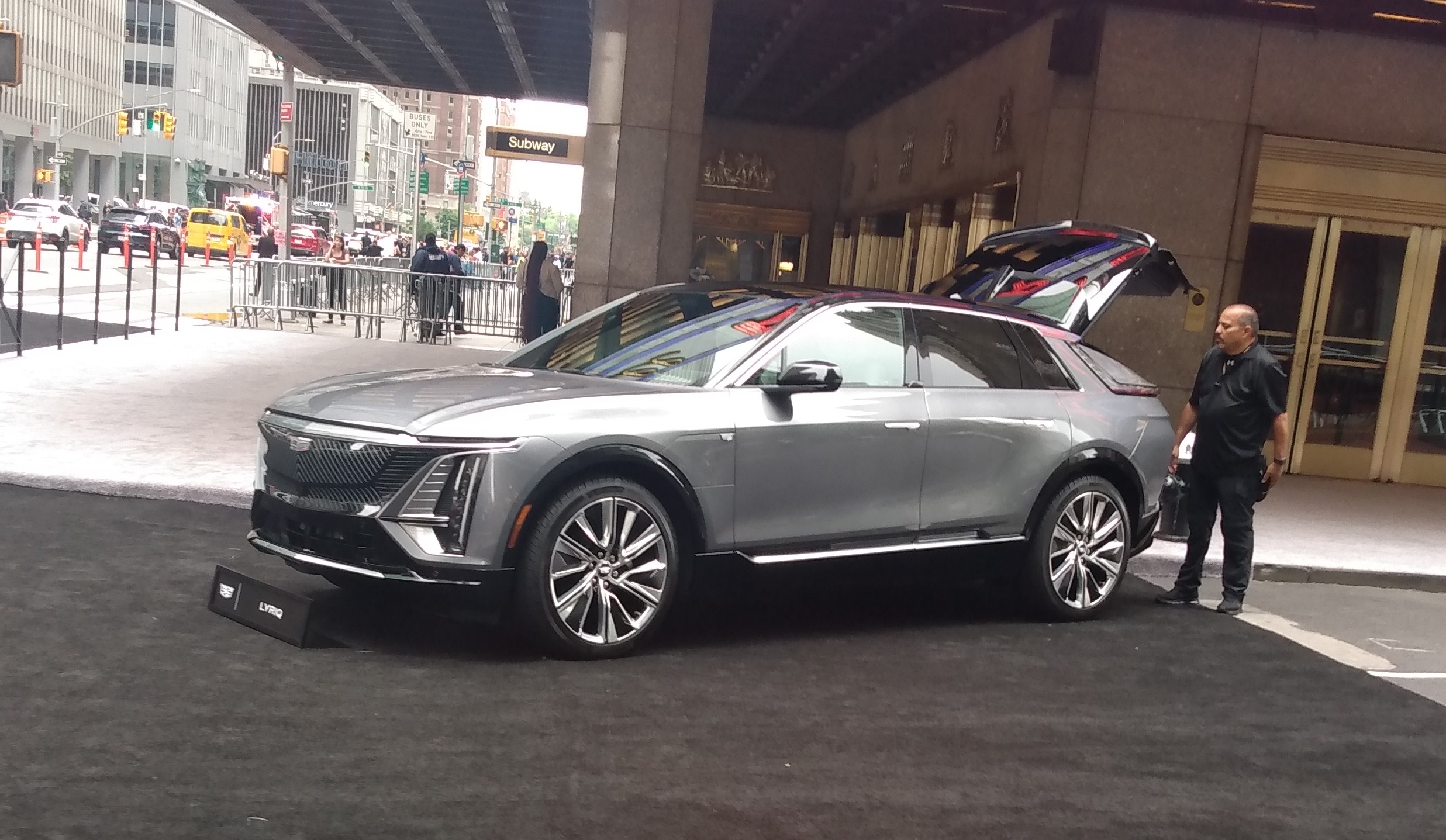
China extends subsidies for new energy vehicles despite strong sales growth, signaling economic concerns. Ford cuts F-150 Lightning production to one shift, reallocating workers to boost Bronco and Ranger output amid lagging Ranger sales. Jeep teases its electric Wagoneer S with impressive off-road and performance specs, launching in fall 2024. Cadillac reports strong sales growth and expands Lyriq EV availability, while Bentley faces declining sales despite increased personalization. Hyundai invests heavily in India after losing ground in China due to geopolitical tensions. The episode also covers challenges with EV charging in cold weather and industry shifts toward software-defined vehicles.
Topics:china ev subsidiesford f-150 lightning production cutsford bronco and ranger productionjeep wagoneer ev teasercadillac lyriq sales growthbentley sales declinehyundai investment in indiaev charging challengessoftware defined vehiclesluxury ev market
- China Adds NEV Incentives - Bosch To Slash 1,200 Software Engineers - U.S. To Invest $325 Million In Chargers as Bitter Cold Strands EVs - Ford Cuts Lightning Production, Boosts Ranger and Bronco - Jeep Teases Wagoneer EV - Hyundai Bets on Indian Car Market - Cadillac Boosts Lyriq Sales, Adds Dealers - Bentley Bucks Luxury Segment, Sees Sales Fall
"...d while it struggled to ramp up production of the lyric EV, it says it's now fixing those issues. Cadilla..."
Select text to request an explanation
This is Outolne Daily, the show dedicated to enthusiasts of the global automotive industry.
China is once again extending subsidies for new energy vehicles or ANYVS, which includes beevs, plugins, and fuel cells. This year and next year,
anyv's will be fully exempt from vehicle purchase taxes, and in twenty twenty six and twenty twenty seven, anyvs will be exempt from half of taxes. Automakers
sold nearly nine and a half million nyvs in China last year, a thirty eight percent gain, and this year ANYV sales are expected to hit eleven and a half million units, a twenty percent increase and a market share of thirty seven percent. So it's surprising to see China extend ANYV incentives once again since
the segment is going so strong. That suggests the government is concerned the slowdown
in its economy will hurt car sales. If we were to believe early forecasts,
we'd all be riding around in autonomous cars, watching movies, getting some work done or catching some shut eye instead of actually driving. But that's not
the case, and the supplier boss says that slow rollout is the reason it will have to make cuts in its software division. The company wants to slash
twelve hundred software development jobs by the end of twenty twenty six because autonomous driving has not taken off like it thought it would. But we think something else
could be going on here too. As traditional automakers begin developing software defined vehicles
or sdvs, they want to copy Tesla and write all their own software in house. Right now, one hundred and fifty different suppliers are writing software code
for one hundred and fifty different microprocessors in the average car, and automakers don't have access to all that code. So as sdvs catch on, suppliers are
worried that they could just end up building parts to spend and lose all that software business. The winter weather has been bitterly cold in much of the United
States this week, and there's been blaring headlines of problems with charging electric cars, like they won't charge at all. The worst case seems to have been
in Chicago, where sub zero tempts meant that public chargers would not charge the batteries, including Tesla superchargers, which are the best public charging system by far.
Some say that owners did not pre warm their batteries before charging. They
point out that the chargers will operate very slowly at first while the batteries warm up, and then charge faster when it gets to the right temp. But
when drivers see their car charge so slowly at first, they assume the charger is not working. And this is just the latest problem with public chargers,
which is why the US government will invest three hundred and twenty five million dollars to replace broken chargers, as well as reduced battery cost and I prove EV technology. It's all part of the National Electric Vehicle Infrastructure Program or NEV,
which is part of the Bipartisan Infrastructure Act. Ford is once again cutting production
of the F one fifty Lightning. It says quote to achieve the optimal balance
of production, sales growth, and profitability. It will reduce lightning production to
one shift, which will impact roughly fourteen hundred employees. Seven hundred of those
people will go to Ford's Michigan assembly plant, where it's adding a third shift to build the Bronco and Ranger. The remaining employees from the Rouge plant where
the lightning is built will be moved to other roles there, placed in another facility, or they can take advantage of a retirement program, but Ford really needs to start making more Rangers. Michigan Assembly was one of the plants shut
down by the UAW strike, and from October to December of last year, it didn't make more than five hundred Rangers in a month. The pickup ended
the year in the US with roughly thirty two thousand units sold, which is way behind the competition. Even the Honda Ridgeline, which had a pretty good
year for itself, easily outsold the Ranger. We want to know what drives
your testing. OTA Connected Car Diagnostics, Remote Testing. Intrepid Control Systems is
here to help you work from anywhere. Intrepid Control Systems driven by your data.
Jeep is getting ready to launch its first EV for global markets, the wagoneer S, and it showed this teaser image to mark the occasion. From
what we can see, it looks pretty darn close to the concept that it showed in September twenty twenty two. It's a mid size suv that Jeep says
we'll have four y E off road capability, six hundred horse power, and we'll be able to do zero to sixte in about three and a half seconds.
Sales kickoff in the US and the fall of this year, followed by other major markets, including Europe. Hundai used to be a pretty big player
in China, but in twenty sixteen, when South Korea bought an anti missile defense system from the US called THAD, the Chinese government retaliated against everything from South Korea. It banned K pop bands from performing in China, it prevented
Chinese tourists from going to South Korea, and it strongly encouraged citizens not to buy any products from Korean brands. That started Hyundai's long slide downward in China,
and it's never recovered. So it's not surprising to see Yndai making a
major investment in the Indian car market, which is booming. It bought GM's
assembly plant there and is investing over seven hundred million dollars to boost its assembly capacity in the country. Hondai is already the second largest automaker in India and
this latest investment will bring its production capacity there to over a million units.
Cadillac had a strong year in twenty twenty three. Its overall sales in the
US were up nine point three percent, and it had its best year for seday and sales since twenty eighteen, including record years for the CT four and CT five. Its V series had a record year as well, up fifty
five percent. Its global sales were also up, but Cadillac didn't provide those
figures, and while it struggled to ramp up production of the lyric EV, it says it's now fixing those issues. Cadillac delivered nine thousand lyrics in the
US last year, which it claims makes it the best selling luxury compact EV.
In the fourth quarter, it delivered thirty eight hundred lyrics, accounting for twelve percent of its retail sales, and in China, lyric sales are up sixty percent year over year. Surprisingly, Cadillac has also added a few dealerships
in states where EV adoption is high, and despite talk of slowing EV growth, Cadillac says there's still strong demand for luxury evs. It seems like all
the high end luxury brands are doing well, but not Bentley. It's sales
dropped eleven percent last year. It sold thirteen thousand, five hundred and sixty
cars, down for more than fifteen one hundred and twenty twenty two, which was a record and sales were down across the board, including in the Americas, in China and Europe, but it did say more customers chose to personalize their vehicles and that business was up by forty three percent. Bentley blames challenging
market conditions for the sales drop, but other luxury brands had great years.
So that makes us wonder what's going on at Bentley, and that will have us keeping an eye on the Ultra Luxury brand going forward. But that brings
us to the end of today's show. Thanks for tuning in, and I
hope that you have a great weekend. Auto Line Daily is brought to you
by Bridgestone Solutions for your Journey, Intrepid Control Systems, over the Air Engineering Boost your game, and by Tajin Automotive Technologies The Formula for Better Mobility.
The Tajent Automotive Technologies we combine world class composite materials expertise with cutting edge designs because frankly, there are better ways to lightweight vehicles, so lighten up with Tajing Automotive Technology, The Formula for Better Mobility. WARDS is the industry leader
for news, data and analysis. That's why companies across the Globe, subscribe
to our premium serve, maybe even your own log in for subscriber access.
Now check your company's intranet for details, and rely on Ward's Auto dot com to keep you informed.
Request an explanation for:
4 cars
4 cars featured
Request an Explanation
Heard something you'd like explained? We'll add it to this episode.
Sign in to request explanations for terms you heard.
Want to learn more?
Browse our glossary for plain-English explanations of automotive terms, jargon, and concepts.
See something that's not quite right? Our annotations are AI-generated and can sometimes miss the mark.
Click the flag icon on any annotation to suggest a correction.