Tesla is cutting 10% of its workforce and halving its Full Self-Driving subscription price amid production and market challenges, while BP scales back its EV charger operations. Honda is investing heavily in EV production and battery manufacturing in Ohio. The UAW is pushing for union votes at Volkswagen and Mercedes plants, aiming to expand union presence. Meanwhile, automakers and suppliers like Magna are testing humanoid robots in manufacturing. The episode also covers Tesla Cybertruck's innovative battery tech, Chinese automaker Cherry's European expansion, Cadillac's new electric crossover interior, and a promising luxury off-road EV from M Hero.
Topics:tesla layoffsfull self driving pricingev production investmentsuaw union voteshumanoid robots in manufacturingtesla cybertruck technologychinese automaker european expansioncadillac electric crossoverluxury off road ev
- Tesla Axes 10% Of Workforce, Slashes FSD Price - BP Pulse Cuts 10% Of Workers - Honda On Pace to Start U.S. EV Production In 2025 - UAW Votes at VW This Week - Magna to Test Humanoid Robots at Production Sites - Tesla’s Extraordinary Design Evolution - Chery To Sign Deal with Premium European Brand - Cadillac Reveals New Optiq Interior - Dongfeng’s Wild Off-Road EV May Come to Market
"... Optic is built on the same platform as the Chevy Equinox EV and the Buick Electra E four, and it should be..."
Select text to request an explanation
This is Outolined Daily, the show dedicated to enthusiasts the global automotive industry, and we start out this week with a lot of bad news on the EV front. First off, Tesla announced it's laying off ten percent of its global
workforce, which would translate to about fourteen thousand employees. That's almost as much
as Rivian's total workforce, which is about sixteen eight hundred people. Also,
Tesla cut the monthly subscription fee for full self driving in half. Prior to
this, owners paid one hundred and ninety nine dollars a month for FSD.
Now it's down to ninety nine bucks. FSD was part of the justification for
Tesla's massive market cap, but the stock price is down thirty percent this year.
On top of that, there's no construction going on at its plant site in Mexico, and Mexican officials complain that they can't get any answers from Tesla or Musk. Plant was reportedly going to be the site for Tesla's revolutionary assembly
process, what it calls unboxed assembly, and that was going to be key for developing an inexpensive EV with good profit margins. But then must set the
first line for the twenty five thousand dollars car would be in Austin, Texas, followed by Mexico. And all this comes on the heels of reports that
Tesla is now canceling its affordable EV though Elon must denies that, and BP, the oil giant, is also laying off ten percent of the people that it has working on EV chargers in its business unit called BP Pulse. Specifically,
it laid off one hundred of the nine hundred employees there, and it pulled out of eight countries where an expected surgeon commercial evs for fleet customers never materialized. BP paulse says it will concentrate on the US, the UK,
Chinese and German markets, which is where evs are growing the fastest. But
it's not all doom and gloom on the EV front. Honda is plunging ahead
on its EV investments in Ohio. It's consolidating two assembly lines at it's Marysville
plant in a one that will enable it to make ic in evs on that one line. It's also retooling its Ana engine plant to bring in six six
thousand ton die casting machines to make battery cases. The aluminum cases will be
cast in two pieces and then friction stirwelded. Together. All those investments come
to seven hundred million bucks and another four point four billion dollars is going into a battery cell plant that it's building with LG. Honda will start making EV's
in Ohio next year, with a goal of reaching eighty five percent b EV sales in twenty thirty five and one hundred percent by twenty forty. It's a
big week for the UAW. Volkswagen workers in Tennessee will cast votes Wednesday through
Friday on whether or not they want to join the union. If they do,
it would be the only foreign auto plant in the US represented by the union. The UAW also filed a petition earlier this month with the National Labor
Relations Board to hold a union vote at Mercedes plant in Alabama as well.
The UAW hopes these votes will be a springboard to organize more non unionized plants around the country, but it hasn't succeeded in past efforts to organize non union plants, so this is going to be fascinating to see what happens. But
maybe the UAW better pay attention to this next story because more and more automakers are starting to test humanoid robots on the production line. BMW announced plans earlier
this year to start training robots at its plant in South Carolina over the next two years. Chinese off maker Neo is testing humanoid robots at one of its
plants, and Tesla, of course, is developing its own robot called Optimists.
But it's not just automakers that are interested in humanoid robots. The supplier
Magna is planning to test them at its manufacturing facilities. The robots were developed
by a startup called Sanctuary AI from Vancouver, which Magna has been an investor in since twenty twenty one. Magna didn't reveal specifically where, when, or
what purpose the robots will be used for, but it did say they'll be used quote across multiple applications within automotive manufacturing processes. The tagin automotive technologies,
we combine world class composite materials expertise with cutting edge designs because frankly, there are better ways to lightweight vehicles, so lighten up with taging Automotive Technologies the Formula for Better Mobility Friday Show last week, John and I were invited back to vehicle benchmarking specialist Caresoft to continue to follow them on their teardown of the Tesla cybertruck. We thank some of the team there for laying out parts of
the systems for display, because it made it really easy to demonstrate the evolution of the Tesla brand, and not just compared to legacy automakers, but also to itself. I think the best example might be its approach to the auxiliary
battery. Everybody has always used a twelve volt lead acid battery, which Tesla
did as well for a while. But by the time the model WHY rolled
around, it was ready to make a change. And more importantly, as
Caresoft president Terry Wachowski points out, listen to how fast it made that change, and quite amazing. Within a year that was replaced with this, so
that twelve volt lead acid battery was replaced with a sixteen volt lithium ion.
This is unrealis lieh my god? That is beautiful. So mass begets mass,
but in an ev it's it's exceptionally important because you have to carry your mass with you, so it's gonna it takes range, and in order to get range, it takes batteries. Well, batteries are heavy, and they're
very expensive, and so mass is one of your biggest enemies. This all
comes down to Tesla's first principles thinking breaking down previous assumptions or barriers to create truly innovative solutions. So it dumped the industry standard lead acid for a lithium
ion battery, and it also boosted voltage from twelve up to sixteen volts that significantly cut the weight and size of that battery. And you can see those
same principles applied to the forty eight volt battery of the cyber truck. And
you can see even more of this in the video with John and Terry.
But there's also some other areas where the cyber truck might not be the breakthrough of efficiency, like the Model three or why are Chinese automaker Cherry is making a big push into the European car market. It's nearing a deal to start
building vehicles in Spain, and now the company's chairman says it's going to sign a deal with a premium European brand to share its platform. That deal is
expected to be announced sometime this week. Cherry didn't say what brand it is,
but it does have a joint venture with Jaguar land Rover to build its vehicles in China, so that's a possibility. Cherry's chairman also said it's in
talks with another premium European brand for platform sharing, and it's in talks with two other brands for possible partnerships. Cadillac revealed the interior of its upcoming small
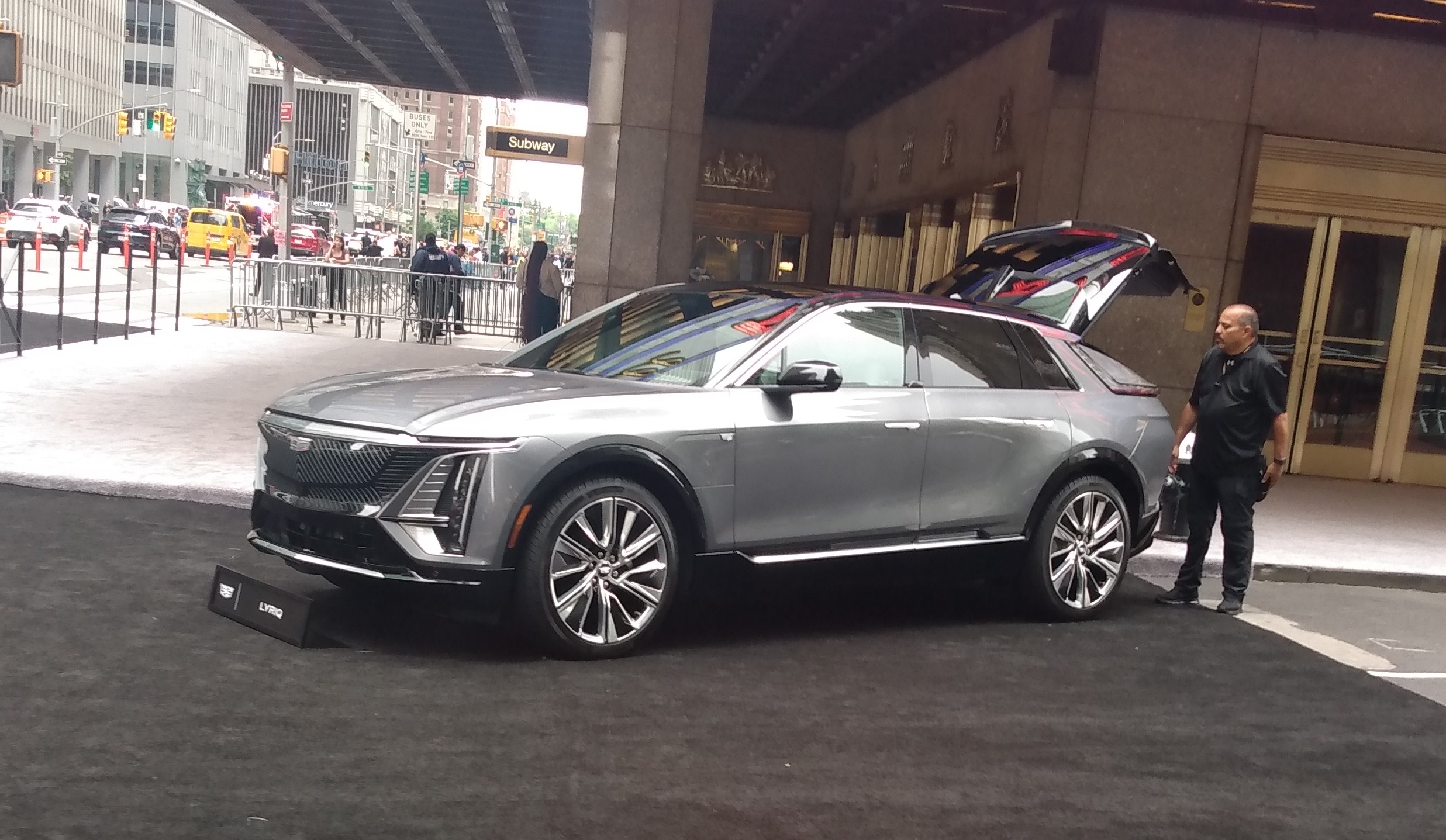
electric crossover, the Optic. The dashboard appears large and seems to jut out
over the passenger's legs. At first, I thought the piece that sticks out
in the middle of the dash was a place to rest and charge your phone, but it's a styling element for one of the events and also houses the HVAC controls, and like the Lyric, it has a large curve display screen.
The Optic is built on the same platform as the Chevy Equinox EV and the Buick Electra E four, and it should be on sale before the end of the year. Here's a cool looking off road EV that actually has a
chance of making it to the market. It's the M Hunter from luxury off
road brand m Hero, which is part of Chinese automaker dong Fung. The
details are few right now. It's only using flashy wording like military grade technology
and aerospace grade carbon fiber, but Gascou reports there are plans to put it into production. M Hero currently has one other vehicle, the nine seventeen,
a large SUV that's offered as a BEV and as a range extended electric vehicle.
The BEV has a four motor setup with one thousand, eighty eight horse power and will do zero to sixty and four point two seconds. The EREV
has eight hundred and sixteen horse power, over one thousand kilometers or six hundred and twenty miles of range, and roughly a ninety thousand dollars starting price tag.
The nine point seventeen is just making its way to the European market on top of China, and we would expect a similar setup and market launch for the m Hunter. But that brings us to the end of today's show.
Thanks for making autoline a part of your day. Auto Line Daily is brought
to you by Bridgetone Solutions for your Journey, Intrepid Control Systems, over the Air, Engineering Boost your Game, and by Tajin Automotive Technologies. The formula
for better Mobility, keeping your heart racing in and out of the gym.
That's what really matters, Bridge don't pretend to sport as tires with a fifty thousand mile limited warranty. Intrepid's NEOVIPI allowing automotive engineers to interface, capture,
and monitor vehicle data using Raspberry Pie. As a matter of fact, it's
the automotive industry's first robust platform for Raspberry Pie, featuring Intrepid canefting technology and Raspberry Pie compute module. The NEOVIPI is designed for automotive environments, allowing use
with relative power ranges and applications. In addition, the NEOVIPI enables you to
use the Raspberry Pi for compute while avoiding additional development to adapt to network environments.
That makes the NEOVIPI powerful enough to solve your vehicle network problems, yet small enough to fit in your backpack. One of many Intrepid tools used for
developing zonal architecture and software divined vehicles.
Request an explanation for:
6 cars
6 cars featured
Request an Explanation
Heard something you'd like explained? We'll add it to this episode.
Sign in to request explanations for terms you heard.
Want to learn more?
Browse our glossary for plain-English explanations of automotive terms, jargon, and concepts.
See something that's not quite right? Our annotations are AI-generated and can sometimes miss the mark.
Click the flag icon on any annotation to suggest a correction.