This is out Oflged Daily, the show dedicated to enthusiasts of the global automotive industry. Mercedes is holding back on expanding its battery capacity until it has quote
more transparency on demand for evs. In twenty twenty two, it said it
would need two hundred gigawat hours of batteries by twenty thirty, which was supposed to be supplied by eight cell plants around the world, but now it's pausing plans on at least two of those plants in Germany and Italy. With current
battery partner ACC, Mercedes will still rely on ACC for cells that come from a facility in France, as well as from other partners like CATL, But it also looks like Mercedes wants to make batteries in house. It just opened
a new cell center at its headquarters in Germany to develop batteries for future evs and plans to reduce its battery costs by thirty percent in quote the coming years.
Just before the July fourth break, we reported that Mercedes is spending more money on combustion engines than it previously planned to. It's an effort to keep
its cars competitive because by twenty thirty. It still expects fifty percent of its
sales to come from models that have some sort of IC engine, and Stillantis is also reacting to the slowdown in EV demand and the increase of hybrid sales by equipping more models in Europe with a hybrid powertrain. The company says it
will have thirty hybrid vehicles for sale by the end of the year and plans to introduce six more by twenty twenty six. It will especially leverage its DCT
technology, which combines a small IC engine with a twenty one kilowat electric motor that's incorporated into the transmission, as well as a forty eight volt belt driven starter generator and a nearly one kilowad hour battery pack. Still, Lanta says
its hybrid sales are up over forty percent this year, which is part of the reason it invested another two hundred and forty million euros at a plant in Italy and April to be able to make up to six hundred thousand e DCTs a year byd is expanding even more into Europe, which we see as a response to the EU's new tariffs on imported Chinese made evs. It agreed to
spend a billion dollars on a new plant in R and D Center in Turkey that will be able to make up to one hundred and fifty thousand vehicles a year. The facility is expected to start pumping out beev's and pehabs by the
end of twenty twenty six and will employ up to five thousand people. Even
though Turkey is not part of the EU, it is one of its main trade partners and also has a customs union with the EU, so presumably the BYD vehicles that come out of the plant in Turkey will no longer be hit with a seventeen point four percent import tariff. There's also reports that Chinese automaker
GAC is in talks with Turkish evmaker tog on a possible production joint venture.
BYD's European expansion includes providing new energy vehicles to businesses in the region as well.
It's signed a memorandum of understanding with European vehicle leasing company AVANS and they expect to provide EVY fleet services to over thirty companies in the first year.
Initially, the vehicles will be offered in France, the Netherlands, Belgium and Luxembourg and Avans will also help byd expand into more retail locations in Europe.
Michigan is leading the charge in mobility and innovation and I can't think of a better state to be in. The Ford Capri is coming back. Ford of
Europe posted a video on social media of an old Capri two point eight trying to plug into an EV charger with the text the legend is back ten seven twenty four. The model was last produced in nineteen eighty six, but the
new version is expected to be the second Volkswagen EMYB based EV that forgets.
The first is the Explorer EV that just launched. Depending on how you read
the date that was teased, we'll either know more about the new Capri tomorrow or in the first week of October. Luxury ev startup Lucid Motors sales were
up significantly in the second quarter, but it relied heavily on incentives to help boost those sales. The company revealed it delivered two thousand, three hundred and
ninety four air sedans in Q two, which is up seventy one percent compared to a year ago, but Lucid offered more than sixteen thousand dollars per vehicle in factory incentives, which is sixty six hundred dollars more than last year.
Lucid also said production dipped slightly in the second quarter, down about three percent to two thousand, one hundred and ten vehicles. For the first six months
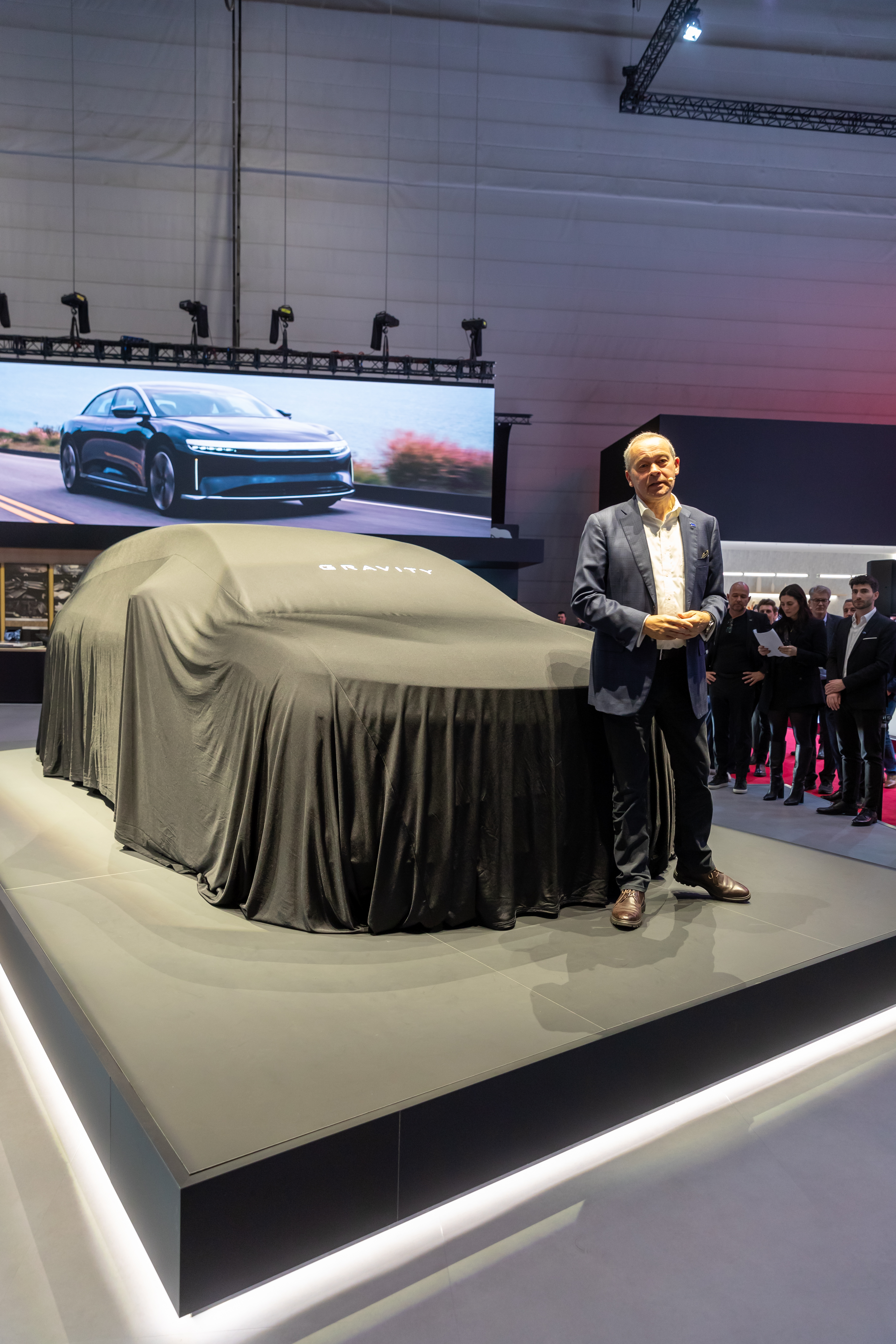
of the year, Lucid has produced more than thirty eight hundred air sedans, a pace that's behind its target of building nine thousand vehicles this year, but it should get closer to that goal when its first suv, the Gravity, launches later in the year. Indian company Bajaj Auto, which makes motorcycles and
scooters, introduced what it claims is the world's first motorcycle powered by compressed natural gas, called the Freedom. The one hundred and twenty five cc bike has
a range of one hundred and twenty miles or one hundred and ninety three kilometers from its twelve and a half liter CNG tank, but since CNG can be harder to find in some parts of India, the bike also features an auxiliary two liter gasoline tank, which provides an extra eighty miles or one hundred and twenty nine kilometers of range. The bike has a top speed of ninety and
a half kilometers an hour or fifty six miles an hour while running on CNG, and it's three kilometers higher with gasoline. But Jog claims that CNG cuts
the cost of running the bike in half and that it reduces CO two emissions by twenty five percent. Battery companies all over the world are working on solid
state batteries and the race is on to see who can make it to mass production. But a startup called Natreon not only things that has the solution.
Nothing in the battery plant has to change either. It's a drop in solution
where nothing has to change. You just eliminate the liquid electrolyte and replace it
with a solid state fabric. You still use the same process and the same
equipment. Alex Kashikov, the CEO and co founder of Natureon, explains what
it's all about. Our technology is a material with COALISAC and this replaces the
liquid components that will typically be in a rechargeable aissium battery with a solid material, thereby making it a solid state battery with significantly enhanced performance and safety.
And there have been methods of doing this in the past, but what I think we really finally figured out is a way to do this with the existing battery manufacturing processes and techniques and really make it as easy as possible to make a transition to solid state batteries and make them as scalable and low cost as possible for ebs and so forth. By the way, Natreon was the winner
of this year's GAMIC Prize, the Global Automotive Mobility Innovation Challenge, where a panel of top automotive experts choose the most promising technology. We have a lot
more info about the battery and the process to make them. You can find
a link to the full interview in the transcript or in the description box.
As we said earlier in the show, hybrids are hot sellers right now, and Mazda is finally entering the CX fifty crossover into the hybrid segment. The
core of the powertrain is a naturally aspirated two and a half liter four cylinder coupled to a CVT in three electric motors. The all wheel drive package delivers
thirty eight miles to the gallon compared to twenty five mpg with the non hybrid version. It also adds one hundred more miles of range and can tow up
to fifteen hundred pounds. Mazda says it tune the CVT for responsive driving,
and we look forward to a test drive to confirm if that's true. The
CX fifty is offered in a slew of different trims across a wide price spectrum.
A base non hybrid version starts at thirty one thousan seven and twenty dollars, the hybrid starts at thirty five thousand, six hundred and ninety and a fully loaded non hybrid turbo costs about forty five thousand, five hundred dollars, and that brings us to the end of today's show. Thanks for tuning in.
Auto Line Daily is brought to you by Bridgestone Solutions for your Journey, Intrepid Control Systems, Over the Air Engineering Boost Your Game, MEDC where Michigan businesses are powering the future of mobility, and by Tajent Automotive Technologies the formula for better mobility. There's nothing wrong with heavy metal, hey light enough,
but with world class composite material, Tagent Automotive Technologies makes vehicles lighter, say and more ego friendly. Intrepid's NEOVIPI allowing automotive engineers to interface, capture,
and monitor vehicle data using Raspberry Pie. As a matter of fact, it's
the automotive industry's first robust platform for Raspberry Pie, featuring Intrepid cannefting technology and Raspberry Pie compute module. The NEOVIPI is designed for automotive environments, allowing use
with relative power ranges and applications. In addition, the NEOVIPI enables you to
use the Raspberry Pie for compute while avoiding additional development to adapt to network environments.
That makes the NEOVIPI powerful enough to solve your vehicle network problems, yet small enough to fit in your backpack. One of many Intrepid tools used for
developing zonal architecture and software divined vehicles. Knowing that when it's time to unplug,
your tires were built to get you to the place you recharge. That's
what really matters. Bridgestone Taranza Evy tires with a fifty thousand mile limited warranty
About this episode
Mercedes is pausing expansion of its battery capacity amid uncertain EV demand, focusing instead on in-house battery development and combustion engine investments. Stellantis is ramping up hybrid models in Europe, leveraging DCT technology and expanding production in Italy. BYD is growing its European footprint with a new plant in Turkey to avoid EU tariffs. Ford teases a new electric Capri based on VW's MEB platform. Lucid Motors boosts sales with heavy incentives, while Bajaj Auto launches a CNG-powered motorcycle. Startup Natreon introduces a scalable solid-state battery solution compatible with existing manufacturing. Mazda enters the hybrid SUV market with the CX-50 hybrid offering improved efficiency and towing.
- Mercedes Halts Battery Capacity Expansion - Stellantis Offering More Hybrids in Europe - BYD Spending $1 Billion on New Turkey Plant - Ford Capri Coming Back as MEB-Based EV - Lucid Boosts Sales But With Big Discounts - A Motorcycle That Can Run on CNG or Gas - Natrion Makes Solid State Easy - Mazda Gives CX-50 a Hybrid