
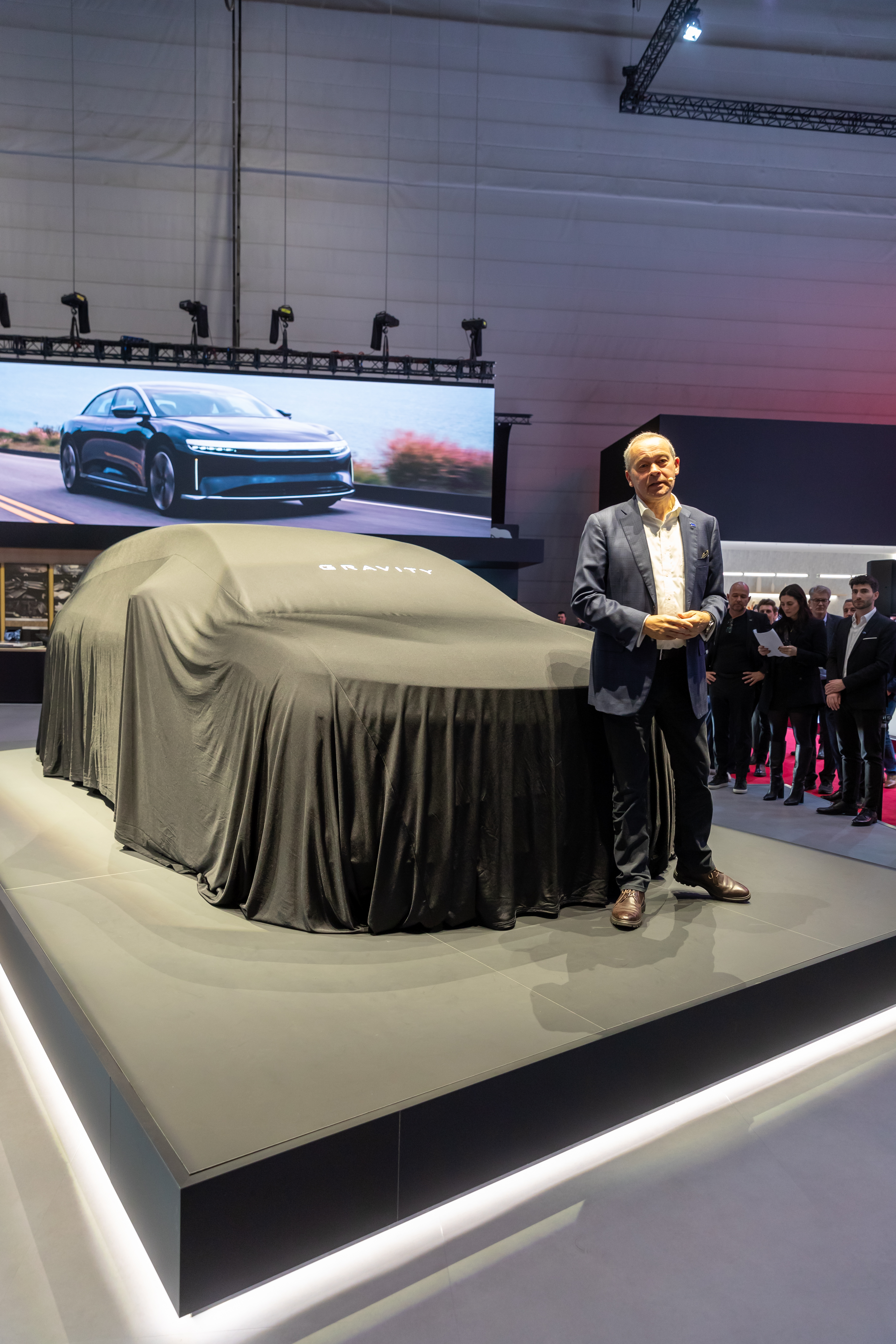
Lucid secured a $1.5 billion investment from the Saudi Public Investment Fund despite a $800 million Q2 loss, supporting its upcoming Gravity SUV launch and plans for more affordable models by 2026. Continental plans to spin off its automotive division to focus on software-driven tech. Nissan faces challenges in the US with declining sales and is testing innovative cooling paint to reduce EV energy use. Goldman Sachs forecasts EVs will reach cost parity with ICE vehicles by 2025 due to falling battery prices. Chinese automaker Dongfeng nears a deal to build cars in Italy, while Huawei and Baic unveiled a luxury EV sedan. Robotics company Ubtech is expanding humanoid robots' roles in automotive manufacturing.
Topics:lucid investmentsaudi public investment fundcontinental spinoffnissan us market challengesinnovative cooling paintev vs ice cost paritybattery price declinedongfeng italy planthuawei baic evrobotics in manufacturing
- Lucid Gets New Billion Dollar Saudi Investment - Continental Wants to Spin Off Automotive Operations - Nissan Offers Buyouts to U.S. Salaried Workers - Special Paint Keeps Cars Cooler - EVs and ICEs Could Hit Breakeven Point Next Year - Dongfeng Close to Deal for Italian Plant - Mercedes EQS Gets More Chinese Competition - Humanoid Robots Being Trained to Make Cars
"...it Lucid will use the infusion to help launch the Gravity Suv by the end of this year, and it also gives it..."
Select text to request an explanation
Speaker 1: This is on ALIGNE Daily, the show dedicated to enthusiasts of the global automotive industry. Lucid reported a Q two
net loss of nearly eight hundred million dollars, but it also got another one point five billion dollars in commitments to the company. Nearly two thousand, four hundred Air Sedans
were delivered to customers in the second quarter, a jump of over seventy percent compared to a year ago. The
vehicle benefited from an up to ten percent price cut, which meant some models had over sixteen thousand, five hundred dollars slashed from their sticker price. Those vehicle sales brought
in a little more than two hundred million dollars of revenue, a jump of thirty three percent from Q two twenty twenty three. But now let's get back to that big investment.
Lucid entered an agreement with an affiliate of the Saudi Public Investment Fund, which owns about sixty percent of Lucid, for it to purchase seven hundred and fifty million dollars of the EV startup stock and for it to provide Lucid with another seven hundred and fifty million dollar line of credit Lucid will use the infusion to help launch the Gravity Suv by the end of this year, and it also gives it enough assets to last until the fourth quarter of next year. But Lucid plans to launch
more models with the starting price under fifty thousand bucks in twenty twenty six, so it will need even more money. However,
CEO Peter Rollinson recently said that the Saudi PIF would remain a long term partner and so far it's invested eight billion dollars into Lucid. The giant German supplier Continental
is considering spinning off its automotive operations quote due to the increasing dynamic markets in the industry. Says the board
will come to a decision by the end of this year and if approved, which it sounds like it will be, will be put to a shareholder vote in April of next If that's approved, it hopes to complete the spinoff by the end of twenty twenty five, and it says it's already preparing for that to happen. The automotive division
makes things like breaks, comfort systems, sensors, displays, software platforms, and driver assistance systems. Kanti says the move will allow
it to adjust to changes in the market, easier, to focus more on software driven tech and quote harness its full potential for creating value. Last year, its automotive operations
generated sales of twenty point three billion euros and employed about one hundred thousand people. The tire division and Kanti Tech,
which is a plastics and materials company, will remain under the Continental umbrella, and they make about the same amount of money and employ about the same amount of people as the automotive operations. After poor results in America last quarter,
Nissan is offering buyouts to salaried employees in the US.
It says they were offered to some white collar workers who are at least fifty two years old, and that it only accounted for a small percentage of the roughly twelve thousand non hourly workers at employees, but if Nissan continues to perform like it has in the US, those buyouts could turn into layoffs. Sales were down over three
percent last quarter. Its inventory was over one hundred day
supply at the end of February versus an average of seventy six days, and it offered the highest purchase incentives of any full line brand in March at over three thousand, seven hundred dollars per vehicle, and in other Nissan news, the automaker is testing paint that's designed to keep a vehicle's interior cooler and reduce its energy usage. The automaker
partnered with Ratycool, a company that specializes in radiative cooling products, to create the paint. The companies are testing it on
an Envy one hundred small van that's operating as a service vehicle at an airport in Japan. Initial tests show
that the paint reduced the vehicle's surface temperature up to twelve degrees celsius and its interior up to five degrees compared to traditional paint. Nissan's cool paint incorporates meta material
and synthetic composite materials that redirect the sun's rays away from the vehicle, but the paint is thicker than traditional automotive paint, so Nissan is still working on a process to apply it that meets its quality standards, but it says that it sees strong potential for the paint, especially for light commercial vehicles that spend most of their day driving.
Speaker 2: Michigan is leading the charge in mobility and innovation and I can't think of a better state to band.
Speaker 1: EV prices are actually on track to break even with ice vehicles as early as next year in the US, A study from Goldman Sachs says falling battery prices due to a seventy percent plunge in lithium prices, will make evs more affordable. According to Kelly Bluebook, the average cost
of a new EV in June was more than fifty six thousand bucks, compared to just over forty eight grand for an ice vehicle, but battery costs are expected to go from one hundred and fifty one dollars per kilowade hour in twenty twenty three to ninety one bucks in twenty twenty five, a nearly forty percent drop, So Goldman Sachs predicts the break even point between evs and ICs will be achieved sometime between twenty twenty five and twenty twenty six. Its cost of ownership includes the price of
the vehicle, fuel or battery, recharging, repairs, and maintenance over the lifetime of the car, but it doesn't factor in government subsidies for purchasing an EVE. Chinese automaker Dong Fung
is closing in on a deal to build vehicles in Italy.
Reuter's reports that talks between the Italian government and the automaker are in an advanced stage to build a car plant in the country. The Italian government could take a
minority stake in the investment, and it could also include investment from other Italian suppliers. Stillantis is currently the only
major automaker that builds cards in Italy, but Italy is aiming to boost production in the country from eight hundred thousand and twenty twenty three to one point three million units, so it's looking for anyone to help hit that target.
The first vehicle from the joint venture between Chinese tech giant Huawei and car company Baic was just unveiled, called the Stolato nine. The electric luxury sedan is aimed at
competing with vehicles like the Mercedes Benz Equs, but with a much lower price. Single motor versions feature two hundred
and twenty seven kilowatts of power, while dual motor versions come with three hundred and eighty five kilowatts. Both are
equipped with a one hundred kilowat hour battery pack, which offers eight hundred and sixteen kilometers or five hundred and seven miles of range on single motor models, and the dual motor is rated at seven hundred and twenty one kilometers or four hundred and forty eight miles of range, and that's based on the Chinese test cycle. In addition
to a fifteen point six inch touch screen up front, the rear features a thirteen point two inch tablet in the center armrest and a giant thirty two inch projector screen between the seats. It's also available with several driver
assistance features, including hands free drive capability. The Stilato S
nine is priced between roughly fifty six thousand dollars and sixty three thousand bucks. Humanoid robots are on their way
to replacing actual humans on the production line. A Chinese
robotics company we've reported on a few times called Ubtech is teaming up to expand the automotive capabilities of its robots, currently called Walker s. They've already started Tasset Neo and
Zeker factories doing things like inspecting seat belts and body panels, so they can't do everything yet, But now Ubtech is working with Gili parent company to Zeker to find even more applications for Walker s in manufacturing, and it's also working with another company to collect data on production lines that use robots and to come up with plant designs that are better suited for robots. Ubtech also has collaborated
with Dong Fung and faw Volton. But that brings us
to the end of today's show. Thanks for making autoline
a part of your day.
Speaker 2: Autoline Daily is brought to you by Bridgestone Solutions for your Journey, Intrepid Control Systems, Over the Air Engineering, Boost Your Game, MEDC where Michigan businesses are powering the future of mobility, and by Tajent Automotive Technologies the formula for better mobility.
Speaker 3: There's nothing wrong with heavy metal, hey light enough, but with world class composit material, Tagent Automotive Technologies makes vehicles lighter, safer, and more eco friendly.
Speaker 4: Intrepid's neo vi Pie allowing automotive engineers to interface, capture, and monitor vehicle data using Raspberry Pie. As a matter
of fact, it's the automotive industry's first robust platform for Raspberry Pie, featuring Intrepid canufting technology and Raspberry Pie compute module.
The NEOVIPI is designed for automotive environments, allowing use with relative power ranges and applications. In addition, the NEOVIPI enables
you to use the Raspberry Pie for compute while avoiding additional development to adapt to network environments. That makes the
NEOVIPI powerful enough to solve your vehicle network problems, yet small enough to fit in your backpack, one of many intrepid tools used for developing zonal architecture and software divine vehicles.
Keeping your heart racing in and out of the gym, that's what really matters.
Speaker 3: Bridge don't pretend to sport as tires with a fifty thousand mile limited warranty
Request an explanation for:
1 cars
1 cars featured
Request an Explanation
Heard something you'd like explained? We'll add it to this episode.
Sign in to request explanations for terms you heard.
Want to learn more?
Browse our glossary for plain-English explanations of automotive terms, jargon, and concepts.
See something that's not quite right? Our annotations are AI-generated and can sometimes miss the mark.
Click the flag icon on any annotation to suggest a correction.