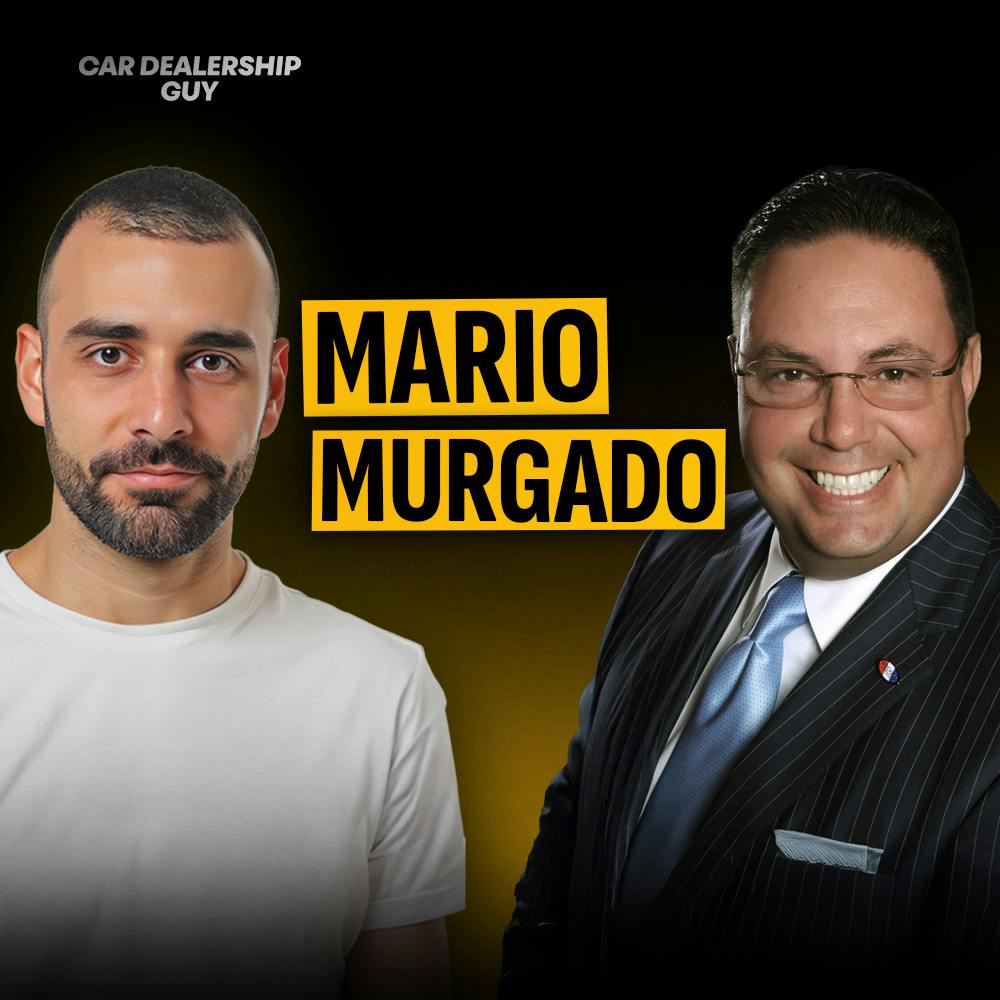
Against All Odds: This Dealer's Rise from Refugee to 29-Store Auto Empire | Mario Murgado, CEO of Murgado Automotive Group
Car Dealership Guy Podcast
Against All Odds: This Dealer's Rise from Refugee to 29-Store Auto Empire | Mario Murgado, CEO of Murgado Automotive Group
Car Dealership Guy Podcast · Sep 4, 2025
Annotations will appear as you listen
0:00
53:22


LIVE
You know, we bought single and we sold them, and we did good because it's pricing and doing things.
And it's selling the excitement, the sizzle, and then the service and the experience.
And I think when people walked in our stores, they knew that we appreciated them.
We knew that the dealers were in, that the partners were in, and there wasn't a time that we
needed to advertise. There's never a day that one of us is not here. So we work Sunday,
we work Saturdays, you know, we work through our late nights. And all those things offer
you the opportunity to separate yourself from someone else. You can buy a car, it's a commodity
from A, B, C, or D. Why buy from me? And what we offered was something different than
I think that somebody else didn't, wasn't prepared at that time.
Today I'm joined by Mario Mercado, CEO of Mercado Automotive Group.
After arriving in America as a young boy and refugee from Communist Cuba,
Mario set out to build his own American dream and defy every expectation along the way.
We talk about his dramatic journey, the growth model fueling his expansion into underserved
communities and the strategy behind his dealership acquisitions, plus a lot more.
His journey is very powerful, authentic, and easily one of my favorite stories
since starting this podcast. I can't wait for you to hear it.
A big thank you to our sponsors for making today's episode possible.
Lotlinks, Widewell, and Nomad Content Studio. And now let's get into the show.
Mario Mercado on the CDG podcast. Mario, welcome.
Thank you. Thank you. Thank you for having me on.
Good to have you here, Ron. I was just saying, your website definitely made my job a bit easier
because you spelled out a big part of your life on there. So it would be nice if everyone had one
of those. Did you put that together? Yeah, we did. That's a long time ago. I started a company,
Innovative Internet. Innovative Internet. We opened it up in 1995, just when the internet
was coming in. So we did a few different things. We were doing websites for universities. We were
doing preparing them for FIU and other universities as well. And then we grew that
further along and just finished selling it just recently. Oh, wow. So you were in the tech business.
I didn't know that. It's really, I have a partner, Jack Supportus. And I always liked the way he
worked. I was well worked with him. And it was his to go run. And I first backed it up and
supported it. And we did a lot of things together and very proud of it. That was very
interesting times. If you recall when 1995 came around and the internet, there were people
who either hated it or were afraid of it or said that'll go away. Well, those that hated it
had to learn how to love it. Those that said it'll go away, they're wrong. They may not be
around anymore. So everything changed there. And it was a wonderful, wonderful experience,
wonderful change. But I really saw it really more than anything, a great educational way.
You know, when I looked at what we did at the schools, the things we did with certain
universities of being able to have multiple languages available easily to be able to
translate things really quick to Spanish or something else. That was a phenomenal thing.
There was a great tool at that time today. There's many more advanced tools than that.
But that was a good start for us. I mean, look, here's what I'll say. I know I have a great beer
going here, but I was going through my terrible twos in 1995. So I don't remember too much,
but I do study history. So I'll give you that. You got a small detail that I noticed. I don't
know if this is me just looking into things or maybe there is something there, but you had
like four or five pictures of lighthouses on your website. Yeah. Is this like, is this
just you'd like to vibe or are you like into lighthouses? I was just I was just interested.
It's a great story. So when I came to this great country, I came alone without my parents and
then my mother came and then my father came afterwards. I had met someone that was from
the Navy and he told me that lighthouses has always brought sailors home. So your father
will find his lighthouse and he'll be here. So it's always meant something to me.
To the point that's my personal logo. So if I write to you something in my personal
stationery, it's a lighthouse. If I go play golf, I'll give my golf ball. My golf ball has
a lighthouse. If I have a hat, it'll have a lighthouse. And it's always been something
that means has great significance for me of having my father come, having something that
someone inspired me, encouraged me at a moment when I was down and I've never forgotten.
That's incredible. You see, initially, I was, I, so I ran it through ChatGBT. I actually
screen shoted the pictures on your website and I put it through ChatGBT and I was like,
he probably has like a second home in like Martha's Vineyard or something. And he's just like,
you know, enjoys it there. And then I'm like, wait, a lighthouse in Maine. Then it was a
lighthouse in Florida. I was like, all right, there's a bigger, broader pattern here. So
I did my, you know, all my forensics, but I'm glad that there's, there's something there.
That's really cool. It's a cool story. So what can you tell us about just coming here as a
kid from, from Cuba and, you know, growing up in the US, that's obviously, you know,
just massive transition in early childhood. What was that like from as much as you can
remember? You know, I'll take you, I'll take you back to that time, but, but at this time here,
I'll just say to you, really the thought that has always been in my mind has always been
blessed and grateful. Blessed to be able to be in this great country, grateful to be in this
country and have the opportunities that have been afforded to me. And sometimes
opportunities that not every, everyone sees, but really when it comes to immigrants,
I think they see how powerful, how incredible this country is. And it's still the land
of opportunities. But taking you back at that time, it was a moment where,
frankly, fear comes in. And one of the things that first, that first night that you're here,
and the first night that you were at the foster parent, darkness was something. So I never liked
darkness. But again, I had someone in the morning tell me, you know, every day it's going to get
dark. And every morning, there'll be morning. So no matter what happens in that day, no matter
what challenges you have, no matter what difficulties, no matter what situations,
light will come tomorrow. And that motivated me in a very strong way to say, well, you know,
every day when the light comes, I don't want anyone to take my light. I want to make sure that I
get it. I want to make sure that I enjoy it. I want to make sure that I take advantage of it.
So it's always stimulated me at a very young age. But that would be the first thing it was fear,
fear of the unknown. You kind of, you lose your childhood like this,
and you mature very, very quickly, because you have to start doing things for yourself.
But I was blessed to have my mother within months. And then later on a year,
my father, a little over a year.
Can you walk me through that? Because I missed a foster parent.
So this is what happens. In Cuba, there was a group called Peter Pan,
Pedro Pong. That's a group of kids from 1959 until about 1962, 63. It was over 14,000. I always call
them our pride. Because they came to this country, they were separated, and they came
to the Catholic Church. At that time, work were parishioners all throughout the country,
and had foster parents who took care of these kids like that. And it was a very successful,
it was 14,000 kids spread all over in Oklahoma, in Texas, in Nebraska, Montana, Illinois, New York,
Pennsylvania, all throughout. And some got reunited with their parents. Some never got
reunited with their parents. They were a little older. They were between the ages of nine and,
let's say 15 on an average. I would say, if you take a look at them,
they've been very successful group of Cuban young men and women that came to this country.
I came in at that 65. When I come in, it's at the beginning of the Freedom Flights.
And the Freedom Flights, my father wasn't allowed to go. They said, my mother can leave,
but my mother, my sister couldn't leave, and she was six months old. So what mother's going
to leave a baby? But my mother, my father made this, it's not a problem. Mari can go. And
through the church, they had someone as a foster parent. And there's always, they say,
six degrees of separation. I think between Cubans were about two degrees of separation,
because someone knew this person. They knew this person that was an anthem mind. So it's
afforded me the opportunity to have someone who someone knew that through the church took care of
me for a period before my parents came. I got to ask you, have you been back since?
So I went back. I never had gone back. I had only gone back through the Navy. I had
gone to Montano. And then in 2016, when they started to do trips to Cuba and Obama had
done that and opened that up. I saw in the car industry, how do you launch a car there?
Well, Twangy was launching a car there. So there's a gentleman who was the designer
for Infinity Alfonso. And he decided to ring the QQ60 to launch there. So I went there when
they launched that car. And I was there for a couple of days when they launched that car
there. And it was, you know, it's deja vu. And at the same time, it's sad because you think
and you see what it could be and you see what it is. And that's that reality certainly makes
you appreciate where you're coming from. Certainly makes you grateful for being in America.
Certainly bothers you to see that a country that was so far in advance did so well before that,
not in that situation again. What do you attribute that to? Is it governance,
communism? What do you? It's very simple. It's absolutely communism. It's look,
we live in a country that has rules, laws, but you have freedom. And that freedom allows you a
lot of opportunities with a lot of liberties. When you go down there, those are taken away.
If you looked at anything and you looked up, you like investigating Cuba pre 1959,
you would find out what an advanced country it was. First place that had colored TV after
America. First place that had a doctor for every 957 populations for every 957 people living in the
country. It was a doctor already literacy at a high rate, advancements in technology,
advancements in engineering, advancements in construction, first air conditioning,
retail store, seven floors, all air conditioning before America had electricity before
Spain had it to a great extent. So the advancement they were there were very,
very strong. The growth simultaneously the dollar and the vessel, which is a Cuban,
were at 101, 102 to one a couple of times for Cuba being two pennies more than the American dollar
and value. So it advanced very, very much. Winter ball, when ball baseball finished here,
there was winter ball there. So the advances are there, but it was a time also when America
after World War II to fight communism, they supported dictators. So the dictator and
everyone in life doesn't want to have a dictator, whether it be good or bad, I would say they had
a chance to think it over again, whether they have been happy keeping Batista versus Castro,
I would say absolutely unanimously probably. But at that's a time when you put the show on Iran,
that's a time when you had Marcos in the Philippines, that's time when you, you know,
Franco in Spain, and that's a time when you had, you know, Batista in Cuba. And that
evolved, that revolution comes and that revolution goes the wrong way. It turns into communism,
which is bad for America because 90 miles away, you have a communist state at a time when the Cold
War was pretty much getting into the highest peak and you had them really 90 miles away there. So
that was a problem. You had later on the crisis of October, which is a missile crisis, when they
were trying to bring nuclear bombs to Cuba to have 90 miles away from America. So that was
also very dangerous. So it was a terrible time. And it was a society that has been deprived.
There's no reason to motivate you. There's no reason to stimulate you to do certain
things. There's no reason. I would tell you, if you look at the population today, they probably
have lost millions of youth. And when a country, wow, their youth, that's kind of the end.
This episode was brought to you by Lotlings, one to move metal faster and make more on every deal.
It's all inside the machine. Lotlings helps you take the guesswork out of inventory decisions.
Their Vin manager shows you in real time, which cars to stock, how to price them,
and where to put your ad dollars. So you're not wasting a cent. It's like having a crystal
ball for your lot so you can buy smarter, price better, and sell quicker. Check out Lotlings.com,
that's L-O-T-L-I-N-X.com, or hit the link in the show notes below and see how the Lotlings
machine can power your dealership. That's an incredible history lesson. So I'll look deeper
into that, but definitely learned a couple of things there. Thank you. Talk to me. So you're
a young guy here in the US, clearly very ambitious and hungry to do, right? You've
kind of come out of this place where you have no freedom and ability and suddenly here at the land
of opportunity. What brought you to the car business? I always love cars. So my father,
you know, we were humble and poor, but always, you know, the magazines and reading was always
something that he pushed me on. So he always pushed me to read the paper. I'll tell you a
quick story. In the second grade, he goes, we've got to get the paper so you can read
it. In the second grade, you really can't read the paper. You don't have that ability yet.
But I said, oh, we're poor. We can't have the paper. So he goes, you know, go across the street
of Mr. Granzel and tell him to give you yesterday's paper that he's going to throw away.
And I said to my dad thinking that I was smart. Well, listen, that's old. It'll be one day old.
He goes, if you're one day behind in life, you're okay. But that one lesson taught me to
read the paper every day. By the time I was in the fourth grade, I could fly through the
paper. By the time I was in the fifth grade, I could devour the paper very easy.
So what did it do as a 10 year old, 11 year old that gives you tremendous exposure to
what's happening in the world, what's happening locally, what's happening nationally,
what's happening in the world. And that was a great gift that gives you opportunity to have
conversations with people, be able to discuss many things and to be able to learn in a quick way.
But from there, he said, what do you like in the cars? So I can name every car. I can name
by the exhaust or I can look at the lights. And those cars in those days in the 60s and the
70s, tremendous character. You know, the brands had character. It was a muscle car era.
It was a luxury era. And I remember my father telling me, if you work hard and you become a
professional and you go to school, one day you can drive a Buick or you can drive an Osmobile.
But if you ever make it, you can drive a Cadillac. That was a symbolic at that time there.
And then he took me to a store, which is my first store that he ever took me,
which is in Barrington, Barrington, the Cadillac store. And when I walked in that store
and I got to meet the owner, and that's 49 years ago. And that was a very impressive thing
for me at that time, seeing a brand new car dealership, smelling a brand new car dealership.
So it was always in the back of my mind, even though I went to school, even though I studied
everything. It was always in the back of my mind that I wanted to learn more about.
And you worked at Brayman, is that right? Yeah, I worked at Brayman,
almost 20 years, 19 and a half years. Incredible. Would you say,
is that really where you learned the business and what was that like for you?
Norman Brayman is an icon. I had an opportunity to work for him.
In life, people always think it's me or yourself. And you have to have certain breaks.
And that break that I had was have the opportunity to prove myself, have the opportunity to learn,
and have the opportunity to have the backing of someone like that. Because that's very
important. You're talking to a gentleman who has a mega dealership. You're talking to a gentleman
who is an NFL football team. You're talking to a gentleman who was a distributor for a
Stirling when he brought it to this country and vice versa. But I had that opportunity to
learn. I had that opportunity to express my abilities and my knowledge and my collaborations
by those opportunities were afforded to us here. We had a Honda store. We moved it up well. Later
on, we had a chance to become Chief Operating Officer to run a B&W store, a Roseroy store,
a Bentley store, an Audi store, a Porsche store, and build that out also as well.
And had the chance to develop stores, build stores with him. So I had two Honda stores
that we had built and make them top performers. As you were growing within that organization,
did you have any formal education or were you learning just at the dealership? What was that
like for you? How did you actually... Because today you are operating an empire and we'll talk
about, we'll get into that. But you've come a long way from being a young kid, picking up the
paper and working at a dealership and rising the ranks. So what was your educational process like?
So I took college credits when I was in high school. It was pretty much had my AA degree
almost when I got out, finished my AA degree. Then I got my bachelor's degree. I studied economics
and business. And then I had marketing also as well that I took on to learn. Then later on,
just apply those things as I was going through. Okay. So you had like a combination of formal
education and, you know, in the dealership education. Look, educations, I tell everyone,
it's important. Is it required? No, you can do very well in our business too, but it's
important. What's the importance of it? It opens your mind. It exposes you different things. But
what it gives you really the most is discipline because it gives you the discipline to figure
things out. And that's what's important about it. When you walk out of school, if you did marketing,
doesn't mean you get a job or doesn't mean that you know how to go build a marketing
campaign for someone. You have ideas, but you have the discipline to go figure things out.
What are the needs? What are the announcements you have to do? What are the things you
have to prepare? How do you go about it? So those are the things that are important.
Economics I always loved because the world is numbers. And when you think about that
and how does it move? So understanding economics, understanding micro, understanding
macro, how does that apply? But there's nothing like this business for me.
And it teaches you how to learn. I think that's, you learn how to learn. I think
that's what's really important. So let's fast forward to 2001. You bought two stores in
Brickle. I believe this was really your entrance into being your own dealer principal.
Tell us about that experience. How did you learn about this opportunity? Why did
you decide to take the risk? What was that like? May 21st, 2001, 808 p.m. You don't forget
when you sign your life away. You don't forget when you sign your life away.
The reality is this. I wanted to go look at another store. I was in that process of buying
the store in Sacramento, California. When I was doing that process, it's because I had
worked with someone that was in my 20 group for many years. Didn't have anyone to sell us that
really didn't have any children to take over the business. And I told them, I listen,
let me buy your business. You can have your office. You can keep your office. You can come
to work every day, but let me buy the store so I can do the things. And we had always
had a great working relationship. I had done his paid plans. I had done many things to help
him. But at the end of the day, I decided to stay in Miami. And when I decided to make
that stay in Miami, it was important that I look for the cheapest store that I think I could buy,
a store that was in dire straits. So the Honda store was selling 16 cars a month.
The Pontiac GMC store only six cars a month, 22 used cars. And it was losing money, hemorrhaging
every single month. So it was a tough deal. It was a broken store, but it was an opportunity.
And, you know, to someone's junk is someone's treasure. So at that time, when I looked at it,
to me, it's my treasure. It's my opportunity. And that's how we started.
How did you turn that store around? Really, I have two partners that came with me,
both Rick Baraza and Alex Andreos, both two individuals that I care, love. And it
had been with me. Rick's been with me 44 years, Alex 28 years. And we turned it around by
working hard, rolling our sleeves up. We started with three employees. And if you
worked for me somewhere else, you wanted to come and work for me and I couldn't bring you
it because I would be doing you an injustice to come because I have to build the store.
My office was downstairs on a corner office that I created. Alex would sit here facing forward.
I would sit in the corner to work there, take the door off if you had to off the hinges
or open it up. So people understand we have an open door policy as we do it. And we did
everything. Did everything, you know, from selling to service, everything. The only thing
I didn't do is know how to fix cars. I'm not a technician. But we build it like that and build
it quickly. And this is in May 21st. Guess what happens in 9-11? So 9-11 comes around
and that's another challenge that you have at that time. And when that challenge comes at
that time, you know, the greatest marketing campaign I've seen by General Motors and by
anyone was put America back on the road again in 2001. And as bad as things turn,
as quickly as also we had the opportunity to have a lift. And we worked very hard to
turn a profit every single month. Worked very hard to go build and build consistency.
And we were able to do that.
Mary, you clearly took a lot of risk, but you also had, you know, you were exposed to this
opportunity. Do you think opportunities like this still exist? I mean, 16 cars a
month at the Honda store. I feel like you could put, you know, a brick wall and sell
more cars than that. Now it hangs at a Honda store. Has time changed?
Everyone thinks like that. But it's really not as easy. You know, you had to go put
down five and a half million dollars. So if you didn't save money, you couldn't,
you couldn't buy it. A terrible risk. And you had to put working capital. You had to get
four million dollars in working capital for both of these stores. Had to go to a bank.
A bank doesn't want to loan you. So we had, I had a relationship with someone special,
Tom Cornish. And I remember Tom saying, Hey, forget the financial statement,
write me a performer and write me a business plan so he can take it. Maybe today,
that's not, not as easy as it was then. And then every Thursday they would meet
for credit. And that's when they decided they approve you don't approve you. And I,
and I had Centra's bank approve me and help me there. And Tom helped me
from the rate wise and everything else to be able to do that and pay that loan quickly.
So you can do other things again, and you can reinvest again more
throughout really my 24 years here. It's being reinvesting in the company,
reinvesting in the company, reinvesting the company will pull out, but it's,
it's always reinvesting because that's the only way to grow. Do they exist? They exist.
Are they more limited? Yes. I think the problem is that most people,
you have to decide what you want to do. If you buy a business to have a business,
or if you buy a business to have a job. So I always bought it to have a business.
If it's to have a job, you can run that one store, you can make X dollars in that store,
and you can be happy with that. But the world today, I think it's changed much faster.
And as it does, either you grow with it, you run towards that change, you embrace that
change where you're going to fall behind. It doesn't mean you can't exist.
You can run a Honda store. You can be a single Honda store operator, and you can do very well.
You can be a Toyota and you can do very well and others. But I always wanted to see a business.
I always wanted to see how we can grow that business. And it was growing the Honda store.
It was growing that that time was Panic and GMC. Look, we walked into it at a terrible inventory.
I remember a car called the Aztec, ugly car, terrible car. But guess what? It was a car
that if I ordered it in a certain way, we could sell it. And we taught the sales force to say,
listen, forget the looks on the outside. Let's look at everything that's good in the inside.
And from the inside, let's give you the best value. So it was a car that instead of being $30,000,
we were to order the car at $22, $21,000. And then it was $4,000 in support incentives.
They came in. So where could you buy a car for $17,000? That good brand new instead of a
used car. And we sold them very well. We're a top Aztec dealer at that time.
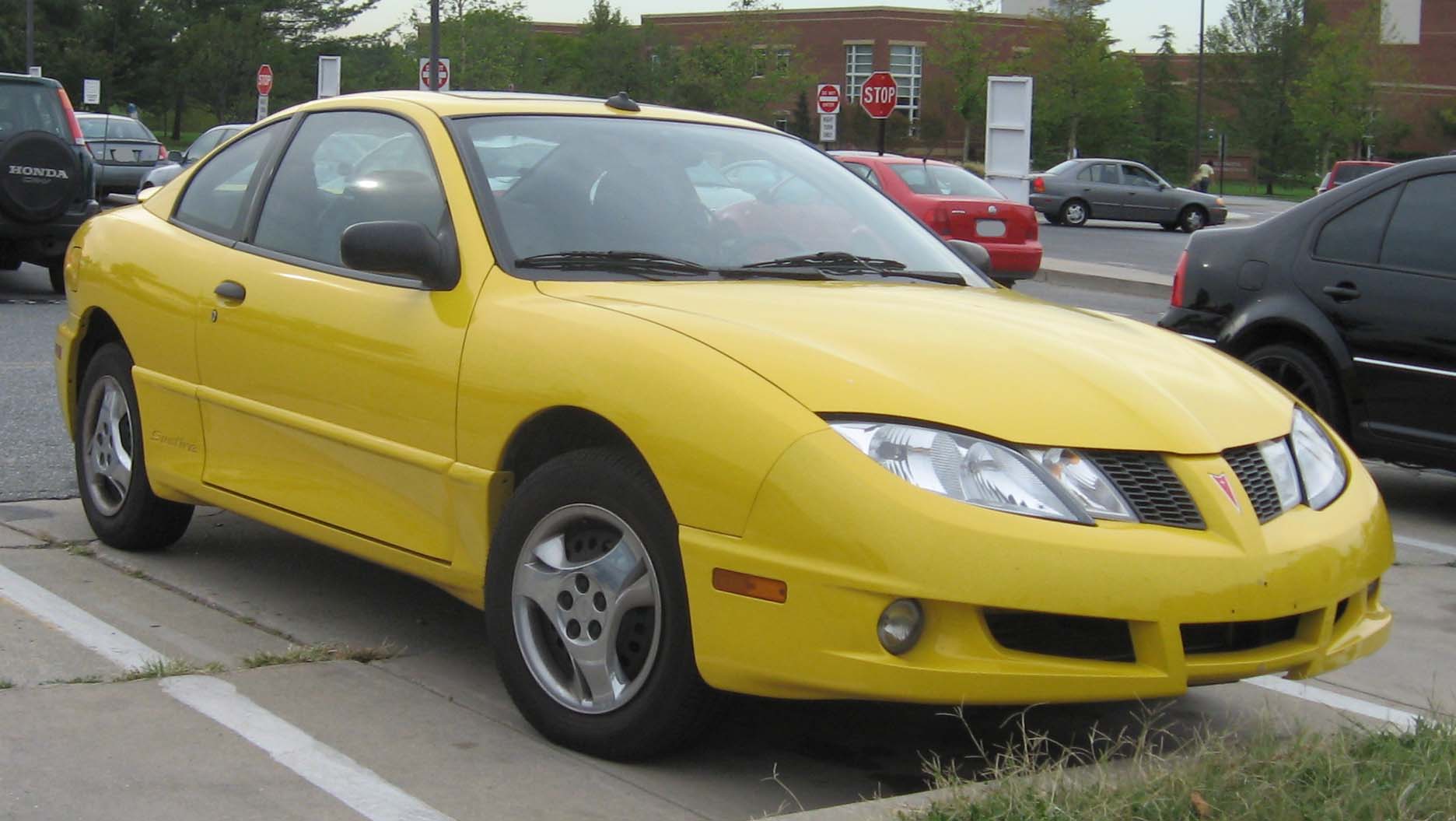
There was a car called a Sunfire in Pontiac. It was a four door small compact car.
Again, we had rich and well priced it right. And we can do a good job there. There was trucks.
We said, you know, young men would love to be in trucks. Everyone says, no, nobody buys those
singles, you know, without the extended cab or without the cab itself. And, you know,
we bought single and we sold them and we did good because it's pricing and things.
And it's selling the excitement, the sizzle and then the service and the experience.
And I think when people walked in our stores, they knew that we appreciated them.
We knew that the dealers were in, that the partners were in, and there wasn't a time that
we need to advertise. There's, you know, there's never a day that one of us is not here.
So we worked Saturdays, you know, we worked here late nights. And all those things offer
you the opportunity to separate yourself from someone else. You can buy a car,
it's a commodity from A, B, C or D. Why buy it from me? And what we offered was
something different than I think that somebody else wasn't prepared at that time.
And that's the dealers are always in.
You mentioned the need for growth or how you view it. And I would say something similar where it's
like, are you working in the business or on the business? I think that's the way I tend to
look at it. Do you think that we're heading to a world where single point dealerships,
right, just single point, I mean, non groups are going to disappear? Like you think
with all the at the rate of change that we're experiencing, right? Are they just going to be
incredibly disadvantaged to the point where they're going to sell out? What's your prediction or take
on that? No, I think they'll be around. I think that there's going to be a lot of multiple
chances for them in rural areas. I think they'll be around in areas that are smaller.
I think they'll be around. And even in big cities, they'll be around. If it's a single point
that you want to pass on to your son or your daughter and vice versa, their costs
is completely different because by that time, that store is paid for. By that time, the mortgage is
paid for. By that time, the rent is much lower so that they can be around, they can exist,
they can operate. It was just different the way that I was thinking. I always had the idea,
the desire, the drive to want to grow the company. I had the desire to represent
the best brands that I felt. And I never represented a brand that I didn't believe in.
I never represented a brand that I felt, listen, I can't, I got to be able to sell it to
my sisters. I got to be able to sell it to my family. I got to be able to sell it to my friends.
And if I can't do that, then I don't want to represent this.
They don't need a car. They call it Mario. So tell me, let's fast-forward. I mean,
this was 24 years ago, roughly. You're still very acquisitive. You made a couple of recent
acquisitions. We'll chat about it shortly. What's the biggest material weakness you're
seeing in dealership environments today? As you're looking at new opportunities,
what are you seeing out there? I think it's getting more complex. It's getting more
competitive. You have a shrinkage in margins. You have a compression. You have pressure.
And all those things create problems. So if you said to yourself, if someone started it in
the middle of COVID, they were writing a place, it's a high that they never had seen before,
and a high they may never experience it again. So then you think business is going to be like
this forever. And when it stops, the train stops, you don't know what to do. And those are
the times when you got to roll your sleeve and you got to go back to work in different ways.
And I think every day you got to look at the business differently. I think every day you
have to take a look at what is changing and how do I change with it? How do I adapt?
And then how can I be proactive? Because if you can be proactive,
then you're taking the actions and not having to react to everything. So I think
those are important things we're doing. What separates I think a good business from another
business? The people. People still are the stars. It's important to hire the right people.
It's important to have a great team. It's important to have a great culture.
It's important to train. It's important to educate them. It's important to treat them
with respect, dignity. It's important to be able to have them see an opportunity for growth.
It's important for them to say, you know, I want to work in this company.
Why do I want to work for this company? And what are the benefits of working in this
company? All of those things are imperative for us. You know, when I tell them, I said,
you know, take a piece of the mission statement and read it every day in your daily
huddles. And why? Because I think it's critical that they understand that mission statement,
that they understand what we want to do, that they understand what we're all about.
So I think that today the changes are dynamic, but not so much if someone wants to stay active
and involve in their business the right way. And what's your model in general? I mean,
you are your, your large group with, I mean, I don't, you can tell me exact number of stores
here. I don't want to make a mistake here, but are you decentralized, centralized? Like,
what's a day in the life of a Mercado auto group in general?
So, so, so I would tell you that we were more decentralized, but now we've tried to
centralize certain things because you want to make sure you have the same controls in
place and is one thing. But the next part that you want is you want 29 locations.
By the way, there we go. Don't want to make a mistake. 29 locations to be specific.
All right, so go ahead. You got it. In five states.
In five states. And let's not forget, wait, 16 brands. I like it. So go ahead. So you were saying
we had always tried to give a lot of autonomy to a general manager and we still do,
but at the same time, you have to centralize some things so you can better control,
so you can better handle, and you can let them be more focused on what needs to be done on
their side. So if I had to tell you that the HR today is much more centralized, that if I
had to tell you the back office is more centralized, if I had to tell you today that
when it comes to buying the insurance, the medical, all those things, those are more
centralized today that are there for us. We try to bring, I bring our entire team,
our general managers, our controller, trying to make them work together and work closer
with our CFO, with our in-house council, with our partners, all of them. We take them on a
quarterly basis. We have a quarterly meeting. So we take them for 14 days. I take out
every year that I adjust for them. We go from a Sunday through a Wednesday
and we do it every quarter. It's to review the quarter, it's to review where we're at,
it's to review the word forecasting, but it's also how do we grow? What do we grow?
How do we do certain things? Here's the vision and work close with that. Those are all things
that I think are imperative to be able to do. How do you enhance your culture?
What are the things that you're finding today that are more difficult,
that you want to be able to change it? How can we go better to change it?
And there's a tremendous power when you can have, if you decide to have a company
and grow it this way, we have 1905 employees today. It's important for us to be able to grow it
and have a collaboration among the general managers, because those are the ones that are
the leaders. And I want them to have a servant heart. I want them to understand that they
are a connolly responsible today for their own stores. And in those stores,
let's say you have 100 employees next door. Think about that times four,
because four people per household, now you're in town over 400 people. So the decisions you make
are going to affect 400 people. And then the next part I try to teach him, I said,
let's do things from a ripple standpoint. When you're a GM, or in my case, you got to have ripple
effects. You can't be a splash. You have a splash that you shake these up. But in doing so,
what are the advantages that we can do and how do we do it better?
This episode was brought to you by Widewell, making reputation management effortless. If
you've tried things like bonuses or QR codes to get more reviews at your dealership and still feel
stuck, you're not alone. These tactics often fall flat. But that's where Widewell comes in.
Their platform automates the review process by integrating directly with your DMS. No manual
follow up needed. And every review is handled by their expert US based response team. So each
review gets a customer response in less than 24 hours. One real insights instead of guesswork,
with voice of the customer analytics, Widewell uses AI to turn raw customer feedback into
clear operational insights. So you know exactly what to fix and where to focus.
And here's a special offer just for CDG listeners. Get three months of review response services
free when you purchase the Widewell platform that's three months free. So go to widewell.com
slash CDG to book a demo. That's W-I-D-E-W-A-I-L.com slash CDG or click the link in the show
notes below. So speaking of growth, what is your, what do you say is your philosophy?
As you think about additional acquisitions, are you looking at brands? Are you looking at regions?
Are you looking at just anywhere but underperforming? What's your model?
No, our model is a little different. Our model is a model that I looked at back in,
hey, built it back in 1999. It was a model and I'm happy to share a little bit here.
It's a model that said this, what separates me from someone else? I'm an immigrant.
I'm Hispanic. I was born in Cuba. So what's the growing demographics in America? Hispanics.
Where is it growing? And what is it like? So in 1999, there was an article that said
by 2040, 2045, that becomes the majority. So I said, okay, that can be an interesting thing.
No one's ever taking public, Hispanic auto, auto group. Not that we're taking it
because I always said if I wanted to go, I wanted to have the flexibility to have
more options of me either to go public with that or if my family wants to stay with it,
then it stays private with my sons so they can move it as long as they learn and want to
be in this business. So hey, I wanted those two things to always be an availability to me.
And that's what I'm trying to do. How did I grow it? For us, it's Miami. That's what we want to be.
Next is Fort Lauderdale. Next for us, Orlando. Next for us is in Tampa. Jacksonville. Move West.
Like to be in Texas. Like to be in San Antonio. Like to be in Dallas. Like to be in Houston.
I also like the border town. So I like McAllen. I like FAR. I like Brownsville.
And people would say, Mario, why? I said, you'd be surprised how good the credit works there.
And you know why? Because people who buy a car there, the car is a necessity.
Absolute necessity because they go to work in that car and that car gets them to work every
single day so they can make and they can send money across the border to keep their families.
It's more important than anything else. Incredible. Their performance does much better. If you
took a look, if you were able to talk to Toyota Credit, if you ever talked to Honda Credit,
talked to GM, they would tell you how good their credit works in those areas. Those people,
it's a necessity. So it's more important to do that. It's not a want to have. It's a need to have.
Yeah. So from there, I like to go to New Mexico, New Albuquerque, go to Tucson,
go to Scottsdale. Oh, so you're legitimately outside of Florida. You're looking for pockets.
Yeah, yeah. I'm looking at areas that we can go that I think we can grow.
And then I look at California. I always wanted to be in California. So we're in Orange County,
which is great to be there. But I like Carlsbad and I like San Diego also as well. And then the
I-75 corridor, I go to Chicago. That's a natural for me. I grew up there, but in Chicago, it's
the largest Hispanics in the entire Midwest. And then you go up the I-95 corridor, New York
and New Jersey. Again, another large. So our only anomaly is, you would say Virginia.
But I love Virginia because it's next to Washington, DC. And I go to Washington, DC
often. And it's important for me. So it's, I think what we have and where we want to fill
in and what we want to do is really important. Wow. You piqued my interest. As someone who's
attempted to scale a large retailer focused on a niche, I think that's something that I
never even considered. What I think many have considered and no one has executed on
was a retailer that's focused on women, which I think is still has a big opportunity.
But this is another incredible idea and niche, which you've clearly executed on.
So I am curious, if I was a public markets investor, like a PE company, and I was underwriting
this, where I understand the thesis, but how are you driving or are you driving incremental
value? What are you doing by going to these pockets? What is different about your business
that is able to generate a better return than maybe someone who does not specialize in this
market? Is it marketing led? Is it operationally led? Are you doing something materially different
throughout the customer experience that is actually generating a better return than
someone else will? So I don't know what anybody else is doing in certain markets. I can only
tell you what we're doing in those markets. I try to study, but I'd rather put my energy
and effort on what I can influence versus what concerns me. What concerns me, it'll give
me some ideas, but what I can influence really makes the difference. So here's,
certainly we're going to measure the KPI, certainly we're going to create our own KPI,
certainly we're going to do certain things. You touch them on something gender. I would tell you,
I would challenge many stores, they don't have as many women as we do in South Florida working
for us. We have a lot of women in the sales. We have women in management and we look forward
to having our first general manager woman also as well. And we do things that are a little
different than other people do in that aspect there, because it's all at the end of the
day. What I want to measure is performance and results. Here are the guide rules, here are the
parameters you have to work with, but we can grow at that and we've been very successful in doing that
all throughout. Margens are important. You have to maintain. If you don't respect yourself and the
margin you need to have, then you won't be able to operate the right way and if you can't
operate the right way, then you can't take care of the customer the right way. I always
try to share, if you go take a look at a great company, if you take a look at Honda,
you take a look at Toyota, you take a look at Mercedes, you take a look at BMW,
you take a look at all these great companies, you've got to be able to make X dollars so you
can go and invest those dollars. If you want to deliver the experience you want these customers
to have and to deserve that's your clientele, then you've got to be able to do those things.
If you don't do it, you miss out. So it's important there are people. What's the culture
you want to have? What's the experience you want to have? I think if you're not talking
about that, if you're not building that, if you're not driving that, you miss out.
Let me tell you a story. So the other day I went to the buy a tuxedo. So fun fact, I'm still wearing
the tuxedo for my wedding. So it was a time, I said, I got to upgrade. Now you're getting
invited to some events, you want to look good. So I went to buy a tuxedo, which is a rare event
for me. And nonetheless, someone saw me at the store. He's like, hey, Josie, a car
dealership guy, which by the way doesn't happen often. So I was like, pretty cool.
Like, oh, what's up, man? I say, hey, love your stuff. And he works at a local marketing
agency. You probably heard of them called Stream. They're very close to me like 30 minutes away.
Anyway, so he said, Josie, I have a request for you. I said, what's up? Talk to me.
He said, I would love for you to talk a little bit about marketing to the Latin and Hispanic
community. By the way, I'm totally like, I swear, God, this is a real story. And I said, okay.
I said, that's a good, that's good feedback. You're right. I haven't
chatted about that. And then I went to thinking I said, who can I ask about this?
And then we had this podcast schedule. So I said, of course I'm going to ask you
about this. So my question to you with that long lead up is what is, what's different? Like,
what is, what can you tell us about marketing to the Latin and Hispanic community, which is clearly
what your business is built on in a big way, right? What is different about it? What should
we know? Like, demystify that for me a little bit. All right. These are what I say to you,
is this, I think we're more family than anything else. And I think when we do business with
them, it's all about family. And I think it's kind of the way we were brought up,
what we're doing at the kitchen table, we're eating it, but we're also doing our homework.
And I think when, when I go sit down with someone or talk to them, or if Alex does or Rick does,
I think that means a big difference to people like that, that you can, when you get my card,
you get my cell number, you get my direct. It's very warm. Very warm.
That we care that we're involved. That's just the way it is. It's a, you know,
I remember growing up, I would, something that would always bother me. I had friends that
says, no, when I'm 18, you know, I got to leave the house because they forced me to
leave the house. I don't think my mom ever wanted me to leave the house.
That was never, never a thought. And certainly later on, when I became a parent, I never
thought about my, my kids leaving the house. So, so I think that's just something that's
we're brought up with. I think it's something that's part about who we are. I think I,
I get a kick. We'll go to the store here and we're delivering someone. Let's say it's,
it's a big deal when you're buying your first new car. They'll bring a lauelita.
They'll bring the grandpaves there. They'll bring the cousins there. They'll bring all the
other things. And I think all those things make a big difference. And I think at the very end,
what they, what they want the most and what they need the most is they can, they have someone
they can relate to and something that's being authentic. And I think authenticity works with
everything, but I think it even works a little more with the Hispanic.
Incredible. And does that, tactically speaking, does this permeate into your
advertising, like the language you use, not like the actual Spanish for Singlish,
but the, the type of phrases you use, the type of marketing in general, right? Like we see a lot
of deal oriented stuff, right? $99 or whatever, $500, whatever. I'm clearly not 99, but $500 a month,
like does that permeate into your advertising in a different way? Sure.
It's permeated more and maybe less in different times. I think today the digital world
does things where it even allows then your people to create their own brand or sub-brand,
let's say, within your company to go do that. So if you're a young woman,
that's been here for four or five years, she's already has a clientele base,
let's say, if she's here four years, 500, 600, 700 customers already there.
And that is her own brand. And she really doesn't even work anymore, really taking any ups
or any new customers she's building off the customer base she has. She's got a book.
Right. And then she's, and then she's talking to her friends and said,
Hey, do you know anyone here? And then she'll post something on Instagram that says,
look, we got this new special. We have this car now. It's a Mazda CX-7. They got
this hybrid boom and she'll get her own business that way. Same thing for the guys. I think
that's a neat thing that develops, but I think the store also needs to have that.
I think we try sometimes too many things. I think I always tell people, I said, look,
you can't be everything. You can't be a jack-of-all-trades. You got to be more specific.
If you're more specific, you're going to go win and you'll win over the long haul. You'll
do more because if they understand you, if they see you and they see your face and they
trust your face and they know you and you've been around, they'll trust you more.
And I think that's an important part that sometimes we want to change.
And we want to change because the industry changes so fast and things are changing so fast,
we want to try the latest things. And now you have the component of AI and what is AI going
to do? Look, AI can help you write the descriptions you want. AI can help you
do a lot of different things, but at the end of the day and it can help you with the pictures
and it can help you with the setup and it can help you with the video, I said,
but there's got to be a human element to it there. It's not that easy. It's not a jukebox
where you can drop the dollar and press the button that comes out. So don't miss out. Utilize
that tool to help you, to facilitate for you, to help you do things quicker, faster, better,
accuracy, all of that, but still it's the individuals. And don't forget that.
Wow. Especially with a group like yours, with the emphasis you put on this culture,
it seems like it goes against in a way, right? To have, like you said, the human aspect that
the robot chatting with a person doesn't feel like it's like second nature or something in your group.
Yeah. No, it's, you know, will it be component to that in the future? I'm sure there will be.
Will there be things they will do more than that? Yeah, because the evolution of the business
takes you there. Of course. It'll be. You've got to keep progressing, yeah.
You know, when Roaster came out, I remember we were there, but at the end of the day,
does it deliver the way you want? No, it doesn't yet. But eventually I can see somebody who
wants to be up at one in the morning doing everything at one o'clock in the morning.
So it's, the store's not open at one o'clock in the morning, but they're doing that at one in
the morning. I had Alan Hague on the podcast, advice advisor, and he mentioned ice raids
impacting South Florida dealerships. Have you noticed an impact on that for that?
Look, I think like everything right now, yes, it has impacted it. We had a Friday here,
we were lost 24 employees. Wow. We had a month ago, we had, I think we had
31 or 32 vehicles return to us. And these are, these are good people, wonderful people,
honorable people that worked for us, they did a great job for us. And it was sad to see,
because they receive a letter and they lived here for X period of time and had to go and
they had to quit working here. And then the people who returned to cars think about this,
that's someone else could have done something different. They came here, listen, I have to
leave, I'm going to make arrangements to leave. Here's my car back, give it back to Honda Finance
or give it back to GM Finance or give it back to Chase or give it back to whoever. So I think,
I think we don't think about all the things that the ripple effect
with this has. I support what our president does. I support what our local congressmen and
the congresswomen and senators do. But like everything in life, you can go too far.
So I think everyone here would want to have, at least for me, I would say this,
anyone who's a criminal, you don't want them here. And they shouldn't be here. And that
looseness that we had, but you can overblow it. Over swing the pendulum.
Yeah. And I think that's a little bit what's happening right now. But I think it'll get
corrected. It needs to get corrected. And at the end of the day, I think we're just much
better than that. This country's too good. And I'm trusting that the people that are at
the head and that are running, that they're better than that also as well. And they'll
correct that and they'll fix that. This episode is brought to you by Nomad Content Studio.
Many dealerships are still getting social media completely wrong. They either ignore it,
post inventory photos or hand it off to someone on staff with no strategy.
Meanwhile, the dealership down the street is racking up millions of views and turning
those views into real car sales. That's where Nomad Content Studio comes in.
They're the team behind the dealers you actually see online.
Their system trains a videographer, tells you exactly what, who and how to film,
then storyboards, clips, they're all footage and post the content daily across all your
social platforms. They literally do it all for you. They're the same team behind some of the
top dealerships and biggest automotive influencers today. I believe in them so much that I even
personally invested in them. If you want your dealership to be next, head to trynomad.co
that's trynomad.co to book a call or click the link in the show notes below.
On that Friday when that happened, I mean, what goes through your mind at that moment?
It's sad. It's sad. It's sad. And it's how can you help them? And I've helped before.
What attorneys can do certain things? What attorneys can't do? But at the end of the day,
it's a sad day. Look, I have always been a supporter of the dreamers. And the dreamers
are kids that came more or less my age. So if you came here to this country and you're
four years old or five years old, all you know is this country. That's all you know.
It's not somewhere else where you came from, where you're born. All you know is here.
And if you've done good in school and if you were tired in school and you've gone out of college
and you're finishing college, you're going to be someone that's going to be, I think,
successful. You're going to be successful in society. You're going to pay your taxes.
You're going to grow in this. So I hate losing that. And I especially hate someone
that has an education that's prepared himself, certain things. So I care a lot about that.
It's for me, it's important. I think the point you bring up is that things are
nuanced and being in the media business and personally having tweeted 30,000 times in the
last three and a half years, I can tell you that what gets the most attention are very
binary black and white opinions, thoughts, discourse. A nuanced sober perspective does not
travel as far as a very star kind of one-sided. And so the problem with that is it polarizes
opinions and discourse. And I'm giving a more macro first take on what's happening.
But I think that's you. You just said it yourself. You're like, on one hand,
I support the president. On the other hand, I don't support the way this is happening.
So that's a nuanced perspective, which I think people can appreciate.
And you don't see that every day. It's very like one-sided. And I think that creates issues,
just like what you describe. Yeah. Look, and I think about that very much. And I say to myself,
hey, I try to be involved in our politics. I try to elect the best person that I think can do it.
I try to elect things. I very much want to give people who serve in our military
much more of a chance. I take a look at this country. And I say to myself,
if you take a look at through growth and everything else, I think those that served in
our military did a much better job. Why? Because it wasn't are they red or are they blue?
It wasn't about Republican or Democrat. It's about a patch here that says USA. It's a flag.
And it's like, you can have your ideologies. You can have your thoughts. You can have
your own opinions. But then you know what? Because you served. You learn how to collaborate.
You learn how to talk. You learn how to discuss things. And you and I can have
different opinions. But if we have a conversation about it, we'll respect each other
through those different opinions. And we'll probably look for what we have more common
than what we have less common with. And other folks aren't that. I hate to say we have today
more attorneys and they're taught in life to put things in silos. And when you do that,
that creates a problem. And it's not about your voice being bigger than mine or my voice
being bigger than yours. At the end of the day, it's about rolling our sleeves. Hey, listen,
we have a problem. How do we best address it? What's the best solution for me to do?
No one has fixed it. The Republicans haven't fixed it. The Democrats haven't fixed it
over time. Certainly what we were doing the last three years wasn't good.
But I certainly want to make sure that we do a better job than what we're doing today.
Did you think you're going to go public one day?
No. My son loves the business. My son enjoys the business. He's been 18 years. He's been well
trained. If you talked to him, he would tell you, listen, I'm not easy. And Alex has worked
hard with him. Rick has worked hard with him. So he's prepared. He's prepared for the next
step. So I feel very, very good that this will be a family business that will continue
in perpetuity. And I'm happy about that. Do you see yourself turning the dial down and maybe
getting to some other things? Are you Murgado for the next 20, 30 years?
So I don't think I'll retire ever because I never thought about that. And I've never,
when people would ask me at a younger age, what do you think about this? I said,
look, there's you evolve. As long as I am active that I can give and I can help this
company do better, then I want to be here helping and help do better. When I can't,
somebody else should be doing it. When I join a board, I never join a board if I don't have the
desire to be the chairman of it. So I never join a board if I'm not the chairman of it.
Because if I have anything less than the desire to be the chairman of it, guess what?
Then I'm not giving 100%. And I have a fiduciary responsibility when I go work for that board
or to participate in that board to give 100%. And so that's just the way I decide
so here I want to dedicate to do the best I can help where I know I can help,
give where I think I can give. But one day if it's not, then it's not. Do I,
would I like different things that we diverse ourselves in? Sure. I think in our industry
that you need to have different things that you can grow today. We've closed certain ways,
but would it be real estate? Would it be property? Would it be development?
Would it be marketing? Would it be average? All these things are an array of things
that can accompany our business and support our business from transport companies to so many other
things. Have you diversified into anything interesting, non-traditional, other than real estate?
No. Real estate is really what I've done the most for us here. The internet company that we had is
another area that we had done for us early, early, early on. But no, but we're looking now at
development, different things. We're looking at certain things in real estate world to develop
more real estate. But today I find a need for pricing and the pricing of housing has gone
up. So if I can build something that I think can deliver on that need well, that's something
we're exploring really well now. We look and store it to build 250 units there,
250 units where it's for rentals. Where is that at? In store Florida. So for us,
it's north of Palm Beach. In that site, we originally started with 12 acres. We bought
our additional 22 acres. And on that 22 acres, we want to develop really a retail
concept there. So we'll have restaurants, we'll have carwash, different things. But we also
have further development there. And I think it's all part of the business changing and growing.
Incredible. Mario, before we wrap up, this has been just an incredible conversation. I had so
much fun. And I hope you did as well. What's that for our young listeners? What's like one
piece of advice you'd give for, it can be an up and coming GM, a salesperson,
just people that are coming up through the business. What's a word you'd like to pass
on to them? Well, if you allow me, I'd like to give you a couple. So the first one
is be intentional. Be intentional. I think way too often people are doing things and
their intentions aren't there. So be intentional about everything you do. The next one,
never stop learning. Never think that you know it all. Never stop learning. And God gave you
two years. So listen. Oh, I swear to you. And I know I'm cutting you off when you said that.
So it's really ironic. But I was going to add on to that at the end and say,
shut up and listen. That's just unbelievable that we had the same one for the third one.
That's crazy. I'm telling you, I'm sitting here in disbelief right now. I'm about to say it
because you could have said like listen more than you speak, but you said God gave you two years.
So you listen twice as much as you speak. That is just crazy. Wow. I'm blown away right now.
That's a clip right now. We got to clip that. That's too good.
And the most ironic part is that I cut you off right when you said that. You see it
unbelievable. Gotta take my own advice. God gave you two years so you listen twice as much as
you speak. Mario Morgato, Morgato Auto Group. You have an incredible dealership there on 95.
Every time I pass it, I see the massive Morgato on the side. Can only imagine it can't even quantify
the return on investment of that. But that's a good one. Love that. So Mario Morgato.
Please stop one day. We have a good day here. I'll show you.
I will. I know you have, well, before I actually wrap up, let's end on that note.
You built a Cadillac Museum. And so when you initially mentioned Cadillac in the beginning,
I was going to ask you about that. But I said, you know, let's pump the brakes. We'll get to that.
So please tell me about that. Like, what is this museum? How did this come to be?
It's my love for cars. It's my collection of cars over the years. 40 years plus of collecting
cars, saving cars. I have my first Corvette I bought. So it's that important to me. It's
that important to me. And Cadillac to me, it's like something that my father put in my mind.
It said to you, you know, if you ever made it, then you would have a Cadillac. And
blessed to have not only have a Cadillac, but to have a Cadillac dealership and
share that with other folks is really important to me. And it's a 62,000 square foot, you know, store
that it's state-of-the-art. But we also have a museum, so people can come and enjoy.
And you have no idea the events we've done, the events we continue to do,
that people come and see. Because when you look at the past, some of those cars are things that
you dreamed about when you were a kid and you thought about it. And maybe you never had it,
but that's what I try to bring there for them. And that's what I want them to see.
And then I give them a history lesson on Cadillac a little bit. I break it down by decades.
And I remind them of some of their advertising that I have around also as well.
And then I bring the future to them. I show them racing and we're Cadillacs at today and now soon
to be an F1. So those are all things that are important. Very aspirational. Wow. It's so incredible.
I'll definitely come. I have to come check it out. So I'm looking forward to that.
Mario, appreciate you joining us. It's been incredible. Thank you so much.
Thank you. All the best.
All right. Hope you enjoyed that episode. Please give the podcast a rating.
Consider subscribing to the show and check the show notes for links to what we talked about.
Thanks for tuning in. I'll see you guys next time.
About this episode
Mario Murgado, CEO of Murgado Automotive Group, shares his inspiring journey from being a Cuban refugee to building a 29-store automotive empire. He discusses the importance of hard work, customer experience, and community engagement in the car dealership business. Murgado highlights his unique approach to marketing to the Hispanic community and the significance of family values in business. The episode also covers his strategies for growth, the challenges of the current automotive landscape, and his vision for the future of the dealership industry.
Original notes
Today I’m joined by Mario Murgado, CEO of Murgado Automotive Group. We cover Mario’s dramatic escape from communist Cuba, his journey to building a 29-store dealership empire across five states, the growth model fueling expansion into underserved communities, the day he lost 24 employees in a single immigration raid and so much more.
This episode is brought to you by:
1. Lotlinx - Get the best possible market advantage on every vehicle transaction. Optimize operations and boost profits using artificial intelligence (AI) and machine learning. Learn more @ https://lotlinx.com
2. Widewail - Want real insights instead of guesswork? With Voice of the Customer Analytics, Widewail uses AI to turn raw customer feedback into clear operational insights so you know exactly what to fix and where to focus. Go to https://www.widewail.com/cdg to book a demo.
3. Nomad Content Studio - Most dealers still fumble social—posting dry inventory pics or handing it off without a plan. Meanwhile, the store down the street is racking up millions of views and selling / buying cars using video. That’s where Nomad Content Studio comes in. We train your own videographer, direct what to shoot, and handle strategy, to posting, to feedback. Want in with the team behind George Saliba, EV Auto, and top auto groups? Book a call at http://www.trynomad.co
Check out Car Dealership Guy’s stuff:
For dealers:
Industry job board ➤ http://jobs.dealershipguy.com
Dealership recruiting ➤ http://www.cdgrecruiting.com
Fix your dealership’s social media ➤ http://www.trynomad.co
Request to be a podcast guest ➤ http://www.cdgguest.com
For industry vendors:
Advertise with Car Dealership Guy ➤ http://www.cdgpartner.com
Industry job board ➤ http://jobs.dealershipguy.com
Request to be a podcast guest ➤ http://www.cdgguest.com
Topics:
00:19 What sparked your early tech ventures?
03:18 How did immigration shape your journey?
06:38 Returning to Cuba: key reflections?
10:37 Why enter the car business?
15:36 First dealership acquisition story?
24:01 Current dealership market outlook?
27:49 How do decisions impact employees?
34:55 Marketing to Hispanic communities effectively?
45:15 Future business diversification plans?
Car Dealership Guy Socials:
X ➤ x.com/GuyDealership
Instagram ➤ instagram.com/cardealershipguy/
TikTok ➤ tiktok.com/@guydealership
LinkedIn ➤ linkedin.com/company/cardealershipguy
Threads ➤ threads.net/@cardealershipguy
Facebook ➤ facebook.com/profile.php?id=100077402857683
Everything else ➤ dealershipguy.com
Car Dealership Guy Podcast
Car Dealership Guy
0:00
53:22