AI, Trade Agreements and the Economics Behind Mobility with Kristin Dziczek, Senior Policy Advisor for the Federal Reserve Bank of Chicago
The Mobility Table
AI, Trade Agreements and the Economics Behind Mobility with Kristin Dziczek, Senior Policy Advisor for the Federal Reserve Bank of ChicagoThe Mobility Table · Jun 3, 2026
This means AI that doesn’t just run on a computer, but actually controls or helps with real-world machines and processes. In car-making, that could be robots and systems that plan production or respond to what’s happening on the factory floor.
Industrial automation is when factories use machines and computer controls to do tasks with less manual work. In car production, it helps make cars more consistently and can speed up the process.
Automated driving is when a car uses sensors and computers to help with driving tasks. It can range from simple help features to more advanced systems that handle parts of driving for you.
This is how factories decide what parts to order and when to build cars. AI can help plan and schedule so production runs smoothly instead of getting delayed by missing parts or poor timing.
It means making the “parts delivery system” work better. The goal is to get the right materials to the right place at the right time, with fewer delays.
AI is computer software that can learn from information and make decisions. In cars, it helps the car understand what’s happening and respond appropriately.
A software-defined vehicle is a car where software controls many important functions. That can let the car improve over time, but it also means the software has to be secure and trustworthy.
The check engine light is the car telling you it found a problem. It’s usually best to get it checked soon because the issue may get worse if you ignore it.
Cyber security is about keeping the car’s computer systems safe from hackers. As cars rely more on software and connections, security becomes more important.
LIVE
Hello and welcome to the Mobility Table, powered by Gem.
I'm your co-host Bernard Swicky, VP of Mobility and Research at the Detroit Regional Partnership
and at the Global Epicenter of Mobility, or GEM, and I'm joined by my co-host Janine.
Hey there, I am Janine Gantt, the Mobility Engagement Officer for the Global Epicenter
Mobility. We are always excited to bring the Mobility Table to everyone. We're really trying
to create a space where people can learn more about what's happening in the Detroit regions
advanced mobility ecosystem, everything from workforce to suppliers to everything it takes
to support an emerging ecosystem. And you know one of the things that we were talking about is
just the location of a global epicenter mobility. I mean we're Detroit and we actually are right
on the border of Canada and we start thinking about trade and what that looks like and some of
the things that impact that conversation. Yeah and it's clearly a global industry and Detroit,
as the North American center of it, is a border town and we are very much subject to the global
trends of the industry as well as North American trade. And so our guest today is Kristen Gichek
from the US Federal Reserve and she's the Automotive Policy Advisor there. And it's interesting now
to explore these intersections of global and national trends on this border town of Detroit.
And we're going to get into some of those things especially when it comes to trade because
the things that are going to get made in Detroit, you know a lot of that decision making comes from
what's happening globally and continentally at that trade level. You know and of course there
are other things Kristen's done some great work on AI recently. Oh absolutely I can't wait to hear
more about that. You know it's really interesting because since I've been doing this work we've
actually held a couple meetings you know at the Federal Reserve and I always thought this is
kind of weird. Like why are we at the Federal Reserve? Like what does this mean for our work?
How does it impact the work of the global epicenter mobility? So I think it's going to be really
interesting to have a conversation with her just to get a little bit more insight and I remember
I have to caution y'all that we have all kinds of different folks listening so let's make sure
that we are careful about our acronyms and all that kind of stuff. So I'm really looking forward
to learning a little bit more about you know her work. Yeah and frankly as the Automotive Policy
Advisor the automotive industry has always been critical in terms of jobs and employment but
also technological leadership. And now as vehicles become so much more sophisticated as they touch
more technologies and sort of adjacent fields these things are that much more intertwined and
that much more important. So I think it's going to be kind of a complex but a really fascinating
conversation because we get to see how some of these things fit together. Absolutely I was in a
meeting I think it was last year and Kristen spoke and presented it was actually a workforce
development like a statewide workforce development conversation as we really think about where the
opportunities are going to be for folks in the Detroit region around jobs related to EV
and other types of advanced mobility. And I found her insight really interesting right because that's
the information that's going to help us really figure out how we move forward where the opportunities
are and so forth. So I'm really looking forward to hearing from her today. And that's the perfect
note on which to introduce our guests. We'll be joined by Kristen Gichek, Senior Automotive Policy
Advisor to the U.S. Federal Reserve. Welcome Kristen. Thanks for having me. Thank you for
joining us. So I've got questions that I just need to read this question as we start off just so I
can get it right because I want to make sure that we are introducing yourself and your work in a way
that can kind of couch the conversation. But can you tell us a little bit why the U.S. Federal
Reserve Bank of Chicago in Detroit has an interest in understanding the automotive and mobility sector?
Well you know I get this question a lot. I go to conferences or events and I've actually
one was very instilled in my mind that people next to me were whispering there's somebody
from the Federal Reserve here. Why are they here? And I said I turned to them I was a battery
conference and I said so is what you're doing affecting the economy? And they said oh yeah like
well that's why. We have to keep we have people in Washington at the board of governors of the
Federal Reserve who look at industrials forecasting and sales and you know that sort of thing about
like the overall economy. But automotive and mobility is about five percent of the GDP and
it's changing a lot. So you know I keep an eye on everything from you know technologies and you
know different shifts in production and models, labor contracts, trade deals, AI and how it's
impacting all aspects of the industry. You know just about everything affordability, insurance,
you know what is happening in automotive that's affecting our economy and people in our region.
So I work at the Federal Reserve Bank of Chicago in the Detroit branch because that's where the
auto industry is. But Chicago is really the home of the auto industry in our system. There are 12
reserve banks and we're sort of auto central and we have majority of the production,
plants and that's why we get the home of the automotive advisor for the Fed. And Kristen
increasingly the crosswalks from automotive to not just other mobility sectors are stronger than
ever but also to other parts of the economy. So you know I'm thinking AI, cybersecurity you know
that is used throughout you know whether we're talking retail medical you name it. So I think
that maybe hopefully that makes the automotive and mobility sector even more noticeable in terms
of its impact on the economy. It is and you know one of the first things I do at the
Fed, I have an annual conference it's in February if I can make a little plug. I have attended and
I heartily recommend. Yeah so first week in February we have the automotive insight symposium.
All of our sessions are up on the web so if I have reference anything to that you can go look at
chicagofed.org and look them up. But one of the things I did this year was about automation and
AI and the confluence of physical AI. The very first industrial automation was in the auto industry
in 1963 I think. So we talked a lot about that. We also talked about the very first physical AI.
The AI that was in a was an automation was 1966. So this stuff has been around. 1966. 1966. That was
the year I was born interesting. Well cool. There's things that go back a long way. So that was you
know invented at Stanford and you know the auto industry these days has really embraced AI in many
many aspects not just in things that you might think about like the you know automated driving and
that sort of thing but in purchasing and planning and scheduling manufacturing making sure the
welds are good you know and material handling and engineering and engineering changes and
on board vehicle diagnostics like all kinds of things that AI is very useful for and
you know this is a very technical industry and it's really embraced technology. Are there any
areas with with with AI that you've seen that you think are the most beneficial to the mobility
industry? Well I think they're all pretty interesting and you know productivity is going to have
you know this is all going to have some big impacts on productivity potentially labor as well
we're not quite sure how that sorts out yet. It also plays into trade you know some of the things
that we're talking about that you guys set up about the trade agreements is you know what is
built here what isn't built here and what is built here if we're reshoring things from lower cost
countries are often going to be more highly automated more use of AI and bringing things back
so that we can still afford to buy cars. Yeah curious about AI in the work that you've done
where are sort of the are there low hanging fruit and what I'm really curious about for example
there is so much made of the competitive position of China in automotive these days
can we maybe use AI to get us a little bit of a competitive edge on global competition?
Well I don't know that I can say much about how it affects us competitively in the competition
and the globe but you know there's let's let's just kind of break it down so we think about
automation and AI in use in the factory. Okay so that I think for many people is really clear
like you can we have tons of data this is an industry that's been producing data on what we
do in manufacturing forever if we have good data you can feed this to AI and you can start to make
decisions from that data so manufacturing makes a ton of sense the use in the engineering and
development and product development side I think it's a little newer but it's really very promising
and you know some of it is you know taking some of the load off of engineers who you know you do
this thing and then you have to go document it or you know just taking that kind of load.
Supply chain it I think that makes some intuitive sense too like it's a very complex system a network
of you know where are you going to get things and if this thing is I always I'm amazed by supply
chain people in our industry that we can get 30,000 parts to one place at one time and assemble
something that people buy and use for 2030 I mean how old your oldest car burner?
Right now 2019 so not that old. Not that old yeah but you've had older I know. I've had older
and I've been around really old and yeah and they're always amazing in terms of the complexity
that goes into it and you know sometimes I think if we had to make these in lower volume each vehicle
would cost maybe a million dollars right it's the volume that's enabled by that supply chain
is what makes these vehicles actual consumer products. I remember a meeting you and I attended
and it was a company was presenting a product that they'd just come out with and like usually this
guy said you know people will come up to him say oh can you get me a car at cost he said I'd be happy
to sell you this one at cost because it was a brand new technology thing and they were
like oh can you get a cost was probably a 100000 unit and he was very happy to give you
that discount discount. Yes no but that plays into so many things you know for example we talk about
battery electric vehicles and some of the new technologies and we get into some of those supply
chain issues around you know we need higher volumes to make them affordable however the volumes are
harder to find and so that AI optimized supply chain can be one of the tools that actually
brings those things to market. Well and think about I mean like right now we're in the midst of
a massive disruption of petrochemicals and oil and it's not really affecting our supply
chain here in North America very much yet but there are some things like we don't make everything
in North America that we need to make cars we just don't and there are some places that we
rely on in Europe and Asia and you know even Morocco other places in the world where they're
having government enforced energy conservation measures and there's very highly energy intensive
processes taking place in those countries think about a paint shop that has to be up and running
all the time because taking a paint shop down and back up again is just really disruptive and
hard to calibrate so supply chain managers are like okay well I can get the part but I can't
have it heat treated coated painted you know any of these intensive energy intensive things so where
else can I move that or you know we had a big automaker a few years ago had a fire in a supplier
and like oh well we now need to get the largest plane in the world to take our dies from here
to this other country where they have some capacity like AI is really playing a huge role in supply
chain optimization supply chain you know contingencies and you know there's always things going wrong
in the supply chain you know there's bankruptcies there's traffic there's weather there's fires
there's all kinds of things going wrong geopolitics is the big one now but you know that's a really
big role for AI and then I'd like to take it back to you know so I've got engineering I've got
manufacturing driving which is a huge thing automated driving relies a lot on artificial
intelligence and the software defined vehicle but the onboard diagnostics too
right now your car will throw a light at check engine light and boy you better get that checked
out pretty quick because that meaning that it tripped that is like you don't have much time
before you have a problem but AI in your systems can be looking at oh this is starting to trend out
of spec this is going to trip that you know so right now it's a real hard like this condition
trips the light and AI can be monitoring all of your systems and say this is starting to get not
good and maybe you should go see a dealer yeah and it may come down to this is not doing so well
would you like us to make an appointment for you we can order the parts and it can be ready and you
know like you just make it very seamless for the owner are there any cautionary elements that we
should be mindful of as we think about AI well I think from the industry standpoint like the
things that I think about are underlying all of those different areas is data and data storage
data security you know you need your data centers for this too and then you need people and you know
that's a tough salary now too is like those people are in high demand so I think you know our
limitations are really on how quickly the base infrastructure which is shared across all of those
areas and the people to to implement these changes and you know cyber security is always a big
concern being and having really good data that you can trust the decisions that are made from that
data also big I think there still seems to be a lot of hesitancy yeah for folks around AI adoption
and how it works within processes and people's level of comfortability with it but it's here
honestly it absolutely is did you see there was a Wall Street Journal article the other day that
the guy had talked tried out having AI run his investment portfolio and he's like it's really
good but it's like having a really good research assistant who also uses a lot of marijuana
like you gotta check it you gotta like great ideas great things but you really still need
intervention and human intelligence on top of it what makes me worry about that is I have a young
kid who doesn't have necessarily those years of experience to to kind of know when it's right
or not and so like how do we bring the next generation into the workforce when you know
what the workforce is doing is monitoring AI and bringing our years of experience and we know that's
to somebody who doesn't have that yet the the feel for it yeah because you develop the feel
by doing the the raw work on the actual numbers or whatever it is and yeah that hunch well when
we did workforce development stuff you know I remember it was a big division between certain
automakers who like had people do quality charts pencil and paper and others who wanted you to have
the best software like you have to be on you know the 4.3.2 version of the software and
knowing how to do it by hand means you can use any software and you understand what it's doing
so like that's a real you know getting back to in in Germany when you get an apprenticeship
and printing you learn the Gutenberg press you know you're never going to run a Gutenberg sometimes
you make your own tools right before you use them and it gives you that foundation which I agree
in some cases I'd be concerned about the data equivalent or the engineering equivalent of
maybe being missing yeah it's something that you know it works now because you've got experienced
people but what does yeah honestly I've heard that Gen X honestly are the best folks to really
leverage um their thinking their experience in terms of how do you use AI because again we've
done the work I mean what Google knows of anything Gen X I'm looking at you like we're both Gen X I
don't know but I'm Gen X but that we created it I mean everything you know like we we created
the frameworks we created a lot of the thinking that people now use as oh let me google that yes
we created that so the idea of having folks like us that have that experience really behind how do
you leverage AI I think is is critical so yeah no and Kristen I'm going to segue
just a little bit here because in our conversation so far we've talked to you know in addition to AI
about supply chains and some of the global dynamics and on that front we have in 2026
maybe the most definitive development affecting automotive being the renegotiation of the US
Mexico Canada free trade agreement or you know it's USMCA to us it's Kazma in Canada they put the
the C first and T Mac in Mexico and T Mac in Mexico right but um it has such a defining
characteristic in terms of its impact on these three countries and as Janine mentioned Detroit's
a border border town so in addition to all the automotive work we're also very much a part of
that global dynamic so last time we did this automotive was an enormous part because this is
an economy wide agreement and automotive because of its importance to the economy played such a huge
role and I'm curious do you have thoughts do you think automotive will be as big of a factor in
this year's renegotiation as it was last time around absolutely so first of all I want to be
careful it's not a renegotiation um so the USMCA was created and went into effect in
the middle of 2020 great time to do anything because like for data purposes like lots of other
things were happening in 2020 so when you're looking at this for comparisons like oh you've
got to overlay the play you know the pandemic and the supply chain issues isolating impact it's very
very difficult um what is happening now is so that agreement had a six-year review clause
and it was supposed to be you know come to the table and see like you know what's working what's
not what can we tweak there's some things like the the USMCA is based on a current version or
what was current at the time of the trade codes I won't get into acronyms but the codes that we
used to measure trade and those codes got updated after the agreement went into effect and the
previous codes don't have electric trucks in them for example so the new agreement would have to be
updated to you know use the latest nomenclature for trade um it might be you know the one of the
whole reasons for having a new trade agreement was it had um kind of uh aged and so there were
things in in our core parts lists that were like eight-track tape players and distributor caps and
stuff like that that you know we didn't have in cars anymore really maybe we'll get those back I
don't know the new generation's pretty retro um but uh you know it was to modernize the agreement
and to keep it modern so the six-year touch base is about what's going right what's what's not
it's turning into what might be a renegotiation um and they are supposed to um convene this review
it's actually it's it's article 34.7 if you want to look it up in the agreement um it's rather vague
about what the review means so um it's supposed to be done by July 1st and we've already heard from
the U.S. Trade Representative Jamison Greer it's not likely to be done by July 1st um and if it's
not done then we go into year by year extensions for 10 years um and that creates a lot of uncertainty
year by year extension for 10 years yeah a lot of uncertainty now there's one outcome there's
many other outcomes that could happen um you know we could get a deal sometime after July 1st
and say you know we're not going to do this year by year thing we've you know extended the period
or something like I said this 34.7 is pretty vague um so there's a lot of things so the
Center for Strategic and International Studies had a nice list of the six potential outcomes I'm
going to use their list so they can renew that's perfect you're you're getting to the
next question on your own so we're just going to let you roll because that's perfect they can renew
we can have what they call painful extensions um we can have a series of annual reviews reviews the
six year you know every year for 10 years it'll expire in 2036 in that case um we could have
bilateral deals you know one with Canada one with Mexico or we could withdraw
and they're putting the the emphasis of like the most likely I was the series of annual reviews
like that that's probably the thing that's going to happen now I can't prognosticate
like that but they can so I'm going to point to them um but there's a that's the whole set of
you know what could happen it's probably going to be pretty contentious there's already been
serious level talks with Mexico um that get very complicated um not a lot of talking with Canada
yet so I don't know what is it I don't want to like you know we're pretty early in the year like
we got a few weeks yet but um getting something done by July 1st is going to be tough so not
a renegotiation but a review that's really vague and undefined got it got it no and
you know to bring this back to the Detroit region you know we are used to the any automotive
industry having really long lead times for decision factors I didn't answer your question
by all means about like how big of a deal or automotive is it is a an economy wide agreement
so there's softwood lumber there's phytosanitary about you know trade with animals and plants and
oil and all that auto is 22 percent of the trade of the volume of trade auto is the biggest
that's a powerful statistic the biggest part of us mca so a lot of attention on auto and a huge
impact and you know going back to to my question in automotive we're used to needing our information
as early as possible because the decisions take a long time then the product development takes
a long time then your return on investment takes a long time to materialize so in the
Detroit region where we have companies that need the greatest possible level of certainty among
these things how does that challenge come home to roost what can we do to maybe well and that's
maybe not a fair question yeah but what does it look like in terms of its impact on the Detroit
region where we know that that's the environment that's really the most conducive to success well
I'll just say that I worked on a roundtable event a couple of weeks ago and it was one of these
things about thinking about the certainty for timelines for investment for different things
related to AI and EVs and everything else and one of the participants came back from their little
huddle and to the main group itself if I just knew what the weather tomorrow was going to be
you know that would be good like we used to want this this industry wanted certainty for you know
10 years or you know thinking of these long time horizons and I think that the the mentality is
could we get a year or two like you know you may not necessarily be able to know with certainty
what the next 10 years looks like and so many you know moving parts in this system and such a
global industry with you know there's heat treating in some country somewhere
that's not getting done so yeah it's it's really very difficult to do these these sorts of long
term plans yeah well and maybe to tie it back to our previous conversation in that environment of
maybe less certainty and less understanding of what the future holds AI optimized planning might
actually really feed into how we work around some of this environment we're going to have to be
very flexible dynamic and you know roll with punches because there's going to be a lot of
different things that are going to you know like all those poor supply chain managers if there's
any listening I just like you should get the award every year for doing like just you know superhuman
work to get these things done yeah no I remember when we did the analysis on the USMCA initially
being on many panels with automaker and supplier executives feeling very fortunate that I I was
just the guy studying this I don't have to make multi-billion dollar decisions on this information
and it's not an easy job for them to have no it's not and you know they're very Canada and Mexico
are very dependent on the US in the auto industry and we're dependent on them and if you think about
like there has been a lot of you know post pandemic post you know USMCA going into effect a lot more
reinvestment into North America for EVs for batteries for autonomy for lots of other things
and we've reshored a bunch of stuff to North America and we had before last year free trade
as long as you met the qualifications for this agreement you could trade your goods without
tariffs there are no tariffs in place there are tariffs in place on non USMCA compliant
goods there's tariffs on steel and aluminum you know so there's it's not as frictionless as it once
was um and you know that uh is is difficult and you know we're like hold on a second I have
somewhere on my sheet what percent oh here we go so Canada exports 94 percent of their
US they're really invested in having a deal with the United States now another thing that you
and I did a long time ago was look at how diversified are Canada and Mexico they have free trade with
more than half of the rest of the world's market for new vehicles so if they were to reorient which
Mexico is is more reoriented Mexico has been exporting to to Europe to Asia and other places
Canada not quite as much they don't have they haven't turned that focus out in autos as much
but you know they have other options besides us but we are the big kahuna in North America
like we are it for them so they're really very interested in getting to some kind of a deal
yeah no thank you very much for that insight and I could say from our point of view at gem and at
drp we're going to be keeping a very close eye on this throughout the year we're already planning
content and updates because we know for our stakeholders this is the kind of thing that's
going to have tremendous long-term impact yeah and especially on an emerging ecosystem that
we're trying to develop here with advanced mobility that's true there's just so much uncertainty
and we really appreciate having someone like you available here and the insight you've been a great
supporter of the work that we've been trying to do and really thank you for being here today I know
we've got to wrap up great but thank you so much for your your insight and we you are always welcome
back to this mobility table as things continue to change right like we've got to be that's the one
thing that's certain that's the one thing that's certain things will always change thank you so
much thank you everyone for joining us on this edition of the mobility table
we look forward to seeing you next time
About this episode
Detroit’s border location sets the stage for a conversation on how trade policy and AI are reshaping mobility economics. Kristin Dziczek from the Federal Reserve Bank of Chicago connects EV and advanced mobility jobs to industrial forecasting, automation, and “physical AI.” She explains how reshoring can increase automation, why vehicle affordability depends on supply-chain scale, and how AI supports manufacturing, diagnostics, and cybersecurity. USMCA review timing and tariff rules add uncertainty that affects long-lead investment decisions.
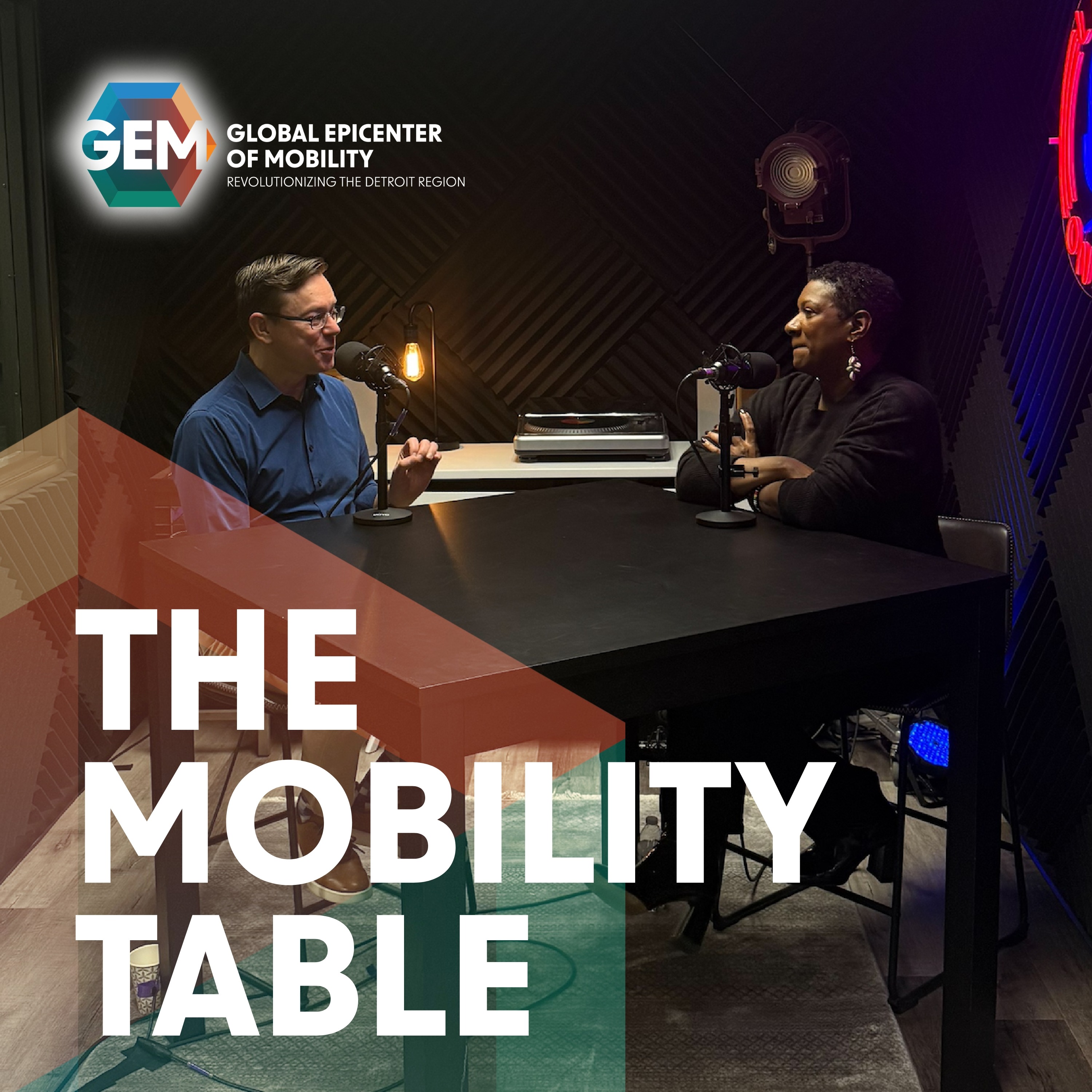
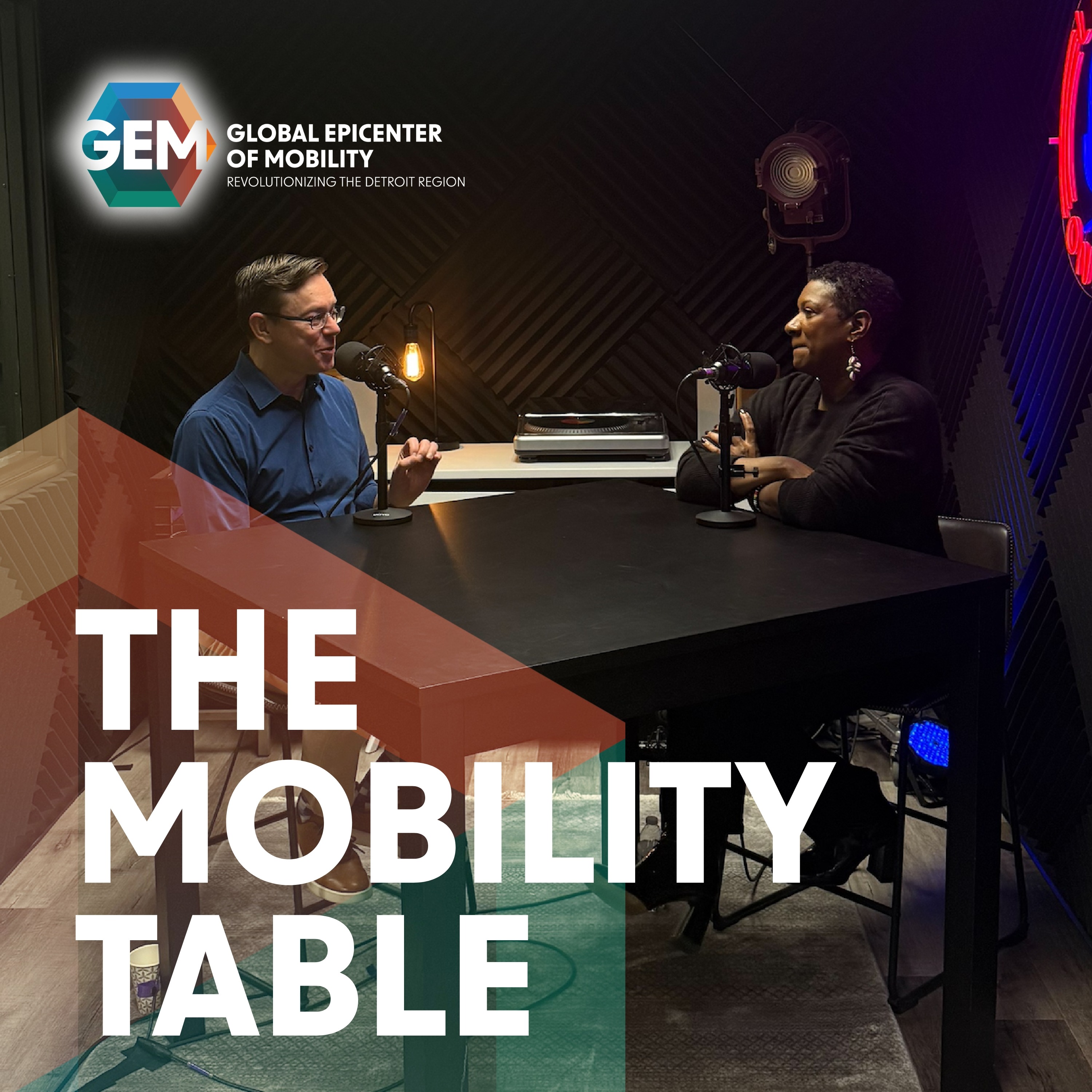
Kristin Dziczek took a seat at The Mobility Table with Jeannine and Bernard to discuss the implementation of AI within the automotive industry, the impact of the mobility industry on the broader economy in Detroit and the impacts of the USMCA trade agreement review.
Kristin Dziczek currently acts as a senior policy advisor to the Federal Reserve Bank of Chicago’s research, policy and public engagement division. Before her position at the Federal Reserve Bank of Chicago, Kristin served as the senior vice president of research at the Center for Automotive Research (CAR).