F1 cars have to be at least a certain weight. Teams try to get as close to that limit as possible so the car is light and quick, but they still have to follow the rules.
The Constructors’ Championship is the season-long points battle between teams, based on the combined results of both cars. Finishing higher (like P5) matters because it reflects overall team performance and affects prestige and financial outcomes.
Upgrades are improvements teams add to the car during the season. The goal is to make it faster or handle better than before.
Term
ground-told moment
This sounds like a big crash or accident that damaged the car. In F1, that can be very costly because you often have to replace expensive, race-specific parts.
That phrase points to the car’s power system—how the engine’s power gets sent through the transmission/gearbox. If that gets damaged, the car can’t perform normally and repairs are major.
F1 now has a spending limit for teams. If you crash and have to replace expensive parts, that uses up budget that could have gone toward making the car faster.
A regulation change means the rules for what F1 cars can be like have been updated. When it’s the first year, teams often have to spend a lot to redesign the car to match the new rules.
Driver input is the feedback drivers give to the team about how the car feels and behaves—often translated into actionable setup changes. In F1, that feedback is a key part of development because it connects on-track sensations to engineering adjustments.
FP1 is the first practice session on race weekend. It’s when teams experiment and try different settings to learn how the car behaves before qualifying and the race.
Telemetry is the car’s live data log from sensors. It helps the team and driver see what the car is doing and why, so they can adjust setup and driving for the next run.
In F1, “new regulations” means the rules for what cars are allowed to do have changed. That can force teams to redesign parts and drivers to change how they drive and set up the car.
Racers try to cut even tiny amounts of weight because it can help the car move and handle better. Weight that’s higher in the car is usually worse for cornering because it makes the car feel like it wants to tip more.
Topic
rallying up in Seattle
He’s talking about driving in a different kind of motorsport—more like rallying than track racing. That means you have to change how you steer and use the throttle and brakes.
The battery in an F1 car isn’t just for starting—it’s used to store and release energy during the race. Drivers and engineers manage it so the car has the right power at the right moments.
Monaco is a famous F1 street track with very tight turns and little room for mistakes. It often feels very different from other circuits, so drivers have to adjust their driving style.
Barcelona is another major F1 circuit, usually with faster, smoother sections than Monaco. Drivers often have to change how they approach corners and power delivery from one track to the other.
In F1, “deployment” refers to how the team releases stored energy (especially from the battery/ERS system) during a lap. Albon’s point is that after a break between races, you have to mentally and physically re-adapt to the specific energy/power strategy for that track.
“Getting in the zone” means when a driver is fully focused and everything starts to feel natural. On different tracks, the car and corners demand different timing, so it can take a different mental setup to reach that state.
LIVE
This episode is sponsored by Indeed.
There's a lot that goes on behind the scenes of this show,
booking guests across time zones,
tight turnaround edits, and constant time management.
And when things get chaotic, you realise pretty quickly
how important it is to have the right person on your team.
If I had to hire someone tomorrow, I wouldn't just want a good editor.
I'd want someone who understands pace in long formings of use
and can work fast under pressure.
And in moments like that, you think,
this is a job for sponsored jobs.
Because Indeed sponsored jobs boost your listing in search results,
helping you reach the candidates with the specific skills and experience
you actually need. And it works.
Sponsored jobs posted directly on Indeed are 95% more likely to report a hire
than non-sponsored jobs.
That's a serious edge when the pressure's on.
Spend less time searching and more time actually interviewing candidates
who check all your boxes. Less stress, less time, more results.
When you need the right person to cut through the chaos,
this is a job for Indeed sponsored jobs.
And listeners of this show will get a $75 sponsored job credit
to help get your job the premium status it deserves
at Indeed.com slash podcast.
Just go to Indeed.com slash podcast right now
and support our show by saying you heard about Indeed on this podcast.
Indeed.com slash podcast.
Terms and conditions apply.
Need to hire?
This is a job for Indeed sponsored jobs.
Alex Albon reaches a major milestone in 2026
when he becomes the driver with the most race starts in Williams' history.
Williams gave me my opportunity to get back onto the Formula One grid.
I don't think a lot of teams would have taken that risk.
I would love to stay. I think that for me it's
it's unfinished business.
Of course, it would be lovely to win races and score podiums
and I have that desire that my time will come again.
That hope is with Williams.
Here on F1 Beyond the Grid with me, Tom Clarkson.
Alex tells me what that Williams record means to him
and how he's changed on and off the track
since joining the team back in 2022.
We also talk about Alex's relationship with teammate Carlos Sainz
and where the Williams have reset their targets
after a disappointing start to the new era of Formula One.
We're in this position more because we were taking a lot of risks.
We want to be thinking outside the box and thinking as far ahead as we can
and think realistically we bit off more than we can shoot.
We were maybe too ambitious.
Alex, great to have you on the show again. How are you?
Very good, thank you. Not too bad.
We're in Monaco, so nice to be home.
Home race, very relaxed.
I was thinking this is actually a good space to have an apartment.
This is bigger than most apartments.
This is bigger than yours.
I might inquire how much this place is to rent
and I'm going to rent this place and I could lease it out to Formula One.
That's a business plan. A nice little side hustle for you right there.
While we're talking Monaco,
you know how it normally clashes with the Indy 500?
This year it clashes with another American event,
the US Open Golf, where your fiancé Lily is competing.
It's in California, so what?
It is. Home tournament for her too.
Yeah, but no sleep for Alex Albon this weekend
if you're going to be watching her whole by whole, right?
That's going to be tricky.
Normally she will wake up around 3pm, hour time more or less.
That's pretty much how our relationship was for 67 years now.
She wakes up around 3pm and then she'll pretty much start playing
around the time that I'm having dinner
and then I'll watch maybe the first four or five holes
and then I do have to sleep.
I love her, but I do need to sleep.
On a serious note, does it help having a professional sports person
as your other half because you understand the pressures?
Yes, I think what I've realised growing up
and spending time with more and more people,
it's very interesting to see how you know people
that have come through some sort of sporty background
when they can really empathise with the sacrifices
and the hardships, the commitment that it takes to do whatever you're doing.
That can be not in a bad way,
but you can notice people who don't know what that is
and it can almost be confusing in many ways to people that
but they have no fun.
They're just these kind of born and bred,
this is all they care about kind of thing.
But with Lily, of course, she's very much on a very similar path to me.
It's all we've grown up doing and it helps a lot.
I think in just general life, general conversations,
when we're having our lows, having our highs, whatever it may be,
you have a sounding board that resonates very closely to you.
So it is very, very lucky to have that.
Congratulations on the engagement, by the way.
Thank you.
Have you come up with a date for the big day?
I have, I won't reveal it, but I have.
It'll be repushing on, just like Formula One.
Updates and upgrades are coming every week.
So yeah, we're forced to do our head.
Look, while we're talking marriages,
can we talk about you and Williams because...
Long marriage.
Well, you've been with the team since 2022.
Yes.
And the upcoming Spanish Grand Prix is going to be race number 96
for you, for the team,
which is going to be more than any other driver in their history.
How does that make you feel?
It doesn't feel...
It doesn't feel fair, first of all,
because we do so many races nowadays.
We have something very special coming up for Spain.
I believe it's Spain, as I peer over to my shoulder.
The manager's just absolutely focused on not that.
Yes.
So we are focused on something pretty cool.
I won't give away too much,
but I am surpassing Nigel for this milestone.
And we had him in the garage in Miami.
I think he lives out in Florida.
Yeah, he does.
Has for years.
For years.
I had him around the garage with his family.
And he's so nice.
He's honestly one of the kindest.
He really appreciated just us spending time with him,
Carlos and me, to be fair.
And it was kind of strange because it's like,
no, we're the ones that want to spend time with you kind of thing.
But he was very excited.
We got his kids in the car and always grandkids in the car.
And yeah, it was very cool.
Very cool.
I can guess what you're going to do in Spain.
You're going to grow a mustache, aren't you?
Yeah.
You've got to be quite a bushy one.
Are you capable?
I've got a week to grow a mustache.
I can tell you right now,
these genetics do not grow a mustache in a week.
But I tell you what this does show, Alex,
it does show longevity and commitment from you to the team.
I guess both ways.
It does.
You know, you think about it,
that Williams gave me my opportunity back in 2022
to get back onto the Formula One grid.
I don't think a lot of teams would have taken that risk.
You know, considering I did have a tough final year at Red Bull.
And then throughout these, how many years is that now?
I should know, but five years.
I've just been able to align.
Obviously, every year we've grown as a team,
we've got better and better.
Clearly this year has been a bit more of a struggle.
But being honest with you,
I really do enjoy racing for this team.
The board members involved in Doralton
and everyone over in the States and the UK.
It's a very friendly place and very personal people.
And I really enjoy their time.
Do you think you are now the archetypal Williams driver?
I think I'm probably part of the transition of us going forward
in terms of I spent one year without JV.
Back then it was Yost Capital.
And we were just starting this turnover.
I think that's really when Doralton
were investing heavily within Williams.
And each year we've gone through,
you see the factory now, you see all the buildings
and the technology coming through,
the machines or whatever it may be.
You see all the personnel coming through.
We've increased size massively since when I first joined.
It is really, really impressive.
How different is the atmosphere at Williams now
compared to 22?
Do you feel there's an inner confidence now
that there wasn't there?
Yeah, I remember distinctively my first couple of weeks
visiting the factory in 2022.
And there were so many things where it was like
you came from a time at Red Bull
where there was clearly a very winning mentality going on.
And then when you go to Williams,
it wasn't the people within the factory that you felt were,
you know, weren't good enough.
It was purely the culture, the confidence within the team
that was almost like they had a very tough few years.
And each year, I think at that point,
they were going backwards.
And there was that, you know, it's that feeling
just like any single human would feel
if they were, you know, feeling like they were going backwards.
It was just a bit of a grind.
And the team that I see now, what's funny is, you know,
we are on the back foot this year.
There's no secret.
You know, we are at the moment the ninth team.
But we've been the ninth team in 2022, 2023.
But that desire to be like, this is not where we belong.
We don't belong here.
We belong, you know, back to where we were last year,
at least, you know, this kind of P5
in the Constructors' Championship is there.
There's determination to get back as quickly as we can.
That's a completely different mindset if you think about it
to what it was like when I was first there.
But do you understand why you're where you are now?
As in why we're on the back foot this year?
Yeah, I do.
And if you actually look at it,
I think we're in this position more for completely different reasons
than we were a few years ago.
We're in this position more because we were taking a lot of risks.
We want to be thinking outside the box
and thinking as far ahead as we can
and think realistically what ended up happening
were we bit off more than we can chew.
And so there were some areas within the factory,
within the team that we didn't foresee,
and we created bottlenecks,
procedural things that just,
especially when you change your regulation
and there's so much to do,
it was a lot easier before when we were just refining the car
and just making the car faster and faster.
This was a lot more, you know, deep into development phases.
We were late.
We pushed things right as late as we could,
and that just put us to where we are.
So it's not for the same reasons of we're just slow.
It was actually more the opposite of we were maybe too ambitious.
Given everything you've just said
and the recruitment drive that the team is on at the moment,
there's a recent signing that I think sounds really significant,
and that's Piers Thin, who was in charge of the factory at McLaren.
He won the most recent Constructors' Championship in Formula One
and he's now joining Williams in a couple of months' time.
That strikes me as quite a big shout from Williams
given the reasons you've just stated for the problems this year.
It is. If you strip everything away
and you just look at what do the top four teams do better than everyone else,
their turnover speeds, the fact that they're bringing upgrades almost every race,
even if it's a small upgrade,
how quickly they can convert CFD and wind tunnel production into physical parts.
Their turnover is extremely quick
and it's one of the big things that separates midfield teams to the top teams.
We realised, you know, I think it's no secret.
A few years ago we were back on the Excel spreadsheets and whatnot
and we were quite far behind them
and we've got this huge gap to bridge, bridge to gap, gap to bridge.
We'll do both.
That's one of the areas that we've noticed consistently
and kind of touching on a new regulation change.
That's one of the areas where we saw ourselves most exposed.
What about extricating yourselves from the whole at the start of the year?
We all know that the car was overweight.
I mean, overweight in itself is a function of being late.
It's being slow because one of the quickest things to gain back time
and get back on target is to not crash test,
to not refine, to just get parts in the car as quickly as you can
and miss out that weight-saving opportunity phase of the car build.
So it all kind of leads a lot of it to efficiency.
But how much can you recover this year,
given the processes that you now have back in growth?
I'm fairly confident we can get back on weight by...
I don't want to say when, but I think we've got a clear plan.
You could imagine that it's at one of the very top priority lists of the car.
And if you're on the weight limit, is the performance there?
Is P5 in the constructors' championship still doable?
We have a calculation of where we know our car would be if it was on the weight limit.
That's not to say that everyone is on the weight limit.
They aren't, but...
Can you share that?
No, but I would say that clearly the results aren't where they would be.
We'd be much more in the points than we are now.
The good thing is you've seen maybe the last few races an uptick in performance from the team
and there are some upgrades happening on the car,
but a lot of that is the weight getting stripped out.
And how much of a setback was the ground-told moment that you had in Montreal?
Because it actually cost a lot of money, the amount of damage that was done.
That was an engine gearbox.
I've heard like a million dollars being floated around in the budget cap era.
Budget cap era is maybe quite overlooked in terms of didn't matter too much if you banged a wheel or two,
lost a front wing or two previously and now,
especially with being the first year of this regulation change,
how much money that takes to invest in the car.
You don't want to be spending it on crashed parts.
So yeah, it's not fun.
I don't think the insurance covers groundhogs.
So yeah.
This episode is sponsored by Saley.
I think one of the most satisfying feelings before any trip
is knowing you've already sorted all the boring stuff before you leave home.
Passport packed, boarding pass downloaded, hotel booked.
Because once you land somewhere, the last thing you want is another problem to solve.
Like figuring out how you're going to get online.
And that's why I use Saley.
Saley is an eSIM app from the creators of NordVPN
that gives you affordable mobile data in over 200 destinations.
So instead of worrying about roaming charges or trying to find a local SIM card when you arrive,
you can get connected straight away.
And what I really like is that you only need to install the eSIM once.
Then if you're planning another trip somewhere else,
all you need to do is add a new data plan.
Saley also includes built-in security features like a VPN and ad blocking,
which helps protect your browsing and can even reduce mobile data usage by stopping ads from loading.
And if you're worried your phone might not be eSIM compatible,
Saley offers a full refund if it isn't.
Plus, if you travel frequently, they also offer the Saley Ultra Plan,
which includes extra perks like airport lounge access, fast track services and priority support.
So download the Saley app in your app store, use the code GRID at checkout to get 15% off your first purchase.
This episode is sponsored by Indeed.
There's a lot that goes on behind the scenes of this show,
booking guests across time zones, tight turnaround edits and constant time management.
And when things get chaotic, you realise pretty quickly how important it is to have the right person on your team.
If I had to hire someone tomorrow, I wouldn't just want a good editor.
I'd want someone who understands pace in long-form interviews and can work fast under pressure.
And in moments like that, you think, this is a job for sponsored jobs.
Because Indeed sponsored jobs boost your listing in search results,
helping you reach the candidates with the specific skills and experience you actually need.
And it works.
Sponsored jobs posted directly on Indeed are 95% more likely to report a hire than non-sponsored jobs.
That's a serious edge when the pressure's on.
Spend less time searching and more time actually interviewing candidates who check all your boxes.
Less stress, less time, more results.
When you need the right person to cut through the chaos, this is a job for Indeed sponsored jobs.
And listeners of this show will get a $75 sponsored job credit to help get your job the premium status it deserves
at Indeed.com slash podcast.
Just go to Indeed.com slash podcast right now and support our show by saying you heard about Indeed on this podcast.
Indeed.com slash podcast.
Terms and conditions apply.
Need to hire? This is a job for Indeed sponsored jobs.
We've discussed the team and how it's getting back on track. Let's discuss you now, Alex.
The driver silly season is up and running.
We've just had Charlotte Claire announcing a new contract at Ferrari.
Where are you at with Williams? Do you want to stay?
I mean, James Valls has said he wants you and Carlos for the future.
Are you on the same page?
I would love to stay.
I think that for me, I've been a part of this journey before JB, in fact.
And I've been here feeling like maybe it's true or not,
but I've been a contribution to a lot of the, to part of the success of the team.
And I want to see it through.
I want to see where we get to.
I feel like there's unfinished business where we are.
And this year was actually tough in many ways, even just mentally,
because you kind of just seeing this forward momentum going through.
And now we're not that we've slightly having to reset kind of where our trajectory curve is,
but in a way, yes.
There's areas that we realize, OK, well, this is going to take a couple more years than we would like, let's say.
And so as much as you want to immediately get a pen to paper,
you do want to see where and how the team evolve.
And I think for me, it's 100%.
As I said before, I love the board.
I love JB.
I think the team is in a great place.
So I want to see this work.
James has said 2030 is when he wants to see Williams challenging for world championships.
First of all, do you think that date is doable?
Yeah, I would have said, you know, we're previous to the end of last year.
My eyes were kind of, you know, 28, 29, 28, really.
It was kind of like, I thought, if we keep going, that's not too long away.
I think from this year, it's kind of gone, OK, you know, it's been slightly more 2030.
I think that's realistic.
I do, I think one thing about JB is he is honest and he doesn't try to set unrealistic targets.
I do think that 2030 is, I haven't spoken to him about it, but I believe it's a good number.
And he has said that you and Carlos is the best driver lineup in Formula One.
You're now 18 months into that relationship.
How are you rubbing along?
Yeah, great. I think we are still in a very similar place to the first weekend we spent together.
There's no difference in our openness.
And most probably more than anything, we've realized we were very open before in terms of what do we need to do to get this team to go forwards.
And then this year, being on that back foot, there's been even more focus.
I say there's been a huge amount of driver input back to the factory and yeah, just between us trying to understand how to make this car go faster.
So I like the way that we have this partnership.
I'm not sure it's that coming across teams to have two drivers with experience that understand the picture of what the team needs or what team need to get to go forwards.
Not to say that young drivers are going to just focus on themselves, but it's nice that we can have these weekends,
even for example, FP1s where we can do completely different things across cars to focus on different philosophies and see if things can work out.
Neither car really focusing on pure performance, just trying to figure out what the window is of the car and then kind of come back together.
I could imagine there are a lot of midfield teams that wouldn't do that.
Do you think that dynamic would change if you were fighting for podiums and wins?
What sort of personality?
Yes, I think it would, but we're not there yet.
So that's a problem to have later on.
And Carlos as a teammate, has he made you a better driver?
Do you look at his data, his telemetry and say, OK, I'll try that.
I would say that I look at it, I don't, I think he would say the same to me.
There's nothing that I see that you feel like you cannot do or whatever.
We kind of look at each other, we bounce off each other.
I think he's taken to these new regulations well as well, so it's been helpful for me to see his data.
What does he do especially well in a racing car?
I would say that his strongest asset is actually his feedback and his communication.
It's actually the out of car work that he does.
That's very good.
I think he speaks well, he has great insight, he has an engineering brain on him.
I think that's really important.
Are you quite similar?
We are similar for sure.
I think that we both attack or we go into a weekend and prepare for a weekend in a very similar way.
Maybe that's also why we get on well.
Beginning of next year, you'll be starting your 150th Grand Prix.
It seems quite a lot, doesn't it?
I know, I always think of it like I'm 30 now, I turned 30 in between China and Japan.
Your fourth decade, wow.
A 30 is crazy because I'm way over the average age now.
You're an old boy now.
Although Jackie Stewart would tell you, you are absolutely at your prime at 30 as a racing driver.
Actually, JV says the same thing, but I'm glad Checo and Valtteri joined the grid to get that every change up.
Louis, stay around a bit longer.
Fernando, we need you.
Everyone stay.
It helps my ego.
Can we explore how you think you've changed as a driver over the last eight years?
If I split it between the two, if I go purely driver, pure technique wise, my driver default is the same.
I drive the same way, I have the same technique, same style.
Are you faster now?
I've noticed my weaknesses more, so I know the corners that I need to work on.
There's obviously a consistent pattern that you kind of go through.
I know the tires much better, I know how to manage the tires in a race much better, I know when to push.
I think that's the biggest difference between when you start to where I am now is that balance of saving, saving,
and then when you start picking up that pace and start going for it.
On a technical level, I understand the cars better clearly and I pretty much know how to,
and I know all the things we can do to the car.
And then in terms of a personable level, I'd say there's still the racing side,
which is mostly the area that I think I've become better at is being that team person,
that point of contact of moving the team or explaining to the team what I need from them, from the car.
What do we need to go back to the factory and work on?
What are these specific areas that we need to focus on?
Having better communication, basically, and knowing who I need to speak to to get what I want from the car, from the team.
And then there's the outside kind of non-racing side, but it still applies as me as a human.
I'm more confident now, more confident and comfortable in my own skin as well,
not trying to be someone I'm not, and more relaxed as well in weekends.
Do you think you being thrust into that team leadership role, you know, when you had Logan Sargent,
when you had Nicholas Satifi as your teammate, were you ready for that?
And is that what helped create the person that you've just described?
I think it definitely was a part of it.
I think it was more an element of maturity as well.
I think that there's a big difference mentally that changes when you are driving to survive and then driving to not survive, basically.
And the attitude is that self-confidence within you that's kind of like, I'm okay.
I don't need, it's not all about me.
And it's kind of what I was saying before around, you know, having that two experienced drivers in the midfield.
And it's more about what do we need as a team to go forwards?
How do we get away from these P12s and P13s and how do we start moving into the points?
And there's a, I guess, a human reaction towards, I belong here and I don't need to prove myself.
And so you do think far more big picture and that kind of narrow minded approach of in it for myself goes away.
So that's that's simply the biggest difference.
So when you were finishing in the points in what seven of the opening eight races last year, that was Pete Alex.
That was it was Pete Alex for sure.
In many ways, things were clicking and you're just relaxed.
I think there's an element of the cars goods.
You're just in that rhythm.
It's hard to explain, but there's none of this kind of like, I gotta do this.
Even it sounds really silly, but I mean, this is maybe going a little bit off subject, but you know how different it is to be able to go into Q1.
And it doesn't have to be the perfect lap to get through.
You can play around with your tools.
You can play around with the front wing.
You can play around with your out lap because it doesn't really matter.
You're still going to go through the mentality of I can't adjust too much and I need to make sure my outlaps perfect.
And it's a bit of a weird mentality, but sometimes harder to take risks when you're on the back foot, when you know the car's not good enough for Q2.
So it is a shift in many ways.
And I think it just makes you more relaxed.
You know you've got a good car body.
And do you think you would deal with a team like Red Bull differently now?
The Alex, the version of you now would deal with that opportunity differently now?
For sure, yeah.
Like deal with hell with it.
I look at myself back when I was in Red Bull to where I am now and I think I am very, very different.
Still have the kind of my core is still the same, but how I can deal with things and the biggest thing is get myself out of things.
You know, if I'm in a tight spot or whatever and things aren't clicking, how do I get myself out of them?
That's the biggest thing.
When I was at Red Bull with that maturity and the lack of fundamental engineering knowledge, it was hard to know why it was difficult.
What do you know now that you wish you had known in 2019 when you started in Formula One?
It's so technically boring.
There are things you can do with the car, like things which I most probably didn't understand back then,
but the way you can set up the car and play around with it, there's a lot you can do basically.
And I think that sometimes I was not giving the exact feedback that I should have been giving because back then it was just doing this, it's doing that.
I wasn't in the detail of understanding why.
I think some drivers don't like that though.
So to explain, it's like some drivers are just quick.
There's not really a thought behind it.
They just drive anything they get given.
That's great.
And that's actually a nice thing to have.
If I can understand what makes the car clicking, why is it doing that?
If I can understand that, I can also get that time out of it.
It's almost like, okay, I need to understand the language of the car.
Once I get that, then I can unlock it.
And so back then at Red Bull, I would say I was far from that.
But that's experience that surely every young driver is the same.
Even Max Verstappen, the 2016 version of Max Verstappen surely was the same.
Exactly that.
You can even say you sit with Kimmy this year.
There's that learning part of it where you're just driving and I think as a mentality, you're kind of just reacting to whatever you get.
You have underneath you.
Once you start going away from reacting to being proactive and being able to say,
I want the car to do this.
I need this rather than this is what we've got.
Can you drive around these issues or these issues?
You gain that time.
A dedicated teamwork win races on the track and only the most advanced security technology and elite specialists have the power to prevent, defend and stop cyber attacks.
Technology makes all the difference in who has a clear advantage where Bitdefender is renowned for driving leading edge innovation.
Bitdefender supports Ferrari in strengthening its cybersecurity posture.
They improve the cybersecurity team's operations and support resilient performance across a large and complex global environment.
It's a partnership built on trust, a shared confidence in the technology, the expertise and the ability to respond effectively as the threat landscape evolves.
So join the millions of consumers and businesses that trust Bitdefender to protect their digital worlds.
Visit bitdefender.com to learn more about how Bitdefender supports Ferrari through cybersecurity built on trust and how you can make your digital life safer.
This episode is sponsored by Indeed.
There's a lot that goes on behind the scenes of this show, booking guests across time zones, tight turnaround edits and constant time management.
And when things get chaotic, you realize pretty quickly how important it is to have the right person on your team.
If I had to hire someone tomorrow, I wouldn't just want a good editor.
I'd want someone who understands pace in long-form interviews and can work fast under pressure.
And in moments like that, you think, this is a job for sponsored jobs.
Because Indeed sponsored jobs boost your listing in search results, helping you reach the candidates with the specific skills and experience you actually need.
And it works.
Sponsored jobs posted directly on Indeed are 95% more likely to report a hire than non-sponsored jobs.
That's a serious edge when the pressure's on.
Spend less time searching and more time actually interviewing candidates who check all your boxes.
Less stress, less time, more results.
When you need the right person to cut through the chaos, this is a job for Indeed sponsored jobs.
And listeners of this show will get a $75 sponsored job credit to help get your job the premium status it deserves at Indeed.com slash podcast.
Just go to Indeed.com slash podcast right now and support our show by saying you heard about Indeed on this podcast.
Indeed.com slash podcast.
Terms and conditions apply.
Need to hire? This is a job for Indeed sponsored jobs.
I think there are three phases to an F1 driver just from years of observing.
One is the reacting phase that you talk about when you first come in.
You just come in and do it.
And you're often very successful at that because you don't overthink it.
Then you've been around.
Phase two is you've been around for a while.
Suddenly you realize the privileged position you're in and you start to, oh, one driver start to overthink it.
And sometimes it doesn't come so easy.
And then you get into phase three, which I feel where you are, where suddenly you understand it all now and there's less pressure.
And then then it ramps up again.
So you sort of bookended by high performances with a slightly...
You're onto something there.
I think every driver, if you look at it, they've kind of gone through that phase.
You look at even like a Max or George, a Charles now, a Lando now.
And it's hard to see it from the outside, but I really do believe everyone's just getting better and better.
It might not be pure lap time and pure driving, but if you understand the cars more, you understand the tires more, you understand the tracks more,
you understand how these things work more, you become faster and faster.
What about incremental gains from a driving perspective?
You've talked about all the tools you have in the car.
How hard do you think about things that you can do and something I'm reminded of?
It's a real balance.
So like Nico Rosbo 2016 didn't paint his helmet because he was going to save 80 grams of weight high up in the car.
He gave up cycling because he wanted to get rid of the leg muscle to save weight.
You know, that's the sort of...
I think Nico was extreme.
But do you think constantly about where you can make gains like that?
Or are you at the point now where I've got nothing more in that department?
This is me.
I have a...
I think every driver will have this.
I have a relentless desire to be better.
And I think a lot of drivers in different ways are motivated by multiple ways.
I think I saw Jensen, you did a podcast with Jensen and talking about...
I think every driver has a level of insecurity that drives them forward.
Because you don't feel like, you know, are you the best?
Can you be the best?
I'll do everything to be the best.
And you go through and you look at every single part of you to improve.
For me, recently in the last two years, a lot of that's been...
I feel better driving a lot of different things.
Like I think Max does that naturally, driving GT3 cars and whatnot.
For me, a lot of it spent driving different cars.
I did some rallying up in Seattle the other day, driving random cars around Sonoma,
going around in go-karts, just doing everything.
Feeling like just driving and getting that feeling is really important.
The other side of it, though, is kind of with balance,
because it really is balance, is overthinking the sport and just driving.
Like I think a lot of it is...
There's all these things you can focus on and do to try to improve,
but then once you get to the racetrack itself, you need to disconnect
and just kind of be in that quietness.
And just, you know, this is it now.
You've done all that prep work.
You've done all the...
All the whatever you feel that you need to do.
And once you're there, it's just...
It's the fine details of driving the cars quickly as you can.
Damon Hill says the best race he ever drove, Suzuki 94.
He wasn't thinking it was just happening.
Yeah.
It's the sweet spot.
It's the sweet spot.
And I'll say this.
I think that this year it's been much harder to be in that area mentally
because it's so much more going on to the cars this year than there were in previous years.
Like you can't disengage in the way that you want to.
You have been taught at an early age to just drive corners as quickly as you can,
but there's a layer this year that's different.
And I'm not saying this in a bad way.
I'm not trying to say the regulations were unique, but you can do different things
which you never did before to go faster.
So there's this thing in the back, which is the battery that you can manipulate.
And it's interesting because just driving, being in that quiet space, can sometimes be not efficient.
And so for me, especially the lot of work in a simulator is spent driving to try to make that bit feel quiet
so that it's not dominating your thoughts as you're going around the lap.
And that will come with experience.
The more exactly that.
Like even from Melbourne to now, your mind quietens down a lot, at least for me.
And I think I'm excited to compare.
For example, I just did the sim prep for Monaco in the net.
I moved on to do Barcelona.
We don't go back to the UK in between the two races, at least I don't.
And suddenly all the deployment comes in and you're like, oh yeah, I forgot about this.
Need to go back to that style of driving again.
It's very interesting.
In terms of getting in the zone, is that circuit dependent?
Do you believe that drivers have favourite circuits, favourite corners even?
Yes.
And I think that when you're really feeling like you're driving at your very best,
it's very similar to what Damon says.
For me, you just know.
Like that corner, I can't explain it, but I just know.
I know that's how you take that corner.
I know how you take this corner.
There are some corners which naturally you're like, I'll try this, I'll try that.
Does this work?
Yes, it's okay, but okay, I'm going to try a little bit of this.
Okay, can my tools help me?
Can we help with the setup?
Okay, you know, I need to break a bit later here.
Two minutes later here.
They're small and we do them a lot, but it's just these little small things.
And it's like, it's not I do this kind of thing.
And for me, when it's I do this.
Tell me a corner where you just do this.
So I can go and stand there and watch you.
Okay, good question.
Anyway, even if it's one we've already done.
I'm trying to think of one that we can go to soon.
What's after Barcelona?
Austria.
Silverstone.
Silverstone's a great one.
Silverstone.
What is, give me a, just do it corner for Alex.
Turn nine.
Is that cops?
That's cops.
That's cops.
So like cops, you can go in there and you spend a couple of laps understanding the winds.
Once you understand what the winds doing.
You just do it.
You just do it.
Every driver has it.
I'm sure of it.
Every driver has corners where no teammate can ever beat them because they just, they're just in that.
And cops to you.
This might sound like a silly question, but given that, you know, footballers have a favored
for tennis players, a favor, you know, backhand forward.
Do you prefer turning left or right?
Are you better turning left or right?
I asked the team to do a statistic for me on it just to see if I, if I did have a preference,
but I don't.
You don't have a preference.
No, no.
Is that a silly question?
No, it's not.
I've realized like, I think I'm slightly better at optimizing the track when it turns right.
So I can get, you know, you kind of got your time actually got your white line and then
you got the grass.
And when I turn right, generally speaking, I can get the tires overhanging on the, on
the tarmac on the white line, but not in the grass.
That's me turning right.
And then when I turn left, I'll watch an onboard and everyone I know, but there's a bit, the
left hand is, there's a little, there'll be a little bit.
I think it's right handed.
But normally I even, I mean, I still, I still go pretty well over.
But yes, I think there's a bit there.
That's so interesting.
Yeah.
The final, final topic I just wanted to ask you about was you've grown up and beaten so
many of the guys who are winning in formula one now.
Long time ago though.
Junior formulas.
But you know, it's a lot of that is equipment related in F one, isn't it?
Well, I'm thinking of George.
I'm thinking of Lando.
How do you view the success that those guys are having now?
I'm fully deserved most of you.
I think that I had my chance at Red Bull was a bit young at the time and maybe would have
benefited from a little bit more time, you know, still in the midfield team and, and
I also, I feel a lot of gratitude in, in, in what I do.
I feel very thankful that I did get a second opportunity and I feel that yes, of course
it would be lovely to win races and score podiums.
And I have that desire still to do that.
But it's not me looking over my shoulder being envious of my colleagues.
It's very much desire that my time will come again, that I get a chance back at a top
team.
And of course that hope is, is with Williams.
I think my, my, my goal this year was, was to get my first podium for Williams.
That was, that was said last year.
I felt like I, I was close a few times, but in that the chance will come again.
It might take a year or two more though.
Well, Alex, best of luck with everything that comes and thank you very much for your time.
Thank you.
I'm sure that first podium with Williams will come, Alex.
You just might have to wait a little bit longer than planned.
The team is laying the foundations for future success.
And as you know only too well, the path to the top in Formula One is never linear.
I always enjoy talking to Alex.
He's thoughtful.
He's engaging and he's witty.
And I love how our conversations always go off on tangents.
And who knew that drivers do seem to have a favored corner direction?
Alex, thanks for your time.
Go well.
And I'll see you very soon.
Well, that's almost it for this week.
Before I go, please remember to check out F1's other official podcasts.
F1 nation's review of the Monaco Grand Prix with myself, Laura Windsor and Lawrence Beretto
is out now.
We discuss whether Kimi Antonelli is a generational talent after his fifth win in a road
and what's next for George Russell after losing more ground in the title fight.
And this week's episode of F1 Explains is all about the race start procedure.
That will be on the F1 nation feed this Friday.
Thanks very much for listening.
I will of course be back next week with another big name from the world of Formula One.
F1 Beyond the Grid is produced by Formula One and AudioBoom Studios.
Until next time, keep it flat out.
About this episode
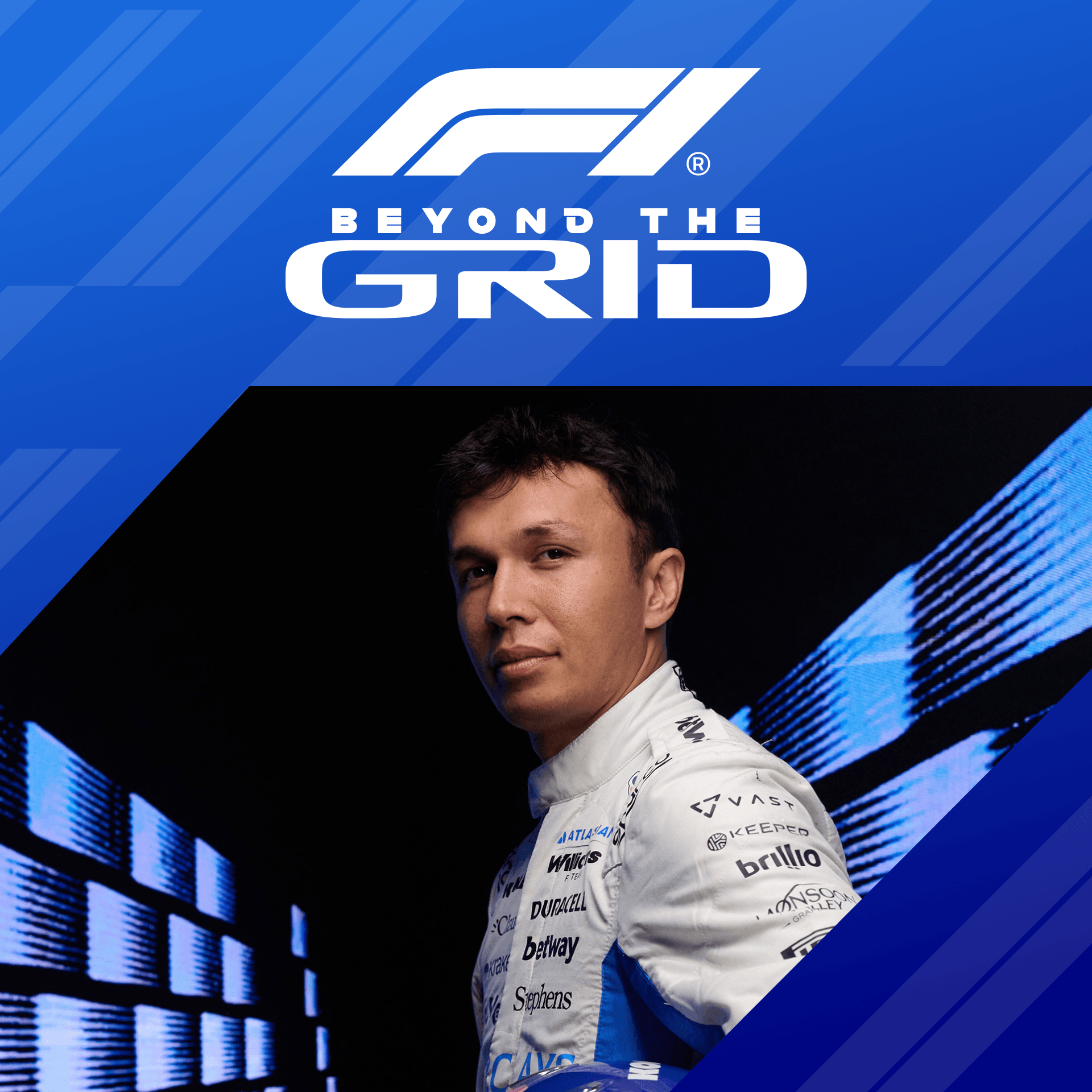
Alex Albon talks Williams milestones and why he’s staying on “the cusp of history,” including becoming the driver with the most Williams race starts and hitting race number 96 at Spain. He explains how Williams reset expectations after a tough new-era start, shifting culture and confidence, and how development timing, weight, and upgrade cadence matter under the budget cap. Off-track, he’s in Monaco with fiancé Lily competing in the US Open, and they joke about Spain and family moments in the garage.
In Barcelona, Alex Albon is set to become the driver with the most race starts in Williams history – surpassing Nigel Mansell’s record of 95 Grands Prix. Speaking to Tom Clarkson, Alex talks about what that milestone means to him and how he’s changed, as a driver and as a person, since joining the team in 2022. Alex also tells Tom why Williams have had a difficult start to the new era of Formula 1 and how that setback has changed their targets of competing for podiums, race wins and championships.
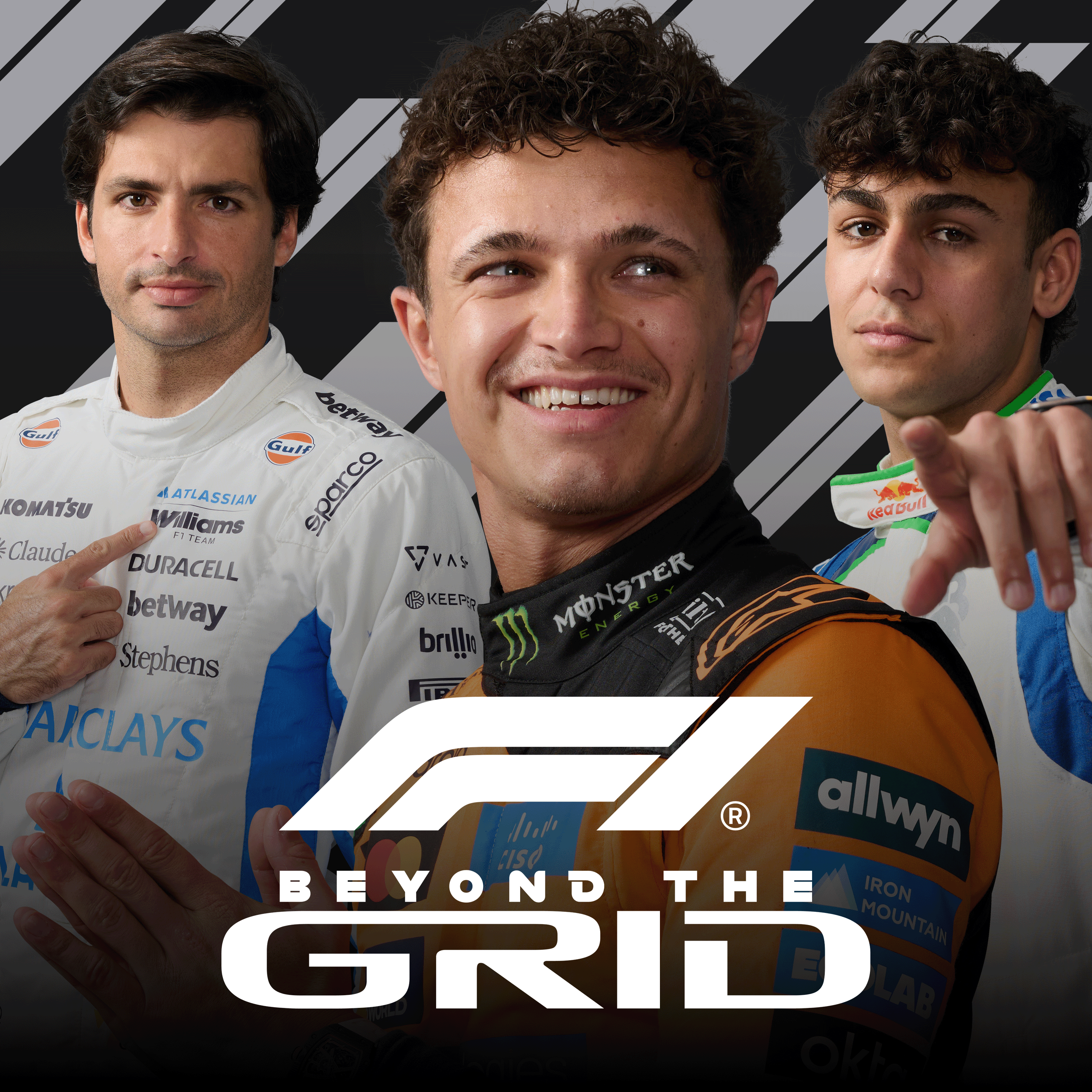
You’ll also hear about Alex’s relationship with teammate Carlos Sainz and how he views the success achieved by the likes of Lando Norris and George Russell, having raced against them in junior categories.
This episode is sponsored by:
Saily: get an exclusive 15% discount on your first Saily data plans! Use code grid at checkout. Download Saily app or go to to https://saily.com/grid
Bitdefender: visit Bitdefender.com to learn more about how Bitdefender supports Ferrari through cybersecurity built on trust and how YOU can make your digital life safer.