The supply chain is the process that shows how products are made and delivered, starting from the raw materials to the finished cars you see in dealerships.
The Ford Flex is a big family car that looks a bit like a box on wheels. It has lots of room inside for people and their stuff, which makes it great for road trips or daily use. People talk about it because it's different from most other SUVs and is very practical.
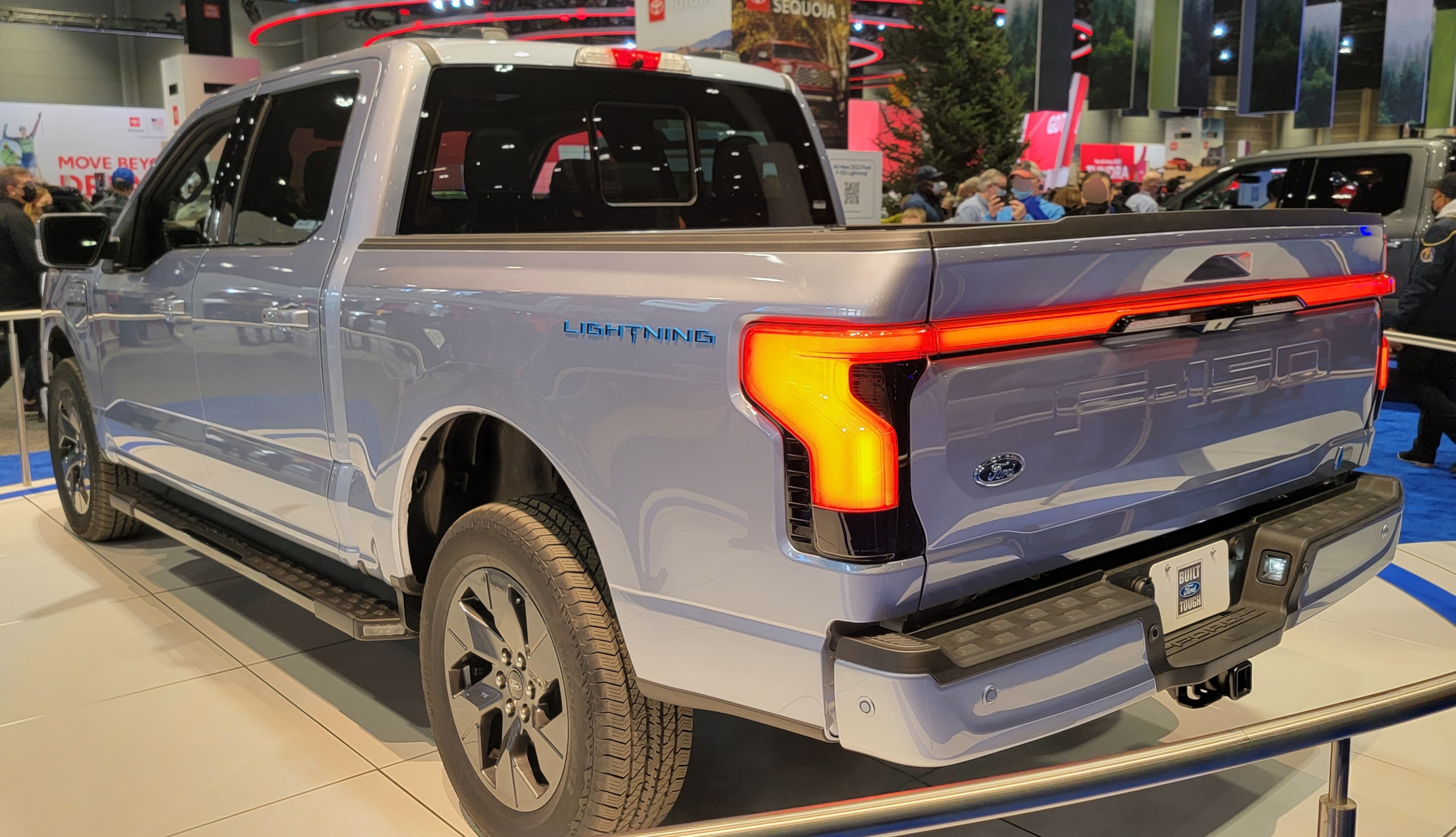
The Ford F-150 Lightning is an electric truck made by Ford. It's designed to be powerful and useful, just like the regular F-150, but it runs on electricity instead of gasoline.
Aluminum manufacturing is the process of making aluminum, which is a lightweight metal used in cars to help them be more efficient. If a factory that makes aluminum has a fire, it can cause problems for car companies that need that metal.
The Ford Lightning is a new electric truck from Ford that is based on their popular F-150 model. It's designed for both work and everyday use, offering a powerful electric option.
Aluminum parts are pieces of a car made from aluminum metal. They are lighter than steel parts, which helps cars use less energy and go further, especially electric ones.
A price war happens when companies try to sell their products for less money than their competitors. This can make things cheaper for buyers but can hurt the companies' profits.
A tariff is like a fee that countries charge when goods come from another country. It makes things more expensive, which can affect how much companies pay for materials.
MSRP is the price that car makers suggest you should pay for a new car. It's like a starting point for how much the car costs before any discounts or negotiations.
The Ford F-150 Platinum is a fancy version of the Ford F-150 truck. It has more luxury features and technology than the standard models, making it more comfortable and stylish.
The dealer invoice price is what the dealer pays to get the car from the manufacturer. It's usually less than the price you see in the showroom, which is the MSRP.
The target discount range is the amount of money you might be able to save when buying a car. It's a guideline for how much less than the MSRP you could pay.
Days supply of inventory tells you how long the cars on a dealer's lot would last if no new cars came in. If there are a lot of cars, it means they might not be selling quickly.
A supply demand imbalance happens when there are too many or too few cars available compared to how many people want to buy them. This can cause prices to go up or cars to not sell well.
Aluminum cost is how much it costs to buy aluminum, which is used to make parts of cars. If the price goes up, it can make cars more expensive to build.
Incentives are special deals or discounts that car companies offer to help sell their vehicles. They can make buying a car cheaper.
LIVE
If you're the purchasing manager at a manufacturing plant, you know having a trusted partner makes all the difference.
That's why hands-down you count on Grainger for auto-reordering.
With on-time restocks, your team will have the cut-resistant gloves they need at the start of their shift.
And you can end your day knowing they've got safety well in hand.
Call 1-800-GRAINGER, click Grainger.com or just stop by.
Grainger for the ones who get it done.
Happy holidays!
Want to give your host a gift?
Consider subscribing, rating and reviewing the show this holiday season.
It really helps the show grow.
From all of us at Believe, have a merry Christmas everyone and a happy holiday.
It's noon here in wet, windy Ventnor City, New Jersey and our nation's capital, Washington, D.C.
And this is Car Edge Live for Monday, October 13th with your hosts, me, Ray here in Mr. Bullventner
and Zach, well, living the high life in his apartment in D.C.
How are you today, handsome?
Happy Monday, Dad. I'm doing fantastic.
Grateful to be here with you both of us in our white t-shirts today, folks.
Today's show has no sponsor beyond caredge.com.
My dad and I, six years ago, to be six years in December, it's absolutely crazy to think
we started working on Car Edge to try and level the playing field for customers who go to the car dealership
to buy a new or used vehicle.
What a journey we've been on.
If we can help you out with anything, please check it out, caredge.com.
And we don't spend enough time talking about it.
The community forum, I think maybe five years old now, four years old now, caredge.com.
We've got an incredible group of people there that are trying to help folks out.
The big story this morning, American automakers are going down a slippery, slippery slope,
and they know it.
They know they're in serious trouble.
And the latest news from General Motors over the past week or two here,
you got to read between the tea leaves, as I like to say, to figure it out.
But there is some damning stuff going on in these contracts that these major automakers have.
I'm talking about GM, Ford, and Stellantis.
The contracts they have with their suppliers, with the folks that actually help them make vehicles.
Did you get a chance to read this article, Dad?
I did.
Don't ask me if I remember everything in it.
But yes, I did read it that GM is slipping in a new clause, an insanity clause.
I think it might be called.
All right.
So let me lay the land of what's going on here, and then I want you to help us make sense of this
and then understand what the takeaway could be for the car market.
GM added a clause in their contracts with suppliers,
letting their contracts extend indefinitely with six months notice.
We're going to explain what that means in a second.
Suppliers fear planning uncertainty and unilateral pricing adjustments,
omitted inflation and tariff pressures.
Attorneys to these suppliers recommend that they reject these terms while continuing to work with these automakers.
And GM's move actually puts them in alignment with the other Detroit three, Ford and Stellantis,
in trying to tighten their agreements with their suppliers.
Now, Dad, what's insane about this is that the way that the suppliers work with the automakers
is they have contracts for all the different things that they're going to get from their suppliers.
And then those contracts typically run for a term, which is, I don't know, a common thing in a contract.
The idea that there's a fixed term which gives suppliers clarity on a program
and lets them know how long that program is going to last,
like how long they're going to need to provide supplies to produce a certain vehicle, for example.
Are you suggesting for a moment that in most contracts there's a beginning date and an end date?
Yeah, and think about it.
I don't even know if there's an end date, but typically there's a way to get out of it within a month or something like that.
But think about the relationship here between General Motors and one of their suppliers.
Maybe the supplier for the trailblazer, for example.
You are having to commit to pricing for the components that go into that trailblazer,
and now what General Motors is trying to do is right here.
The buyer, General Motors, may add its option upon six months notice to seller extend the term of the contract,
which may include multiple subsequent term extensions,
essentially having an indefinite contract term length with their suppliers.
This is so nitty gritty, folks, but it's super, super interesting because it means,
if I'm General Motors, I could be running a program with a supplier in perpetuity
and never change the prices that I'm paying for my supplies.
That's essentially what GM is trying to do here.
It's what Ford and Solantis have also done to try and ruffle the feathers of their suppliers.
GM is trying to get leverage and flexibility, Dad,
because they don't know what's going to happen to the prices of their vehicles or their inputs,
how it's going to impact profits, things like that.
So they're trying to get this insanity clause into their supplier contracts,
and all the supplier lawyers are coming back and saying this is insanity.
There's no way we're signing these things.
I don't know if we've done a great job explaining it, but if you fully understand it,
it is absolutely, as you like to say, ludicrous.
And he was a hell of an actor and a pretty decent rapper, that ludicrous character.
Let's clarify to a certain degree.
GM is also stipulating that there can't be a price increase from the supplier to GM
unless there is a meeting about that,
and that they can show how and why they might need that price increase.
So it is not only GM dictating to the supplier that,
well, we can continue the contract every six months for an additional six months,
and we're going to be the arbiters as to whether or not you can actually raise prices
for your costs going up.
Everything parts suppliers, Dad, go out of business recently.
I mean, we've seen bankruptcies impacting these parts suppliers,
and we know from prior research we've done how tenuous the relationship is
between the automaker and the parts supplier, and now they're putting into the contract.
We have to have a meeting if you want to increase prices,
and we ultimately choose if we can increase prices in this perpetually termed contract that we agree.
It is bonkers, man, what they're trying to get away with here.
Yes.
Oh, and by the way, I want a similar contract moving forward
so that I can renew it every six months whether you want me to or not.
No, I mean, let's actually make this analogous to what we do professionally.
So I have an employment agreement with CarEdge, with this company that you and I run, right?
And essentially what we're coming up with here would be if on General Motors and CarEdge is the supplier,
I get a contract that I can choose to just extend whenever I want in perpetuity,
and I also get to dictate to the company how much they have to pay me,
which I guess is a little bit how it works.
Like if I don't want to work here, you have to pay me more or something like that.
But in a supplier to automaker relationship where you need each other, where you're very codependent,
I think it's a sign of the trouble that General Motors is feeling and the fear that they have that they're going to erode their profits.
That and the other thing that it says to me that if you are a part supplier,
don't put all your eggs in one basket and only supply parts to one of the big three or one of the manufacturers,
because when you do that, you lose leverage.
They know, General Motors knows that perhaps they account for 70% or 80% of your sales.
That's an incredible amount of leverage that General Motors would have when they say,
well, you either keep the prices the same or we're going to go find another supplier.
So manufacturers or suppliers who put themselves in this position,
they in some degree to some degree have brought it on themselves.
Their attorneys who are telling them don't agree to this,
say, no, we will not accept this clause but we will continue to sell you the products that you need
and the current contract is the way to go.
Yeah, the data, I don't know if it's as simple as that.
I don't know how bespoke components are for an automaker and I would love to find someone.
Maybe this is a question for David Chow from Automotive Press.
Maybe I'll text David and see if we can talk about this with him later in the week
because I don't know if I'm a part supplier, if my parts are universal in the sense that
if I have a contract with General Motors, I can sell the same exact part over to Solantis.
I'm not sure how bespoke each individual part is and I just want to call out here how ludicrous this is.
So this is Dan Sharkey, a Detroit area auto supplier attorney.
He said he first bought the clause a few weeks ago, tucked near the end of a purchase order,
which automakers routinely issue to suppliers to dictate the flow of parts to their factory.
So every time there's a new vehicle being brought to the market or a model refresh,
things like that folks, that's where you get these new purchase orders to suppliers.
It's not like General Motors owns the full supply chain of all of their components and parts.
They work with handful, many automotive parts.
Hundreds.
Yeah, hundreds.
So they're going out to the market and they're finding these parts.
And every time there's a new purchase order that typically is tied to the manufacturing life cycle
for that particular vehicle.
Now the quote here from this attorney Sharkey,
how can you agree to a unilateral undefined extension that can go on not just six months,
but just keeps going and going with no power to revise the price,
especially in an inflationary environment.
It's a real potential doozy.
That's for sure.
So again, use my example earlier of the trailblazer debt.
You're the part supplier.
And let's say it is fairly bespoke to create some of the components for the Chevy trailblazer.
You're doing the 2026 model.
Let's go 2027.
You're providing the parts for the 2027 Chevrolet trailblazer.
And you sign this agreement because GM says you have to.
Now it's 2028 model year, 2029 model year, 2030 model year.
And you're trying to raise the prices for the parts.
GM essentially did what they're trying to put into this contract to say,
no, you can't.
Which again, to me is a sign of real serious trouble.
And I know we're harping on GM.
Ford does this type of stuff and Stalantis does this type of stuff too.
They have tarnished their relationships with their suppliers,
which is again, they're just trying to flex their leverage and their muscle to preserve their profits.
But it's indicative of the broader challenge that's being faced.
Well, and part of that challenge that's being faced is the fact that every one of those manufacturers that you mentioned
has either delayed or canceled EV projects that were supposed to happen.
And that impacts their suppliers because you can't say,
gee, we're going to, we're going to build a vehicle without having made arrangements with suppliers
to supply the individual parts that takes to build those vehicles.
And whether you're saying, we're going to build this vehicle in 2027.
Well, the suppliers are working on coming up with the tooling and everything that's needed now
for those future parts that will suddenly are no longer going to be needed
because the project was delayed or canceled.
So this has a negative impact for the suppliers.
The negative impact for the manufacturers is that they committed so many billions of dollars
to a battery electric vehicle future that hasn't panned out quite the way they thought it would.
Every show with you, man. Every show we go easy.
It's not always about the EVs.
Oh my God, you know, just stop being so naive.
Yes, it is because of EVs.
It is because of the billions of dollars that they committed towards that fuel source.
And that's impacted every decision that they made for the past five years
and will continue to impact every decision that they make for the next five years.
So, you know, I know we hate talking about EVs, but it has had a negative impact on the industry.
And then I don't want to bring up the T word, but tariffs have impacted it as well.
So when you combine those two things, it can become, as you put it, a very slippery slope.
Talking about a slippery slope, we might be talking about more EVs here
because, Dad, Ford and General Motors, they must, or at least some senators in the U.S. Senate,
must have watched our YouTube show last week calling out that Ford and GM,
there was a loophole in the federal tax credit that Ford and GM were looking to take advantage of
to provide a $7,500 EV lease credit to those that purchased, excuse me, lease the vehicle after the end of EV credits.
Now, we know EV tax credits ended September 30th, once October 1st hit around.
We lost the EV, the $7,500 EV tax credit.
Dad, give me the high level here again of what had happened.
And then, obviously, there were two U.S. senators that called out Ford and GM
and made them walk back their decision, which was the same thing you were talking about a week ago.
Yeah, the decision was that according to the IRS guidelines,
if a purchaser or lessor had agreed to purchase the vehicle, lease the vehicle,
buy on the date of September 30th and gave money and signed a contract stating that they would take future delivery,
that the government would still honor the $7,500 federal tax credit.
So Ford and GM decided that they were going to utilize their captive lenders
to basically put placeholders on their inventory so that in the future,
they could utilize that $7,500 federal tax credit.
I said at the time on our show that I thought they were swindling the American taxpayer,
that they were using this loophole to their advantage because a lease isn't a lease
until you have the customer who's leasing the damn thing.
And apparently, there are two Republican senators that agreed with me to a certain degree
and they basically said to Ford and GM that you're swindling the American taxpayer.
Their word was bilking, your word was swindling, their world was bilking.
Okay, similar. They might be synonyms.
I think they are synonyms.
Yeah, dad, it was really, I mean, just again to put this into perspective here,
Ford and GM have walked back what they were doing because two Republican senators,
we had Bernie Moreno was one of them and then...
Senator John Barrasso.
Yeah, from Wyoming, if I'm not mistaken.
They put pressure on the automakers and dad, you and I talked about this 12, 13 days ago.
26,000 people have watched it. We got 999 likes on that.
Thank you all. Hopefully, we can get to 1,000.
And you went off, man. I mean, you really went off.
Yeah, there were a lot of solos time, solar time for dad during that show.
But rightfully so because you saw right through that loophole and who it was impacting,
which are us as taxpayers underwriting that program in a way that at the time...
And it really was meant to.
Yeah, not meant to. Illegal, I guess, because they figured out the loophole,
but not the intention at all.
And so a huge shout out to you, dad, for calling it like it is. You always do.
And a huge shout out to those senators for putting pressure on those automakers and doing what's right.
Yeah, every now and then, it would be nice if our politicians actually stood up for us.
And this is one of those examples where at least two of them said,
the visuals of this don't look good.
And the reality is you're bilking the American taxpayer by doing what you're doing.
And we don't think that's the appropriate thing for you to do.
And not to strain my arm by patting myself on the back,
but I said it right away.
I called it out for what it was right away.
And, you know, sometimes I'm right, sometimes I'm wrong.
This is one of those cases where I was right.
Where the intention of the rulings was not to allow multi-billion-dollar corporations
to figure out a way to continue to get additional monies from the federal government.
And so, yeah, I'm glad that some of the folks at Ford and General Motors have come to their senses
and they have just figured out how they're going to reach into their own damn pockets,
their own damn corporate pockets, and take the $7,500 from their account
as opposed from America's account.
And so, bless those two senators, bless those two corporations for at least succumbing to some pressure
that said, what you're doing might be legal, but it's not right.
Final two quotes from this, and then we'll move on to the next story.
So this was the quote that was in the letter that was sent by Bernie Moreno and Senator Barrasso.
This guidance, while well-intentioned, is unfortunately being taken advantage of by certain car companies
who wish to continue bilking the U.S. taxpayer.
It has come to our attention that certain car companies are gaming this guidance
by instructing their captive finance entities to enter into written binding agreements
with dealers for EVs paying a nominal down payment to secure the credits on vehicles
that may not be leased to the end user for months,
given this concerning information we write to Accrest,
your assistance to close this loophole and address the total violation of congressional intent by these nefarious actors.
Strong words there. When Ford was asked why they walked back to the program,
they said, quote, Ford makes its own decisions, which is a great response.
I mean, I'm going to give them credit, the PR team there. Ford makes their own decisions.
Yeah, so they had to know that they make their own decisions.
You know, I would like to know if when Senator Moreno said it was brought to our attention,
if anybody had seen our show that day and brought it to his attention or anyone else's attention
from having viewed our show and shared it with them.
Because, you know, every now and then, okay, that part's a lie.
Every day we try to stand up for what's right for the American consumer.
And this was just one of those examples where I took the position that it was inherently wrong what they were trying to do.
And if it eventually made its way to Senator Moreno's office or Senator Barrasso's office
and they saw what we were saying and they paid some attention to it,
then God bless us for doing what we do on a daily basis.
Completely agree, Dad.
Now, we've got another Ford story that continues on the theme of American automakers are in serious trouble.
The headline in automotive news that it reads, Ford F-150 lightning plant.
Not too surprised it's the lightning. We'll talk about that in a second.
Too idle because of New York aluminum plant fire union official says Ford could face a billion-dollar loss here.
Perhaps what is going on? The F-150 lightning is not being produced right now and it comes back to parts.
Well, it does. The largest aluminum manufacturing plant for automotive had a fire.
And they might not be able to come back online fully until springtime.
Well, if that's where Ford's getting the aluminum parts that they need for the lightning,
it means that they're going to run out of parts or they have to idle their plants.
Now, does it mean that it could cost them a billion dollars?
Because, well, they're not going to be able to produce the number of lightings that they had hoped to.
Or is it because they're going to have to find an additional source at a higher price for the aluminum that they need?
A lot of the aluminum production is happening in China.
That could create an issue and a price war because of the T-word.
This is just one of those situations where if a supplier has a fire like this, what do you do?
Now, if you're Ford, do you add a clause that says you can contract every... I don't know.
But the point is that as a manufacturer, you're putting all your eggs in one basket
as to where you're going to be getting some of the parts you need.
And there's an outside issue that won't allow that supplier to manufacture those parts.
That becomes a serious, serious problem.
Yeah. And I want to comment on a few things here.
So, Igor's got its spot on.
So, this is the biggest aluminum factory for Ford and many other brands.
And aluminum, like Tier Point Data is being supplied from China instead.
And we know that there's the tariff on that.
So, prices are going to go up.
And to put this into context, folks, this is months.
I mean, this is not like, oh, the fire happened. We're back to operating.
No, this is going to be months of impact here.
And it comes at the same exact time that we track every single day.
Average transaction prices and MSRPs for new cars.
And look at this chart, y'all.
The yellow line are MSRPs.
The blue lines, average transaction price up into the right.
So, it's a scary, scary moment here.
The other thing that's scary about it, Dad,
which is why I'm confident in saying these American automakers are in serious trouble,
is their supply is building up amidst all of this.
So, they're going to continue to raise prices.
Or in the case of why we started the show,
put contract clauses that give them so much leverage
that ultimately just screw their parts suppliers,
because they know they can't raise prices anymore,
because they know they have supplies sitting around.
It is a damning moment for these U.S. automakers.
And I'm saying U.S. specifically,
because the Japanese automakers are doing pre-dog on well right now.
At least a lot better in most cases than the domestics,
than Ford, than Solantis, and General Motors.
So, what a...
It is a lot on the board, man.
It is a very, very tough moment,
whether it be the supplier issues,
whether it be the price pressures from tariffs,
how to pass along those price pressures
that are caused by the tariffs.
It is...
We know, and the manufacturers know,
that there is and there continues to be
an affordability crisis
for most automobile buyers in this country.
And it becomes harder and harder
to address those issues
when the costs of the supplies that you need
in order to manufacture your vehicles keep going up.
And there's only so much that these manufacturers can eat
of those added costs
before they are forced to raise prices
when they don't want to be in a position to have to raise prices
because their prices are already too high for most Americans,
and they know it.
And so, this really becomes a prophetic moment
for the industry is, how do you navigate that?
Where you know your prices are already too high,
but you can't lower them
because the cost to manufacture has gone up significantly.
You're in this conundrum where you know you need to lower prices
but you need to raise prices
because you need to cover the added expense.
And your stockholders are saying,
we want to see double digit profit margins
and not single digit profit margins.
How do you navigate all that?
It is going to be interesting over the next several years
to see how all these manufacturers do this.
Absolutely, and I just want to call out,
if you haven't watched our most recent video
over on the main CarEdge channel,
it's the fastest selling cars in the United States right now,
and I'm pulling that up for a reason because
you watch that video, you quickly realize,
again, the Japanese automakers are doing great.
Toyota is doing an incredible job.
And then you come over here, Dad,
you do a live experiment back on the CarEdge car search.
You put in Ford F-150 and you look, Dad,
here's an example in our area within 50 miles of me here in Maryland, D.C. area.
You've got a 2025 Ford F-150 Platinum,
250 days on the market and one right next to it,
94 days on the market,
and look at the MSRP's on these vehicles,
over $85,000 for a truck.
So you click into this vehicle, Dad.
You know the dealer invoice price is six grand,
nearly six grand lower than the MSRP.
You've got a target discount range from CarEdge of $4,260 to $6,391.
What I'm interested in, Dad, are the market conditions.
This is shocking.
6,030 days supply of inventory.
That means based on current sales rates for Ford F-150 Platinum
within 100 miles of this one,
that would take 6,000 days to sell all the available inventory.
How does that make sense?
Well, only one has sold in the last 45 days.
Only one within 50 miles of where I'm located right now.
The zip code is 20904.
So it's within 500 miles.
Holy cow, man.
In the past 45 days, Dad,
within 500 miles of where I'm sitting right now,
only one F-150 Platinum has sold.
Yet there are 134 for sale right now.
Talk about a supply demand imbalance.
This is it ad nauseam.
I mean, this is, it doesn't get any worse than this.
And then if you're Ford,
your part suppliers are raising prices on you,
your aluminum cost.
I mean, whoa, whoa, whoa.
Well, and, you know, just how many people can afford
that $85,000 truck?
What's the payment?
What's the payment on this?
Let's, and you know what?
What's the incentive on it right now?
Let's jump down to incentives.
Okay, 0% financing for 36 months.
So that is Ford stepping up a little bit.
Okay.
Okay.
So go to the Altador calculator that we have.
We'll do the monthly payment calculator.
Yeah.
Okay.
Then do 0% for 36 months.
Yeah.
Because everybody out there is looking for a 2200 hour a month
payment.
I mean, who isn't?
Okay.
That's, that's a mortgage.
That's, that's, that's an apartment rental payment.
Okay.
That, that, that is ludicrous.
That is why American automakers are in serious trouble.
Yes.
Then that's why American consumers are in serious trouble when it
comes to being able to afford these products that Ford GM
and Stellantis are putting forth for us to buy.
I mean, yeah, it's a great incentive.
0% for 36 months.
Yeah.
I, I, yeah, I might be able to make the first month payment,
but after that, I'm pretty sure I'm done.
I mean, who can afford 2200 hours a month?
There's, you know, we're living in some type of unusual fantasy
land.
I'm going to make a tic-tac later because this needs to go viral
on social media.
One has sold in 45 days, yet there are 134 for sale.
What other data point do you need to show just how out of whack
supply and demand is?
And yeah, to your point, dad, it's a freaking mortgage payment
or a rental payment to be able to get into that truck with the
quote unquote incentive right now, which should be clear that
incentive does cost Ford money.
It's not like it's free for them to underwrite 0% financing,
even if it is only for 36 months.
But here's the thing.
I mean, the cost of everything has gone up.
So, so, you know, how does somebody afford 2200 hours a month on
top of everything else that they, I mean, if you're, what,
what is the average household income?
$75,000 a year, $80,000 a year.
Well, on $80,000 a year, you can't afford a 2200 hour a month
truck payment on top of your mortgage or rental payment.
No, dad, I hate to say it because it's kind of tongue-in-cheek,
but like at that point, you have to live in the truck.
I mean, you don't have a choice.
Like, you know, I look, I look at my electric bill here and, you
know, where I am and how much electricity has gone up the
cost of electricity.
So it's, it's all these things add up in it.
And it's suddenly you go, I can't buy that truck.
I can't buy any truck.
So coming back full circle to the story that we led off with dad,
General Motors this morning, we learned about them putting
new language into their contracts with suppliers.
Hopefully at this point, if you've watched the whole show,
you've seen how these pieces all connect back to one another.
It's pretty clear to me.
This is a sign of serious trouble for these American automakers.
They're trying to get that language into these supplier contracts
so that they have more leverage so they can preserve their profits
because they know they're on shaky footing.
All the data points lead to that.
Dad, let's come here from Rich.
Appreciate you.
Rich kind contribution.
The Shetska generation gap lives on with EVs.
I want to talk about EVs.
But you're so right that these automakers pivoted.
They followed Tesla.
They tried to go become EV automakers.
And now they're struggling mightily because of it.
And they're struggling because of all these other aspects
we've discussed today as well.
But definitely that initial pivot to EVs going all in forward
is the most clear example of that.
Has it really not helped them right now?
No, it has not.
And all of this stuff is intertwined.
It's not just one thing or another.
It's everything that has conspired
to artificially increase costs
on just about everything that we purchase.
So it's a difficult time.
It's not only a difficult time for these manufacturers.
It's a difficult time for American consumers.
Now that being said, Pops, it's a good time in car edge land.
I want to give a great shout out to AZ Family.
This is the CBS station in Arizona, Dad,
just over the past week.
In the Phoenix area.
In the Phoenix area.
Yeah, so excuse me.
So it was back on Friday.
I think it was on Friday, Dad, this interview that we did.
I did with our local.
I grew up in Arizona with our local CBS station, Went Live,
which is so awesome, man.
So that was a huge moment for us.
And then, Dad, over the weekend,
I think you did multiple radio shows.
You did another one.
We've been everywhere, man.
I am like horse poop in the early 1900s.
I am everywhere.
Yes, I did 25 minutes on the car doctor radio show
in the Boston area yesterday.
And I did 15 minutes this morning on a Texas radio station,
not far from Dallas.
So yeah, we are like horse poop.
And I bring it up because it's only possible because of our
community, the people that tune in here.
So thank you everyone.
While things are challenging out there and a lot of the news
that we report on on car edge live isn't necessarily the most
fun to talk about.
We are seeing a lot of success for our company and we greatly
appreciate it because yeah, it doesn't happen unless there are
people like you tuning in, like in the video,
sharing them with senators to try and influence how these big
corporations operate.
And again, a friendly reminder if we can help with anything,
just check out our website, caredge.com,
been doing it for almost six years now.
Incredible team behind the scenes working every day to serve you.
All right, Dad, let's call the show and do it all again tomorrow.
I think also let me call out so I am coming to the shore.
I'm going to be with you in person on Wednesday.
And third.
And be in person with you Thursday.
Yes.
Okay, it's the following week.
Am I not going to be on the show?
No, I've got a guy.
Okay, yeah, I think actually everything's good for like the
next two weeks.
English cost.
Stop.
I should be wrong about that.
Yeah, you could be.
Ray is a star like horse poop.
Yeah, we're going to end on that one.
We're back tomorrow, folks.
I love you that.
Enjoy the afternoon.
Love you too, handsome.
Thank you, everybody.
See you back here tomorrow.
Looking for the ultimate car talk?
Buckle up for CarCast, the podcast that blends horsepower,
insider knowledge and big personalities.
Join me, Motorator Matt DeAndrea, along with Edmunds.com,
Editor-in-Chief Alistair Weaver and WWE Hall of Famer,
Bill Goldberg.
As we dive into the latest rides, car culture,
and behind the scenes stories, you won't hear anywhere else.
From track-tested reviews to legendary car collections,
this is where passion meets performance.
Subscribe to CarCast Now on Apple Podcasts,
Spotify, or wherever you get your podcasts.
Happy holidays!
Want to give your host a gift?
Consider subscribing, rating,
and reviewing the show this holiday season.
It really helps the show grow.
From all of us at Believe,
have a merry Christmas, everyone,
and a happy holiday.
If you liked the show,
please take a moment to rate, review, and subscribe.
It really does help the show to grow.
Thank you for listening.
Bye!
About this episode
American automakers are facing significant challenges, as discussed in this episode. The hosts delve into General Motors' controversial new contract clause with suppliers, which could lead to indefinite contracts and limit price increases, raising concerns about the health of supplier relationships. They also highlight the impact of recent events, such as a fire at an aluminum plant affecting Ford's F-150 Lightning production, and the broader implications of rising costs and supply chain issues. The discussion underscores the precarious state of the U.S. automotive industry amid shifting market dynamics.
Today on CarEdge Live, Ray and Zach discuss the issues faced at Ford, GM, and Stellantis. Tune in to learn more! Hosted by Simplecast, an AdsWizz company. See https://pcm.adswizz.com
for information about our collection and use of personal data for
advertising.