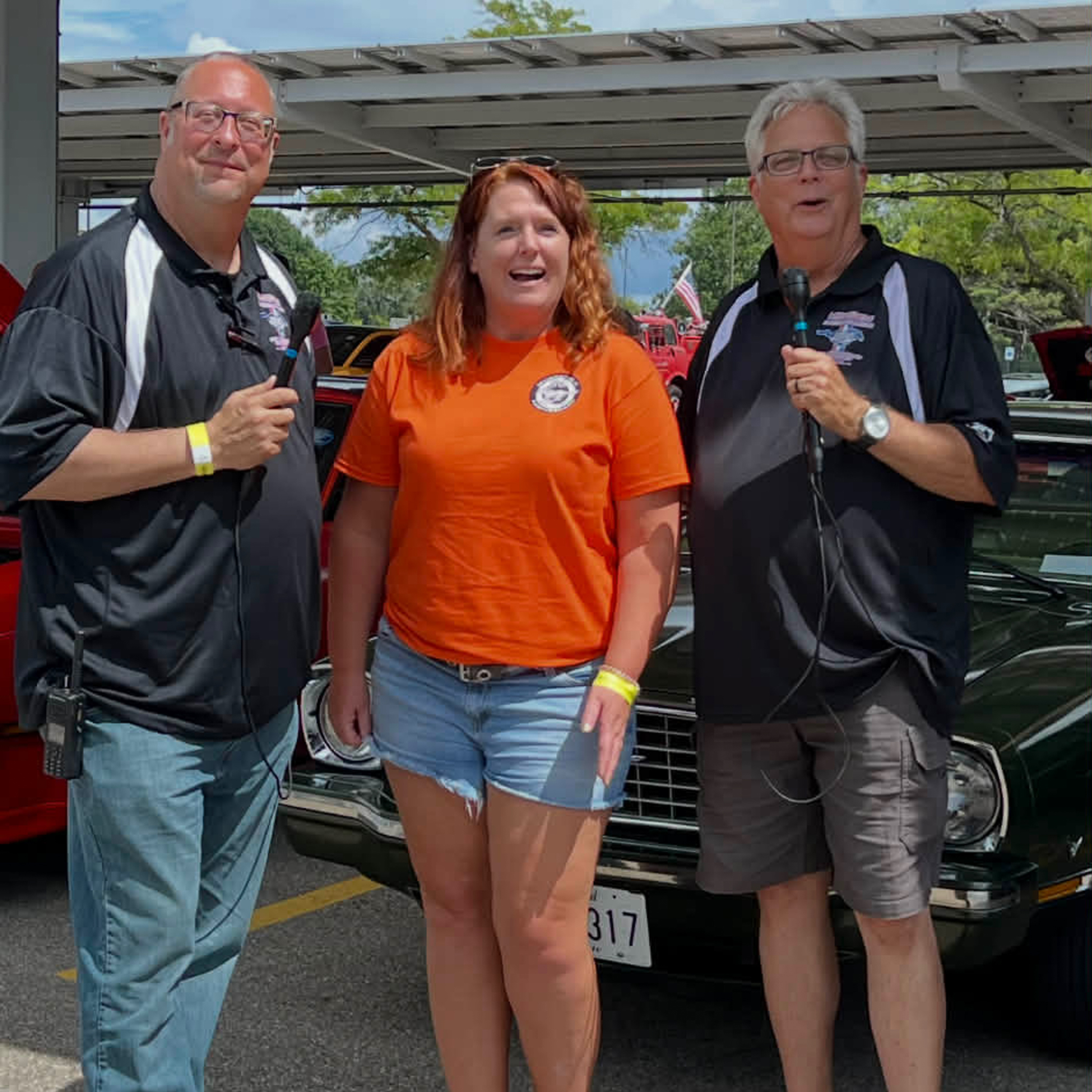
Amy Rebecca: How a Fox Body Love Affair Turned into her Mustang Mega-Collection
About this episode
Amy Rebecca shares how a childhood fascination with a neighbor’s Mustang grew into a huge collection built around Fox bodies, Cobras, and oddball cars that often found her rather than the other way around. She walks through her current stable of 16 Mustangs, including rare 1979–1993 examples, a 95 Cobra hardtop convertible, and a daily-driver 2015 V6. The conversation also covers her move to Tennessee, retirement, and plans to keep driving and showing the cars she loves.
If you’ve been in the Mustang hobby for a while, then you’ve likely heard about extensive Mustang collections that some fortunate fellows have been able to put together over the years. But it’s not too common to come across women with personal Mustang collections that they’ve grown well into the double digits. That’s precisely why John and Mike decided to catch up with Mustang enthusiast-turned-collector Amy Rebecca, whose eclectic stable of Ford pony cars is both notable and remarkable. Listen in as Amy traces the story behind each and every Mustang she owns – and why she loves them. While John knew Amy from her Mustang II Ghia’s appearance at a show, Mike’s interest stems from Amy’s favorite Fox Bodies, including the super-rare early-80’s Cobras. And just wait until you hear what’s next!
Selene reunion
"The Mustang 2 reunion, she brought hers there. We did, I think it was the Selene reunion, we did a Foxtoberfest, she brought that there."
“Selene reunion” appears to be another themed Mustang event tied to a specific car/brand identity within the hobby. The transcript doesn’t explain what “Selene” means here, but it suggests a community centered around a particular Mustang style or build.
root cause of our Mustang illness
"So when Amy, when we get a collector and a Mustang lover like you, you know, we got to take us back to the beginning and people need to find what they call the root cause of our Mustang illness. So what in the heck got you, this little girl, into Mustang?"
They’re basically asking what started the person’s Mustang obsession in the first place. It’s an “how did you get into Mustangs?” story angle.
The hosts use “root cause” as a metaphor for why someone becomes obsessed with Mustangs. It frames the episode as an origin-story discussion—what sparked the passion and how it turned into collecting.

Ford Mustang
"So I think I would have to go back to kindergarten, first grade, my best friend at the time, her [106.1s] parents had a Mustang and it must, I'm guessing it must have been a 79, 80, 81 somewhere in [112.6s] there. [112.9s] And I just thought it was the coolest thing I'd ever seen. [116.1s] Like I'd go over her house to spend the night and I would always ask questions about the [119.6s] Mustang"
A Ford Mustang is a famous American sports car. It’s known for its classic looks, and in this story it’s the car that first grabbed her attention as a kid.
The Ford Mustang is one of the most iconic American pony cars, and it has gone through many generations since the late 1960s. In this segment, the host is describing early exposure to a late-1970s/early-1980s Mustang and what visually stood out to her (the front-end styling).
round like grill medallion on the hood
"[119.6s] Mustang and she would just kind of look at me funny like, why do you care about this? [124.2s] But I just loved the, the round like grill medallion on the hood. [128.7s] I just thought that was the coolest thing ever. [131.2s] And then I just always liked them."
The speaker is describing a specific visual detail on the hood/grille area—an emblem/medallion style feature. On classic Mustangs, these kinds of exterior badges and trim details are part of how enthusiasts identify year-to-year styling differences and package options.
stick ship car
"[150.8s] I ended up dating somebody who had a 90 LX50 with black with a sunroof stick ship car. [157.9s] And I just thought it was the coolest car ever. [159.7s] I had to meet him because of his car, like this is what I like about you, Amy."
“Stick ship car” means it had a manual transmission (a stick shift). Instead of the car shifting for you, you choose the gears yourself.
“Stick ship car” is a colloquial way of saying the Mustang had a manual transmission. Manual gearboxes are often part of the appeal for classic Mustangs because they make the car feel more engaging and give the driver more control.
sunroof
"[150.8s] I ended up dating somebody who had a 90 LX50 with black with a sunroof stick ship car. [157.9s] And I just thought it was the coolest car ever. [159.7s] I had to meet him because of his car, like this is what I like about you, Amy."
A sunroof is a panel in the roof that lets in extra light and can open for fresh air. It’s a noticeable option people often remember on older cars.
A sunroof is a glass or fabric panel in the roof that can open for ventilation and light. On classic Mustangs, it’s a common feature people mention because it changes the cabin feel and can affect how the car was optioned.

Toyota A90
"I just had to have one. I ended up dating somebody who had a 90 LX50 with black with a sunroof stick ship car. And I just thought it was the coolest car ever."
The Toyota Supra is a sports car from Toyota. It’s known for being fast and exciting, which is why people often get really interested in it. The podcast mention is about someone having a strong personal connection to one.
The Toyota Supra is a performance sports car known for its reputation and enthusiast following. It comes up in conversations because certain model years are especially memorable to owners and fans, and because it’s often treated as a “dream car.” In the podcast context, it’s mentioned as a personal favorite that stood out due to the car’s look and feel.
forever car
"But Amy, what was your first one when you said I'm going to buy one and that's going to be my forever car? So I graduated college in 96 and my dad was like, well, you can come back here and live,"
A “forever car” is the car someone hopes to keep for many years. It usually means it’s the one they really want, not just something temporary.
“Forever car” is enthusiast slang for a vehicle someone plans to keep for a very long time—often because it matches their identity, driving needs, and collecting goals. In this context, it frames why she prioritized getting a Mustang right after college.
co-signed for me
"So my parents helped me. They co-signed for me, but it was all my my payment. And so that was my first Mustang."
Co-signing means someone else helped guarantee the loan. If you can’t make the payments, the co-signer may have to step in.
Co-signing is when another person (often a parent) agrees to take financial responsibility for a loan if the borrower can’t pay. For car buyers, it can make approval easier or improve loan terms when the buyer is new to working.
Mustang Fox Body
"...s, I thought that was your car. And then I see a Fox body. Then I see, you know, then you got a summer edi..."
“Mustang” here means the Ford Mustang sports car series. The podcast speaker is talking about spotting different older versions, like the Fox body. That’s why you hear references to specific Mustang types and years.
In this podcast context, “Mustang” is used to refer to the Ford Mustang line, including older generations like the Fox body. Different Mustang generations are often discussed because they have distinct styling, driving character, and parts availability. The mention of seeing a Fox body and other variants suggests the conversation is about recognizing and comparing Mustang eras.
Foxtoberfest
"The Dennis Carpenter Award at Foxtoberfest? I mean, yeah, we interviewed her twice before, once at Memories and once at Foxtoberfest as well for the podcast."
Foxtoberfest is a Mustang meet-up/event for enthusiasts. It’s where people show their cars and where the community gives out recognition and awards.
Foxtoberfest is a Mustang-focused event where Fox body owners and enthusiasts gather. Awards and interviews tied to the event are a big part of how the community recognizes cars and owners.
Dennis Carpenter
"Mike, what was it? The Dennis Carpenter Award at Foxtoberfest?"
Dennis Carpenter is a well-known Mustang parts supplier, especially for Fox body cars. An award named after him typically reflects contributions to the Fox body community and the parts ecosystem that supports these cars.
Mustang owners podcast
"It's time to fess up. You're on the Mustang owners podcast. People on this show love Mustang owners."
This podcast is specifically about Mustang owners and their cars. It’s more about the people and the Mustang community than just specs.
This refers to the show’s niche focus: Mustang owners and the culture around owning specific Mustang generations. In this context, it frames the conversation as community-driven rather than a general car review.
daily driver
"And this doesn't include my daily driver. Okay. Okay."
A daily driver is the car you actually use most days. It’s the one you rely on for normal driving, not the one you’re saving for a future project.
A daily driver is the car you use regularly for everyday errands and commuting. In a collection context, it’s often kept separate from non-running or project cars so the owner still has reliable transportation.
running and driving
"I'm talking about, I mean, dude, they're not actually running and driving. You're not talking rusting shells in the backyard that someday you're going to fix up."
“Running and driving” means the car can start, move under its own power, and be driven safely enough to operate like a normal vehicle. For collectors, this is a big distinction from cars that are only stored as parts or restoration projects.
rusting shells in the backyard
"You're not talking rusting shells in the backyard that someday you're going to fix up. You're talking about cars with wheels on them."
“Rusting shells” refers to stripped-down, non-running car bodies that are stored for later restoration. It’s a common way enthusiasts describe long-term projects that may take years to bring back to road-worthy condition.
MCA cars
"Toby is one of my current MCA cars. It's concourse restored, concourse trailer restored."
“MCA” sounds like a Mustang club or group. Amy is saying Toby is one of the cars she currently has connected to that group. Clubs like this often organize shows and help owners keep their cars in top shape.
“MCA” in this context most likely refers to a Mustang club or organization that Amy is part of, and “current MCA cars” implies she has multiple Mustangs associated with that group. Club affiliation can matter in the collector world because it often connects owners to events, judging standards, and parts sourcing. The transcript doesn’t expand the acronym, so the exact meaning is uncertain.
concourse restored
"Toby is one of my current MCA cars. It's concourse restored, concourse trailer restored."
“Concourse restored” means the car was rebuilt to look extremely correct, like it’s ready for judging shows. It’s usually more detailed than just making it run and look decent. Amy is saying her car is restored to top show standards.
“Concourse restored” means the car has been restored to look and function as close as possible to how it would have appeared when new, down to details judged at concours events. It’s typically more exacting than a driver-quality restoration, often involving careful originality and presentation. In collecting circles, it signals a high level of work and authenticity.
Carlisle
"It has made an appearance at Carlisle before and the Chocolate Fox show."
Carlisle is a famous car-show/collector event. If a car has been to Carlisle, it usually means it’s been shown and cared for by enthusiasts. Amy is using it to show Rusty’s “show history.”
Carlisle refers to the Carlisle events in Pennsylvania, which are well-known for car shows and auctions—especially for classic American cars. Mentioning that Rusty has appeared at Carlisle signals the car is active in the show circuit and likely maintained to a high standard. For collectors, event history can be part of a car’s story and provenance.
Chocolate Fox show
"It has made an appearance at Carlisle before and the Chocolate Fox show."
This sounds like a themed car show for Fox-body Mustangs. Amy is saying Rusty has shown up at that kind of event before. It helps listeners understand the car’s community and show pedigree.
The “Chocolate Fox show” appears to be a niche Mustang/Fox-body themed event. Amy’s mention places Rusty within a specific enthusiast community and suggests the car is recognized among Fox-body collectors. Event names like this often matter because they indicate where the car is known and how it’s presented.
Ponies in the Smokies
"And then Franklin was actually just at Ponies in the Smokies. That's a 79 Cobra, black with the green graphics."
“Ponies in the Smokies” is a Mustang-focused car event. Amy is mentioning it to say Franklin was recently shown there. That’s a way collectors track where their cars have been and how they’re received.
“Ponies in the Smokies” is an enthusiast event name, likely focused on Mustang owners and classic pony cars. Amy uses it to document where Franklin recently appeared, reinforcing that her cars are active in the show scene. For collectors, these event appearances can help establish a car’s reputation and visibility.
straight six
"I have Blueberry, which is a blue 80 Gia coupe. That's a straight six that actually I took that to Fox. Hey, we're fast last year."
A “straight six” means the engine has six cylinders in a single line. It’s a common older-engine layout, and it can be a little different from the V8s people usually associate with Mustangs.
A “straight six” is an inline six-cylinder engine layout. Compared with V8s, inline-sixes are often smoother and can be easier to work on for some owners, but performance and parts availability depend heavily on the exact engine family and year.

1980 Cobra
"OK, and then I the one that I was leading to the one of the ones that doesn't run, I picked up in 1980 Cobra in the fall. It's a 2.3 turbo, but it needs a full restoration."
This sounds like a Ford Mustang “Cobra” from 1980 that the owner bought as a project. They’re saying it’s not running and will need a lot of work to bring it back.
The Ford Mustang “Cobra” name is being used here for a specific 1980 Mustang project car. In this segment, the host says it’s a 2.3 turbo and that it needs a full restoration, which frames it as a long-term restoration candidate rather than a daily driver.
2.3 turbo
"OK, and then I the one that I was leading to the one of the ones that doesn't run, I picked up in 1980 Cobra in the fall. It's a 2.3 turbo, but it needs a full restoration."
“2.3 turbo” means the car has a 2.3-liter engine with a turbo. The turbo helps the engine make more power, but it can be more complicated to keep healthy—especially on an older car.
A “2.3 turbo” refers to a 2.3-liter engine equipped with a turbocharger. Turbocharging forces more air into the engine, which can increase power potential, but it also adds complexity (boost control, cooling, and oil management) that matters during restoration and maintenance.
one year only gas tank
"Which comes with the one year only gas tank. And ask me how I know... One year only for that model."
This means her Mustang’s gas tank is only correct for that one model year. If you grab the wrong year’s tank, it may not fit or work properly.
A “one year only gas tank” means the fuel tank design/fitment is unique to that model year, so it can’t be replaced with the most common tank from other years. That makes sourcing harder and can increase cost, especially for older, less common configurations.
MPD
"Luckily, MPD helped me locate one at Greens before Greens closed. And they had exactly one available."
MPD is referenced as a help in locating a hard-to-find part (the correct one-year-only gas tank). In Mustang circles, specialty parts sourcing networks like this can be crucial when a component is scarce or year-specific.
Greens
"Luckily, MPD helped me locate one at Greens before Greens closed. And they had exactly one available."
Greens is where the part was found. When a place like that closes, it can become much harder to get the exact parts you need for an older car.
“Greens” is mentioned as the place where MPD found the last available one-year-only gas tank before the shop closed. For collectors, closing yards/suppliers can suddenly make certain parts much harder to obtain.
evap
"...depending on the fuel pressures and the fitment of some evap, the gas tanks have to be different."
EVAP is the system that keeps fuel vapors from escaping into the air. If you change the engine or fuel setup, the EVAP connections may not match, so the fuel tank (and related parts) may need to be different.
“EVAP” refers to the evaporative emissions system that captures fuel vapors and routes them through charcoal canisters and valves instead of venting to the atmosphere. The hosts are saying that EVAP plumbing/fitment can differ when swapping between turbo and V8 setups, which can require a different fuel tank.
turbo vs naturally aspirated fuel system differences
"...when they put the turbos on the car rather than naturally aspirated, it sucks the gas tanks in because the higher fuel rail pressures are different on a turbo."
When a car gets turbocharged, it often needs different fuel delivery settings than a naturally aspirated engine. Those changes can mean the fuel tank and plumbing have to be different too.
The hosts describe a common engineering knock-on effect: adding turbocharging changes fuel delivery requirements (including higher fuel rail pressures) and can alter how the fuel tank and related components are packaged and calibrated. That’s why turbo cars may use different tank designs than naturally aspirated versions.
fuel rail pressures
"...higher fuel rail pressures are different on a turbo."
Fuel rail pressure is how strongly fuel is pushed to the engine’s injectors. Turbo engines usually need different fuel pressure than non-turbo engines, which can affect what fuel-system parts fit and work correctly.
Fuel rail pressure is the pressure in the fuel delivery system feeding the injectors. Turbo engines often require different (often higher) fuel rail pressures than naturally aspirated engines, which can cascade into changes in tank design, plumbing, and emissions components.
bladder tank
"...the bladder tank on a Cobra, a 78 with that little two and a half gallon tank up in the fender."
A bladder tank is a fuel tank design that uses a flexible inner container to hold the gas. It’s often used when there isn’t room for a normal rigid tank, and in this case it’s a rare part.
A “bladder tank” uses a flexible inner bladder to hold fuel, typically to fit packaging constraints and reduce the risk of fuel sloshing issues. The hosts are saying the Cobra’s bladder tank (with a small capacity) is a rare, hard-to-source component.
two and a half gallon tank
"...with that little two and a half gallon tank up in the fender."
They’re pointing out that this Cobra setup uses a very small fuel tank—only about 2.5 gallons. That’s why it’s not something you can easily replace with a normal tank.
The hosts mention the Cobra’s very small “two and a half gallon” tank capacity, emphasizing how unusual the setup is compared with typical full-size fuel tanks. This helps explain why the part is scarce and why swaps can be complicated.
T-top
"Then I have an 82 Gilex teatop car... But it's kind of rare because it's a Gilex. They didn't make a lot of Gilex top cars. Plus Fox body teatops are always cool."
T-tops are roof panels you can take out to let in more air and light. They’re a popular feature on certain Mustangs because they feel more open than a normal roof.
T-tops are removable roof panels (two-piece sections) that let you open up the cabin like a convertible, but without the full convertible body style. The host notes that Fox-body T-tops are “always cool,” reflecting how this feature can add desirability.
sourcing a ton of cars for the 50th anniversary
"Yeah. And you know, real quick, Amy, to just when me and John, where we were sourcing a ton of cars for the 50th anniversary and 80 and 81 were by far the hardest ever fight."
The segment mentions “sourcing a ton of cars” for a “50th anniversary,” which suggests a collector/market effort to find specific model years and configurations. In enthusiast circles, anniversary-driven demand can affect pricing and availability, especially for rare trims and colors.
Motorcraft battery
"And I also had a really rare motorcraft battery that a lot of MCA people are after. So I sold the battery and it was enough money to pay for the car."
Motorcraft is Ford’s own brand for parts. If a Motorcraft battery is described as rare, it likely means it’s the right kind for that era, and collectors care about that kind of detail.
Motorcraft is Ford’s parts brand, and a “Motorcraft battery” being described as “really rare” suggests the car may have had period-correct or hard-to-find original equipment. For collectors, correct branding and date/fitment can matter for authenticity.
MCA people
"And I also had a really rare motorcraft battery that a lot of MCA people are after. So I sold the battery and it was enough money to pay for the car."
“MCA people” means Mustang collectors who are part of a Mustang club/community. In these groups, members often know which parts are hard to find and that can affect prices.
“MCA” in this context likely refers to the Mustang Club of America (or a similar Mustang collector community), where members trade knowledge and parts. Collector communities like this can significantly influence what’s considered rare and what parts sell for.
eBay
"an original SVT license plate frame and people are thinking he might get up to a grand for it on eBay. Oh, yes, yes. The stainless steel in the package and everything."
eBay is a website where people buy and sell things online. Collectors use it to find rare car-related items. Here, they’re talking about what an SVT item could sell for there.
eBay is an online marketplace where collectors buy and sell parts, memorabilia, and rare accessories. In enthusiast circles, items like original license plate frames can trade for surprisingly high prices depending on authenticity and condition. The segment uses eBay as the venue where the SVT frame might sell for a large amount.
automatic
"But OK, then 89 I have a saline and it's automatic. It was ordered as an automatic, which is also kind of a weird thing. And we saw that at Foxtoberfest a couple years back."
Automatic means you don’t have to shift gears yourself. You just drive and the car changes gears for you. Some Mustang fans prefer manuals, so an automatic can feel unusual or less expected.
An automatic transmission means the car shifts gears without the driver operating a clutch or manual gear lever. For many performance-minded Fox body Mustangs, manuals are more common, so an automatic order can stand out to collectors. The hosts call it “weird,” implying it’s an unusual spec for the kind of car they’re discussing.
five speed
"A friend had it at five speed and a friend was like, that was your first fox. Don't you want another one? The other one was not a five speed, but this one is a five speed."
“Five speed” means the car has a manual gearbox with five gears. It’s the kind of setup many Mustang fans prefer because it’s more engaging to drive.
“Five speed” refers to a manual transmission with five forward gears. On Fox Body Mustangs, the specific manual transmission choice matters because it affects feel, shift pattern, and how the car behaves under acceleration.
million mile odometer
"And the other one has the million mile odometer, which was starting to make an appearance in 93. Wow. OK. Then we move on to 93."
A “million mile odometer” refers to a car whose odometer has reached (or is showing) one million miles. On older Mustangs, this is a notable durability milestone and often implies long-term maintenance and frequent driving rather than garage storage.
original miles
"OK, that car has fourteen thousand five hundred original miles. Wow, I do not drive it and there's one off the trailer."
“Original miles” refers to a car’s mileage that remains as-delivered, without being rolled back or replaced. In collector circles, low original mileage is a major indicator of condition and helps support claims of originality. It often correlates with less wear on interior, drivetrain components, and wear items.
warranty
"It's just changed the numbers on the warranty. It's still under warranty."
The transcript mentions the car “still under warranty,” highlighting how warranty coverage can apply even to a very low-mileage collector car. Warranty terms can be affected by ownership changes, mileage, and how the warranty is administered. In practice, buyers often verify warranty status and transferability before relying on it.
Best Third Generation
"So that one actually did win Best Third Generation in the years of Mustang display at Ponies and the Smokies last weekend."
At a car show, “Best Third Generation” means the car won an award in a category for a certain Mustang generation. It’s basically the show saying, “This one was the best among the cars in that group.”
“Best Third Generation” is a class award at a Mustang-focused show, meaning the car won within the third-generation category. For Fox-body fans, “third generation” typically refers to the 1979–1993 Mustang era, and these classes help judges compare like-for-like cars. Winning indicates strong presentation and/or originality relative to other entries in that class.
Ponies and the Smokies
"So that one actually did win Best Third Generation in the years of Mustang display at Ponies and the Smokies last weekend. Very cool."
“Ponies and the Smokies” is the name of a Mustang event where cars are displayed and judged. Mentioning the event provides context for why awards like “Best Third Generation” matter to the owner and collector community. It also signals the car’s participation in a real show environment, not just private collecting.
leather
"But it has great leather and a sunroof. And he got my favorite is black."
“Leather” refers to leather upholstery, which is a common option on Mustangs and can significantly affect comfort and perceived value. For collectors, interior condition—especially when paired with low mileage—can be a strong indicator of overall preservation. Leather also has its own maintenance needs (conditioning, avoiding cracking).
collectible car set completion
"“fully completes the Fox body Cobra… No more cars that Amy needs at all.”"
They’re describing the collector goal of finishing a “set,” like getting the specific cars/years/versions that complete the collection. It’s less about buying random cars and more about checking off the exact ones people want.
The hosts talk about “fully complet[ing]” a Fox-body Cobra and then joking that adding the next year means “No more cars that Amy needs at all.” This is a common collector mindset: building a complete set by year/trim/configuration, where the goal is completeness rather than just driving or performance.
hard top convertible
"“I also have a 95 Cobra, but it's the hard top convertible one.”"
“Hard top convertible” means a convertible that’s built to feel more solid than a regular soft-top. Collectors often care about these versions because they’re less common.
A “hard top convertible” usually refers to a convertible that uses a more rigid roof structure than a typical soft-top, or a convertible design that’s discussed as having a “hard-top” feel/structure. In collector circles, these configurations can be rarer and more desirable because they’re less common than standard soft-top convertibles.

Shelby Cobra
"That's not my daily driver. I also have a 95 Cobra, but it's the hard top convertible one. So the b..."
The Shelby Cobra is a sports car made to be very fast and exciting. It’s usually considered a special car, not something most people use every day. The podcast mentions it as part of the owner’s collection.
The Shelby Cobra is a high-performance sports car associated with the Shelby brand and built for serious driving thrills. It’s frequently discussed because it’s a distinctive, iconic design and because many owners treat them as special vehicles rather than everyday transportation. In the podcast, it’s referenced as part of the host’s lineup, highlighting its role alongside other cars.
Maxim Club
"“But we got two people in the Maxim Club that are owners of 95 hard top convertibles.”"
They mention the “Maxim Club,” which sounds like a group of car enthusiasts. The point is that only a couple of members have that rare 1995 convertible setup.
The transcript mentions “two people in the Maxim Club” who own 1995 hard-top convertibles. This sounds like an enthusiast group or club tied to a specific car community, where members share ownership information and knowledge about rare variants.
unloved six cylinder
"and it didn't really matter to me because I always joke around that I have the orphanage for unloved six cylinder."
She’s basically saying she collects the “unloved” V6 Mustangs—the ones people don’t talk about as much. It’s a way of appreciating cars that aren’t the most famous or fastest on paper.
Amy’s “orphanage for unloved six cylinder” is a collector concept: focusing on the less-hyped V6 Mustangs instead of only chasing the most famous performance variants. It highlights how enthusiasts can build a meaningful collection around overlooked configurations.
RTR
"That would be great. But I also retired last year. Early retirements for the federal government. And I moved to Tennessee."
RTR is a company that makes Mustang performance and appearance upgrades. When someone says they have an “RTR” Mustang, they usually mean it’s been built or styled by that aftermarket brand.
RTR refers to a performance and styling brand associated with Ford Mustangs, known for aftermarket parts and turnkey builds. In this context, “2025 RTR” suggests a Mustang modified or branded by RTR rather than a stock factory car.
Pony
"Like the Celine, that's a really good story. I had just come back from Pony. I was actually on my way back from ponies in the Smokies in 23. And this woman contacts me out of the blue."
“Pony” here is almost certainly shorthand for a Mustang event or gathering (since the episode is about Mustangs and “ponies in the Smokies” is mentioned). These meetups are common in the Mustang community and often lead to networking and car sales.
pole barn
"...Derek Bieri thing where you're setting up your pole barn and trying to get all these horses into that stable."
A pole barn is a simple metal building supported by posts, commonly used to store vehicles and equipment. For collectors, it’s a practical way to keep cars protected from weather while you work on them over time.
rotate through
"Are you going to try to keep them all going and maybe rotate through? I mean, you can't just park them and go in there and look at them."
She’s describing the idea of not using just one car all the time. Instead, you drive different cars on different days so they stay in better shape.
“Rotate through” means periodically driving different cars instead of leaving them parked. For collectors, rotation helps reduce issues from long storage (like battery drain, flat spots, and stale fluids) while also keeping each car exercised.
Mustang Club of America
"Like Mustang Club of America's 50th birthday is at the end of they're having their show at the end of August."
Mustang Club of America is a Mustang fan group that puts on events. She’s choosing which of her cars to drive based on when their big show happens.
Mustang Club of America (MCA) is a dedicated enthusiast organization that hosts events and club shows for Mustang owners. She’s planning which car to bring based on MCA’s 50th birthday show schedule.
in conservator
"probably the yellow 93. It's in conservator. Beautiful."
“In conservator” sounds like she’s keeping that car protected while it’s not being used. The goal is to preserve it so it stays looking great for shows.
“In conservator” suggests the car is being stored or protected in a conservation-style environment, often meaning controlled conditions to preserve condition and reduce deterioration. Collectors may use this term to describe special storage for show cars.
Mustang Week
"Unfortunately, Mike, that's the same weekend as Mustang Week, I think. It is. Yeah, for sure."
Mustang Week is a big Mustang event where lots of owners show up. She’s saying it might overlap with another show she wants to attend.
Mustang Week is a major annual Mustang-focused event, typically drawing large crowds and lots of owners driving their cars. She notes a scheduling conflict because MCA’s show weekend overlaps with Mustang Week.
Mustang community
"collector enthusiast women in the entire Mustang community. You know, not only that, Amy, most, I mean, I know some ladies that have"
The “Mustang community” is basically the group of people who love Mustangs. They meet at shows and share tips, and that’s where a lot of the collecting and “what’s cool” ideas come from.
The “Mustang community” refers to the broader enthusiast network—clubs, shows, forums, and social circles—where owners share knowledge, parts sources, and event connections. For collectors, these communities often determine which cars are most sought after and how values and reputations develop over time.
Mustang show
"So Amy, do you find yourself when you're at the show... You, you are the quintessential Mustang collector... But just beware when you're at a Mustang show and they see this beautiful gout, these beautiful cars, they want to take you to, hey, let's all go over to"
A Mustang show is a car event where people bring their Mustangs and talk to each other. If you have a really impressive collection, other owners will notice and want to ask about your cars.
A Mustang show is a car-enthusiast event focused on Ford Mustangs, where owners display cars and swap stories. These events often create a “collector magnet” effect—people recognize the brand and start conversations, questions, and sometimes networking around specific cars and builds.
Mustang collector
"You, you are the quintessential Mustang collector... Probably, yeah... if you have a Mustang collection anywhere in your Amy's, call us because we want to find you."
A Mustang collector is a person who has more than one Mustang. They usually enjoy the cars so much that they keep collecting them, restoring them, or showing them.
A Mustang collector is someone who owns multiple Mustangs—often across different years, trims, or builds—rather than just one daily car. Collecting can be about preservation, restoration, or building a personal “garage history,” and it usually comes with a strong network of other owners.
one car from each generation
"“...so we're doing one car from each generation. Amy, we're going to get more details later...”"
They’re planning to show a Mustang from multiple eras, not just one year or style. It’s a way to show how the car changed from generation to generation.
“One car from each generation” means selecting representative Mustangs across different model eras. This helps viewers understand how the Mustang evolved over time—design, engineering, and what each era is known for.
seven generations
"Everybody has a Mustang story and we're going to find the coolest Mustang stories per all seven generations at Carlisle."
When they say “seven generations,” they mean the Mustang has been redesigned and updated in several big eras. It’s a simple way to talk about how the car changed over the years.
The phrase “seven generations” is a way of grouping Mustang model eras into distinct redesign periods. For listeners, it helps frame how the Mustang evolved over time—body style, technology, and performance changes—so “Mustang stories” can span decades.
clubs
"you can check out our talk about clubs. Are they facing tragedy?"
They’re talking about car clubs—how they work and what they mean to members.
The hosts briefly reference a prior episode segment about clubs and then continue discussing the Mustang club community. This functions as a structural topic marker for the conversation.
Mark Badella
"We had a great interview with Mark Badella, the greater Pittsburgh Mustang. And I want to read his thank you car."
Mark Badella is mentioned as the guest behind an interview connected to the “greater Pittsburgh Mustang” community. This is relevant because it ties the Mustang club scene to real people and local organizations.
SVT store dot com
"You know, you can check out our apparel store at the SVT store dot com. And make sure you get on to either Spotify or YouTube"
They mention SVT store dot com as their apparel shop. SVT is Ford’s performance brand, so it’s a natural place for Mustang fans to find gear.
The SVT store dot com is referenced as the place to buy Mustang-related apparel. SVT is Ford’s “Special Vehicle Team” branding, which is commonly associated with performance Mustangs.
Request an Explanation
Heard something you'd like explained? We'll add it to this episode.
Sign in to request explanations for terms you heard.
Want to learn more?
Browse our glossary for plain-English explanations of automotive terms, jargon, and concepts.
Help improve this episode
See something that's not quite right? Our annotations are AI-generated and can sometimes miss the mark. Click the flag icon on any annotation to suggest a correction.