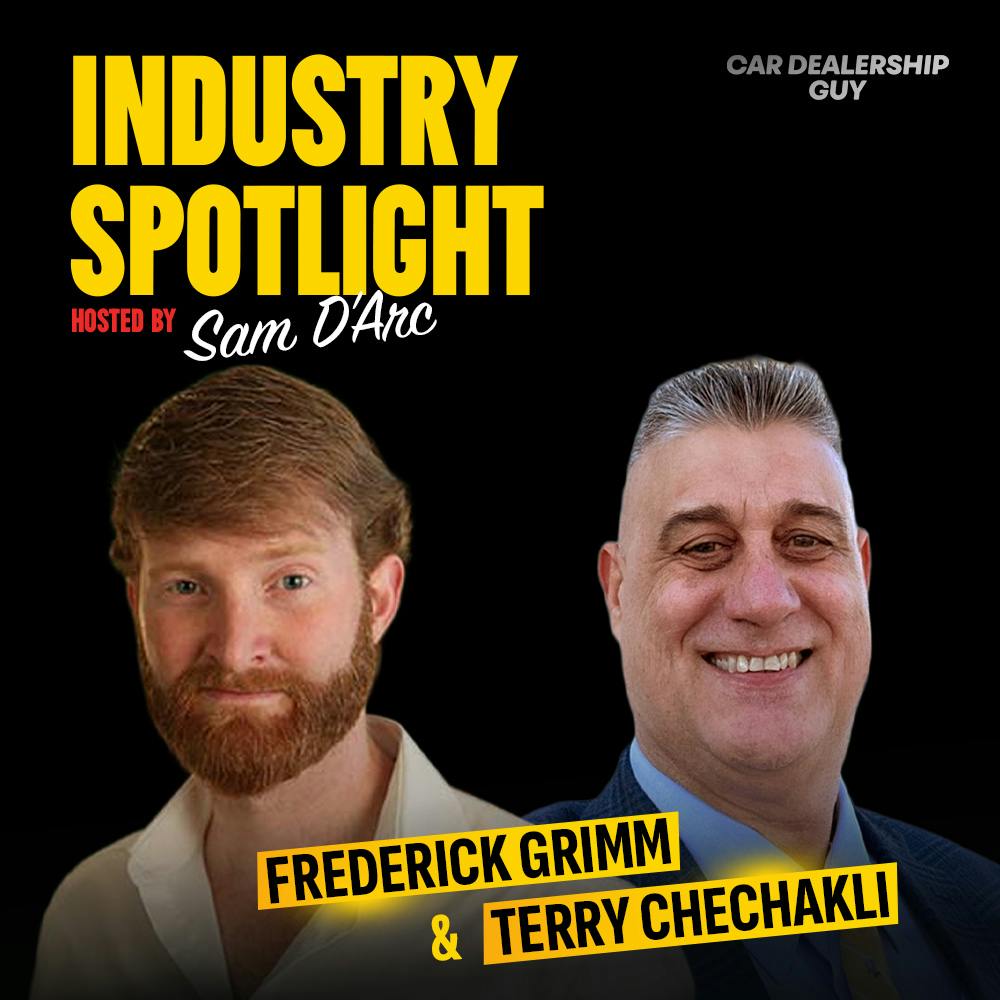
Exploring the intricacies of used car acquisition, this episode features Terry Shishokli from Smith Auto Group and Frederick Grimm from Appraisal Pro. They discuss strategies for increasing the used-to-new car ratio, emphasizing the importance of trust and transparency in the appraisal process. A key highlight is the introduction of an OBD2 diagnostic tool that helps uncover hidden issues in vehicles, allowing dealers to make more informed buying decisions. The conversation also touches on the integration of technology in automotive practices and the evolving landscape of dealership operations.
Welcome to Industry Spotlight—a focused series hosted by Sam D’Arc, highlighting standout dealerships and innovative companies, and exploring the trends driving success in today’s automotive market. Today, Sam sits down with Terry Chechakli, Director of Operations at Smith Auto Group, and Frederick Grimm, Co-founder of FIXD.
This episode of the Car Dealership Guy Podcast is brought to you by AppraisalPRO:
AppraisalPRO - Stop getting hammered on hidden trade-in costs. AppraisalPRO instantly reveals repair costs, alerts you to recently cleared codes, and integrates directly with vAuto— meaning diagnostic data populates automatically in your appraisals. Our comprehensive scans take seconds, not minutes, and are simple enough for anyone on your team to use. Join dealers saving $10,000s per month with the fastest and most accurate OBD2 appraisal solution in the market. Special deal for CDG listeners: FREE 1-week trial, then just $195/month with no setup fees and OBD2 scanners included. Visit @ http://www.getAppraisalPRO.com
Check out Car Dealership Guy’s stuff:
For dealers:
Industry job board ➤ http://jobs.dealershipguy.com
Dealership recruiting ➤ http://www.cdgrecruiting.com
Fix your dealership’s social media ➤ http://www.trynomad.co
Request to be a podcast guest ➤ http://www.cdgguest.com
For industry vendors:
Advertise with Car Dealership Guy ➤ http://www.cdgpartner.com
Industry job board ➤ http://jobs.dealershipguy.com
Request to be a podcast guest ➤ http://www.cdgguest.com
Topics:
01:22 Smith Auto's growth and acquisition strategy?
02:10 Biggest used car acquisition challenges?
03:12 Auctions vs. alternative inventory sources?
06:28 How AppraisalPro improves transparency?
10:30 Appraisal Pro's financial impact?
21:59 How do OBD scans help?
24:52 From fault codes to recon estimates?
27:31 Benefits of transparent dealings?
38:35 Future developments for AppraisalPro?
Car Dealership Guy Socials:
X ➤ x.com/GuyDealership
Instagram ➤ instagram.com/cardealershipguy/
TikTok ➤ tiktok.com/@guydealership
LinkedIn ➤ linkedin.com/company/cardealershipguy
Threads ➤ threads.net/@cardealershipguy
Facebook ➤ facebook.com/profile.php?id=100077402857683
Everything else ➤ dealershipguy.com
"We have right now two Mercedes stores, three Volvo stores, and then a GM store, Ford store,..."
Mercedes is a well-known car brand that makes luxury cars and trucks. They are famous for their quality and advanced features.
Mercedes-Benz is a German automotive brand known for luxury vehicles, buses, and trucks. The brand is recognized for its high-quality engineering and innovative technology.
"...three Volvo stores, and then a GM store, Ford store,..."
Volvo is a car brand from Sweden that is famous for making safe and reliable cars. They offer different types of vehicles, including SUVs and sedans.
Volvo is a Swedish automotive brand known for its focus on safety and durability in its vehicles. The brand produces a range of cars, including sedans, SUVs, and wagons.
"...and then a GM store, Ford store, Mazda store,..."
Ford is a well-known American car company that makes a variety of vehicles, including trucks and cars. They are famous for models like the Ford F-150 truck.
Ford is an American automotive brand known for its trucks, SUVs, and cars. The brand has a long history and is recognized for popular models like the Ford F-150 and Mustang.
Mazda is a Japanese car brand that makes different types of vehicles, including sedans and SUVs. They are known for their stylish designs and unique engine technology.
Mazda is a Japanese automotive brand known for its innovative designs and technology, particularly its rotary engines. The brand produces a range of vehicles, including sedans and SUVs.
"...and what's your new used mix across the group? Well, that was what I was gonna go with. So right now we're at 2.75 to one used to new."
The new to used car ratio shows how many new cars are sold compared to used cars. A ratio of 2.75 to 1 means that for every 2.75 used cars, one new car is sold.
The new to used car ratio indicates the proportion of new cars sold compared to used cars. A ratio of 2.75 to 1 means that for every 2.75 used cars sold, one new car is sold.
"So it's a device that plugs into the OBD port and gives you that diagnostic information. What point in the process do you use it"
The OBD port is a plug-in point in your car where mechanics can connect a device to check for problems. It helps them understand what's wrong with the car by reading data from the car's computer.
The OBD port, or On-Board Diagnostics port, is a standardized interface in vehicles that allows external devices to connect and access diagnostic information from the vehicle's computer systems. This information can help identify issues with the vehicle's performance and emissions.
"I had one that was a C300 about four months ago when I was in a store appraising a car and it came up with turbo problems."
The Mercedes-Benz C300 is a fancy car that is part of the C-Class series. It's known for being comfortable and having nice features.
The Mercedes-Benz C300 is a luxury sedan that is part of the C-Class lineup, known for its blend of performance and comfort. It often features advanced technology and a stylish design.
"...and it came up with turbo problems. And, you know, luckily I had..."
Turbo problems happen when the turbocharger, which helps the engine get more power, has issues. This can make the car not run as well or lose power.
Turbo problems refer to issues that can arise with a vehicle's turbocharger, which is a component that forces more air into the engine to increase power. Common problems include boost leaks, wastegate failures, and oil supply issues.
"is that it also shows you when the codes were last cleared. Ooh, so if somebody clears something before they come in to trade in that vehicle..."
Codes are messages that a car's computer creates when something is wrong. Mechanics use these codes to find out what needs to be fixed.
In automotive diagnostics, 'codes' refer to error codes generated by the vehicle's onboard computer when it detects a malfunction. These codes help technicians identify issues during repairs.
"...that specific examples where catalytic converters were bad, one needed a canister, a charcoal canister."
A catalytic converter is a part of the car that helps clean the exhaust gases before they leave the vehicle. It makes the car less polluting and is important for passing emissions tests.
A catalytic converter is an essential component of a vehicle's exhaust system that reduces harmful emissions by converting toxic gases into less harmful substances. It plays a critical role in meeting environmental regulations and improving air quality.
A charcoal canister is a small part in a car that helps keep fuel vapors from escaping into the air. It helps the car run cleaner and is part of the system that controls emissions.
A charcoal canister is a component of a vehicle's evaporative emissions control system. It captures fuel vapors from the fuel tank and prevents them from escaping into the atmosphere, thereby reducing emissions and improving fuel efficiency.
"...the sales manager will walk out with the OBD2 unit and set it on the desk and say, okay, so we scanned your vehicle..."
An OBD2 unit is a device that connects to your car to check for problems. It reads error codes that tell you if something is wrong with the engine or other systems in the car.
An OBD2 unit is a diagnostic tool used to read trouble codes from a vehicle's onboard diagnostics system. It helps mechanics and technicians identify issues with the vehicle's performance and emissions systems.
"So we actually started selling on the consumer side. We started a company called Fixed Automotive and we made an OBD2 sensor that helped everyday drivers understand in plain English what problems their vehicle had..."
Fixed Automotive is a business that makes a device called an OBD2 sensor. This device helps car owners figure out what's wrong with their cars and how much it might cost to fix them.
Fixed Automotive is a company that developed an OBD2 sensor designed to help drivers understand their vehicle's issues in simple terms. This technology allows users to diagnose problems and estimate repair costs easily.
"...we made an OBD2 sensor that helped everyday drivers understand in plain English what problems their vehicle had..."
An OBD2 sensor is a device that connects to your car to check for problems. It tells you what's wrong with your car and can help you understand how much it will cost to fix it.
An OBD2 sensor is a diagnostic tool that connects to a vehicle's onboard diagnostics system, allowing users to read error codes and monitor vehicle performance. It provides insights into potential issues and helps estimate repair costs.
"...So an OBD scanner to get greater visibility into issues with a used car isn't new."
An OBD scanner is a device that connects to your car to check for problems. It reads codes from your car's computer that tell you if something is wrong.
An OBD scanner is a diagnostic tool used to read data from a vehicle's onboard diagnostic system. It helps identify issues by retrieving trouble codes and other information from the car's computer system.
"...one thing to really highlight there is I'm sure everybody knows about OBD2 scanners. You can buy a cheap one off Amazon and it'll give you a code."
OBD2 scanners are devices that connect to your car to check for problems. They can tell you if something is wrong with the engine or other important parts.
OBD2 scanners are diagnostic tools used to read trouble codes from a vehicle's onboard diagnostics system. They help identify issues with the vehicle's performance and emissions systems.
"...you may have a really expensive OEM scan tool."
An OEM scan tool is a special device made by the car manufacturer to diagnose problems in their vehicles. It's usually more advanced and can do more than regular scanners, but it's also more expensive.
An OEM scan tool is a diagnostic device specifically designed by the original equipment manufacturer for their vehicles. These tools provide in-depth diagnostics and are often more expensive than generic scanners because they can access proprietary data.
"...I'm gonna use aftermarket parts. I'm gonna get as greedy."
Aftermarket parts are car parts made by different companies instead of the car's original maker. They can be cheaper and used to fix or improve your car.
Aftermarket parts are components made by companies other than the original manufacturer of the vehicle. They can be used for repairs or upgrades and often come at a lower cost compared to OEM (original equipment manufacturer) parts.
Term
OE
"...Yeah, generally for parts for using OE, there's kind of a mixture that we're using..."
OE means the parts that are made to be exactly like the ones that were originally in the car. They help keep the car running well and are a safe choice for repairs.
OE stands for Original Equipment, similar to OEM, and refers to parts that are made to the same specifications as the original parts used in the vehicle. These parts are often used in repairs to maintain the vehicle's performance and reliability.
"...when you use OEM parts, when you use factory certified technicians, and you recon that car to the best standard possible."
OEM parts are the original parts that come with your car when it's made. They are made by the same company that built your car, so they fit perfectly and work well.
OEM stands for Original Equipment Manufacturer, referring to parts made by the vehicle's manufacturer. Using OEM parts ensures that the components are designed specifically for the vehicle, maintaining quality and compatibility.
"...when you use factory certified technicians, and you recon that car to the best standard possible."
Factory certified technicians are mechanics who have been trained by the car's manufacturer. They know a lot about how to fix and maintain your specific car model.
Factory certified technicians are mechanics who have received specialized training and certification from the vehicle manufacturer. This ensures they are knowledgeable about the specific models and can perform repairs and maintenance to the manufacturer's standards.
"...and you recon that car to the best standard possible. And sometimes guys will wanna..."
Recon means fixing up a used car to make it look and work like new again. This can include cleaning, repairing, and checking everything to make sure it's safe and ready to drive.
Recon, short for reconditioning, refers to the process of restoring a used vehicle to a condition that meets or exceeds certain standards. This can involve repairs, cleaning, and ensuring all systems are functioning properly before sale.
Smith Auto's growth and acquisition strategy?
Biggest used car acquisition challenges?
Auctions vs. alternative inventory sources?
How AppraisalPro improves transparency?
Appraisal Pro's financial impact?
How do OBD scans help?
From fault codes to recon estimates?
Benefits of transparent dealings?
Future developments for AppraisalPro?
Select text to request an explanation
Hey everybody, welcome to another episode
of the Cardiola Ship Guy Industry Spotlight.
I'm your host, Sam Darkin.
Coming up today, a conversation
about all things used car acquisition.
Today you'll hear strategies
to buying that elusive, great used car.
How South Carolina based Smith Auto increased from,
get this, two and a half to one used to new,
to 2.75 used to new in 2025.
How used car acquisition is truly about trust
and credibility.
And how Smith Auto found a tool
that uncovered hidden expense grenades
in the appraisal process all the while,
increasing trust and transparency
between dealer and customer.
And meanwhile, increasing profit and CSI.
Joining me today, Terry Shishokli,
Director of Operations at Smith Auto Group
and Frederick Grimm, co-founder and COO of Appraisal Pro.
Special props to Appraisal Pro
for supporting today's content.
Now, let's get into it.
So Terry, give us a little bit of background on you
and what you do there at the Smith Auto Group.
So me, I've been in the business for about 40 years,
40 years this year, in fact.
I've been working with the Smith Auto Group since 2012
I'm the Director of Operations.
We are a nine dealership group with 10 rooftops
over five states in the South and Southeast.
So we are growing.
There's a couple of stores right now, they're in acquisition
and we want to get to 20 really within the next three.
All right, is it a particular OEM you're looking for?
Anybody you're looking for to buy?
Yeah, yes, but that's trade.
Top secret.
So you know, all right, we'll keep that up.
We have right now two Mercedes stores,
three Volvo stores, and then a GM store, Ford store,
Mazda store, CDGR, so.
How many cars do you sell a month, Terry?
We sell between 650 and 700 and throughout all the stores
and then we're trying to get that up to about 800.
Okay, and what's your new used mix across the group?
Well, that was what I was gonna go with.
So right now we're at 2.75 to one used to new.
Oh, wow.
Up from last year, last year it was 2.5
and we're trying to get it to three
and our goal is to get it to three to one
by the end of the year.
Why?
We want, because we control our own destiny with used.
Yeah.
We still will do what we need to do for the manufacturers
but we don't have to take the inventory that they want.
We get to buy the inventory that we want.
So we get to control what happens.
We're trying to get that to three to one.
We have to have the cars to be able to sell them.
We only get about 25% of our vehicles come from trade.
So there's another 75 cars that are 75%
that we have to account for.
Typically we go after the auctions to be able to do that.
We have a buying team that's located out of our Ford store
and Travelers Rest South Carolina and they do a great job
but we're looking for more ways to be able to get inventory.
Terry, you've done a great job getting your used to new up.
That is one of the toughest things
in all automotive to do today.
How have you done it?
Like give us a best practice for that.
You know, it's really, it's the inventory.
You've got to have the inventory
and you have to have a consistent stream of inventory.
You can't porpoise, right?
You can't, I got to go buy a bunch of cars
and then they all age on you at the same time.
You know, we still have aging issues just like anyone.
We still have, we still struggle trying to get inventory
but we're always trying to find new ways, right?
The auctions, you know, they come with their problems, right?
And the cars come with their problems.
So we try to find different ways
because you know, why does a dealer send a car to auction?
Because they don't want to spend the money on it, typically.
Yeah.
So we know that we're going to have issues.
We have one store that found, you know,
a little bit of success with Facebook Marketplace.
So we're trying to implement a process to streamline that,
to figure out how can we buy more vehicles off the street
because we know that, you know,
we're not bidding against somebody else
and we're able to bring the car in
and find out if there's problems, you know,
right then and there.
So Terry, it is interesting,
like a successful dealer needs some sort of an edge up
against everybody else.
You've got everyone in there in the market
fighting for the same great used car.
To your point, auction is no good
because that's just pushing it off on someone else's problem.
It's nothing very evil.
You have to have the car to be able to make the money.
What's your percent of auction versus other currently
as you increase your use?
So you recently came across a tool
that gives you a little bit better visibility
into some of the challenges that can exist in a used car.
Tell us a little bit about that tool.
So at NADA this year, the shortened NADA this year.
Yeah, I was hard, it was a mess.
I talked to Micah Tinder,
who is with Viotto and Kelly Bull Book Instant Cash Offer
and he told me of a new integration that they had
with the OBD two tools and a couple of manufacturers
that did it.
And after doing some research,
I landed on Appraisal Pro,
which is part of the fixed group.
And we launched one store as a test
and then took it out within about a month
to all nine stores.
So you've said that helped you
to increase that used to new ratio.
Specifically, how does it do that?
Like, what does it do
that allows you to buy more used cars confidently?
I think it helps us to buy more,
it helps us to buy cars more confidently
because there are hidden problems
that don't show up on a test drive.
You know, we always said don't arm chair an appraisal,
just don't look out the window and say,
what do you think it's worth?
You gotta go drive it.
You gotta, you know,
but not everything is gonna show up on a test drive.
And oftentimes it doesn't.
So, you know, it's helped us be more confident
to find hidden issues.
It's helped us to be able to have a tool
that monetizes what the repairs are going to be
and allows us to be able to put that in front of a customer
and say this is part of the reconditioning
that we're gonna have to do on this vehicle
and this is why we can't give you that figure
that you were hoping to get for your trade.
Cause everybody's hoping to get a certain amount.
And this gives us, you know, real world numbers
to be able to put in front of the customer
and say this is what we need to buy the car for.
So it's a device that plugs into the OBD port
and gives you that diagnostic information.
What point in the process do you use it
or do you use it to give you that?
Right at the beginning of the actual appraisal
or the manager's appraisal, we plug the unit in.
So our stores all do an active appraisal
where the sales person will walk around the vehicle,
get all the information, you know, look, you know,
make sure and involve the customer in that process.
But when the manager gets it,
the first thing he does is grabs the unit
and hopefully he doesn't leave it in the car
when the customer leaves, which has happened.
Has happened.
But they'll plug it in and it hooks up right to their phone,
takes about two to three minutes to run all the diagnostics
and then it emails them, that individual appraiser,
and it automatically integrates into Vauto
and puts it in the Vauto record.
Oh wow.
What the appraisal is and then that saves.
So like if we get that, say that car,
customer comes back in a month, you know,
we can go right back to it and look and we don't have to go
find, hey, didn't you run the appraisal pro on this?
And do you show the screen somehow to the customer
as part of the education, the devaluation piece
or is that just an internal tool?
We print off, we can print right out of Vauto
or we can print our email that came
of the actual report that appraisal pro gave us
that is very detailed on what the repairs are gonna cost.
In fact, they've even had a couple of recent enhancements
that give you what can happen to certain vehicles
by time and miles that are on their report.
And they've had an enhancement
that has had enhanced codes that coder could not be problem
but puts it into the dollar amount.
So it just gives us more negotiating power.
So Terry, before we go to Frederick Grimm,
who's the co-founder and CEO of Fixed Automotive
and I wanna just ask you as you've started to use,
as you've used this tool, first,
how long have you been using it?
Are there specific instances
where you've uncovered an issue with a car
and what has that saved you in dollars?
I mean, umpteen dollars overall.
But specific instances,
you know, it's anywhere from $1,000 to $5,000.
I had, you know, I don't do most of the appraisals.
I have done some where I had it happen about four months.
Or to answer your question in your order,
we've been using it for six months.
Okay.
I think we've done about 2,700 scans in the six months.
I had one that was a C300 about four months ago
when I was in a store appraising a car
and it came up with turbo problems.
And, you know, luckily I had,
I even said, well, let's just make sure.
And I took it back in the shop
and had them put it on.
It was a Mercedes store, it was a Mercedes C300.
And sure enough, there was turbo problems.
And, you know, the big key that happens is,
is that it also shows you when the codes were last cleared.
Ooh, so if somebody clears something
before they come in to trade in that vehicle
in an attempt to cover it up,
use car manager can't necessarily see it.
This will show you and tell you when
and you can uncover the scene of the crime really.
Absolutely.
And in fact, 25% of the codes that we've run
over 1,700 scans had the codes cleared in the last 2,000 miles.
Wow.
I called some of my GMs this last week
and they all sent me, you know,
something from about the last week or 10 days
that specific examples where catalytic converters were bad,
one needed a canister, a charcoal canister.
And all of those said, you know, codes cleared 55 miles ago.
Codes cleared 389 miles ago.
You know, the customers know that this is,
you know, why do people trade vehicles in?
They trade them in because, hey,
I don't want to have to spend money on it.
So I need to go trade it in and get a new car, right?
And so you have to go back out there
and lightly approach with them.
You know, we do it in a very transparent way.
We usually have the guy, you know,
it's about the size of this AirPods case
and he's got a lanyard on it
and the sales manager will walk out with the OBD2 unit
and set it on the desk and say, okay,
so we scanned your vehicle
and we found that you had some codes that came
to store that happened in the last,
and when we do it in a nice way,
tell us what happened.
You know, we don't tell them,
you're trying to pull one over on us,
tell us what happened.
And most of them will just spill.
Some of them go, what are you talking about?
So here's what's interesting, Terry, in automotive,
successfully delivering a great experience
to the consumer and connecting with them
has so much to do with having trust in the relationship
and as a dealer having credibility
that you know what the heck you're talking about.
A customer that comes into the dealership
thinking they're gonna pull one over on you,
they're gonna be upset if you devalue their trade
because you sort of suspect something's going on.
When you have a credible source of information
and you can call it out
and you can just kind of unveil the whole thing,
like that's instant credibility.
So that's gonna help you in buying that car
at the right number.
And that probably also helps
in negotiating the right deal to sell your used car, right?
I would, you may not have these stats,
but I wonder if having that level of transparency
actually helps your grosses on the front as well.
I would say it does definitely help on the front.
I don't have stats that show this is how much
we increased it by, but it definitely does help in it.
And you know, our goal always is to try
and take the, just like the goal of the customer
is to try and get as much for the vehicle.
Our goal is to try and take it in for, you know, a good price.
But 20% of the scans done had codes reset
within a period of time before they came
into trade the vehicle and astounding stat.
Yeah, 25%.
25% over 2,000 miles.
That's okay. Within the last 2,000 miles.
So Freda Grimm, COO and co-founder of Fixed Automotive,
does that stat surprise you?
25% of codes reset within 2,000 miles?
No, it doesn't.
And I mean, there's different mileage as you can look at that.
I think one that we pulled internally before this was,
they had about 10% that were cleared in the last 100 miles.
So those are probably customers that are drivers
that very recently cleared that code,
kind of trying to take advantage of the dealership.
And so that is a theme that we see.
And so dealers that are armed with a tool
to be able to prevent that and start an honest
and frank conversation has an unfair advantage.
So you founded this company, you've created the tool.
What led to the creation of this?
What was the need that you saw as a very similar
to what Terry's seeing, a need for greater transparency
on that trade and ability to communicate
that to the customer?
Yeah, so really quick backstory.
So we actually started selling on the consumer side.
We started a company called Fixed Automotive
and we made an OBD2 sensor that helped everyday drivers
understand in plain English what problems their vehicle had,
how much it would cost to get repaired.
And so we scaled that business,
we sold over 5 million units,
we've connected 7 million vehicles
and done hundreds of millions of scans.
And we ironically found that some of our customers
that were buying this were actually dealerships
and they were our power users.
They were scanning hundreds of vehicles a month
and we said, something's going on here.
What's the story?
We called these users, we found out they were dealerships
and that they wanted things to be presented
a little bit differently.
They needed the information displayed differently.
So we ended up creating Appraisal Pro
because some of our users were dealerships
and telling us they had this problem
and they did this shit.
So that was kind of the origin story behind it.
Very cool.
And how long have you been doing this for
and how many dealers do you have out there?
Yeah, Fixed, we've been doing for 10 years.
Appraisal Pro, we actually just kicked it off
at the beginning of the year.
So we had some beta users at the end of last year
as we were kind of building this out.
And then we launched, we did a big launch
with the Viotto Integration earlier this year
at NADA that was announced.
And in that time we've signed up,
we're just about to close in on 500 franchise dealers
that are using the product.
So an OBD scanner to get greater visibility
into issues with a used car isn't new.
There are other products out there that do this.
How do you differentiate from those other products
and what does Appraisal Pro bring to a dealership
in terms of transparency and knowledge
that maybe the other products don't?
Yeah.
And one thing to really highlight there is
I'm sure everybody knows about OBD2 scanners.
You can buy a cheap one off Amazon and it'll give you a code.
But then the really hard problem is being able
to take that code and correlate it to an exact repair.
And from that repair, getting the exact repair cost.
And that's where we're very different.
As I said on the consumer side,
we've scanned hundreds of millions of vehicles
over the last 10 years.
And so we've been able to do a very hard problem
which is able to correlate for a specific year-make model
mileage and error code to a specific repair
and then giving you the actual repair cost
using the labor rates of your specific dealership.
And we're very accurate in that rate
and a lot of dealers have come to trust that number.
In fact, Carvana uses us on every vehicle
that they're scanning when they're looking
to acquire vehicles because of the accuracy of our data.
And so that's the problem that we've solved for.
So anybody on your team, if you wanna use our product,
you plug it in and a few seconds, we generate a report
that gives you in plain English what the problem is
and what the reconditioning costs are going to be.
So how many devices do you recommend in a dealership?
Is it based on the units they sell, the number of managers
and then what are the devices cost?
Yeah, so we have a little bit of a different pricing model.
We don't like nickeling and diming.
We don't do that on the consumer side.
We don't wanna do that on the dealer side.
We're all about transparency.
So for a one-time payment, $195 per month,
we'll give you as many sensors as you need.
They come with a lanyard.
We generally start our dealers off with about five sensors,
but if they have more associates in that
or they need more for any reason,
just let our team know and we'll immediately ship extras out.
We know that, like Terry said,
sometimes your team leaves them in a vehicle
or they get lost or broken.
That's no worries.
Just let us know and we'll ship you as many as you need.
Interesting.
But a consumer could manager that, by the way.
Have you?
We don't ever lose anything in automotive, Terry.
Come on.
We don't leave stuff in cars and whatnot.
Hope the lanyard makes it easy for people.
Oh, yeah.
Even then, we know mistakes happen
and we're not here to nickel and dime.
So Frederick, with all the dealerships you do business
with the 500 Rooftops using this tool,
what are some of the best practices
to get the most out of this?
Again, I'm thinking about everybody in automotive
is trying to figure out how do I get the edge
in used car acquisition.
So when I think about that outside of auction,
I think about service lane appraisals.
I think that's where some OBD scanner tools
are used by other companies.
Used car trade-ins on the lot.
And then maybe even as part of a buy center,
folks that are going out to customers curb
and appraising a car there,
what are some of the best practices for that?
Yeah, for trade-ins during that appraisal process,
that's where we really emphasize use.
And I think one thing that's counterintuitive is,
we have some dealers that onboard that say,
okay, great, I'm gonna use your product
whenever I see a check engine light
or whenever I see a light on the dash.
And that's great.
You're definitely gonna understand the reconditioning cause.
You're gonna miss stuff though, the hidden crime scene.
A lot.
The theory you just highlighted is a lot of vehicles
that you're gonna plug this into and you're gonna scan
that have hidden or underlying issues
that you need to be aware of
to be able to take that into account for reconditioning.
And when you have that condition report
that you slide across the desk to the customer,
you wanna be able to have that conversation with them
and have possible items to deduct for.
And also like Terry said,
there can easily be instances where customers
cleared the check engine light
and there may be no indicators on the dash.
And if you don't plug it in
on every vehicle that you're appraising,
you're gonna miss out.
So I think to Terry's point, it's quick, it's easy,
it flows into your kind of existing process.
And if you just make sure that every vehicle
that we're evaluating, we do this process,
you're gonna uncover a lot of hidden expenses
that your team can kind of take advantage of.
I mean, I'm going through-
So on their dashboard, on their dashboard out there,
on their dashboard, there's a lot of information.
And another stat that I didn't bring up was is that
of those scans, those 2,700 scans,
55% of them had codes.
Wow.
Yeah.
And not all of them were on the dash, right?
Right, I would say maybe 20% there's actually a light.
So Frederick, if I'm an elite used car manager,
and I'm not, because I'm CEO of a company,
Terry, your operations as well,
some of our best used car managers are like,
you know what, I have that feel, I know what's going on.
That fact you just shared with us, Terry, is astounding.
That means there are hidden bits of information
that could affect my trade appraisal.
And I know, used car managers, they'll say,
hey, I'll run the scan only on vehicles
that are showing a code.
What are some of the most common issues
that the dashboard won't show me
that I could uncover with the OBD scan, Frederick?
Oh, goodness.
I mean, there's tens of thousands of possible issues.
I think that's part of the problem here is,
you know, you may have intuition,
you may have been doing this for your whole life.
Because I'm good.
I'm the best there is.
Yeah.
I will say this, right?
Like, if you're in a specific vertical,
you know what vehicles you're seeing every day.
You know, you probably have some sense of pattern failures.
You know that for a specific year make model
at a specific mileage range,
it's probably gonna be likely to surface problems,
baby and sea.
Yeah.
But the problem is that's not enough, right?
Because there could be anything going on.
And as I said, there could be tens of thousands
of underlying problems that are affecting that one individual
that your intuition, which may be great,
may not be able to account for.
And so I think that's just one of the beauty
of using our tool is you can still have
your sense of intuition.
You can still use your existing process,
but augment it with our product,
which gives you more data, more accuracy,
and it helps just eliminate any of the risk
that you would otherwise be responsible for.
Terry, as you work with your team,
do you have a sense of like what sort of advantage
this gives you in the marketplace
in terms of being able to buy more aggressively,
being more successful at acquiring cars?
Because you're able to make better decisions
and any type of a stat that kind of supports that?
I don't have a stat, but what I see is,
is that we're able to buy the vehicles at the curb,
at a much better rate.
We can get our cost to market down on those vehicles
because we're paying up on all the cars
that we have to buy at the auction.
So it helps us balance out what our cost to market is
because let's face it, profit in this day
is all based on the acquisition.
How much profit that you're going to make.
That car's worth, pretty much so what that car's worth.
But how you acquire really makes the difference.
So even if I'm able to know that I'm gonna have $300,
$500, $700 extra in reconditioning on this vehicle
because I've got to do some emissions items
or some things on it,
I'm able to buy that vehicle for a little bit less money
and then do the proper reconditioning on it
so that when I sell it, it's out there
and it's the right vehicle.
So I'm fascinated by that.
You mentioned getting to the quote for the repair.
And I think that is a unique feature
that your product has, Frederick,
being able to go from the fault codes to the recon estimate.
Walk us through that, Frederick,
from a practical standpoint,
how do you go from the OBD to fault codes
to the itemized recon estimate?
In one to two minutes, I think you said, right?
Yeah, we try to make it as quick as possible.
And again, I think this is a huge benefit
of coming from the consumer side
and having done, again,
over a hundred million scans of different types of vehicles,
we've been able to see over the last 10 years
for every year make model at different mileage ranges,
what type of issues they're having,
what the error codes are,
and then we have a feedback loop with our customers
of being able to understand what repairs were done.
So with a large enough sample size of data,
you're able to make very strong correlations to error code
to a repair.
And then from a repair, it's easier
to be able to get to the repair cost.
We just need to take into account
the parts cost and the labor hours.
And we take account the labor hours
from the dealership that we're working with.
So you're able to tell us what your labor rate is.
We add that in so you have a very tailored
and specific number that's unique to your dealership.
So it's been a very, very hard problem to solve.
And again, you're not gonna be able to solve that
with a cheap OBD2 scanner.
And the alternative in your service department,
you may have a really expensive OEM scan tool.
Those are a very different beast altogether.
Like they do a very different thing that we do.
They help your mechanics kind of walk down
that decision tree of being able to get
to a 100% positive kind of repair.
But they also take a lot of time
and they need a lot of skill.
And your used car team is most likely
not gonna have the experience or the know-how
to be able to use that tool and scale
at all of your trade-ins.
Whereas ours, we give them to every member of your team.
And so simple a caveman can do it.
You just plug it in, you won't be lifting your number.
So it's interesting because there are variables
in those repair bills, right?
There's a lot of used car managers that would say,
hey, I'm gonna put as much as I can on that car.
And then I'm gonna use aftermarket parts.
I'm gonna get as greedy.
I don't wanna say greedy
because there's people out there that are doing it
just to buy the car as best they possibly can.
But are you using factory parts?
Are you using OEM, parts labor hours?
Or is there a path for a creative used car manager
to cheat the system and try to figure out
how to do a little bit better on it?
Yeah, generally for parts for using OE,
there's kind of a mixture that we're using,
but it's generally OE.
But again, we're trying to be the dealer's friend.
We're trying to help give transparency
and a tool to the dealers to have that conversation
with a customer.
So, we also allow for an area in our condition report
for dealers to put other costs that they find.
If you need new tires or whatever else.
The visual inspection, yeah.
Visual inspection, you can put those line items on there too,
which again, it just aids in that conversation
with the customer.
So you can take the mechanical reconditioning cost
plus other items and you can slide it across.
And to Terry's point, it really helps your gross
if you're able to bring down that acquisition cost
in the vehicle.
But doing so in an honest way,
doing so in a way that the end driver, the customer,
is really gonna be able to understand.
On the fixed side with our millions of customers,
we had to make it so easy that a 90 year old
Graham would be able to understand what we're saying.
We've tried to do the same thing with appraisal pro
in the condition report.
It's all dumbed down.
It's very simple to understand.
So you can slide that to any type of your customers
and be able to have an easy transparent conversation.
And you know, I'm not trying,
with the whole aftermarket OEM conversation,
I'm not trying to throw anybody under the bus,
but it is interesting to me.
The customers best serve when you use OEM parts,
when you use factory certified technicians,
and you recon that car to the best standard possible.
And sometimes guys will wanna,
and gals will wanna like cut that a little bit
using other sources,
and it just doesn't serve the customer.
So I love that you can sync it up that way
and get a quote so fast,
it's tough to work around that.
So what is the output to the desk actually include?
What are the line items, what does that look like?
Yeah, so on the condition report,
the first thing you're gonna see is,
has the vehicle had the check engine like cleared recently?
That's gonna be at the top.
That's gonna be the easiest kind of conversation
started out with the customer.
Then we're gonna go in depth
on the mechanical reconditioning cost.
So if there aren't error codes,
we're gonna tell you in plain English what they mean,
and then we're gonna show you the cost bill.
So we sum that up for you at like one high level cost.
Then on the side,
you're able to put in any of the other kind of repair,
needed or any other items that your dealership wants to include.
And then there's a second page
with a lot more information where we go in depth,
but that's something that's more just for the dealer.
It's not necessarily for the customer unless they ask for it.
But to Terry's point, with the integration with Viotto,
it types in, it's really easy,
and it just kind of, it goes in line with the Viotto process.
So what does a rollout plan look like, Terry?
Were you there when you onboarded the tool, that look?
So yeah, so we did it slowly.
We started with one dealership, tried it for about a week,
then went to another dealership,
instead of trying to do it all at the same time.
And I travel store to store,
so I'm in the stores usually once every six weeks or so.
And so I made sure that when we rolled it out each time,
I came to town, showed them how to be able to do it.
It's relatively easy.
The hardest part was making sure that when we put it,
put their name into the dashboard
that we spelled their email address rights.
And then when they signed on to the fixed app
that they put their proper email address in,
and then once that, then it's basically automatic
and goes directly into Viotto.
One of the cool things was is that when we started,
I realized that it only worked for one store when you ran it.
So once you set up a user, he could only be at one store
and we have buying teams.
We have stores that are all in the same town
that sometimes they'll need an appraisal
and they'll come from the other store to do the appraisal.
And boy, I made one call and this is early on.
This is probably within a month of doing business with them.
And these guys are geeks.
I mean, no offense, Frederick.
But I feel about that, Frederick, you're a geek.
Our founders, Georgia Tech, our most of our team is engineers.
So, yeah, well, and within a week,
they came up with a way that once that email came to you,
you could change which store you wanted to send it to,
to Viotto.
So within a week, they figured out how to be able to,
how to be able to meet our needs.
And it was like, you know, that's a great idea.
You know, we didn't think of that.
Let's see what we can do to fix that.
So they've been fabulous.
How important is it, Terry, in the world of automotive today
to work with partners that are quick to pivot and agile
versus, hey, we can't do that because, you know,
we're a 100-year-old company
and we don't have the technology
or the platform of the know-how
or even the desire to make a change, right?
Like we run into that old mentality so often in automotive
and speed to execution is everything in automotive today,
right?
It's huge.
Yeah, yeah.
That is cool.
So what's one report, Frederick,
that every GSM should check every morning
to keep acquisition discipline tight?
I'll ask you that and then I'll ask Terry that.
Yeah, so with our reporting tools, you know,
we make it easy to see how many vehicles were scanned
in the past day and then with the total sum
of reconditioning cost, we've been able to observe a bit.
So I think, you know, to Terry's point,
that this is something that is part of your processing
or mandating that, hey, for every vehicle
or every, you know, trade-in we're looking at,
let's make sure that we're scanning the vehicle,
you're gonna be able to see
if your team's actually adhering to that.
So we make it easy to monitor adherence
and then more importantly to be able to see the value
of the reconditioning cost from being adherent.
So do you bring like a service manager into that car?
Like if I'm a service manager or service writer,
being able to view that would be fun
because then I could say, hey, wait,
let's get that particular car back in.
We've got a slot, we've got availability,
we could do the recon on it, right?
Does service ever, like if we don't,
if we end up getting the car, then that's work for service.
If we don't get the car, that's a potential repair bill.
Does service ever follow up on that
and create service opportunities out of decline trade?
I'm writing that down right now
because that's a great idea, thank you.
I like that idea.
You heard it first, daily dealer or industry spotlight.
Yeah.
That's beautiful because we haven't been working
as closely like with the service department on
as we've been watching over the course of this year,
but that's brilliant and yeah, also wrote it down.
So thanks.
I love it.
I mean, that's a proprietary piece of your technology,
I think being able to deliver the repair bill that quick.
Now it's like, what do you do with that?
Like that is such cool, valuable information.
So one thing, Frederick, as we've talked,
that I'm surprised by a little bit
is your ability to just hand out these OBD sensors
as people misplace them.
I mean, obviously you want some discipline behind it, right?
But remind us that fee that you charge,
the monthly fee for the service.
And then how are you able to keep replacing these
as people lose them as they do an automotive?
Yeah, yeah, so our core value that we stand behind,
me and my other co-founder is being able to deliver value
and making sure that our customers see the value.
So for all dealers, we offer a one week free trial.
If you want to test this out for yourself,
we'd love for you to try.
We'll send you a free kit that comes with two sensors
and we can ship you more if you need for your team
to be able to see the value.
Our team will make sure that you're set up,
you're able to use the product.
And in that first week, hopefully seeing around $10,000
worth of hidden reconditioning cost.
And then if you see that and you're impressed
and you want to continue paying for the product,
it's just 195 a month with no additional or hidden fees.
195 a month per rooftop.
195 a month per rooftop, that's it.
It's 200 bucks.
Even kind of for the larger enterprise group.
Do you have to pay for the integration to Viotto
or is that included?
No, it's included.
So if you're a Viotto customer,
it's just 195 a month that you kind of transact with us
and then it pipes right in and you're good to go.
And to your question, we'll give you as many sensors
as you need.
I generally, we start with about five,
but if you need more, we're happy to ship them to you.
And the only reason that we're able to do that
is because we fully believe in our product
and we stand behind what we've created.
And so we think our customers will continue
working with us on the long-term as we continue
to roll out new features and new enhancements
just to make the trade-in process easier
and more profitable for dealers.
So I want to pressure Tess out a little bit
because we challenge all these assertions
on daily dealer live and we appreciate, Terry,
you bringing this forward as a best practice,
but there are a lot of competitors in the space
of these types of scanners that charge a ton more.
And I know you're value-driven
and everybody, I mean, everybody's value-driven, right?
I have yet to see somebody that says I'm here.
Like, why not capitalize on the moment in time
when you have the advantage with the integration
and charge three, four, five times that?
Like, are you going for scale?
Are you, is there a benefit to you
having as many of these out there as you possibly can?
Yeah, I think it's a relatively new,
it is a very new product, right?
Being able to solve that problem from error code
to repair cost is something that's only been done
within roughly the last year.
So our goal is to make sure that every dealer
is able to hear about this type of product
and is aware that it exists and they're able to try it
and see if it works for them
at a very low kind of entry price point.
And then in the future,
we want to continue to build on this product.
We want to be able to add more features,
but we only want dealers to pay for that.
If they're seeing the value at that time.
So we've got a really solid base product, Terri,
I hope can attest to it and seize the value in it.
And yeah, it's right now,
it's just about getting the word out
and making sure dealers are aware.
That's interesting.
So Frederick, as our last question for today,
what are you working on next?
You've come up with this tool,
you can deliver a repair bill in one to two minutes,
you give transparency, what are you working on next?
Yeah, so there's kind of like short term,
we're working on a lot of really cool product enhancements
and new features to add to really beat this up.
And like I said, make it a powerful tool for Terri's team
to be able to increase profitability per car.
And then longterm, I think one thing
that's really unique for us is,
Terri talked about the problem of finding great vehicles to buy.
We've got millions of vehicles
on the consumer side of our business
where we don't just know the condition of them,
we know the mechanical condition of them
because we're plugged in.
And so I think that's a problem
that we're looking to solve kind of longterm too,
is how do we link our dealers with millions of vehicles
where we already know the exact mechanical condition
of these vehicles to solve a really hard problem
and being able to kind of bridge that gap
and give dealers a unique new pool
to be able to bid on great cars.
So that's kind of a longer term thing that we're working on,
but it's really just gonna be,
every incremental step is how do we help our dealers out?
Yeah, well, we appreciate you both being on the show.
Terri, thanks for bringing this best practice forward.
Thanks for giving, you know,
it's no longer your little secret.
Now everybody's got a little bit of an edge up
in use car recon, hopefully nobody near you,
wherever, if there's a Smith Auto Group dealership near you,
ignore this show, but for the moment,
you've got the advantage.
So thank you for being on the show, Terri.
Please, stop telling Frederick
that the price is too cheap, okay?
Yeah, yeah, yeah.
No, no, actually, so I'm not saying it's too cheap
because I don't think, like,
but it is interesting a strategy that provides a tool like,
so actually this is a little bit of an aside,
but I think it's an interesting part of this conversation.
AI and technology have decreased the expense
of a lot of these tools,
and I'm astounded by the number of companies
that find an AI hack or a tech hack,
and this is that in many ways,
and they wanna charge arm and a leg to capitalize
on the moment and time when they have the technology,
and they're not thinking longer term.
I think, Frederick, you're thinking longer term.
You're like, look, we wanna be relevant now
and well into the future.
We wanna get a relationship with dealerships,
provide them value, and then later on,
we're gonna provide additional innovations.
You're not looking to become a billionaire
off this one tool, you want a relationship.
Is that fair or is that the shtick?
Because every dealer listening to this,
they're like, this is stupid, like 200 bucks,
like why would you, how does that make sense?
We're an AI first company,
like more than half of our team are all engineers,
so we build everything in-house.
We've been able to leverage AI in really interesting ways,
especially on the consumer side,
and that's our whole thesis.
Our thesis is if we're using AI
to build something really cool,
you shouldn't have to pay,
yeah, here you should be paying,
yeah, like if we only have a handful of engineers
that are building this,
you shouldn't be paying $2,000 a month.
And I hope that over time,
as we continue to build new products
and offer more services to our dealers,
and they see value,
that we're gonna be able to continue
to increase our lifetime value with our customers,
but only when we've been able to demonstrate that value.
Yeah, I mean, Terry and I would both tell you
that probably 80% of our job today
in this AI driven world is convincing vendors that,
yeah, it's a cool tool, it's a special feature,
but it's not worth a bajillion dollars.
And if you're not willing to provide this
at a reasonable cost,
we're just gonna do it manually until the cost comes down.
Because like the plasma TV screens of 20 years ago,
the technology cost comes down.
And Steve Greenfield of Automotive Ventures,
he said, it's not the technology that's tough today,
it's the problem.
And so in AI and in technology,
it's finding the problem and creating the solution
that's the issue,
it's not the solution looking for a problem.
So we appreciate you being on,
and Terry, I won't tell them it's too cheap
because in five years from now,
it won't be cheap,
but those dealers that implemented tools like this
will have an advantage.
So thank you both for being on the show.
Thanks.
All right, thank you.
Request an explanation for:
Request an Explanation
Heard something you'd like explained? We'll add it to this episode.
Sign in to request explanations for terms you heard.
Want to learn more?
Browse our glossary for plain-English explanations of automotive terms, jargon, and concepts.
See something that's not quite right? Our annotations are AI-generated and can sometimes miss the mark.
Click the flag icon on any annotation to suggest a correction.