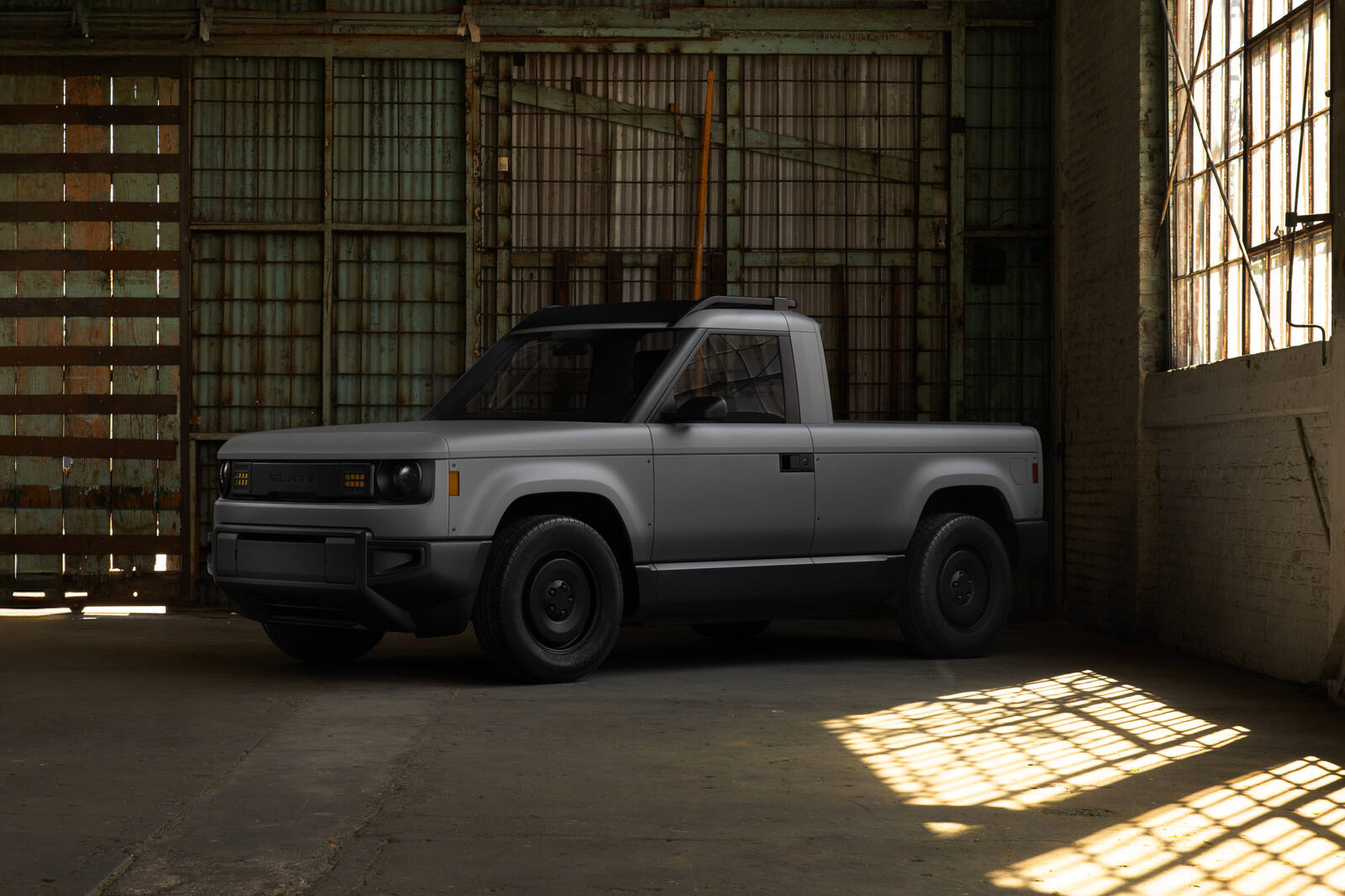
This is an interview with the lead designer of the Slate Truck, a cheap electric pickup that can be customized and even turned into an SUV. She explains how the team set out to design a car that's both inexpensive and something people would actually want.
Step up and deliver the superior experience that today's consumers have come to expect.
DealerTrack DMS gives you the tools to improve workflow efficiency, reduce in dealership time,
and put the focus on your customers so your sales team and your entire dealership shine.
To cut auto tariffs, Nissan plans a product blitz that would reincarnate the X-Terra, and
Tesla's three-row Model Y might not make it to the U.S. Plus, Slate Auto's head of design,
Tisha Johnson, joins the show to talk about the low-cost EV pickup that can be customized
and converted to an SUV.
Let's run through all the news you need to know to keep up in the auto industry.
The U.S. and European Union are opening the door to cut auto tariffs and put discounts
in place for steel and aluminum.
The new plan represents a step forward from a preliminary trade deal announced a month
ago.
It includes specific benchmarks for the EU to secure its promised sectoral tariff discounts
on cars, pharmaceuticals, and semiconductors, as well as new commitments for addressing
the bloc's digital services regulations.
A senior Trump administration official told reporters that discounted 15 percent tariffs
on European auto imports could be in place within weeks.
Nissan plans to deliver 20 new and updated models to the U.S. and Canada by spring 2027.
At its national dealer meeting Wednesday in Las Vegas, the Japanese automaker teased
all kinds of new sheet metal, including new generations of the Rogue crossover, Centra
sedan, and Infiniti Q50 sedan.
Nissan also disclosed plans for a pair of mid-size utility vehicles, including
a reincarnation of its XTERRA SUV coming in 2028.
And Tesla CEO Elon Musk says the company's new six-seat Model Y variant might never enter
production in the United States.
He says that's due to the rise of self-driving vehicles.
Tesla launched the Model Y L in China this week.
The company will build the three-row model at Tesla's Shanghai factory in its price
at around $47,000.
In a response to a post from a user on his social media site X, Musk wrote, quote,
This variant of the Model Y doesn't start production in the U.S. until the end of next year, might
not ever, given the advent of self-driving in America.
Musk did not elaborate on how the rise of autonomous driving would negate the need
for a six-seater vehicle.
Tesla did not immediately respond to a request for comment.
And those are today's headlines.
You can find more details on all those stories at AutoNews.com.
If you've been listening to the show the last couple days, you know that our own John
Irwin is a busy man covering trade policy and the supply chain for us at Automotive
News.
He's here now to talk more about this deal between the U.S. and the E.U.
John, welcome back yet again to Daily Drive.
Glad to be back.
So as I mentioned earlier in the show, the U.S. and the E.U. announced a trade agreement
last month.
So what's significant about this new development that we're talking about today?
Yeah, it basically lays out in more detail what the U.S. and the E.U. agreed to
a few weeks ago when they initially reached that preliminary agreement.
If you think back a few weeks, essentially the U.S. and the E.U. said, okay, we've
reached this framework of a deal.
Part of it includes lowering auto tariffs to 15%, which matches kind of the overall
tariff rate for most imports from the E.U.
But that hasn't actually happened since then.
Automakers have been sort of waiting on when that 15% tariff rate will go into
effect.
Today, they got at least an answer that we don't know an exact date yet, but
it should be coming soon, basically the U.S. saying that it will lower the 15%
auto tariff on E.U. vehicles and parts once the E.U. introduces legislation that
will lower or eliminate tariffs on U.S. industrial goods and make some progress
on market access for U.S. agricultural goods and that sort of thing.
One of the key things is that the U.S. is saying that they'll lower the 15%
tariff rate once the legislation is introduced.
It doesn't have to actually pass.
It doesn't have to be implemented, anything like that.
It just has to be introduced in Brussels.
And E.U. has signaled that that might happen pretty quickly.
They're hoping to introduce legislation maybe by the end of the month, in which case
the U.S. says that whatever month that legislation is introduced, they'll
retroactively lower the auto tariff rate 15% for that month.
So if that legislation is introduced before the end of the month, the
U.S. will lower the auto tariff rate retroactively to August 1st.
In addition to that, there are a couple other developments.
They're pretty vague at the moment, but you know, could signal
something down the line.
Steel and aluminum, the U.S. has said for a while that their 50%
steel and aluminum tariffs are pretty much set in stone.
But as part of this framework that they laid out today, the U.S.
is basically saying, you know, that they're open to discussing
the possibility of quotas, which is the first time that that's
come up in steel and aluminum talks.
It's notable just in the sense that it's the first time that the
Trump administration sort of budged a little bit on steel and aluminum.
Again, we'll see what happens.
It's not a commitment to actually implement quotas.
It's basically an agreement to look into it, but it's notable in
that sense at least.
And then the U.S. and you've also talked about the commitment to
again, look into the possibility of regulatory alignment.
That's something that automakers have been looking for for a long
time for years, and it's something that the U.S. and
EU are at least signaling here that they're going to look into.
And that could have wide ranging impacts.
But again, it's pretty vague at the moment.
It's just a couple of sentences in this three-and-a-half page
document.
There's a lot to be worked out.
But yeah, we got a lot more details today about what this
trade agreement might actually look like once it all comes
together.
Right.
So as you said, progress, and I think maybe when the
preliminary agreement came out without a whole lot of
details, there maybe were people out there with some
questions like, what direction does this go from here?
Will they make progress?
Will it go in maybe the other direction?
So I guess this does send a signal that they're going in
the right direction.
Is that a fair statement?
I think that's fair to say.
Yeah.
I guess there was a little bit of concern from automakers,
like, okay, when is this actually going to take effect?
And you know, this is a sign that, okay, the ball is
rolling a little bit here.
We'll see when a lot of this stuff takes effect, what
the details are.
There's still a lot of details to be sorted out, some of
which are going to take months or maybe even years.
But at least on the tariff front, it looks like
there's a little bit of a sign that this 15% tariff
rate is potentially coming in the next couple of weeks.
But we'll see.
And obviously we're going to be looking out for Japan
and South Korea too.
That's a similar rate that they agreed to, 15%.
That's, again, that 15% auto tariff rate hasn't
been implemented yet.
We'll see if the U.S. might use auto tariffs as, use
it as a similar way in their negotiations with
Japan and South Korea.
But that's still to be seen.
And what do you think this signals for all of those
other countries?
Obviously there's a lot of plates spinning here when
it comes to trade all over the world and how the
U.S. is going to handle these relationships going
forward.
Do you have a sense of sort of what this says to
other countries about what the U.S.
approach is here, how the Trump administration is
handling these?
I think if it wasn't clear before, I think it's
extra clear now that the Trump administration views
auto tariffs as one of its big bargaining chips.
You know, we've seen, again, this EU trade examples,
you know, a kind of prime example of that, where
they're kind of dangling this, okay, you want,
you know, 15% auto tariffs, but first we're going
to make sure that we get, you know, what we
want when it comes to industrial goods.
I would expect that maybe to be the case with
Japan and South Korea as well.
Again, it remains to be seen.
But I'd imagine auto tariffs, again, will be
front and center with Canada and Mexico, both
in the short term with, as they talk about,
you know, trade deals just in the short term,
but also with the USMCA negotiations looming.
I'd imagine auto tariffs will be front and
center, and I'd imagine the Trump administration
won't be afraid to, you know, use auto tariffs
as a bargaining chip just because it's front
of the front of mind for all these companies
because the auto sector is crucial to, you
know, the economies for a lot of these
countries that we're talking with right now.
So I think that's pretty clear at the
moment, but yeah, we'll have to see what the
details are once those come out with the other
negotiations.
All right, John, well, we'll try to give you the
day off tomorrow here, at least for daily
drives purposes, and so you can keep up on
everything going on in the world.
Thanks again, John, for joining us.
Thanks for having me.
Coming up, we'll hear from the head of design
for Slate, a Jeff Bezos-backed EV startup
that's getting a lot of buzz lately.
That's next on Daily Drive.
Consumers have high expectations of the car
buying experience.
88% of consumers said their experience matters
as much as the company's products or services
and with low inventory, high prices and high
interest rates, you have the opportunity to
step up and deliver a positive buying
experience that helps consumers overcome
their frustrations and feel good about
their purchase decisions.
Your DMS is a data powerhouse and must be
well integrated across your dealership.
DealerTrack DMS is proven to seamlessly connect
your operations and reduce manual data entry
by pre-filling forms, so consumers spend
less time at your dealership.
DealerTrack DMS is also key to helping you track,
optimize and improve the performance of your
entire team.
With actionable data insights from streamlined
reports and metrics, you can find new
opportunities for growth and unlock important
process and profitability improvements.
Because DealerTrack is flexible and easy
to use, your team spends less time re-keying
data and memorizing codes and more time
delivering the next level customer experience
your dealership rides itself on.
Bottom line, DealerTrack DMS improves workflow
efficiency and puts the focus on your
customers so your sales team and your
entire dealership shine.
See how you can unlock better experiences
and improve your entire operation with
DealerTrack DMS.
Daily drive listeners like you have access
to the lowest price for Automotive News
Congress 2025 on September 11th.
The event is where the industry's biggest
players tackle its toughest challenges.
Congress attendees don't just follow the
industry, they lead it.
This year's featured speakers include
Hyundai Motor Group Executive Chair
Yusung Chung, Asbury Automotive CEO
David Holt, and General Motors CEO
Mary Bara.
We are investing in America.
We're creating jobs.
That's creating IP in this country.
And I think, you know, the United States
needs to lead in key technologies.
Join us to gain the insights and connections
needed to steer your business through
massive change.
To get the lowest price for the event,
go to autonews.com slash events,
select Auto News Congress, and type in
the discount code daily drive.
That's one word all caps, daily drive.
And we'll see you on September 11th
in Detroit.
Welcome back to Daily Drive.
I'm Jake Neer.
Slate Auto has been growing quietly just
up the road from here in Detroit.
But now the EV startup is out of stealth
mode and officials are laying bold
plans to disrupt the market.
As part of that push, Slate showed off
its minimalistic electric pickup in
California last week as part of
Monterey Car Week.
Our own Lawrence Eilif spoke with
Slate head of design Tisha Johnson
at the event.
Here's a piece of their conversation.
So what's kind of the history from
your point?
What's your history?
Like when did you start and when did
you start deciding what it was
going to look like?
Okay, great, great question.
So I joined Slate in December of
2022 and there were about 15 or
16 people.
I was the first designer to join
and that has been an incredible
owner.
So the first things that we needed
to do was form a team of designers
who have different types of
capabilities and really start to
look at what the proportions of
the vehicle needed to be.
We had a very, very clear vision
before I jumped in regarding the
fact that this car was going to
be really so different because it
absolutely had to be both really,
really low cost and really,
really something people would want.
Something people would feel truly
proud of.
That's actually why I signed on as
a designer because so often one
or the other of those would get
left behind that here it was an
opportunity to bring something to
more people and something that they
would feel really proud of.
So we as a team began first to
look at what the proportions would
be and what we wanted to do was make
sure that it's signaled to people.
People understood that this is
absolutely a capable vehicle.
It's got plenty of utility and it
meets some of those really important
day-to-day uses such as easily
getting in and out of the car,
the vehicle easily loading things
into the back of the truck.
So we have a really nice low entry
on the truck itself and you can get
four by eight sheet back there,
some rock sheet or whatever you need
plywood and tons of capacity.
At the same time, the vehicle
architecture really speaks to people
on a level of true simplicity.
We wanted to make sure that it wasn't
really there was nothing really
frivolous here.
So that's where we started.
You know, we see so many EVs that are
you know, sculpted for aerodynamics
and sometimes those bring like some
really weird shapes.
You know, obviously the Mercedes EQS
wasn't very popular.
They're kind of saying, well,
it was very aerodynamic,
but we're not sure now.
Maybe we'll go back to a more classic
look and I don't know how you feel
about the Ionic 6.
I like it.
I think it's cool, but it's funky
and it's not selling great.
So that's a different story,
but you don't have to comment on those,
but like it doesn't look like a classic
EV aerodynamic bar of soap.
Well said and thank you.
I take that as a compliment.
My team, thanks you for those,
for those very kind words.
In fact, that was something else
that was quite intentional from the beginning.
We knew that this is a capable vehicle
that can convert from a truck into an SUV,
whatever people want all a cart
and our mission was to really deliver that
and something that would be much more timeless.
Something that could really
you could look at it and feel a sense of familiarity
and at the same time something
that is completely relevant right now today
and of course casting the stone into the future
something that would hold up.
So there we said,
all right, let's deliver on that.
The vehicle is first and foremost
something that is incredibly useful
something that we wanted people to love
and oh, it happens to be an EV.
Okay, so go ahead and tell me a little bit
about your background.
Oh, sure.
Thank you for asking.
So my background,
I've been in the auto industry since 1999
as a car designer.
I went to Art Center College of Design
and knew by the time I started
that when I graduated
I wanted to be really in the automotive industry
designing cars.
I have been designing cars
since at least the fifth grade
as our family story goes.
My parents remind me often
about the images that I was creating as a child
and it was all of the classic car design stuff.
So I might design one day on paper
a van from my dad who was a surfer
making sure that he could throw his surfboards in there
and have all of the utility.
I even had the classic call outs
that we do professionally
noting what some of the details are of the vehicle.
So I have had a passion around this
since I was a child
and there's nothing more satisfying than as an adult
to be able to do something that I've loved endlessly
for as long as I can remember.
But now of course there's real purpose driven work here.
I really have wanted to for such a long time
deliver a vehicle that people can afford
that they would really want to own.
And in fact my senior thesis at Art Center
was centered around that idea.
Now when you you know
when we think about this
that obviously there's a lot of nostalgia here.
I had a the Izuzu pickup right
which Chevy also sold as the the LU the LUV
and the Izuza version was the PUP.
Yeah, I had it too.
Oh, you did.
Great.
Great.
I loved my man.
That was such a good car.
Yeah.
And in fact, I think there's a certain kind of heartache
that that we have around this this void
this small pickup that just left the market
and we can see over time
that the people have been asking for it to come back.
It was literally my first new car
because it was cheap.
It was like what's the cheapest thing on the lot?
Yeah.
I think it was $7,500 that time.
Obviously that was a long time ago.
Okay.
So you want the nostalgia, but you know, I never understand
this because I'm not well versed in it.
But how do you get nostalgia and modernity together?
Is it like the basic shape is nostalgic
and the details are modern or it's not that simple?
That might be it.
That might be the you know, what it is
but what what we did was as a team
we backed up and we said we have to go after both.
We have to have something that is recognizable to people
as I said earlier something that is familiar
but we're a new car brand.
So what are we going to draw on?
It's not like we have you know some heritage to look back on
but we do know that trucks in the landscape across time
have certain attributes that people understand.
They recognize that they consider desirable
and they know this this means you know really capable truck
in our minds and so those are the proportional things
that we went after and at the same time in fact yes
we have certain details here very simple
but I think of them as just really good industrial design
and so I think that combination of functionality
of you know that is wrapped around a proportion
that you recognize that that might be why it's you know
why people are referring it to it in the way that you just did.
You know I was talking about this with somebody the other day
in the car industry in Detroit and they're like
you know what it occurred to me that the slight pickup
would be like a really good fleet vehicle.
I mean obviously you guys have talked about that
but his comment was you know I think it's primarily a fleet vehicle
but more than that it kind of led me to think
that this is kind of in a way every segment.
It's the pickup segment.
It's the crossover segment.
I guess if you lift it up enough it's the SUV segment
because we kind of distinguish between crossovers
and SUVs kind of soft rider versus more macho.
Traditionally they were body on frame we don't do that anymore
with electric cars really kind of sort of and then I mean those
are kind of all the basic shapes right.
So I mean obviously not a sports car you're not going
for that but we do have the fastback SUV.
When you were thinking about that you know how do I fit what
important I mean obviously it's important that you create
a nostalgic pickup and then it converts to a crossover.
What about what did you think about like a fleet vehicle
like how many things can we make this do.
Well you know we have a saying at Slate we built it you
make it that is absolutely what our DNA is.
So if if you can conceive of it and really good use for it
then we just want to make sure that you're able to get it
there and will help you along the way.
So therefore I always think of the truck as the basis.
It is the first part of a system might say it snaps
together you know like Legos or something but it is really
just the beginning of a system that you will be able to put
together in whatever combination gets you that use out of it
that you want.
And for some folks it's going to be much more of a statement
and for other people it's going to be much more of a
workhorse so you know we should satisfy that bandwidth
and so that's what we're going for.
Slate's head of design Tisha Johnson spoke with our own
Lawrence Eilif at Monterey Car Week in California.
You can hear more of their conversation on this week's
bonus episode of Daily Drive which will be available Sunday
morning.
That's Daily Drive for today.
I'm Jake Nier in for Kellan Walker.
Thanks to our own John Irwin and Irvach Karkaria for their
reporting for today's podcast.
We also had reporting from Curt Nagel of our sibling
publication Cranes Detroit Business.
You can get the latest news on EV startups, trade
negotiations and everything happening in the auto industry
at AutoNews.com.
Come back tomorrow for a conversation about how the
new budget bill could affect dealership F&I.
I think whether it's cafe, whether it's EV, manufacturers
and even retailers they need to be looking down the road
and saying with the next president will these be
reestablished or reinstituted.
We'd love to hear from you.
Let us know what you think of the show and the topics
we covered today.
Send us an email at DailyDrive at autonews.com or
leave us a voicemail at 313-444-2774.
And if you enjoy the podcast remember to like,
leave a review and subscribe so you never miss an episode.
About this episode
A significant trade agreement between the U.S. and EU aims to cut auto tariffs, potentially lowering them to 15%. Nissan is planning a product blitz, including the return of the X-Terra, while Tesla's six-seat Model Y may not reach the U.S. market due to the rise of self-driving technology. Tisha Johnson, head of design at Slate Auto, discusses their innovative low-cost EV pickup that can be customized into an SUV, emphasizing a blend of nostalgia and modern utility. The episode highlights crucial developments in trade policy and the evolving EV landscape.