Our host is Coach Charlie Melton, ASC-certified master technician.
I'm Jermaine Flood.
Hey, Coach.
Hey, how you doing today?
I'm doing all right on this rainy day.
Well, I just thought about it.
I went out.
I walked this morning at 4.30.
It was cool.
I said, I'm going to save some money this week because my air conditioner ain't
going to have to run as much.
I turned the one at the house off.
They cut it all because when I got here to the station, it was 69 degrees.
So I'll take a little rain for some good weather.
That is right.
I'll take a little rain for some good weather.
Listen, everybody, today we're talking flood vehicles in remembrance and the thought of
Hurricane Katrina at 20 years.
We always think that it's just the buildings and the houses, but it involves a whole
bunch more than just building and houses.
It affects you in all different ways.
I remember where I was in 2005 when this all went down and how bad it was and the aftermath
of and all of that.
We are paying our homage to that time and remembering Hurricane Katrina and to talk about
the flood vehicles that possibly came out of Hurricane Katrina and what flood vehicles
are and what you can do about them and how you can avoid them.
You know, I need to give you a little story real quick about what I did right before the
hurricane really hit land.
We're in Jackson, Mississippi.
I didn't think I was going to lose no power.
So I told my wife, I said, dang, the grocery store got steaks on sale, half price.
I went up there and I bought me some steaks, half price and go and put them in the
freezer.
Well, guess what?
The power.
I lost power.
I was grilling steaks for three or four days on my backyard.
Yeah.
Yeah.
My wife says, that's one crazy thing you've done in your life that you do.
Why do you think they were half price?
Yeah.
Because they were trying to get rid of them before the storm came before the storm came.
I just remember when it came, we didn't have power for a full week.
And my father had a generator and every day, twice a day I had to go with my brother
and get gas for the generator to fill it up so that we could run the fans.
We could run the TV and we had our refrigerator attached to it.
And so we kind of saved our food that way.
And gas was so hard to get.
It was hard to get and it was high.
It was high and it was hard to get.
You were standing in lines for hours.
Yeah.
There were lines forever to get gas.
Yeah.
And you think that you got in one place and time you got up there, you were
out of gas.
Yeah.
Yeah.
And my aunt called Jen Rack.
You always got some power now.
Well, auntie called Jen Rack.
She got some power from our grandmother's house, like, you know, full power.
And then for her own home.
So I mean, the aftermath of Hurricane Katrina made everybody rethink things and start
putting things into place so that if something like that happened again, you wouldn't
be in that situation.
Right.
You know, we have generators at the house and I'm thinking about getting a home
generator as well.
Yeah.
Yeah.
Yeah.
Okay, y'all.
So listen, our email address for questions is auto at mpbonline.org.
The phone number is 1-877-MPB-RING.
That's 1-877-672-7464.
If you've got any questions about any of your cars or if you've got a flood
vehicle story or even a Hurricane Katrina story, we invite all those again.
That's 1-877-672-7464.
All right.
I've got a couple of write ups, coach.
So first off, a flood vehicle definition.
A flood vehicle is a car or other vehicle that has been damaged by
submersion and water leading to issues with its mechanical, electrical and
structural components.
Now, Hurricane Katrina is estimated to have damaged around half a million
vehicles with the National Insurance Crime Bureau reporting around 300,000
claims for damaged vehicles and the Insurance Information Institute noting
about 350,000 claims.
The storms amidst floodwaters led to widespread damage creating a
significant challenge for insurers and the used car market as many
vehicles sought to re-enter circulation.
Well, you've got to understand what they do.
Those titles should have salvage or flooded vehicles on them until they get
rebuilt or repaired because you can rebuild flood vehicles, but the problem
with rebuilding a flood vehicle is that you may not be able to see the
damage at that moment when you buy the car.
That that damage is going to come a little bit later.
If it's electronics, if it's the engine itself or the transmission, all
of that's going to show up later.
But that's really what they're supposed to put on those titles.
And if they don't, we're naming them a shady seller.
That's another thing that you got to think about is that even though that
flooded vehicles are in the state, maybe it's Florida, maybe it's
Mississippi or wherever a big massive flood is, they don't usually sell the
cars in the same state that they flooded in.
That's what you told me today.
So the Hurricane Katrina vehicles left us.
They left the state and went to other states to be sold where they're not
prone to be flood.
Okay.
And so that means that the consumer would not really be looking for
flooded vehicles if they're in another state, maybe out to Arizona, out
to California somewhere in the mid part of the country where it doesn't
flood as much.
Right.
And so you could get some of those shady sellers who would
attempt to disguise those vehicles by cleaning them and selling them
without disclosing their history after these major weather events.
Well, you know, we talked earlier that, you know, we had a show not too
long ago.
It's been a while, but we talked about a Warsh title where they can...
Yeah, I remember you saying that.
We could take all that off the title where they, what they do, they
would go to a state that they're not so stringent on the title and
they would retitle that vehicle from that state and then they could sell it
as a regular vehicle.
Now I want you to know some of these words that we're talking about these
bad people, the shady sellers and the unscrupulous sellers of the title
washers.
Yes.
And then when you start talking about that, the consumer itself has to
be very weary even if they're buying a used car no matter what, but
especially after a flood and, you know, and sometimes we just look at it, oh yeah,
it looks nice, it cranks up, it runs, but we need to go a little bit deeper if
we're going to look at a flood vehicle to make sure it has not been
flooded.
Right.
Right.
Right.
So there's some things that you can do.
You can check for possible odors.
You can check for stains.
Well, you want to think about an older car, if they put, it has
new carpet in an older car, you know, something's wrong.
Yeah.
You want to, you know, this is one of the things that people don't really
look at.
Look at the screws and see if they're rusted.
If the heads are rusted on them, then you know it's been sitting in
the water because they're going to rust, you know.
So that's one of the things that older the screws, a good way to look
at it is that the seat rail where the seat moves back and forth, put
your hand down in there and see if there's any water down in that
rail.
And if it's rusted under that seat because the springs all will
rust because they're made out of steel, those are places that you
don't, that you need to look at.
But the thing is, there's people out there that can help you look
at these loaded vehicles.
Just say you spend $100 for somebody to technician to inspect
that vehicle for flood.
It'd be well worth it to the consumer to spend that $100 to
have that vehicle inspected to make sure they weren't getting
a bad vehicle, you know, because, you know, a lot of
times the spare tire, how many people look at the spare
tire?
Not many people.
No, because it's in the trunk.
Right.
You want to take and pull that cover up, pull that spare
tire out, look and see if there's mud and water all under that
spare tire.
Then once again, you know, it's been flooded fogged lights.
That spare tire could be a good telltale.
That would be a good telltale sign.
Yeah.
Yeah.
Because underneath it, you know, now they can clean them
up pretty good, but they can't get it all.
Yeah.
And then they might miss the spare tire.
That's right.
They may miss the spare tire.
They've got to just look, just say if you had lights that
were fogged, you know, that had sweat all in them.
That's another sign of flooded vehicles, you know.
But the thing is, you want to check your engine, pull
the dipstick, make sure that oil don't look milky, you
know, because it looked like a chocolate milkshake.
Yeah.
So you want to make sure it's not milky.
You don't pull that transmission dipstick, make it
where it's not milky.
It'll look like a strawberry shake.
Right.
And then just go by shakes and you can tell some things
about your car.
Right.
You know, but there's ways that you can check things to
make sure that that car is not been inflated.
Yeah.
What you think, Abram?
Oh, just that if you want to be a mechanic, you need
to be a desert aficionado first.
You have to know all your milkshakes first and then
you can be a mechanic.
That's right.
All your colors.
Exactly.
Well, you know, that's how you would teach a
student, you know, these different colors, all liquids
and fluids in a vehicle have a different color.
They have a different texture, you know, and a different
smell.
Yeah.
And so I didn't really talk about a lot of flooded vehicles
while I was in school, but I talked about water or
coolant in transmissions, water and coolant in oil and
y'all.
So I had to have these milkshakes up.
Mm-hmm.
Yeah.
You had to figure out what it was.
What would touch their minds.
And give it a name.
Say, hey, you just make it a milkshake.
You had to go to Wendy's every single day just to
display the frosty color.
It's that one.
That one.
That is true.
It's that one.
That's true.
Listen, we've got Christian on the line.
He's calling us from Ross Barnett Reservoir.
He's got a tip about rain and possibly your sensors
and your cameras.
Christian, you're on with Coach Charlie.
Hold on.
I'm getting my frosty.
Well, you know, you know, Jermaine was talking
about windshield wipers last week on the sensor.
So maybe you may have a better idea.
Yeah.
Yeah.
Well, that was me.
And like the producer says, your cameras and your sensors
don't have eyelids.
So what we want to do is get us some wax or some
rain eggs.
And, you know, I mean, I'll take the rain for the
mild temperatures, like you said before.
But if you find a dry spot today, a good tip.
Because that stuff lasts for weeks and weeks.
And that rain will sheet off instead of you having
to look for it or your car tell you that your
sensors are not able to work right now.
Right.
Right.
Right.
Well, Christian, thank you.
And you better enjoy that frosty.
Well, it's according to which one.
Which one?
Which frosty?
Which frosty did you get, Christian?
I got to get the chocolate.
I'm going to go with the oil.
That's right.
That's right.
That's a good one.
Christian, thanks for your phone.
I don't look to have strawberries.
So they used to now.
They did for a limited time.
Now, you can't get the one that is Cream Sickle, you know, Dream Sickle.
You can't get that one because there's nothing I can really communicate that compared to.
Compared to.
So.
Right.
You too, Christian.
You too.
The phone number is 1-877-MPB-RING.
That's 1-877-672-7464.
If you've got a question, send your emails to auto at mpbonline.org.
Your talking flood vehicles in remembrance of Hurricane Katrina at 20.
Is your car under recall?
I'll tell you how you can find out next.
You're listening to Autocorrect with Coach Charlie Melton.
I'm Jermaine Flood.
If you want even more autocorrect, find the podcast on all podcast platforms for your
smart device.
Autocorrect is heard on MPB Think Radio Thursdays at 10 a.m. with the replay Saturdays at
11 a.m.
Here's some recent recalls, Coach.
First up, it's Mitsubishi.
If I can get Mitsubishi out of my mouth, it's Mitsubishi.
Mitsubishi.
It's Mitsubishi.
That's right.
Mitsubishi, second major recall of the year, affects nearly 91,700 examples of its Outlander
and Outlander plug-in hybrid SUVs.
The issue involves the vehicle's liftgate gas spring cylinders affected SUVs include
Model Year 2014 to 20 Outlanders and Model Year 2018 to 22 Outlanders PHEVs sold or currently
registered in these following states, Alaska, Connecticut, Delaware, Illinois, Indiana, Iowa,
Kansas, Kentucky, Maine, Maryland, Massachusetts,
Michigan, and Mitsubishi, Michigan, Minnesota, Missouri, North Dakota, Nebraska, New Hampshire,
New Jersey, New York, Ohio, Pennsylvania, Rhode Island, South Dakota, Utah, Vermont,
Washington, D.C., West Virginia, or Wisconsin.
In these vehicles, salt water may accumulate within the dust cap of the liftgate's gas
spring cylinder and this could cause corrosion and a loss of pressure potentially resulting
in a rupture or the liftgate falling unexpectedly increasing the risk of injury.
So what those are, those are the arms that hold the liftgate up, you got one on each side,
those are the cylinders, they call them, you can call them gas shocks, but they're the
little cylinders that hold the liftgate up and salt water gets in there.
And breaks them down.
And if you notice they didn't say anything about it in the southern states, they're
all up north.
They don't have the issue.
But you only notice they only have two recalls, how many does Ford have in a week?
I've got another, look, I had to shuffle the deck to show you that there's a Ford in here.
There's a Ford in here.
There's a Ford in here.
So yeah, they've only got a couple.
Two for the year.
Yeah, two for the year.
So to resolve, dealers are replacing the left and right liftgate gas springs for
free.
Yeah.
So that's how they'll fix that.
Okay, up next, GM is recalling more than 23,600 examples of its Chevrolet Corvette
sports car over an issue that increases the risk of a fire.
This includes model year 23 to 26 Corvettes equipped with a left side radiator fan combination.
During refueling, excess fuel may spill into the vehicle fuel filler pocket and come into
contact with an ignition source such as a hot engine or exhaust components increasing
the risk of a fire.
Need to take that in right away.
Okay.
Because those babies get hot.
Yes.
Okay.
So as a fixed dealers are installing a shield to divert spilled fuel for free.
Yeah.
Because of what's going to happen.
And they're really talking about when that fan comes on, it could make an electrical arc
and.
And do that.
And light that gas.
Okay.
Now this last one is going to hit you right in the soul.
It probably does.
It probably does.
Because I got three of them.
This last one's going to hit you right in the soul.
And I know you told me a little story on the break and I'm going to get you
to reiterate.
You don't have to throw anyone under the bus.
Right.
Hang on.
But we've got to laugh about this.
Okay.
Abram, you ready?
Are we just laughing so we don't cry?
No.
What is?
No.
This is a beautiful story that ends kind of well.
Oh, good.
Good.
So in our final recall, Ford F-150 pickup truck.
That's mine.
I knew it was going to hit you right.
That's mine.
Right in the kicker.
And super duty trucks are the latest vehicles to be affected by this major
recall.
This issue involves 355,000 of the vehicles and it involves the instrument panel.
This includes model year 25 F-150s, model year 25 to 26, super duty F-250s, F-350, F-450
and F-550 trucks.
The instrument panel in these trucks may fail at startup, preventing the driver from
seeing information like the speedometer and warning lights.
And this of course increases the risk of a crash.
So there's another one, Coach.
Well, do we need those?
Like everyone said, yeah, you know, we're just going to drive.
Just the speed.
You know.
Back in the day, you didn't eat it, you know.
Well, you know, my Ford truck has been at a dealership now for...
Here comes the story.
Three weeks.
You know.
So really, three weeks, this makes the fourth week.
Coach is tired.
So he was like, let me tell y'all something.
Tell him what you told him, Coach.
Yes.
So I told him, I said, well, guess what, I'm stranded and you need to get
me a vehicle.
Now.
Now.
And they got me a vehicle.
One guy said, well, we ain't got one.
And the other guy says, well, just hold on, I'll go get you a vehicle.
Next thing he comes out, I'm driving a Mustang Mach E.
Coach is in an electric...
I am in an electric vehicle.
That's crazy.
He was like, let me go get you a car, sir.
Yes.
And he went back there, didn't ask Coach what he likes.
He just threw me an electric vehicle.
I put seven miles on it.
I asked him, did he drive it today?
Because I wanted to go out and look at it.
He said, no.
Oh no, I'm not driving it.
I ain't driving that car, because like I say...
Coach said it's on 94% like a cell phone.
It was on 94%.
I said, well, I got to charge that thing up.
And as high as Trishy is, I can't charge that thing up at my house.
The one person who gets a loaner...
Gets a brand new E.
Gets a brand new E.
Oh my gosh.
The one person to get a loaner.
I had to get used to it.
I take my foot off the brake and the thing stops.
I mean, off the gas, it stops.
It just stops in the middle of the road.
Oh yeah, you take your foot off, it just stops.
What?
Yeah, so I got to...
I told my wife and said, I don't know about this thing.
So...
He's going to drive it up here next week.
I'll drive it next week.
I hope so.
I hope so.
I want to look at it.
He'll come up here in his electric vehicle and tell us about Kia's next week.
Yes, and that's our topic.
And complain about it the whole time.
Now how do you know I'm going to complain about the Kia?
Because you told me last week you would.
Well...
I love it when we just get real.
I probably will complain about them.
Me too, Abram.
But I'm going to brag about some of them.
Oh, good.
The Sophia, not the one.
The old Rio.
The Kia Rio.
Yeah.
You know, I know that.
We'll tap on it.
We'll talk about it next week.
We'll tap on it.
All right.
Next week's show.
That's right.
To resolve your issue, though, coach, for this recall, the instrument panel software
would be updated by a dealer or via an over-the-air update for free.
So it doesn't have to stay in the shop for this one.
Wow.
I can do it at the house then.
Right.
You can find out if your car has a past recall by going to the National Highway Traffic Safety
Administration's website, nhtsa.gov, forward slash recalls, and inputting your VIN number.
Or you can find their safer car app.
We're talking flood vehicles.
We're also taking your vehicle repair questions.
Our email address is auto at mpbonline.org.
The phone number is 1-877-MPB-RING.
That's 1-877-672-7464.
Let's go to the phone lines.
We've got Chris and McComb with an extended warranty comment or question.
Chris, you're on with Coach Charlie.
Coach Charlie, I'd like to know your opinion of extended warranty.
My warranty ran out and I don't know whether to get additional warranty or if it would
pay me to do so.
What year vehicle is it?
2017.
Okay.
So we're already eight years old.
Okay.
Now, how many miles you got on it?
87.
Okay.
Let me explain to you how I feel about extended warranties.
Most vehicles have a 36,000 mile warranty bumper to bumper.
Then they have a 60,000 mile powertrain warranty.
That means the engine and the transmission and then have an 80,000 mile exhaust or
emission system warranty.
Okay.
Well, your vehicle is already eight years old, fixing to be nine years old on this extended
warranty.
Evidently you don't drive it very much because for 80,000 miles, that's less than, that's
right at 10,000 miles a year.
But when I bought a new vehicle, what I did, I bought the electronic extended warranty
because that's all I needed because everything else was warranted for a good long time.
When you think about extended warranties, they only, they're really not what they're out
to be because you got to pay for it up front, then you got to pay a deposit, I mean, yeah,
you got to pay a fee for to bring it in a deductible form to bring it in and look
at it.
And then if they don't find where the insurance company will cover it, then you still got
to pay for it.
Okay.
So what I would do, since you don't drive your vehicle very much, I wouldn't spend
my $4,000, $5,000, $6,000 for a extended warranty.
Matter of fact, when I bought my new truck, I made them give me my money back because
they taught me into buying one because my wife was with me, and I made them give my
money back to me because I did not need their extended warranty because it's too
expensive.
So basically, you're negative about it because it costs too much?
Yes, ma'am.
And you could be, you know, if there's nothing wrong with your engine, you
know, small parts don't cost a whole lot of money, you know, and it don't
take a whole bunch of money to put them on.
You know, if you can spend $4,500 to have it fixed, it's a lot better than
spending $4,000, $5,000 for a extended warranty that you may not use.
Well, I sure thank you for that.
I was just, well, in your opinion.
Okay.
Thank you so much.
Yeah, that works.
Thank you, Coach, for that one.
Yes.
Let's stay on the phone lines.
We've got Curtis and Jackson on the lines.
Question about a 2016 Ford Mustang convertible.
Curtis, you're on with Coach Charlie.
Yes, my brake light is staying on.
So your brake light is staying on?
Yes.
What are your vehicles you got?
Yes, I have a 2016 Ford Mustang convertible.
Okay.
And my brake light is staying on, it won't go off.
Okay, this is the first thing I'm going to tell you to do.
Look under your brake pedal, there's a little, there's a switch underneath the
brake pedal, and there's a little rubber or plastic piece in the brake
pedal.
And a lot of times that little plastic piece or rubber piece will come out of the
brake pedal itself, because what that does, that pushes on the brake light switch
and cuts the lights off.
And if it comes out, you like to stay on.
Okay.
Wow.
So it's just a little piece of plastic that is in there or a piece of rubber
that's in the brake pedal, and you'll see the switch underneath there, and you'll
see where you can push that little switch, and you can see if it goes off.
If that piece of rubber or plastic is missing, replace it.
You can just get them, they're very cheap at the auto parts store, or is that
switch right there, that brake light switch itself?
Curtis, have you ever looked at that?
I never knew this, Coach.
A lot of people don't know that.
No, I haven't.
Okay.
Okay.
Yeah, a lot of people don't know that.
I was looking at YouTube videos, and it was saying the same thing.
So I was just wondering what the stuff that I could fit myself.
Oh, sure.
I'll give you 15 minutes of your time, and $3 or $4 if it's just a little
piece of rubber, and you can replace that switch as well.
That switch is probably about $25, but you'll be charged quite a bit if you
take it into a dealer to get it fixed.
All right.
Curtis, I hope that helps.
All right.
I appreciate it.
All right.
We appreciate you.
The phone number, 1-877-MPB-RING, that's 1-877-672-7464.
Our email address where you can send questions is auto at mpbonline.org today.
We're talking about flood vehicles between your car repair questions.
What's in the news?
What is hydroplaning, and what should you do if it happens?
That could happen today.
It's raining around this way.
Yes.
I'll tell you more next.
Thank you for listening to Autocorrect on MPB Think Radio.
Coach Charlie Melton, retired instructor from Clinton High School's
Automotive Tech Program, is our expert host.
I'm Jermaine Flood.
I hope you've downloaded the app for your smartphone.
That's the MPB Public Media app.
In addition to listening to the show on that app, click on the support button, please, and
make a contribution.
Those contributions help keep our programs on the air for you, I, and others to enjoy.
And we thank you for your contribution to Mississippi Public Broadcasting.
Autocorrect is heard on MPB Think Radio Thursdays at 10 a.m., with replay Saturdays
at 11 a.m.
In the news, what is hydroplaning, and what should you do if it happens?
It all possibly has happened to all of us, actually.
It has happened to me.
Coach has a story.
Yes.
You had a story about hydroplaning.
Tell it before I get into it.
Well, you know, hydroplaning, my pastor was driving down the road.
He was going 70 miles an hour.
He's almost towards Newton, and it just came a storm, and he hydroplated, and
he was going back the other way.
He finally got the vehicle in control, and he went down the ditch and hit a sign and
towed his car out.
But what happened right before the same thing is that another vehicle did it right in front
of him.
Yeah.
It was like a chain reaction.
Right.
But, you know, he went off.
He didn't know what was happening.
But, you know, it's such a scary situation to be going back the opposite direction
in traffic that you're supposed to be going, you know.
You know, 70 miles an hour, 100% you know, you can see your life flashing forward in front
of you.
It's scary.
You don't know what to do when it's going down, and it's like, where do I turn?
Do I brake?
What do I do?
No, he hit a sign, and he didn't get hurt.
Right.
So, here's a little something of what possibly you can do if it happens in a little
definition.
So, also known as aquaplaning, hydroplaning occurs when a layer of water on the road
comes between your car's tires and the road's surface, causing you to lose traction and
momentarily making your car feel like a boat.
Traveling on a film of water also causes you to have limited control over your car's
steering and brakes.
So, your car's only points of contact with the road are your tires, which grip it
via grooves on tread patterns on the outer surface.
Now, this tread also acts as channels to disperse water when you're driving on
the wet roads.
However, though, if you're going too fast, the tires are rotating faster than the rate
at which they can disperse the water.
Now, this causes them to drive on the water's surface on the road instead of cutting through
it.
And this can last for a moment or several seconds, this hydroplaning, but that
time is enough for you to lose control and crash into a guardrail or another car
or a sign, kind of like your pastor or whatever.
So, a lot of factors can cause hydroplaning, excuse me, pools of water collecting on the
road due to sudden downpours or improper drainage are common culprits and even a
tenth of an inch of standing water can cause hydroplaning.
Driving fast in the rain also increases the chances of hydroplaning and if the tires
are spinning faster than the time it takes them to evacuate water between the grooves
that excess water can accumulate, the tire contact patch on the road.
You don't even have to be very fast.
Hydroplaning can happen at speeds as low as 35 miles per hour, depending on the
weather, the road, and the condition of your tires.
And bald tires can easily cause hydroplaning.
I said that one more time.
Bald.
Yeah, well, they make sure you have some tread on those.
Baby bald tires.
If they are bald, you will hydroplane and you will have an accident.
Yeah.
And coach, tell them about the story about you getting them tires.
Well, I knew I needed some tires on my vehicle.
So I went and I bought five tires several months ago, but you know, I had
operation and so I couldn't do anything.
So I said, well, I need to get these tires on there and I couldn't really pick
them up because my operation and I told this young man, I said, I tell you
what, I got five tires over here with rims.
I'm going to give you those rims because you're going to make more off
of me with those rims than you are off my tire.
He's a negotiating man, everyone.
And so he was able to remove my tire, remove my, and I gave him those
five rims and that was the payment.
And that was the payment.
And I was a happy camper.
I was gone.
He got some new tires.
I got new tires and just kept on going because my tires needed to be
replaced before because I did that after my pasture hydroplane.
I'm not going to hydroplane, but you got a deal out of this one.
You did get a deal.
So there are ways to prevent hydroplaning for one slowdown while
driving in rainy weather.
Driving at slower speeds helps you spot puddles more easily and slow
down in time to be safe.
And if you can't avoid standing water, reduce your speed before passing through
it. Also avoid using cruise control.
As with it on, you won't be able to slow down immediately.
And having good tires is important.
Ideally, your tires should have tread depth greater than two to two 32s.
Am I saying that it's called two 30 seconds, two 30 seconds.
Thank you, coach, of an inch of water to properly disperse the water and
ensure that they are properly inflated as improper tire pressure increases
the chances of hydroplaning.
And then make sure you know your weather tips.
If you miss all the signs in your vehicle starts to hydroplane.
Here's this fix.
Try to keep a cool head.
That's a hard thing to do when you're going out to the direction
and you feel like you're on a roller coaster ride.
Panicking, though, will only have you go hard on the steering and the brakes,
which is the opposite of what you need to do.
Get your foot off the gas pedal, but don't slam on the brakes.
If your tires are pointing in a different direction from the front
of your car slowly correct, you're steering to the point the tires
in the direction the car is moving and weight as your car slows down
to the point where you can regain control and cross the standing water.
Then it says take a deep breath.
Hydroplaning can be a nerve wracking experience.
And after a hydroplaning event, it's a good idea to take a break
and calm your nerves.
So I think my patch went out and got a root beer after that.
Yeah, you just need a little something to curve it.
He calmed his nerves with a little root beer.
That was a wild ride.
Listen, everybody, I'll include a link to this story in our show's podcast description.
Today, though, we're talking flood vehicles.
Coach, is there any other thing that they can do?
There's debris possibly that they could look for, right?
There's all kinds of things that are that will make you jerk your steering wheel
if when it's raining and stuff like that.
So you need to be very careful because jerking the steering wheel
is really what makes you go the opposite direction.
That hydroplaning, that hydroplaning.
When it comes down to flood vehicles, when we're talking about looking for that damage,
debris can be one of those like silt sand or mud, right?
Oh, yeah.
When you start talking about the stuff that's inside from the flood,
if it's debris, it's leaves and all.
But the main thing, just look at the interior.
It's an interior.
It usually has a watermark on it and you can't usually get
that watermark out all the time.
So make sure that you look at the inside of that vehicle.
If there's leaves and trash all up underneath the seats or really pull the carpet back
because you pull the carpet back and look up underneath the carpet.
You can really tell if it's been flooded and most back seats,
you can pull the back seat up and look up underneath that back seat
where the cushion sits and you see that that will help you as well.
The mud and stuff like that.
And then if you want to go a little further, what about the history reports?
You can go to VIN check or you can go to Carfax.
They all should be able to take and check the history for you.
Now, if you pay for it, you don't get a little bit
in-depth history report, but these free ones, they do pretty good.
But you could go to those different
carfaxes and they would be able to check those out and check that title.
That's the main thing.
Checking the title, make sure that it's not been altered.
You know, and like say, and just be
go to somebody you trust that selling used cars,
I wouldn't be buying a used car off the side of the highway
that sells a whole bunch of used cars, you know, as an individual, maybe.
But not if you know that somebody steady putting cars out there on the highway.
Then, you know, that they're buying cars from the auction,
they're buying cars from somewhere else and they could be flooded.
Yeah, and they're flipping them quick.
So in response to Hurricane Katrina insurers and law enforcement took
steps to identify and flag the flood vehicles.
And that all does go through that car fax and that national venture.
Now, there's another thing, insurance insurance.
According to what kind of damage it has on that vehicle,
being flooded, how it was written on the title,
they may only give you liability on a vehicle.
Another thing you may want to think about, if you can buy a vehicle
that you know should cost a lot more than what you're paying for it,
then you know something's wrong.
So you want to there's those telltale signs that you need to be looking for,
you know, because like I say, people are trying to make a dime off
somebody else's tragedy.
So you want to be careful.
Like coach was saying, these vehicles can become salvage items
sold at auctions or by less scrupulous sellers.
There goes that scrupulous person, often with the history of major
problems that are hidden to the buyer.
I say, and you don't like say water in the transmission.
They might have drained the transmission out and got all the water out,
but it's already did the damage.
And also, if you have a friend like a coach, Charlie, get him to inspect your car.
Yes, you can get an inspection where somebody can look at your car
and keep you from getting a flooded vehicle or a vehicle that's not really good.
You know, matter of fact, I met a friend of mine that used to be
a schoolteacher over the dealership that I got my truck at right now.
And that's exactly what he does.
He goes around inspects cars for people,
even if they're in the dealership, getting fixed to see if they're getting done
correctly. That's right. That's right. All right, coach.
We're going to go to the phone lines before we head into a break.
We've got Joe and Raleigh on the line.
He's got a comment about his experience with electric vehicle.
Joe, you're on with coach Charlie.
Good morning. Thank you for taking my call.
We have a Chevy Bolt.
We've had it about a year and really very happy with it.
Our electric cost is only about four cents a mile.
We have a gas powered Toyota Yaris and
the gasoline cost for it is running about seven cents a mile.
So our EV is quite a bit more economical than the gas car.
Yeah, I think it's the main thing.
It's just getting to learn how to drive it because I wasn't used to driving it
when it stopped on me driving down the road when I took my foot off the gas.
I wasn't really used to it.
But like I told the guy, I said, you know, just got to have a vehicle.
And like I say, EVs are good for if you're around town and stuff like that.
But, you know, I've just have not seen a very good response
to a lot of people driving a mile of town because it's
if I drove it out of town, this particular vehicle gets
it said two hundred and eighty four miles per charge.
But automatically, the guy told me, said, don't let it get down below 25 percent
or we're going to do something to try to get it all charged back up.
He says so 25 percent out of that, you know, that now we're down to 200 miles.
Joe, is that your experience too?
Yeah, our boat has a range of about 230 miles.
But now my wife drives it from Raleigh to Jackson
to visit her mother, which is about a 60 mile one way.
So one hundred and twenty mile round trip and she runs some errands.
She's got about 50 miles that she can use for running errands and come home.
And so far, we've had no problem with that.
She gets home, I plug it in, it charges up overnight
and is ready to go the next day.
Yeah, that's what they told me as well with this one that I got, you know,
and they're making chargers better, they're making batteries better.
So, you know, Evies, they're good for people running around, you know,
just short distance, but for long distance, like, you know,
if you're going here to Dallas, you don't need to stop several
several times, you know, and stuff like that.
You know, but like I say, Evies, they're coming along.
He doesn't he doesn't not not like that.
I don't not like your main problem is that you just drive
to Oxford a whole lot, don't you?
Right. I drive to Oxford a whole bunch like I'm leaving this afternoon.
Go to Oxford and I'll be driving around all up there all weekend, you know.
Joe, thank you so much for that.
Thank you for that one.
Well, we've made one trip to the coast and that's about 140 miles one way.
So that we can't make a round trip on one charge.
But we stopped at a outlet mall on the coast
and recharged and drove back home.
Right. Yeah. Well, Joe, thank you so much for that.
Coach, we're getting that Maki out on the road.
I'm going to get it on the road.
Joe said I could do it.
Right. The number the number is one eight seven seven MPB ring.
That's one eight seven seven six seven two seven four six four.
We're discussing flood vehicles and taking your car repair questions and comments.
Send an email to auto at MPB online dot org.
We've got a new car review from Casey Williams coming up
and coach's tip of the week.
This is auto correct on MPB think radio.
Here's a new car review from Casey Williams.
It's auto Casey on auto correct.
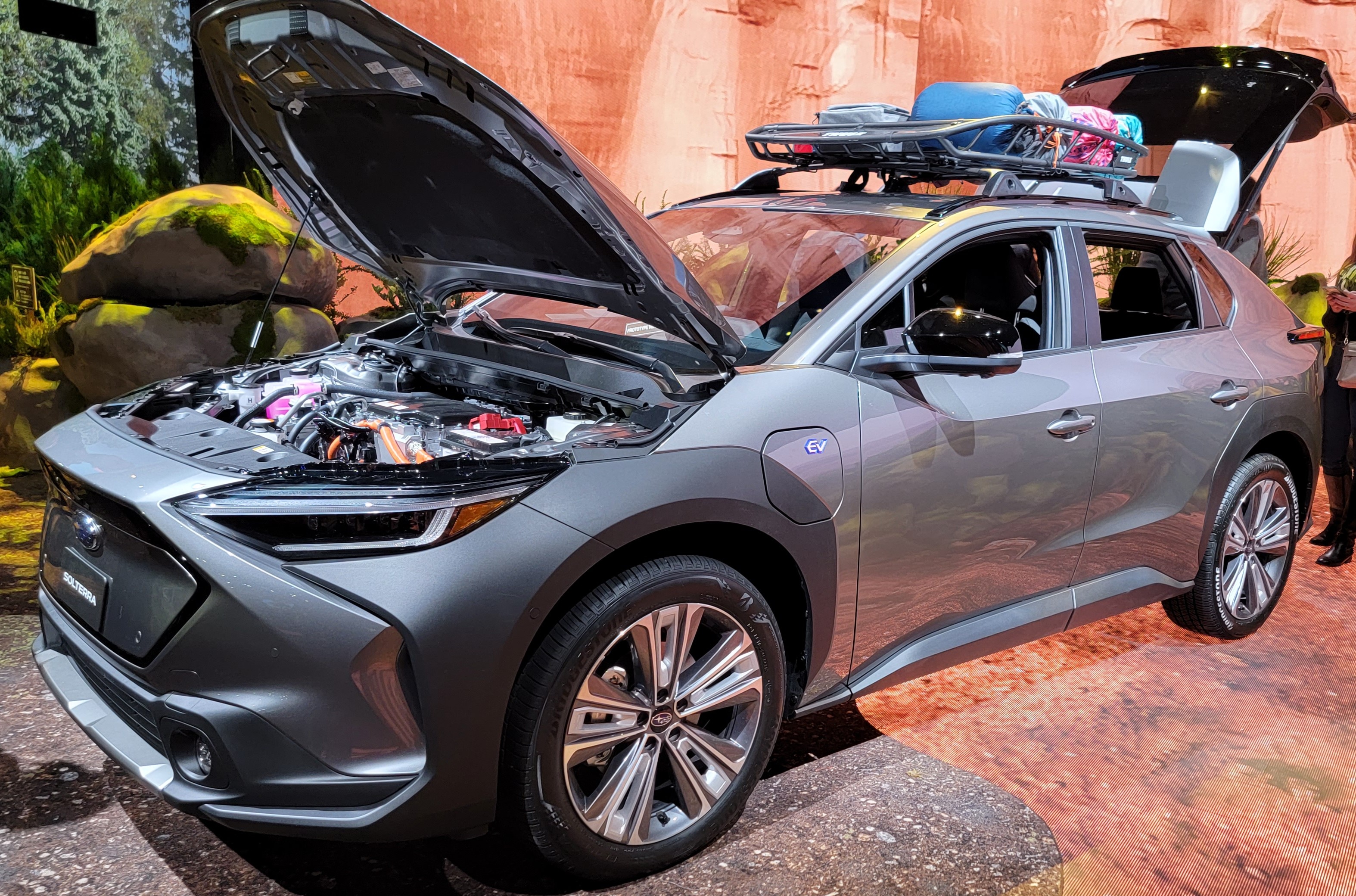
This week, we're out near Denver, Colorado, driving the mostly redesigned
2026 Subaru Solterra.
So this is their midsize electric crossover.
And the vehicle has always been very nice.
We've it's been on the market for a few years now
and really like driving it like the style of it.
It looks a little bit like a Toyota F4, which is OK
because Toyota and Subaru could develop the vehicle.
They revise the style a little bit on it,
but the real thing they need to work on was range and recharge times
and they've done that.
So the range has increased 25 percent, looking at 288 miles range
in the top model, recharge time, much faster.
You can go from 10 to 80 percent on DC fast charger
in about 35 minutes.
This now has the next charger, the Tesla style plug,
so you can use the Tesla superchargers as well.
Outside of that, interior has been redesigned slightly.
You got heated ventilated seats, a nice 14 inch touchscreen
and heads up display pricing will be out soon.
Be expected to start just under $40,000.
See the full video on his YouTube channel, Auto Casey,
and listen to Auto Correct on the MPB Think Radio YouTube channel.
I'll be a thousand dollars.
That's what we do here.
We coach, we don't never stop on break.
We don't save it for the actual air.
You just keep going.
I know, we just keep going.
We keep going.
One day we'll get you the behind the scenes.
That's right.
This is Auto Correct.
If you've missed any of the program, listen to the whole show
from AutoCorrect.mpbonline.org.
AutoCorrect is heard on MPB Think Radio Thursdays at 10 a.m.
with a replay Saturdays at 11 a.m.
and at 11 a.m. today at Southern Remedy Kids and Teens.
I'm Jermaine Flood, our expert, is coached
Charlie Melton ASC certified master technician
and my break conversation, man.
That's right.
It's time for Coach Charlie's tip of the week.
You know, we're talking about flooded vehicles.
The main thing is just make sure that you look
at all those little bitty places that other people may not look at,
you know, because those are the telltale signs,
those little spots that may be rusted or maybe debris.
So just check them out.
If not, get a technician to look at it
and just make sure that you do not get handed a flooded vehicle.
You don't want no bad car.
No bad car.
You don't want no bad car.
All right, we're going to head to the phone lines.
I think we've got Brenda ready on the line.
Brenda's got some dealership tips.
She's in Hattiesburg.
Brenda, you're on with Coach Charlie.
Hi, Coach.
Thank you for taking my call.
Yes, ma'am.
I appreciate the tips you've given us far.
I'm about to have to have my car taken
to a dealership to 2020.
I think it's a sonic Chevrolet
and it had several issues before it died.
And I when I had it jumped up, it did not stay jumped off.
One is something about the I'm sorry,
I should have written it all down at the time.
I think that in something trained also,
there's a radiator problem and the air conditioning with it.
What are some of the questions I need to ask
when I take it?
Now, let me ask you a question.
Did all that happen when the vehicle wouldn't stay running?
No, it just gradually happened.
OK, so you just had different things going.
Well, it sounds like you have a charging problem, either a battery
or a alternator right now that where it wouldn't stay running
where the battery just dies.
Most of the time when the battery just dies or the alternator is bad.
That's usually what happens there.
But with the air conditioner, you could have a leak in there.
How many miles you got on the vehicle?
Oh dear, I don't know.
I think 40. OK, so you still probably have a powertrain warranty.
So if there's anything wrong with that transmission or that engine there,
they'll probably still take care of that for you under the powertrain warranty
because it's usually 60,000 miles, 50 or 60,000 miles, you know, five years.
So your five years is coming up now.
So main thing is just make sure that you don't they don't sell you
something that you don't need to be sold because they will try to do that to you.
So you want to just make sure you ask the questions before they do the work,
you know, maybe call back and just tell me what they told you and will
you could even put it on the our call and we can answer it as well.
But just make sure you ask the questions when they start saying
you need the work done and you say, why?
Yeah, these resemble some of its problems.
It resembles back when I had a dog that had to have a lot of fuel pumps.
OK, it means some of the problems had started to resemble that.
Right. So much for your health.
Here's a welcome.
Yeah, Brenda, thank you so much.
And we did have a caller drop.
I have to say this because he was calling us from South Carolina.
OK. And he had a Chevy question.
His name is Robert.
So Robert, next week, if you can give us a call, we'll talk about Chevy
and in lieu of Kia, we'll throw a Chevy question in there.
But we will talk about that.
I know. I was looking at Abram when I said that.
Abram has that Kia.
It is. It is too bad the cameras weren't rolling
because you would have seen my eyes go to the back of my head.
Like, please, please, Robert, call in with a question.
Well, there are there's a lot of kids out there now.
Yeah.
That'll help us divert from the top for just a minute.
A little bit.
But yeah, if you are out there and you are shopping,
make sure you get around that flood vehicle
with all those tips that we gave. That's right.
That'll work. Listen, that'll wrap us up for today's auto.
Correct. I want to thank all of our phone callers,
Robert in South Carolina.
Give us a call next week.
Our crew engineer today, Abram Nanny.
Call screener was Marissa Vaughn.
And for Coach Charlie Melton, Master Technician,
I'm Jermaine Flood.
Next week, it's Abram's choice.
Yeah.
Yeah, they couldn't hadn't figured that out.
Yeah, yeah.
But you know, we'll give them a little, you know,
Kia and Hyundai are the same thing.
OK. You talk about Hyundai's as well.
OK, that'll divert from Abram's Kia.
Making models first Thursday is next Thursday.
We're talking Kia.
Thanks for listening to AutoCorrect on MPB Think Radio.
This is an MPB Think Radio podcast.
To hear previous shows, visit MPBonline.org
or download the MPB public radio app to listen on your iPhone
or Android phone on demand.
About this episode
Reflecting on the 20th anniversary of Hurricane Katrina, Coach Charlie Melton and Jermaine Flood discuss the impact of flood vehicles resulting from the disaster. They define flood vehicles, share personal anecdotes about the storm's aftermath, and provide tips on how to identify and avoid purchasing these problematic cars. The episode includes insights on the importance of checking vehicle titles, inspecting for hidden damage, and the role of shady sellers in the used car market. Listeners are encouraged to ask questions and share their own experiences with flood vehicles.
A flood vehicle, or flood-damaged car, is a vehicle that has been partially or fully submerged in water, leading to significant and potentially hidden damage to its body, engine, and electronics. These vehicles often receive a "salvage" or "flood" title, which should be disclosed by sellers.
Hurricane Katrina flooded and damaged an estimated 500,000 to 600,000 vehicles along the Gulf Coast, with about 300,000 vehicle insurance claims filed due to the storm. Efforts were made to identify and destroy these water-damaged cars, but thousands still resurfaced on the used car market, sometimes with hidden damage.