ADAS means Advanced Driver Assistance Systems. These are high-tech features in cars that help drivers stay safe and make driving easier, like warning you if you're drifting out of your lane.
Blind spot monitoring is a system in cars that helps you see if there's a car in your blind spot, which is the area you can't see in your mirrors. It warns you so you can change lanes safely.
Front cameras are cameras on the front of cars that help drivers see what's ahead. They can help with parking and avoiding accidents by showing a clear view of the area in front of the vehicle.
Radars are devices in cars that help detect things around them, like other vehicles. They help with safety features like keeping a safe distance while driving.
Cost of ownership is how much money you spend on a car over time. This includes the price you pay to buy it, plus things like gas, insurance, and repairs.
OEMs are the companies that make the original parts for cars. If your car needs a replacement part, it's usually best to get it from the OEM, as they made the car in the first place.
Vehicle rental means you pay to use a car for a short time instead of buying one. This can be a good option if you don't want to own a car or if you only need one occasionally.
four times better website conversions, automated follow-up and real time ROI tracking. Get industry
leading customer support with Cuckooie. That's K-U-K-U-I dot com. You're probably tired
of chasing new customers who never return. We understand pit crew loyalty ends the one
and done cycle turning first visits into lasting reliable revenue on the web at pitcrueloylty.com.
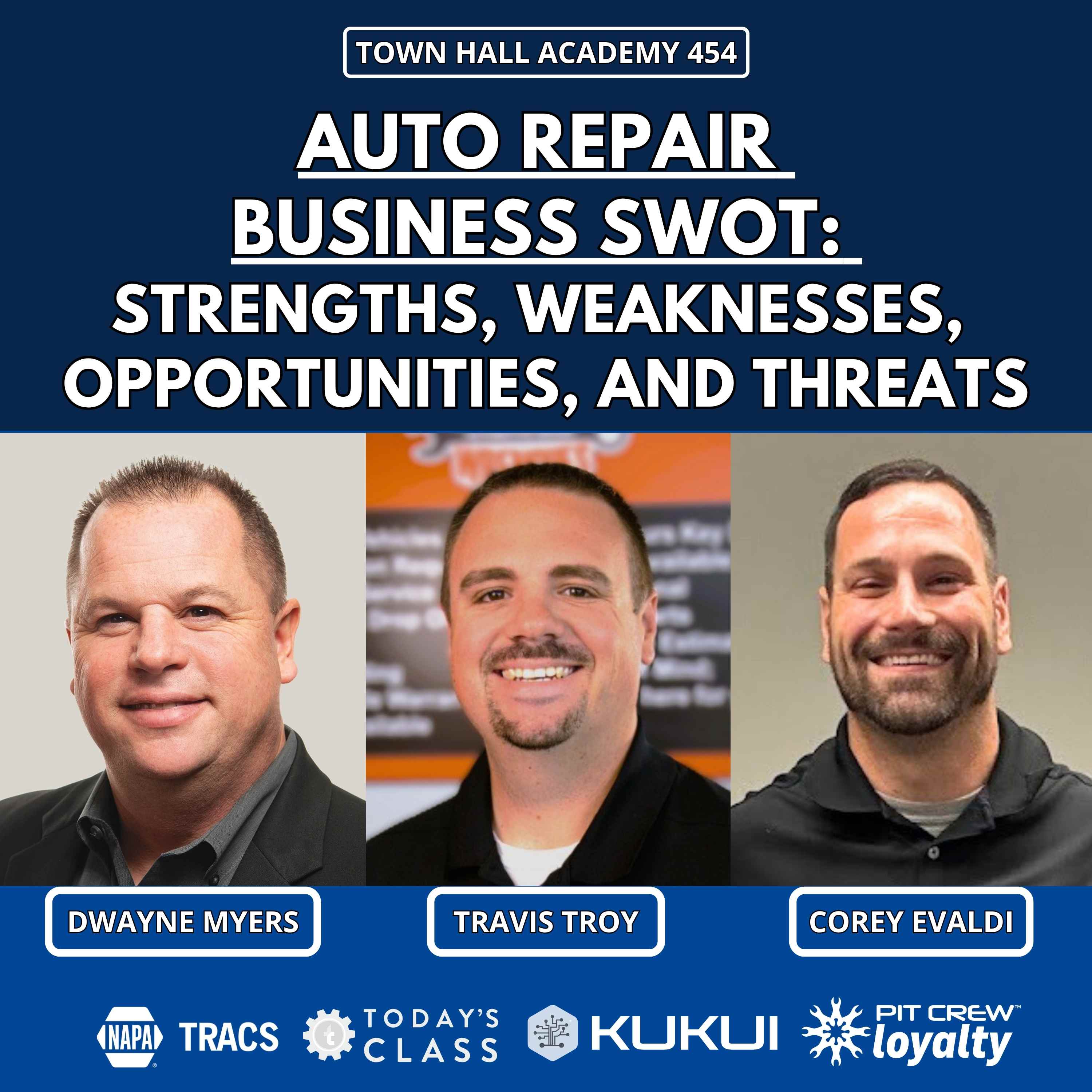
Hey, welcome back. Whoa, royalty. Love you guys. Dwayne Myers dynamic automotive 30-year
celebrating it this year, right, Dwayne? Yeah, that is correct. Do you sleep because you just
open your seven store, I think. Oh, I sleep well. I got a great team. I know you do. All about
the team. Good for you. Good to see you, Dwayne. Travis Troy, honest wrenches, 14 years in the business,
two locations in Iowa. Thanks for having me on. Good to have you. Travis, Cory of all these here,
former Buffaloni in just like me. Are you still a fan or are you a Cleveland fan? Oh, absolutely.
Go Bells. Olmsted AutoCare is in right near Cleveland. So I was assuming. But 10 years is
the owner, but you've worked at Olmsted for a lot of years, right? Yeah, 20 years. Are you still
coaching? I coach a little bit. Yep. I still am involved with some of my clients and such like that
with the repair shop at tomorrow. And yeah, have a lot of fun. Strengths, weakness is opportunities
and threats. And this is the kind of way that you would want to work it in these particular quadrants.
You don't have to live in these quadrants, but it's what's real nice when you share with people
what a SWAT analysis about is that both the helpful and the strengths of the weaknesses are both
internal and origin. The opportunities in the threats are external and origin. And strengths and
opportunities are helpful and weaknesses and threats are harmful. So feature eye on that. And hopefully
you all will see where we're going with this thing. I'm going to do something that I never thought
I would do, Dwayne, Corey, Travis. I'm not going to ask you guys to talk about your strengths.
But I want to just, if you will list them for these particular reasons, I think there's more to
talk about in the weaknesses, opportunities and threats for where we're heading as an industry.
Travis sent me some strengths. We have a resilient industry and an aging fleet. Who's going to
argue with those particular two points when we say that we're resilient? We always seem to come
back no matter what. Look at pandemic. Corey says we're always on demand. Average age of the
vehicles is increasing. Shop diversity. A shop for every client. I love that piece. A shop for every
client. And we could probably get into the firing the client's story and letting them go down the road
to someone else because they're not really right for us. That's probably what you meant. Absolutely.
National warranty program with national programs. And Dwayne, your strengths were the car park
again. It keeps getting older, maybe it's 12.8 years or something in that vicinity. The EV
market has been pushed back. Interesting move, but it doesn't mean that you need to ignore it.
And recession proof, we can survive in all economies. So true. Nothing moves. We don't eat if we don't
have transportation. Now, it doesn't mean that people are going to spend a ton of money, but
there's a lot of people that won't go on a business unless they choose to and they're really
poor operators. Are they putting money away? Six months worth of expenses, right? Yeah, you guys
hold on. So let's get into the weaknesses side. And they've all done the research and their studies.
And I want them to talk about it Dwayne. And it's on everybody's list here in my studio. It's all
about our team. That's our biggest asset. It can be your biggest weakness or biggest strength.
It can be all of these things. Yeah. It can be. What are you doing about it? We're doing tons. And
I feel like we need to do more. But yeah, you know, we got our whole entry level, you know,
as you know, we've talked before, Carm. Our entry level was rock solid with our apprenticeship
programs. We have a waiting list. So we get to pick the people we choose to put in there. I mean,
they choose us and we choose them. It's not a whoever comes through the door. But
things that we learned from apprenticeship was if that works so well, why aren't we still doing
more of it, which turns into our career paths, you know, where we're actually having a path for
every single person, having opportunities. One thing, one nice thing about growing is there's
opportunities for a team to grow, which helps with the retention, which is big. You know, I think
everyone does struggle with experience help. And our struggle comes when we grow. We add a
location. How do we fill that? There's only so much you can pull from what you have. And apprentice
is only learning so fast. I tell everybody they know they can have great knowledge. But it's time
in that gives you experience. And there's no way to speed that up. But so we're attacking it for
many, many different avenues. And I think we're doing okay. But you know, we it's still a struggle,
even with all the things we do. That the gap in talent is so challenging. And I think you're right
when you say it's, you just can't wake up to it. It's time. It's time in the seat. It's time in
the shop. It's time being side by side with some of our senior level technicians. And you know,
one of the things that we focused on, you know, greatest over the last several years is putting as
many people next to our senior level technicians as we possibly can and multiply that. It's the
same thing we did in our businesses in order to be able to grow them to get us out of the seats
that we were always in. We've got to take all of the knowledge and the wisdom that's within
side of our brain and spread it out amongst as many people as we can in the event that something
would happen to us. And that same thing goes for our senior level technicians. They're not going
to be around forever. And they're not going to want to do this forever. So we need some amazing
mentors to help bring this next generation up to speed. And I think we went through a low
in our industry where we just didn't care enough and we didn't invest enough. And we're feeling
that gap and that pain right now. I see the change. I see the shift. We're going to have to ride
the wave a little bit and learn from it and never allow our industry to get back in that situation
again. I'd like to add Travis brought up a good point though about, you know, developing our
people and having places for them to go. Succession planning, you know, of course, we have it at our
level, but we also have a sheet. And it's not perfect. But, you know, each location gets a sheet
for their succession plan for the location. Like, who is the next locationly? Who is the next
assistant? Who's the next shop format? Like map it out and then where are our holes? Where do we
not have someone? In some stores are smaller and they don't have that depth. But a lot of them
are big enough that they do. And it starts that that guide. And now we can then can train and
teach to that pair them up. Like you said, put more people with the senior tech, put more people
with the leader of the company or go to leadership training. But yeah, we've been working on that.
It's not done. It's darling. What wish it was done, my HR and she's the one that leads it. But
we seem to fail just like we do in succession planning in general with that. But throw it out there.
It's a good thing to do and we've gotten part of it. We need to do a little more. That's actually
really interesting. I like that concept. Okay. So look, I've been out in the country and
giving my keynote on the rise of the specialist, which is my big language shift and really trying
to make us more professional. A couple of things have hit me most recently. I'm getting ready to
speak to the Illinois Community College and Structure Association in a few weeks in a great big
city of Peoria, Illinois. Very nice. You'd have to take a paper cup to get in there, right?
You're not far from Iowa, Carm. I should stop by. And I ended up at a conference last weekend.
I met the guy who brought, it was bringing me on. And I gave my speech and he comes out. He says,
man, you're doing this for us in a couple of weeks. We're excited because education. There's a lot
of them have stepped up everyone. And if you're listening to this and you're saying, oh,
this is this weakness thing. It's depressing. No, it's not depressing. It's an opportunity
for us and that this whole technician issue and growing our team and developing our team.
Yeah, it's a weakness, but it's also a huge opportunity because we need to get in front of our
parents and our educators. I can't tell you, I used to go into these local schools and I said,
change the name on the outside of the building. This is not a skilled trade center anymore. It's
an essential skill trade center because everybody who's learning everything in there, we need them.
And if we didn't have them, boom, goes away. We'd be really screwed as a nation as a people.
And it was COVID that put the word essential in it. And just two or three weeks ago,
I'm doing an episode. And I think we were off mic and someone says, Carm, I love your passion,
but we got to drop the word trade. And it just hit so hard. We have to change the word trade
to career. Think about what the word career means to people coming inside of our industry.
Versus a trade, you're going to go out and learn a trade, son. You're going to come to my school
learn a trade. No, you're going to learn a skilled career opportunity. And I think the word career
in my opinion, which has been so strong of late, is it means home and family and it means more
than a trade. A trade you could maybe make some money, but in a career, you could have something
long lasting. And then our opportunity inside is to develop a career path for our people because
we talk a lot about it, but we refuse to look at someone and say, we're going to teach you this
unbelievable career. And in fact, as you come into this mechanical specialist, we're going to
teach you how to be a technologist or a technical technology specialist. We're there's so much
opportunity. And I think one of the great opportunities we have is the diversity of the systems that
we fix and the equipment that we use. And I think some of our young people will be marveled at the
things that we do. I agree 100%. You talked about weakness as an opportunities on that. I moderated a
panel for students looking to get into the automotive industry last night. And we had a whole panel of
automotive professionals up there. And it's a weakness that we have in our industry, but it's a huge
opportunity for the people coming into our industry. And it just makes our industry that much more
appealing. I just remember looking into the audience and just kind of seeing the parent's eyes light
up when I shared, you know, some of the information like when you're one essential to inner resilient
industry, you don't have to worry about a whole lot of things like you're going to be okay and you've
got a long lasting career path. And we had some amazing people that started out as technicians and
moved all the way up to shop ownership. We had people that started out as porters and moved to
technicians and started out as technicians and went into the parts industry. Like the career paths
are so, I mean, amazing that you can get into this industry and just go about anywhere and they're
all rewarding paths. Absolutely. This industry, there's so many different opportunities for people.
We need to exemplify. We need to show that to a lot of these younger generations. I've always used
career to kind of describe us because of that. There is such a longevity. Most of us shop
were technicians at one point. I mean, what's the stat on that kind of? I'm sure you know an 80%
or something like that were former technicians. And the reality of it is, is we all went into shop
ownership because we thought we could do it better than the guy that we worked for. I'm boiledly humbled.
But you see, it takes a guy like Travis to get up in public and say that. See, unfortunately,
part of our problem in our industry is that the realization of the missteps, no one wears them
on their up. They just don't want to say, listen, it was me. I did this. I know I should have
gotten a coach 10 years ago. I know everybody wants to hide behind their mistakes. And I believe,
if you get up and over them, you grow as an individual and you can build your company.
I think you need to keep them out in front of you at all times. I mean, that's the wisdom that we
need to share with the people that are coming into this industry or that we're mentoring along.
If you just tell me everything that you did right in business or in life, the only thing that I can
do is go try something that's probably wrong. You tell me everything that you did wrong in business
or in life. And I go try the opposite of that. The chances of me doing something right are probably
pretty high. I actually thrive and I love talking about all my failures that I've had in life
and in business. And I think talking about that has way more impact and longevity than talking
about all the ways that I want. I don't think, you know, there's a very small place in that.
I mean, think about this SWAT, right? You're like, we're going to spend a very short amount of
time on our strengths. And then we're going to spend the rest in the weaknesses and opportunities
and threats. And I think that same thing goes when we're talking about our wins. Like, spend very
little time on your wins and talk about all the ways that you failed and how you learned and how
you overcame. Because I think that's where the true value really comes. I think it's great to be
proud of your wins. I totally get that. But at the same time, you have to keep moving forward,
right? Do I? As going to say, we don't remember our wins that well. We remember the things that
humbled us. As technicians here, we all remember the jobs that took us way too long that we learned
because of that. And I take that. And I believe that I use that team member development and leadership
development is, you know, embracing our mistakes. And you know, you own them because now it's
education. When someone actually embraces the fact that they made a mistake and admits it,
I now just move that off of a loss and put that right over to education. And it's the mistake
they never forget. You know, they rarely make it again. They can actually teach other people. So
as Travis said, they probably won't make the same one I made. But I always tell people, I tell my
team, you know, I, oh, and I messed up here and here and here because it's like that overnight success.
Yes, it was full of mistakes. So I got there full of them. And if you embrace them, others learn
and you learn yourself. So when I hear him say the word humble, it takes me back to episode two of
remarkable results radio 10 years ago, Dwayne, his partner, Lee and Jose were on. And I never heard
more humbleness from three guys. And especially Dwayne, who was working in the base,
had died in back then. He was in interview two interview two thousand some ago. So oh my god,
it's just amazing to stop and think, let's face it, your shop management system is the single most
important tool in your shop period. Napatrax was built from the ground up to make your business more
profitable and efficient. We provide an extensive set of tools to increase and track profitability
in real time. Napatrax offers the industry's best post sale support hands down and we train your
people on site. Yep, on site. And we offer remote refresher training 10 times a week and customer
support is open six days a week. Give us a call, visit the website or join our Facebook community
today to learn more. We'll prove to you that tracks is the single best shop management system
in the business. Napatrax is always customized and tailored for you whether you're a one-man shop
or a large multi-bay or multi-location company. After all, it's your shop. So it's your choice.
Visit us on the web at Napatrax. That's n-a-p-a-t-r-a-c-s dot com.
Hey, Carm here suggesting you discover a smarter way to train your entire automotive team.
Experience powerful bite-sized training sessions accessible from any device in just five minutes
daily. It's perfect for technicians, advisors and managers alike. Today's class prepares your
shop for sustained success by reinforcing crucial knowledge. Plus add a competitive edge with
our leader board to make learning fun and rewarding for everyone. For effective training that
delivers, turn to today's class dot com. Shop owners, we know you are overwhelmed with a flood of
missed calls, empty bays and disconnected marketing tools. Kakui has spent over a decade building one
integrated platform for auto repair shops, one login, one dashboard and mobile first websites that
convert four times industry average. Smart, innovative CRM with automated follow-up, 24-7 online
booking and real-time ROI tracking. With 900 plus years of combined team experience, we fuel the
growth of 2,200 plus shops and have influenced $3 billion in revenue. Stop working harder,
start working smarter, get industry leading customer support and book a demo with Kakui. That's
KUKUI.com. You know, most shop owners feel trapped spending on ads while half their first-time
customers never come back. It's frustrating. It's exhausting and it's not your fault. The industry
average is 54% one and done. We understand how discouraging that can be. Well, Pit Crew Loyalty
changes the story. Our clients cut that rate by up to 38% raising lifetime value by more than 50%.
Loyalty members visit nearly three times more often, creating predictable revenue without extra
ad spend. Pit Crew Loyalty were customers stay and shops thrive on the web at Pit Crew Loyalty.com.
Look, guys, I want to move on for just to respect our listeners time. In weaknesses,
doing you had, we don't have one voice as an industry and we're fighting each other and under
threats, Corey, I think that you talked about there was too much infighting. We talked about this
before we turned on the mic and Travis says, yes, you guys are all aligned on this. What can we do
about this? And I thought that was funny because all three of us had this on our list, but we
placed it in different areas. I saw it as a threat. Like, you know, our industry has got this black eye.
What we do to each other, not support each other, like Travis you were mentioning, why can't we be
happy about the guy down the street that's running his business maybe a different way than ours
and just keep it on our lanes? Like, we need to be cheering each other on.
You know, to me, it starts in our shops. It starts at our counters. You know, you get a client
that's had a bad experience somewhere else. Like you just tell him that you're sorry about that
bad experience. Don't feed into it. Don't be like, oh, there are a bunch of knuckleheads there. I
wouldn't have taken anything. That kind of stuff like we do it to ourselves in this industry.
And I can't stand it. It's hurting us all. It's not making you look any better because you're in
the same association with the rest of us. Turn on the internet. Look at any of the pages. They're
all dashing each other. They're all passionate. And at the end of the day, they're all right.
If they would just set the ego aside and just cheer the next person on, the way that, you know,
person A is running their business is great. And they're going to do just fine and the way
person B and C is and they just get so passionate that if one guy's running their business this way,
it's wrong. If one person pays this way, it's wrong. They recommend this service.
It's almost like politics and it just gets exhausting. I mean, I have such a deep passion for
this industry and for the people that are inside of it, that it pains me to see the division
that's happening in our industry. And I think we can fix it. We just have to be aware of it.
It's obviously we're just not going to do it anymore. It's education and communication.
Those are the two things that bring our industry that give us that black eye because
it's always a problem. A customer has an issue with our industry. The person that helped them,
whatever, maybe they weren't educated enough, miscommunications happen all the time in our shops
with our clients, but our team. It stuff happens all the time. Without clarifying that, it just makes
our industry look even worse. Look at the Hollywood projection of the automotive industry, you know,
the grease munkiness, you know, we talk about this before. That's not the case anymore. A vast
majority of the people in our industry are not looking to screw the next person over. They're not
looking to hurt their clients. They're not looking to take advantage of, but it gets communicated
like they are. If people can see the back stages and the relationships and what we see in our industry,
we all go to events. I mean, these events are full of people that are hungry to learn. They have
a passion for our industry. They want to help people that doesn't get construed. I think a lot of
it's driven by fear, some of it, of what you're going to take from me. It's disturbing, but I,
people are willing to get help that don't live close to me. I'll get phone calls from people that
aren't close all the time. The thing is, I'll help anybody. You can be my neighbor and I have
helped. I think we need to be more open that we're in this together. We're not just competing. Let's
face it to me. We're not competing. We're helping each other. If we do things alike and are both good,
we raise the industry up. I think it's better, but the online forums and all have given them an
avenue of getting to speak every bit of their mind. Some they shouldn't. Some they shouldn't,
because there's a lot of knowledge in there, but there is a lot of crap too. I'll also say,
I just last week sat down with a guy local that's going to sell a shop. He's up there. He's
very successful over the years. Great person. Didn't know him that well. Got to know him. I love
the conversation. He's like, are you all interested? I said, we are, but let's take this first as a
he's like, I don't know what to do. Well, here's what you should do. We've been through this a few
times just from buying them and I gave him some pointers. These are what you should do. This is
what you should be expected to give, not give, how you protect yourself. He's like, I can't believe
you're telling me this stuff and I said, why would I? I said, it's got to be a win in the end of the day.
And will we, won't we purchase this? I have no idea. It's almost like they're not doing. If you
were doing this online, people would be saying, he's wrong. He doesn't get it. So I got this wild
thought, guys, he's listening to you. And I wrote down, stop being an expert. Right. I don't know if
that's right. Nobody knows everything. This is my thought. It's my opinion. This is what I'm seeing.
But stop being an expert. What I'd love to find out, guys, I've said this on previous
podcasts. The immediate response to somebody is, no, you're wrong. You don't get it within seconds.
I want to know is, what do they do for a living? I mean, is either just waiting for social media to
come up? Are they actually running a business? Do they fix? What's going on with the replies are so
damn quick. And then I would love them to vet that answer. And to find out, was that a Travis
Troy saying that a Dwayne Myers or a Corrie of Aldi? Or was that a, I don't know who's giving me this
expert opinion? And I don't know necessarily. We always know the right person. If the person's been
ever vetted in our own mind, why would I take information from someone that I don't know?
That's a really good point. And also I think when they think they're the best, when you think you're
the best, I mean, you're just arrogant in yourself. And what you should be sharing is, here's
what I did to get me here. Because if you think you're on top of the mountain, all you have to do
is just look up. And there's somebody standing on a mountain lot taller than the one you're on.
So what got you here isn't probably going to get you there. And if where you are right here is
where you want to be, then be amazing at that. And just understand that in order to get there,
you can help people get there. But if they're going to surpass you, they're going to have to do
something different than what you did. And that's where I think some of the opinions come in. And
this is the only way. And it just gets exhausting. And I don't think that the people quite understand
what they're doing and how they can truly confuse a young shop owner that's just trying to find a path.
You know what I just thought of? We should have had you on and just on one topic instead of trying
to do SWO T all at once. Seriously, I may have made a huge mistake being so humble when I'm looking
at all, I want to go here. My God, but this discussion has been just incredible. Dwayne, you've got
under weaknesses, access to data, training and tool investments and ADAS collaborations. So
let's talk about right to repair. Where are we with that? Where are we with that? We got a house
film, a set up bill. We are there. Actually, we were down two weeks ago on Capitol Hill. You know,
the big difference. This is the third time I believe we've done this. First two times, a lot of
questions. What is this? What is right to prepare? They actually know what it is now. Even our newly
elected officials know what it is. It's making enough headway that DOE's are putting advertising
and all around when we're down there doing it. So it's making a difference. People say, well,
is it needed? I know this week alone, I got two cases where we couldn't do ADAS collaborations
because now those systems are dropped into secure networks. We have the tooling to do it. We'll
purchase what we need, but they're different systems. Some are blind spot monitoring, some
front cameras, radars. No longer able to do them. So what's next? You know, it's the newest
generational stuff to get peeled off without access to data. We're repair data. We are crippled.
We can't do the good we do. You can't even simply change your brakes on a car. Become impossible
in some models. So we're still doing the fight. A lot of work still to do. So I encourage everybody
to be a part of it because it is our livelihood. It benefits our customers. But yeah,
it's definitely further along and ever, but still a lot to do. Thank you for your commitment,
Dwayne, in working with AutoCare and getting in Washington for us. One of my great friends who
continues to fight that fight. And I wanted to go to Washington this year, but I couldn't make it.
Corey, on your weakness list, you wrote down access to continuing education. Yeah, I just don't think
that there's enough of that. You know, this industry is so rapidly changing. I know that there's
avenues for training. No doubt. But I just think that there should be more, especially in the local
levels. You know, and I'm not saying it's all the parts vendors, responsibilities like that. But
I would like to see more of it being available. And I know if I look, I can find more I can find
some, but it's just not as I feel like compared to some other industries or some other trainings.
There's more than what the automotive has. For the amount of technology that we have,
the amount of stuff coming out. Why isn't the education up to speed with this? So you put that
as a weakness. And I placed it as a threat, just a slightly different angle. So I love how we've
kind of created them all. And this was unplanned as well. But for me, I think there's a ton of
business coaching out there. There's a ton of service advisor training out there. I mean,
you can pretty much drop a pen and get one of those. But I want to coach for a technician.
Yes. Bingo. There is not enough of that. In some of our, I mean, just outstanding technical
instructors are aging out. And they are leaving our industry. That is going to create a massive
threat for the continued development of our people. Okay, Travis. Thank you for laying this right
upside my lap. I did an episode with Matt, Fonslow, Bob Leonard. And it was all about this.
And ironically, guys, we talked in depth. We actually came up with a list of who's retiring.
It's right on the episode, you know, Scott, John, all the way down the list, Eric, go down the
list of people that flocked to our events. They were in high demand. And what are we going to do
about it? This is the episode came up with this really cool idea. And actually, I have to present it
to you and a lady named Sherry because it has to involve an association willing. And I'm going
to give you a little bit of the premise of the episode. We have scholarships for students to go
to training. What about scholarships for people who want to be trainers to come and be taught
by our legacy people? Wouldn't that be cool? A week long, you know, trained the trainer program.
And we haven't even talked to John or Scott about this or whoever.
They've been fallen told, right? Well, that's kind of what the episode's going to be just like that.
And I don't mean to go off on a tangent, but the thinking that's going out of this,
the amazing, the top tier, everyone's in a line. It could be a weakness or a threat,
but we're all feeling these kinds of issues and pains. And the next thing is how do we solve them?
And this episode started to go deep into if I was going to even get a name. It was just wild how it all
came up. But I can't wait to publish that episode. But I'm going to keep this in mind,
Travis, since I know you're absolutely heavily involved in Moaca and the entire vision event. And
we're never going to have the breadth of trainers or even the width of knowledge to continue to teach
our people if we don't start growing our own. And I met someone there who says, yeah, I want to be a
trainer so bad, but that trainer doesn't necessarily know how to present. Oh, I got a whole bunch
of slides. I've done case to know that may not necessarily be the way to approach it. And they've
got to learn how to do it. And if not, they're going to come go to vision, get a bad rating because
they weren't able to connect with the group. You know how that works. And it really starts in your
shops. It's putting the other workshops inside your walls and getting them to start training your
people internally and then growing it to, you know, like Cory had mentioned some local training
our local Moaca chapter does a really good job with bringing local training in and allowing them to
broaden their horizon and get in front of, you know, maybe they had 10 people in their shop now
getting in front of 30 people and take those steps along the way to continue to groom and evolve
their ability to be able to train and get in front of people and inspire them because that's really
what it is. It's getting out there and training and inspiring people to want to continue to grow.
You know, Carl, I love the fact of training the trainer. And I think it's the same thing we do with
our technicians, you know, why aren't we having the apprenticeship program for the trainer. But also,
what if you flip this around, you know, and talking about, you know, having good training,
well, we need people in the classes so they can pay for it and all of it. Same people. Same people
every time. These are the same people. Guarantee you go to these, we know who's going to be there.
Good nice thing is we're all friends because we're all together, but there's so many. You know,
there'll probably be more training events if we had more people to fill them because there is so
many we can go to. That's the other side of that coin though to think about is I don't know how
we're not training with our technology. It's out there. At what point do you hit a line where you
just can't function anymore and be relative to our industry because you haven't trained. But you are
and you're replacing parts, you're calling a friend, you're trying to rely on YouTube or, I mean,
stop me if I'm wrong. The virtual online training is great. I think there's a lot of that. For me,
the way that I like, I like in person training. I've always liked being person stuff.
I doubt that if somebody's not willing to go to, you know, like a vision, you know, and experience that,
you know, take the money, take the time aside. If they're not willing to invest that time,
you think they're really willing to go online and look. I mean, if they have that problem
with that second, I'm sure they're probably panicking but they're not preparing by doing it ahead of time.
Okay, guys, look. Wow. Let's jump into opportunities. In fact, that was the thing. Travis, you had
technical trainers needed under opportunities and you just slam dunked that right.
Duane, under opportunities, you talked about EV hybrid, scaling, shop owners retiring. It's a
huge issue right now. And AI, you know, we've got AI episodes coming up and I don't think we can
walk away from AI. I think we have to embrace it, but we have to embrace AI in the absolute right
way. And AI works better. If we don't give them one word requests, we have to get deep in it.
I happen to see some stuff at this conference last weekend with, you know, glasses and AI and
it's just fascinating stuff where it's going. We're using it. Yeah. And it's going to help
technically, but it's also going to help you have a more professional. You know, there's your,
another word I like to use is professional shop. You know, like I need an onboarding process. We
have one. It took us a long time to get one. You know, they say most people know within a few hours
that they're going to stay with you by the onboarding process. If your onboarding process is
literally, there's your bay. There's the bathroom. I'll be up front. That doesn't work anymore.
AI can help with that stuff. You know, they can help you create it because we're no masters in that.
They also can help you create your own training curriculum. Here's a book, dive into this. I want
this out of it and it helps you get a lot further along than if you tried to do it on your own,
but it is a tool just like any other. It is not the end though. Right.
Yeah. For me, I think AI is great because it sorts through all the data for me. Now, again,
it's a tool. You got to take things with the grain of salt. But one of the things I always say is
information fixes cards. And it's now we're getting all this information from service manuals and,
you know, all that, a Mitchell motor, identifix, whatever the case may be, Google, GSM, you know,
but I like being able to have a program, an AI tool that can sort through that and bring it to
me in a better format and summarize so that I can spend less time doing research and more time
being productive. Okay. What about EVs, hybrids? Guys, someone did mention that it may be taking a
little bit of a step back, but if you're not in it, you're out. Yeah. I think it's a huge
opportunity. I think it's something else that'll thin the herd. You have to have the training.
You have to have the safety stuff. You have to have things dialed in if you're going to do this.
But I think we have a little more breathing room with a shift and what people are thinking. But
I do think it's an opportunity. It's the hybrid piece that's going to, that's where we're swinging
back to, which I think is more of where we wanted to go for now. But another thing we're,
we need more training, we need more safety. There's all kinds of stuff to put in there to take
advantage of it. Point is that the shingles not out. You're out. You're not doing it. It's,
I know it's a word of mouth. I get that if I'm a hybrid repair center. If you're not in it,
someone told me the other day, just go out and buy a 10-year-old hybrid. It should be your
loner car. What am I special as Bob for himself? I'm like, he asked me about it. He's like,
you think this would be good. I'm like, for you, where you are in your career? Well, obviously,
his family and stuff. I mean, putting that as wife still got a gas powered vehicle. But I'm like,
for you in your career, where are you trying to go? Absolutely. I remember when we first got,
when the IDS first came out, and I was looking for buying a new vehicle. I'm like, I'm going to go
with Ford because I want to play with a new scan tool that we got. You've got to take those steps
and you've got to be prepared to be able to take that stuff on. The only thing that I've seen
is people dive into these things, into these shiny objects and invest a ton of money and then it
pulls back. That can get slightly painful. I think you've got to do a lot of your due diligence
on the backside. You've got to continue to train and be ready. I say, practice the dancing. When
it's your turn to get on stage, be the best dancer. Don't just be the first person on stage when
you don't have an audience there to be able to support it. We have limited funds. There's only so much,
and if you put too much in something, you're cutting something back, but I also believe that we
are an industry now that you can't skip steps. Back in the 80s and 90s, if things change,
you could catch back up pretty quickly. That's a shot. It changes so fast. It changes so fast.
I think if you don't keep up in some way, it will pass you by and then you become the dinosaur.
On Travis' sheet under Opportunities, he wrote M&A in private equity investments. He also
put that as a threat. And so did Dwayne put that as an opportunity of scaling shop owners
retiring, consolidators as a threat. It depends on how you look at it, guys.
What's going on in your mind? I love each of you to speak to this whole entire consolidation
phenomenon. I don't want to be hit the critical because I'm doing it as
smaller scale, much slower, but with our culture and keeping it community-based relationship
based shop. I worry now I have a lot of friends in this area. I don't deny what they're doing
and the good they're trying to do. But if you wrap all these up and you take all the mom and
pops and you spin it to 200 shops. And then where does that go? You know, they sell it.
You know, all right, now what does it become? Is it look anything like who we are today?
That's my threat or my worry because I feel part of our greatness is the relationships we have
with our customers. That's why we win. That's why 70% of the motoring public come to us instead of
the dealers. Is that still the case in 10 years? That worries me a little bit.
On the flip side, I think it creates a great opportunity for the dynamics and stuff like that that are
still in those markets and thriving because when all the consolidators do come in, if you power
through that, you're going to have a massive, massive opportunity for client-based when that word
gets out. They're doing a really good job right now of kind of keeping it hush-hush, not really
rocking the boat per se, but it's eventually going to come out that a place that you thought was
locally owned is now owned by private equity. One of the things that I felt was really good with
some of the consolidations, and this is more in the body shop industry. Body shops have a tough
life because they're dictated a lot by insurance companies and it took a lot of these consolidators
and all these locations to finally stick it to the insurance companies so that they can charge
more than $40 an hour in labor. I mean, body labor is still really, really low. I feel like it
hasn't really moved until some of these bigger corporations came in and started buying up all
these independence and being able to say, you know, if you want your clients, you're the insurer,
you want your clients' cars to be fixed and fix the proper way. This is what we're going to be at.
And who are you going to go to to change that? I think that goes both ways though. Those large
consolidators also have a lot more pull and a lot more ability to negotiate with these insurance
companies where a one-two-location body shop, they just don't have that negotiation power and
that as a smaller location as myself with two locations, that can almost become a threat with
some much larger M&A going on in consolidators that their discounts, the way that they can order
their parts, the kickbacks that they can earn just becomes so much that it makes it really,
really difficult especially for the single location shops to be able to even think about competing
in that more or less a two, three, four or five location shop. They're still going to try to combat
you on a price, are they still going to have the labor, the staff, the personal pledge that
you can still offer. That's where we win and that's what Dwayne had mentioned. You know what I mean?
Like you're going to lose one or the other. It's very, very difficult to scale at the rate that
they're scaling at and be able to sustain the culture that you thought you created and was going
to grow with. It just doesn't happen right there. You're so right, Travis. The elephant in the room
is this to your point, chatting with somebody a couple of weekends ago on this exact topic. And I
said, my God, man, I know five, six guys that have done this. They're in it. They sold. And they're
still part of where they come on my show and talk about culture and the people. And there's
other guys that haven't done it and say, I've taken some people from there because it's not the same.
And I'd like to know, is it the same how much has the previous owner fought for this? And I don't
necessarily know how to approach it. I just don't want anybody to get called on any carpet or maybe
we just need to get some people together that have done this and say, you know, we're working hard.
Our culture is good. We haven't lost hardly anybody. It goes back to this ugliness in our industry.
Oh, you don't want to go to them because they did this and there's no longer locally owned.
That would be a bad thing that goes against this professionalism of our industry. God bless them.
They did this. They made a deal. They're next. Stop being an expert of what you think they're doing.
Carm, you know, who's really worried about this is our parts companies. The ones, you know,
the program groups that, you know, they built the relationships with us. Then there is an acquisition
and all of a sudden that relationship's gone. That's where you bring them one and ask them how they
feel about this. Doing all of a sudden, oh, we have a new national account. Next week, another new
national account and then another new national account. These guys went through a hundred stores.
It's a national account. You're right. You're 100% right. It's anybody. It's our accounting
firms. We all use, you know, these local accounting firms and stuff like that. And in people that
have been very loyal to our industry, I was actually asking in a conversation with our accountant,
you know, have you felt it? And they've lost some people, but it hasn't been enough of an impact.
But it will eventually become an impact for some of our vendor partners that have been so supportive
of us and our industry as this, you know, continues to happen. But it's one of those things. It
really depends on what season of life you're in. And obviously, we're not all going to be in this
forever. And we've got risk and we're looking for a reward eventually. And so it's a, you know,
for a Duane Myers, this is a huge opportunity for them to continue to go out and grow. And for
somebody else, it's looking to exit. It's a huge opportunity for them to be able to exit. So it
just really depends on what season of life you're in within business. So it's not Duane Myers' private
equity. It's Duane Myers' private local private community. See, that's where he's going to grow.
There ain't no private equity money. It's what money. I understand that. My point is it wasn't
private equity. It was private community. It was like, this is what we do and how we do it and why
we do it. Duane's probably got a private equity company a week beating his email box down,
you know, absolutely. They do. How many dinners have you had, sir? Let me see, which offer would
you like the one from last month? Which one get a bit of read? You know, what they've taught me is,
I wouldn't say tactics, but I've watched them and I've learned some things. And I'm like, wow,
again, you know, always be a sewer to your craft and what you're doing. And they're winning for a
reason. So yeah, I've actually learned a lot from them. But I am a believer that everyone must
win if you want this to be successful. Nice. I'm going to wrap this up with some threats. We
are going long, but I'm good with this thing. I heard too many crazy stories two weekends ago
hanging out with shop owners, supply chain quality issues. It was written in your threat
Travis. And I heard it a lot. And so I've got to ask this question, what's going on?
Have you a really good question for the manufacturers and the suppliers? I think it's a continuous
drive down in price for what us, you know, what we're trying to buy the parts for and where they're
sourcing the parts and just a whole slew of issues that they're experiencing. And not only that,
they've had some extreme pressures from the government and EPA on how they've got to be able to
manufacture some of this stuff and what they can put in some of it. And I think it's just really
shaken some things up on the part side of things. And I've really, really created some extreme
challenges in just the pure quality of what we're getting. Now, granted, you can still go straight
OE and still get a solid quality part there. But there's times when you get an OE part and you know
it was produced probably right next to the aftermarket part that you got. And you set them side by
side. And I don't think a lot of people really understand that there's not a whole lot of
manufacturers out there anymore. But there's a lot of conveyor belts on what boxes these parts go into.
To your point with the OE stuff, I find a lot of OEs with stuff on national back orders. And like
that to me is the worst. It's, you got a car that's not even that old. And we can't get a part
and your only option is to find something used like this continued parts was another big topic
discontinued that planned up the lessons man. Wait a minute, the cars are getting older but let's
discontinue. I don't get that. Why isn't there like a minimum of support for these vehicles.
Go to my other threat that I have this kind of rolls right into it is OEMs attempting to try to
control everything that we do if they quit making that part and you can't get it and you're dead
in the water. What do you got to do? You got to go out and get another vehicle. What's that do? That
increases the actual cost of ownership of you being able to have that vehicle and have it on the road.
I think that the OEMs are backing us into a corner and I don't know that we're paying enough
attention to it. But they are continuing to drive the cost of repair, drive the cost of ownership.
And we're eventually going to get back into a corner that it actually becomes more economical
for them to just allow consumers to rent vehicles from them. Turn them in when they need it,
come in for an oil change, do whatever they got to do. And you no longer own. It was somebody
out there that said by 2030, you no longer own anything. And I think they're getting very, very
accurate. I think their dates off, but I really don't think we're far off from hitting that tipping point
of the cost to repair and maintain something versus just going out and having an OEM
allow you to just rent it for six, 700 bucks a month. That's an average car payment anymore.
Not including what it takes to maintain it, what it takes to repair it. You go out and buy a five,
six year old vehicle and you've got a six, seven hundred dollar a month car payment. And then you get,
you know, dropped a 60 K service or, you know, wheel bearings or something else that goes better,
transmission or something else. I mean, that's a big threat that I think we have as an industry,
as a whole, that we need to be very, very careful on with the rising costs. And I think the OEMs
are watching us like a hawk. I really, really do. That's a great observation. Uh, wow. We
almost have to get back together and start from A and go back to Z. There's so much here. Guys,
I can't tell you how much I appreciate everything here to get this thing discussed.
For our listener, this was profound. There was a lot of great stuff thrown around here. Did you
hear anything for the first time? Maybe not. But if you hear it and you hear it often and you hear
it coming from top tier shop, professional shop owners, it makes sense. Hopefully it drives you to
make decisions and strategic decisions in your business, which is why I think this is so important.
And should you do an SWOT on your own business? Absolutely. Should you sit down with your people
and maybe not you be the leader of it, but someone else so that they can come and tell you. I think
it is so profound. There's so, so much to learn about what your people think about the business,
think about the industry, think about what their jobs are, think about the customer, think about the
marketplace, think about the industry. I think you can take that information and do great,
great things and make forward moving, leaning decisions. Wow. Final words. I'm going to go
around the room one minute each, Dwayne. This was a great exercise. We did it more industry-wise,
but I think what you said internally, it's good and have your team help you with that. But
it comes down to me, even with threats and all. I mean, you've got to look at them and all
and get better. But our opportunity is amazing. Where we can go at, what we can do,
amazing industry. We can do who about things, but I think we got to fight. Well, we can fight
and then just deal with what we can't and move forward, but we can get better and keep,
which should keep trying to get better and doing stuff like this helps. Great point, Dwayne,
Corey. I've always been a fan of swats ever since I've been introduced to them. When I was
coaching, we did some Zoom swats and stuff. I've done them with my teams at the shop too,
but to speak with Dwayne, I still am very passionate about this industry and I can help
but see the longevity in it. I know there's a lot of scary stuff out there, but there's been scary
stuff in your life forever. It shouldn't paralyze us. 100%. Anything worth doing well is going to
be challenging, right? I think we're all on this call as extremely passionate people in an industry
that we love dearly. If we got into this industry because we thought it was going to be easy
boy where we fool, I think the challenges will always be there and I think having a level head,
the wanton, the desire to continue to do what's right for our industry and bring our industry together
and not separate. It is how we're all going to win. All right, Travis. Thank you. Dwayne Myers,
dynamic, Travis Troy, honest wrenches, Cory of all the homestead auto care. Thank you so much
for your great insight. Appreciate it. Thank you. Thanks for being on board to listen and learn from
the premier Automotive Aftermarket podcast. Until next time.
About this episode
A deep dive into the automotive repair industry's strengths, weaknesses, opportunities, and threats (SWOT) reveals critical insights for shop owners. The panel discusses the importance of team dynamics, the need for effective training, and the challenges posed by evolving technology and market consolidation. Notable guests share their experiences and strategies for navigating industry changes, emphasizing the significance of mentorship and succession planning. The conversation highlights the necessity of collaboration and communication within the industry to foster growth and resilience.
Thanks to our Partners, NAPA TRACS, Today's Class, KUKUI, and Pit Crew LoyaltyWatch Full Video Episode
This episode focuses on a SWOT analysis, examining the Strengths, Weaknesses, Opportunities, and Threats that will shape the automotive industry over the next three to five years. Panelists highlight key strengths, such as the industry’s resilience and the aging vehicle fleet, alongside critical weaknesses like the shortage of experienced staff and trainers. Opportunities explored include EV and hybrid servicing, as well as the growing demand for technical educators, while threats encompass supply chain challenges, OEM influence, and internal industry conflicts. The conversation also underscores the importance of framing automotive work as a skilled career rather than a trade, along with the need for succession planning and mentorship within shops.
Thanks to our Partner, NAPA TRACS
NAPA TRACS will move your shop into the SMS fast lane with onsite training and six days a week of support and local representation. Find NAPA TRACS on the Web at http://napatracs.com/Thanks to our Partner, Today's Class
Optimize training with Today's Class: In just 5 minutes daily, boost knowledge retention and improve team performance. Find Today's Class on the web at https://www.todaysclass.com/Thanks to our Partner, KUKUI
Stop juggling multiple marketing tools. KUKUI’s integrated platform delivers 4x better website conversions, automated follow-up, and real-time ROI tracking. Get industry-leading customer support with KUKUI at https://www.kukui.com/Thanks to our Partner, Pit Crew Loyalty
You’re probably tired of chasing new customers who never return. We understand. Pit Crew Loyalty ends the one-and-done cycle, turning first visits into lasting, reliable revenue at https://www.pitcrewloyalty.com/Connect with the Podcast: