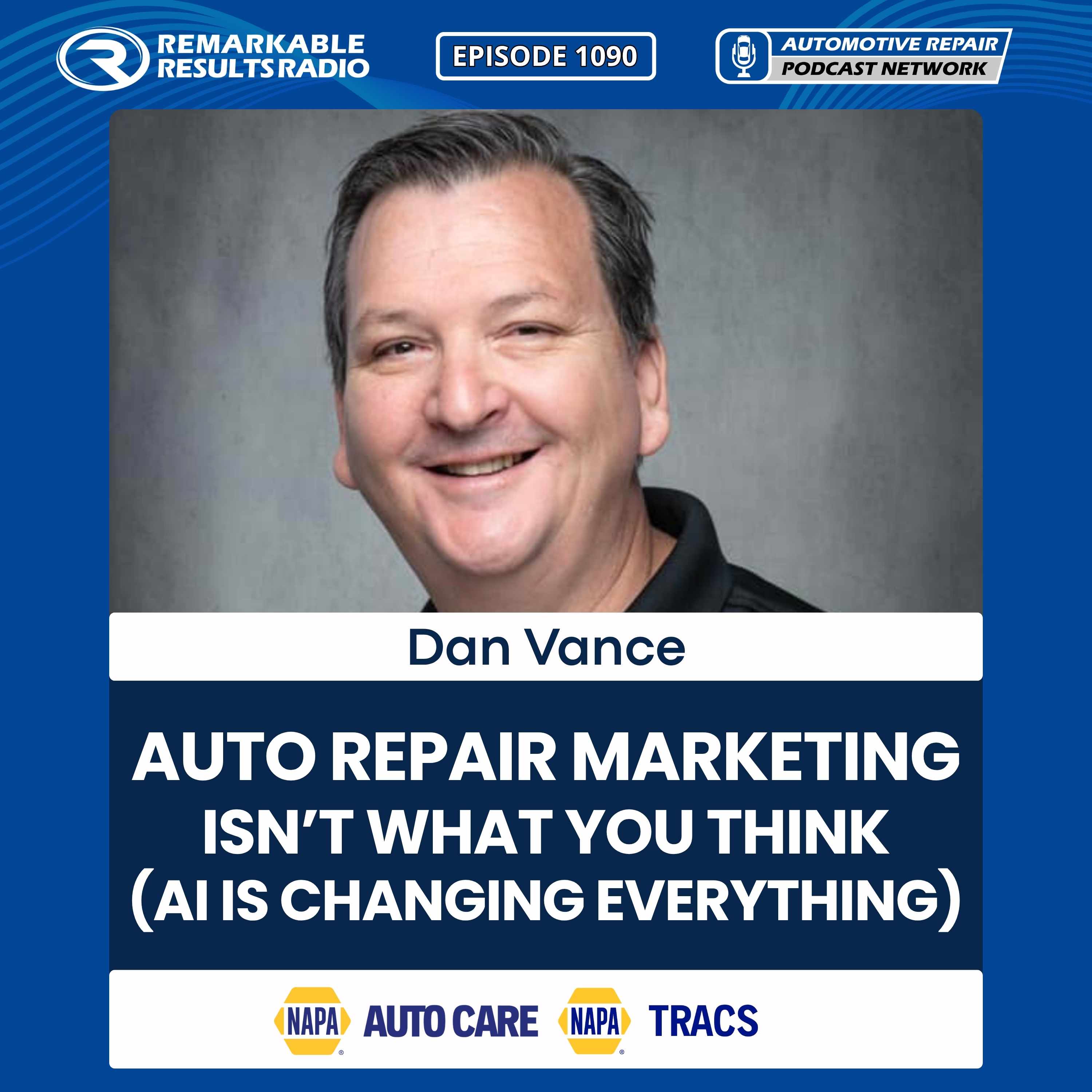
Auto Repair Marketing Isn’t What You Think (AI Is Changing Everything) [RR 1090]
About this episode
The conversation reframes auto repair marketing as much more than ads or SEO. It ties real growth to shop operations, customer treatment, community presence, and trust signals like E-E-A-T. The speakers also dig into how search visibility, reviews, Google posts, and AI tools can help a shop position itself against dealerships, understand public perception, and even improve hiring decisions by analyzing reviews and candidate data.
Dan Vance, CEO of Shop Dog Marketing, challenges how auto repair shops think about marketing in today’s AI-driven world. The conversation goes beyond websites and SEO, exploring how real marketing lives in every customer interaction and how tools like ChatGPT and Google AI Overview can become powerful strategic partners.
What You’ll Learn
- Marketing Is Bigger Than Digital Tactics: Most shops mistake marketing for SEO, ads, or websites. Dan reframes marketing as theentire customer experience,from the way a repair is explained to how a customer feels in your waiting room. The shops that win combine smart digital strategy with authentic human connection.
- Why “Precious Moments” Builds Powerful Brands: Small, meaningful experiences, like a child choosing a toy or a team member giving back to the community, create emotional anchors. Capturing and sharing these moments builds trust and a brand that customers remember and talk about.
- How E-E-A-T Drives Visibility and Growth: Search engines prioritize Experience, Expertise, Authority, and Trust. Shops that intentionally showcase these qualities can outperform larger competitors. Long-term credibility matters more than short-term ad spend.
- Using AI as Your Strategic Thinking Partner: AI isn’t just a tool; it’s a collaborator. Dan shares practical ways shops can use it: Identify dealership weaknesses through review analysis and position your shop as the better alternative. Understand your shop’s real online reputation, both strengths and blind spots. Improve hiring by comparing candidates to your top performers and analyzing interview traits.
Stop thinking of marketing as something you do and start seeing it as something you are. When you combine authentic customer experiences with the strategic power of AI, you don’t just compete, you create momentum that builds trust, visibility, and long-term growth.
Dan Vance, Shop Dog Marketing.com
Thanks to our Partners, NAPA Auto Care and NAPA TRACS Learn more about NAPA Auto Care and the benefits of being part of the NAPA family by visiting https://www.napaonline.com/en/auto-care NAPA TRACS will move your shop into the SMS fast lane with onsite training and six days a week of support and local representation. Find NAPA TRACS on the Web at http://napatracs.com/ Connect with the Podcast:- Visit the Website:https://remarkableresults.biz/
- Subscribe on YouTube:https://www.youtube.com/carmcapriotto
- Follow on Facebook:https://www.facebook.com/RemarkableResultsRadioPodcast/
- Follow on LinkedIn:https://www.linkedin.com/in/carmcapriotto/
- Follow on Instagram:https://www.instagram.com/remarkableresultsradiopodcast/
- Join Our Virtual Toastmasters Club:https://remarkableresults.biz/toastmasters
- Join Our Private Facebook Community:https://www.facebook.com/groups/1734687266778976
- Join our Insider List:https://remarkableresults.biz/insider
- All books mentioned on our podcasts:https://remarkableresults.biz/books
- Our Classroom page for personal or team learning:https://remarkableresults.biz/classroom
- Buy Me a Coffee:https://www.buymeacoffee.com/carm
- Special episode collections:https://remarkableresults.biz/collections
The Automotive Repair Podcast Network: https://automotiverepairpodcastnetwork.com/
- Remarkable Results Radio Podcastwith Carm Capriotto: Advancing the Aftermarket by Facilitating Wisdom Through Story Telling and Open Discussion.https://remarkableresults.biz/
- Diagnosing the Aftermarket A to Zwith Matt Fanslow: From Diagnostics to Metallica and Mental Health, Matt Fanslow is Lifting the Hood on Life.https://mattfanslow.captivate.fm/
- Business by the Numberswith Hunt Demarest: Understand the Numbers of Your Business with CPA Hunt Demarest.https://huntdemarest.captivate.fm/
- The Auto Repair Marketing Podcastwith Kim and Brian Walker: Marketing Experts Brian & Kim Walker Work with Shop Owners to Take it to the Next Level.https://autorepairmarketing.captivate.fm/
- The Weekly Blitzwith Chris Cotton: Weekly Inspiration with Business Coach Chris Cotton from AutoFix - Auto Shop Coaching.https://chriscotton.captivate.fm/
- Speak Up! Effective Communicationwith Craig O'Neill: Develop Interpersonal and Professional Communication Skills when Speaking to Audiences of Any Size.https://craigoneill.captivate.fm

Chevrolet Trax
"...p, so it's your choice. Let us prove to you that Trax is the single best shop management system in the..."
The Chevrolet Trax is a small SUV made by Chevrolet. It’s meant for regular driving and everyday errands, with a higher seating position than a typical car. People talk about it because it’s a practical size for those who want some SUV features without something too big.
The Chevrolet Trax is a compact crossover SUV from Chevrolet, designed for everyday driving with a practical size and good visibility. It’s often discussed because it’s positioned as an accessible option in the small-SUV segment, making it a common choice for buyers who want SUV space without a large vehicle. In a podcast, it may come up when talking about value, ownership fit, or what makes a particular model stand out for daily use.
Marketing vs tactics for auto repair shops
"Dan has been reflecting an awful lot of late [168.1s] on organizational structure for marketing. ... [203.6s] That's a tactic, that's not marketing. [206.6s] And marketing is so much more than that. [209.3s] Marketing is everything you do in the shop,"
They’re talking about the difference between marketing and smaller tricks. The idea is that marketing is bigger than just SEO or a website—it’s how the whole shop runs.
The hosts distinguish “marketing” from narrower “tactics” like local SEO, building a website, and lead generation. The segment frames marketing as a broader set of actions that shape how the shop operates and attracts customers.
local SEO
"But in reality, they're doing a tactic, [196.3s] like local SEO or build you a website [199.3s] or lead generation through visitors to your website."
Local SEO is how a business tries to show up in Google searches for its city or neighborhood. It’s meant to attract customers who are looking for services nearby.
Local SEO (search engine optimization) is the practice of improving a business’s visibility in search results for a specific area. For auto repair shops, it typically means showing up when nearby customers search for services like “oil change” or “brakes near me.”
lead generation
"like local SEO or build you a website [199.3s] or lead generation through visitors to your website. [203.6s] That's a tactic, that's not marketing."
Lead generation means getting people interested in your business and encouraging them to reach out. For a shop, that might be filling out a form or calling after visiting a website.
Lead generation is the process of attracting potential customers and turning them into “leads,” usually by getting them to contact the business or request information. In this context, it’s described as driving visitors to a shop’s website to create those leads.
Karm's auto
"And I said, why Karm's auto? [442.8s] And every time you make a post, [444.1s] if one of your guys is doing some great work"
“Karm's auto” is the name of the auto shop they’re talking about. They’re discussing how the shop can market itself by sharing what its team is doing.
“Karm's auto” is the shop/brand name being discussed in the context of recruiting and marketing tactics. The host is using it as an example of how a legacy shop can promote its people and community involvement through posts.
reviews
"[511.0s] I don't know how they do all that completely, [516.3s] but reviews is a big part of that. [518.6s] So they can see what it looks like in the real world."
“Reviews” are what past customers say online about a shop. Good reviews can help more people find the shop and trust it.
In auto repair marketing, “reviews” usually means customer ratings and written feedback on platforms like Google or Yelp. These reviews influence how potential customers perceive a shop and how visible the shop is in local search results.
ranking performance
"[518.6s] So they can see what it looks like in the real world. [522.3s] And it does drive your ranking performance. [525.1s] So you get the benefit of digital lift"
“Ranking performance” is how high a business shows up when people search online. If a shop ranks higher, more local customers are likely to find it.
“Ranking performance” refers to how well a shop appears in search results for relevant local queries (for example, “auto repair near me”). Better ranking typically comes from signals like review volume, review quality, and engagement in the local area.
digital lift
"[525.1s] So you get the benefit of digital lift [527.8s] when you focus on that relationship, [530.4s] building relationships with people."
“Digital lift” means your online results get better because of what you do offline. For a shop, that can mean more visibility and more customers finding you.
“Digital lift” is the measurable improvement in online visibility or results that comes from actions taken in the real world—like building relationships and generating community goodwill. In this context, community engagement feeds back into digital signals such as reviews and search visibility.
Shop Dog Marketing
"[591.5s] That's a great point, Karn. [593.4s] And you know, Shop Dog Marketing, the CEO of this, [597.2s] you're a marketer."
They mention “Shop Dog Marketing,” which is the marketing company being discussed. The host brings up its CEO as an example of someone who understands marketing for auto repair shops.
Shop Dog Marketing is referenced as the company behind “Shop Dog Marketing,” with the speaker identifying its CEO. In the context of this episode, it’s part of the discussion about how auto-repair businesses market themselves.
Napa AutoCare
"Hey, you know, it's no secret [813.4s] the automotive industry is facing a technician shortage, [816.6s] but Napa AutoCare is stepped up with a powerful solution, [819.8s] the Napa AutoCare Apprentice Program,"
Napa AutoCare is a program/network tied to NAPA that supports auto repair shops. Here, they’re highlighted for helping solve the problem of not enough trained mechanics.
Napa AutoCare is a service network/program associated with the NAPA brand, focused on helping auto repair shops and technicians. In this segment, it’s presented as responding to the industry’s technician shortage with a training pipeline.
technician shortage
"Hey, you know, it's no secret [813.4s] the automotive industry is facing a technician shortage, [816.6s] but Napa AutoCare is stepped up with a powerful solution,"
A technician shortage means there aren’t enough trained mechanics available. That can make it harder for repair shops to keep up with customers and stay staffed.
A technician shortage means there aren’t enough trained automotive mechanics to meet demand for repairs and maintenance. In the context of auto repair marketing, it’s important because shops compete for labor and often need to invest in training pipelines.
McNeil's AutoCare
"This program was pioneered by shop owners Pete McNeil [828.1s] and master technician Jake Sorensen [830.0s] at McNeil's AutoCare in Sandy, Utah. [832.5s] They recognized that waiting for skilled technicians"
McNeil's AutoCare is a local repair shop in Utah. The hosts say the apprentice program started there with the shop owner and a senior technician.
McNeil's AutoCare is the Utah shop where the program’s founders are said to work. The segment credits shop owner Pete McNeil and master technician Jake Sorensen at McNeil's AutoCare with pioneering the apprentice program.
nine-stage curriculum
"The program features a comprehensive nine-stage curriculum [854.7s] with in-depth classroom videos,"
A nine-stage curriculum means the training is divided into nine steps. The idea is to teach people in a planned sequence so they can build skills over time.
A nine-stage curriculum is a step-by-step training plan broken into multiple phases. Here it’s used to explain how the program provides structured learning (including classroom video instruction) to develop apprentices into certified technicians.
Napa AutoTech
"instructor-led Napa AutoTech classes, web-based courses, and hands-on training with a mentor."
Napa AutoTech is Napa’s program for training car mechanics. It mixes classroom learning with real practice so trainees can become shop-ready.
Napa AutoTech refers to Napa’s training program for automotive technicians. It’s positioned as instructor-led education plus hands-on mentoring to help apprentices build job-ready skills.
ASE certifications
"Graduates earn four ASE certifications, the G1, A4, A5, and air conditioning,"
ASE certifications are mechanic credentials earned by passing tests. They show you’re trained for particular kinds of repairs a shop would do.
ASE certifications are standardized credentials that cover different technician specialties. In this segment, the speaker lists specific exam areas (G1, A4, A5, and air conditioning) that map to common shop work.
A5
"the G1, A4, A5, and air conditioning, and are officially registered with the Department of Labor"
A5 is another ASE topic code. It’s used to identify a specific category of mechanic knowledge that’s tested for certification.
A5 is an ASE certification test-area code mentioned alongside G1 and A4. It represents another specific area of automotive technician knowledge/skills.
A4
"the G1, A4, A5, and air conditioning, and are officially registered with the Department of Labor"
A4 is a code for one of the ASE certification topics. It tells you which kind of mechanic work the test covers.
A4 is another ASE test-area code referenced in the segment. It indicates a particular specialty area that technicians can earn certification in.
G1
"the G1, A4, A5, and air conditioning, and are officially registered with the Department of Labor"
G1 is the code for one of the ASE subject areas. It’s basically a label for a specific type of mechanic knowledge that’s tested.
G1 is one of the ASE test areas mentioned in the transcript. It corresponds to a specific category of automotive knowledge/skills that technicians are tested on for certification.
billable hours
"As apprentices gain skills, they generate billable hours, often boosting shop profits as early as stage five."
Billable hours are the hours a mechanic’s work that the shop can charge customers for. If apprentices become productive, they can help generate more of that chargeable work.
Billable hours are the labor hours a shop charges customers for. The segment connects apprentice skill-building to more billable work, which can improve shop profitability.
stage five
"often boosting shop profits as early as stage five. Plus Napa now offers a new apprentice toolkit"
“Stage five” sounds like a step in the training program. The speaker is saying that by that point, apprentices can start contributing enough to help the shop’s money.
“Stage five” appears to be a program milestone within the apprentice framework being discussed. It implies a point where apprentices are productive enough to noticeably impact profitability.
Carlisle Tools
"Napa now offers a new apprentice toolkit developed with Carlisle Tools at an exclusive price, helping break down one of the biggest barriers for new technicians the cost of tools."
Carlisle Tools is a tool brand that Napa teamed up with. The idea is to package tools for apprentices at a better price so starting out is less expensive.
Carlisle Tools is the tool brand partnered with Napa to develop an apprentice toolkit. The segment frames it as a cost-reducing bundle for new technicians.
shop management system
"your shop management system is the single most important tool in your shop, period. Napa Trax was built from the ground up"
A shop management system is software that helps a repair shop run its workflow. It can help with things like scheduling jobs, writing estimates, and billing customers.
A shop management system is software used to run day-to-day operations in an auto repair business. It typically supports scheduling, estimating, invoicing, and tracking work so the shop can operate efficiently.
Napa Trax
"Napa Trax offers the industry's best post sale support hands down, and we train your people on site... We'll prove to you that Trax is the single best shop management system in the business."
Napa Trax is a software system for auto repair shops. The company says it helps shops manage their business and improve how they operate.
Napa Trax is a shop-management software product marketed to automotive repair businesses. It’s positioned as a system for running day-to-day operations and supporting customer-facing processes like training and support.
position my shop as the local alternative to the dealer
"Dan, if I wanted to position my shop as the local alternative to the dealer, what would a review analysis show to support or refute this marketing plan?"
They’re talking about how to market your repair shop as the better local option compared to a car dealership. They mention using customer reviews to judge if the plan is working.
This is a marketing strategy discussion about competing with dealerships for local customers. The hosts focus on using review analysis to support or challenge whether that positioning works.
review analysis
"what would a review analysis show to support or refute this marketing plan? That's such a great way to do that, and look, I see shops do this..."
Review analysis means looking at customer reviews and figuring out what people are saying. Here, it’s used to see whether the shop’s marketing is convincing customers.
Review analysis is the process of evaluating customer reviews to find patterns and measure how customers perceive a business. In this context, it’s used to test whether a shop’s marketing position (vs. dealerships) is resonating.
Google profile
"on the dealerships website or on their Google profile? [1007.6s] What kind of reviews do you see,"
A Google profile is your business page on Google. It often shows your reviews, hours, and location, and it helps people find and choose your shop.
A “Google profile” usually means a business listing on Google (commonly Google Business Profile) that shows your address, hours, photos, and—most importantly—customer reviews. For auto repair shops, it’s a key place where local customers compare options before calling or booking.
incentives
"Because you can't just say we're cheaper than the dealership, [1015.7s] but we offer all the same incentives, [1018.0s] clean shop, best parts, great service, we're just cheaper."
Incentives are special deals or discounts you offer to get customers to choose you. The host is saying you need to offer comparable promotions, not just say you’re cheaper.
“Incentives” here means promotional offers used to attract customers—such as discounts, coupons, or special service deals. The point is that a shop can’t just claim it’s cheaper; it needs to match the same types of offers customers see from dealerships.
search engines will pick up on it
"But if you see that in the reviews, [1047.0s] you can work on addressing that with your own reviews, [1047.0s] and then the search engines will pick up on it, [1049.5s] and they will offer you up as an alternative."
They mean Google and other search sites notice what people are saying about your business. If your reviews and posts match what customers want, you’re more likely to show up in search results.
The speaker is referring to search engines using signals like review content, keywords, and engagement to rank businesses in results. In practice, consistent messaging across reviews and posts can improve how often your shop appears when people search for nearby auto repair.
Request an Explanation
Heard something you'd like explained? We'll add it to this episode.
Sign in to request explanations for terms you heard.
Want to learn more?
Browse our glossary for plain-English explanations of automotive terms, jargon, and concepts.
Help improve this episode
See something that's not quite right? Our annotations are AI-generated and can sometimes miss the mark. Click the flag icon on any annotation to suggest a correction.