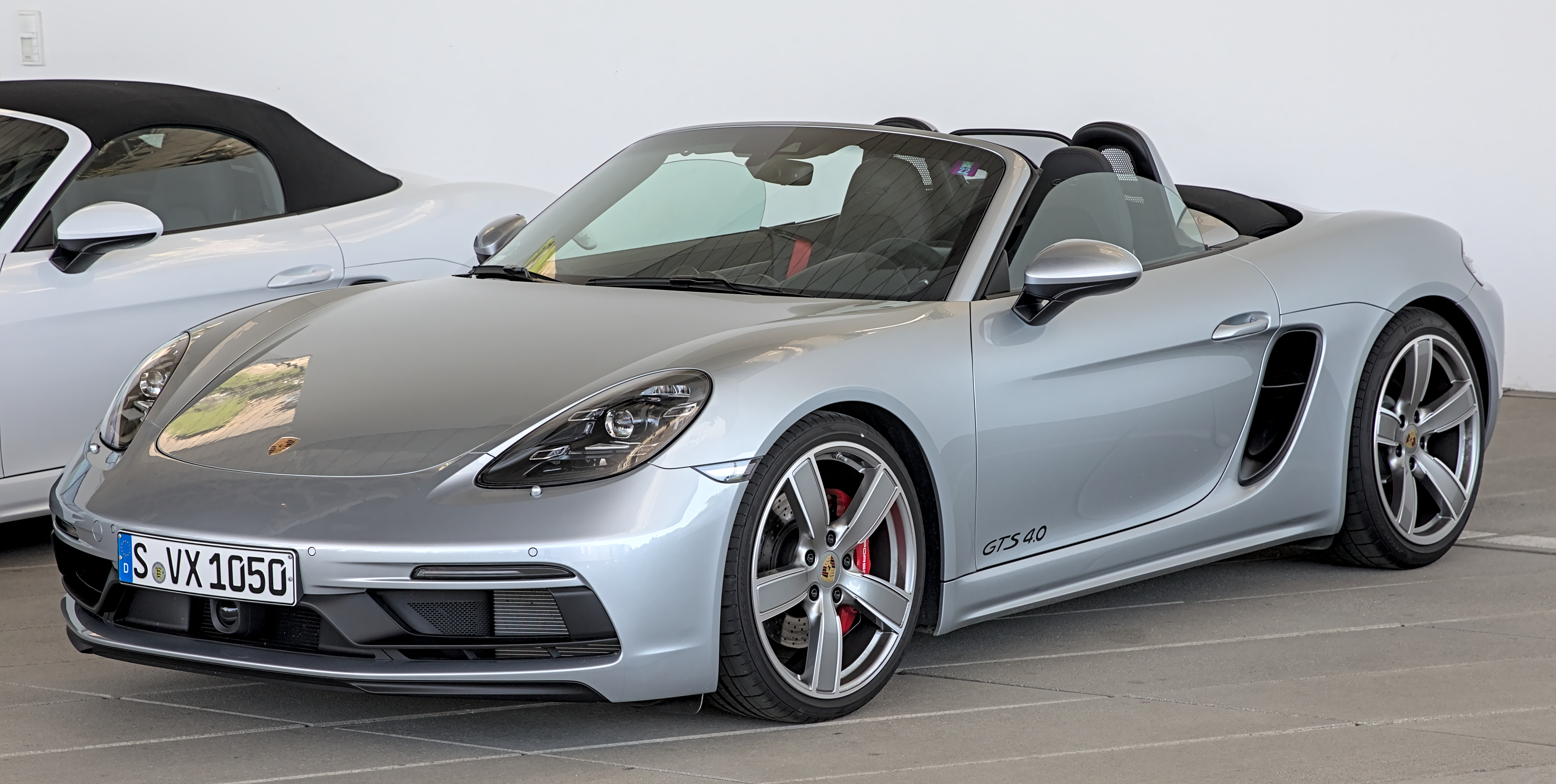
Pirelli is a brand that makes tires, which are the rubber parts of a car that touch the road. They are known for making high-quality tires that help cars perform better.
The Jaguar XKE is a classic sports car from the 1960s known for its sleek looks and fast performance. It's a car that many people admire for its design and history.
The Porsche 911 is a famous sports car known for its speed and unique shape. The 1966 and 1967 versions are some of the earliest models made.
Car
Porsche 912
The Porsche 912 is a car made by Porsche that was produced in the 1960s. It looks a lot like the 911 but is generally less expensive and has a smaller engine.
The Porsche 356 is an old sports car made by Porsche that first came out in the late 1940s. It's important because it was the first car that Porsche made, and many people still love it today for its style and performance.
The Chevrolet Corvette is a famous sports car from America that has been around since the early 1950s. It's known for being fast and stylish, making it a favorite among people who love cars.
Autocross is a type of car racing where drivers go through a course made of cones. It's about how well you can handle your car rather than how fast you can go.
The Porsche Cayenne is a big, fancy SUV made by Porsche. It was one of the first SUVs from a brand known for sports cars, and it offers a mix of speed and space.
The Porsche Panamera is a luxury car with four doors that drives like a sports car. It was first made in 2009 and is known for being fast and comfortable.
Volkswagen is another famous car brand from Germany that makes many types of cars, including the well-known Beetle. They are one of the biggest car companies in the world.
Porsche of America Corporation is the part of Porsche that sells their cars in the United States. They help manage how the cars are sold and serviced in that region.
Mechanical fuel injection is a way to get fuel into a car's engine using mechanical parts instead of computers. It's an older technology that can be very reliable but might need more care to keep it working well.
Houndstooth seats are a type of car seat fabric that has a unique checkered pattern. It's often found in older sports cars and gives the car a classic style.
The Porsche 944 Turbo is a sporty car from the 1980s that has a turbocharged engine, making it faster than the standard 944. It's a favorite among car fans for its fun driving experience.
The Interstate Highway System is a big network of highways in the U.S. that makes it easier and faster to drive from one place to another. It started being built in the 1950s.
The Porsche 928 is a luxury sports car made by Porsche that was produced from the late 1970s to the mid-1990s. It is known for its comfortable ride and powerful engine, making it suitable for long-distance driving.
Laguna Seca is a well-known racetrack in California where cars and motorcycles race. It has a famous part called the Corkscrew, which is a tricky turn that many drivers find challenging.
The Mercedes-Benz SL is a fancy sports car that has been around since the 1950s. It's known for being powerful and comfortable, making it a popular choice for people who want a luxury driving experience.
The Porsche 904 is a classic sports car from the 1960s that was made for racing. It's special because it's lightweight and has a unique design, which helps it go fast and handle well.
The Porsche 924 is a sports car made by Porsche from the late 1970s to the late 1980s. It was designed to be more affordable than other Porsches, making it easier for more people to own a Porsche.
The Porsche Cayman is a sporty car that came out in 2006 and is known for being fun to drive. It's designed to handle really well on the road, which makes it a favorite for people who enjoy driving.
LIVE
Welcome to the Porsche Club Insider, your one stop for all things Porsche and PCA.
Here's your host, Vu Gwin, and the Insider Crew.
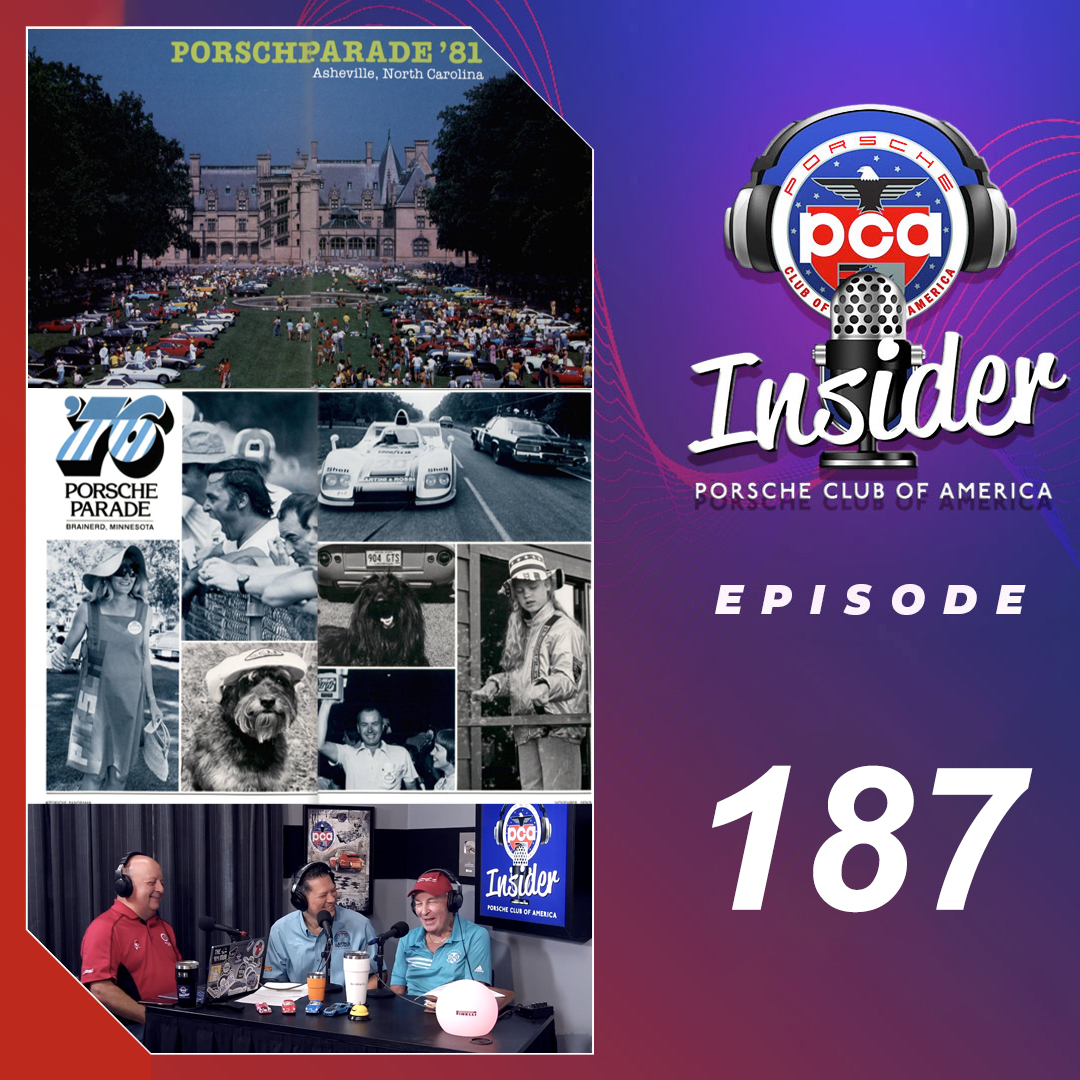
Welcome everyone to Episode 187.
In PCA, we often say it's not just the cars, it's the people, and today we're going
to celebrate a very special person.
We are here at the PCA National Office, to my right, I have Manny Alban, Damon Launey
is at the controls, and I'll introduce our special guest here in one moment.
I want to thank our presenting sponsor, Pirelli.
Pirelli tires have to achieve the highest levels of performance, safety, noiselessness,
and grip on the road surface.
Innovative tires that satisfy the most specific mobility needs at the end consumer.
And thank you all for listening.
If you aren't currently a PCA member and own a Porsche, what are you waiting for?
Be sure to have your VIN handy.
And for those of you that don't currently own a Porsche, check out our Test Drive program.
Just head over to PCA.org.
On this episode, we'll speak to Bob Rossa, a PCA member who's been to more Porsche
parades than anyone else.
We will also talk about the news and give some PCA updates.
And that brings me to welcoming Bob Rossa.
For those of you that are avid Porsche Panorama readers, you've probably seen his Street Talk
column.
He's been a member for 58 years and has attended every single parade since 1966.
Bob, welcome to the show.
Thank you.
Nice to be here.
So I've obviously, you've been in the club since I've been in the club.
And I've always read your column.
I've always seen, we're lucky to have you in the Chesapeake region here locally.
So I've seen you at events.
But I mean, today we're just going to kind of delve in with how you even got here, how
the club has, you know, changed and maybe stayed the same after six, close to six decades
of participation.
Manny, I know you have a long time relationship with Bob as since he's been around since
you've been around.
I was one of the first people I met when I joined the region.
And in fact, I thought of Bob this past weekend because the event that he created, the Chesapeake
Challenge, we just held it.
And I had lost count how many I've attended, but it's a key, key part of our region and
something that they actually brought back the overall trophy.
So now people really get serious and they want to win the Los Anza award.
What I really admire about Bob is not only has he been a long time member, but he has been
a very active member.
What, just a smattering of positions that you've held in PCA.
Well, president of Chesapeake region several times.
I was a national membership chair and national legislative liaison chair for a number of
years back in the late 60s and early 70s and a bunch of other things.
I've been the treasurer of the Chesapeake region and just been active all along.
That's awesome.
So rewind back to 1967 or maybe even a couple of years before that.
What got you into Porsche?
Well, it was actually 1966.
My first application went in and Jane Nelser had lost it and I had to submit a second
one.
We knew Leroy Spaniel, Dr. Spaniel, who was the parade chair for 1966.
And he was the PCA national president at the time.
And he unfortunately passed away right after the parade.
And I had been an active autocrosser and rallyist in the Baltimore area.
I had a Jaguar XKE and you probably know that Jaguars don't have a super reliability.
Oh, you're going to trigger someone.
Bob, you're so low Jaguars.
I see your garage.
Yes, I do.
I have seven of them.
But the XKE was not that reliable.
So I wound up trying to figure out what else I could buy in a sports car.
My mom knew Dr. Spaniel through his medical practice.
And he was a 356 owner.
So I talked to him and he suggested Porsche and I had a couple of colleagues at Westinghouse
where I was working and they suggested why don't we look at Porsche.
So we did.
So I went down the 40 West Porsche and ordered one.
They didn't have any 66's in stock, 9-11's.
They had one I think was black and I didn't want a black car.
So I ordered a 67 in June and I told Leroy about it and he says, well come to the
parade.
So that's why I went to the 66th parade in Colorado Springs.
So not black.
Without a car.
What color did you order?
Irish green.
Oh.
Did you fly out to that?
Yeah, I flew to Colorado because I didn't have the car yet.
And that parade was great, the 66th parade.
It was kind of fun.
All 356's except for a couple 9-11's and 9-12's that showed up.
But mostly it was 356's.
And a 9-11 owner was, excuse me?
So are you your background in engineering?
Yes.
I'm an electronic engineer.
We find a lot of PCA members are engineers and they revel in what Porsches represent.
So were you not aware, like I know you're a car person like you had other makes and models
like did you never think of Porsches before?
It was introduced by that gentleman?
Well yes I had, I mean I'd seen them around mostly 356's because the 9-11's only came
out in earlys in 65.
And I had already settled into the Jaguar because it was a very, very nice car.
What we saw in the area was 356's and there weren't that many of them.
You see one or two here and there.
So what was it like a 356 was less than a decade old as a model?
What did the general population think of the 356?
Most people thought it was a glorified Volkswagen unfortunately.
That's what I was thinking possibly they would think.
That's what most people thought of, unfortunately.
Until they drove them and realized there was some magic behind it.
They were excellent cars.
They just had a look that spoke Volkswagen and they knew it had a Volkswagen heritage
and it was okay.
And then once you decided on a 9-11 and you saw the introduction of the 9-11, how
were those received versus like a 356?
Well the 9-11 changed the perception of Porsche quite a bit.
It was now perceived as a modern sports car and I loved mine and it got looks wherever
I went and it was a great car.
It was a major upgrade from the 356.
Everybody knows this.
So I believe you even have like a Mustang Cobra and you have some V8 cars too.
How did the muscle car crowd treat 9-11's or 356's?
And the Corvette people as well.
Different nature of beast.
A 9-11 could out handle any of those without question.
But those muscle car guys liked that burst of speed and that raw power and that noise.
But you were at different venues.
You were at courses, SCCA or doing autocrosses whereas the muscle cars were on capital
raceway or something where they're just doing drags and stuff.
Well, not necessarily.
We had a lot of Mustangs in our autocrosses.
And a lot of Corvettes.
Yes.
Really?
Absolutely.
Oh, how they do.
Well, they were set up.
The Corvettes did reasonably well because they set them up for autocrossing.
We had a couple of Corvette autocrosses that were really hot and one lady who I knew quite
well was an excellent driver and her name was Mike Henry.
Her name was Michalia and they called her Mike.
And she had a 63 split window coupe and they'd set it up for racing and she would beat everybody.
Wow.
I think that's how Hurley, he would in Peter Gregor Met.
Hurley was driving a Corvette, Peter a 9-11 and he had never been beaten at an autocross
and Hurley beat him.
Really?
There you go.
He wouldn't know who this guy was.
There you go.
He beat him in a Corvette.
Oh, yeah.
There you go.
The relationship began.
Wow.
Yep.
How back in 1967 did you get the membership application and how did you find out where to apply?
Did you know how large your organization was?
Oh, yeah.
The dealers back then were a little bit more closely affiliated with the Porsche Club.
And in fact, I can tell you some stories about that when we get into it, but the
dealership where I ordered it told me about the Porsche Club and Leroy, of course, when
I was talking to him, he says, if you get a Porsche, you can join PCA because he was
a national president at the time.
Ah, okay.
And so I did that immediately when I ordered it and that's how I got to go to the first
one.
Do you remember how much the dues was back then?
It was only like 20, 24 bucks or something like that.
It was pretty cheap.
I forget the exact amount.
Oh, 24 bucks back in 1967.
That's a sizable amount of money.
Yeah, but it was, it might have been less than that.
I can't remember.
It's been 60 years.
I can't remember what it ate yesterday.
My memory is good, but not that good.
It might have been, come to think of it, it was probably closer to 15.
It was like, yeah, I'm thinking, yeah.
So you get an application, you fill it out and you...
And it was a simple little application, two-fold.
Fold it up, put a stamp on it, send it out.
Only mail.
There was no internet, no electronics.
A couple weeks later, a membership card arrives?
About a month later.
A month later.
Yeah, it was Jane Nelseroo, was executive secretary, and she processed everything.
Back in 66, the club only had a little over 3,000 members total, so it was pretty small.
And then you headed to that first parade.
How many people were at that parade?
It was about 250, as I recall.
Well, people or cars, there's a...
We've had some discrepancy in reporting.
Some of the parades are reported by 300 cars, but it was really 300 people.
At the Colorado Springs parade, I think the number was 275 cars, so close to 500 people.
That's big.
Right, yeah.
And was the, I guess, you know, modern-day parades and how we're jam-packed agenda
from day one to the last day.
Was it the same back then, or was it more free-flow?
It was a little more free-flow.
Because we had less people, we had less events, so it was only a five-day event, not seven days.
And of course, that was expanded from the early parades, which were a weekend.
And it was more low-key back then.
So we have these photos for those of you that haven't been to the PCA National Office.
We have photos that we blew up real big for the 60th anniversary, and it has photos
of the very first parade.
It looks like there's so very few rules.
There's just cars everywhere, and they're doing, what's, not gimmick rally.
It seemed like Jim Conn.
There was less lawyers.
Yes, less lawyers involved, because they're like, you know, they're driving cars backwards,
they've gotten hands over people's eyes, trying to do obstacles, I'm like, oh my gosh.
And there's people standing like right at the edge, right at the edge of course.
Only confident that the yellow cone is going to protect them.
Right, yeah, you had to drive backwards in a Jim Conn.
That's an example in the parking spaces and things.
So it's like us when we were younger and we didn't have seatbelts, and when we skied
without helmets, thank goodness we survived it all.
Well, yes.
And that's the deal, we used to go out and people, kids would play and they'd
rough and tumble and nobody got hurt, and parents would say, if it's not broken,
then don't bother me with it.
So after that first parade, you come back, you finally get your car.
And then I'm assuming you just got really active in the Chesapeake region.
That's correct.
I got active in the Chesapeake region.
I found that it was pretty much all 356 owners and they weren't thrilled
about 9-Eleven coming into the club.
That's funny to think that.
That's change.
It's change, right?
Like we talk about all the, you know, when the Cayenne came out,
when the Panamera came out, when the Boxer came out, like anything new.
Like just default, must not like.
You heard Lee's story, they basically told him to sit in the corner
of the room because he had a 9-12.
Yeah, one member of Chesapeake region that came to a meeting and was
going to join and didn't was Leon Raskin, who Mani knows pretty well,
you know him.
And he went to a Chesapeake region meeting and when they introduced
him as a guest and he said he had a 9-Eleven, they actually booed him.
They booed him?
They did.
That's so mean.
And he says, I'm done with this group.
And he left and he didn't come back for it.
Remember a whole banquet room booed when they announced the Cayenne
at Parade.
Yes.
I remember when Bob was there, you were like, yeah, I was there.
And now everyone has the Cayenne in their driveway who has the second Porsche.
Right.
Again, I don't get why a Porsche ambassador would want any project of
Porsches to fail.
Like I don't get it.
Even if you don't like it for yourself, why would you wish upon
the brand that you'd love to fail at something?
It was the attitude and what they're used to.
Yeah.
You know, I bought a Porsche because I like the looks of it.
It's a 356.
You brought this new model and it doesn't look anything like mine.
What are you talking about?
But then how did you answer them when you had a six cylinder 9-Eleven
that, you know, had a lot of modern advances that probably whipped these
356s?
Well, we waited until we got to $1 across.
Yeah.
And then we showed it.
You spoke with a time.
Right.
We spoke with our foot.
Wow.
That's crazy.
A 9-Eleven wasn't welcomed.
No.
It's like us in Southwest and open seating.
Right?
Right.
We're not thrilled about that at all.
Wow.
What do you mean reserve seating?
Well, when they changed to reserve seating.
They're stopping at open seating, which we love.
You're right.
Dropping, yeah.
So we'll see if that's a new 9-Eleven or something else.
Yeah, the entertainment at the first meetings was folks talking
about the day they drove their 356 down St. Paul Street.
So I know that the club was formed,
and they kind of had a side name for themselves
as the gripe group wanting to come together to help take
care of their 356s.
When you first came on, the scene
was it still very technical where people gathering to say,
hey, let's go over and work on Joe Bob's car
or let's set these cars up?
Or was it social?
Or what was the balance, I guess?
That part, the technical part had faded
because the information started to flow
and people got to know it better.
And Porsche got more involved with the Porsche Club
and shared technical information.
And parades had a cadre of technical people there.
So it was more social.
Oh, OK.
With competitive events on a cross and rally, mainly.
And what was your, as a member, what
was your communication rhythm from the region
and your communication rhythm from PCA National?
Well, I got involved as president pretty quickly in 1967
because a number of other members that also in 9-11
felt that talking about driving your 356B at a meeting
and that was your entertainment wasn't exactly thrilled.
And the Chesapeake region themselves didn't do events.
Oh.
They just existed as more of a social club.
It was the events that were put on in the Baltimore area
where the Chesapeake Sports Car Club, the Corbett Club
of Baltimore, CCB, the Mustang Club, the Volvo Club,
the Volvo Mark Club, it was called.
They're the people that were doing order crosses and rallies.
Does the Volvo Club still exist?
No.
I don't think so.
I haven't seen it.
I know the cars still exist, right?
Well, they're Chinese now, so.
Yeah.
And we talked about that.
A couple of friends of mine, back three friends
that worked for Westinghouse and a couple other friends.
About six of us, we got together and we actually
suggested can we have some new elections
and get some new blood in and start some things.
So we did that and I became president almost immediately.
And I initiated Times Speed Distance Rallying activities
and order crosses to the Chesapeake region, which
they weren't doing.
We also joined, they had a council in Baltimore
called the Baltimore Area Sports Car Council.
And PCA didn't belong to that, so I caused us to join that.
And when we joined that, we got more involved.
So we started having competitive events
and that was a big draw.
We started having entertainment at meetings.
And that was a big draw.
We went from having 20 people at a meeting
to having 65 people at a meeting.
And we only had 43 members of the Chesapeake region.
And because what I did was I rented the Shell Racing Series
movies and started showing them at meetings
as entertainment.
And the word got out and the number of people coming
to meetings just grew.
And that's what I had the idea to found the Chesapeake
challenge because I read about it in a panel.
So as you, I diverted in a tiny bit,
you asked how the national interface was.
Because I became president, I was a member of the board.
So I had a direct interaction with PCA
national at the time.
So I got to know, well, the president
after Leroy Espanol was Charlie Kuhl,
I got to know him very well.
I became a national officer.
So I was pretty heavily involved in all that.
Did you ever get to meet Mr. Scholar?
Oh yeah, of course.
Oh yeah, he was at the 6th to 6th parade.
What was he like?
Laid back, reserved there, but laid back and reserved.
He was gracious.
The only thing I know of him or my reference for him
is when I watch Made by Hand, he narrates it.
And he's got that very like 50s TV.
I'm not even going to try to do it.
I don't mean he's waiting for me to try to sound like him.
But it's just a very distinct voice of the era.
Yes, well, he was a PR guy.
He was an artist and a PR guy, so he knew how to do that.
But he was reserved and knowledgeable, of course.
He was very sociable, very nice gentleman.
And then how long did he stay in the club, I guess,
since you started?
I hear at some point he just kind of closed the chapter
on PCA and moved to Florida or something, right?
Yes, he moved to Florida.
And in fact, I think he moved in the Bahamas
for a while and then went to Florida.
It's in the history.
I applaud him for that, being able to walk away,
because it's very hard, especially when it's something
you created to be able to walk away
from the list of other people running.
I understand it was Virginia, his wife,
who wanted to just relax and enjoy leisure years as was.
And that's why they moved to the Bahamas
and then to Florida.
Back then, cars or Porsches weren't typically sold
at a Porsche-only dealership yet in the 60s?
Oh yeah, we had Porsche-only dealerships.
A lot of them were dual with Volkswagen.
And they got started because of Volkswagen.
That's how 40 West got started.
It was a Volkswagen dealer and then they went into Porsche.
So by 67, there were just Porsche-only dealers then?
Yeah, my second Porsche I bought
from a little Porsche dealership
called Stuttgart Import in Towson.
That had two stalls, one was the Sherroom,
the other was the Mechanic Bay, one was Susquehanna Avenue,
and it was a tiny little shop and run by
for a part to call Milton Long.
And he was a Porsche-only dealer.
When POAC became into play in late 69, early 70,
Porsche of America Corporation,
they wanted to change a lot of that.
And they wouldn't renew his dealership.
And what was it like to buy a Porsche back then?
Was there, were there cars sitting on the lots
or did you have to order them?
And was there this whole waiting period
to be able to get one?
Typically there was a waiting period.
Porsches weren't in huge production
because again, the Porsche sales in the US weren't huge.
Dealers would sell one or two a month at the most.
Wow, one or two a month.
Right, so the cars weren't sitting on lots.
They would have one in the Sherroom
and you could buy that one.
Or would you be able to sit down with them
and spec one exactly and just wait for it?
Well, you could do that,
but the number of options available were minimal.
When I ordered my 1969, I was able to,
well, what I did was in the summer of 68,
I did a visit to Germany on business
and I stayed over and went to the factory in Stuttgart.
And I hadn't gotten to know Lars Schmidt
because he had been attending parades.
Lars Schmidt was the director of production at Porsche.
After Peter Porsche left that job and I told Lars
I was coming and he says, all you come see me,
I show you around.
So he gave me a private tour of the factory
and showed me what the 69s were gonna look like,
the longer wheelbase.
He told me that these were the first cars
are gonna have factory air conditioning
and then some other options.
And he says, here, you'll order this
and you'll order that and hear the numbers.
And when I went back to my dealer and I gave him that,
he says, well, you can't order these things.
I says-
Just put it in.
The guy says it's okay.
He says, okay, but I'll put it in
but it's not gonna work.
And it did.
It worked.
So I got the first factory air conditioned car
delivering United States because of that.
So going back to parade, was it hard for,
when they tell you it's five days?
Cause even today, you know, we tell new people,
parade seven days.
And they're like taking it back.
Yes.
And I, and then I followed up with a,
you don't have to go at all seven days.
She goes a little, but you're gonna get hooked on it.
You're gonna want to do seven days.
Back then, was it hard to convince people
to go somewhere for five days of Porsche stuff?
Well, for some of the people to think it was,
but there were events every day,
but the events, but the day wasn't completely jammed full.
Today, I mean, we didn't have a 5K run.
We didn't have the kids program.
We didn't have the RC cars.
And the early days went to Jim Conner.
We had a rally.
And then we added the Conquery
after the first few parades.
And those were the events.
And then they added a tech quiz later.
They had, I forget what the heck,
it wasn't a tech quiz initially.
It was something else.
And it did have some tech sessions
because we always had factory people there.
So tech sessions were big
and they were scattered throughout the week.
The tech sessions weren't only one day like they are now.
So that made it interesting for people
who still wanted to do the technical updates.
I didn't realize the first few parades
didn't have a concord.
No, the very first parade did not, right?
They're more about driving and Jim Conner.
It was more about Jim Conner and social stuff.
Well, the first parade was a weekend parade
and Jim Conner remember it was like a three-day weekend.
Yeah.
Huh.
I mean, for me, when I think parade,
I think the first thing I think of is a concord.
Well, that's today.
And because you're a fairly new member.
Yeah.
Huh, interesting.
When did concours first start coming into parades?
I think it was after the third parade,
if I'm not mistaken.
The masochist who decided to get a Q-tip out
and start to...
And it wasn't a concord like it is today.
The intensity wasn't there.
It was, we judged more cleanliness
and we didn't go and probe everything.
And it was more of a top only.
Clean your car up and show it and how nice is that?
So today they argue whether or not something's original.
Yeah, is that fast?
I can imagine from what you're just saying
about ordering the car,
I can imagine back then they were probably still arguing
whether that was really in the car or came from the car.
Except that we didn't have originality
as a criteria in the early concord.
That only came later on.
But I can't imagine PCA people back then
still didn't walk up to your car
and say that's not original.
No, they didn't do that.
They didn't, really?
No, they didn't do that.
They would say, oh, that's interesting.
Where'd that come from?
They didn't argue about it.
They were more inquisitive.
Oh, I've never seen that.
Oh, that's a factory air conditioner.
That's the first one I've ever seen.
That was the reaction.
How long did you keep that car
and do you still have it?
I kept it for close to about 50-some years.
I only sold it last year.
I had it in storage in California
where I had been living for a while.
And I only sold it because the people,
the brother of the guy that was storing it for me
kept making me offers that were out of sight.
Really, you just sold it last year?
Yeah, it needed a mechanical fuel injection rebuild.
It was an 9-11E Targa.
Wow.
And it was a custom color.
It was the same color as Porsche's wife's car.
Okay, which?
This was Peter Porsche's wife, Cooney.
And the reason for that is
when I had this tour with Lars Schmidt in the summer of 68,
I saw this car sitting in the back of the shop
and it was a light gold color.
And I said, that's beautiful.
He said, oh, yeah, that Cooney Porsche car.
And it also had air conditioning
and it was sitting in the back
because they couldn't get it to work.
And that's why it took nine months
for my car to be delivered afterward
because they couldn't get the air conditioning to work.
That's a good thing they've continued.
Right.
I ordered the car in August of 1968
and it was delivered on July the 4th of 1969.
Wow.
Wow.
So.
I mean, the wheelbase already changed in a 9-11.
Well, this was a long wheelbase car.
It was too much work.
Oh, so you did get a 69.
Yeah, I ordered a 68, I ordered a 69 car.
No, no, no, I ordered a 69 car.
Wow.
But it took them that long to get it delivered, but.
So what's the condition of that car?
Not to go too far off.
It is that car, I've seen it, it's in Vancouver, BC.
It's in a collection and it's beautiful.
They've kept it preserved.
It had the Houndstooth interior.
And that's what they called it, Houndstooth.
Yeah.
The latest term that people are using.
Papita is what they think.
Papita is not what it was called.
Right.
Well, I think it's a different pattern altogether.
Didn't we just do an article on that, Damon?
Or the different patterns?
I don't remember.
I don't recall the head on either.
I read it somewhere.
The difference between Houndstooth and Papita,
there's actually a pattern change.
Although from a distance, it looks very similar.
Anyway, it was called Houndstooth and they preserved it,
except they removed the air conditioning.
Well, we want to get more into your thoughts on Paray,
but before we do that, let me recognize
and thank our most recent corporate sponsor
and that's Auto Atlanta.
If you're chasing down maybe Papita or Houndstooth seats,
you have Porsche parts that are impossible to find.
Restoring a 944 turbo or looking for a trim piece
for your 911 E-Targa, looking for our original fuel
distributor for your 911 SC.
Either way, Auto Atlanta has you covered.
They've been taking care of Porsches
and only Porsches since 1978.
Not only do they have every Porsche part for you,
they can ship them internationally.
They have experts to help you out.
No matter where you are in the world,
they can help you find it.
They are online at autoatlanta.com.
They have specialists waiting by the phones,
ready to handle everything from complex,
mechanical repair discussions to full restorations,
regular service or even detailing your car.
Keep in mind, they also buy and sell pre-owned vehicles.
If there's a Porsche in your garage
that needs a new home, they'll buy it.
If you need to give a new lease on life,
just call them, they'll buy them.
Whether you're rebuilding a classic
or just need a single clip to finish your project,
Auto Atlanta has you covered.
Head to autoatlanta.com.
Don't forget to use the 5% discount code P-C-A,
the number five, O-F-F.
Again, that's autoatlanta.com.
Porsche parts, Porsche people, Porsche passion,
since 1978.
Back to parades.
So you went to the first one in 66.
Yep.
Mm-hmm.
But then you finally officially become a member in 67.
I turned my membership application in,
but some had other, Jane,
and I handed it to Jane and Leroy at the parade.
And they said, come to the parade,
because this was, when I was talking to Leroy,
he said, oh, come to this parade,
even though you don't have your car yet,
and you don't have a certain number,
come to this parade,
and you can fill out an application.
So I wasn't really a member,
but I turned in my application.
But then Jane lost it.
Oh, party.
Didn't make it home.
Didn't make it home, you had to fill out a new one?
Well, she didn't even realize it.
I never got a membership card.
So I called and I said, what happened?
I said, oh, well, let me leave you a thing.
And oh, I think I lost that.
Here, fill out another one.
Fill out another one.
And so did you decide from that point on?
Because again, all the parades you've,
did you intend that from this point forward,
every year of my life,
I'm going to attend this Porsche parade?
No.
I kept attending because they went to interesting places,
and it was Porsches, which I really loved the car.
It was my daily driver.
The car was fantastic.
I mean, it was the best thing I've ever owned.
And I went to the next parade,
which was in Alexandria in 1967,
because I wanted to meet more Porsche owners.
Again, 911s weren't big.
The club was small,
and I wanted to meet more people.
Then the 68th parade, the Sonnenfest parade,
was in Florida.
And I said, oh, I'm going to go to that.
That sounds good.
I'll drive my Porsche to Florida.
So you hopped on, I guess, 95 back then?
Well, no, 95 wasn't quite built back then.
I mean, in the 60s, I mean.
When was 95 built?
It would have been Route 1.
Yeah, right.
There were parts of it, but not the whole thing.
I mean, you remember the Interstate Highway System
only was authorized in the late 50s.
New things to electricity and the internet all happen in the...
Been around forever.
The dinosaurs had like...
I'm trying to process all of this.
Like, I'm debating whether or not
I'm driving my 356 to New Jersey.
And I have full, well-built roads,
and I have a cell phone and GPS,
and you got in a car to go to Florida.
And you have hopin' a prayer sitting next to you
for all those miles.
And that's incredible.
Yeah, we just went to...
I mean, that was life.
Like, you did not have an option,
and that's if you wanted to be there.
That's what you did.
Yeah, that's exactly right.
You had like a Rand McNally map,
and you pilot...
Did they have Rand McNally maps back then?
Yes, they did.
But what you did was you went to AAA,
and you asked for a Triptych.
The only real club in America,
and you asked for a Triptych.
And a Triptych was a little booklet
that they put together that showed your route.
And all the stops, and it was highlighted,
and a little page had it at 15 or 20 or 30 miles on a page.
And when you flipped it up, that was called a Triptych.
T-R-I-P-T-I-K.
Now, I know there's something that PCA used to do.
I think it was the March issue of Pano,
where they published all the members' address
and telephone numbers.
Well, usually, what you remember
is the officers of the regions they would publish.
Oh, the officers of the regions.
Okay, so if you're driving...
Back in the 50s, it was entire membership, but...
No, they never published entire membership,
but we had a list of all regions.
Regions, oh.
And we had the region president
or his disneyed-in-contact point and their phone number.
So if something happens while you're on the road.
Correct.
That was your lifeline.
Every issue of Pano had that, right?
And you had to have a dime, I guess,
to put into the phone that you would hopefully find
somewhere that needed help.
All right, I'll pay phone.
You're not that young.
I know you remember pay phones.
I know, but I'm just saying that is a commitment
to drive that kind of distance in a car.
When I drove in 2000 to the parade in California,
I used to rain in McNally.
Well, yeah, we did, too.
I mean, what's my guess?
I remember looking and going to Wyoming
and having to move over like the pages
to get to pick up in Wyoming again to...
Yeah, right.
That's just the way you did it.
So were there a lot of people,
what was the percentage of people at a parade
that were local versus those that came from
four or five different states over?
I would say that probably 15% of the attendees
were local and the rest were from the...
Really?
Yeah, right.
I don't know.
Well, remember, in 68, the club had
maybe 4,000 members total, okay?
So we didn't have a huge membership.
So to get 300 people at a parade,
250 cars at a parade, I'll say,
there was only 30 or 40 members of a given region
and 30 or 40 members here, maybe 15 members here.
So to get 250, they came from other regions.
Tell us, this is gonna be a funny one.
Right now, we have a very complex registration process
for parade because we offer so much a la carte
and we need so much details from each attendee.
What was the registration process like for parade then?
You filled out something in paper and you send it in
and it was, you wanna intend to parade?
Yes, here's how much it costs.
You put a check in the envelope as well?
Put a check in the envelope and you mail it in right now.
Wow, and then you got a letter back
saying you've been accepted?
Yeah, well, they've accepted pretty much everybody.
They just got an acceptance, you know,
and then you got an information
on how to make a hotel reservation.
You had to make a pay phone call or use your landline
because we didn't have cell phones back then.
Right, so you came to PCA right the year
we went digital for registration.
Hershey was the first online registration in 05.
But before that, like Bob said,
the problem with registration now,
if you wanna say there's a problem,
is that because they made it digital,
we can ask a lot more questions.
Where back then, we weren't asking
for shirt sizes of every particular event,
all these things that we asked now
that we would ask that registration when you got there.
So the pay perform wasn't the printed version
of what you see now, it was much shorter.
It was really a matter of reading handwriting.
And you didn't have options, it was you bought,
your meals came with your registration.
Right.
You paid a fee and you got to go to the parade
and you could do whatever you wanted.
I do remember it was almost like,
not half and half, but we still received stacks
of parade registration in the mail
that we had to key into the database.
So yes, it was online, but there was still a lot of members
that preferred to print out the registration,
put it in a Manila envelope with their check
and send it to PCA.
And that was just-
Five years prior, they thought the internet
was gonna be a fad in 2000.
In 2000, yeah.
So yeah, it was a lot easier back then registration
than what we see now is this two-part
myelolith of information.
It was simple.
We're gonna have a parade, it's three or four days
and we're gonna do this and this and this
and you wanna come or not?
Yes, okay.
Here's the host hotel, here's the rate.
Right.
At what point did you say to yourself,
or maybe you just haven't,
and you just are enjoying it year by year,
like was there a point where you said,
you know what, I really love parade
and I'm gonna be determined to go every year.
No, I never said that.
You never said that, you just did it.
Now it was just, when's the next one?
And I was like, okay, I'll go to that, you know.
And then after Sonic Fest was Anaheim
and I said, that sounds fun
because I went to school at the University of California.
I'm happy to drive there.
I got my triptych and off I drove to Anaheim in-
What part did you do that in?
Well, again, the parade was before my 69 E-Targa
had arrived so I drove my 67 9-11 to Anaheim.
Wow, that's awesome.
Yeah, cross-country back in the day.
Sure.
So with all the parades that you've attended,
are there a couple of ones
that really stick out as being special for you?
Well, all parades are good.
And the reason for that is the people that attend
are just nice people.
You don't have any bad people.
No, everyone's afraid.
And then you have a common interest,
like right from the beginning.
And we have a common interest and it's just fun.
And you get to see people that you know.
So, and you get to do some competitive events
that are a bit more complex
than what you would get at a local event.
And so it's just a fun thing to do.
So I would plan my vacation around the Porsche Parade
and I just said, okay, I'll go next year.
Okay, I'll go next year.
What I tell people when you just do not only a parade
but a PCA event, it's nice to be with people
that understand, and I say this jokingly,
understand the sickness that we have, right?
Like the fact that we can talk about Porsches,
we can talk about Fuchs wheels,
we can talk about all these details of a brand.
And it seems completely normal
because if I go to, let's say,
one of my wife's tennis friends parties,
like I feel like I'm restrained.
I feel like I can't go into all my car stuff
because I'll look completely like a weirdo.
But at a PCA event.
When you go to a tennis party,
do you admit that you play pickleball?
No, I can't, then, then, that's just-
I knew they looked down at pickleball.
I know, they're just gonna kick me out, right?
So I have to keep that on the DL.
But you know what I mean?
Like that's what's so great about parade
is you go there and everybody just understands.
You understand why you're so excited
that you got a certain color
or you still have your car for 50 years
that was ordered, like that person
that you were gonna talk to.
You know they're gonna appreciate those details.
Yeah, you gotta remember that the average American
isn't into a sports car, okay?
So when you're into a sports car, that sets you apart.
And when you're into a Porsche,
that even sets you apart even more.
And to find like people who enjoy the same thing you do
is important.
And back in the early days,
there weren't that many Porsches around.
So at a parade, you found a whole bunch of people
that owned the same car you did.
And had the same interest.
So it was exciting, it was fun.
And you got to meet a lot of new people.
Yeah, plus after a while,
it becomes a reunion of sorts.
It is, right.
And somebody phrased it really well.
He said, parade's a place where you
don't see someone for a whole year.
And when you see them,
it's as if you saw them just yesterday.
You pick up the conversation
that you had a year ago up again.
And you forget the fact you haven't seen
this person in a year.
It's just everything falls right back into place.
Yeah, right.
And I've been in it long enough
that I really enjoy seeing when I first started
in 2006 was my first parade,
seeing the younger generation
that has grown up through parade.
And now they're old enough to own their own cars.
And also they're starting to volunteer
and lead a lot of the initiatives at parade as well.
Correct.
That's very cool to see.
Yes, it is.
It's a family thing.
Let me take a little detour
because I wanted to find out
when did you start contributing
with Street Talk in Panorama?
Well, Street Talk's been going on for about 30 years now.
It turns out that in the board meeting
for PCA in November of 1969,
that's when the editor-in-chief, Paul Heinmiller,
he had passed away in that summer.
And Emily took it over for a couple of months
and they appointed Betty Jo Turner
as the editor in November of 69.
And I was sitting next to her.
And I said, Betty Jo, I've been writing
for my local region magazine and publishing it.
If you need any help, let me know.
So I became one of her contributing editors
the same day she was appointed as editor.
So I'm on her longest term editor.
I used to do all the new cars.
I used to do road tests for.
The 914, 914.6, the 928, the 924, 924 Turbo,
the 944, I did road tests for Pano.
You can, they're online now.
And Tom Bobbitt, when he was president,
had this thought that it might be a good idea
if we had some local news thing.
So that was 2003.
And so it was not 30, it was 20 years, but 22 years.
And Betty Jo came to me and says,
you know, your stuff is interesting.
You wanna try this?
Is it okay?
Yeah, so I do appreciate,
because I think it's more of a global look
at the automotive industry and what you write about.
But yet you kind of spin it as to how it may affect
or align with what's going on with Porsche.
Well, yeah, I'm glad you like it,
because first of all, I don't make it up.
Some people I say, I'll just make the stuff up
and they think that's funny.
I get the automotive press
and I have some other automotive editors
over in the UK and Europe that I communicate with
and they share things with me.
So I see things that the average person wouldn't see.
And I have a stack of stuff like that
that I could go through, one inch thick here.
And I pick the stuff that I think might be useful.
So I read constantly and I just put in the things
that I think might be of interest.
One thing I do publish, which everybody knows
is the Porsche sales, because that's hard to get.
And that's, of course, we're gonna do it every quarter now.
Yep.
All right, let's get back to you, Parade.
It's supposed to be about Parade.
Yeah, yeah, yeah.
Parade, it's supposed to be about Parade.
We haven't talked about it at all.
So let's talk about some of your favorites here.
I think Manny and you had a conversation.
Yeah, we did.
1973.
Well, I figured here's the guy who's been
to all these Parades asking him
what are your most memorable.
Yeah.
Not necessarily favorite, but memorable or bring to mind.
Memorable was the key word
and that's because some things happen that are interesting.
The 73 Parade, which was in our first Parade in Monterey,
Bob Little was the chair and he owned a restaurant in Carmel
and the Lou Marable was the president.
And that was the first Parade
where we actually won over 300 cars.
We had published some data in the past
that said we had 300 in some cars in prior Parades,
but I think those were people
because Jane Nelson Road and Lou Marable
and Bob Blue and I were all sitting together
looking at that number.
And Jane said, yeah, that's the most number
of cars we've ever had.
It was like 330 cars, 550 some people.
And it was the first one in Monterey.
We used Laguna Seca as our autocross.
So that was kind of fun.
I mean, that was having a big racetrack
was really important.
They were hard.
That was hard to do.
At the Son & Fest Parade,
we used a go-kart track for our autocross.
So it was narrow and it was in the sandy swamp area
because it was a narrow track.
But the 73 Parade was memorable
because it was our first big Parade
and it was a beautiful scene.
It was the first year we used the Hyatt in Monterey.
Which is still there and then we went back.
Well, we went back twice.
Like I say, every Parade, I think we've done there.
The Hyatt has been the hotel every time we've been there.
We've been there three times.
We've been to San Diego three times.
It's the same buildings?
I think they seem like the same.
They seem like they are.
Yeah, they haven't changed much.
No, it's the same right now.
The window unit air conditioning system
is I think the same.
I like that hotel in that location.
But I was like, are these rooms
or are these buildings from the 60s, 70s, 80s, or 90s?
They look it.
Well, they've done some modernization
but the hotel was built somewhere in the late 60s,
that Hyatt in Monterey.
Another memorable Parade,
and I didn't mention this to many,
but was the first Florida Parade,
which was the Sun Infest in 1968.
And the reason that was memorable was one,
the autocross was on a go-kart track,
which made it really interesting.
The other reason was that for the concor at that Parade,
we had two issues that we've never had in the past.
The first issue was we're getting ready
for judging at that Parade.
And we hear this buzzing sound overhead
and we was looking up
and then there's this airplane comes into view
and it gets lower and lower.
I was just gonna say drone.
Yeah.
That didn't exist then.
And so this airplane swoops down
and it's really low.
It's flying about 100 feet over the golf course
and we were at a PGA golf course.
People focus on we'll use the PGA golf course
for the concor, but they don't know what happened.
This airplane was spraying for mosquitoes.
Oh no, on top of the cars?
Right, about 8.30 in the morning,
just before we're getting ready to judging
and he sprays and everybody gets mosquito juice
all over there.
Oh no.
I call them mosquito juice but it's bug spray.
So we delayed the judging for a half hour
and told everybody, okay, clean your car.
Oh man, could you imagine if that happened today?
I can't imagine it's healthy for you either.
You like that?
Yeah.
A half hour later,
we're getting ready to start judging.
Guess what?
What?
Here it comes.
Again?
Again.
Round two?
Round two.
Nobody told, nobody radio the guy
and tell him don't do it again?
Radio.
Oh, whoops.
Got you.
Apparently not.
Apparently not.
And he did it again anyway.
Fortunately, and it's the same thing.
At 100 feet, he obviously saw cars there.
He was probably, he's probably chuckling
and just saying I was paid to do this
and those cars shouldn't have been there.
He was paid to spray the golf course
and he's spraying the golf course.
You remember, I'm sure you do.
The 98th Parade in Steve Bones Springs,
the Concord, they didn't tell the driving range
to shut down.
No.
The sprinklers came on.
Well, no, no, the balls were coming at us.
What?
Yeah.
Because I remember we picked
Gene Fierro's speedster to prepare
and I was working on the wheels
and I hear the sound of something going through air.
And then again, and then I hear somebody scream,
they're shooting golf balls at us.
Oh yeah, that one.
And I looked and I got the golf balls rolling.
Oh my God.
People trying to become a human shield
in front of their car.
Until they called the driving range and told them.
And much of your point about the pilot seeing the cars,
you know these guys in the driving range
told the car and probably thought,
what fine targets we have to hit with our bodies.
What a fun challenge they have this weekend.
Right.
Well, we're not done with that Concord
at the Sonifest Parade.
There's more.
Yep.
At approximately, oh, 11 o'clock in the morning,
here comes the clouds and they roll in really fast
and the heavens break loose.
Oh no.
A thunderstorm like you wouldn't believe, okay?
So there's a pavilion up on a rise
and everybody runs up to the bend.
Of course, we only had about 100 cars at the Concord.
And maybe it was a little bit more than that.
And there were a lot of 356s and even the 9-11s
without Fuchs wheels had hubcaps.
And the way we did a Concord then,
we took the hubcap off when you displayed them
face up on the ground in front of the wheel.
So we're watching the rain.
Loom, Arable and I are standing in that little pavilion
and we see some things moving on the ground.
Like alligators?
Hubcaps.
Oh, the hubcaps are floating?
The hubcaps are floating away with the rain.
Oh my goodness.
Everybody's hubcaps are washing down
because there was a little irregular.
How did they come off the cars?
They took them off to judge.
Oh, yeah.
Then the role was you removed your hubcap
and you placed it in front of the wheel, face up.
Hubcap racing, we haven't thought of that one.
So that was a panic where everybody
wouldn't try to retrieve their hubcaps.
So that's why that was memorable.
Anyway, so the 70s parade was memorable
because it was one of the largest ones
and it was a beautiful scene.
That Monterey area is nice.
And Laguna Seca was a fantastic lot across.
San Diego area is also nice and that's 1977
and I believe there was a special reveal at 77.
In 1977, we used the Town and Country Hotel
and a ferry Porsche was present.
And the 928 was known to be in development
and what Porsche did was keep the 928 under wraps
until the Tuesday night of that parade
when they unveiled it on a platform
in the middle of SeaWorld San Diego,
a platform that was just out over one of the little Lagun's
and Ferry Porsche himself pulled the cover off the car
and that was the world introduction of the 928.
Wow.
Now, how was that car received?
When he pulled it off, like the 911 you said earlier
was a change and they didn't like it.
How did the 928?
Well, that's interesting that you called it a 928.
Porsche always called it a 928.
928?
Yeah, we have some things.
We call them 914s, never a 914.
But the 928 was always called a 928.
928?
It's weird.
Okay.
But anyway.
How was it received?
People were amazed at the looks of the car
because of the headlight configuration
and the large back window.
It was, people thought it was really interesting.
Plus, the 924 came out a year prior.
So the shock of front engine water cold,
they already thrown their first shock, if you will.
So now you're getting a car that people are complaining
that wasn't enough horsepower.
It was only four cylinders into this thing
that had a much arguably beautiful headlight.
Much arguably beautiful body with a V8.
But it wasn't introduced as a replacement for 911.
No.
It was just another model.
It was designed to compete with the Mercedes 350 series.
Okay, gotcha.
And the sports car, the SL series, I would say.
Like SL, I think the 350,
it might have been a 280 at the time.
It was designed to compete with the Mercedes SL series.
The Grand Cruisers.
As a Grand Cruiser.
And people looked at it as another upscale Porsche.
So it wasn't booed like the Cayenne and SUV.
We're a sports car club, a car company,
not a utility car.
And that was pretty nice.
It's interesting, because in Panorama,
back in the day, they used to print the speeches
from the VIP speakers from Porsche.
And so when I was getting these pictures for the podcast,
I was looking for the digital version of Pano
and I read the speech from Ferry Porsche.
He was there and he had a couple of lines in there
explaining how, well, it's nice to look in the past,
Porsche has a company about moving forward.
And that explaining, I guess, preempting,
or I guess he would have already shown in 928.
With the 928, you had the welcome party?
Yeah, right.
Yeah, so they would have already seen the 928
talking about why they had to build the 928,
what their direction.
Maybe think about where we are today
that people still want to live in the past.
The future is important to the company.
And Ferry had two of his sons there.
Hans Peter was there and Wolfgang was there.
And Hans Peter and I and Wolfgang,
we had a ping-pong tournament going on
at the Town and Country every afternoon.
It was really fun.
Oh, nice.
Peter was very good.
Yeah.
Yeah.
He was a tennis player, Peter was,
until he got a little bit older.
So he knew what he was doing.
He was very, very good.
He won the tournament, but that was fun.
One year before that was Brainerd.
You had mentioned that on the list too.
Well, Brainerd was interesting because that's when,
in the mid early 70s,
Conqueror started to get really, really big.
And 9-Elevens were selling like crazy.
And at Brainerd, we had 59 cars
in the 9-Eleven class only.
Wow.
And we were at one of the golf course
and the banquet was in the golf building.
And it was only Conqueror then was big.
We had probably 350 cars entered at Brainerd, maybe,
and 200 in the Conqueror.
And back then it was just full only for everybody, right?
Yeah, right, right.
There was no street class.
No, no street, right?
That didn't come to much later.
So we had 59 cars and I was judging.
And we were judging at six o'clock
and the pavilion or the clubhouse
where they're doing the banquet was up on the hill
and they were starting dinner and we're still judging.
That is insane.
Right, but the Brainerd parade was a lot of fun.
That was a great, that was a great person.
For those of you that are just listening to us
and not looking or watching us on YouTube,
you might want to go back to YouTube a little bit later
because Damon and Manny,
they've pulled out some photos, vintage photos.
And it's just so cool to see not only the cars you expect
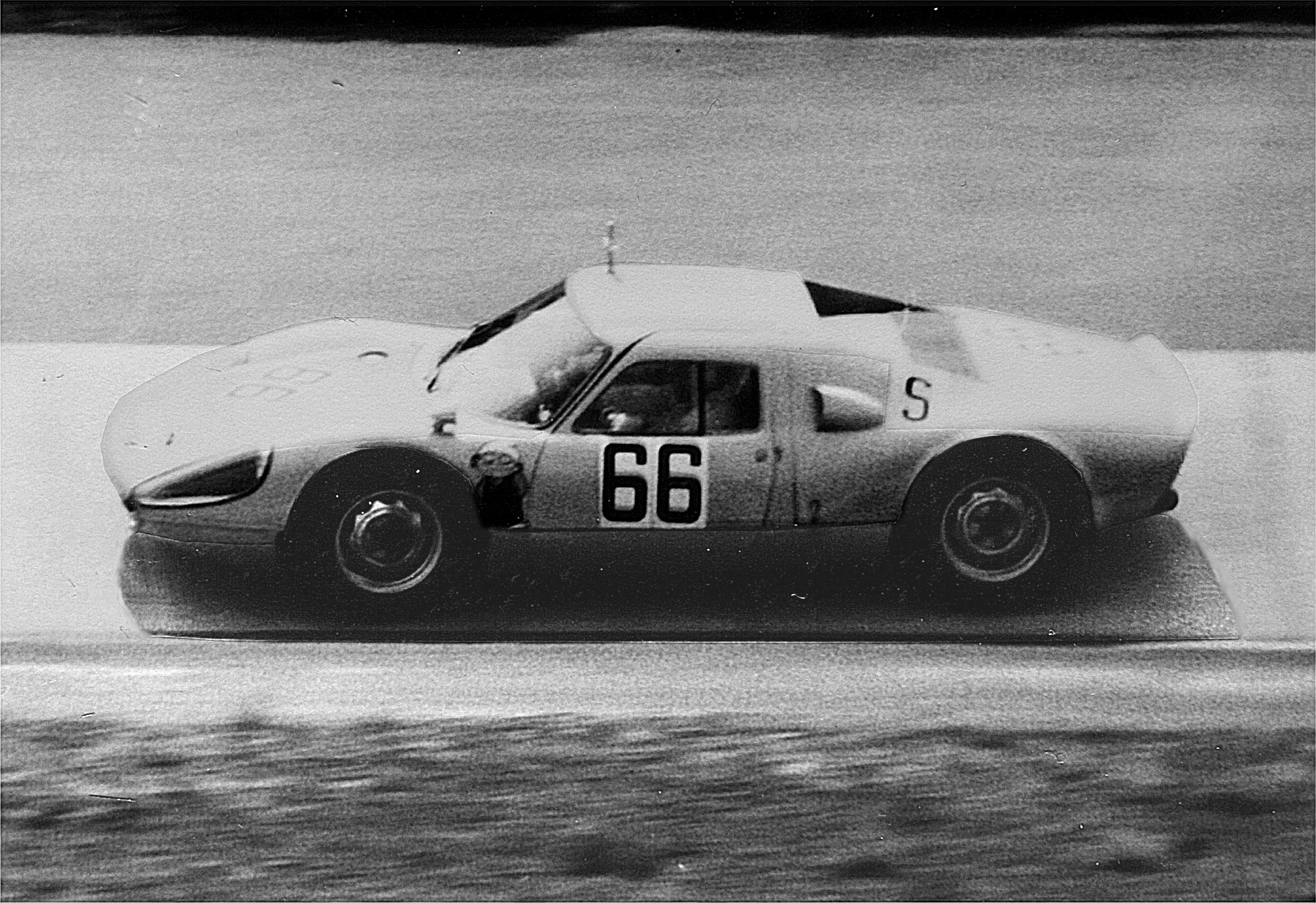
like a long hood, but I'm looking at a 904.
I'm looking at some.
Not just a 904, that's an autocross
and a 904 is at the autocross, autocrossing.
Oh, that's cool.
And there's a 906 behind it
and I'm not sure what the third car in line is.
Yes, yeah.
There were a number of 904 owners back then,
Vern Covert out of LA owned one
and he brought his 904 to every parade that he attended
and it was big.
And Otis Chandler owned a parade.
I mean, a parade, owned a 904.
Matter of fact, I'm going to go back
to the 77 parade in San Diego.
I was, we had Manhattan judging them
and I had, I was a Manhattan judge.
That's the overall concor, right?
Right.
Yeah, Manhattan was the overall concor winner
we had at the time.
And I had been judging the 9-11 division class
that was classes then.
And Manhattan judging, cause it's 1356,
one race car, which is a 904, a 9-11, some others.
And so I'm in a Manhattan judging
and I got to this 904, silver 904, very nice.
And it's beautiful, it's gorgeous.
Cause it would win, it's the racing.
And I'm judging interior
and I had to reach inside the 904 has a door shell
and there's a little, like a compartment inside the shell.
And I reach in to see if there's any dirt
and I pull up a mouse nest.
Oh no.
A whole mouse nest.
Uh-oh.
And when I'm thinking, I just, I said,
who owns this car?
And this big head sticks in the window, it's mine.
And it's Otis Chandler.
Otis Chandler, it was the heir
to the LA Times publishing.
Oh.
Yeah, it was a huge collector.
Oh wow.
And a huge car collector.
He had a big car collection out in Oxnard.
And I said, well, I said,
what was I made to do with this?
Oh no.
That's the only thing I could think of.
And he just, he had about two or three people
that prepared the car and he cleared it then
when he jammed it.
Oh.
And he didn't, he probably would have won
because that car was spectacular
but they missed that mouse nest.
Wow, and you found it.
Yeah, and I didn't know it was Otis Chandler's car.
Oh man.
It turns out that the president
of the 356 registry, Jim Fearsland's name,
knows Otis Chandler and didn't know about that story.
So we were chatting and he,
and I filled him in on it and that was interesting.
So I do have to ask,
what was it like having Fairy Porsche at Paris?
Because when I started going it was the sun
that were coming, not the man himself.
Correct.
When Fairy Porsche went to parade,
he participated fairly well.
He went to the dinners.
He would walk around.
You could see him at the hotel.
You could talk to him.
Very personable.
He was very reserved.
He wasn't outgoing like Wolfgang is.
He's very reserved but you could talk to him
and he's really a very nice man.
He was a very nice man and he was active
and I guess he would go to the events.
He would watch the art across.
He didn't rally but you were there.
That's one thing that we were very fortunate to have
is the participation from the Porsche family.
Now with the grandsons and their not only
showcasing products, current products,
but they really do relish their history
with PCA and Porsche.
They genuinely, if they can, they're there.
They wanna be there.
It's just sometimes either health and or business
pulls them away from Porsche parades.
And that's a good thing.
But we used to have a lot more factory participation.
We would have two to five people
from the Porsche factory at every parade.
And those people were active.
They gave tech sessions.
They were involved.
The first Colorado, the second Colorado parade
when we did the Pikes Peak Hill Climb,
it was Eric Philius.
No, it was Lars Schmidt.
Lars Schmidt drove the Hill Climb
and he made a famous comment
which we reported in Panorama.
He says, I've never been up a hill like that.
He says, I'm driving and I look and my windshield,
it fills with sky.
And Betty Joe printed that quote
and he just was amazed at the beauty of America
because he hadn't seen that much of America.
I do have to say that Bob was also instrumental
in the Hershey parade when Bob Gutierrez and I co-chaired.
Bob did the museum, which I still think
sets the standard for museums.
It was the biggest one we've had, yeah.
It was a very impressive, all the memorabilia we had
and whatnot.
That was the...
That's the one I missed.
That was the one I had to go to work
and it was right before I started with PCA.
I miss Hershey.
That's one of my biggest regrets
is not being able to go there.
Yeah, the Hershey parade was fun.
I mean, that was the first time we did a museum
and these guys called me and said,
would you do this?
I said, okay, I can do that.
So we got a lot of stuff
and we had one entire ballroom full of memorabilia
and a lot of it is out in your office now.
I think that's where you found out
that we had a lot more charter members
than we thought, initially.
Correct.
The original charter members were 85
because they were the people that signed up
and then they voted that, well,
anybody that signs up to January of next year
can be a charter member
and that's where we got from 85 to 181 or something like that.
You wanna touch upon the 80s,
Asheville and Traverse City?
Well, Asheville, yeah, yeah.
Asheville was a fun parade.
We used a, of course, that was the one
we were talking about earlier
where we used the lawn of Biltmore.
Yeah, that's an iconic photo.
Right, yeah.
That's great.
I was on Bob.
We asked if we could do that,
recreate that photo when we did Treffen there
and the people that Biltmore still remembered 81
and said the last time you guys were here,
you tore up the lawn
so we don't allow any cars in our lawn anymore.
Oh no.
That long ago they still remember.
Right.
Yeah, it didn't tear it up,
but it left some ruts.
It leaves some ruts.
Was it wet that night before or something?
No, it wasn't not.
But when you bring 180 cars
and drive them on the golf course,
you use some, yeah.
But they still use that picture in their marketing.
Really?
It's a very iconic photo.
We're not gonna do it again.
Wow.
We used a lodge, and I forget the name of it,
it's a now upscale lodge.
Mike Walker was the,
not Mike Walker, Mike,
what was his name?
I'll look it up.
He was a colonel, an honorary colonel
in the Kentucky National Guard.
Anyway, he was the chair
and we're supposed to use an autocross site,
it was an airport,
and the night before,
they said, oh, sorry.
Oh no.
You can't do this.
So Mike and whoever PCA president was at the time
got together and gathered.
Oh, I was saying that was 81.
Oh, Hank Walter, yeah, and Jim Perrin, yep.
And scrambled to find an alternate autocross site
and they did like in one day,
they found an autocross site.
And it was a very low key parade in general,
probably about 400 cars or so.
It was one of the most low key parades,
casual, relaxed atmosphere
because we use this nice luxury motel.
Everybody stayed in the same place,
which is common except for Lake Placid,
where we have to do multiple locations.
And what Mike Parker, what Mike did was
orchestrate things so that they were as low key as possible.
Everybody got to relax, enjoy each other.
They scattered tech sessions throughout the parade.
We had a lot of Porsche AG,
Atkin, Gesellschaft, people there for technical sessions.
We used to use the Porsche technical people
to do most of the technical work.
We did have, Bruce Anderson did some, of course,
and some others did some,
but we used a lot of the Porsche folks
and the tech sessions were outstanding.
Of course, in the 80s, we had a multitude of cars.
We didn't have any SUVs,
but we had a lot of 914s floating around,
a lot of 928s floating around,
a lot of 924s, 944s floating around.
And what people don't realize up to,
I believe the mid-2000s,
parades were 99% driven by the region and volunteers.
And a lot of it.
Through 2009, yeah, 10 was the first national parade.
Yeah, so just think about that.
A national conference that is led by volunteers
in a different location each year,
and with different volunteers year after year,
you're almost kind of not starting from scratch,
but you have some growing pains each year
because there's a new crop of people.
But it also would leave the volunteers drained
and it was taxing.
Put on a parade is a,
and no cell phones and emails to organize
and communicate for a large portion of that time.
And then you get an emergency
such as you can't do an autocross
and you have to scramble to find something.
But, man, mad respects.
And going to a national,
and you're right about 2010,
that was the first one Tom Brown did.
There were also some inconsistencies
that doing it at the national level resolved.
Yeah, yeah, exactly.
To make them a little bit more consistent.
Let's sit on one that celebrated our 60th anniversary
and that was in 2015.
Yeah. French lick.
Well, French lick was a parade
that the host hotel
was a spectacular pair of 100-year-old buildings.
And the atmosphere was delightful.
It was out in the country in southern Indiana.
There was plenty to do.
There was a casino there if you wanted to do that.
We had a golf course that we used for a concor,
but we had to move it because we had rain.
Heavy rain the night before
and it flooded part of the golf course.
So we had to rearrange that a little bit, but it worked.
But it was another one of those low-key events.
There was a big porch on the main hotel at French lick
where people would go out and sit in the evening
and relax and chit-chat.
It was one of those people-focused parades
is one of the reasons why that was so great.
We started this conversation with you saying
you go to parades because the locations
that PCA has chosen drives you to a unique experience.
I believe 100% that French lick was that.
Most people just believed in PCA
and believed in our volunteers that I'm going to go
because it's going to be a fantastic parade.
But I think everyone after the first French lick parade
was like, oh my gosh, I didn't realize
it was going to be this incredible,
not only the building, but the staff of the French lick hotel.
They were so accommodating.
Like you wish you could package these people
and take them to every location you go
because if you wanted something, they gave you 110%.
And if you wanted to change something,
they had an army of people to do everything.
Exactly.
The French lick parade, we all came back from French lick
and we're like, when can we go back?
I know we don't usually go back to some place
very soon, but the demand, everyone's like,
we got to go back.
And they were like,
were you like me asking what's in French lick?
Yeah.
Yeah, and I was actually just trying to get a word in there
that, geez, 11 parades or 10 parades
because there was nothing in 2020.
10 parades and French lick number one is still,
I think it's still my favorite out of all the parades
I've been to.
French lick number two was great,
but there was something about French lick.
I remember the year before Wolfgang Porsche
were at some dinner and he leaned over to me
and he goes, what's a French lick?
Yeah.
Well, everybody says the French lick is known
for the home of Larry Bird.
Like that's like the first thing they say.
Okay, so what are you going to do after you know
or see Larry Bird's home, right?
I don't think we ever saw Larry Bird.
We didn't even see it.
And here's the story that I always tell,
like they were so prepared and shout out to Joe Vazozo
who was the GM, I'm not sure if he still is
because he was getting ready to retire,
but he said, I'm not going to retire
until you come back,
which we fulfilled that demand.
But when we went to go get gas,
the gas attendant was like,
we were doing a site visit.
The gas attendant is like, oh, what are you here?
You know, you're not, obviously,
we don't look like we're from around here.
So he's like, what are you doing here?
Oh, we're going to be back here
with the Porsche Parade in the summer.
He's like, oh, I've heard and I've been told
that I need to make sure during that week
that I have to have super unleaded
because you guys like super unleaded, right?
So we're going to make sure
we have plenty of super unleaded for you guys.
I'm like, the town knew that we were coming.
Like it was a big deal.
That's just one example of why French Lick
was so incredible and we did go back
and Joe Vazoso knocked it out of the park
the second time too,
because we didn't, as you said, the first one,
we had some torrential rains and...
And the boss point, it wasn't simply a
let's just move it to the parking garage.
That was a major undertaking.
I remember they decided that it wasn't going to drain
in time, that we had to find a new location.
Joe said, let's do it in the parking garage.
And he immediately dispatched his people
to start cleaning it, putting brighter lights in there.
I mean, they could have easily said,
yeah, just parked the cars in there,
but he knew by then he had to tend to five parades.
So he knew how particular we are.
And he completely redid the garage
as best he could in 24 hours
to be ready for the Concorde.
And they made it nice too.
And of course, when we went back,
we did the Concorde in the garage.
Another detail they did.
So any beautiful historic hotel
has beautiful paintings down the hallways
of the conference center and stuff.
And Joe's like, you know what?
I'm going to take down these beautiful paintings.
And if you guys could put up,
give us some ideas or we'll print them ourselves.
We'll have some Porsche or PCA specific artwork
throughout the hotel.
I'm like, man, again, it would be incredible
if we could find that commitment in a host hotel
wherever we go, because it just made the experience,
I mean, top level.
My favorite story is the couple who got caught
stealing our sign in the security.
Because you remember there was a road,
a private road between the two hotels.
And we had these flags on all the light poles
for the Porsche parade.
And they figured no one, the middle of nowhere,
no one's watching us,
but they didn't realize they had cameras everywhere.
And they call them one camera climbing up the pole.
They were so nice about it too.
Because they first came to us and said,
so we have a little bit of a situation.
We do recognize that one of your banners
is no longer on that pole.
We do have cameras and we actually know who took it.
How would you like us to handle it?
And we said, yeah, if you could politely
get that banner back for us.
And they went right to the room and yeah.
But they knew that this would happen
because we also did a museum on the 60th.
And I remember being in the hallway
talking to one of the maintenance guys.
And I looked at the banner in front of the museum
and I said, yeah, this was on the Friday.
So we're almost done parade.
And I'm like, I'm pretty impressed
that this thing didn't get stolen.
The guy goes, that's your third one.
He bought extras till we knew
they may think they grow leagues to walk away.
Definitely.
Yeah, that was a great parade, yeah.
Yeah, you know, as you were flipping
through pictures there, Damon,
I do want to recognize a name
that's very also quite synonymous
with parade is Mike Robbins.
I saw, I saw his name there.
So fact, the fact, the second French
like parade was Mike Robbins last.
No, that's what I was just thinking.
His number 57, 57 parades.
Yeah, he was only there for in a wheelchair
for the one for the one night, but he did.
Yeah, standing ovation and the.
Yeah, for those of you that don't know,
Mike Robbins, we actually have a video.
I believe it was at Chicago, Chicago.
Chicago, where he talks about
the very famous speech interview inside the speech.
And the car that he took to,
I think what, 40 some parades, right?
Yeah, he drove his, he had a three to six A speedster black
and he drove that to about 40 some
of the 57 parades that he attended.
That's incredible.
And I remember Porsche always saying,
you know, we can get you in a new car, right?
I remember on Peter, it always stands up
and say only in a Porsche can you drive that many miles.
Right.
Yeah, he had 500,000 miles on it.
Yeah, I would rather recommend it.
And this is a perk for PCA members,
but you can go onto the website,
click under Panorama Magazine,
and we have all our back issues digitized.
And it is, it can become,
you can be there for a long time going back and reading.
If you want to do parade,
they're usually September, October, I think, issues.
Yeah, October, October issue.
Going back and reading about,
just even looking at the pictures
of what went on back in that parade
and of course looking at the ads are pretty funny too.
But the pictures and how much PCA's changed.
Yeah, we had a lot of pictures
in the earlier parades in Panama.
Lately the coverage in Panama has been reduced
because only a tiny percentage of people go to a parade.
Right, right.
We have 111,000 members, primary members now.
Yep, so if this hasn't gotten you revved up
for attending parade, I don't know what will.
So I will just say that for those of you
that are in the Mid-Atlantic and the Northeast,
be prepared.
Next year we were going to be in Lake Placid.
We've been there before
and you won't want to miss out lots of fun.
I also want to remind everyone to head over to PCA.org
to sign up for PCA's newsletters, performance news,
e-break news, and Mark Fresh all free.
Just a few items, I think you just have one item
for Porsche News.
Before I want to get into that one with Mani,
I do want to congratulate Porsche for being number one
for customer loyalty among premium car owners
according to the JD Power Study.
For the fourth year in a row,
they've been named the luxury car owners JD Power 2025
US Automotive brand loyalty study, number one.
Our heads rolling at Lexus
because usually they go back and forth
between Lexus for that title.
Exactly, exactly.
So I'd like to think that PCA has a bit to do with that.
What's that?
Lake Placid Discovery Map.
Are you going to use that map instead of GPS to get there?
I know how to get there.
All right, Porsche News from the newsroom
talking about IMSA and a disappointing race at Indy.
Yes, we're down to our going to our last race
at Petite Le Mans in Rotolana
and it's going to come down to the wire.
Porsche had a big lead
but it's slowly been chipping away.
Once again, we'll hit my hat to the IMSA NASCAR.
They have thought it right as far as making it exciting.
At the beginning of the year
with those first four wins,
I thought that they would clinch a championship
way before Petite Le Mans but it hasn't happened.
Nothing's a given.
And they finished seventh,
the highest finishing 9-63 was seventh
at Indianapolis.
They were hoping for rain.
That was going to be the great equalizer.
Rain never came and they have seventh
and I think twelfth which was disappointing.
Even for GT, the GT class cars,
Rexia didn't finish it very well
even though it was leading for a while.
So Petite Le Mans, that'll be the one to watch
and we'll be biting our nails.
Hopefully Porsche clinches that championship.
All right, a few of us on staff
we'll be heading out to...
I think there was one more.
Was there?
About Porsche stock going down.
Oh, maybe I skipped that on purpose.
What, did you buy anything?
No, I didn't.
Maybe now's the time to buy Porsche stock
because they've been in the news recently.
They are getting pounded.
Oh.
And of course, we're going to have,
I'm trying to get Steve Postal,
have him on the general manager for Porsche Hunt Valley
to help give us some insight into all this news articles
that Porsche is abandoning EV and going back to ICE
which that is not correct.
Yeah, let's set this record straight
for all these stories that have been out there.
Go ahead.
I think this is a click bait.
I think people are journalists or writing things
just to get people to click on the articles
but people aren't clicking on the articles
just reading the headlines
and there's a lot more to it than just the headline
but Porsche is not abandoning EVs.
Porsche like other manufacturers have gotten hit hard
by the Chinese market
where the Chinese aren't,
they're not stopping buying cars.
They're buying their own cars.
And so that's put a really big hit
on foreign cars for China,
especially the tall EV.
So Porsche's had to repivot
and they made that announcement of what they repivot.
Now if you read their announcement
and you read the news articles,
something doesn't jive
where people are interpreting completely different.
The funny thing was I showed Steve this at an event
and he hadn't even seen the Porsche announcement yet
much less.
Steve Postal.
Steve Postal, yeah.
So I'm gonna get him some questions.
He's gonna get them approved
and then we'll have him on the show.
It does take, what is it, about like a five year cycle,
five years to come out with a new model at minimum?
About four to five years
but on the point about the Chinese,
the situation is that the Chinese cars
over the last couple of years
have improved performance over what Porsche
has been able to offer and at a lower price
and that's the reason why the Chinese
are buying their own EVs
as opposed to anything that Porsche makes.
So Porsche sales in China have gone way down
and that's what's driven their stock down.
Not only Porsche but all non-Chinese automakers.
All non-Chinese automakers are losing ground in China.
So let's set the record straight
because I've read this a lot too
as people are saying the 718 ice is going to continue
and that is?
True.
Well, not completely.
Not completely.
And the performance additions only.
Well, so let's look back at why they stopped making it
is because it wasn't going to pass the cybersecurity
laws that chassis required.
The US that wasn't the problem, I don't think,
it was more Europe.
Right, it was driven by Europe.
Yeah, but Porsche had planned that,
hey, we're going to have the EV version
so this is perfect timing.
EV comes in, ice goes out, everything's fine.
Production for 718's Boxster Cayman
is going to cease next month.
It's going to cease.
And there are plans that there will be a derivative
of 718 ice version down the road
but that is not slated until like 2030.
And the Porsche.
So it's not a continuation of the current product.
That's done unless I'm missing something.
Unless they, well they say top.
The top of the 718 chain.
So that would mean they are keeping this GT4 RS
and the RS Spider, but they still,
if they want to sell them in Europe,
they still have to do something of the chassis
to make it legal.
So they'd probably.
This way, let me get a quick thing in here.
So what engine is going to stick around for a long time?
The engine that's in the 911,
which means that the top models will have a flat six,
not a flat four like right now.
And this is speculation, but I think it's pretty spot on.
If the flat fours and potentially,
the three liter turbo flat six
or whatever it might be aren't around anymore,
but Porsche is still selling a GT3.
Yeah, Spider RS, GT4 RS, the top models will be sold.
We don't know if they're going to use
the current chassis for any of that,
the current ice chassis.
Or I've also read somewhere else
that the 718 EV chassis technically
could accept a gas engine.
This is something I read that was a quote
from Oliver Bluma in America,
unless they got the quote wrong.
So what I'm trying to get at
is that there's a lot of information
and none of it is lining up,
but there's gotta be some truth there.
So I could see definitely GT4 RS,
Spider RS using a 911's engine
and then the EVs will stick around.
But I will also say I would,
I'm gonna be smiling real big
when all of those lower spec EV models
smoke the top spec GT4 RS, they're not on price.
So anyway.
Well, according to yesterday's automotive,
US automotive press,
the top line of the Cayman and the Boxster
will have an ICE engine in a year or two.
That's consistent with what you were.
And then that comes back to the fact
that this chassis is 15 years old.
And will it be competitive?
I mean, the Porsche enthusiasts
won't be looking at another brand,
but a lot of buyers will be comparing it to other brands
and if the other brands have a more updated engine
and chassis, is the car still competitive?
You know, there's so many questions.
So, but the main point is that Porsche
is not getting out of UV.
They're doing what any other business does,
they're pivoting because their number one market
two years ago was China.
And now it's just plummeted.
So, like any good business, you know,
suddenly if, remember when Atkins hit,
Atkins-
Why are you looking at me?
Why are you looking at me?
Restaurants had to pivot, right?
Did they say, okay, no one's eating a carb.
So we now we gotta make a protein heavy menu.
That's what Porsche is looking at now.
They're realizing they're not gonna be selling
as much as the UVs, not because people aren't interested
in UVs, but because the market that they had planned
to sell all the UVs to is dwindling and they're-
And in the U.S., the loss of the $7,500 up to $7,000
tax credit disappears in one week.
Do you think Oliver Blumman will still be CEO
of Porsche in a year?
No, he has committed that he will give up that role
in lieu of the Volkswagen only.
He told that to the investors at their July meeting
that he is planning on dropping this Porsche CEO role.
Makes sense.
But keeping the Volkswagen role.
Investors have been asking for that for a while
and he felt he needed to stay with it.
But at the July 18th, the thing was investors meeting,
he said, no, I'm gonna step down from Porsche shortly.
Well, interesting times for sure,
much like some of the stories we talked about earlier
when there's a, you know, the next generation,
the evolution, it doesn't come easy.
And so we're in the thick of it all.
It's gonna be interesting how it all plays out.
I just remember back to reading how Pistol people
were when the Creeps D6B came out.
That was the end of the world too.
We're with the A's, UB's.
You screwed it up when he came out to B.
A's are the best.
Oh man, so funny.
All right, for those of you that are interesting
in racing wheel-to-wheel, but online with PCA members,
check out PCASimracing.com.
For those of you looking for insider swag,
head over to PCA's web store.
We have water bottles, insider podcast mugs
and insider teas.
And if you're looking for some decals,
we'd love to send you a set of decals.
Just send us your address information
to podcast at PCA.org and we'll get them out to you.
And man, what a treat it's been to talk to you
about close to 60 years of PCA fun.
I hope that I can have just as much fun as you have.
It's been great.
The club is fantastic and the people
are what really make it, of course.
So the car is significant,
but the Porsche people are just the greatest.
That's awesome.
Thank you, sir.
Anything else before we wrap up?
Man, David?
Watch Damon's video of the Makani V.
Oh yeah, for sure.
When I wrote up the run of show,
we didn't have the link yet for his review,
but they had a great job with the base Makani.
And for future TechWiz,
is that it is the only rear-wheel drive SUV
they've ever built,
which I didn't know that until we got the orientation
from Calvin Kim that I never realized that.
That's right.
That's the only non-all-wheel drive SUV
Porsche had built.
What I liked about the video
was the real world experience
as he was keying in his destination to go charge
and had to pivot as he realized that,
that charger is what either wasn't there.
I'm putting the wrong destination.
I would have been paying a closer attention
to the type of charger.
But that's a newbie, right?
Like once you get that dialed in
and you know where you're going
or you know how to do it,
like it's gonna be safe.
I like to because I also used the Porsche app
when I drove it,
because Calvin Kim told us that's the best thing to do,
but I noticed it had the speed at 350, 250,
and I didn't need it for a while.
So I saw 350, I clicked it and said,
you're 45 minutes away.
I'm like, that's perfect time.
I lucked out that there was a pizza place
right across from lunchtime.
So it was the world's,
everything on the planet's aligned perfectly.
Well, speaking of looking out,
there's one more luck out thing
talking about the Lake Placid for next year.
The EV people will be happy to hear
that they have already installed Porsche charging stations
at all of the hotels we're using
for Lake Placid for next year.
Oh, there you go.
Because of the parade or just because they...
Because of the parade, they're already installed.
Wow.
That is gonna be probably one of the biggest parades.
Because back then, we used to actually sell out a parade
or theoretically have a sellout number.
Now we don't really, we sell out of events,
we sell out of hotel rooms,
but we don't really have a sellout.
So, but that's gonna be a...
It's gonna be a big one.
The Northeast of Atlantic,
that's the bulk of our membership,
so that's...
Correct.
A lot of people I talk to say,
I'm going to Lake Placid.
I didn't go to Oklahoma, but I'm gonna Lake Placid.
I'm thinking that's gonna be a lot of people.
It is, it is.
And you don't want to miss it.
All right, folks.
Well, thank you for listening.
Be sure to like, comment, and subscribe.
Consider sharing our show with fellow Porsche enthusiasts.
Until next time, stay safe
and we'll catch you down the road.
About this episode
Bob Rossa, a dedicated PCA member since 1966, shares his remarkable journey of attending every Porsche Parade over nearly six decades. He reflects on the evolution of the PCA, the camaraderie among Porsche enthusiasts, and memorable moments from various parades, including the unveiling of the 928. The episode highlights Bob's contributions to the PCA, his experiences with iconic Porsche models, and the changes in the automotive landscape. His passion for the brand and the community shines through, making for an engaging conversation about the rich history of Porsche and PCA.
On this episode, Bob Rassa, PCA member since 1967, talks about what PCA was like in the 60’s, how he joined the club and why he decided to start attending Parades. He also tells us about buying his first Porsche, meeting club founder Bill Sholar and what it was like having Ferry Porsche at the Porsche Parade. This one is a little longer than usual but it’s chock full of interesting stories. We also cover the latest Porsche news to include IMSA results for the 963 and Porsche stock slowdown.